School Refusal Treatment: A Practical Guide for Parents
By 7:15 on a Monday morning, a child in Coral Gables may be gripping the doorframe, crying that their stomach hurts, while a parent checks the clock and wonders whether to call the school. The stomachache may ease by midmorning, yet Sunday-night dread returns the following week. When school is unexpectedly closed, the relief can be immediate. The family may see defiance, but the child may be experiencing fear, shame, exhaustion, or a sense of being unable to cope.
Good school refusal treatment doesn't begin with blame or a demand to “just go.” It begins by understanding what keeps attendance from happening, then coordinating the child, caregivers, clinician, and school around a practical return plan. The aim is compassionate and active: support the distress while steadily rebuilding attendance.
## Table of Contents - What School Refusal Actually Looks Like at Home - The morning cycle - How Clinicians Define School Refusal - Four common functions - The Core Evidence-Based Treatment Components - Cognitive behavioral therapy - Graded exposure - Parent coaching and school coordination - What Happens in the First Clinical Assessment - The information clinicians gather - What families should receive - A Realistic First Month of Treatment - Weeks one and two - Week three - Week four - Building a Coordinated School and Home Plan - What belongs in the document - Timelines, Setbacks, and When to Adjust Care - Practical Questions Families Ask After Treatment Begins
What School Refusal Actually Looks Like at Home
The pattern rarely appears as one dramatic refusal. More often, it grows through small disruptions. A child who once needed occasional reassurance may begin asking to stay home on Mondays, reporting headaches before a particular class, or requesting an early pickup whenever a transition approaches. Another child may get dressed but freeze at the front door. A teenager may attend physically while spending the day in the nurse's office or repeatedly messaging a parent.
The physical symptoms are real, even when a medical examination doesn't identify a cause. Stomach pain, nausea, fatigue, dizziness, and headaches can express emotional overload. A child may not be able to say, “I'm afraid I'll be embarrassed,” or “I don't know how to catch up,” so their body communicates first.
The morning cycle
A familiar sequence can develop:
- Alarm: The child notices a school-related cue and reports distress.
- Negotiation: The parent offers reassurance, extra time, a later arrival, or a promise to pick the child up.
- Escalation: The child cries, shuts down, becomes angry, or reports another symptom.
- Relief: Staying home ends the immediate distress.
- Repetition: The next school morning feels even harder because avoidance worked in the short term.
Parents often get pulled into long explanations. They promise that nobody will judge the child, call several staff members, or ask repeated questions about what could make the morning easier. Those responses come from care, not failure. Still, repeated reassurance and negotiation can unintentionally make attendance feel optional while teaching the child that distress must disappear before they can move.
A useful starting point: Treat the behavior as communication. Ask what the child is escaping, fearing, or needing, rather than deciding that the child is simply unwilling.
Look for quieter clues, too. Avoidance may center on a bus ride, lunchroom, gym class, substitute teacher, tests, separation from a caregiver, or unstructured time with peers. The child may function normally during weekends but become distressed when Sunday evening arrives. This is a pattern of distress linked to school, not a single bad morning, and it deserves a careful assessment.
How Clinicians Define School Refusal
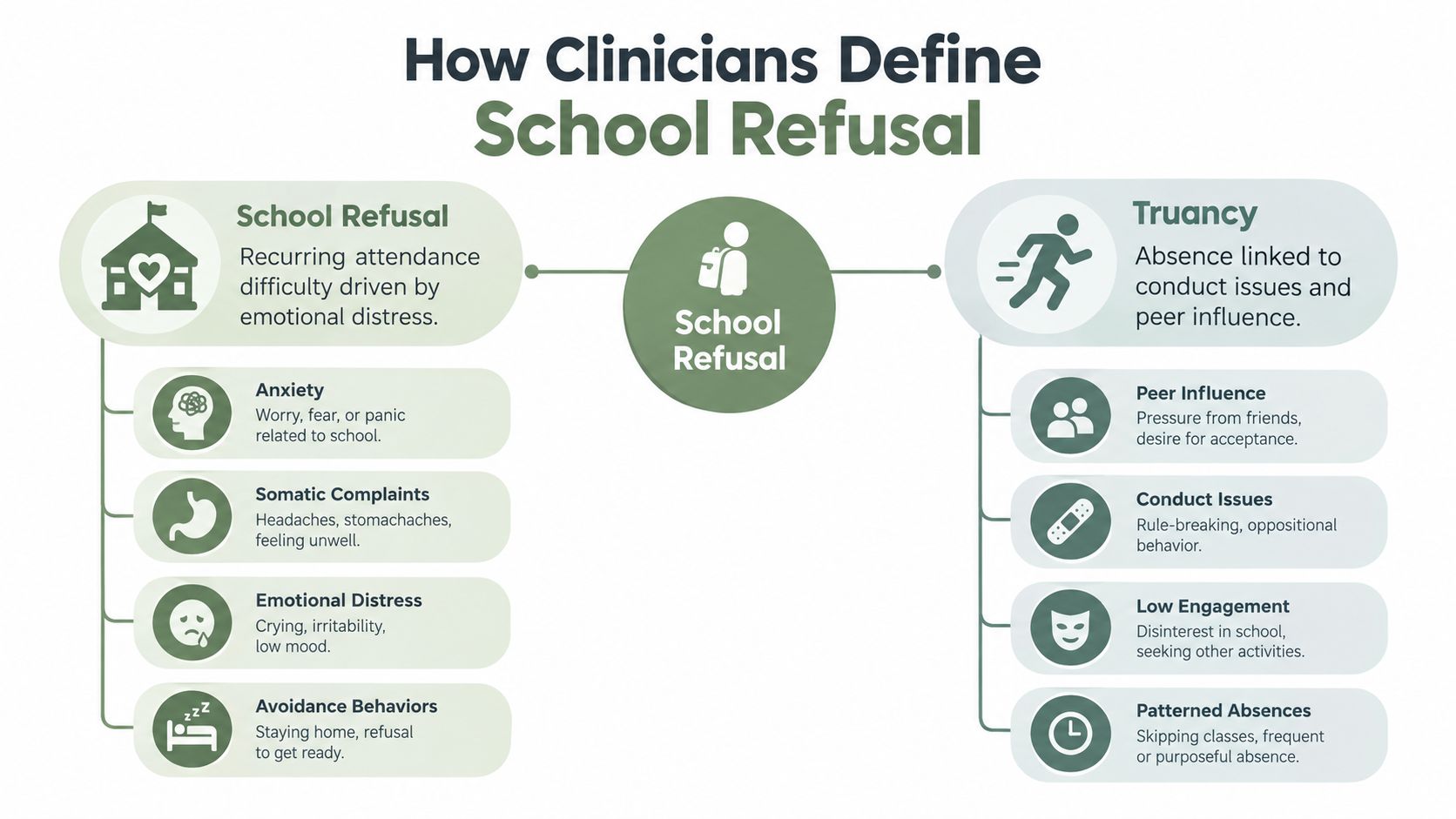
Clinicians generally use school refusal to describe recurring difficulty attending or remaining in school because of emotional distress. That distress may involve anxiety, depression, social fear, trauma-related reactions, physical complaints, or a combination of concerns. It differs from truancy, where absence is more commonly connected with conduct problems, concealment, or pursuit of activities outside school.
The distinction matters because the same attendance record can reflect very different needs. A child who is frightened of the classroom needs a different response from a student who skips school to spend time with peers without caregiver knowledge. A clinician won't rely on the absence alone. They'll ask what happens before the child avoids school, what the child gains or escapes afterward, and which adults or settings influence the pattern.
Four common functions
A child can have more than one reason for refusing school:
- Escaping school-related distress: The child avoids difficult feelings connected to work, separation, fatigue, or a specific setting.
- Avoiding social evaluation: The child fears embarrassment, peer judgment, presentations, bullying, or eating around others.
- Seeking caregiver attention: Separation distress makes remaining away from home feel intolerable.
- Pursuing a rewarding alternative: Home, online activities, sleep, or time with friends may become more appealing than school.
These functions aren't moral labels. They're working hypotheses that help a treatment team choose the right sequence. A child driven by separation distress may need parent coaching and gradual separation practice. A student avoiding a bullied peer needs school protection and coordination alongside therapy. A teenager overwhelmed by academic failure may need learning support before exposure to a full school day can succeed.
Parents can review a plain-language discussion of the relationship between school refusal and anxiety, but an individual assessment remains important. The clinician must also consider depression, learning difficulties, family stress, medical concerns, and the school environment before deciding what attendance step is appropriate.
The Core Evidence-Based Treatment Components
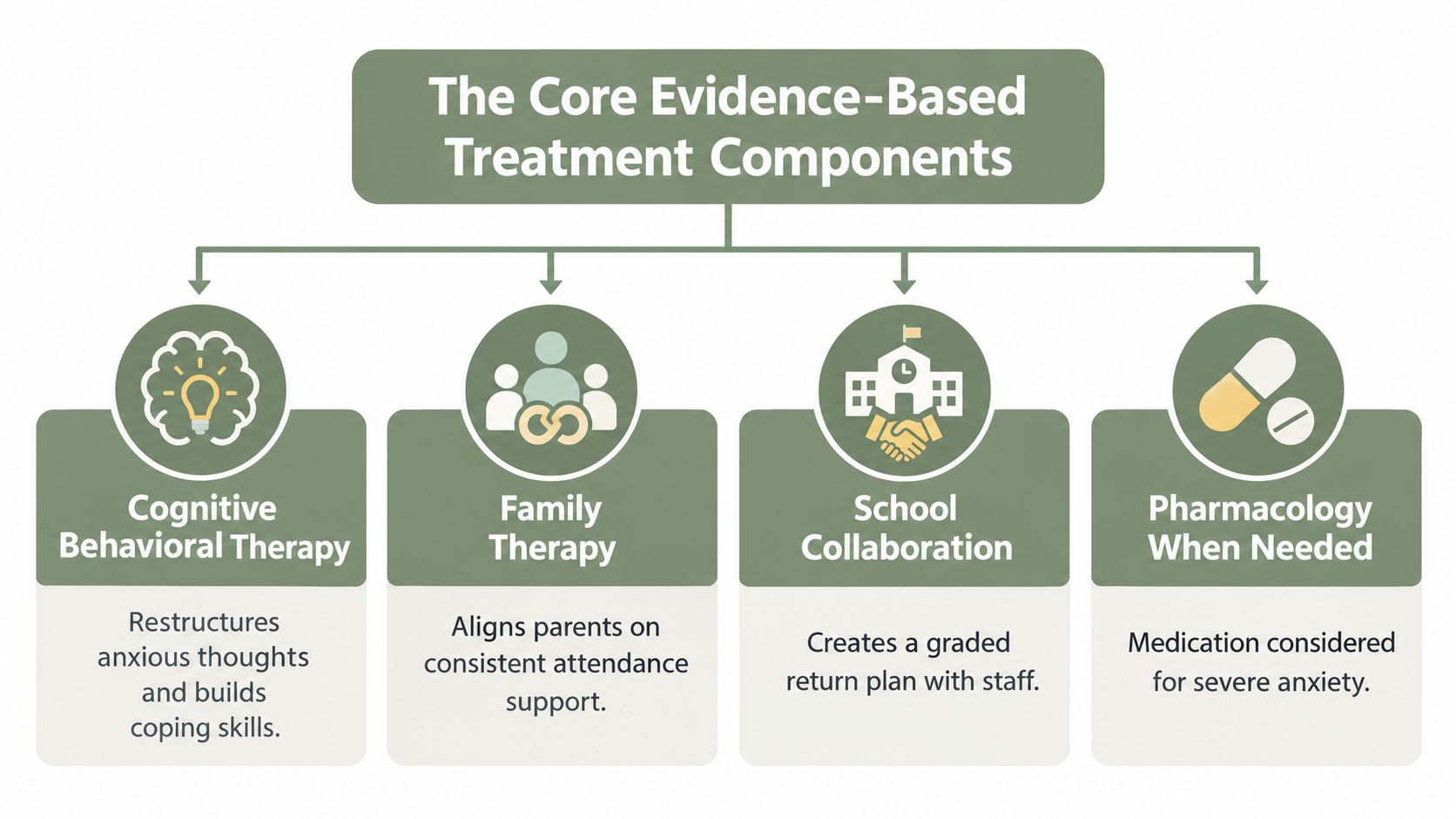
Effective care usually combines cognitive behavioral therapy, graded exposure, family involvement, and school collaboration. A 2022 clinical review describes this integrated approach as including psychoeducation, CBT-based child interventions, family strategies, school coordination, and medication when indicated, as summarized by NCBI's clinical review. These parts support one another. A child may learn coping skills in therapy, but the skills won't transfer if mornings remain unpredictable or the school has no agreed response to distress.
Cognitive behavioral therapy
CBT helps the child understand the fear-and-avoidance cycle. The clinician may map a sequence such as: “I'll panic in class,” followed by stomach pain, a request to go home, and short-term relief. The child then practices identifying anxious predictions, testing more balanced thoughts, and using coping skills while remaining in the situation.
The work continues at home. A child might record a prediction before entering school and compare it with what happened afterward. Older children may practice breathing, grounding, or coping statements. The purpose isn't to convince the child that school is perfectly safe. It's to help them tolerate uncertainty and act while uncomfortable.
Graded exposure
Exposure turns return to school into a sequence of manageable actions. The clinician and family create a hierarchy based on the child's actual triggers. A low-demand step might involve driving past the school or walking through the parking lot. Later steps could include entering the building, meeting a trusted adult, attending one class, staying for part of the day, and eventually resuming a broader schedule.
The pace should be challenging without becoming chaotic. The clinician reviews what happened, adjusts the next step, and avoids letting one difficult attempt define the whole plan. Parents can learn more about this method through guidance on exposure therapy for children.
Parent coaching and school coordination
Parents practice calm, consistent responses. They validate the feeling without making attendance dependent on feeling calm: “I know this is hard, and school is still the plan.” Coaching may address repeated reassurance, lengthy negotiations, morning routines, rewards, and what happens during school hours if the child remains home.
The school needs a matching plan. Staff may identify a designated arrival adult, reduce unnecessary uncertainty, provide a predictable check-in, or adjust the first attendance step. Medication can be considered when a qualified prescriber identifies a clinical indication, but medication alone rarely addresses the routines and reinforcement patterns surrounding nonattendance.
The 2015 Campbell review found only 8 eligible studies involving 435 participants, and reported medium-quality evidence that CBT improved attendance, while anxiety outcomes were not statistically significant (Campbell Collaboration review). That finding supports a practical point: early treatment may measure success through functional re-engagement, even when fear and worry take longer to settle.
What Happens in the First Clinical Assessment
The first assessment should leave the family with more clarity, not just a recommendation to wait. Clinicians usually gather information from the child, caregivers, and school records, then connect the information to a working treatment plan.
The information clinicians gather
The process may include:
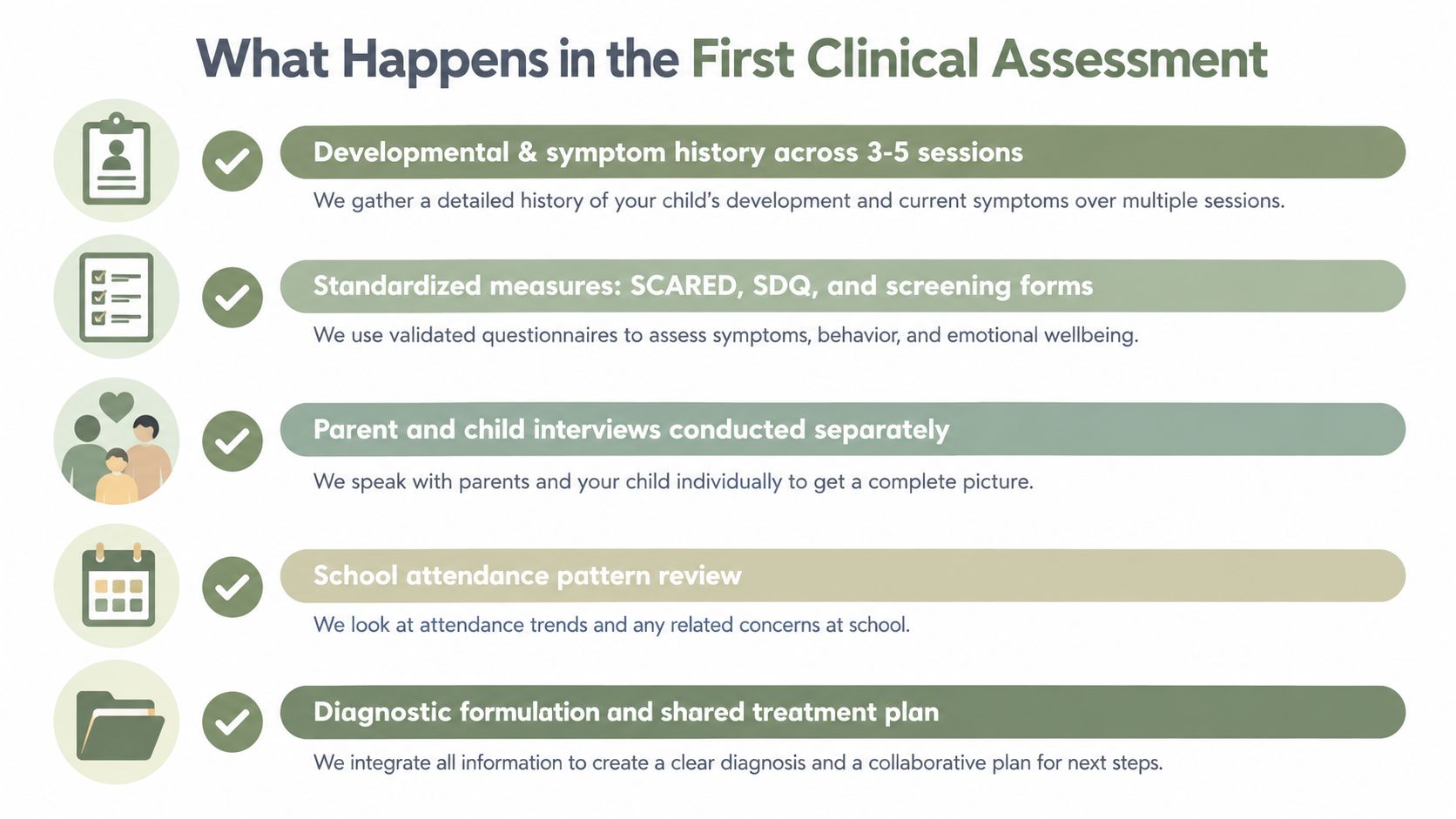
- Developmental and symptom history: The clinician asks about early development, health, sleep, learning, mood, anxiety, trauma, relationships, and the attendance pattern.
- Standardized measures: Questionnaires such as SCARED or school-refusal-specific measures can help organize symptoms and track change.
- Functional analysis: The clinician maps what happens before, during, and after an absence or early departure.
- Separate conversations: Parents and children may meet separately so each can speak more freely, with information shared according to age, consent, and safety needs.
- School review: Attendance records, class patterns, nurse visits, teacher observations, bullying concerns, and transition points add context.
The clinician is looking for more than anxiety. Learning difficulties, bullying, depression, family accommodation, sensory demands, school climate, and recent family changes can all affect attendance. A child may avoid math because the work feels impossible, then develop anxiety about the embarrassment that follows.
What families should receive
By the end of the assessment phase, families should understand the clinician's working formulation, the main maintaining factors, the recommended treatment intensity, and whether medical, educational, or school-based evaluation should happen in parallel. The clinician should also explain how progress will be monitored.
Adolescents deserve a clear confidentiality discussion. They need to know what remains private, what general themes may be shared with caregivers, and which safety concerns require adult involvement. Assessment sessions may include the child, caregivers, or both, depending on the child's age and needs. The important point is that assessment produces an actionable plan. It isn't a passive period while the family waits for attendance to improve on its own.
A Realistic First Month of Treatment
Consider a representative family whose middle-school child has missed several mornings, reports stomachaches before school, and becomes distressed when a parent mentions attendance. The first month doesn't begin with a demand for a full schedule. It begins with information, trust, and agreement about the first achievable step.
Weeks one and two
The clinician completes the history, speaks with the child and caregivers, and explains the avoidance cycle in age-appropriate language. The child may draw a map of a difficult morning or rank school situations from less frightening to more frightening. Parents start tracking sleep, morning prompts, physical complaints, attendance, and what happens after the child stays home.
The family also begins making mornings predictable. That might mean preparing clothes the night before, choosing one brief supportive phrase, and removing repeated negotiations from the routine. The clinician contacts the school, with appropriate permission, to identify a point person and clarify what the first return step could look like.
Week three
The child learns a small set of coping skills and practices them outside the hardest situation first. A parent coaching session focuses on reducing accommodation without becoming punitive. The family may agree that the parent will acknowledge distress once, state the attendance expectation, and offer a specific support such as walking to the entrance.
A written exposure ladder takes shape. The first step may be a short visit to the building, while the school prepares a calm arrival and a clear endpoint. Homework is practice, not a worksheet marathon. It could involve repeating the visit, recording predictions, or rehearsing a handoff.
Week four
The first attendance exposure happens. For one child, that might be entering the building and meeting a counselor. For another, it may be a partial day with a planned departure. The family uses a simple reward plan tied to the agreed behavior, such as completing the arrival step, rather than rewarding the absence of anxiety.
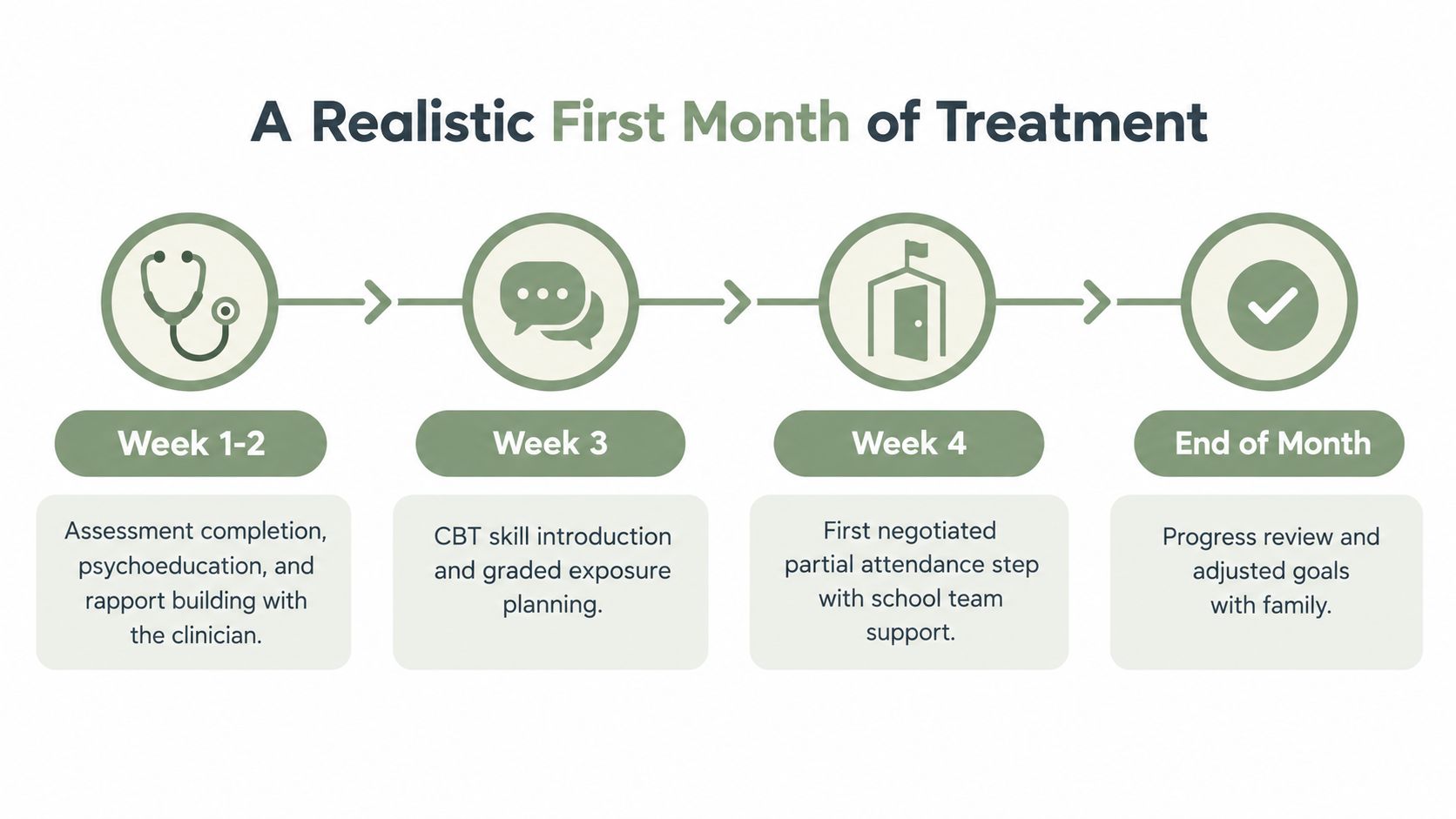
A difficult exposure doesn't automatically mean the plan failed. The team asks whether the step was too large, whether a school trigger was missed, or whether the child needs more preparation. The first month's achievement is usually a functioning collaboration and evidence that return is possible, not a perfect full-day schedule.
Building a Coordinated School and Home Plan
A return-to-school plan should live in writing. Verbal agreements disappear when a substitute teacher covers a class, a parent has a difficult workday, or the child becomes distressed at the entrance. The plan gives each adult a defined responsibility and gives the child a predictable path.
What belongs in the document
Include:
- The first attendance step: State the arrival time, location, duration, class or activity, and designated adult.
- The escalation pathway: Explain who responds if the child cries, calls home, asks to leave, or reports physical symptoms.
- Agreed accommodations: Consider a later start, partial day, safe adult, exit card, reduced assignments, or a quiet arrival, with a review date.
- Communication protocol: Name the school contact, parent contact method, response expectations, and information that should be shared.
- Definitions of success: Attendance may mean entering the building, remaining for a planned period, attending a class, or completing the next exposure step.
The clinician typically writes the exposure hierarchy and coping language. The family owns sleep preparation, transportation, morning boundaries, and home practice. The school implements the plan during the day and reports what occurred without turning every difficult moment into an emergency.
| Plan Component | Clinician Owns | Family Owns | School Owns | |---|---|---|---| | Exposure hierarchy | Ranks steps and adjusts difficulty | Practices agreed steps | Provides feasible settings | | Morning routine | Coaches caregiver responses | Prepares, prompts, and transports | Receives the student predictably | | In-school support | Defines coping and escalation language | Shares relevant updates | Assigns a contact and follows the plan | | Academic workload | Advises on tolerable demands | Supports completion without taking over | Prioritizes essential work | | Review process | Tracks progress and recommends changes | Reports home observations | Reports attendance and school observations |
Families sometimes worry that a written plan will label the child. The document can protect privacy by sharing only the information staff need to implement support. If a school resists, ask for a meeting with the counselor, psychologist, administrator, and relevant teacher. Focus on observable actions, clear responsibilities, and a scheduled review rather than debating whether the child is “really” anxious.
Parents who want a structured way to organize goals and responsibilities can browse treatment plan templates, then adapt any worksheet with the clinician and school. Home routines should reinforce the same expectations described in guidance on behavior management strategies for parents, without turning attendance support into punishment.
Timelines, Setbacks, and When to Adjust Care
Recovery rarely moves in a straight line. The NCBI clinical summary notes that school refusal is commonly estimated to affect about 1% to 5% of school-aged children, with a clinical summary placing prevalence at 2% to 5% at some point in childhood or adolescence. The same summary notes similar rates for boys and girls, but individual recovery depends on the child's age, duration of absence, functional triggers, family circumstances, and school response.
Some children show meaningful change after consistent CBT, parent coaching, and exposure work. Others need a longer period of preparation or a more intensive format. Monday mornings, illness, examinations, substitute teachers, and family transitions can expose weak points in the plan.
Treat those events as information. Ask:
- Was the exposure step too large?
- Did the child encounter an unaddressed problem at school?
- Did home responses become inconsistent?
- Is depression, bullying, learning difficulty, or family conflict affecting progress?
- Does the plan need more frequent clinical contact?
A clinician may add parent-only sessions, intensify exposure practice, coordinate a medical or educational evaluation, refer for medication assessment when indicated, or recommend a higher level of care. Prompt reassessment matters when physical symptoms persist without an identified medical cause, mood worsens, family accommodation remains unchanged, or exposure progress stalls despite consistent practice. A setback is a signal to adjust the system, not proof that the child cannot return.
Practical Questions Families Ask After Treatment Begins
What should I do during a morning meltdown? Keep your language short and calm. Validate the distress, state the agreed attendance step once, offer the planned support, and avoid arguing until the child becomes convinced. Parents can control preparation, transportation, and boundaries. They can't force a child to feel calm.
Should siblings know what's happening? Give them a simple explanation that protects privacy: “School has been feeling hard, and the adults are helping.” Siblings don't need the child's private therapy details, but they do need reassurance that the family schedule and expectations remain fair.
What about incomplete work? Ask the school to prioritize essential assignments during reintegration. A child who stays home shouldn't spend the entire day reproducing a full classroom schedule, but unlimited leisure can make avoidance more rewarding. The clinician and school should agree on a manageable academic load.
Do rewards help? They can, when tied to a clearly defined attendance behavior, such as arriving at the agreed location or completing a planned period. Rewards shouldn't depend on the child feeling no anxiety. A child who attends while distressed has still completed meaningful work.
What if my child calls from school? Follow the escalation plan. The school contact should first help the child use coping skills and return to the planned activity, unless there's a genuine safety, medical, or safeguarding concern. Parents can ask, “What step are you on, and who is helping you there?” rather than immediately arranging pickup.
How should sick days work? Medical illness should be handled medically. When symptoms are anxiety-linked, contact the treatment team and follow the written plan instead of creating a new rule in the middle of a crisis. Grandparents, babysitters, and other caregivers should receive the same brief instructions so the child doesn't encounter conflicting expectations.
Clinicians can coordinate with school counselors or psychologists after parents authorize communication. Share attendance patterns, triggers, accommodations, and safety information. Therapy details remain private within the limits explained during consent, while practical recommendations can be communicated in a focused, respectful way.
Between-session rule: Choose the response that supports safety, preserves the attendance plan, and avoids making avoidance more rewarding. If those goals conflict, contact the clinician rather than improvising a major change.
Wald Behavioral Health offers child-focused therapy, parent training, and school-refusal planning that can include school collaboration and gradual return-to-school support. Visit Wald Behavioral Health to arrange a free 15-minute consultation about fit, scheduling, and next steps.
Questions about your child or teen?
Dr. Wald offers a free 15 minute consultation to talk through what you are seeing and whether the practice is a good fit.
Free 15 Minute Consultation