School Refusal Anxiety: A Parent's Guide
School refusal anxiety affects roughly 1% to 5% of school-age children, and it's real, common, and treatable. Families don't have to wait for a crisis to act.
The morning may begin. Your child is dressed, their bag is packed, and breakfast is on the table. Then the stomachache starts. They visit the bathroom again, say they feel dizzy, or freeze beside the car when it's time to leave. By the time the bus arrives, everyone is arguing, crying, or bargaining, and you're left wondering whether your child is frightened, unwell, or refusing to cooperate.
As a pediatric psychologist, I want parents to know that school refusal anxiety is distress-driven avoidance, not a synonym for laziness or bad behavior. The child may want to attend but feel unable to tolerate a separation, classroom, social situation, academic demand, or physical sensation associated with school.
This guide explains what that pattern can mean, which signs deserve clinical attention, how assessment works, and how treatment combines child-focused therapy with parent coaching and school collaboration. The practical aim is a gradual return plan that helps your child face school in manageable steps while the adults around them respond consistently.
## Table of Contents - What School Refusal Anxiety Looks Like at Home - Look at the whole pattern - Defining School Refusal Anxiety - What Drives School Refusal - Signs That Point to Clinically Significant Refusal - Emotional signals - Physical signals - Avoidance signals - How a Clinician Assesses School Refusal - The child's perspective matters - Evidence-Based Interventions for the Child - Graded exposure - Cognitive behavioral strategies - Parent-child work and accommodation reduction - Family Strategies That Make Treatment Work - Reduce accommodation gradually - Create one home-school plan - Planning a Gradual Return to School - Make drop-off brief and predictable - Treat setbacks as information
What School Refusal Anxiety Looks Like at Home
At 7:15 on a Monday morning, a child may appear ready for school but still be unable to leave the house. They might put on their uniform, eat very little, and then make repeated trips to the bathroom. A stomachache may feel severe before departure, yet fade by lunchtime after the child stays home.
The parent usually sees the behavior before understanding the fear behind it. The child argues about the bus, hides under a blanket, asks for one more minute, or becomes tearful when a caregiver reaches for the car keys. The argument can intensify quickly because the child is trying to escape distress while the parent is trying to restore attendance.
The behavior is communicating distress, even when the words sound defiant.
School refusal anxiety can involve separation anxiety, social anxiety, panic symptoms, academic worry, depression, or somatic complaints such as nausea and headaches. A child may also be reacting to bullying, sensory overload, a learning difficulty, a change in teacher, or a transition into a new school environment. Several factors can operate at once.
Look at the whole pattern
A useful starting point is to record what happens before, during, and after the refusal:
- Before school: What does your child say, do, or feel when school is mentioned?
- At departure: Does distress rise at dressing, breakfast, the car, the school gate, or separation?
- After staying home: Does the child become calmer, seek your attention, complete preferred activities, or avoid schoolwork?
- At school: Does the child leave class, visit the nurse, withdraw, or appear distressed during particular lessons?
Those details help clinicians identify the underlying causes, decide whether medical evaluation is needed, and build a return plan. They also help families move away from the unhelpful question, “How do I make my child go?” and toward, “What is making school feel unsafe or impossible, and what support will help my child approach it?”
Defining School Refusal Anxiety
School refusal anxiety means emotional distress makes it difficult for a child to attend school or remain there. Anxiety, low mood, fear, panic, or physical symptoms may occur at the same time. The distress is real, even when a medical examination finds no physical illness.
The pattern differs from truancy, which more often involves unsupervised absence, rule-breaking, hiding the absence, or little interest in school. A child experiencing school refusal is more likely to show visible distress, ask a caregiver to stay home, report physical symptoms, or calm down as soon as the school demand disappears.
Clinicians also ask what the refusal helps the child avoid or obtain. This is not about blaming the child or parent. It is like identifying what happens after pressing a distress alarm, because the immediate result can make the same response more likely the next morning.
- Avoiding school-related fear: The child seeks relief from separation, panic, noise, a specific classroom, or another distressing school experience.
- Escaping social or evaluative situations: Presentations, tests, reading aloud, changing for physical education, crowded hallways, or peer judgment may feel unbearable.
- Seeking attention or proximity: Staying home can provide close contact with a parent when separation feels threatening.
- Accessing rewards outside school: The child may gain screens, games, extra sleep, shopping, or time with friends.
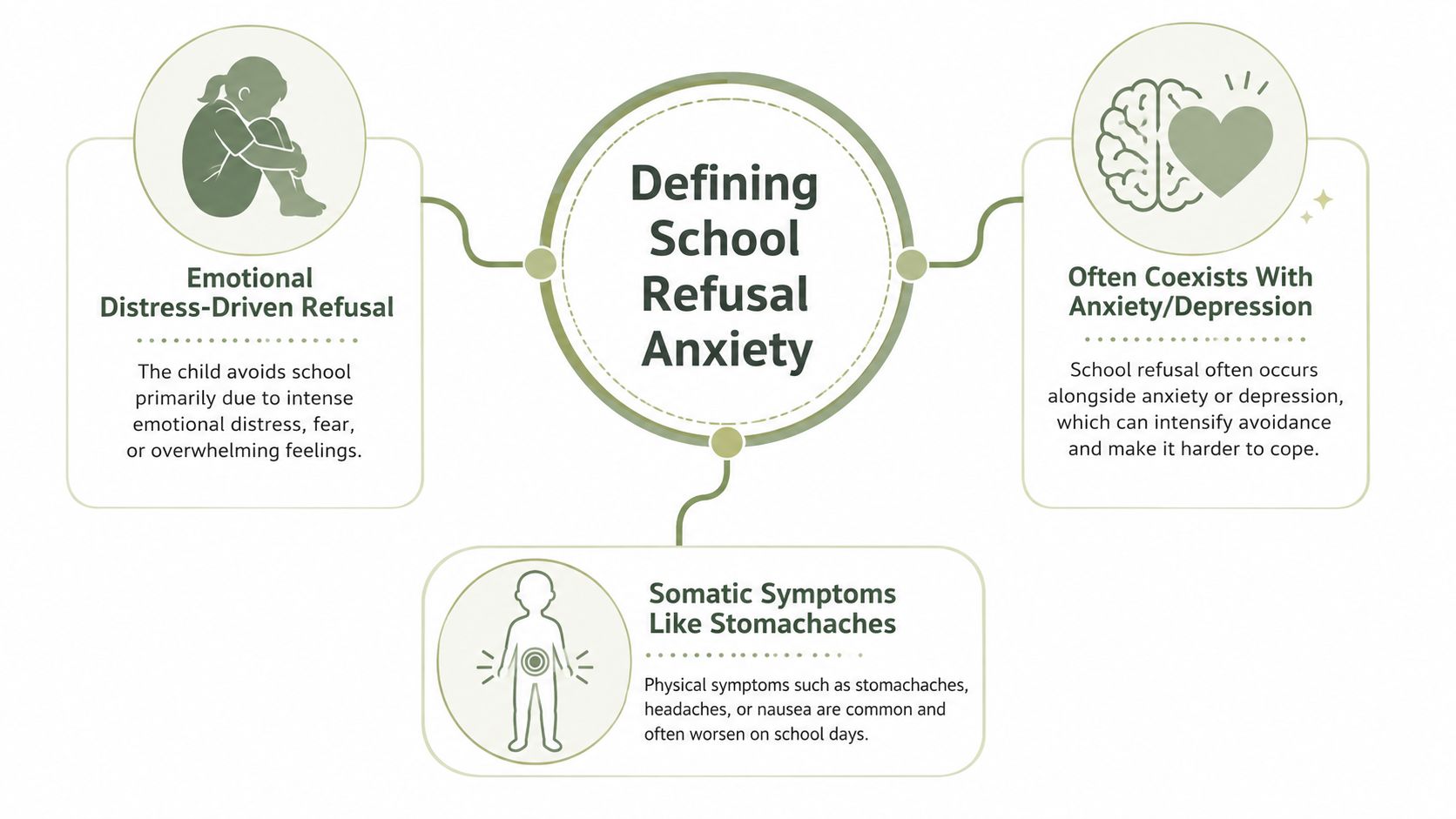
Most children show a blend of functions, and the main function can shift with age or circumstances. A younger child may fear separating from a parent. An adolescent may dread peer evaluation, then stay home because a phone offers immediate comfort. Parents can help by noticing both sides of this loop: the child's distress and the short-term relief that keeps avoidance going.
Clinically significant school refusal is commonly reported in roughly 1% to 5% of school-age children. A 2024 review estimated about 2% to 5% globally, while an older community-based estimate placed anxious school refusal at 1.6% (2024 review of school refusal). It often clusters around transitions, with reported peaks at ages 5 to 7 and again around ages 10 to 14. Recognizing these patterns helps families plan support around the child, the parent response, and the school setting rather than treating attendance as the child's responsibility alone.
What Drives School Refusal
There's rarely one explanation. A child may have an anxious temperament, face a difficult classroom demand, and receive understandable but avoidance-reinforcing help at home. Assessment works best when it treats the child, family, and school as connected parts of the same system.
| Category | Example factors | Typical presentation | |---|---|---| | Anxiety and mood | Separation anxiety, social anxiety, panic symptoms, generalized worry, specific fears, trauma-related distress, depression, or OCD | Dread, reassurance seeking, panic, crying, shutdown, or physical complaints before school | | Family context | Recent loss, separation, disruption, caregiver anxiety, high conflict, or repeated accommodation | Difficulty separating, prolonged morning negotiations, sleeping beside a parent, or repeated checking | | School environment | Bullying, academic pressure, difficult relationships, transitions, sensory overload, or a stressful class change | Refusal linked to a subject, teacher, hallway, lunch period, bus, or peer group | | Developmental needs | Autism, ADHD, learning differences, communication challenges, or a mismatch between demands and abilities | Exhaustion, confusion, rigid avoidance, overwhelm during transitions, or distress after masking all day |
A child with autism may find noise, unpredictable changes, or crowded spaces overwhelming. A child with ADHD may struggle with the sequence of getting ready, moving between classes, and beginning work. A child with dyslexia or another learning difference may fear being exposed in front of classmates. These possibilities don't excuse the impairment, but they change the support the child needs.
Anxiety remains the most common underlying factor across the literature. Historical reviews link school refusal with separation anxiety, social anxiety, panic symptoms, and mood disorders, and describe it across socioeconomic groups and in boys and girls, challenging the idea that it's a discipline problem (AACAP overview of school refusal).
A scoping review of 30 studies identified anxiety-related symptoms as a central difference between young people with school refusal and peers without it (scoping review of school refusal and anxiety). Staying home can immediately reduce fear, which teaches the nervous system that avoidance works. That short-term relief can make the next morning harder.
Signs That Point to Clinically Significant Refusal
One difficult morning doesn't establish school refusal anxiety. Children sometimes dislike school, feel tired, or need a day to recover. The concern grows when emotional distress, physical symptoms, and avoidance form a repeated pattern.
Emotional signals
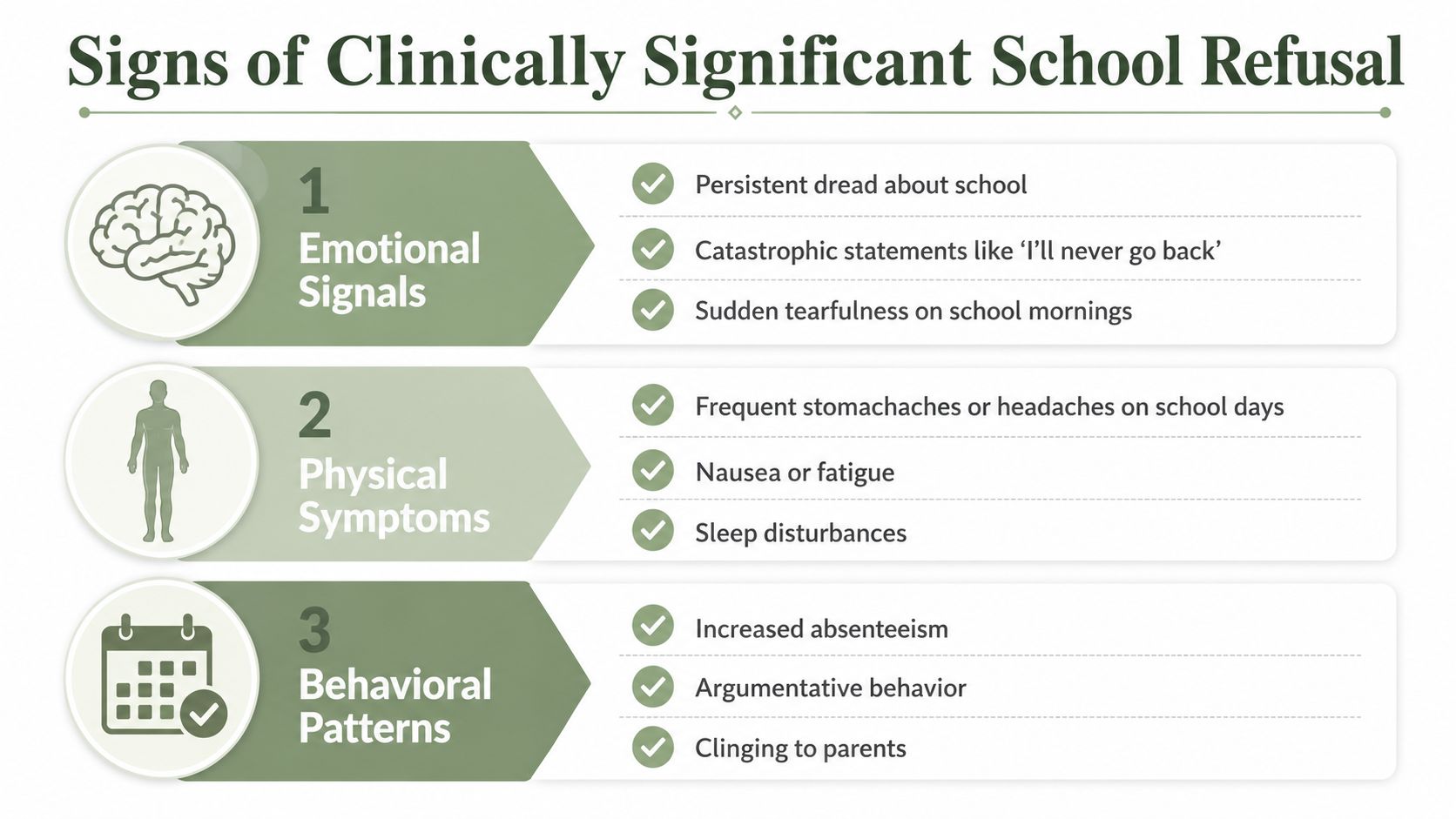
Your child may express persistent dread, make catastrophic statements such as “I'll never go back,” or become tearful on Sunday evening. Irritability at drop-off can be anxiety in disguise, especially when the child visibly relaxes after you agree they can stay home.
Watch for changes in mood outside the morning routine too. Withdrawal, unusual fatigue, sleep disruption, appetite changes, and loss of interest can suggest that depression, anxiety, or another concern needs evaluation.
Physical signals
Stomachaches, headaches, nausea, dizziness, trembling, breath-holding, and panic-like sensations often appear before school. Some symptoms ease after the child misses school, while others continue throughout the day.
A symptom can be anxiety-related and still deserve medical attention.
Arrange a medical check for recurring pain, fainting, significant appetite changes, sleep problems, or other physical concerns. A pediatrician can consider medical contributors while a mental health professional evaluates the emotional pattern.
Avoidance signals
The behavioral layer may include slow dressing, hiding, repeated bathroom trips, pleading, missing the bus, leaving class, visiting the nurse, or bargaining for a later start. Some children refuse loudly. Others become quiet, frozen, or unusually compliant at home while avoiding school in less obvious ways.
A pattern lasting two to four weeks, symptoms occurring on most school days, or attendance dropping below 80% to 85% suggests the need for a clinical look. These thresholds aren't a substitute for professional judgment, but they can help parents act before absence becomes entrenched.
Your child isn't faking because the pain appears before school and improves later. Record the timing, intensity, triggers, and what follows each episode. That information gives both the pediatrician and clinician a clearer picture than the label “school avoidance.”
How a Clinician Assesses School Refusal
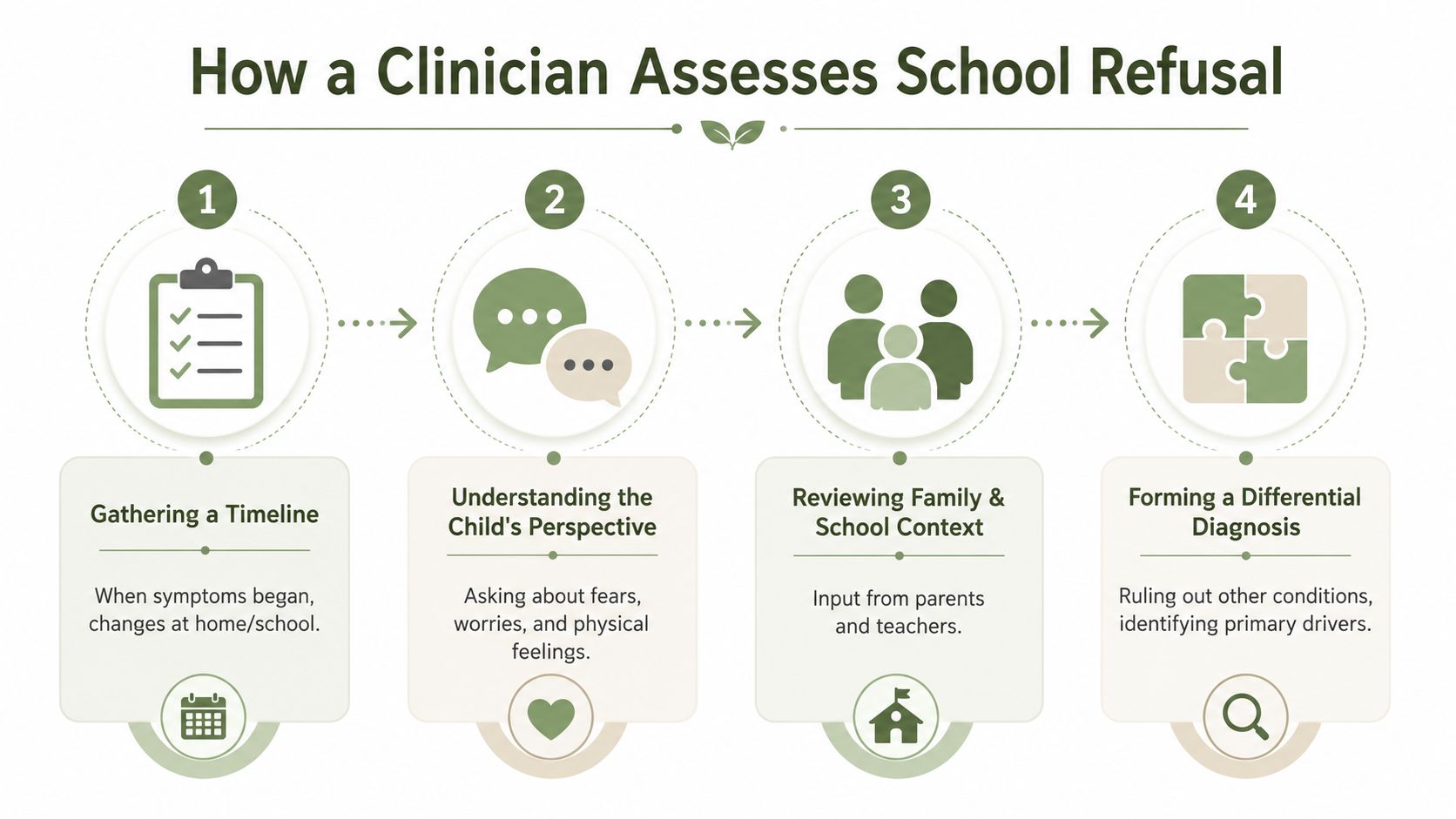
A first appointment should feel like an investigation, not an interrogation. The clinician usually begins by building a timeline: when the difficulty started, whether it followed a transition or stressful event, which mornings are hardest, and what happens after the child stays home.
Bring attendance records, teacher messages, nurse visits, homework information, and a short log of morning symptoms. Note whether the child can attend preferred activities, whether distress occurs on weekends, and whether one subject, person, location, or time of day repeatedly appears in the pattern.
The child's perspective matters
The clinician will ask what the child fears, what physical sensations occur, and what they believe will happen at school. Younger children may answer through drawing, play, or choices between possible worries. Adolescents may speak more openly without a parent present, particularly about peer judgment, bullying, academic failure, identity concerns, or access to rewards at home.
A structured tool such as the School Refusal Assessment Scale-Revised may help identify whether avoidance is driven mainly by school-related fear, social evaluation, attention, or outside rewards. The clinician also screens for separation anxiety, social anxiety, generalized anxiety, OCD, depression, learning differences, ADHD, and autism-related traits.
The assessment often includes separate parent and child conversations, collaboration with the pediatrician when physical symptoms need review, and permission to speak with school staff. The aim is a working formulation, not an instant label. The formulation answers a practical question: what keeps the refusal going, and which adults need to change their responses?
Families considering remote care can review Wald Behavioral Health's telehealth information and ask how parent participation, school coordination, and privacy will work in their situation.
Evidence-Based Interventions for the Child
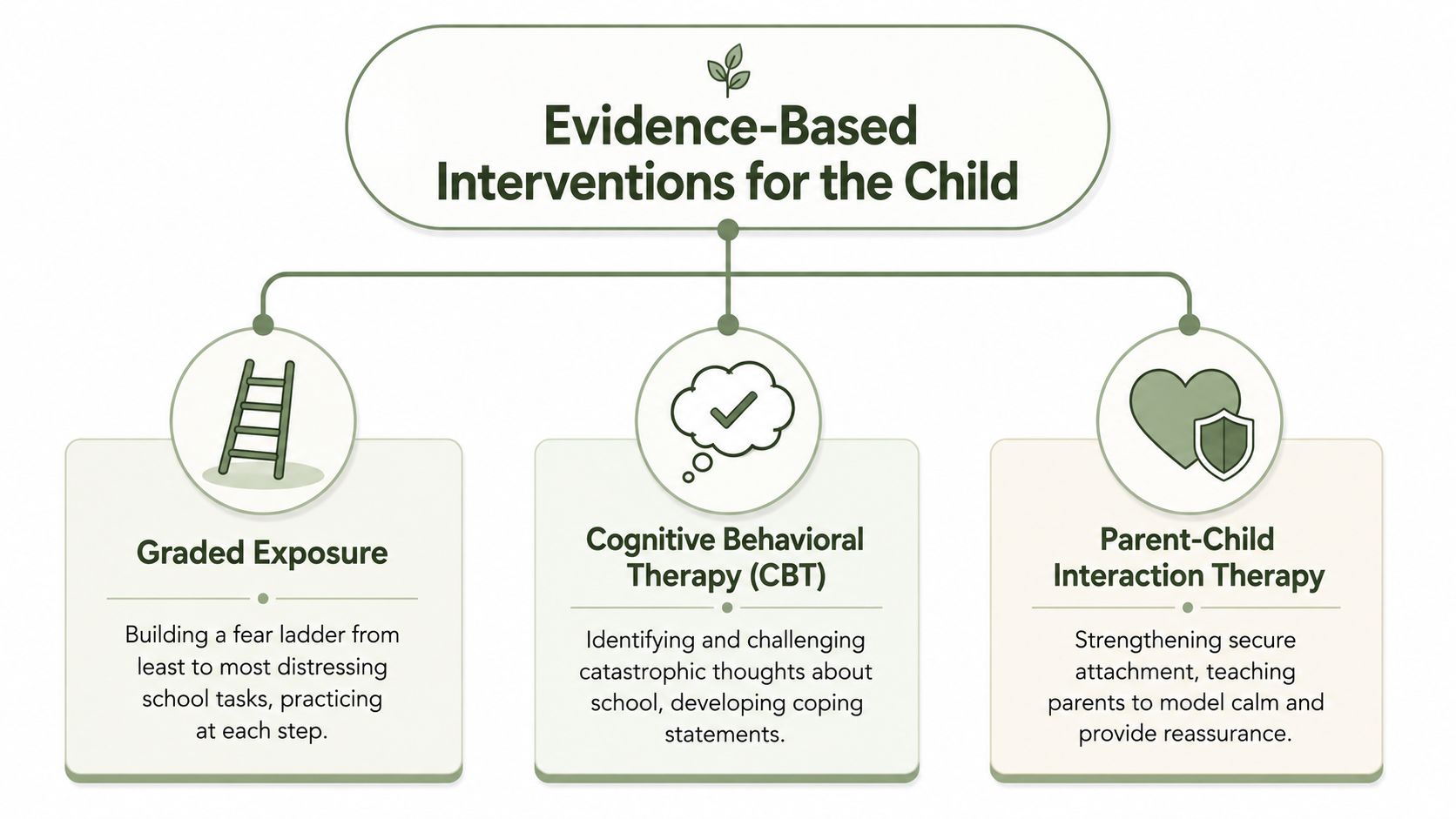
Treatment usually combines exposure, cognitive work, and changes in the family responses that unintentionally maintain avoidance. The child shouldn't be expected to solve the problem alone, because the adults control many of the routines, school contacts, and accommodations surrounding attendance.
Graded exposure
A clinician and child create a fear ladder, beginning with a task that causes manageable discomfort. The first step might be driving past school on a weekend. Later steps could include sitting in an empty cafeteria, entering the office, attending one class, staying for a morning, and eventually completing a full day.
The child repeats each step rather than completing it once and moving on. Repetition teaches the nervous system that discomfort can be tolerated and that feared outcomes don't always occur. A graded plan shouldn't force the child into the hardest situation immediately, but it also shouldn't let avoidance decide the schedule.
Cognitive behavioral strategies
Cognitive behavioral therapy helps children identify predictions such as, “Everyone will laugh when I answer,” or, “If I feel sick, I'll have to go home.” The child can write evidence supporting and challenging the prediction, then create a coping card: “My stomach feels tight because I'm anxious. I can take slow breaths, ask for my planned help, and stay for the next step.”
Children don't need to feel completely confident before acting. The therapeutic target is flexible behavior in the presence of worry.
Parent-child work and accommodation reduction
Parents may allow bed-sharing, excuse missed assignments, offer constant reassurance, or provide repeated early pickups because those responses calm the child in the moment. A clinician can help the family replace unlimited accommodation with supportive boundaries, such as one reassurance statement, a predictable check-in, and a return to the agreed routine.
Medication may be considered when a co-occurring anxiety disorder is severe or therapy alone isn't sufficient. The decision belongs with an appropriately qualified prescriber and should fit the child's broader treatment plan. Families can also review child anxiety therapy options when deciding what type of support matches the child's needs.
A meta-analysis of 8 studies involving 435 children and adolescents found psychosocial interventions significantly improved attendance, but didn't show a significant short-term reduction in anxiety symptoms (meta-analysis of psychosocial interventions). That distinction matters. Your child may attend school while still reporting anxiety, so progress should include attendance, coping, participation, recovery after school, and gradual reduction in impairment.
Family Strategies That Make Treatment Work
A school morning often starts long before the child reaches the door. The night before, lay out clothes, pack materials, and agree on the morning sequence. Keep wake-up and bedtime times predictable, then leave enough calm time for dressing, breakfast, brushing teeth, shoes, and travel. A short routine reduces the need to discuss the whole school day while everyone is already tense.
Choose one parting script and use it consistently:
“I know your stomach hurts and your worry is loud. The plan is school, and your teacher knows how to help. Take three slow breaths, then walk with me to the entrance.”
This wording names the feeling while keeping the family plan clear. Avoid lengthy explanations, repeated promises, or arguments about whether the child is “really” sick. If the same question returns, answer it once and point to the agreed coping step. Repetition can become another way anxiety keeps the morning focused on reassurance.
Reduce accommodation gradually
Write down what happens after your child avoids school. A parent may stay in bed with them, complete assignments, check symptoms repeatedly, or allow unrestricted screen use. These responses often bring short-term relief, so removing every support at once can make the family struggle. Choose one accommodation, explain the change beforehand, and replace it with structured care.
For example, stop answering the same reassurance question throughout the morning, but offer one scheduled check-in after breakfast. Your child still receives warmth and help. Anxiety has less control over every family action.
Parents need coaching too. A 2025 feasibility study found that a coach-assisted online parenting program improved parents' self-efficacy in responding to adolescent school refusal and increased alignment with evidence-based parenting strategies (parent coaching evidence). This supports treating the parent's confidence and responses as part of the intervention, not as background details separate from the child's treatment.
Create one home-school plan
Ask the school to name a consistent arrival adult, quiet entry point, predictable check-in, and first exposure target. Use the same brief language at home and school, with direct adult communication so the child does not have to carry messages between settings.
Family changes may take two to four weeks before progress becomes clear. Early resistance can show that a new boundary is interrupting a pattern that once brought immediate relief. For parent guidance and structured support around school refusal, families can review Wald Behavioral Health's parent services.
Planning a Gradual Return to School
A gradual return should bring the child back into the school environment, not demand a sudden jump from staying home to completing a full day. The clinician, parent, and school should select a first step that is difficult but achievable, then define exactly what happens before, during, and after it.
One possible progression looks like this:
- First stage: Drive past school, then walk into the office for five minutes with a designated adult.
- Next stage: Attend the morning meeting and one predictable lesson, followed by a planned departure.
- Middle stage: Attend half days with a clear exit point, consistent pickup, and no last-minute bargaining.
- Later stage: Attend full days with a named check-in person and a written response if anxiety rises.
The steps must fit the child. A student distressed by noise may need a quiet entrance before attending class. A student afraid of social evaluation may first enter through a less crowded route. A child with learning differences may need work adjusted before exposure can succeed.
Make drop-off brief and predictable
At the door, say something like, “You're worried, and you're taking the next step. Ms. Lee is meeting you here. I'll see you after the planned pickup.” Then leave according to the agreement.
Don't begin a long negotiation, threaten consequences in the doorway, or promise an early pickup every time the child cries. A caring parent can remain calm and firm at the same time. If the child has a panic response, school staff should follow the prearranged coping and safety plan rather than improvising a new escape.
Treat setbacks as information
A missed morning, meltdown at arrival, or weekend relapse is data. Ask what changed, which step was too large, whether the child slept, and whether a school trigger appeared. The team may repeat a step, add support, or make the target smaller. It shouldn't abandon the whole plan after one difficult attempt.
Progress may sound ordinary. Your child asks what's for lunch instead of whether they have to attend. They complain about a lesson but still enter the building. They recover from a hard morning without requiring the entire family to reorganize. These changes show that school is becoming a manageable part of life, even before anxiety disappears.
---
Wald Behavioral Health provides evidence-based therapy and structured parent guidance for school refusal anxiety, child anxiety, separation concerns, and related family routines. Visit Wald Behavioral Health to request a free 15-minute consultation and discuss in-person care in Coral Gables or telehealth availability across eligible states.
Questions about your child or teen?
Dr. Wald offers a free 15 minute consultation to talk through what you are seeing and whether the practice is a good fit.
Free 15 Minute Consultation