Exposure Therapy for Children How It Works for Anxiety
Your child refuses school because the hallway feels terrifying, asks to sleep in your room after dark, or freezes whenever a dog comes near. You may find yourself offering repeated reassurance, changing family plans, answering the same question again, or removing anything that might trigger distress. Those responses come from love, but they can accidentally teach anxiety that avoidance is the safest solution.
Exposure therapy for children offers a different path. A child doesn't have to face the worst fear all at once. Instead, the child, parents, and therapist create a bravery ladder, then practice manageable steps while reducing escape, reassurance-seeking, and rituals. The aim isn't to force fear away. It's to help a child discover, through repeated experience, “I can handle this feeling and keep going.”
## Table of Contents - Introduction to Exposure Therapy for Children and Why Avoidance Keeps Fear Going - What exposure is not - How Exposure Therapy Works in a Child Friendly Way - Four learning processes parents should understand - The language therapists use - What Research Shows About Effectiveness and Real World Use - Why routine care can look different - Building a Fear Ladder and Planning Developmentally Appropriate Exposures - Start with the child's map - Build the ladder one rung at a time - Adapt the ladder to development - The Parent Role as Coach and When to Step Back - Coaching versus accommodation - Real World Examples of Exposure Therapy for Common Childhood Fears - Separation anxiety - Social anxiety - Specific phobia - OCD and contamination fears - Safety Considerations and Next Steps for Families Considering Exposure Therapy
Introduction to Exposure Therapy for Children and Why Avoidance Keeps Fear Going
A child who avoids school may feel immediate relief when a parent allows a day at home. A child afraid of dogs may feel calmer after crossing the street. A child worried about sleeping alone may settle quickly when a parent stays beside the bed. That relief is real, but it's short-lived. The brain can interpret the escape as proof that the situation was dangerous and that avoidance provided protection.
This creates a difficult family pattern. The child becomes more dependent on reassurance or accommodation, while the parent feels increasingly responsible for preventing distress. Nobody is failing. The family is responding to an alarm that feels urgent, even when the feared outcome isn't likely.
Anxiety treatment focuses on changing that learning cycle with compassion. Rather than saying, “There's nothing to be afraid of,” a parent can help a child practice, “You feel afraid, and we can take one small step together.” This approach is part of evidence-based anxiety treatment for children, and it can be adapted to developmental level, diagnosis, family routines, and the child's goals.
What exposure is not
Exposure isn't punishment, flooding, teasing, or forcing a child into the hardest situation. A careful exposure is planned, explained, and adjusted with the child's participation. Safety remains important, but anxiety itself isn't treated as an emergency that must always be removed.
Parents serve as coaches, not bystanders. They help build the ladder, encourage practice, and avoid doing anxiety's job by answering every question or removing every challenge. Progress may look quiet at first. A child might still feel nervous but attend class, touch a doorknob without washing repeatedly, or remain near a dog while noticing the urge to flee.
The rest of this guide explains how the process works, how clinicians build a fear ladder, how parents can calibrate their support, and why meaningful gains may appear after practice rather than during the first exposure.
How Exposure Therapy Works in a Child Friendly Way
An anxious brain often acts like a smoke alarm that detects danger too easily. Avoidance is like leaving the building whenever the alarm sounds. The alarm becomes quieter for a moment, but the brain never gets the chance to learn whether there was a fire.
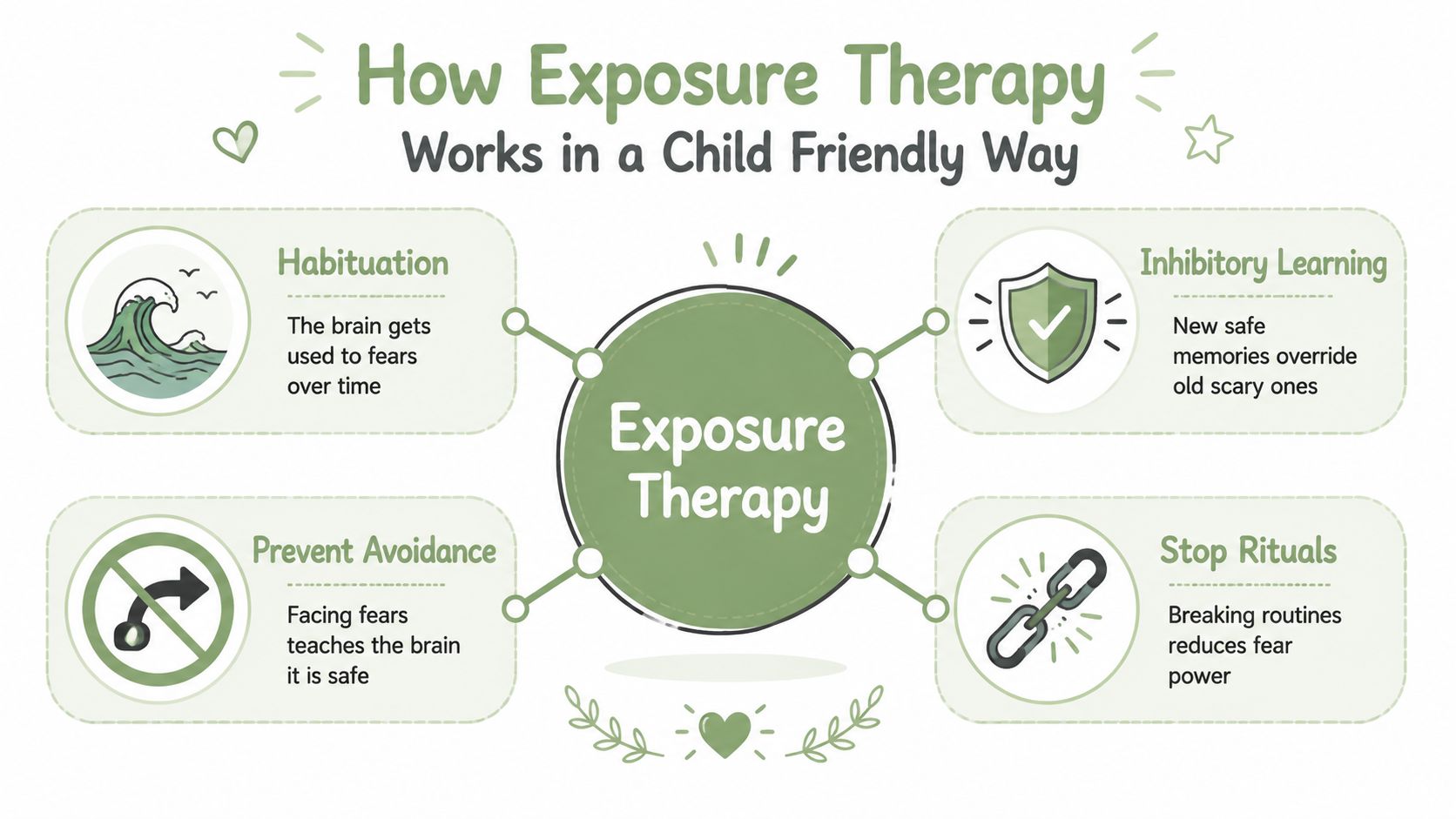
Exposure creates a controlled opportunity to stay in the situation without using the usual escape route. The child may feel anxious, notice scary thoughts, and still remain present. Over time, the brain gathers new information: fear can rise and fall, uncertainty can be tolerated, and a ritual or escape isn't required for safety.
Four learning processes parents should understand
Habituation means anxiety may become less intense with repeated contact, although it doesn't always drop during every practice. A child can also benefit by completing the activity while still feeling nervous.
Inhibitory learning means the child develops a new memory that competes with the old fear message. The lesson may be, “I can sit in class while anxious,” or, “I can have an unwanted thought without performing a ritual.”
Preventing avoidance matters because leaving early can preserve the original fear prediction. Staying long enough to practice gives the child more useful evidence than escaping at the peak.
Response prevention is especially important for OCD. The child approaches a trigger while postponing or resisting the compulsion that normally provides temporary relief.
The language therapists use
A fear ladder ranks situations from easier to harder. A child may rate distress with a child-friendly scale called SUDS, meaning subjective units of distress. For younger children, a thermometer, faces, or a color scale may work better than numbers.
The exposure should be predictable, repeated, and appropriately challenging. A tiny step may teach very little if it's completely comfortable. A step that overwhelms the child may produce panic, refusal, or loss of trust. The therapist's job is to find a useful middle ground.
Central principle: The child practices feeling afraid without letting fear make every decision.
The therapist also watches for subtle avoidance. Looking away, asking for constant reassurance, distracting from every sensation, or completing a ritual “just once” can keep the fear cycle active. These behaviors aren't treated as misbehavior. They're signals that the plan may need clearer coaching and a more gradual pace.
What Research Shows About Effectiveness and Real World Use
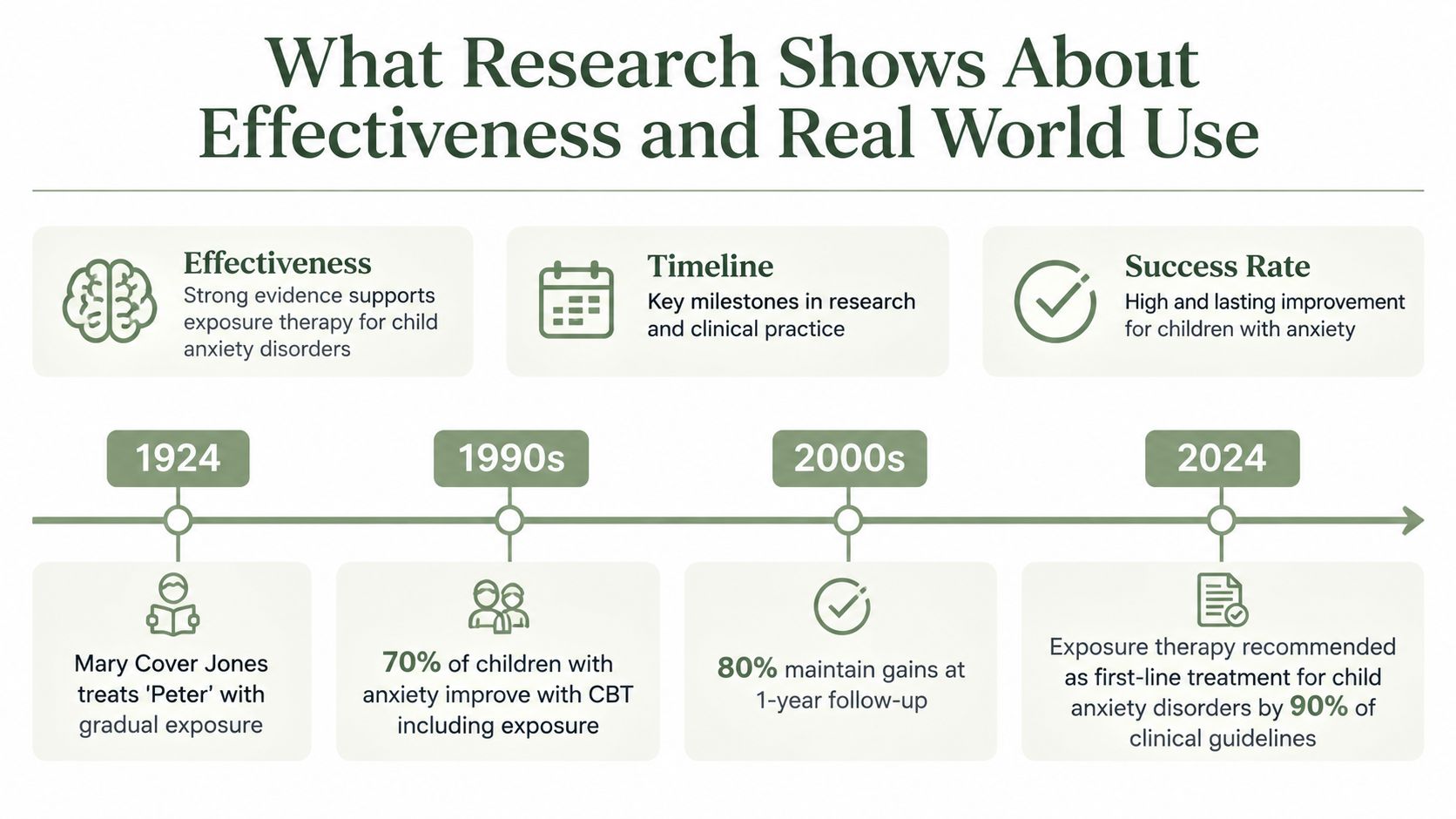
Research on childhood exposure began with early case-series work associated with Mary Cover Jones. During the 1990s and 2000s, a larger body of studies helped establish modern exposure practice within child psychology. This historical account of child exposure therapy describes that period as a major expansion in the field.
For pediatric anxiety and OCD, exposure-based CBT is a first-line psychosocial treatment. Evidence comes from more than 40 randomized clinical trials. One review found that about two-thirds of anxious youth no longer met criteria for their primary anxiety disorder after treatment. That benchmark describes a meaningful change in symptoms, not just a child feeling a little calmer. The findings appear in this review of CBT and exposure-based treatment for youth anxiety.
Trauma research in children is smaller, but it still provides useful guidance. A 2022 systematic review and meta-analysis examined 6 randomized controlled trials with 278 total patients and found exposure therapy more effective than control conditions overall, with an SMD of -0.47 and a 95% CI of -0.91 to -0.03. The effect was stronger for single-trauma cases, with an SMD of -1.04 and a 95% CI of -1.43 to -0.65. Findings were particularly meaningful for adolescents with an average age of 14 years and older. The pediatric trauma exposure meta-analysis supports exposure while showing why age, trauma history, and clinical presentation should shape treatment planning.
Why routine care can look different
A treatment can have strong research support and still be used inconsistently in everyday services. In a usual-care study of child and adolescent mental health services in Hawai'i covering 2006 through 2015, exposure therapy appeared in 1,372 of 6,616 treatment episodes addressing an anxiety-related problem, or 20.7%. The results are reported in this usual-care study of exposure delivery.
A separate meta-analysis of 75 studies on CBT for childhood anxiety found that more in-session exposure was associated with larger treatment effects across reporters. Compared with waitlist controls, exposure was linked to effect-size improvements in the approximate range of -0.12 to -0.15. These findings are described in the childhood anxiety exposure meta-analysis.
Parents can use this evidence when choosing care. Ask whether treatment includes active, planned exposure, rather than conversation alone. A clinician may also teach coping skills or discuss anxious thoughts, but progress usually depends on practice in situations that anxiety has narrowed. The child climbs a bravery ladder with the parent coaching from the side, and improvement may appear after repeated attempts rather than after one session.
Building a Fear Ladder and Planning Developmentally Appropriate Exposures
A fear ladder turns a vague goal, such as “stop being anxious,” into observable practice. The child and therapist identify specific situations, arrange them by difficulty, and choose a first step that feels challenging but possible.
Start with the child's map
Ask what anxiety makes the child avoid, postpone, check, ask, or refuse. “School is scary” may become several separate targets: entering the building, walking to class, answering a question, eating in the cafeteria, or staying after a mistake.
Use the child's language. A preschooler may describe a “monster feeling,” while a teenager may identify fear of embarrassment, contamination, illness, or losing control. Tools and activity ideas can support this conversation, including age-appropriate anxiety therapy activities for children.
Build the ladder one rung at a time
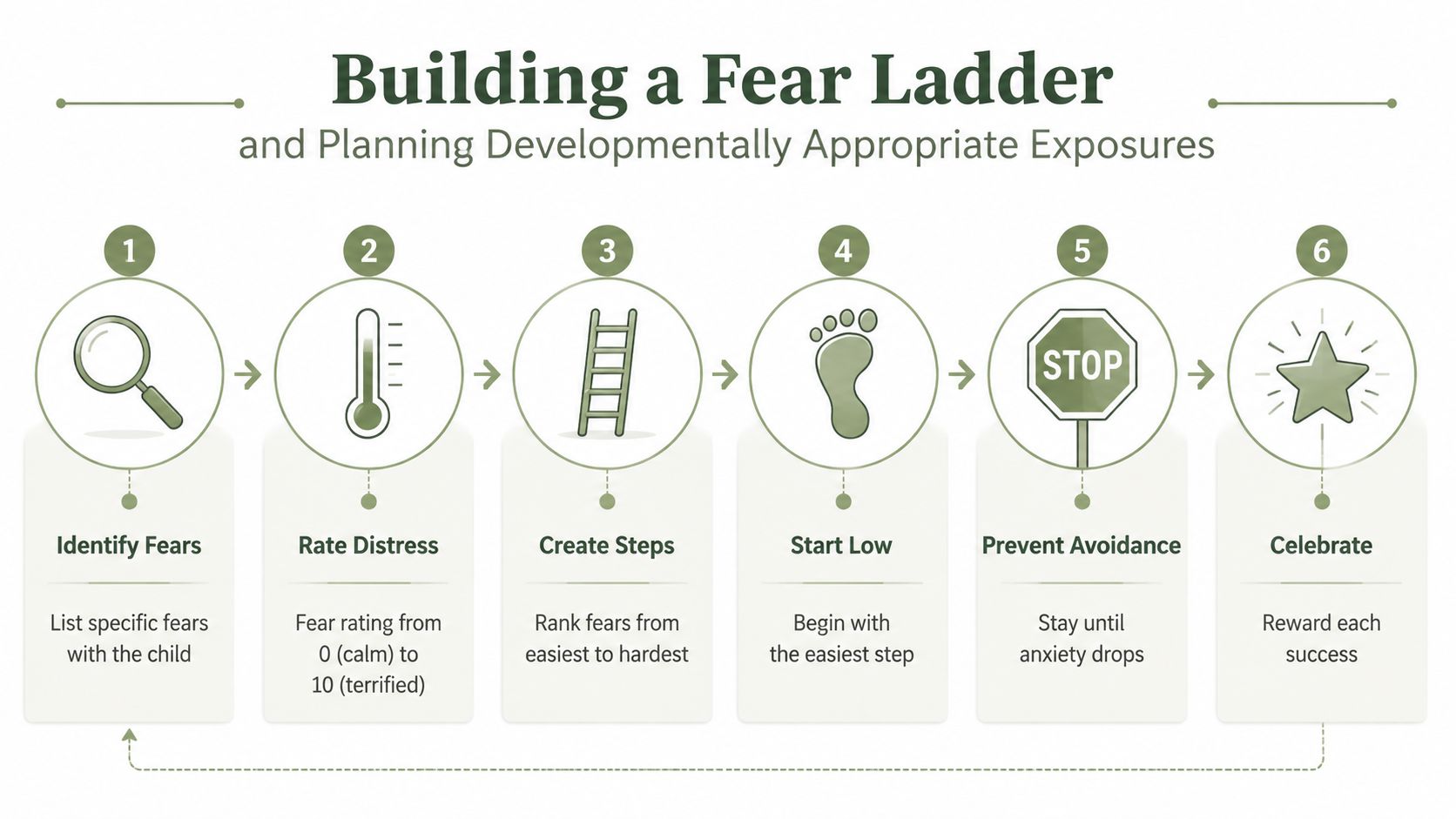
- List specific fears. Include situations, thoughts, sensations, and rituals. For OCD, identify both the trigger and the compulsion that follows it.
- Rate distress. A therapist may use a scale from 0 to 10, with 0 meaning calm and 10 meaning terrified. Younger children can point to faces or colors instead.
- Rank the steps. Put lower-distress activities near the bottom and harder challenges higher up. The ladder doesn't need to be perfect on the first attempt.
- Choose a starting point. Begin with a step the child can attempt while remaining engaged. Starting low isn't “giving in.” It builds the skill of approaching.
- Prevent the usual escape. During an exposure, the child practices staying with the situation and postponing avoidance or rituals. For pediatric OCD, expert guidance describes starting with lower-distress situations, continuously preventing compulsions, and often repeating in-session trials until anxiety drops by about 60% to 80% or reaches a very low level, as detailed in pediatric intensive CBT and ERP guidance.
- Review and celebrate. Discuss what the child predicted, what happened, and what the child learned. Reward effort, willingness, and follow-through, not perfect calm.
Adapt the ladder to development
Young children often learn through play, drawings, puppets, stories, and brief repetitions. A child might help a stuffed animal climb a “bravery mountain” before trying the same step personally. Praise should be immediate and specific: “You felt worried and still put your hand on the doorknob.”
Teens generally benefit from more autonomy and a direct connection between exposure and personal values. A teenager who fears judgment may choose to ask a teacher a question, speak to a peer, or attend part of a social event. The parent can help with transportation and scheduling without taking ownership of the challenge.
Pause or adjust when the child becomes overwhelmed, dissociates, cannot understand the task, or loses the ability to participate. Exposure should be supervised by a qualified clinician when trauma, severe OCD, medical concerns, self-harm risk, or complex family accommodation is involved.
The Parent Role as Coach and When to Step Back
Parents often ask whether more involvement produces better treatment. The evidence doesn't support a simple answer. A meta-analysis found no clear advantage for parent-involved treatment over child-only anxiety treatment, with an effect size of -0.10 in favor of child-only treatment, and a newer randomized microtrial in childhood specific phobia suggests that the helpful balance may depend on how both the therapist and parent participate. The meta-analysis of parent involvement in youth anxiety treatment points toward calibration rather than an automatic rule.
A parent coach offers encouragement without becoming an anxiety-management service. That means validating the feeling, pointing back to the plan, and allowing the child to experience manageable uncertainty.
Helpful script: “I know this feels hard. I won't answer the question again, but I'll stay nearby while you practice what your therapist taught you.”
Coaching versus accommodation
| Parent response | What it communicates | |---|---| | “You can do the first step, and I'll watch.” | Fear is difficult but manageable. | | Repeatedly promising that nothing bad will happen | Certainty is required before action. | | Completing a ritual for the child | Anxiety gets relief through another person. | | Offering a calm reminder of the plan | The child can use skills instead of reassurance. |
For a young child, a parent may participate directly, model the step, or provide a simple reward. For an older child, the parent may arrange practice and then step back. With OCD, parents often need therapist guidance to reduce accommodation without withdrawing warmth.
Parents should also watch their own anxiety. A worried caregiver may unintentionally communicate danger through facial expressions, repeated checking, or last-minute changes. Calm does not mean pretending the task is easy. It means staying predictable while the child practices.
A useful decision rule is:
- Encourage when the child is hesitant but able to participate.
- Observe when the child has begun independently and only needs quiet support.
- Let the therapist lead when rituals, trauma memories, severe distress, or family accommodation make the situation complicated.
Parent participation should match the child's developmental needs, diagnosis, and current pattern of dependence. More help can be useful, but help that removes every opportunity for independent coping can keep the problem in place.
Families seeking broader guidance about supporting children can review parent resources from Wald Behavioral Health.
Real World Examples of Exposure Therapy for Common Childhood Fears
A ladder should reflect the child's actual life, not a generic list of fears. The following examples are templates to discuss with a clinician, not instructions to complete without assessment.
Separation anxiety
A younger child who cries at bedtime might begin by sitting in bed while a parent stands near the doorway. The next step could involve the parent moving farther away, then checking at planned intervals, and eventually leaving after a brief goodnight routine.
The parent praises staying in bed and tolerating uncertainty. The parent doesn't return every time the child calls, add repeated reassurance, or create a new ritual that must happen before sleep.
Social anxiety
A school-age child who fears speaking may start by reading one sentence aloud to a parent, then answering a question in a small group, and later contributing in class. The child's success is making the attempt, not sounding perfectly confident.
A parent can role-play, help schedule practice with the therapist or school, and ask afterward, “What did you learn about being nervous and participating?” The parent shouldn't interrogate the child for reassurance about how others reacted.
Specific phobia
A child afraid of dogs might begin by looking at a drawing, then viewing a photograph, watching a calm dog from a distance, standing closer with a trusted adult, and eventually remaining near a leashed dog. The therapist determines the pace and confirms that the animal and setting are appropriate.
The child doesn't need to touch the dog to make progress. Remaining present, keeping feet still, and resisting the urge to flee can each represent a meaningful rung.
OCD and contamination fears
For contamination concerns, an exposure might involve touching a mildly feared object and waiting before washing. Later steps could involve touching more challenging surfaces or eating without an extra cleaning routine.
The parent avoids providing repeated reassurance or washing items for the child. In ERP, the family practices allowing uncertainty while reducing the ritual's control, under guidance suited to the child's symptoms and safety needs.
Across all examples, improvement may mean greater participation before it means comfort. A child can feel anxious, complete the planned action, and carry that learning to home, school, activities, and relationships.
Safety Considerations and Next Steps for Families Considering Exposure Therapy
Safe exposure is collaborative, gradual, and clinically informed. It isn't a dare, a punishment, or a demand that a child endure overwhelming distress. A qualified child therapist should assess the diagnosis, developmental level, medical context, trauma history, risk concerns, and family accommodation before creating a plan.
Ask prospective providers:
- Do you use CBT with exposure for childhood anxiety?
- Do you provide ERP for pediatric OCD?
- How do you involve parents without reinforcing reassurance or avoidance?
- How do you decide when to lower, repeat, or raise a ladder step?
- What practice will happen between sessions?
- How will you measure progress beyond immediate anxiety reduction?
Families should also expect that progress may not arrive as instant relief. Recent findings indicate that observed in-session exposure in a small youth sample didn't predict immediate symptom reduction, but it did predict better outcomes at follow-up. That pattern fits the learning model: a child may practice bravery first, then notice broader benefits later.
Virtual reality is a developing option, but it deserves measured optimism. A 2026 systematic review found significant symptom reductions, yet only 5 of 466 screened studies met inclusion criteria. The included evidence remained small and heterogeneous, with k=3 for the SUD meta-analysis and I²=81%, so VR exposure isn't a replacement for careful assessment and individualized treatment. These findings come from the systematic review of VR exposure for youth.
Start by scheduling a consultation, naming the situations anxiety has restricted, and asking how a provider would turn those situations into a collaborative ladder. Your child doesn't have to feel fearless before beginning. With the right support, bravery can become a practiced behavior rather than a personality trait.
---
Wald Behavioral Health provides developmentally informed therapy for children, adolescents, young adults, and families, including exposure strategies for anxiety and ERP for OCD with parent guidance as appropriate. Visit Wald Behavioral Health to learn about in-person care in Coral Gables, telehealth options, and a free 15-minute consultation to discuss your family's needs.
Questions about your child or teen?
Dr. Wald offers a free 15 minute consultation to talk through what you are seeing and whether the practice is a good fit.
Free 15 Minute Consultation