10 Behavior Management Strategies for Parents
You've asked your child to get dressed three times. They're still in pajamas, the school bus is approaching, and every reminder has turned the morning into an argument. The same pattern appears at homework time, during screen transitions, or after lights-out. You raise your voice, your child resists harder, and everyone starts the day exhausted.
Effective behavior management strategies for parents aren't one universal punishment system. They begin with a closer look at the behavior: What happened just before it? What does the child gain or avoid? Which replacement skill would work better? What calm response can every caregiver repeat consistently?
The strategies below cover prevention, reinforcement, emotional regulation, consequences, anxiety-related avoidance, and structured sleep support. Some approaches work well for minor, attention-maintained behavior but are unsafe for aggression, running away, self-harm, or serious distress. Consistency matters across parents, grandparents, teachers, and other caregivers, but consistency doesn't mean ignoring developmental differences or individual needs.
When home strategies aren't enough, Wald Behavioral Health can help families create individualized parent-training plans for sleep, tantrums, school refusal, separation, noncompliance, ADHD-related behavior, anxiety, and mood concerns.
## Table of Contents - 1. Use Positive Reinforcement - Make rewards sustainable - 2. Use Natural and Logical Consequences - Connect the consequence to the behavior - 3. Use Time-In for Emotional Dysregulation - Connection doesn't remove boundaries - 4. Set Clear Expectations and Consistent Boundaries - Make the response predictable - 5. Apply Time-Out Carefully - Know when it's a poor fit - 6. Listen Actively and Validate Emotion - Listen before solving - 7. Use Extinction for Specific Attention-Seeking Behavior - Expect the pattern to test you - 8. Solve Problems Collaboratively - Turn discussion into an experiment - 9. Address Avoidance With Exposure and Behavioral Activation - Keep the plan safe and specific - 10. Build a Consistent Sleep Plan - Respond to stalling the same way - 10 Parenting Behavior Strategies Comparison - Turn Ten Techniques Into One Consistent Plan - Keep safety boundaries explicit
1. Use Positive Reinforcement
Children repeat behaviors that reliably lead to worthwhile outcomes. Positive reinforcement uses that principle by rewarding a specific desired behavior soon after it happens, instead of giving most attention to mistakes.
Start with one observable target. “Be good” is too vague. “Put your shoes on after the first reminder” gives your child a clear path to success. A preschooler might place a gold star on a morning chart. A child with ADHD might earn a preferred activity after completing a defined homework step. A child struggling with school refusal might earn extra tablet time after following the agreed morning plan and entering school.
Practical rule: Reinforce the behavior you want to see, not a general impression of your child's character.
Praise should be immediate and specific. Say, “You felt frustrated and still used a calm voice,” rather than “Good job.” High-fives, a short game, choosing the family music, and other child-approved rewards can supplement verbal praise. Ask what feels motivating, because a reward that worked last month may no longer matter.
Make rewards sustainable
External rewards are useful for starting a new pattern, but they shouldn't become the only reason a child cooperates. Gradually shift attention toward effort, confidence, independence, and natural benefits. Keep the criteria visible, and make sure all caregivers respond similarly.
The evidence base supports structured parent training broadly. A major Cochrane review found reductions in child conduct problems and harsh or negative parenting practices after behavioral and cognitive-behavioral parent training, including a parent-rated conduct-problem effect of SMD -0.53 and a parent-rated harsh-parenting effect of SMD -0.77. See the Cochrane review of parent training programs for the reported confidence intervals and assessment details.

2. Use Natural and Logical Consequences
Consequences teach best when children can understand the connection between a choice and what follows. A natural consequence happens without a parent arranging it. A child who forgets a lunch may feel hungry at school. A logical consequence is created by the adult and should relate directly to the behavior, such as pausing a privilege when homework remains incomplete.
Safety comes first. Don't use a natural consequence when it could expose a child to serious harm, humiliation, medical risk, or an unsafe environment. A child who refuses a coat may notice the cold in a safe setting, but a parent still needs to intervene if exposure could endanger the child.
Connect the consequence to the behavior
Set expectations before the problem occurs. “If the toy is used roughly and breaks, we won't replace it immediately. We'll make a plan for earning a replacement.” This gives the child information rather than presenting the consequence as parental retaliation.
Deliver the result briefly and without a lecture. “You missed curfew, so next week's curfew will be earlier.” Then allow time for the child to process. Empathy and accountability can coexist: “I know you wanted more time with your friends. The agreement still matters.”
Avoid consequences that are too broad, delayed, or unrelated. Taking away a favorite activity for an entire week because of one small mistake may create resentment without teaching a useful skill. After everyone is calm, ask, “What will you do differently next time?” Separate the child from the behavior. “That choice wasn't safe” teaches more than “You're irresponsible.”
3. Use Time-In for Emotional Dysregulation
A child in the middle of a tantrum, panic response, or intense frustration usually can't absorb a long explanation. A time-in keeps the parent nearby while the child regains control. The adult provides calm presence and co-regulation, not a reward for unsafe behavior.
Sit close enough to remain available, but don't force eye contact, physical contact, or conversation. You might say, “I'm here with you. You're having a hard time.” Then reduce demands. A child refusing school because of anxiety may need a calm parent beside them while the immediate fear settles. An older child may prefer space with the parent accessible nearby.
Connection doesn't remove boundaries
Time-in isn't a substitute for addressing aggression, property destruction, or rule violations. First make the situation safe. Once the child is regulated, address the boundary and practice the replacement response. “You were angry, and hitting isn't acceptable. Next time, move away and ask for help.”
Parents who want a structured, relationship-focused approach can learn more about parent-child interaction therapy, which incorporates coached parent-child interaction and behavior guidance.
Use time-in for dysregulation, not as a way to prolong attention-seeking negotiations. Don't lecture during the emotional peak. Later, ask what helped the child calm down, model slow breathing, and rehearse the plan during a neutral moment.
4. Set Clear Expectations and Consistent Boundaries
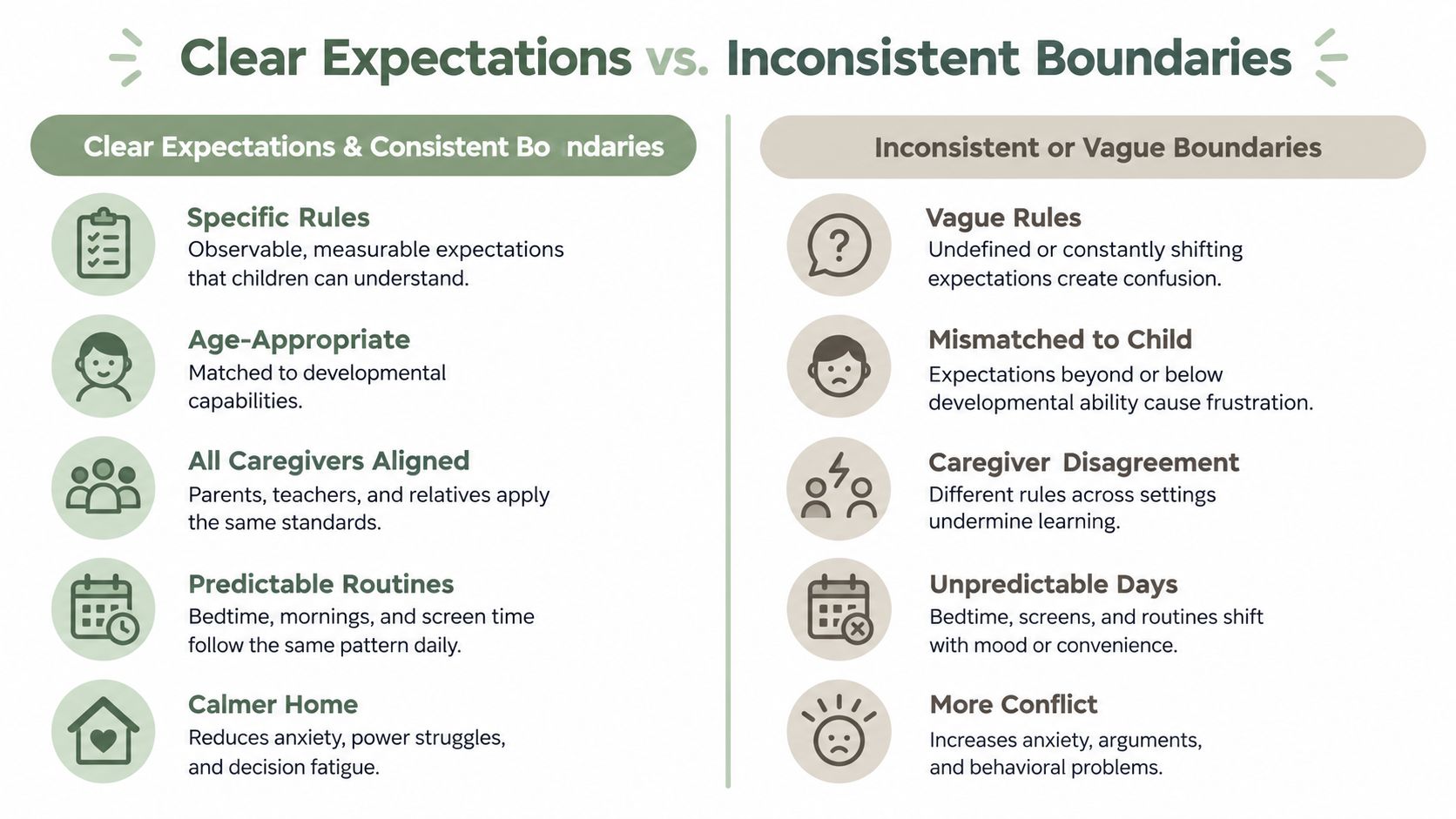
Ambiguous instructions invite repeated negotiation. “Get ready” requires a child to decide what ready means, which step comes first, and when the task is finished. A short sequence is easier to follow: breakfast, clothes, teeth, shoes, backpack.
Choose a small group of core rules and state them positively. “We use kind words and indoor voices” is more teachable than a list of forbidden behaviors. Show younger children pictures or a visual schedule. Practice the routine when nobody is rushing, rather than assuming the child already knows how to follow it.
Make the response predictable
A bedtime plan might specify dinner, bath, story, and lights out in a consistent order. A screen rule might require homework and chores before a defined period of screen access. If a child leaves bed, the adult returns them with minimal conversation instead of starting a new negotiation each time.
Consistency doesn't require identical responses in every circumstance. Illness, travel, family emergencies, and developmental changes may require flexibility. Keep the core boundary intact while adjusting the support. A child who struggles with executive functioning may need a timer, checklist, or adult prompt, not just a harsher consequence.
A boundary works best when the child can predict both the expectation and the adult response.
Discuss key rules with every caregiver. If one adult follows through and another repeatedly makes exceptions, the child receives mixed information and may continue testing the boundary. Review routines periodically and change them deliberately, not during an argument.
5. Apply Time-Out Carefully
Time-out removes access to attention or a rewarding activity after a clearly defined behavior. It can be useful for behaviors such as hitting when the child understands the rule, the location is safe, and the parent can respond without anger. It shouldn't become a place where a child is shamed, threatened, or isolated indefinitely.
Before using it, teach the routine. Identify the behavior and the response in simple language: “Hitting means time-out.” Use a boring, safe location without entertainment. Keep the adult's delivery brief and neutral, then avoid bargaining or extended discussion during the planned period unless safety requires intervention.
Know when it's a poor fit
Time-out is not appropriate for a child who is out of control and needs immediate co-regulation, nor is it a substitute for supervision during dangerous behavior. Don't use it for every act of noncompliance. Reserve it for a narrow set of behaviors and reinforce the alternative immediately afterward.
When the period ends, keep the return uneventful. Say, “Hitting hurts. We use safe hands,” then guide the child back to an appropriate activity. Don't demand an elaborate apology while the child is still upset. Later, practice asking for space, using words, or seeking adult help.
Planned ignoring may be suitable for minor attention-seeking behavior, but not for aggression, self-injury, unsafe climbing, running, or distress linked to anxiety or trauma. Pair any response-cost strategy with positive reinforcement, because removing attention alone doesn't teach what the child should do instead.
6. Listen Actively and Validate Emotion
A child who says, “I'm not going to school,” may be refusing, frightened, exhausted, embarrassed, or avoiding a difficult task. The first useful response isn't always a consequence. Put down the phone, listen, and reflect what you hear: “School feels scary right now. Tell me what worries you most.”
Validation acknowledges the emotion without approving harmful behavior. “You're angry that your brother entered your room. Hitting isn't acceptable” communicates both understanding and a limit. The same approach helps with bedtime separation anxiety, peer conflict, academic stress, and sibling resentment.
Listen before solving
Use open prompts such as “Tell me more” and “What happened next?” Avoid “Why did you do that?” when it sounds accusatory. Don't immediately dispute the child's interpretation or rush to fix the problem. A child often becomes more willing to consider a plan after feeling understood.
“Your feeling makes sense. Your behavior still has a boundary.”
Active listening also gives parents information about the function of behavior. Homework resistance may reflect task difficulty, fear of failure, fatigue, or a need for attention. Bedtime stalling may involve separation concerns rather than simple defiance. Once the child is heard, collaborate on a practical next step while maintaining the expectation.
Parents should model the same skill with their own emotions. Naming frustration, taking a pause, and returning to the conversation teaches regulation more effectively than demanding calm while shouting.
7. Use Extinction for Specific Attention-Seeking Behavior
Extinction means removing the reinforcement that maintains a behavior. If whining reliably produces negotiation, eye contact, or a snack, the parent stops providing that payoff while reinforcing an appropriate request. Unlike time-out, extinction doesn't remove the child. It changes the adult response.
Choose a behavior that's minor, clearly defined, and safe to ignore. Before starting, explain the plan in neutral language: “I'll listen when you use your regular voice. I won't answer whining.” Then keep your response brief and consistent. A parent at the store might remain nearby, avoid arguing about candy, and respond when the child asks appropriately.
Expect the pattern to test you
Behavior may intensify temporarily when the usual payoff disappears. If the parent gives in at that point, the child may learn that louder or longer behavior eventually works. All caregivers need the same plan, and parents should arrange practical support so they can remain calm.
Use extinction selectively. Don't ignore running toward traffic, hitting, threats, self-harm, destruction, or severe emotional distress. A toddler's tantrum may be ignored for attention while the parent stays close for safety, but unsafe actions require immediate intervention.
Reinforce the replacement behavior as soon as it appears. “You asked in a calm voice. I can answer that.” Keep a simple written record if the pattern is persistent, and review whether the behavior is attention-maintained. If the child is escaping a difficult task, extinction alone may increase distress because the underlying problem hasn't been addressed.
8. Solve Problems Collaboratively
Parents often try to solve a recurring problem in the middle of the crisis. That's usually too late. Collaborative problem-solving works better during a calm period, when the child can think, generate options, and participate in a plan.
Define the problem precisely. “Homework takes so long that bedtime gets delayed” gives the family something to address. “You're lazy” creates blame without identifying a solution. Ask what makes the task difficult, then brainstorm options without rejecting ideas too quickly.
Turn discussion into an experiment
For homework, possible plans might include starting with a short work period, using a visual checklist, completing the hardest task while attention is strongest, or taking a planned movement break. For sibling conflict, children might identify separate play areas, a turn-taking signal, or a rule for requesting a toy.
Let the child choose among reasonable options. Write the plan down and decide when you'll review it. Ask, “What worked, what didn't, and what should we change?” This creates ownership without handing the child responsibility for solving an adult-sized problem alone.
For anxiety or OCD-related avoidance, collaboration must not become endless reassurance or permission to avoid every feared situation. The child can help select a manageable step, while the parent maintains the broader therapeutic direction. Guidance on applying exposure principles belongs with a clinician when symptoms are severe, entrenched, or connected to trauma.
9. Address Avoidance With Exposure and Behavioral Activation
Avoidance often reduces distress immediately, which makes it easy for a family to repeat. A child misses school, feels temporary relief, and becomes more afraid of returning. A child with contamination fears avoids touching an object, then relies increasingly on avoidance or rituals. Exposure interrupts that cycle through gradual, planned contact with the feared situation while reducing escape and safety behaviors.
Create a fear hierarchy with the child. Start with a manageable step, not the most frightening situation. For school refusal, that might mean approaching the building, entering with a support plan, or remaining for a planned portion of the day. For separation anxiety, the parent may practice brief separations that expand gradually.
Keep the plan safe and specific
Use coping skills, encouragement, and predictable support, but don't promise that anxiety will disappear instantly. The child's task is to remain engaged despite discomfort and learn that fear can be tolerated. Progress may be uneven, so review the plan rather than abandoning it after one difficult attempt.
Behavioral activation applies a similar principle to low mood. Schedule valued activities, movement, social contact, or enjoyable tasks even when motivation is low. The activity should be realistic and connected to the child's interests, not presented as a demand to “cheer up.”
Parents shouldn't design intensive exposure independently for severe anxiety, OCD, trauma-related concerns, panic, or significant school refusal. The guide to exposure therapy for children can provide context, but individualized clinical guidance is important when avoidance significantly disrupts school, sleep, relationships, or safety.
10. Build a Consistent Sleep Plan
Bedtime behavior often reflects a learned pattern. If repeated requests produce extra stories, extended conversations, or access to a parent's bed, stalling can continue even when the child is tired. A predictable routine reduces negotiation and gives the child repeated cues that sleep is approaching.
Build the wind-down sequence around calming activities such as bathing, reading, quiet play, or cuddling. Use a visual schedule for younger children. Keep the room comfortable, dark, and quiet, and reduce stimulating activities before bed. Introduce changes gradually if the current routine is chaotic.
Respond to stalling the same way
Agree in advance on what happens after lights-out. A parent might return a child to bed with minimal conversation, offer one planned check-in, or use a quiet visual cue. The exact plan should match the child's age, sleep needs, medical context, and family capacity. It must also be realistic enough for every caregiver to follow.
Avoid turning bedtime into punishment. Warmth and structure work together. Validate fear or sadness, then maintain the sleep expectation: “You don't want me to leave, and I'll check on you after the timer. It's still time to stay in bed.”
For persistent resistance, night waking, anxiety, or a routine that repeatedly fails, review how to solve your child's sleep problems and seek professional input when sleep disruption affects daytime functioning or family safety.
10 Parenting Behavior Strategies Comparison
| Strategy | Implementation 🔄 (Complexity) | Resources ⚡ (Requirements / Time) | Expected outcomes ⭐ (Effectiveness) | Ideal use cases 📊 (Impact / Use cases) | Key advantages 💡 (Brief insight / tip) | |---|---:|---:|---:|---|---| | Positive Reinforcement | Low, Moderate, needs immediate, consistent application | Low, small rewards, parent attention, tracking system | ⭐⭐⭐⭐, increases desired behavior, motivation over time | Routines, homework, ADHD, sleep, noncompliance | Strengthens relationship; reinforce specific observable behaviors | | Natural & Logical Consequences | Moderate, requires judgment and advance planning | Low, Moderate, monitoring, caregiver restraint | ⭐⭐⭐, teaches responsibility; slower to change behavior | Forgetfulness (lunch/homework), broken items, chores, noncompliance | Links action to outcome; ensure safety and calm delivery | | Time-In (Connection-Based) | Moderate, High, parent must co-regulate and stay present | High, sustained parent presence, emotional regulation skills | ⭐⭐⭐, improves attachment and emotional regulation | Tantrums, separation anxiety, emotional dysregulation, trauma | Builds trust and regulation skills; avoid lecturing during the time-in | | Clear Expectations & Consistent Boundaries | Moderate, requires caregiver alignment and planning | Moderate, writing rules, visual aids, family meetings | ⭐⭐⭐⭐, reduces anxiety and power struggles | Sleep routines, mornings, ADHD, transitions, school behavior | Predictability reduces conflict; limit rules to core 3, 5 items | | Time-Out (Planned Ignoring) | Low, Moderate, brief, calm, clearly linked to behavior | Low, timer, boring safe spot, caregiver consistency | ⭐⭐⭐, reduces attention-seeking/aggression when used correctly | Hitting, defiance, targeted aggressive behaviors | Quick and low-emotion when consistent; combine with reinforcement | | Active Listening & Emotion Validation | Moderate, High, requires empathy and practice | Moderate, time, focused attention, modeling skills | ⭐⭐⭐⭐, decreases outbursts; builds trust and emotion vocabulary | Anxiety, depression, emotional dysregulation, peer conflict | Validate feelings first, then problem-solve; avoid immediate fixing | | Extinction (Systematic Ignoring) | High, demands absolute consistency across caregivers | High, sustained non-response, tracking, readiness for bursts | ⭐⭐⭐, effective for attention-maintained behaviors over weeks | Whining, attention-seeking tantrums, stalling behaviors | Expect extinction burst; reinforce alternative appropriate bids | | Problem-Solving & Collaborative Discussion | Moderate, High, time-intensive; requires parental flexibility | Moderate, calm sessions, note-taking, follow-up | ⭐⭐⭐⭐, builds buy-in, decision-making, long-term cooperation | School refusal, homework resistance, sibling conflict, adolescents | Use calm times; brainstorm, choose, implement, and review solutions | | Exposure & Behavioral Activation | High, carefully paced; often needs professional guidance | High, graded exposures, parent coaching, repeated practice | ⭐⭐⭐⭐⭐, gold-standard for anxiety/OCD; restores functioning | School refusal, OCD, separation anxiety, panic, depression | Build a fear hierarchy; start moderately and prevent avoidance | | Sleep Hygiene & Bedtime Consistency | Moderate, requires nightly consistency and environment changes | Moderate, routine time, environment adjustments, caregiver buy-in | ⭐⭐⭐⭐, improves sleep quality, daytime behavior, mood | Bedtime resistance, sleep onset problems, daytime behavior issues | Keep bedtime within 15 minutes nightly; use calm wind-down rituals |
Turn Ten Techniques Into One Consistent Plan
Ten strategies are more than most families can implement at once. Choose one clearly defined target behavior first. “Morning resistance” is a pattern, not a target. “Puts on clothes within ten minutes of the visual prompt” is measurable and easier to reinforce.
Then identify the replacement skill. If your child yells for help with homework, the replacement might be asking for a break or pointing to a help card. If bedtime stalling is the problem, the replacement might be completing a final request before lights-out and using a quiet coping routine afterward. Reinforce the replacement immediately when it occurs, even if the child's performance is imperfect.
Write down the adult response. Include what happens before the behavior, what the child does, what the parent says, and what follows. This can reveal whether the behavior is gaining attention, avoiding a task, accessing a preferred activity, or expressing distress. It also helps caregivers respond consistently instead of improvising under pressure.
Review progress over time. Don't change the entire plan after one difficult evening. Ask whether the target was clear, whether the reward mattered to the child, whether the demand was developmentally appropriate, and whether every caregiver followed the agreement. Parent training research supports this structured approach. A later meta-analysis found that behavioral parent training benefits for ADHD-related behavior problems and parent-child relationships continued for at least five months after treatment, as summarized in the 2023 review of behavioral parent training.
Keep safety boundaries explicit
Planned ignoring and time-out aren't appropriate for unsafe behavior. Intervene immediately when a child is hitting, running into danger, threatening self-harm, destroying property in a dangerous way, or unable to remain safe. Time-in, environmental changes, crisis support, and professional assessment may be more appropriate.
Exposure should be professionally guided when anxiety is severe or connected to OCD, trauma, panic, or substantial school refusal. Sleep disruption, mood concerns, developmental differences, ADHD-related behavior, and repeated aggression can also require more than a generic home plan.
Recent evidence continues to support structured, coached parent interventions, but fit matters. A meta-analysis reported medium effects for standard PMT on parent-rated disruptive behavior, larger effects for PCIT, and improvements in parental skills and child social skills in the cited measures. The meta-analysis of PMT and PCIT outcomes also illustrates why coached practice can be more useful than a list of techniques alone.
Wald Behavioral Health supports families dealing with sleep problems, tantrums, school refusal, noncompliance, separation anxiety, ADHD-related behavior, OCD, depression, and other mood concerns. Families can explore parent training, in-person care in Coral Gables, and telehealth where available, including a free 15-minute consultation to discuss fit and scheduling.
---
Wald Behavioral Health provides individualized parent training, child and adolescent therapy, structured home plans, and family guidance for behavior, sleep, anxiety, OCD, ADHD, and mood concerns. Visit Wald Behavioral Health to explore in-person care in Coral Gables or telehealth options where available, and request a free 15-minute consultation.
Questions about your child or teen?
Dr. Wald offers a free 15 minute consultation to talk through what you are seeing and whether the practice is a good fit.
Free 15 Minute Consultation