School Refusal Help for Parents: A Practical Action Plan
By 7:45 on Monday morning, your child may be sitting on the hallway floor with an untouched backpack nearby, while you weigh consequences against the panic on their face. You've tried reassurance, threats, bargaining, bribery, and perhaps carrying them to the car. None of it has solved the problem, and every morning feels more urgent than the last.
Effective school refusal help for parents starts here. You need a plan that addresses your child's distress, your own nervous system, the family habits that may be reinforcing avoidance, and the school's response. Shame won't get your child through the gate. Calm structure, rapid coordination, and carefully graded steps can.
## Table of Contents - When the Mornings Break Down - Reading the Signals Behind the Refusal - What to Do in the First 72 Hours - Morning - School - Evening - Building a Graded Return-to-School Plan - Rules that keep the ladder useful - Working With the School Without Losing Ground - Reducing Family Accommodation and Caring for Yourself - Take the caregiver self-check - When and How to Get Professional Help - Choose the right starting point - Your one-page parent checklist
When the Mornings Break Down
Your child isn't moving. The uniform is on, perhaps, but the shoes are missing. The lunchbox is packed, yet the backpack remains untouched. You're looking at the clock and calculating whether a consequence will motivate them or push them further into panic.
Name the pattern accurately: school refusal is distress-driven avoidance, not laziness, bad character, or a normal phase that will inevitably disappear. Clinical sources estimate that about 1% to 5% of school-age children experience school refusal, with higher risk around transitions such as starting school or entering early adolescence (clinical overview of school refusal). It differs from truancy, where a child may skip school without the parent's knowledge, and from an occasional sick day. In school refusal, the child often wants to attend but feels unable to tolerate what attendance represents.
The cycle is straightforward:
- A trigger appears. It may be separation, a test, bullying, sensory overload, a difficult class, or fear of failure.
- Anxiety spikes. The child experiences panic, anger, stomach pain, nausea, tears, or shutdown.
- The child escapes. They stay home, leave class, or delay departure.
- Relief arrives. The distress drops quickly, teaching the brain that avoidance works.
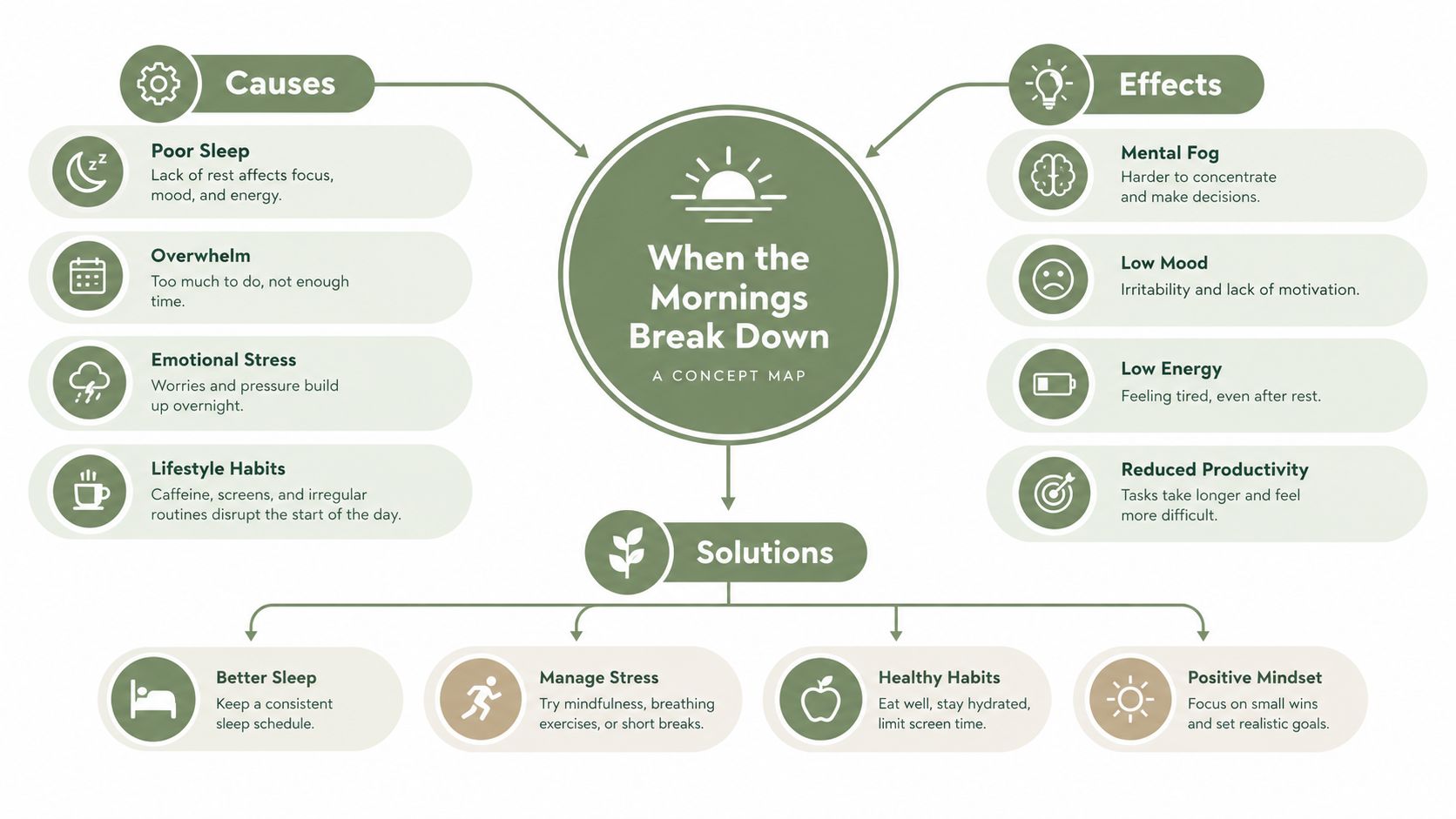
Every additional day at home can make the next return feel larger. The answer isn't to overpower a panicked child, but it also isn't to let panic make the attendance decision indefinitely. You're the steady co-regulator, not a warden and not your child's therapist. Your job is to lower arousal, keep the message brief, and interrupt escape with a practical return step.
Practical rule: Validate the feeling without validating the conclusion. “I know this feels frightening. School is still part of today's plan.”
If your child is autistic or has a strong need for autonomy, collaborative problem-solving may be especially important. A resource on collaborative autism support can help you think about demands, autonomy, and regulation without turning every morning into a power struggle. Also check whether sleep disruption is worsening morning arousal by reviewing this guide to sleep problems in teens.
The rest of this guide gives you a labeling tool, a first-72-hours protocol, a graded return plan, school-collaboration language, and a parent self-check. You don't need perfect words. You need a response that stays consistent when your child's distress rises.
Reading the Signals Behind the Refusal
Before you choose a strategy, identify what you can observe. School refusal may involve anxiety, depression, demand avoidance, social danger, learning needs, or practical barriers. These drivers overlap, so labeling isn't a diagnosis. It tells you which lever to pull first.
Research links school refusal with parental psychopathology, depressive symptoms, anxiety symptoms, family functioning, and maternal overprotection, which is one reason the home response belongs in the treatment plan (review of parent factors and school refusal).
| Driver | Key Behavior Cues | What to Try First | |---|---|---| | Anxiety-driven refusal | Morning stomachaches or headaches, nausea that eases after staying home, catastrophic predictions about tests or separation, visible panic, repeated reassurance seeking | Reduce lengthy reassurance, use a predictable departure script, and arrange a gradual exposure plan with the school | | Depression-driven refusal | Low mood, withdrawal from friends, loss of interest, changes in sleep or appetite, slowed behavior, comments such as “What's the point?” | Contact a pediatrician or mental-health professional and ask for assessment of mood, safety, and functioning | | Avoidance-driven refusal | Escape from particular assignments, transitions, teachers, subjects, or school settings, anger when demands appear, fear of failure, repeated delay tactics | Find the exact demand being escaped and break it into smaller steps while maintaining a firm attendance expectation | | Social or functional issues | Fear of a peer, reports of bullying, noise or crowd sensitivity, confusion about work, unexplained academic decline, distress after grief or family disruption | Investigate safety, learning, sensory, transport, housing, and family factors with school staff and relevant professionals |
Anxiety often speaks through the body. Depression tends to flatten the child's energy and interest beyond school hours. Avoidance can look oppositional, but the behavior may be an attempt to escape a task that feels impossible. Social or functional refusal requires environmental change, not just coping skills.
Ask concrete questions instead of demanding an explanation during a meltdown. “Is the hardest part leaving me, entering the building, a specific class, the noise, the work, or someone there?” Let your child point, draw, or choose from options if direct conversation fails.
If distress is acute or escalating, or if your child mentions self-harm or suicide, skip the labeling exercise. Seek immediate professional help and use emergency services or a crisis resource appropriate to your location when safety is at risk.
What to Do in the First 72 Hours
The first response after a refusal episode shapes what happens next. Your target is brief validation followed by a real return step, preferably the same day. A full absence may sometimes be unavoidable, but it shouldn't become the default response to distress.
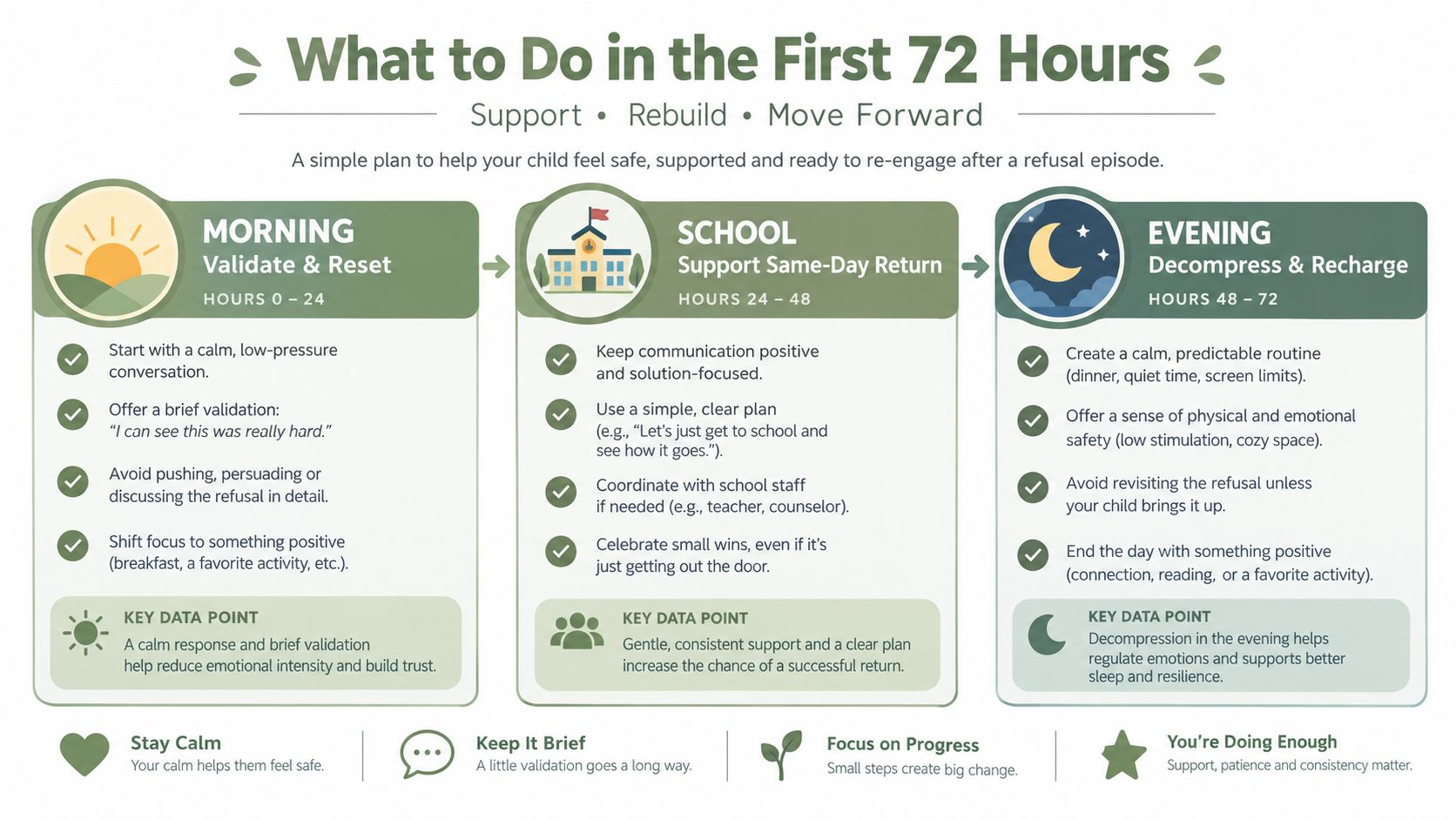
Morning
State the plan at least 30 minutes before departure. Keep your language short: “I know this is hard, and we're going.” Don't open a courtroom debate about whether anxiety is a sufficient reason to stay home. Put clothes, breakfast, medication if prescribed, and the backpack in the same sequence each morning.
Prepare a transition object or message. It might be a note in the lunchbox, a small item kept in a pocket, or a text scheduled for 10 a.m. The object isn't a reward for avoidance. It's a bridge between home and school.
Set a cutoff before emotions peak. For example: “If you aren't in the car by 8:00, I'll help you, and we're still going.” If the child can't leave, move to the smallest same-day attendance step the school can support, such as arriving late for a check-in or attending one class.
School
Send a one-sentence heads-up: “Jordan is experiencing significant school anxiety this morning, and we're bringing them in for a supported re-entry.” Ask for a calm check-in with a designated adult, a discreet entrance, and a clear first activity. A late arrival is usually more useful than allowing the entire day to disappear.
Avoid making the school arrival a public event. A teacher announcement, crowded office, or disciplinary interrogation can turn re-entry into another trigger. The school should know what happened, but your child doesn't need to explain everything at the door.
Evening
Keep bedtime and wake time as steady as possible. Don't offer unlimited screens or a special day at home as compensation for refusing school. Later, hold a 10-minute check-in with open questions: “What part was hardest?” “What helped even a little?” “What should we change tomorrow?”
Teaching children critical thinking and problem-solving can support these conversations over time, but don't turn a crisis morning into a lesson. Your immediate task is regulation and follow-through. For children whose main trigger is separation, this guide to helping a child with separation anxiety may offer useful complementary strategies.
A seven-year-old might say, “My stomach hurts. I can't go.” You can answer: “I believe your stomach hurts. Anxiety can make your body feel sick. We're going to put on your shoes, get in the car, and meet Ms. Rivera at the office. You can carry your note in your pocket.” That response acknowledges the symptom without making the symptom the decision-maker.
Within 48 hours, every refused day should be replaced by a smaller but real school step, such as a half day, a 90-minute visit, or the lunch period. Attendance rebuilds through repeated contact, not through waiting for fear to vanish.
Building a Graded Return-to-School Plan
A graded return is not giving in. It's planned exposure, meaning your child approaches a feared situation in manageable steps and learns that they can remain present without escaping. The parent and school decide the steps when everyone is calm. Nobody negotiates the next rung during a morning panic.
Consider a nine-year-old who has avoided school for two weeks. A reasonable ladder might look like this:
- Sit in the car for five minutes with the engine off.
- Ride to school and walk to the office.
- Enter the lobby and meet a designated adult.
- Attend the first period.
- Attend the full morning.
- Attend a full school day.
The exact ladder depends on the trigger. A child frightened by separation may need a brief, consistent goodbye. A child overwhelmed by noise may need an early arrival and a quiet entrance. A child avoiding academic failure may need a reduced first assignment and a teacher check-in.
Rules that keep the ladder useful
Each step should be short, repeatable, and parent-supported. Repeat a rung until the child can complete it with less struggle, then move upward according to the written plan. Don't promise that the child can go home the instant anxiety rises. Arrange a safe break with a defined return point instead.
Pair each completed step with a small, predictable reward earned that day. Choose something connected to effort, such as choosing dinner music, playing a board game with a parent, or selecting the weekend breakfast. The reward shouldn't be so large that it turns attendance into a desperate negotiation.
Setbacks are data, not failure. Return to the last successful rung, adjust the step, and try again. Don't collapse the plan into indefinite home attendance.
Track four items in a simple notebook or shared document:
- Rung attempted: Record the exact step, not “had a better day.”
- Arrival and departure: Note when the child entered and how long they stayed.
- Distress before and after: Use a simple low, medium, or high rating.
- What helped: Record the adult, accommodation, activity, or transition that made attendance possible.
This record gives the school something concrete to review and helps you distinguish a difficult day from a failing plan. It also prevents memory from being dominated by the loudest morning.
Use a written exposure plan rather than relying on motivation. Guidance on exposure therapy for children can help you understand why gradual contact works best when adults avoid both abrupt forcing and endless retreat.
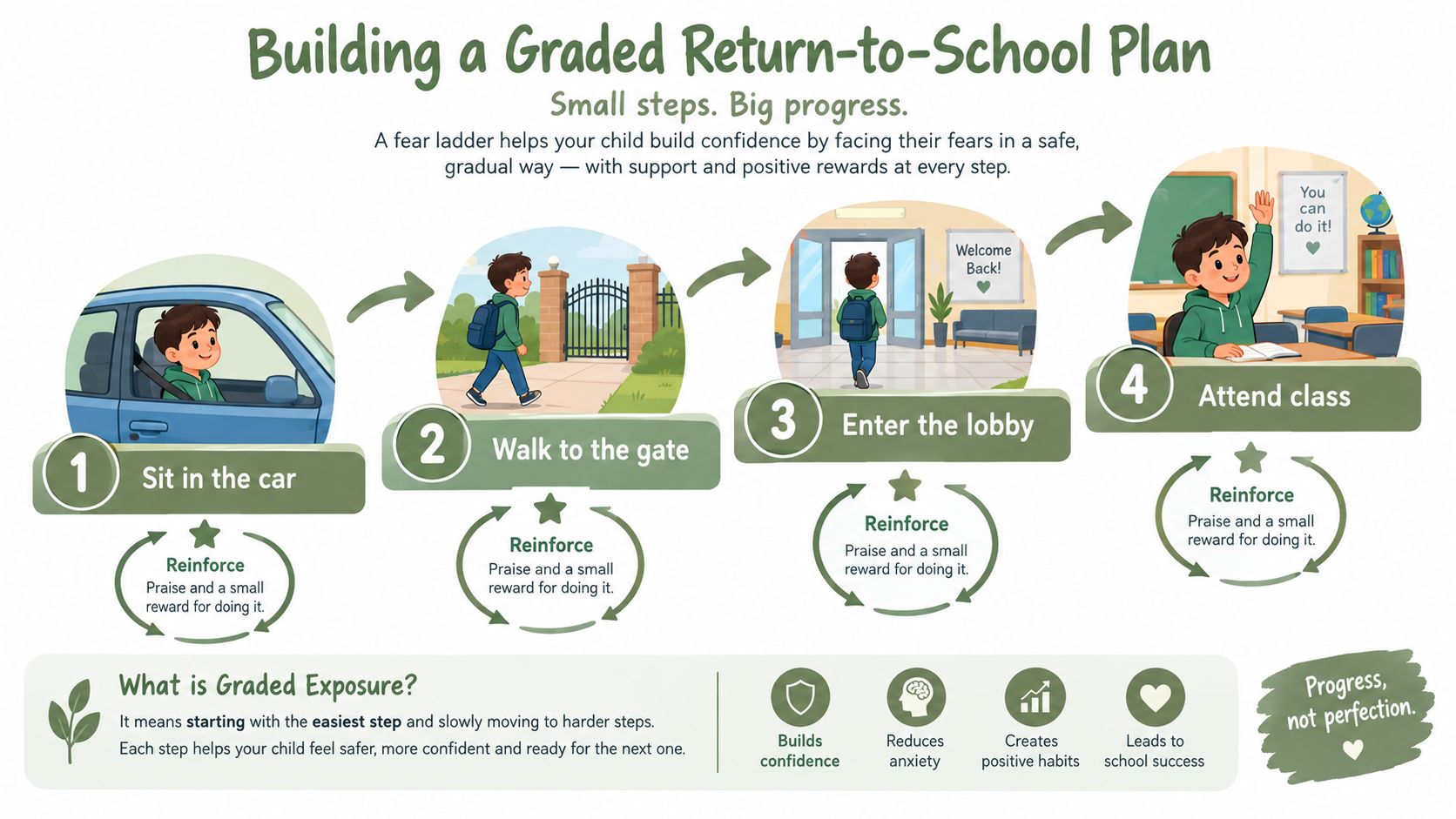
A short visual explanation can help your child understand the sequence without another long discussion.
Working With the School Without Losing Ground
A school meeting should produce a coordinated response, not a new stack of warnings. Write first: “My child is experiencing distress-driven school refusal. I'm requesting a meeting with the teacher, counselor or pastoral lead, and the relevant special-education contact to create a supported attendance plan.”
Bring a short timeline. Include when refusal began, what happens before departure, physical symptoms, subjects or settings linked to distress, and what has helped. Ask the school to share what staff see after arrival. Your child may look composed at home and shut down in class, or the reverse.
Request specific supports rather than general kindness:
- A designated adult: One person meets your child at arrival and checks in at a predictable time.
- A discreet entry: Your child enters through a calm route rather than being questioned publicly.
- A safe break space: The space has a time limit, an adult, and a plan for returning to learning.
- A re-entry workload: Teachers pause nonessential homework while attendance is being rebuilt.
- Peer connection: A carefully chosen buddy or staff-supported social contact reduces isolation.
- Transition support: A visual schedule, advance warning, or adult escort may help between classes.
In the United States, ask whether a Section 504 plan or another formal accommodation process applies when anxiety substantially affects school access. Possible supports include flexible arrival, a quiet testing location, a break-and-return procedure, reduced initial workload, and a designated check-in. The school's eligibility process determines what can be formalized, so document your request and ask for the school's written procedure.
After every meeting, send a brief email: “Today we agreed that Ms. Chen will meet Alex at the side entrance, Alex may use the counseling office for a defined break, and the team will review attendance and distress at the next meeting.” Keep copies of emails, attendance records, work demands, and responses.
If the school defaults to punishment, an attendance contract, or a referral to a punitive attendance body, stay direct: “We are addressing attendance, but punishment alone does not address the documented distress. Please identify the mental-health, safety, learning, and disability supports being offered and put the plan in writing.” If the response remains inadequate, escalate through the counselor, special-education lead, principal, district student-services office, or an independent education advocate while keeping communication factual.
Chronic absenteeism is a broad attendance problem, and it can have multiple medical, psychological, family, and social causes. In the United States, it remained 27.8% during the 2022-23 school year, while school refusal is estimated at 2% to 5% of school-aged children, according to the American Academy of Family Physicians review. Those figures support coordinated problem-solving, not a one-size-fits-all punishment response.
Reducing Family Accommodation and Caring for Yourself
Your regulation is not background support. It is part of the intervention.
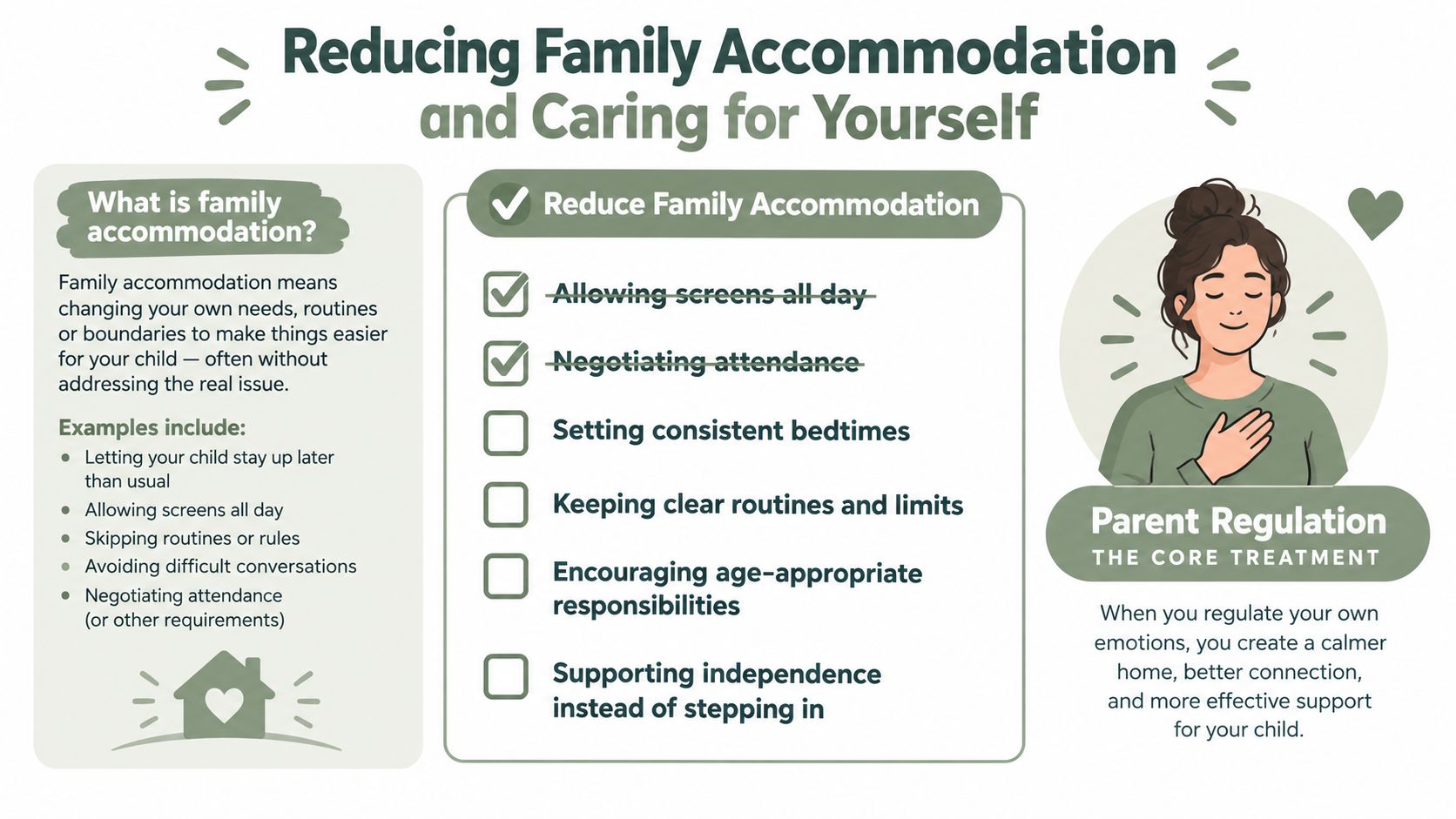
Family accommodation means changing family life to prevent or reduce your child's distress. You may allow screens all day, negotiate one more day off, complete missed work, sleep in your child's bed, cancel family events, answer the same reassurance question repeatedly, or remove every uncomfortable demand. You're doing these things because your child is suffering, not because you're careless.
The problem is that accommodation often produces immediate calm while making future avoidance easier. If staying home reliably brings unlimited entertainment, rescued assignments, and relief from every demand, the brain learns that escape is the safest available solution. The answer isn't to withdraw warmth. It's to stop making avoidance more rewarding than participation.
A 2022 review identified reliable links between school refusal and parental mental-health symptoms, family functioning, and overprotection. Recent research also describes stress, strained relationships, financial pressure, and a need for support among parents affected by children's regular absences (research on parents' mental health and school absence).
Take the caregiver self-check
Ask yourself:
- Am I sleeping poorly because I'm anticipating the next morning?
- Am I more irritable, frightened, or emotionally numb than usual?
- Do I dread school nights and avoid making plans?
- Has this created serious conflict with my partner or other children?
- Am I handling every school email and crisis alone?
- Have I stopped eating, exercising, working, or seeing supportive people?
A “yes” doesn't mean you caused the refusal. It means your family needs more support and fewer impossible expectations placed on one exhausted adult.
Set three firm parent moves. Take one daily break, even if it's brief. Tell one trusted adult the unedited truth about what mornings are like. Write down what the family will and won't do, such as “We will offer comfort and a planned break, but we won't provide all-day gaming after a missed school day.”
You can be compassionate without being endlessly available. Your child needs a calm adult who can tolerate distress without reorganizing the entire household around escape.
When and How to Get Professional Help
Call a professional when refusal keeps recurring, when your child's physical or emotional symptoms are escalating, when sleep or weight is changing, or when the family can no longer maintain ordinary routines. Don't wait for the school to label the problem or for your child to become completely unable to leave home.
Any mention of suicide or self-harm requires immediate safety action. Stay with your child, remove access to immediate means where you can do so safely, contact emergency services or a crisis service in your location, and seek urgent clinical evaluation. A child who says they don't want to live needs a safety response, not a school-attendance lecture.
Choose the right starting point
Start with the pediatrician when symptoms include recurring stomach pain, headaches, sleep changes, appetite changes, panic, low mood, medication questions, or uncertainty about medical causes. Ask for a mental-health referral and explain the attendance pattern clearly.
Choose an outpatient child psychologist or social worker when anxiety, depression, separation distress, bullying, learning difficulties, ADHD, or avoidance is driving impairment. Look for training in cognitive behavioral therapy, exposure-based interventions, parent training, and family work. Effective care should produce a home plan, not only private conversations with the child.
Consider higher-level care when the child is unsafe, unable to function across settings, severely depressed, or unable to participate in ordinary outpatient treatment. Intensive outpatient care, partial hospitalization, psychiatric evaluation, or coordinated medical and school support may be appropriate depending on risk and clinical findings.
A good first assessment should cover the developmental and anxiety history, a school-attendance timeline, mood and safety, learning and sensory needs, bullying or social concerns, family functioning, and the accommodations currently used at home. The clinician should speak with parents and, when appropriate, the child and school. Parent involvement isn't an optional extra. A systematic review found that interventions often fail to bring attendance to required levels without caregiver participation and identified reliable links with parental mental-health symptoms and family functioning (systematic review of parent factors in school refusal).
Your one-page parent checklist
Morning protocol
- Name the plan early and validate briefly.
- Keep clothing, breakfast, backpack, and departure steps predictable.
- Use a transition note, object, or scheduled check-in.
- Avoid negotiating attendance during panic.
- Arrange same-day school contact whenever possible.
Fear-ladder template
- Write the smallest real school step.
- Repeat it until it becomes manageable.
- Pair completion with a modest same-day reward.
- Move upward only according to the plan.
- After a setback, return to the last successful rung.
Accommodation items to reduce
- All-day screens after refusal.
- Repeated “one more day” negotiations.
- Completing all missed work for the child.
- Canceling every family activity.
- Endless reassurance without a return step.
School-meeting requests
- A designated arrival adult.
- A discreet entrance and check-in.
- A defined break space with a return plan.
- Temporary workload adjustments.
- Peer or staff support.
- Written documentation and a scheduled review.
Burnout self-check
- Sleep disruption.
- Irritability or dread.
- Relationship strain.
- Isolation.
- Loss of work, exercise, or ordinary routines.
- No reliable adult support.
Immediate escalation rule
If your child mentions suicide or self-harm, appears unsafe, or has rapidly worsening symptoms, stop working through the attendance plan and seek urgent professional help.
---
Wald Behavioral Health provides parent training and structured home plans for school refusal, anxiety, separation, sleep, and related family challenges, with in-person care in Coral Gables and telehealth across Florida, Maryland, and participating PSYPACT states. Visit Wald Behavioral Health to request a free 15-minute consultation and discuss the right next step for your family.
Questions about your child or teen?
Dr. Wald offers a free 15 minute consultation to talk through what you are seeing and whether the practice is a good fit.
Free 15 Minute Consultation