Sleep Problems in Teens: Causes and Solutions
The most popular advice about sleep problems in teens is also the most incomplete: take away the phone. A phone can delay bedtime, interrupt sleep, and keep a worried teenager mentally engaged, but removing it doesn't automatically make a tired adolescent sleepy at 9:00 p.m. or make an early school bell biologically reasonable.
Teen sleep loss usually reflects several pressures working together. Puberty shifts the internal body clock later, school schedules demand early rising, homework and activities extend the evening, and weekend freedom can create a large gap between school-day and weekend routines. Screens may add to the problem, but treating them as the entire explanation can leave families blaming one another while the schedule remains unchanged.
The scale of the problem supports a broader view. In 2015, 72.7% of U.S. high school students slept less than the recommended 8 hours on school nights, while only 27.3% met that target, according to CDC information on adolescent sleep. More recent CDC surveillance found that only 23% of U.S. high school students got at least 8 hours on an average school night in 2023 (CDC sleep facts and statistics).
Parents need practical boundaries, but they also need an accurate explanation. When a teenager's sleep is understood as a combination of biology, environment, habits, and emotional health, the family can replace nightly arguments with targeted changes.
## Table of Contents - Rethinking the Root Causes of Teen Sleep Loss - A wider sleep assessment - Biological Delays and Environmental Mismatches - Why early mornings feel so harsh - Recognizing the Hidden Signs of Sleep Deprivation - A practical pattern to watch - The Impact of Social Jet Lag and Weekend Catch-Up - Duration and regularity are different questions - Evidence-Based Sleep Hygiene Strategies for Teens - Build a reliable timing signal - Make the bedroom support sleep - Address stimulation beyond screens - When to Seek Professional Help and Therapy Options - What CBT-I actually does - Match the treatment to the driver - Building a Sustainable Sleep Routine as a Family - Make setbacks part of the plan
Rethinking the Root Causes of Teen Sleep Loss
A teenager who scrolls late into the night may be making sleep harder, but that doesn't prove the phone caused the entire sleep problem. The device might be filling an otherwise uncomfortable hour in which the teen is wide awake, anxious about tomorrow, catching up with friends, or avoiding the pressure of an early morning.
Sleep loss has also spread across different demographic groups, which makes a single-device explanation too narrow. Recent reporting cited a rise in the share of U.S. high school students getting under seven hours, from 69% to 77% by 2023, and described broader contributors such as school schedules, social jet lag, and family routines (NPR's coverage of teen sleep and screen time). The important lesson isn't that phones are harmless. It's that parents should investigate the whole pattern before choosing one target for punishment.
A wider sleep assessment
Ask questions that reveal timing and context:
- Bedtime: When does your teen become sleepy, not when do they enter the bedroom?
- Wake time: What time must they get up for school, transportation, or family responsibilities?
- Weekend pattern: How different are Saturday and Sunday sleep times from the school-week schedule?
- Mental load: Does worry, perfectionism, conflict, or school pressure keep the mind active?
- Daytime functioning: Is your teen struggling with attention, motivation, mood, or physical complaints?
This approach doesn't remove parental responsibility. It improves it. A family can still set a charging location outside the bedroom, but it can also address a school start time that conflicts with the adolescent body clock, a demanding activity schedule, or anxiety that becomes loud only after the lights go out.
A more useful question: What keeps this teenager awake, and what makes waking so difficult?
The goal isn't to excuse every late night. The goal is to stop confusing a developmental sleep pattern with defiance. Once parents identify the main contributors, they can choose interventions that match the problem instead of repeating a generic screen-time rule that may not be enough.
Biological Delays and Environmental Mismatches
A teen who cannot fall asleep early may be following biology, not rejecting a family rule. During adolescence, the internal clock usually shifts later. The American Academy of Pediatrics notes that many adolescents cannot fall asleep before about 11:00 p.m., while their bodies may be better prepared to wake at 8:00 a.m. or later. Yet many schools begin before 8:30 a.m. (AAP guidance on school start times for adolescents).
The circadian system acts like an internal timetable for sleep and alertness. In childhood, a 9:00 p.m. bedtime may fit that timetable. After puberty, the same schedule can feel like asking someone to sleep during the afternoon. A teen may lie in bed without producing restorative sleep, because physical stillness and biological readiness are different things.
Why early mornings feel so harsh
The mismatch becomes easier to see when the two schedules are placed side by side:
| Internal timing | External demand | |---|---| | Sleepiness may arrive around 11:00 p.m. | The family may expect lights out much earlier | | The body may be better prepared to wake around 8:00 a.m. or later | School transportation may require an alarm before sunrise | | Adolescents need 8, 10 hours per night | Early starts can leave too little time for that range |
The AAP connects this schedule conflict with shorter sleep, daytime sleepiness, concentration difficulties, behavior problems, absenteeism, and poorer mental health outcomes. Its policy guidance describes delayed school start times as a modifiable factor and gives 8.5, 9.5 hours nightly for most teens as a practical target. This is a system problem as well as a household problem. A teen can follow a reasonable bedtime routine and still lose sleep when transportation and school demands begin before the body is ready.
Parents still have useful options. Morning light, a predictable wake time, less evening stimulation, and gradual schedule changes can provide clearer timing signals. These steps support the body clock, but discipline alone cannot erase a developmental delay.
Attention difficulties can add another layer. A teen who seems lazy may instead struggle with organization, starting tasks, or shifting between activities. Parents may find it useful to review information about ADHD and related challenges when sleep and executive-function problems overlap.
A steady schedule works best when paired with compassion. The aim is to set consistent expectations while recognizing that a developing circadian system, early school demands, and daily obligations may all be shaping the struggle.
Recognizing the Hidden Signs of Sleep Deprivation
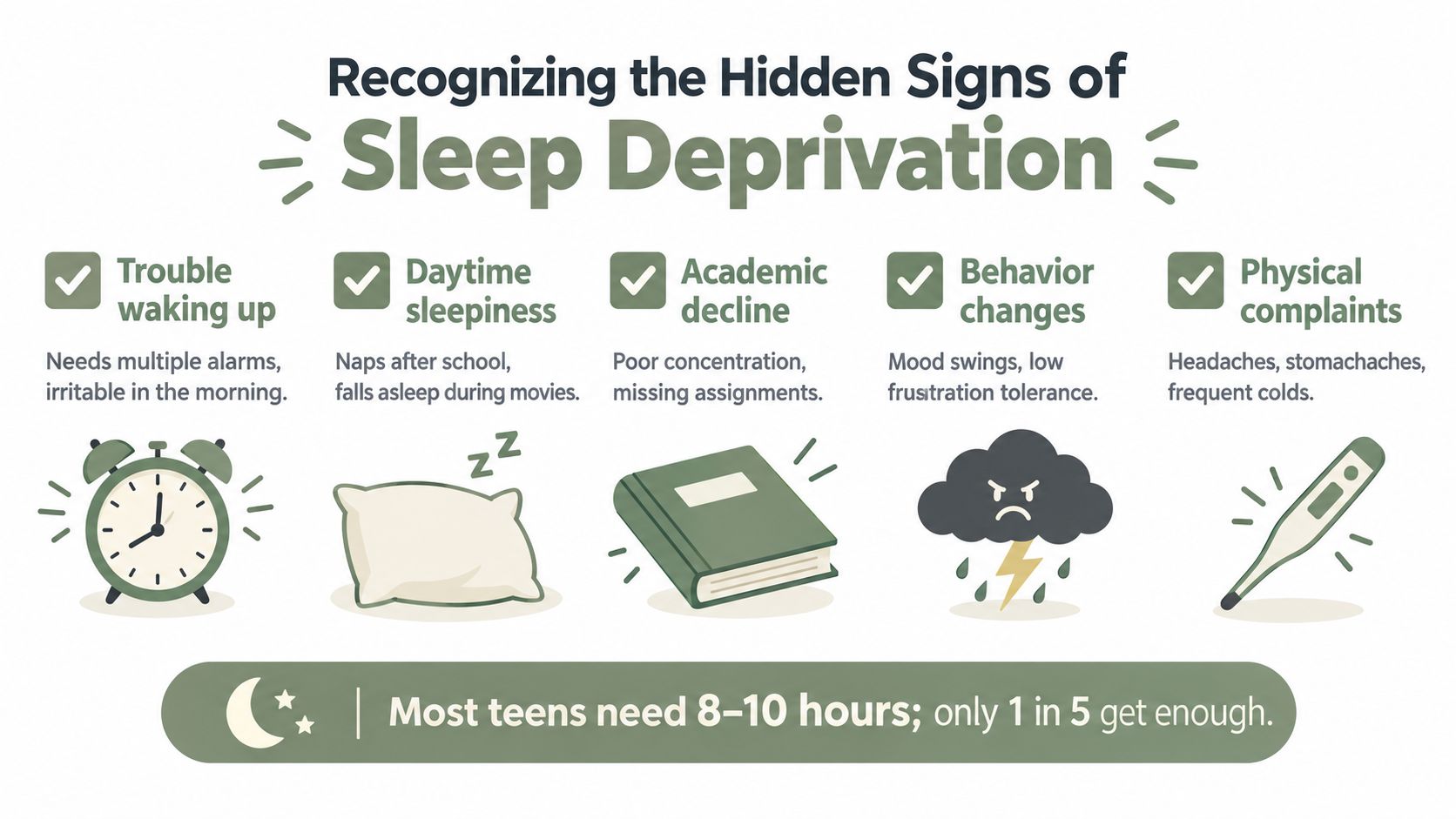
Sleep deprivation in teenagers does not always look like sleepiness. A teen may nod off during a film, nap soon after school, or need several alarms, but many show the problem through behavior and emotions instead. That difference can make tiredness look like defiance, laziness, or “ordinary adolescence.”
A chronically tired teen may become irritable rather than drowsy. Small requests trigger arguments, patience with siblings disappears, and assignments are abandoned. Some adolescents become tearful or anxious. Others look restless, impulsive, emotionally flat, or unusually unmotivated. Short sleep reduces the ability to pause before reacting, so a minor frustration can produce a response that seems far larger than the event.
A practical pattern to watch
Look for changes across several settings, not one difficult morning.
- Morning functioning: Your teen repeatedly struggles to get out of bed, misses preparation steps, or becomes highly distressed before school.
- Learning: Teachers notice reduced concentration, incomplete work, forgetfulness, or less participation.
- Mood: Irritability, emotional swings, low frustration tolerance, or withdrawal occur alongside shortened sleep.
- Body signals: Headaches, stomach discomfort, feeling unwell, or a persistent need to sleep after school becomes part of the weekly pattern.
- Motivation: Activities that once mattered now feel exhausting rather than merely boring.
These signs do not show that sleep is the only cause. Anxiety, depression, ADHD, medical conditions, and school stress can also affect sleep and daytime behavior. Sleep loss may intensify them, creating a cycle: worry delays sleep, short sleep weakens emotional control, and the resulting conflict adds more worry the next evening.
The CDC describes insufficient sleep among high school students as connected with poorer mood regulation and higher-risk behaviors (CDC guidance on students and sleep). This broader context matters when a parent hears, “I'm fine,” while seeing a teen who cannot focus, wake reliably, or tolerate ordinary demands. The pattern may reflect a mismatch between biology and school timing, not screen use alone.
Track bedtime, estimated sleep onset, wake time, naps, caffeine, mood, and school functioning for several days. This record can show whether the main issue is too little opportunity, delayed timing, fragmented sleep, emotional distress, or a combination. It also gives a pediatrician or psychologist a clearer starting point than saying the teen “never sleeps.”
The Impact of Social Jet Lag and Weekend Catch-Up
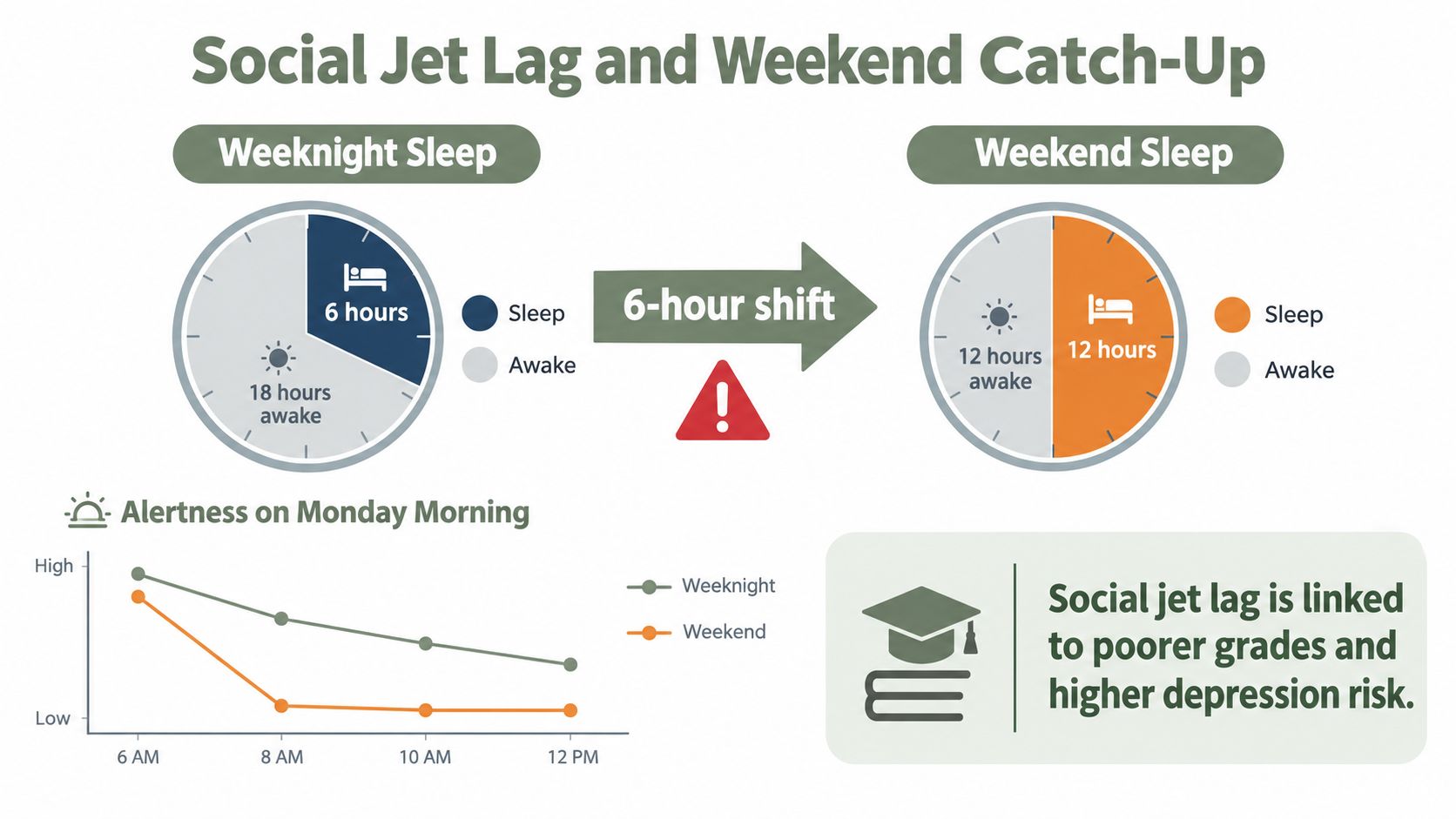
A teenager may sleep later on weekends because they're finally following their biological clock. That recovery matters, but a large difference between school-day and weekend timing can create social jet lag, a recurring conflict between the body's preferred schedule and the schedule imposed by school or other obligations.
Consider a common pattern. A teen wakes early on school days, feels exhausted, and sleeps much later on Saturday. By Sunday night, they aren't sleepy at the desired bedtime, so Monday morning arrives after another short night. The problem isn't just the total hours across several days. The repeated shift keeps moving the timing signal that tells the brain when to feel alert and when to prepare for sleep.
Duration and regularity are different questions
Parents often ask, “If my child catches up on weekends, doesn't that solve the deficit?” Not completely. Weekend recovery may reduce immediate sleepiness, but it doesn't necessarily restore a stable rhythm. A teen can receive enough sleep on some nights and still experience difficulty because bedtime and wake time vary substantially.
A 2026 SLEEP presentation found that social jet lag at age 15 was associated with nearly 2.5 times higher odds of an overnight hospital stay around age 22 (the SLEEP presentation summary). This is an association, not proof that irregular sleep directly caused later hospitalization. It does, however, support taking variability seriously rather than measuring sleep health by hours alone.
Social media deserves a similarly nuanced discussion. Recent review evidence described in the supplied research indicates that general social media use has a small relationship with sleep, while problematic use is more strongly linked with poorer sleep quality. That distinction shifts the question from “Does your teen use social media?” to “Is use keeping them emotionally activated, extending bedtime, waking them through notifications, or interfering with morning recovery?”
Consistency beats perfection. A workable weekend routine is usually more helpful than demanding an ideal bedtime that the teenager can't maintain.
Families don't need to eliminate every late social event. They can reduce the size of the weekday-weekend swing, protect a reasonable morning anchor, and return to the usual routine after an exception. The aim is a rhythm that supports real life without turning every Sunday evening into a crisis.
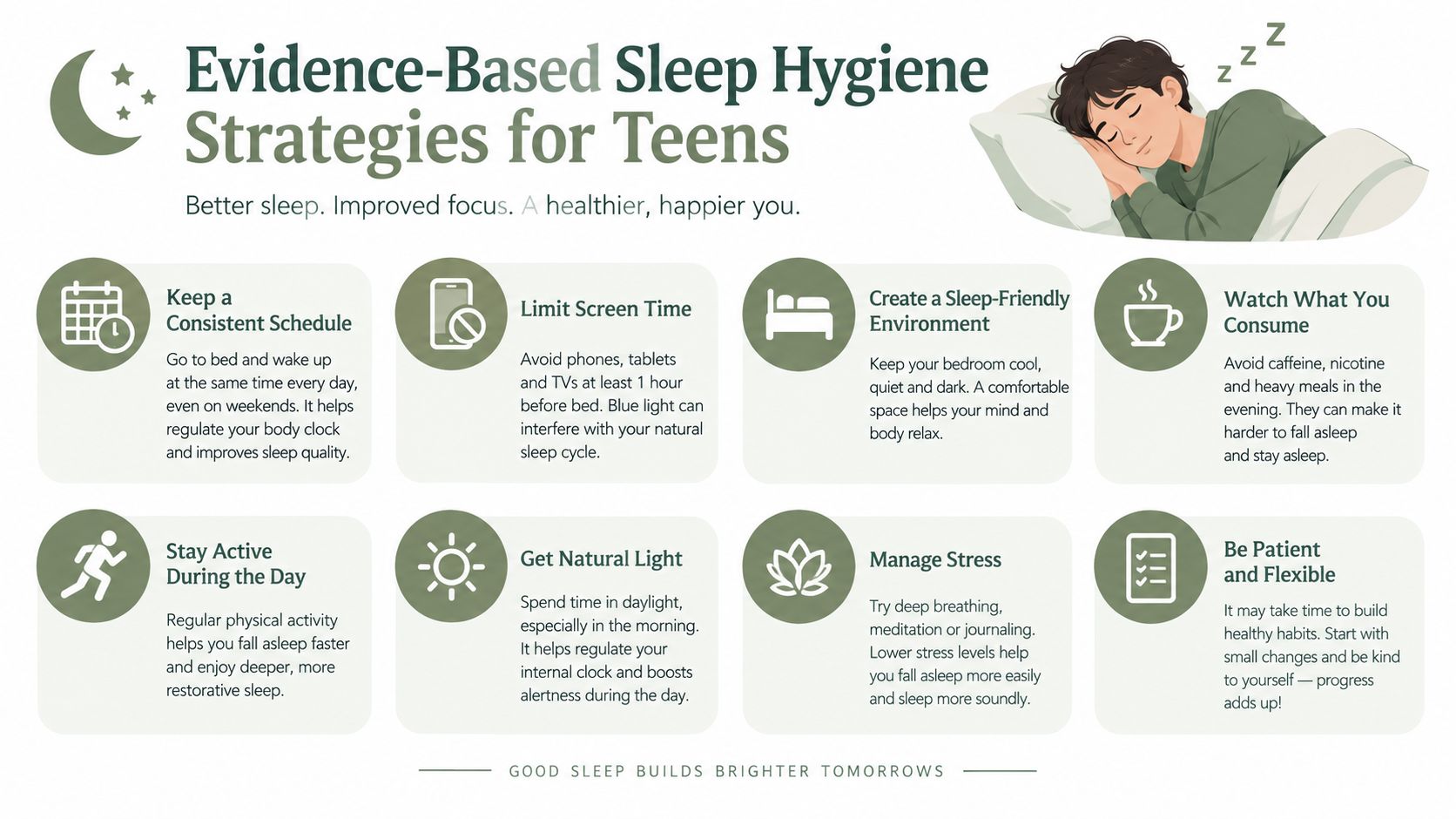
Evidence-Based Sleep Hygiene Strategies for Teens
Sleep hygiene is not a test of obedience. It works by making sleep easier within a teenager's delayed body clock, school schedule, and family life. Parents often focus on screens because they are visible, yet timing, light, stress, homework, and early mornings can keep a teen alert even after the phone is put away. Start with the change that is practical for your household, then build from there.
Build a reliable timing signal
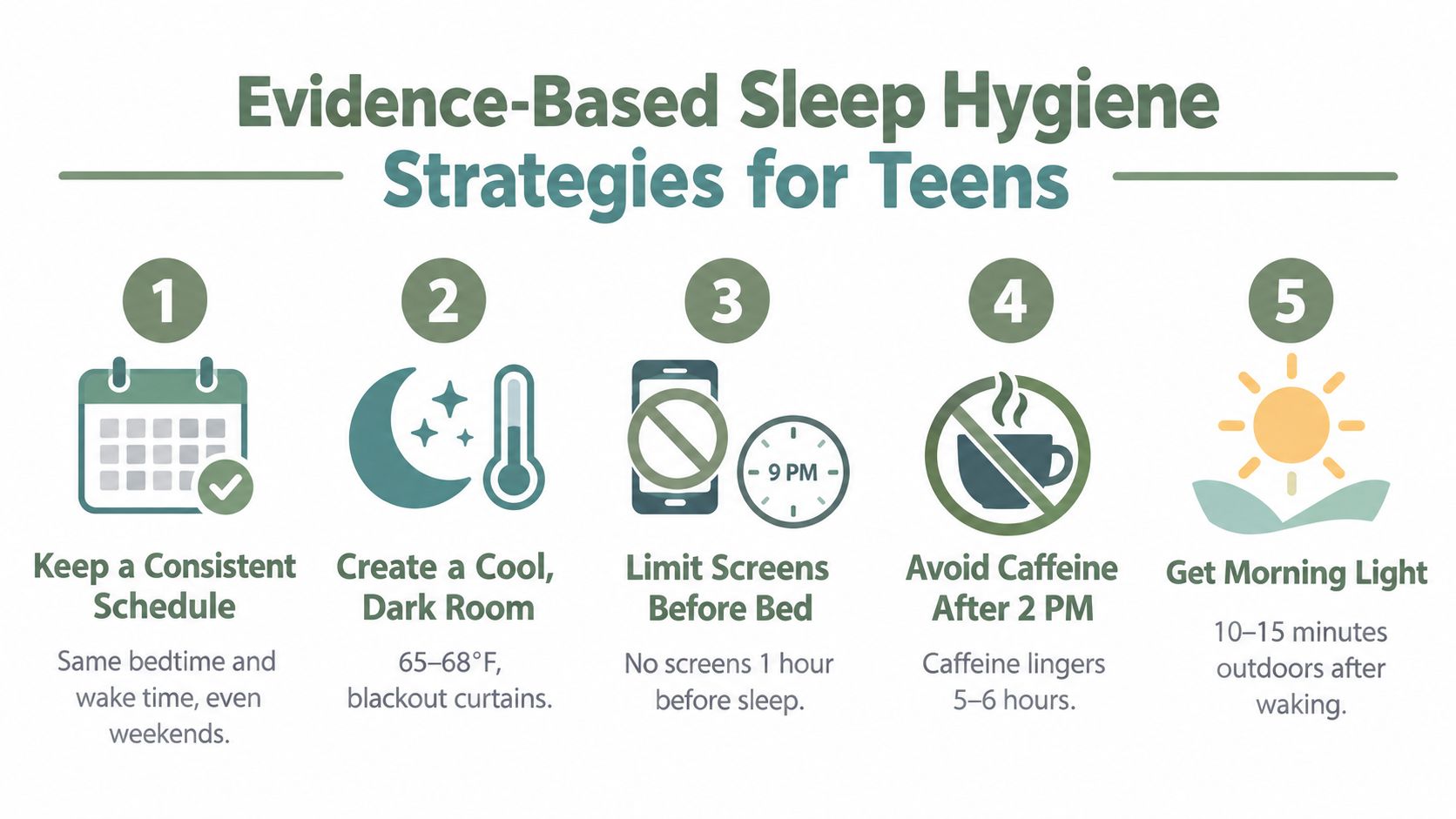
Set a consistent wake time before insisting on an early bedtime. A steady morning anchor gives the body a clearer cue than asking a teen to lie down before feeling sleepy. Shift bedtime gradually when needed, while leaving enough time for the adolescent recommendation of 8, 10 hours per night, as outlined by the CDC's adolescent sleep guidance.
Morning light can help reinforce an earlier rhythm. Open the curtains, have breakfast near a bright window, or spend part of the morning outdoors when practical. In the evening, lower household lighting and choose quieter activities that do not require intense concentration.
Make the bedroom support sleep
A bedroom should signal rest rather than function as a classroom, gaming station, and social hub at the same time. Useful adjustments include:
- Control light: Use blackout curtains or an eye mask if outdoor light enters the room.
- Reduce noise: A fan or steady background sound may help when household noise interrupts sleep.
- Manage comfort: Keep the room comfortably cool, and let the teen help choose bedding.
- Move charging elsewhere: Charging a phone outside the bedroom removes notifications and makes automatic checking less convenient.
- Keep the plan realistic: If a device is needed for an alarm, use a separate alarm clock instead of placing the phone beside the pillow.
Screen boundaries work better when teens understand their purpose and help shape the details. Agree on a charging time, define an urgent exception, and apply the arrangement consistently. The goal is to protect sleep, not punish a teenager for struggling with a biological delay or an overloaded schedule.
Address stimulation beyond screens
Caffeine, late homework, intense gaming, conflict, and anxiety can all sustain alertness. Ask whether coffee, energy drinks, or pre-workout products make evening sleep harder. Encourage daytime movement without turning exercise into another demand.
A short wind-down routine might include a shower, stretching, music, reading, or preparing clothes for the morning. It should be repeatable and calming, not elaborate. General student sleep guidance also emphasizes habits that support adequate sleep and daytime functioning.
If a teen stays awake for a long time, becomes increasingly frustrated, or begins associating bed with worry, more rules may intensify the problem. The pattern calls for careful assessment rather than another lecture about screens.
When to Seek Professional Help and Therapy Options
Home strategies are appropriate when a teen's schedule is inconsistent but sleep improves with reasonable changes. Professional help becomes more important when the difficulty persists, causes significant daytime impairment, or appears connected to anxiety, depression, OCD, ADHD, school refusal, nightmares, panic, or another health concern.
Seek a medical or mental health evaluation when your teenager regularly can't fall asleep despite wanting to sleep, wakes repeatedly, wakes too early, snores heavily, seems to stop breathing, experiences frightening nighttime symptoms, or shows a marked decline in mood or functioning. Urgent support is needed if sleep changes occur alongside suicidal thoughts, self-harm, severe agitation, or symptoms that place the teen at immediate risk.
What CBT-I actually does
Cognitive Behavioral Therapy for Insomnia, or CBT-I, isn't general conversation about feelings. It is a structured treatment that examines the relationship among sleep timing, behaviors, physical arousal, and beliefs about sleep. A clinician may use a sleep diary, identify habits that keep the cycle going, adjust time in bed, teach relaxation skills, and challenge catastrophic thoughts such as “If I don't fall asleep now, tomorrow will be impossible.”
For adolescents, treatment often includes parents because caregivers control parts of the environment and schedule. The clinician may help the family establish predictable responses to reassurance-seeking, bedtime resistance, or repeated requests for exceptions. If anxiety is driving avoidance, therapy addresses the anxiety rather than treating the bedroom as the only problem.
Match the treatment to the driver
A pediatrician can assess medical contributors and refer to sleep medicine when needed. A psychologist can evaluate emotional, behavioral, and family factors. A school may help review workload, attendance concerns, transportation, and accommodations.
Wald Behavioral Health describes support for adolescent sleep difficulties, bedtime resistance, delayed sleep, and related concerns through behavioral strategies, caregiver coaching, and anxiety-focused work when appropriate; families can review its services for children, adolescents, and young adults as one possible starting point.
Medication shouldn't be the automatic first response to a long-standing routine problem or anxiety-driven insomnia. Families should discuss any sleep aid with a qualified healthcare professional, especially when the teen takes other medications or has a medical or psychiatric condition. A careful evaluation protects against treating the visible symptom while missing the cause.
Building a Sustainable Sleep Routine as a Family
A sustainable routine begins with a conversation, not an ambush. A parent might say, “We've noticed mornings and schoolwork are getting harder. Let's track what happens for a few days and choose one change together.” That opening respects the teenager's autonomy while making clear that sleep affects the whole family.
Suppose the teen currently sleeps much later on weekends, keeps the phone beside the bed, and begins homework late because the evening feels like the only personal time available. The family could start by moving phone charging to a shared location, setting a consistent morning target, and protecting a short period of unstructured time before the wind-down routine. They don't need to change every habit on the same night.
Make setbacks part of the plan
Exam weeks, sports, travel, and social events will disrupt sleep. The family can respond by returning to the usual wake time, reducing unnecessary evening demands, and avoiding criticism that turns one late night into a weeklong conflict. Parents should also model reasonable routines themselves. Teens notice when adults demand healthy boundaries while answering messages in bed.
Use parent guidance from Wald Behavioral Health alongside advice from your pediatrician or mental health professional when bedtime resistance, anxiety, or family conflict makes implementation difficult. Sleep improves more reliably when caregivers respond predictably and adjust the plan based on observation rather than punishment.
The first goal isn't a flawless schedule. It's a repeatable routine that gives the adolescent enough opportunity for sleep, reduces extreme timing shifts, and makes it easier to identify problems that need clinical attention.
---
If sleep problems are affecting your teen's mood, school functioning, or family life, Wald Behavioral Health offers evidence-based therapy, parent guidance, and support for adolescent sleep difficulties and related anxiety or behavioral concerns. Visit Wald Behavioral Health to learn about in-person and telehealth options and request a free 15-minute consultation.
Questions about your child or teen?
Dr. Wald offers a free 15 minute consultation to talk through what you are seeing and whether the practice is a good fit.
Free 15 Minute Consultation