How to Help a Child with Separation Anxiety
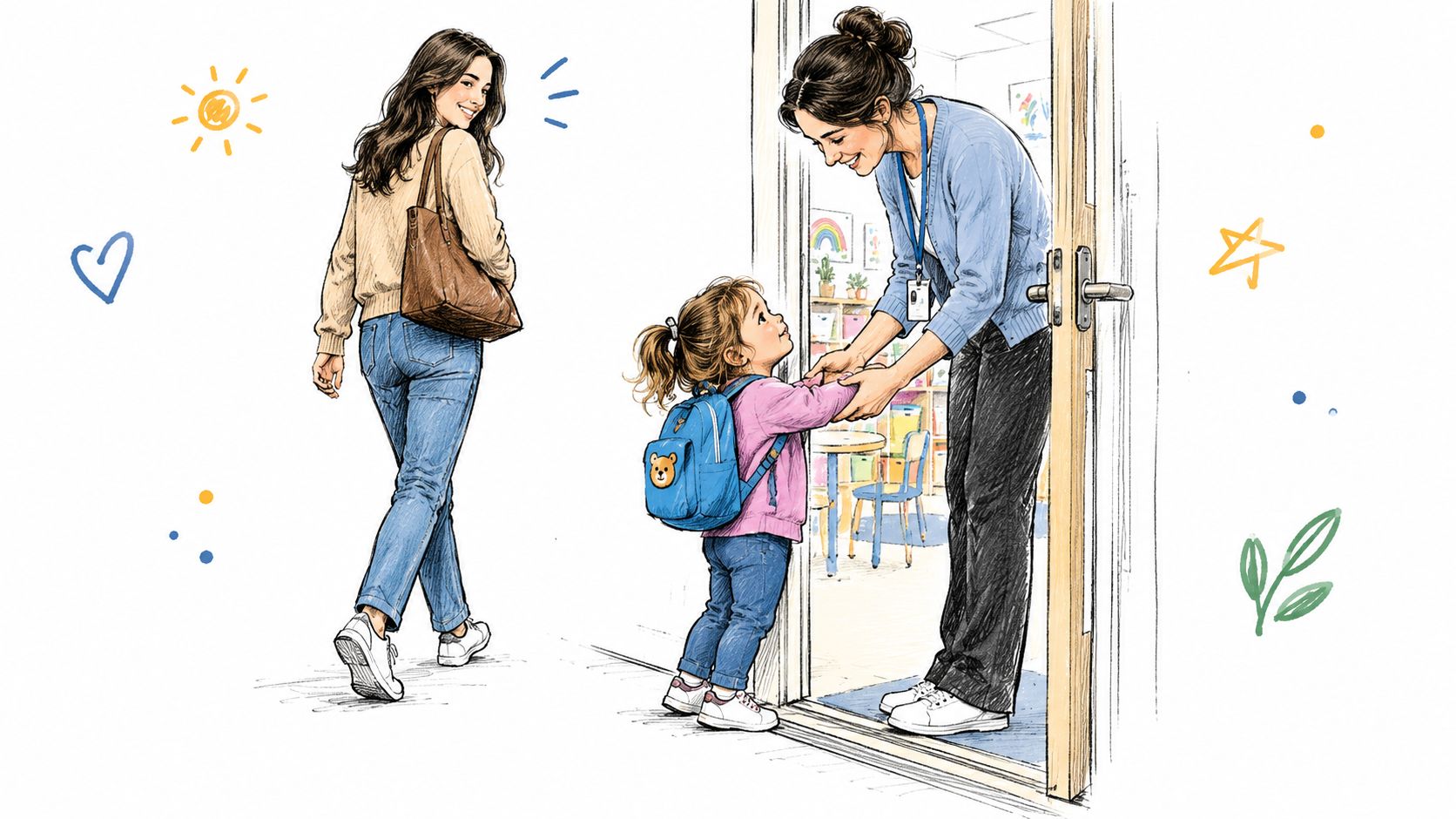
The hardest part of the morning may be the few steps between the car and the classroom. Your child grips your hand, asks one more time when you'll return, and begins crying as soon as the teacher opens the door. You promise that everything will be fine, stay for another hug, then walk away wondering whether leaving made things worse.
You can help. Your behavior is part of the treatment environment, not a side detail. Predictable routines, brief goodbyes, and carefully graded practice teach a child's nervous system that separation is uncomfortable but temporary, manageable, and followed by reunion. The aim isn't to eliminate every tear immediately. It's to help your child keep moving while anxiety gradually loses its authority.
## Table of Contents - Why Goodbyes Feel So Big Right Now - What the child's brain is learning - Preparing Your Child the Night and Morning Before - Use a short, concrete preview - Make the morning boringly predictable - Building a Separation Ladder - A sample ladder - Reinforce approach, not calmness - Keeping the Goodbye Short and Calm - What parents should do at the door - What to Do When Reassurance Backfires - Notice accommodation - When Home Strategies Are Not Enough - What structured CBT looks like - Your First Week of Practice - A seven-day starting plan
Why Goodbyes Feel So Big Right Now
At the preschool door, your child may cling to your leg while the teacher reaches for their hand. You smile too brightly, keep waving, or walk backward down the hallway because leaving feels almost as painful as staying. Your child is not manipulating you, and you have not caused a weak attachment. Both of you are responding to a powerful alarm.
Separation anxiety is one of the earliest and most common anxiety problems in childhood. Average onset is around age 6, and population estimates range from about 4% to 8% among children and adolescents, according to this clinical overview of separation anxiety. Nearly all children between 18 months and 3 years experience some separation anxiety as part of normal development. Concern rises when distress remains intense beyond the expected developmental period or interferes with ordinary activities.
What the child's brain is learning
A young child's brain has learned a simple association: caregiver means safety. Until the child accumulates experiences of leaving, staying safe with another trusted adult, and reuniting as promised, the alarm can remain sensitive. A new classroom, disrupted sleep, family stress, recent illness, or another major transition may intensify it.
Your steadiness gives the child room to gather different evidence. Acknowledge the fear without treating separation as dangerous. Your child can feel upset and still enter school, play with another caregiver, or remain in bed while you gradually step away.
Your behavior is part of the treatment. Lengthy goodbyes, repeated promises, and returning after leaving may reduce distress briefly, but they can teach the child that separation requires rescue. Brief, predictable responses and graded practice at home and school teach the opposite lesson. You are an active treatment partner, not a bystander waiting for anxiety to resolve.
The target isn't zero distress. The target is increasing the child's ability to tolerate distress without escaping.
Untreated, clinically significant symptoms may continue into adulthood for about one-third of affected children, according to the clinical overview cited above. That possibility is not a reason to panic. It is a reason to begin structured practice rather than waiting indefinitely for the reaction to disappear.
Preparing Your Child the Night and Morning Before
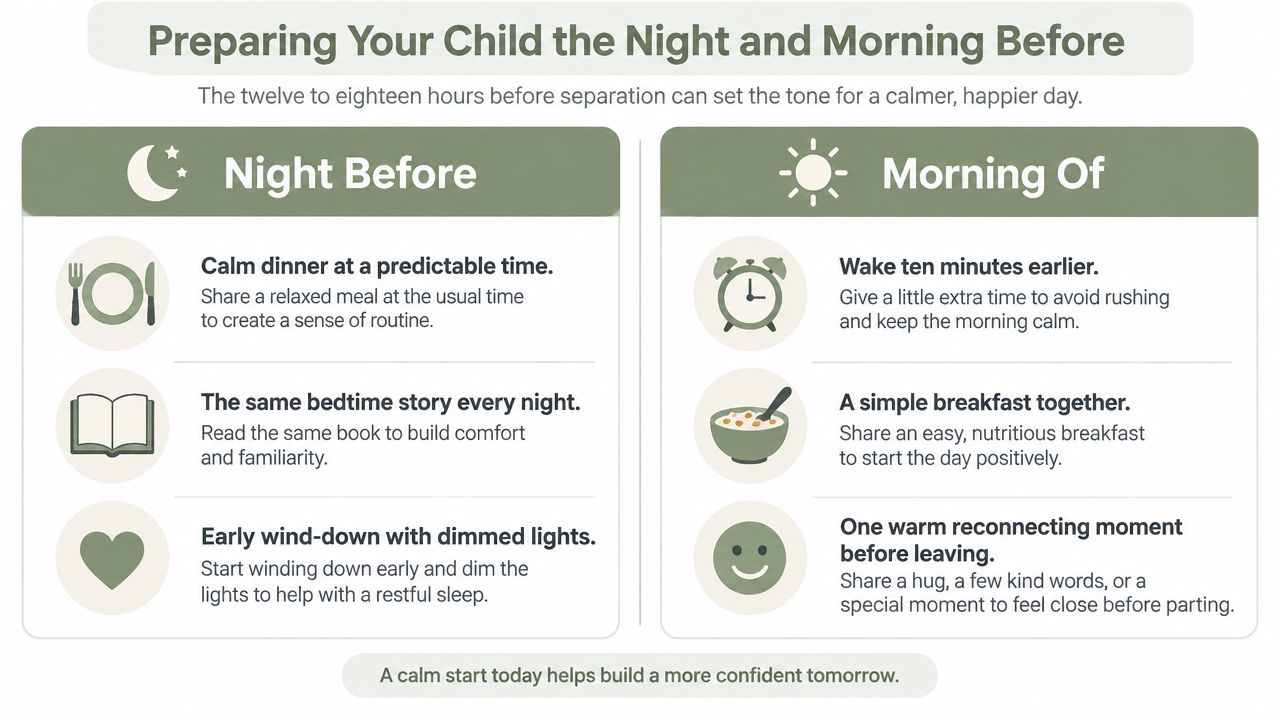
The separation routine starts before the child sees the school door. If tomorrow's goodbye feels unpredictable, repeated explanations in the morning won't create confidence. A calm preview the night before gives the child a sequence they can recognize.
Use a short, concrete preview
Keep dinner, bathing, and bedtime as ordinary as possible. Read the same familiar story and describe tomorrow in simple language:
“Drop-off is at 8:15. Mrs. Chen will stay with you. I'll pick you up at 3:15, and we'll have a snack together in the car.”
Avoid a long discussion about every possible problem. Repeatedly promising that nothing bad will happen can signal that there is something serious to fear. Give information once, then return to the routine.
A visual schedule can make the return easier to understand. Draw or print the morning activities, school, lunch, and pickup, or mark the pickup point on a paper clock. Younger children often understand “after lunch” or “before nap” better than an abstract duration. Make sure your promise matches what you can reliably do.
Make the morning boringly predictable
Wake early enough to avoid rushing. Name the order of events, offer one small choice, and keep moving:
- Name the sequence: “First clothes, then breakfast, then school.”
- Offer limited control: “Do you want the blue sweater or the green one?”
- Choose one comfort cue: A small approved stuffed animal, family photo, or note may travel with the child if the school permits it.
- Repeat the same goodbye: Consistency matters more than finding a perfect phrase.
The routine should feel rehearsed, not emotionally negotiated. You can say, “You're nervous, and school is still the next step.” That combines empathy with confidence.
If the child asks the same question repeatedly, answer with the same brief sentence instead of adding new reassurance. Predictability lowers the number of decisions everyone must make, including the parent who feels tempted to change the plan at the last minute.
Building a Separation Ladder
A child who clings at the classroom door may already manage brief separations at home. Start there. Gradual exposure is the core mechanism in effective CBT for separation anxiety. A review found exposure in 90.5% of successful treatment programs for separation anxiety disorder, and structured CBT showed remission benefits with an NNT of 6 versus wait-list controls, according to this review of evidence-based treatment. These figures support a practical point: parents can help by arranging repeated, manageable separations before asking a child to handle the hardest one.
List situations your child already tolerates, then order them from easier to harder. A useful ladder might include ten to twelve steps, adjusted to your child's capacity rather than treated as a rigid prescription.
A sample ladder
- Parent steps into the next room while the child plays with a trusted adult.
- Parent stays away for five minutes, returning as promised without making the reunion dramatic.
- Grandparent or babysitter takes over while the parent remains elsewhere in the home.
- Parent leaves for a short errand, then returns at the agreed time.
- Child plays in another room during a visit with a familiar caregiver.
- A trusted caregiver visits without the parent participating in the activity.
- Child attends a brief playdate while the parent remains nearby but out of sight.
- Child completes a short daycare or preschool visit with a teacher.
- Child stays for a morning and follows a planned pickup routine.
- Child practices ordinary drop-off and remains for the expected school day.
Repeat each rung several times. Move up when the child can complete it without escaping or requiring repeated rescue, even if some anxiety remains. Waiting for perfect calm can keep practice on hold. If distress becomes overwhelming, return to an easier rung and add more repetitions before trying again.
Reinforce approach, not calmness
Praise the action: “You walked into the room even though your stomach felt tight.” Anxiety often falls after a child remains in the situation long enough to learn that the feared outcome does not occur. Your job is to make that learning possible, not to eliminate every uncomfortable feeling first.
Watch for escape patterns that keep the alarm active, including prolonged goodbye rituals, repeated checking, and immediate reunions whenever crying begins. The reunion should be warm and reliable, but it should not become the payoff for abandoning practice.
For more on building an independent home environment, look at small responsibilities your child can complete without constant adult proximity. Parents seeking a clinician-guided explanation can also review exposure therapy for children.
A visual ladder helps children see progress from familiar separations toward school independence.
Keeping the Goodbye Short and Calm
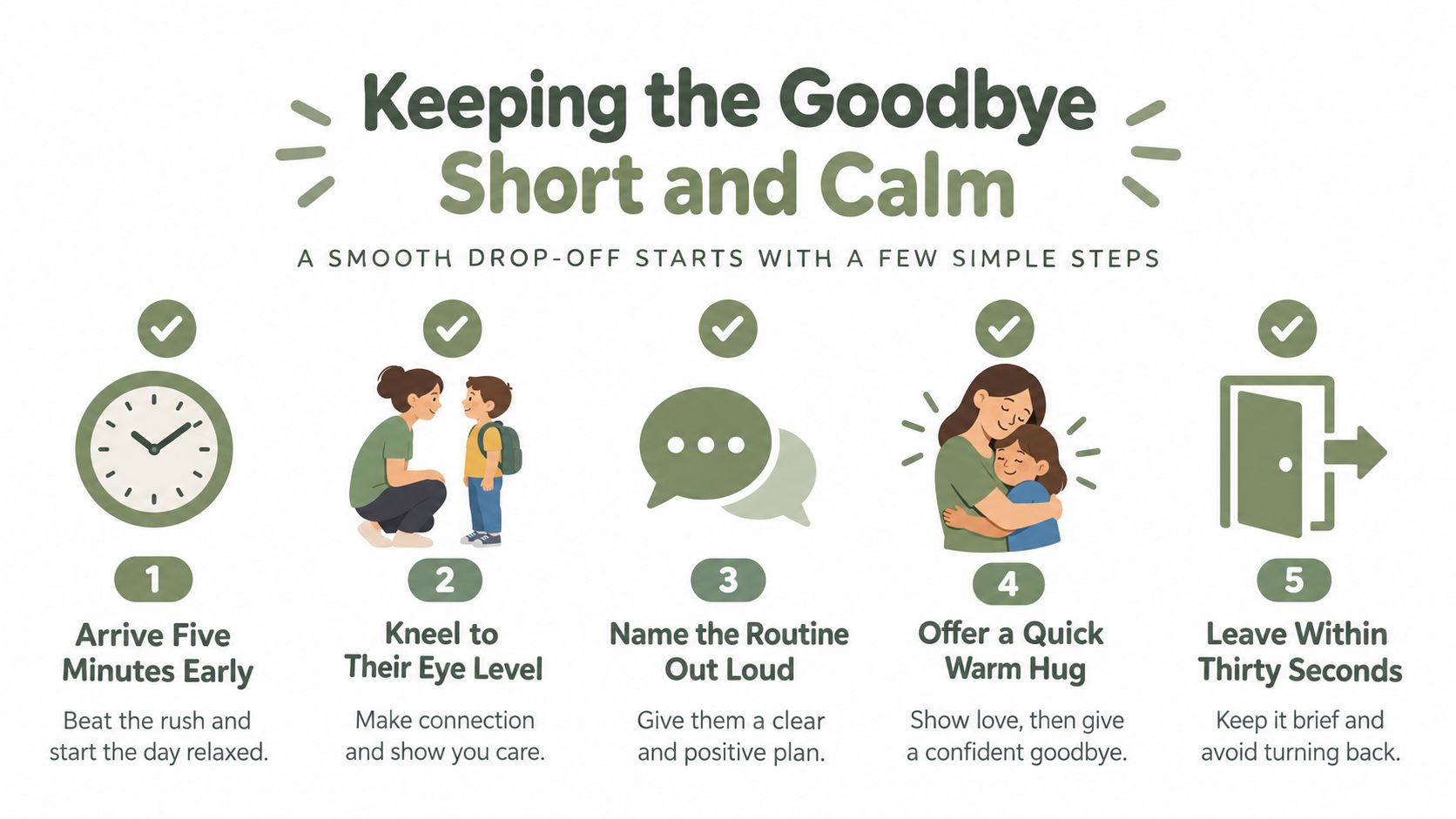
A good drop-off is warm, clear, and brief. Arrive with enough time that you aren't rushing, but don't create a long waiting period in which your child can repeatedly ask whether you're leaving. Kneel to eye level, state the plan, complete the familiar gesture, and hand the child to the teacher.
A script might sound like this:
“I'm going to work, Mrs. Chen has you, and I'll be back at 3:15. Have a good morning.”
Then leave. The child may cry. Crying doesn't prove that the routine failed.
What parents should do at the door
- Arrive five minutes early so the handoff doesn't happen in a frantic rush.
- Get physically close and make eye contact.
- Name who stays and when you return.
- Give one warm hug or handshake.
- Leave within about thirty seconds after the goodbye begins.
The hardest part is usually what happens after the script. Don't return for one more explanation because the child calls your name. Don't keep waving from the doorway. Don't sneak away, because the child may become more vigilant the next time and feel unable to trust the handoff.
If you forget an item, return only when necessary and keep the second contact practical. If tears start as you turn away, let the teacher take over unless there is a genuine safety or health concern. Re-entering can teach the child that escalating distress brings the parent back, even when the parent never intended to offer that lesson.
For additional practical ideas to ease daycare separation anxiety, coordinate the same words and handoff sequence with the caregiver. Parents and teachers should agree on who receives the child, what activity starts immediately, and how updates will be shared without creating a repeated checking loop.
Parent-child interaction work can also help families change interaction patterns that unintentionally maintain anxiety. Parent-child interaction therapy is one structured approach clinicians may consider when the relationship, behavior, and separation response are tightly connected.
What to Do When Reassurance Backfires
Reassurance helps when it validates emotion and points toward action. It backfires when the family must repeat it until the child feels completely certain. No parent can provide enough promises to eliminate every possible worry, and trying often teaches the child that anxiety requires an adult response before the child can proceed.
Compare these two responses:
- Less helpful: “Don't worry. You'll be fine. Nothing will happen. I promise. I'll call you soon.”
- More useful: “I see you're nervous. Mrs. Chen will help you, and you can handle the first activity.”
The second statement doesn't argue with the fear. It acknowledges the feeling, identifies support, and returns responsibility to the child.
Notice accommodation
Family accommodation can look loving while strengthening avoidance. Common examples include sleeping in the child's room every night, allowing a screen whenever separation distress appears, answering the same safety question repeatedly, or making frequent mid-day check-ins that interrupt the child's participation.
Change these patterns gradually. If you currently sit beside your child until sleep, move the chair closer to the door, then outside the room, while keeping the response predictable. If calls occur repeatedly during school, agree on one planned update with the teacher rather than negotiating every request in real time.
Parent anxiety matters here. Children read facial expression, posture, voice, and hesitation before they process the words. A parent who looks frightened while saying “You're safe” may unintentionally deliver two conflicting messages. Regulate yourself before the handoff, use a steady voice, and let the teacher manage the first activity.
Helpful comfort says, “I know this feels hard, and I know what you'll do next.” Unhelpful reassurance says, “We must keep talking until you no longer feel afraid.”
Parents often worry that reducing reassurance is cold. It isn't. You can offer affection, empathy, and a confident expectation at the same time. The child learns that support remains available without requiring avoidance.
When Home Strategies Are Not Enough
Home practice is a reasonable starting point when a child can attempt manageable separations and the family sees gradual, if uneven, progress. Seek professional guidance when anxiety repeatedly disrupts school, sleep, relationships, or ordinary routines. The key question is whether distress is beginning to control the child's life.
Arrange an evaluation if you notice:
- Persistent refusal: Separation-related symptoms continue for several weeks and affect attendance or daily functioning. General guidance for families is available in this clinical guidance for families.
- Recurring physical symptoms: Stomach pain, nausea, vomiting, headaches, or similar complaints repeatedly appear before or during separation.
- Broader avoidance: The child avoids school, childcare, sleepovers, or sleeping alone, and avoidance spreads beyond the original trigger.
- Intrusive fears: The child repeatedly imagines a parent being harmed, lost, or unable to return.
- Possible overlapping concerns: School stress, bullying, depression, ADHD, learning problems, or obsessive-compulsive symptoms may be contributing.
A clinician will ask about development, sleep, medical symptoms, family anxiety history, attendance, transitions, and the exact behaviors before and after separation. The evaluation should distinguish expected developmental distress from a disorder and identify any issue maintaining avoidance.
What structured CBT looks like
Evidence-based CBT often combines child-appropriate coping skills, parent coaching, and graduated exposure. The therapist may help the child recognize body signals, practice responses, and complete a personalized separation ladder. Parent sessions focus on brief goodbyes, reducing accommodation, and arranging practice at home and school.
Medication may be considered for severe anxiety, particularly in older children. It does not replace learning to approach separation. In a large pediatric anxiety trial that included separation anxiety, combined CBT and sertraline produced an 81% response rate, compared with 60% for CBT alone and 55% for sertraline alone, as reported in the treatment evidence review cited earlier in this article. A prescriber should weigh symptoms, age, medical history, and family preferences.
Telehealth can work when a caregiver participates actively. A therapist may coach a parent during a morning routine, observe a brief practice separation, or help adjust the ladder between sessions. Availability varies by clinician and location, so confirm licensing, privacy, session format, and parent participation requirements. Families can also review these soothing tips for stranger anxiety, keeping comfort focused on approach rather than avoidance.
Families seeking a structured option can review child anxiety therapy and compare in-person, school-coordinated, or caregiver-supported telehealth treatment. The parent remains an active treatment partner, carrying practice into daily routines while the clinician supplies assessment, coaching, and adjustment.
Your First Week of Practice
Keep the first week small enough to complete. A plan that looks impressive but collapses during a rushed morning won't teach consistency. Write one action and one sentence on paper, then record what happened without judging the child or yourself.
A seven-day starting plan
- Day 1, establish the script. Preview tomorrow's routine at bedtime and use the same brief goodbye at school. Say, “You know the plan. I leave, you start with your teacher, and I return after school.” If the child cannot recover after the handoff or develops a sharp increase in physical complaints, don't add difficulty yet.
- Day 2, practice the easiest rung. Leave the room briefly while a trusted adult stays with your child. Say, “I'm going to the kitchen and I'll come back after this short practice.” A spike in panic means the interval may be too long.
- Day 3, repeat before extending. Use the same separation and reunion. Don't increase the challenge merely because the previous attempt went well.
- Day 4, add a school cue. Walk to the classroom, greet the teacher, and rehearse the handoff without changing the words. Say, “Mrs. Chen knows what happens next.” Watch for escalating stomachaches or sleep resistance.
- Day 5, practice a slightly longer school transition. Let the teacher lead the first activity while you leave on schedule. Avoid returning to check whether crying has stopped.
- Day 6, make reunion predictable. Use the agreed pickup routine and ask about effort, not only distress. “What did you do after I left?” builds attention toward coping.
- Day 7, review the data. Note which separation the child managed, what accommodation you reduced, and where the ladder needs a smaller step. A setback after illness, a weekend, or a disrupted routine is information, not proof that treatment failed.
Progress usually looks like shorter distress, faster recovery, fewer negotiations, or greater participation, not immediate calm. Keep practicing the rung that is difficult but doable, and seek professional help when impairment persists or the family cannot safely maintain the plan.
--- Wald Behavioral Health provides evidence-based therapy and parent training for separation anxiety, school refusal, sleep difficulties, and related child behavioral concerns through in-person care and telehealth where available. Visit Wald Behavioral Health to review services or request a free 15-minute consultation about your child's needs.
Questions about your child or teen?
Dr. Wald offers a free 15 minute consultation to talk through what you are seeing and whether the practice is a good fit.
Free 15 Minute Consultation