OCD Treatment for Teens: A Parent's Guide to Help
CBT with exposure and response prevention, or ERP, is the first-line treatment for teen OCD, and most young people can be treated effectively with psychotherapy, often with medication added when symptoms are moderate to severe. OCD affects about 1% to 3% of children and adolescents, so a teen's rituals are not a rare sign of personal weakness or poor discipline.
A teenager may know that a fear doesn't make sense and still feel unable to ignore it. They may wash until their hands hurt, check a lock repeatedly, restart homework to make it feel “just right,” or ask a parent the same safety question throughout the day. These behaviors can look defiant from the outside, but they often reflect a distressing cycle of intrusive thoughts, anxiety, and compulsions.
Effective ocd treatment for teens is structured, gradual, and practical. It teaches the young person how to face uncertainty without rituals, while helping parents support recovery without accidentally strengthening OCD. Modern care can happen in person, through supervised video sessions, or in a concentrated format when weekly appointments aren't enough.
## Table of Contents - Understanding the Scope of Teen OCD - Why timing matters - How CBT and ERP Work for Adolescents - What an ERP plan looks like - Medication Options and Treatment Combinations - What SSRIs do - Why combination treatment can make sense - The Critical Role of Family Involvement - Support without becoming the ritual - Modern Delivery Models - Telehealth and Intensive Care - When concentrated ERP fits - Recognizing the Signs and Taking Action - Choosing the next step
Understanding the Scope of Teen OCD
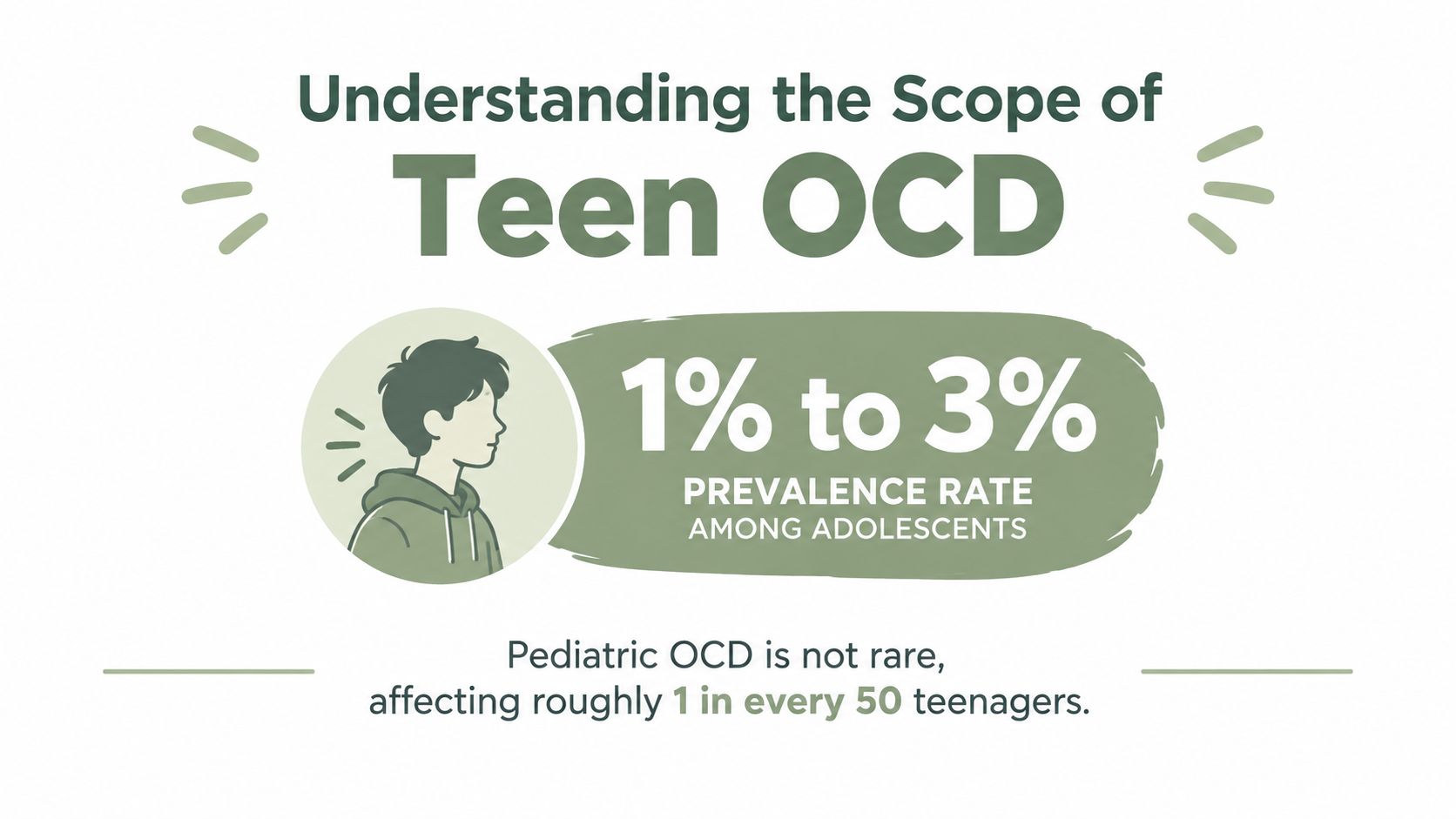
Major clinical reviews estimate that OCD affects about 1% to 3% of children and adolescents, with broader worldwide estimates ranging from 0.25% to 4% (clinical review of pediatric OCD). These figures place OCD among meaningful pediatric mental health concerns, rather than a passing phase families can safely ignore.
Parents often see the disruption before they recognize the disorder. A teen may take so long to get ready that school mornings become arguments. They may avoid ordinary objects, repeatedly ask for reassurance, or become distressed when someone changes a routine. Adults may interpret these behaviors as stubbornness, perfectionism, or attention-seeking. The teen may instead feel driven to prevent danger, guilt, contamination, or an unbearable sense that something is wrong.
OCD usually includes obsessions, unwanted thoughts, images, or urges, and compulsions, physical actions or mental rituals intended to reduce distress. Washing and checking are familiar examples. Other compulsions include counting, repeating silent phrases, reviewing memories, confessing, researching, arranging, or asking someone else to provide certainty.
The pattern can resemble an alarm that keeps sounding after the danger has passed. A ritual may briefly quiet the alarm, but the temporary relief can make the urge return more strongly. Recognizing that cycle helps families respond to the disorder rather than treating the teen as deliberately difficult.
Why timing matters
OCD often starts early. Historical U.S. data indicate that about 20% of affected people show symptoms by age 10 or earlier, while another major reference reports a peak onset age of 14.5 years, with 25% of cases beginning before age 14 and 45% before age 18. A teen may therefore have been adapting to symptoms for years before the full pattern becomes visible.
Rituals can gradually enter schoolwork, friendships, sleep, and family routines. Early evaluation matters when symptoms consume time, cause avoidance, or interfere with ordinary responsibilities. Improvement remains possible, including through modern options such as supervised telehealth and concentrated care when weekly therapy alone does not fit the family's needs.
A useful reframe: Your teen may be resisting the disorder, not resisting you.
A qualified clinician should distinguish OCD from generalized anxiety, depression, trauma-related symptoms, eating disorders, autism-related rigidity, tic disorders, and other concerns. Diagnosis depends on the pattern and impact of symptoms, not on one unusual habit.
How CBT and ERP Work for Adolescents
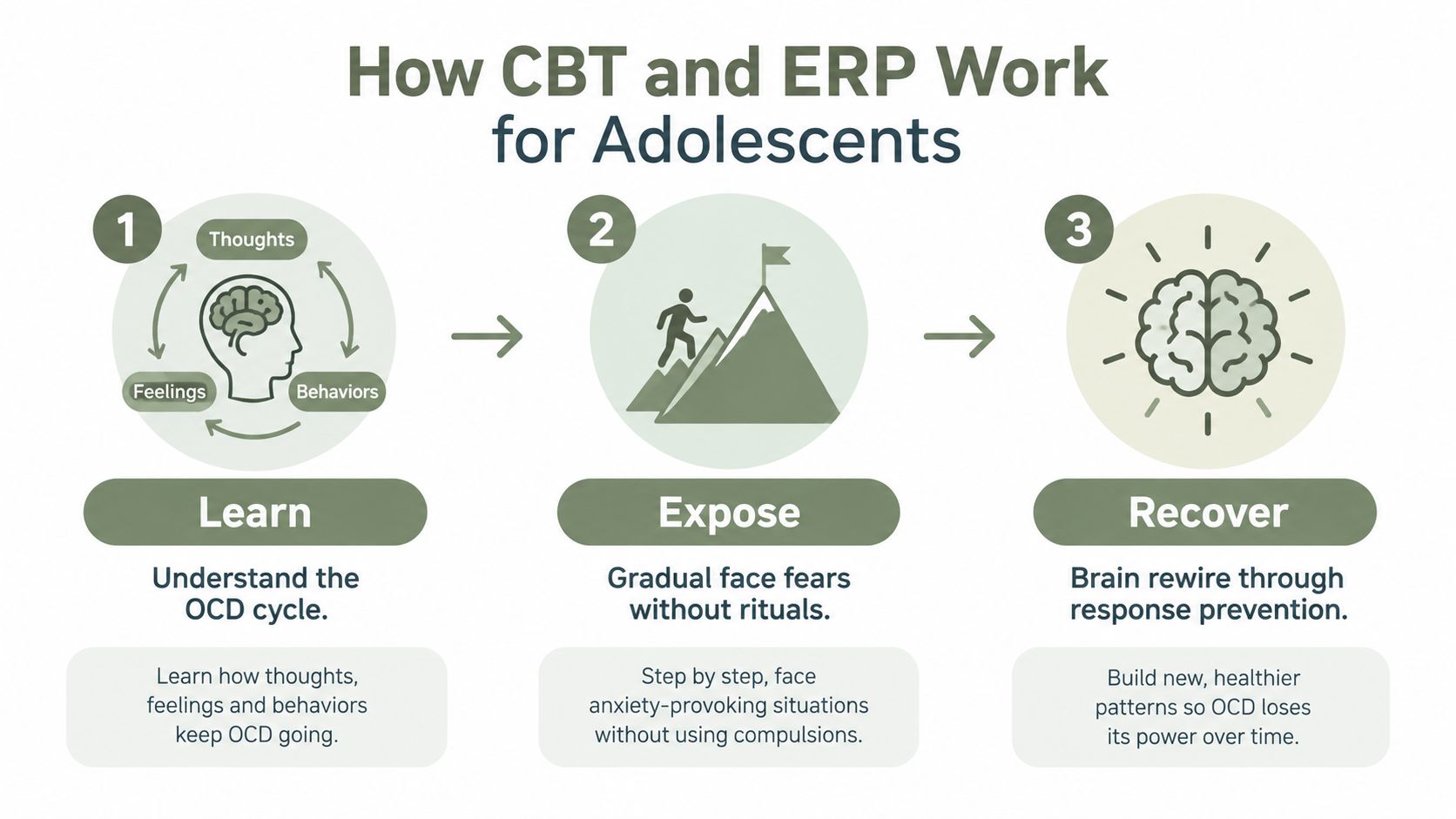
Research supports cognitive behavioral therapy, or CBT, as a first-choice treatment for youth OCD. Its most specific behavioral method is exposure and response prevention, or ERP. ERP gives a teen structured practice with feared situations while helping them refrain from the ritual OCD demands. The goal is not to prove that every feared outcome is impossible. It is to build the ability to tolerate uncertainty and choose a different response.
Consider a teen who fears contamination after touching a classroom desk. The obsession might be, “I could become dangerously contaminated.” The compulsion could involve washing hands, changing clothes, asking a parent for reassurance, or mentally reviewing every surface touched.
Washing often produces immediate relief. The brain can then connect the ritual with safety, making the next urge feel more persuasive. ERP changes that learning loop. The teen approaches a planned trigger and practices leaving the ritual undone, with support from the therapist. This guide to exposure therapy for children explains why ERP follows a structured plan rather than relying only on open-ended conversation.
What an ERP plan looks like
Treatment usually begins with an assessment and a manageable exercise, not the most frightening situation. The teen and therapist map the pattern and create a hierarchy of exposures.
- Learn the pattern. The teen identifies the obsession, ritual, avoidance, and short-term relief that keep OCD active.
- Choose a gradual exposure. After touching a desk, the teen might wait before washing, touch a less threatening surface, or complete an ordinary activity first. The exercise depends on the teen's symptoms and treatment plan.
- Prevent the response. During and after exposure, the teen practices not washing, checking, seeking reassurance, or completing a mental ritual. The therapist helps them handle discomfort without offering certainty.
- Practice between sessions. Repetition turns a session skill into an everyday response. Parents can help schedule practice and encourage effort, while avoiding debates or performing rituals for the teen.
Anxiety may rise and fall during an exercise. The deeper lesson is that the teen can act according to their values even while uncertainty remains. The AACAP explanation of OCD treatment describes assessment, therapist-assisted exposure and response prevention, and homework as parts of care.
A youth-treatment meta-analysis reported a pooled effect size of g = 0.74 for CBT with ERP across randomized trials. This supports ERP as a specific treatment method, rather than a label for general supportive therapy.
Medication Options and Treatment Combinations
Medication isn't a replacement for ERP, and needing it doesn't mean a teen has failed at therapy. Clinicians typically consider the level of impairment, symptom severity, access to specialized CBT, co-occurring conditions, prior treatment response, and the family's preferences.
For mild to moderate pediatric OCD, CBT with ERP is generally the first-line approach. For moderate to severe OCD, guidance supports adding medication to CBT when symptoms significantly interfere with functioning. The AACAP practice parameter describes CBT as first-line for mild to moderate cases and recommends medication in addition to CBT for moderate to severe OCD (AACAP practice parameter).
What SSRIs do
Selective serotonin reuptake inhibitors, or SSRIs, are evidence-based medications often used in youth OCD care. A prescribing clinician may use an SSRI to reduce the intensity of obsessions and compulsions enough for the teen to participate more fully in ERP. Medication can lower the volume of symptoms, while ERP teaches the behavioral skills needed to respond differently to them.
A psychiatrist, pediatrician with relevant experience, or other qualified prescriber should manage the decision. Parents can ask:
- What symptoms are we targeting?
- How will we track benefit and side effects?
- How will medication fit with ERP homework?
- What should the teen report between appointments?
- When will we review the plan?
The clinician should explain expected benefits, possible adverse effects, monitoring, and how changes will be handled. Families shouldn't stop or alter a prescribed medication without speaking with the prescriber.
Why combination treatment can make sense
Combination care is a standard escalation for more severe youth OCD, not an admission that therapy “didn't work.” A teen who can't attend school, sleep normally, complete hygiene, or leave home may need symptom relief alongside intensive behavioral treatment.
NICE guidance recommends CBT including ERP, with family or carer involvement, when functional impairment is moderate to severe or when guided self-help hasn't helped (NICE-aligned guideline summary). The right plan is individualized, measured by functioning as well as symptom intensity, and revisited as the teen gains skills.
The Critical Role of Family Involvement
Parents shouldn't disappear from treatment just because their child is a teenager. Adolescents need growing autonomy, but they also need adults who understand the treatment plan, notice accommodation, and help create consistent opportunities for practice.
Family accommodation means changing family behavior to reduce the teen's immediate distress or make a ritual possible. A parent may answer the same reassurance question repeatedly, inspect an object on the teen's behalf, wash something for them, avoid using a room, or allow OCD to set the household schedule. These responses are compassionate in the moment, but they can keep the ritual cycle operating.
Support without becoming the ritual
The parent's role changes from rescuer to coach. That shift can feel harsh at first, especially when the teen is visibly anxious. A therapist should help the family reduce accommodation gradually and safely, with language that validates distress without confirming the obsession.
Useful responses sound different from reassurance:
- Validate emotion: “I can see that this feels frightening.”
- Name the pattern: “This sounds like an OCD demand for certainty.”
- Return responsibility: “I trust you to use the practice plan.”
- Avoid arguing: Don't spend a long time proving that contamination, harm, or mistakes are impossible.
- Coordinate changes: Follow the therapist's plan rather than withdrawing support abruptly.
The family may also need to manage conflict. A teen might accuse a parent of being uncaring when the parent stops checking or answering. The parent can remain warm and present while declining to participate in the compulsion. That combination, empathy plus a firm boundary, is more helpful than either punishment or endless reassurance.
Practical rule: Support your teen's willingness to face discomfort, not OCD's demand that everyone remove it.
NICE guidance recommends involving family or carers and adapting CBT with ERP to the young person's developmental age (NICE-aligned OCD guideline). Teachers or school staff may also be included when school routines, attendance, testing, or accommodations are part of the problem. Parents looking for broader communication tools may find family therapy techniques useful, though OCD-specific accommodation work should come from an ERP-trained clinician.
Family involvement doesn't mean monitoring every thought. It means learning how to reinforce practice, reduce rituals, protect sleep and school routines, and communicate consistently.
Modern Delivery Models - Telehealth and Intensive Care
A family can understand ERP and still struggle to reach a specialist. Travel, school schedules, therapist shortages, geography, and a teen's discomfort with an unfamiliar office can all delay care. Telehealth and concentrated programs widen the available options while preserving the same behavioral principles.

A 2025 real-world study of video-delivered ERP for children and adolescents found a median 38.46% reduction in OCD symptoms after 13 to 17 weeks, with 53.4% of youth meeting full response criteria (2025 video ERP study). Telehealth is therefore more than a convenience. For some families, secure video care provides practical access to specialized ERP.
Effective remote treatment still requires active clinical structure. The therapist should observe the teen's setting, coordinate with caregivers, assign clear between-session practice, and supervise exposures carefully. The home becomes part of the treatment environment, allowing a teen to practice touching a bedroom doorknob, completing homework, or reducing reassurance-seeking where those difficulties arise.
Families and practices may also find remote-care administration confusing. This CPT code 90834 modifier 95 guide explains related telehealth billing terminology in plain language.
When concentrated ERP fits
Weekly appointments are one way to organize ERP, not the only one. A youth trial found that about 12 hours of concentrated ERP across 4 consecutive days produced significant reductions in OCD symptoms and functional impairment, with 91% of participants classified as responders (concentrated pediatric ERP literature).
A concentrated schedule may fit a teen with substantial impairment, limited access to specialty appointments, or a need for an intensive beginning. It does not replace follow-up. Families need a maintenance plan for daily exposure practice, setbacks, and the gradual return of symptoms or avoidance.
Remote ERP also has supporting evidence beyond a single youth trial. A meta-analysis found remote ERP superior to control conditions, with Hedges g = 0.94, and found no significant efficacy difference compared with in-person CBT and ERP. The delivery format matters less than treatment fidelity, developmental fit, supervision, and consistent practice.
Families seeking benefits of telehealth for mental health should ask whether a provider offers genuine ERP rather than supportive video counseling alone. Ask how exposures will be designed, supervised, measured, and practiced between sessions.
Recognizing the Signs and Taking Action
Teenagers can be private, moody, perfectionistic, or stressed. OCD becomes more likely when unwanted thoughts and rituals create a persistent pattern of distress, avoidance, lost time, or impaired functioning.
Look for changes that are difficult to explain by ordinary adolescence:
- Reassurance loops: Your teen asks the same question repeatedly but never feels reassured for long.
- Ritual delays: Dressing, showering, eating, leaving home, or starting homework takes unusually long because actions must be repeated or completed perfectly.
- Avoidance: The teen avoids bathrooms, classrooms, shared objects, friends, travel, or ordinary activities because of obsessional fears.
- Hidden rituals: You notice silent counting, mental reviewing, praying, confessing, or repeated internal “corrections.”
- Family disruption: Everyone must follow rules, answer questions, or change routines to keep the teen calm.
- Functional decline: School attendance, grades, sleep, friendships, or self-care deteriorate.
A parent doesn't need to determine the diagnosis alone. Start by recording what happens, when it happens, what your teen avoids, how family members respond, and which activities have become difficult. Bring that information to a pediatrician or mental health professional trained in OCD and ERP.
Choosing the next step
Ask prospective providers specific questions. “Do you treat OCD?” is less informative than “How often do you use ERP with adolescents?” and “How do you coach parents around reassurance and accommodation?” A strong assessment should consider symptom themes, rituals, avoidance, developmental needs, school functioning, family responses, and safety concerns.
For families in Coral Gables and Miami-Dade County, in-person care may be practical. Secure telehealth can broaden access for eligible clients in Florida, Maryland, and participating PSYPACT states. Wald Behavioral Health provides evidence-based therapy for children, adolescents, young adults, and families, including OCD-focused CBT and ERP, through in-person sessions and telehealth.
Don't wait for the teen to become fully motivated before seeking help. Motivation often grows after the young person understands the cycle, experiences an achievable success, and sees that treatment won't require eliminating every intrusive thought. The immediate aim is not perfect certainty. It's helping the teen reclaim school, relationships, sleep, and daily choices from compulsions.
Start with the impairment, not the embarrassment. If OCD is changing what your teen can do, professional evaluation is justified.
Early, structured care gives the family a plan instead of a series of emergency negotiations. With ERP, appropriate family coaching, and medication when clinically indicated, many teens can learn to respond to obsessions without allowing rituals to govern their lives. If symptoms are severe, concentrated ERP or supervised telehealth may offer a more workable route than waiting indefinitely for a convenient weekly appointment.
--- Wald Behavioral Health offers evidence-based OCD care for children, adolescents, young adults, and families, including CBT with ERP, parent guidance, and secure telehealth options. Visit Wald Behavioral Health to request a free 15-minute consultation and discuss the right next step for your teen.
Questions about your child or teen?
Dr. Wald offers a free 15 minute consultation to talk through what you are seeing and whether the practice is a good fit.
Free 15 Minute Consultation