Benefits of Telehealth for Mental Health: A Practical Guide

A parent sits at the kitchen table with a laptop open, comparing an online therapy appointment with the long drive to a clinic. Their child has been anxious about school, the teenager has stopped sleeping well, and every missed appointment makes the next step harder. The practical question isn't whether telehealth is universally better than in-person care. It's whether the format supports this young person's clinical needs, safety, privacy, and daily life right now.
The benefits of telehealth for mental health can be substantial. Video sessions may remove travel barriers, make regular treatment easier to attend, and connect families with clinicians who aren't nearby. At the same time, telehealth doesn't solve every access problem, and some situations call for face-to-face care or immediate local support. The right choice is usually a thoughtful fit decision, not a permanent commitment to one format.
## Table of Contents - Choosing Between In-Person Care and Video Sessions - What Telehealth in Mental Health Actually Means - Three common formats - The Core Benefits of Telehealth for Mental Health - What families may notice - How a Telehealth Therapy Session Works - A typical session flow - What the Research Says About Effectiveness - What this means for a child or teen - Honest Limitations and Who Telehealth Still Misses - Speed and safety matter - Practical Tips for Successful Teletherapy Sessions - Set up the room - Test the technology - Support without hovering - Deciding If Telehealth Is Right for Your Family - Three families, three reasonable choices
Choosing Between In-Person Care and Video Sessions
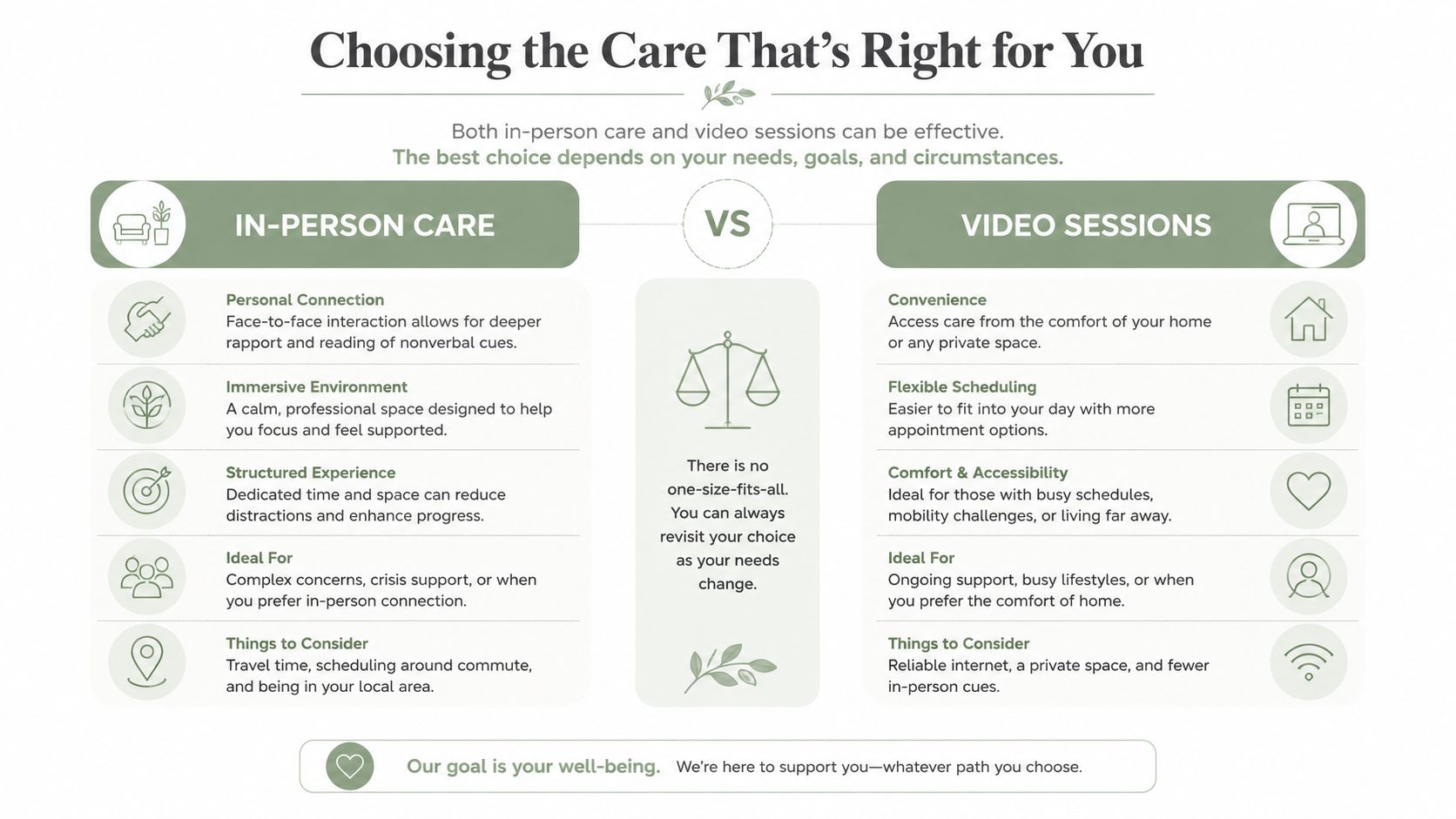
Maya's mother had two appointment options for her daughter's school anxiety. The first required a long drive, time away from work, and a difficult return trip during afternoon traffic. The second was a video session from home. Maya already spoke comfortably with adults online, had a quiet bedroom available, and wasn't in immediate danger. For this family, trying video therapy made practical sense.
Video sessions often fit anxiety, depression, routine follow-ups, parenting work, and established therapeutic relationships. They can also help a young person continue care during a move, school disruption, illness, or period when leaving home feels overwhelming. Mental health telehealth has become an enduring care pathway rather than only an emergency substitute. In U.S. electronic health record data, telehealth-based mental health encounter records rose from 7.2% in the first quarter of 2020 to 65.5% in the second quarter of 2020, then remained at 36.8% in the third quarter of 2023, as summarized in the 2025 analysis of telehealth use.
In-person treatment may be preferable when the clinician needs direct observation, the home isn't private, technology is unreliable, or a child needs substantial parent coordination. A young person at high risk of self-harm may need a more immediate safety assessment and a local response plan than a routine video appointment can provide.
Families can ask:
- Clinical fit: Can the therapist safely assess and treat the concern through video?
- Home conditions: Can the child speak privately without siblings, caregivers, or conflict interrupting?
- Communication style: Does the young person engage naturally through a screen?
- Flexibility: Would a blended plan preserve convenience while adding occasional face-to-face support?
A short consultation can reveal whether the relationship feels natural. Families exploring secure online services can also review telehealth treatment options before deciding.
What Telehealth in Mental Health Actually Means
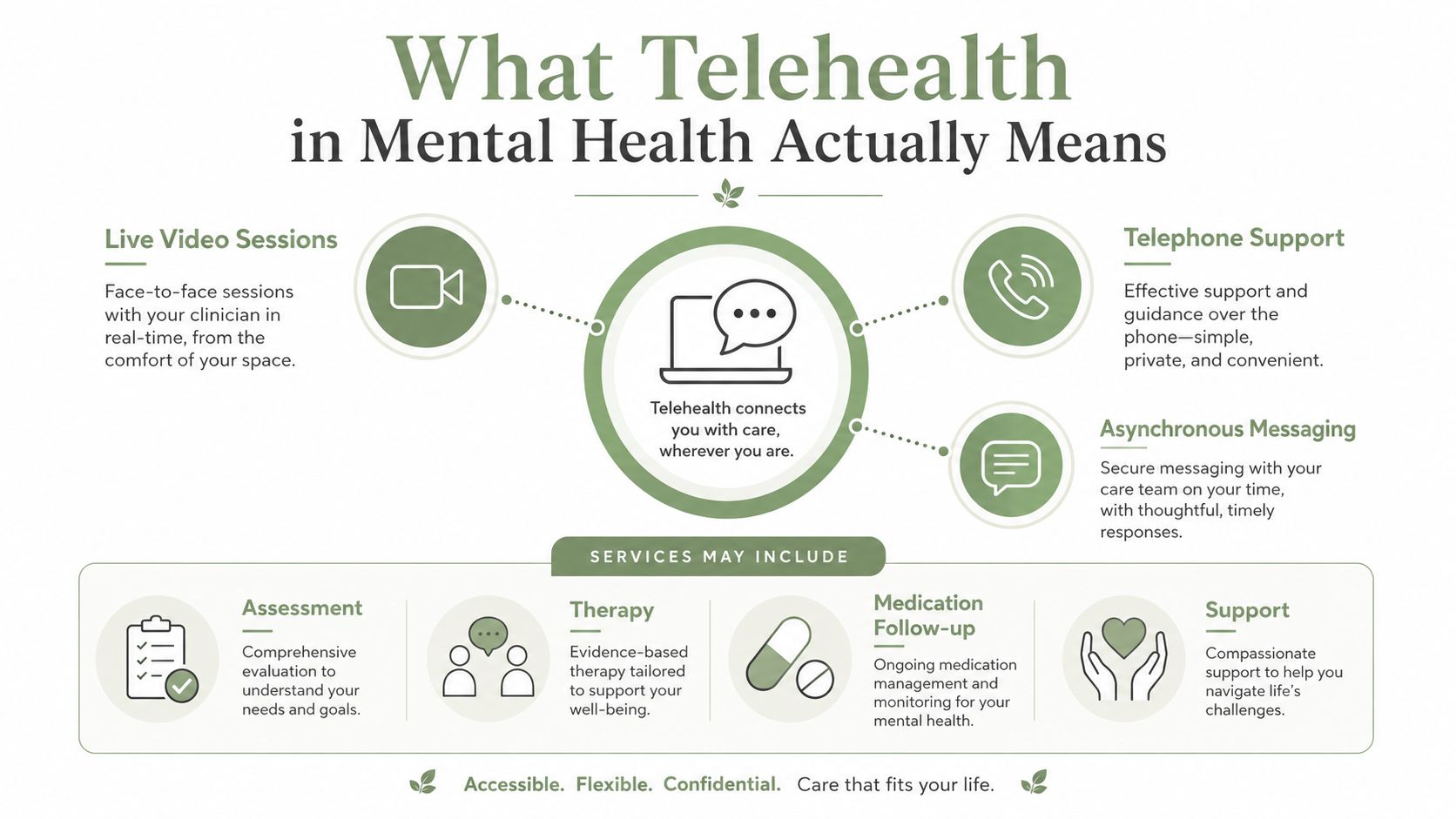
Mental health telehealth is care delivered through digital communication rather than a visit to the clinician's office. It can include assessment, psychotherapy, medication follow-up, parent guidance, symptom monitoring, and related support. The format matters because each option gives the clinician and family a different amount of information and interaction.
Three common formats
Live video sessions are usually the default for therapy. The clinician can hear tone, observe facial expression, notice changes in engagement, and respond to shifts in mood as they happen. Video can support individual, family, couples, and group sessions, although younger children often need more active caregiver participation.
Telephone sessions can be useful when broadband is unstable, a device doesn't support video, or speaking without a camera feels less distracting. Phone care may preserve continuity when video fails, but the clinician has fewer visual cues.
Asynchronous messaging and questionnaires can support intake forms, routine check-ins, psychoeducation, mood tracking, and symptom updates. They aren't a substitute for a live assessment when a situation requires rapid clinical judgment or immediate safety planning.
A good telehealth service should make the process clear. Before treatment begins, the family should know how to enter the platform, what happens if the connection drops, who can participate, how consent works, and how urgent concerns are handled. The platform should be designed to protect health information, but families also need to protect privacy on their own side by choosing a quiet setting and using headphones when appropriate.
Age and communication style matter. A teenager may prefer video because it feels less formal than an office. A younger child may need games, movement, parent coaching, or materials prepared in advance. The clinician should adapt the session rather than assuming that one digital format works for everyone.
The Core Benefits of Telehealth for Mental Health
The strongest benefits are often practical. A parent doesn't need to arrange a long commute, find transportation, leave work as early, or pull a child out of school for as much time. That reduced friction can make it easier to attend consistently, which matters because therapy depends on an ongoing relationship and repeated practice.
Telehealth can also widen the pool of available clinicians. A family in a rural area may be able to meet with a specialist who isn't located nearby, while a college student may continue with a therapist during a move between home and campus. Mental health telehealth became especially durable because families could use it for counseling, psychiatric follow-up, and family-based treatment across changing locations, as documented in the U.S. telehealth utilization review.
What families may notice
A child who becomes distressed during car rides may arrive calmer at home. A caregiver who can't leave work may join a parent-training session from a private office. A therapist may observe the actual bedtime routine, study space, or transition that triggers conflict, then help the family practice a different response in that setting.
Privacy can improve when a person avoids a shared waiting room, but the home isn't automatically private. A bedroom with a thin door, a caregiver nearby, or siblings entering unexpectedly can make honest discussion difficult. Families should treat privacy as part of the treatment setup, not as a guaranteed feature of remote care.
| Benefit | What it can improve | What helps it work | |---|---|---| | Access | Connection with care despite travel or location barriers | Reliable device, internet, and clinician availability | | Convenience | Attendance around school, work, and family routines | Predictable scheduling and a suitable private space | | Continuity | Ongoing therapy during moves or disruptions | A clear follow-up plan and stable therapeutic relationship | | Family coordination | Caregiver participation from separate locations | Agreement about who joins and when | | Real-world practice | Applying coping or parenting skills at home | Therapist guidance and boundaries around privacy |
Clinical outcomes can remain comparable to in-person care for many common conditions. The important qualification is that convenience supports treatment, but it doesn't replace clinical judgment, privacy, or consistent participation.
How a Telehealth Therapy Session Works
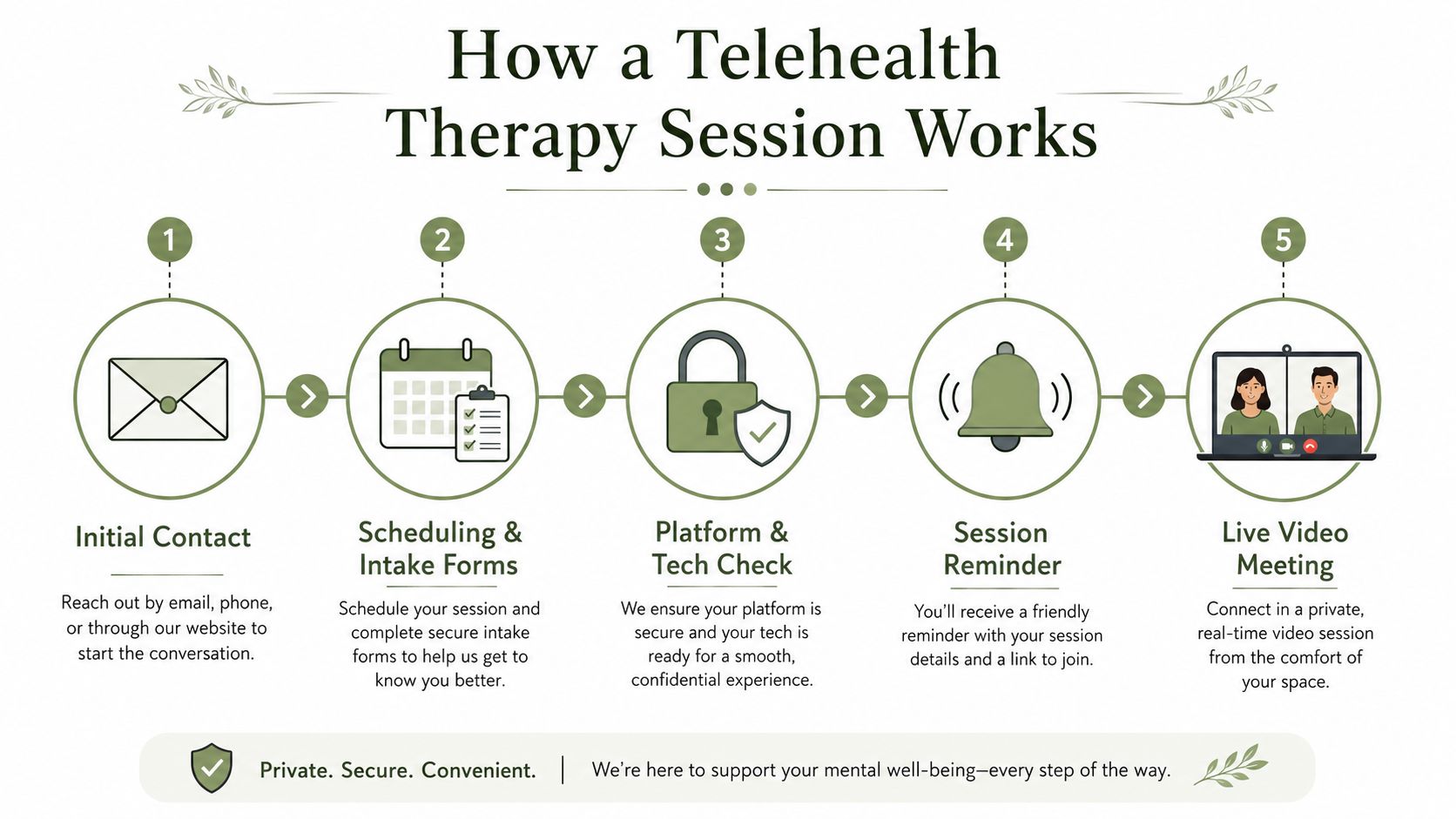
The process usually begins with contact through a practice website, phone call, or referral. The clinician or practice sends information about scheduling, consent, intake forms, fees, insurance, privacy, and emergency procedures. A technology check can identify problems before the first clinical conversation begins.
Many practices offer a brief consultation to discuss the presenting concern, age, location, goals, and scheduling. A free 15-minute consultation can function as a fit check rather than a therapy session. The family can ask whether the clinician has experience with the concern, how parents participate, and what happens if the clinician believes in-person or crisis care is more appropriate.
A typical session flow
- Prepare the setting. The client logs in from a private location and keeps a backup phone number available.
- Verify connection. The therapist checks video and audio, confirms who is present, and addresses privacy.
- Set an agenda. The client, caregiver, and therapist identify the most important topic for the session.
- Do the clinical work. This may include cognitive and behavioral strategies, exposure planning, emotional regulation, parent coaching, or medication follow-up.
- Plan the next step. The therapist reviews practice between sessions, schedules follow-up, and records necessary notes in the secure system.
Video is generally preferred for therapy because the clinician can observe facial cues and help regulate distress in real time. Phone or secure messaging may support care when video isn't workable, but asynchronous communication shouldn't be treated as emergency coverage.
Families should confirm billing before treatment starts. Ask whether the clinician accepts the insurance plan, whether telehealth has different coverage rules, what the out-of-pocket fee is, and how cancellations are handled. A practice's telehealth psychologist guidance can help families understand the service before scheduling.
What the Research Says About Effectiveness
The research supports a careful conclusion: telehealth can work as well as in-person treatment for many common mental health concerns, especially when evidence-based therapy is delivered consistently. A 2023 meta-analysis of psychiatric treatment through telemedicine found no significant differences across 27 of 29 outcomes when telepsychiatry was compared with face-to-face care. The analysis reported equivalence for efficacy, satisfaction, working alliance, and attrition across diagnoses in the published review.
A 2024 systematic review found telehealth interventions were non-inferior to face-to-face treatment for depression and anxiety. For depression, the standardized mean difference was -0.03, with a 95% confidence interval from -0.15 to 0.09. For anxiety disorders, it was -0.06, with a 95% confidence interval from -0.19 to 0.07. The review also found similar satisfaction and therapeutic alliance, as reported in the systematic review record.
What this means for a child or teen
Youth evidence is encouraging, though it shouldn't be generalized to every diagnosis or level of risk. A 2025 meta-analysis found depression severity lower after telepsychiatry than at baseline across 13 studies, with Hedges' g of 0.83 and a 95% confidence interval from 0.59 to 1.08. Anxiety severity was lower across 6 studies, with Hedges' g of 1.15 and a 95% confidence interval from 0.79 to 1.50. Compared with waitlist controls, telepsychiatry improved depression outcomes, with Hedges' g of 0.54 and a 95% confidence interval from 0.23 to 0.85, according to the youth meta-analysis.
| Condition | Telehealth effect size | In-person effect size | Parity | |---|---:|---:|---| | Depression | SMD -0.03 | Comparable comparator | Non-inferior | | Anxiety disorders | SMD -0.06 | Comparable comparator | Non-inferior | | Youth depression after telepsychiatry | Hedges' g 0.83 versus baseline | Not directly supplied | Improvement observed | | Youth anxiety after telepsychiatry | Hedges' g 1.15 versus baseline | Not directly supplied | Improvement observed |
These findings don't prove that video is right for severe psychosis, acute crisis care, or every complex presentation. They suggest that delivery mode alone doesn't have to weaken core psychotherapy when the clinician, platform, safety plan, and family participation are appropriate.
Honest Limitations and Who Telehealth Still Misses
Telehealth is often presented as an answer to unequal access. It can remove transportation and geographic barriers, but it can't remove a barrier that a family still can't reach. A household may lack a private room, a suitable device, reliable broadband, digital confidence, or the money to maintain consistent connectivity.
The equity problem is visible in recent evidence. A 2025 rapid review found telehealth outcomes were often similar to in-person care and could improve access where transportation or provider shortages create obstacles, as summarized by the Center for Health Care Strategies review. The same broader evidence indicates that non-Hispanic Black and Hispanic adults remained less likely than White adults to receive any mental health care, while rural residents were less likely to receive telehealth services. Telehealth creates an option, but an option isn't the same as reachable care.
Speed and safety matter
Most outpatient telehealth clinicians work by appointment. That makes routine treatment possible, but it doesn't turn a scheduled video visit into an emergency stabilization service. A family facing imminent danger, severe confusion, an overdose, or immediate self-harm risk should use local emergency services or crisis resources rather than wait for a routine appointment.
Same-day access can also be weaker. One 2025 study found that patients whose initial integrated behavioral health visit occurred through telehealth had 86% lower odds of receiving same-day access than patients seen in person, although the telehealth effect improved over time, according to the study on integrated behavioral health access. That finding matters for children and young adults who need a warm handoff, rapid triage, or immediate coordination.
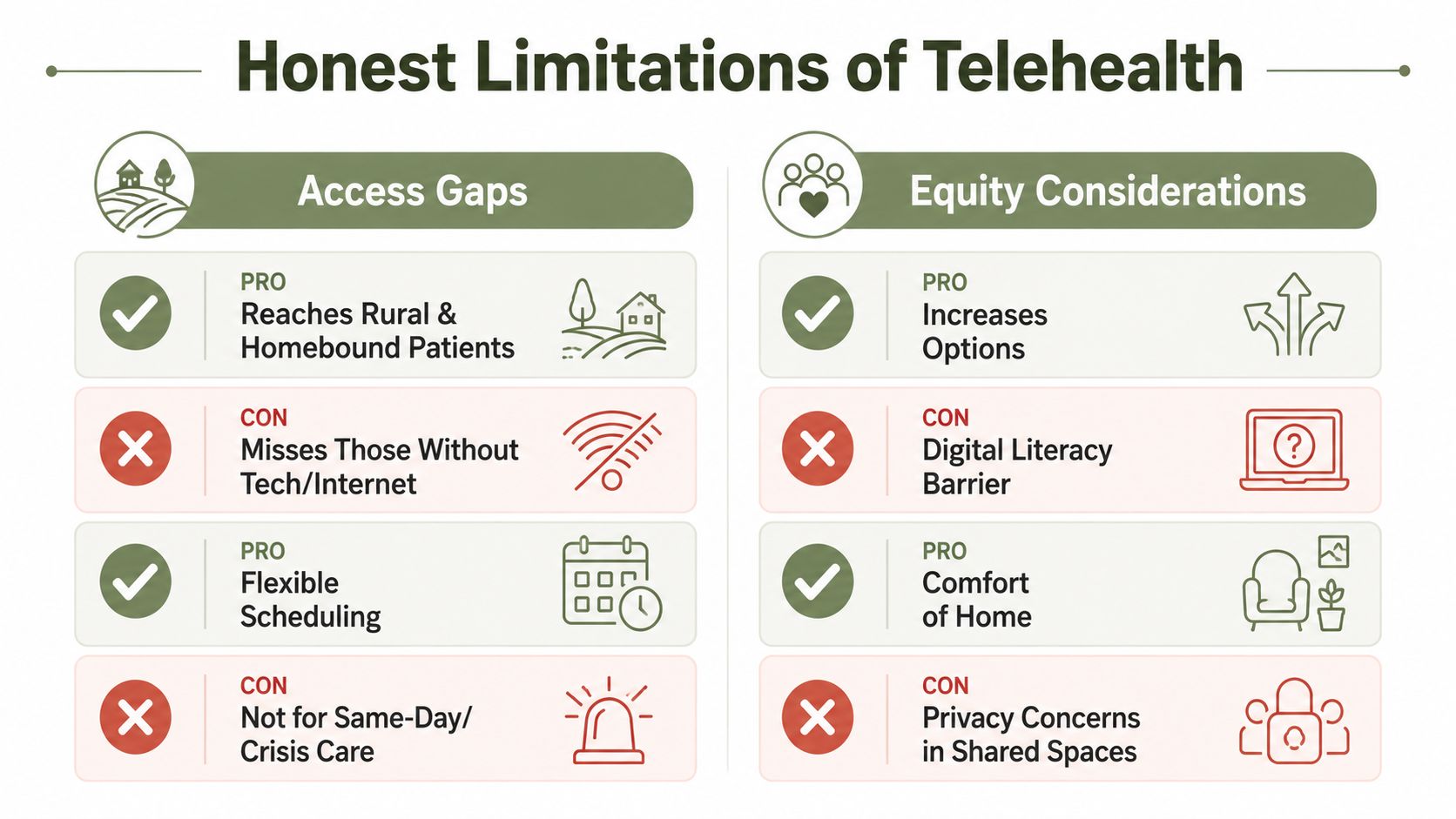
Recent reviews also note slightly higher dropout in telehealth than face-to-face care. Technology friction, low motivation, weak privacy, and the lack of a physical transition into a waiting room can all affect engagement. In-person care may be more suitable when the clinician needs extensive observation, the child is too young for meaningful remote participation, or the treatment requires intensive local coordination.
Practical Tips for Successful Teletherapy Sessions
A successful video session starts before the appointment link opens. Families don't need a perfect home, but they do need a repeatable routine that protects attention, privacy, and connection quality.
Set up the room
Choose a private, well-lit space where the young person can speak without being overheard. A neutral background can reduce distractions, while headphones may limit echo and help protect confidentiality. Place the device near eye level so the therapist can see facial expressions without looking up at a low laptop or down at a phone.
The setup should match the client's age. A young child may need a caregiver nearby and simple materials within reach. A teenager may prefer to control the camera and sit somewhere that feels separate from family life. Parents should clarify with the therapist whether they'll be present for the whole session, join at the beginning, or receive a brief update afterward.
Test the technology
Open the platform link early enough to solve ordinary problems without using treatment time. Close bandwidth-heavy applications, charge the device, and keep the clinician's phone number available in case video drops and the session needs to continue by telephone.
Practical rule: Treat the backup plan as part of the appointment, not as an admission that telehealth has failed.
During the session, keep water nearby and use a notebook for between-session reflections or practice tasks. Avoid multitasking, eating a full meal, or moving around the home unless movement is part of the clinical plan. Children may need a visual schedule, fidget item, drawing materials, or a planned movement break.
Support without hovering
Parents can help a child prepare, then step back when the therapist asks for private conversation. A brief check-in afterward is usually more useful than demanding a detailed recap. Try asking, “Was there anything you want help practicing this week?” rather than pressing for every statement made in therapy.
Families should tell the therapist in advance about pets, siblings, construction noise, shared rooms, or unstable internet. A simple contingency plan might include moving to another room, switching to headphones, turning off the camera briefly, or continuing by phone. The practice may also provide educational materials and planning tools through its family mental health resources.
Deciding If Telehealth Is Right for Your Family
Use three lenses: clinical fit, logistics, and family preference. A decision becomes clearer when all three point in the same direction.
Clinical fit comes first. Video may suit anxiety, depression, parenting stress, school stress, and many mild-to-moderate mood concerns when the young person can communicate and the household can support privacy. Ask whether the clinician can assess risk remotely, involve caregivers appropriately, and coordinate local services if the situation changes.
Logistics can make a good clinical match workable or impossible. Consider the commute, school and work schedules, insurance rules, the availability of a quiet device, internet stability, and whether the family can attend without frequent interruptions. Convenience is valuable only when it improves actual participation.
Family preference also carries clinical information. Some young people talk more openly from home. Others focus better when they leave the house and enter a dedicated office. Neither response is a character flaw, and a family may change formats as treatment progresses.
Three families, three reasonable choices
- The anxious middle-school student: She avoids long drives and feels calmer at home. Her parent can provide a private room and remain available without sitting in the session. Video is a sensible first trial.
- The teenager with worsening safety concerns: The family can't guarantee privacy, and the teen needs rapid assessment and close local coordination. In-person evaluation or urgent local care deserves priority.
- The college student moving between locations: A consistent video relationship may reduce disruption, provided the clinician can legally provide care where the student is located and has an emergency contact plan.
Before committing, book a consultation and ask about the clinician's telehealth experience, privacy expectations, parent involvement, emergency protocols, fees, and backup options. Agree on a short trial period, then review attendance, comfort, communication, symptom progress, and safety. A blended approach may offer the best balance when the family wants remote convenience without giving up face-to-face support.
---
Wald Behavioral Health provides secure video telehealth for children, adolescents, young adults, and families, with in-person care also available in Coral Gables. Visit Wald Behavioral Health to request a free 15-minute consultation and discuss whether online, in-person, or blended therapy fits your family's needs.
Questions about your child or teen?
Dr. Wald offers a free 15 minute consultation to talk through what you are seeing and whether the practice is a good fit.
Free 15 Minute Consultation