8 Family Therapy Techniques That Work

A parent asks for help because every evening ends the same way. A child refuses homework, a sibling joins the argument, one caregiver raises their voice, and the other backs down. Yet the visible conflict may have different causes. A family with unclear boundaries needs a different intervention from one caught in anxious predictions, emotional withdrawal, inconsistent reinforcement, school refusal, or peer-related risk.
The most useful family therapy techniques match the pattern maintaining the problem, not the loudest symptom. The approaches below compare eight evidence-based options and translate each into home routines and telehealth sessions. They aren't a substitute for assessment, especially when safety concerns, severe symptoms, coercion, or significant power differences are present. Families considering remote care can also find HIPAA compliant telehealth tools to discuss privacy and secure communication with a clinician.
## Table of Contents - 1. Structural Family Therapy - Translating structure into daily routines - 2. Parent-Child Interaction Therapy - What parents practice between sessions - 3. Cognitive-Behavioral Family Therapy - Applying the model without turning home into a worksheet - 4. Narrative Family Therapy - Rewriting the story into daily action - 5. Emotionally Focused Family Therapy - Turning attachment needs into usable responses - 6. Behavioral Family Intervention and Parent Behavior Training - 7. Solution-Focused Brief Family Therapy - Turn hope into observable behavior - 8. Multisystemic Therapy and Ecological Family Intervention - 8-Method Family Therapy Comparison - Turn Insight Into a Consistent Family Plan
1. Structural Family Therapy
Structural Family Therapy is a strong starting point when the household's organization keeps the problem going. The therapist looks at boundaries, parental authority, alliances, and repeated interaction patterns, then actively helps the family reorganize them. A child may be labeled defiant, for example, while the deeper difficulty is that caregivers disagree about limits, a child is pulled into adult decisions, or separated parents communicate through the child.
The therapist may create a family map, observe an argument in real time, and ask the family to repeat the interaction differently. This enactment gives the clinician more than a verbal account. It shows who interrupts, who withdraws, who takes responsibility, and whether the parents can lead without escalating.
Translating structure into daily routines
A practical plan might establish that one caregiver gives the instruction, both caregivers support the same consequence, and disagreements happen privately rather than in front of the child. The goal isn't rigid control. It's a clear, predictable hierarchy in which adults carry adult responsibilities and children aren't expected to mediate conflict.
Useful home tasks include:
- Map the pattern: Write down what happens before, during, and after the recurring conflict.
- Clarify the boundary: Decide which decisions belong to caregivers and which choices belong to the child.
- Practice one interaction: Rehearse a bedtime or homework exchange with short, specific language.
- Coordinate caregivers: Agree on the same expectation and response before introducing it at home.
Practical rule: A boundary isn't established because adults explain it once. It becomes reliable when caregivers respond consistently.
Structural work can be harder when one caregiver refuses participation or when direct confrontation increases risk. In separated families, the clinician may focus first on co-parent communication and keeping the child out of adult disputes. Families seeking a plain-language overview of therapy for family issues can use it as background, but a qualified therapist still needs to assess the family's particular structure.
2. Parent-Child Interaction Therapy
Parent-Child Interaction Therapy, or PCIT, fits families with young children whose tantrums, aggression, noncompliance, or separation distress dominate daily life. Instead of relying on retrospective discussion, the therapist watches the caregiver and child interact, then provides real-time coaching. The parent practices while the clinician reinforces specific skills and redirects unhelpful responses.
The early relationship-building phase matters. Caregivers learn to follow the child's lead in play, notice positive behavior, describe what the child is doing, and offer labeled praise. Later, the work shifts toward clear commands, predictable follow-through, and calm responses to unsafe or disruptive behavior. This sequence prevents discipline from becoming the only focus.

What parents practice between sessions
A parent might begin by spending a short, planned period playing with a child without correcting, quizzing, or directing. During a later routine, the parent gives one clear instruction, waits, and follows the agreed plan rather than repeating the command louder. The therapist can review what happened, identify barriers, and adjust the plan.
PCIT works best when caregivers have enough privacy, time, and emotional capacity to practice. Parent depression, exhaustion, conflict between caregivers, or an unsafe home environment can interfere, so those concerns need attention rather than being treated as poor motivation. Coaching should feel like skill development, not a judgment of parenting.
For additional context on parent training and information, caregivers can review practical guidance before asking a clinician whether PCIT is appropriate. In telehealth, the therapist may observe play through a secure video connection, though camera placement, sound quality, and household privacy affect what can be seen.
The following video demonstrates the kind of coached parent-child interaction that families may discuss with a trained provider.
3. Cognitive-Behavioral Family Therapy
Cognitive-Behavioral Family Therapy, or CBFT, is useful when thoughts, behaviors, and family responses reinforce one another. A child may predict that school will be unbearable, a parent may respond by allowing avoidance, and the short-term relief may strengthen the next refusal. In another family, caregivers may interpret ADHD-related disorganization as deliberate defiance, leading to criticism that increases frustration without teaching the missing skill.
CBFT makes these cycles visible and gives the family structured ways to test new responses. A therapist might use a thought record to identify the prediction, emotion, behavior, and consequence. The family then develops a small behavioral experiment, such as approaching a manageable school task while reducing reassurance or avoidance.
Applying the model without turning home into a worksheet
The approach should be adapted to the child's age and attention. Younger children may draw worry as a character or use a simple feelings scale. Adolescents may examine all-or-nothing thinking, avoidance, or assumptions about peers. Parents can model the process by saying, “I'm noticing that I'm predicting the worst, so I'm going to check the facts before reacting.”
Common applications include:
- Anxiety: Identify catastrophic predictions and pair gradual approach with calm support.
- Depression: Plan small, meaningful activities rather than waiting for motivation to appear.
- OCD: Support therapist-guided exposure work without providing reassurance or participating in rituals.
- ADHD: Replace moral judgments with concrete prompts, environmental supports, and realistic expectations.
- Family conflict: Track how criticism, withdrawal, and escalation affect the next response.
CBFT is structured, which helps families who want clear goals, but some people experience worksheets as mechanical or overwhelming. The clinician should protect time for emotion, culture, developmental needs, and relationship repair. A family doesn't need to challenge every thought. It needs to identify the thoughts that are changing behavior and keeping the cycle active.
4. Narrative Family Therapy
Narrative Family Therapy helps when a family has begun describing one person as the problem. A child may be called “the difficult one,” a diagnosis may define the whole personality, or repeated school struggles may make failure seem unavoidable. The therapist separates the person from the problem and examines how that problem shapes routines, relationships, and expectations.
A useful starting question is, “What does anxiety persuade the family to do?” The answer might include repeated reassurance, missed school, or arguments about attendance. With an adolescent, the therapist may ask when the teen has acted with persistence or according to personal values, even briefly. These examples do not deny impairment. They identify abilities and relationships that the problem has not completely controlled.
Rewriting the story into daily action
The therapist listens for exceptions and meanings that blame-focused conversations overlook. A parent might recall a child with ADHD organizing a complicated activity, or a student attending an important event despite intense worry. The family can then turn that detail into a small routine, such as naming the problem before a difficult task and choosing one supportive response instead of criticism.
Narrative methods can include:
- Externalizing language: Ask how “worry,” “bullying,” or “shame” affects the family, rather than treating the child as the cause.
- Exception questions: Explore when the problem had less influence and what conditions supported that change.
- Values questions: Connect actions with care, courage, loyalty, or persistence.
- Witnessing: Invite a trusted relative or community member to recognize a preferred account when appropriate.
- Written or visual work: Use letters, drawings, timelines, or shared statements to reinforce the family's chosen description.
In telehealth, families can bring a drawing, timeline, or written example to the session and discuss it together. At home, parents should use the new language consistently without turning every interaction into therapy. The approach may offer too little immediate structure when behavior management or safety is urgent. A clinician can combine it with more directive support, while protecting the child from shame and keeping practical change connected to identity.
5. Emotionally Focused Family Therapy
A teenager slams a bedroom door after a parent asks about school. The parent follows with criticism, the teenager withdraws further, and another caregiver stays silent to prevent the argument from growing. Emotionally Focused Family Therapy (EFFT) examines this cycle, including the vulnerable feelings beneath each protective response.
Anger may signal fear of rejection. Withdrawal may express hurt or uncertainty. Controlling behavior may reflect a strong need for reassurance. The therapist slows the exchange, identifies the pattern, and helps relatives respond to the underlying need without excusing aggression, intimidation, or other unsafe behavior.
Turning attachment needs into usable responses
EFFT works through carefully guided conversations rather than a generic communication script. A parent may describe feeling powerless when a child shuts down, then practice expressing concern without accusation. The child can learn to ask for comfort, privacy, or practical help more directly. These changes matter during ordinary pressure points, such as homework, school anxiety, bedtime, or repair after an argument.
A clinician may help the family:
- Pause the first reaction: Create enough space to avoid answering a provocative comment with immediate criticism.
- Name possible feelings: Ask, “Could fear be underneath the anger?” without presenting an interpretation as fact.
- Make a specific request: Say whether comfort, space, information, or assistance is needed.
- Notice connection attempts: Respond when someone offers a small disclosure, shared activity, or effort to reconnect.
- Repair the interaction: Revisit the conflict and identify the need each person was trying to communicate.
“The feeling makes sense, and the behavior still needs a safer limit.”
Families can practice one short exchange at home, then review what helped with the therapist. In telehealth, attachment-focused work can continue if participants have privacy, stable camera placement, and a reliable way to speak without interruption. The clinician may need to adjust the format when a family member cannot talk freely from the same room.
EFFT can require sustained emotional effort. It may be a poor starting point when people cannot stay physically or emotionally safe together, or when urgent behavioral stabilization must come first. Professional guidance helps prevent attempts at vulnerable conversations from intensifying conflict.

6. Behavioral Family Intervention and Parent Behavior Training
A child refuses bedtime, escalates after a request, or avoids school, and caregivers may experience the behavior as deliberate defiance. Behavioral Family Intervention shifts attention to the sequence around it: what happens before the behavior, how adults respond, and what consequence may keep it going. The approach is practical when a family needs change that can be observed at home and reviewed in therapy.
Start with one precise target. “Be respectful” is difficult to measure. “Begin the bedtime routine within a few minutes of the first instruction” gives caregivers and clinicians something they can track. The plan then combines clear teaching, quick positive reinforcement, and proportionate, predictable consequences when needed.
The strongest plan is usually the one adults can follow during a difficult evening. Rewards should matter to the individual child, instructions should be brief, and caregivers should agree on the next response before escalation begins. A plan that depends on perfect calm or unlimited time will not hold up in the household's real routine.
Use the following sequence to make implementation concrete:
- Establish a baseline: Record when and where the behavior occurs before changing the routine.
- Choose one target: Select an observable behavior that can be measured.
- Reinforce promptly: Describe cooperation specifically and respond soon after it occurs.
- Add a visual cue: A simple behavior chart or routine board can clarify expectations.
- Align caregivers: Parents, relatives, and other regular caregivers should use the same core expectations.
- Review the record: Bring observations to therapy so the clinician can adjust the plan rather than treating an early difficulty as failure.
Families can review examples of positive reinforcement for daily routines and adapt them to the child's interests and developmental level. A chart supports follow-through, but it is not treatment by itself. Vague targets, delayed rewards, adult disagreement, or shame-based use can turn it into another source of conflict.
Behavioral methods may improve conduct while leaving anxiety, grief, trauma, or relational injury unaddressed. Assessment and professional guidance help determine whether parent training is sufficient, or whether the family also needs work on emotional needs and interaction patterns.
7. Solution-Focused Brief Family Therapy
A parent reports that school mornings usually end in refusal, yet one recent morning went differently. Solution-Focused Brief Family Therapy starts with that exception. It suits families with a defined goal who can identify moments when the problem loosens its grip. The therapist examines existing skills and small signs of progress instead of reconstructing every past failure.
The clinician asks what changed, who acted differently, and which part of the sequence the family could repeat. A calmer sleep routine might reveal visible expectations, lower lights, and less rushed instructions. Those details can become practical building blocks for weekdays. In a telehealth session, the family can describe the routine in real time and test one small adjustment between appointments.
Turn hope into observable behavior
The miracle question gives the family a concrete picture of change: if the problem no longer directed the household, what would the child do first, what would the parent notice, and what would happen next? Scaling questions can track perceived progress, but the rating has limited value without a behavioral description attached to it.
A clinician might shape the next experiment through four focused prompts:
- Repeat an exception: Recreate conditions from a recent successful interaction.
- Notice a difference: Have each family member watch for one small sign of cooperation.
- Build from strength: Apply a caregiver's effective response during a harder routine.
- Make progress visible: Define the small step expected before the next session.
The approach can feel too brief for trauma, entrenched violence, severe symptoms, or problems spread across several systems. It should not pressure anyone to dismiss pain or announce success early. Families may need trauma-focused, safety-focused, or broader systemic care alongside solution-focused work. Professional assessment helps determine whether this method fits and keeps home experiments realistic, voluntary, and safe. Its value is finding usable traction while remaining honest about what still needs attention.
8. Multisystemic Therapy and Ecological Family Intervention
A teenager's school absence may begin with peer conflict, intensify through family arguments, and continue because supervision or transportation is limited. Multisystemic Therapy (MST) addresses these connected conditions rather than treating the adolescent's behavior in isolation. It is designed for complex concerns involving home, school, peers, and community pressures.
The therapist maps how each setting affects the others, then turns that assessment into coordinated actions. Work may include aligning expectations with school staff, adjusting supervision and peer access, strengthening caregiver responses, and helping the adolescent establish safer routines. The family helps set priorities and test changes, instead of receiving instructions without context.
A practical plan examines several questions:
- Home: Who sees early warning signs, and what response follows?
- School: What occurs before absence, conflict, or withdrawal?
- Peers: Which relationships support safety, and which increase risk?
- Community: Do transportation limits, neighborhood pressures, or available resources affect care?
- Treatment access: What makes attendance, communication, or home practice difficult?
Progress should be reviewed across the domains that maintain the problem, including attendance, behavior, family conflict, and emotional functioning. Coordination calls for consent, defined responsibilities, and careful handling of confidentiality. Cultural humility matters as well. A response labeled “noncompliant” may reflect language barriers, discrimination, transportation constraints, or services that do not fit the family's circumstances.
Telehealth can support caregiver meetings, shared planning, and communication with authorized professionals. A clinician may also help the family rehearse a school conversation or revise a home supervision plan during the session. Remote care has limits when privacy is unavailable, the adolescent cannot participate safely, or the plan depends on intensive in-home support. Professional assessment determines whether MST or another ecological intervention fits the risks, resources, and systems involved.
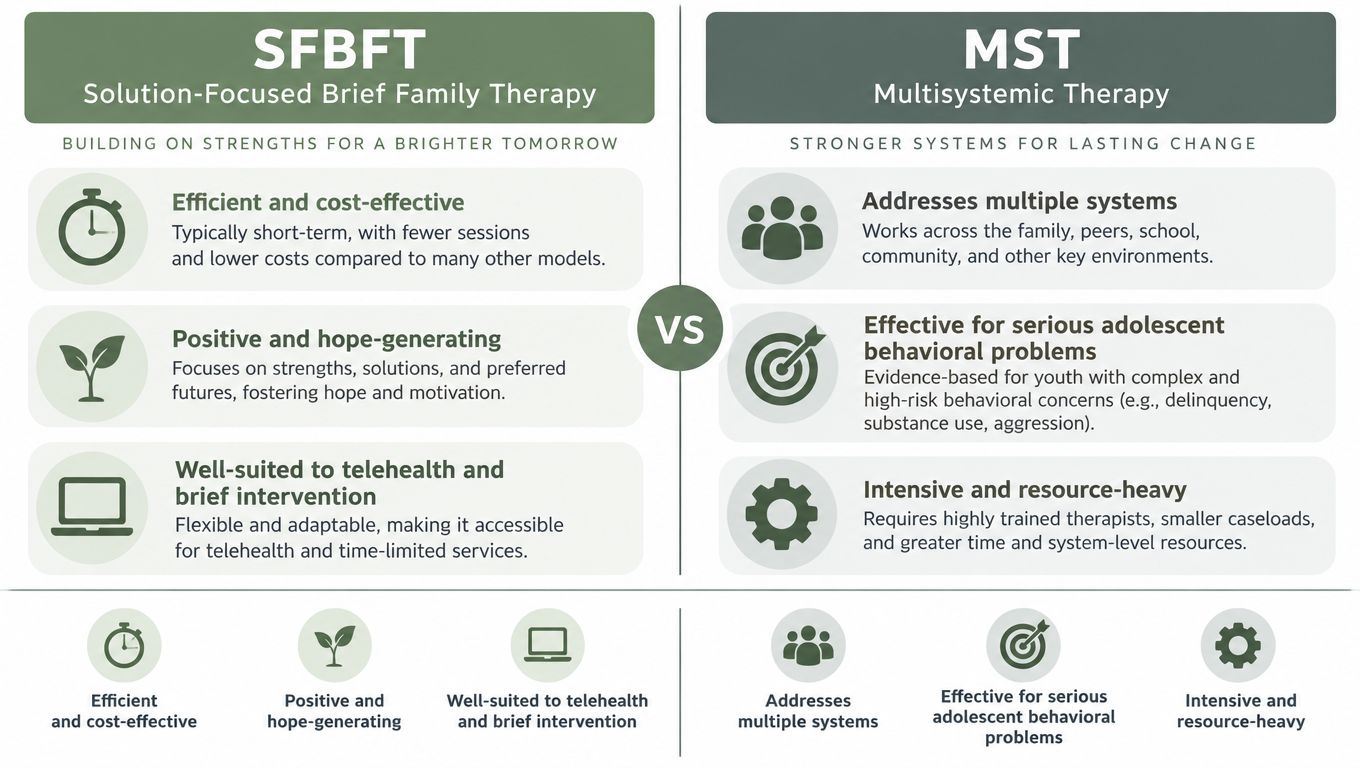
8-Method Family Therapy Comparison
| Therapy | Implementation complexity 🔄 | Resource requirements ⚡ | Expected outcomes ⭐📊 | Ideal use cases | Key advantages 💡 | |---|---:|---:|---|---|---| | Structural Family Therapy | Moderate, High; strategic, directive interventions 🔄 | Moderate; skilled therapist and session time | ⭐⭐⭐⭐; rapid behavioral & interactional change; measurable in routines 📊 | Family conflict, child noncompliance, school refusal, authority issues | Reorganizes boundaries/hierarchy; concrete parent strategies; culturally adaptable | | Parent-Child Interaction Therapy (PCIT) | Moderate; real‑time coaching, two phases (CDI/PDI) 🔄 | Moderate, High; therapist training, equipment (coaching), high parent involvement ⚡ | ⭐⭐⭐⭐⭐; fast, robust reductions in tantrums/noncompliance; clear pre/post gains 📊 | Young children (≈2, 7) with tantrums, aggression, separation anxiety, sleep problems | Live coaching builds skills and attachment; strong evidence base | | Cognitive‑Behavioral Family Therapy (CBFT) | Moderate; structured, skills- and homework-focused 🔄 | Moderate; CBT‑trained therapist, family engagement | ⭐⭐⭐⭐; strong for anxiety, depression, OCD; measurable symptom reduction 📊 | Anxiety, depression, OCD, ADHD with cognitive/behavioral contributors | Teaches coping/exposure within family context; integrates individual/family work | | Narrative Family Therapy | Low, Moderate; exploratory, re-authoring stance 🔄 | Low, Moderate; flexible methods (stories, creative work) ⚡ | ⭐⭐⭐; improves agency and identity; outcomes often qualitative 📊 | Adolescents with identity/self‑esteem issues, bullying, culturally diverse families | Non‑pathologizing; reduces shame; culturally sensitive and empowering | | Emotionally Focused Family Therapy (EFFT) | Moderate, High; emotion‑focused sequences, attunement skills 🔄 | Moderate; therapist expertise in attachment and emotion work | ⭐⭐⭐⭐; deeper relational change and improved emotional regulation 📊 | Families with emotional avoidance, attachment insecurity, separation anxiety | Targets emotional cycles; strengthens attachment and empathic response | | Behavioral Family Intervention (BFI) / Parent Behavior Training | Low, Moderate; protocolized, data-driven steps 🔄 | Low, Moderate; parent consistency and monitoring; telehealth friendly ⚡ | ⭐⭐⭐⭐; rapid, measurable reductions in externalizing behaviors 📊 | Oppositional behaviors, ADHD, bedtime routines, school‑home behavior plans | Highly evidence‑based; concrete plans, quick measurable gains | | Solution‑Focused Brief Family Therapy (SFBFT) | Low; goal- and exception-focused, brief model 🔄 | Low; few sessions, low cost, good for telehealth ⚡ | ⭐⭐⭐; efficient, short‑term improvements; increases motivation 📊 | Time-limited care, busy families, school stress, goal‑setting for ADHD | Strengths-based, hope-generating, scalable for brief work | | Multisystemic Therapy (MST) / Ecological Intervention | Very High; multi-context coordination, crisis capacity 🔄 | Very high; intensive home/community work, 24/7 availability, specialized training ⚡ | ⭐⭐⭐⭐⭐; strong reduction in out‑of‑home placements, recidivism, and severe problems 📊 | Adolescents with serious behavioral/justice risk, complex multi-system needs | Holistic, system-level change; coordinates school/peers/community for durable outcomes |
Turn Insight Into a Consistent Family Plan
Choosing among family therapy techniques starts with the pattern you can observe, not the label you hope will explain everything. Boundaries and authority problems may call for structural work. Behavior and routines often benefit from parent behavior training, PCIT, or another structured behavioral intervention. Anxious or depressive thinking may point toward CBFT, while emotional disconnection may require attachment-focused work. Identity, shame, or blame can make narrative therapy a constructive entry point. Motivation and limited availability may fit solution-focused work. School, peer, family, and community problems occurring together require a broader ecological assessment.
A family can also need more than one approach. A clinician might use structural interventions to clarify caregiver roles, behavioral strategies to stabilize bedtime, and emotionally focused conversations to repair trust. The model should follow the family's needs, developmental stage, culture, language, safety, and willingness to participate. Research on implementation supports this practical emphasis. In community treatment for adolescent behavior problems, greater use of core family therapy techniques predicted better one-year outcomes, including lower delinquent acts and externalizing symptoms, even when clinicians weren't working inside a formally branded family therapy program. The finding is reported in this peer-reviewed community therapist study, and it highlights why reliable delivery matters as much as naming a modality.
Clinics can make that reliability more visible by pairing an adherence benchmark with a standardized outcome measure. The Tavistock and Portman evidence and outcome studies describe SCORE as a validated self-report index of family functioning used to track therapeutic change in systemic and family therapy services. The same source describes a benchmark derived from 141 sessions across 63 families treated by five therapists, allowing routine-care delivery to be compared with a formal research benchmark. Families don't need to manage these measures alone, but clinicians can use them to check whether treatment is producing observable change.
Home practice should be specific, observable, developmentally appropriate, and coordinated across caregivers. Choose one interaction or target behavior. Define what happens before it, what the child or caregiver will do differently, and how adults will respond. Track it briefly, without turning the home into a surveillance system, then bring the information to a qualified clinician.
Wald Behavioral Health provides evidence-based family guidance, parent training, in-person care in Coral Gables, and secure telehealth for clients in Florida, Maryland, and PSYPACT-participating states. Services address concerns including anxiety, depression, OCD, ADHD, school stress, sleep difficulties, behavioral challenges, and family routines. A clinician can help determine whether the family needs individual treatment, parent involvement, family sessions, or a coordinated combination.
Start by writing down one target behavior or interaction and the response you want to change. Track what happens briefly, then discuss the pattern and treatment fit with a qualified clinician rather than trying to apply a complex family therapy technique without guidance.
---
Wald Behavioral Health offers evidence-based therapy, parent training, family guidance, in-person sessions in Coral Gables, and secure telehealth for clients in Florida, Maryland, and PSYPACT-participating states. Families can schedule a free 15-minute consultation to discuss concerns, fit, and practical next steps by visiting Wald Behavioral Health.
Questions about your child or teen?
Dr. Wald offers a free 15 minute consultation to talk through what you are seeing and whether the practice is a good fit.
Free 15 Minute Consultation