OCD Therapy Techniques for Youth and Families

A school morning can become a battle before anyone has found a shoe. Your child may know they're late, yet still need to check the lock again, wash their hands repeatedly, ask whether everyone is safe, or restart a routine because it didn't feel “just right.” By the time the family leaves, everyone is exhausted. Your child feels ashamed or frightened, and you may wonder whether helping them complete the ritual is kindness or making the problem worse.
These situations are common in families affected by obsessive-compulsive disorder, or OCD. The right ocd therapy techniques don't rely on telling a child to “stop worrying.” They give the child, teen, and parents a structured way to respond to intrusive thoughts and compulsions differently, at home as well as in therapy.
## Table of Contents - Understanding the OCD Cycle and the Path to Relief - Why ordinary reassurance often fails - How Exposure and Response Prevention Rewires the Brain - The basic ERP process - Cognitive Strategies for Managing Intrusive Thoughts - Giving OCD a name - Tools that make thoughts less commanding - Breaking the Trap of Family Accommodation - Support the child without supporting OCD - Include the wider environment - Navigating In-Person and Telehealth ERP Options - Questions for choosing a format - What to Expect During a Typical Therapy Session - The opening check-in - Reviewing practice between sessions - Learning and practicing a new skill - When to Consider Medication and Psychiatric Referral - Signs that a referral may help - Build one coordinated plan
Understanding the OCD Cycle and the Path to Relief
Consider a teenager who has an intrusive thought that they might have made a terrible mistake at school. The thought feels urgent, so they mentally replay the day, ask a parent for reassurance, and reread a message several times before sending it. The reassurance helps briefly. Then doubt returns, often with even greater force.
That sequence forms the OCD cycle:
- An obsession appears, such as an unwanted image, doubt, fear, or sensation.
- Anxiety or discomfort rises, sometimes accompanied by guilt, disgust, or a feeling of incompleteness.
- A compulsion follows, such as checking, washing, avoiding, repeating, praying, reviewing, or seeking reassurance.
- Relief arrives briefly, which teaches the brain to use the same compulsion the next time.
The child isn't choosing these thoughts, and the family isn't causing OCD by responding imperfectly. OCD is more than ordinary worry or a preference for order. It can interfere with sleep, school attendance, friendships, family routines, and a young person's confidence in their own judgment.
Why ordinary reassurance often fails
Parents naturally try to settle the fear. They may answer the same question repeatedly, inspect an object, help with a ritual, or change the household routine to prevent distress. Those responses can feel compassionate in the moment, but they may become part of the compulsion. The child learns that anxiety must be removed before they can continue.
Traditional talk therapy can help a young person describe emotions, but discussion alone may not interrupt this behavioral loop. OCD usually requires a treatment that addresses what happens after the intrusive thought appears. Exposure and Response Prevention, or ERP, is the core behavioral element of CBT for OCD, centered on facing feared triggers and resisting rituals.
ERP became formally embedded in major OCD treatment guidance by the mid-2000s. NICE recommends low-intensity ERP for adults with mild OCD when functional impairment is limited, with an initial treatment cap of up to 10 therapist hours per patient, and describes a move to more than 10 hours of CBT with ERP when those options aren't sufficient. This overview of NICE OCD treatment guidance illustrates how ERP was placed within stepped care rather than treated as an optional add-on.
For young people, treatment needs developmental adjustments. A therapist may use drawings, games, stories, rating scales, or the child's own language for OCD. The underlying aim remains consistent: help the young person stop treating every intrusive thought as an emergency and build confidence in responding without rituals.
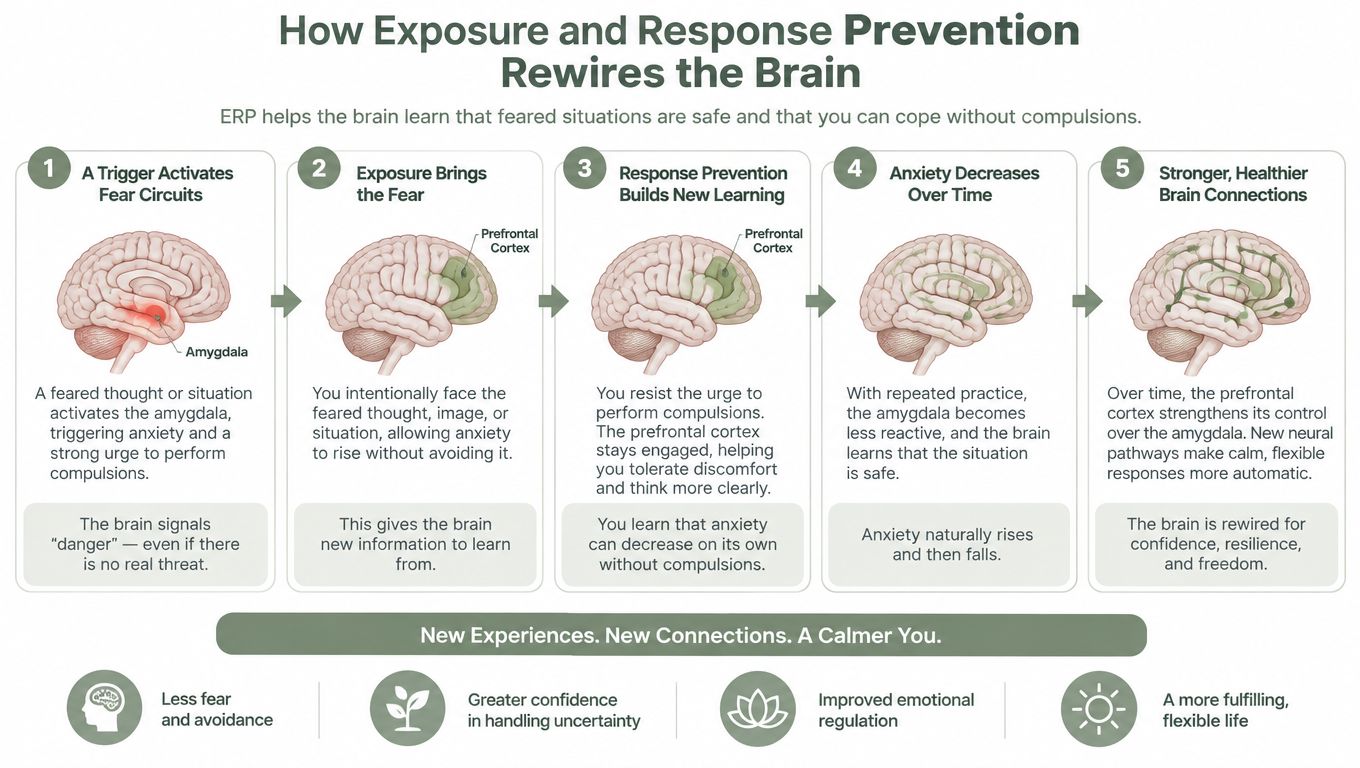
How Exposure and Response Prevention Rewires the Brain
ERP treats OCD like a false alarm system. An alarm can sound when there's a genuine danger, but it can also become overly sensitive. If a family responds to every alarm by checking, escaping, or calling for reassurance, the alarm never has a chance to learn that the situation is manageable.
In ERP, the child practices hearing the alarm without automatically obeying it. The therapist doesn't throw a child into the most frightening situation. Instead, therapist and child create a gradual plan that begins with a tolerable challenge and develops through repeated practice.
The basic ERP process
First, identify the pattern. The therapist asks what triggers the obsession, what the child does next, and what happens afterward. A young person with contamination fears might avoid touching a doorknob, wash immediately after touching one, and ask a parent whether the washing was enough.
Next, create a collaborative hierarchy. The hierarchy lists possible exposures from less difficult to more difficult. For one child, touching a clean household object and waiting before washing may be an early step. For another, the plan may involve leaving a message unrevised, sitting with an unanswered question, or completing a bedtime routine without repeating it.
Then, practice the exposure. The child intentionally approaches the trigger, either in the office, at home, at school, or through imagination. The therapist explains what will happen and helps the child notice urges without turning the exercise into a test of perfection.
Response prevention is the essential part. The child delays or omits the ritual. That may mean not asking for reassurance, not checking, not mentally reviewing, or not avoiding the feared situation. Parents may also need to stop participating in a ritual, following a plan developed with the therapist.
Finally, repeat and generalize. Practice continues between sessions. The aim isn't to make every anxious feeling disappear immediately. The child learns that discomfort can rise and fall on its own, and that they can continue with an important activity while uncertainty is present.
Practical rule: An exposure should be challenging enough to practice courage, but planned carefully enough that the child understands the task and can repeat it.
A therapist may use a simple example. Suppose a child fears that touching a backpack will cause illness. The first exercise might involve touching the backpack and waiting before washing, while the therapist helps the child notice the urge to wash. Later practice could happen at home, where the child touches the backpack before eating a snack and continues the routine without seeking reassurance.
ERP can feel difficult at first because the compulsion has been providing short-term relief. That difficulty doesn't mean the therapy is harming the child or failing. It means the child is practicing a new response, and the therapist should adjust the task if it is too intense, unclear, or disconnected from the child's goals.
Families can learn more about how clinicians adapt exposure work for children through this guide to exposure therapy for children. The most important safeguard is individualized planning. Parents shouldn't create intense exposures or abruptly block rituals without professional guidance, particularly when the child has severe distress, depression, trauma symptoms, or safety concerns.
Evidence reviews support ERP as one of the most data-backed OCD interventions. One major review reports that about 50% to 60% of people who complete ERP experience clinically significant improvement, with some studies finding benefits lasting up to five years, while another summary reports an average reduction of about 60% in OCD symptoms after ERP. A 2022 meta-analysis noted about 25% dropout and about 60% recovery among ERP recipients. These figures come from the International OCD Foundation's ERP treatment guide, and they describe group-level findings, not a guarantee for an individual child.
Cognitive Strategies for Managing Intrusive Thoughts
A child may say, “I had the thought, so it must mean something about me.” A teenager may believe, “If I don't feel completely certain, I can't move on.” These conclusions can make an intrusive thought seem like evidence, even though a thought is a mental event rather than an action or prediction.
Cognitive work helps young people examine the meaning they assign to thoughts. The therapist may call the pattern thought-action fusion, the belief that thinking about an event makes it more likely to happen or morally equivalent to doing it. Another common pattern is inflated responsibility, in which a child feels responsible for preventing every possible bad outcome.
Giving OCD a name
Externalizing the disorder can reduce shame. A therapist might help a child say, “That's an OCD alarm,” or “My brain is sending me a doubt signal.” This language doesn't deny the fear. It separates the child's identity and values from the disorder's demand for certainty.
For intrusive thoughts involving aggression, illness, sexuality, religion, or accidents, the distinction matters greatly. A distressing thought doesn't prove desire, intent, or character. The therapist will still assess safety carefully, but the treatment target is often the compulsive response to the thought, such as avoidance, self-monitoring, confession, or reassurance seeking.
Tools that make thoughts less commanding
A therapist may use a thought record to identify the trigger, automatic interpretation, emotional response, and compulsive urge. The child then considers a more balanced response, such as, “Having a frightening thought doesn't mean I want it to happen. I can notice it and return to what I was doing.”
Mindfulness-based strategies teach the young person to observe a thought without arguing with it or trying to force it away. Acceptance and Commitment Therapy ideas may also help a teen choose an action based on personal values, even while anxiety is present. These approaches support ERP, but they shouldn't become new rituals. Repeating a calming phrase perfectly or analyzing every thought until it feels harmless can still function as compulsion.
Families looking for a broader explanation of cognitive methods can review this proven OCD treatment guide, then discuss which techniques fit the child's presentation with a qualified clinician. The useful question isn't, “How do we make this thought disappear?” It's, “How can my child respond to this thought without giving OCD control of the next decision?”
Breaking the Trap of Family Accommodation
A parent hears a child crying at bedtime and answers the same safety question for the twelfth time. Another parent washes a child's lunch container, checks the stove, or stands outside the bathroom to make sure a ritual is completed. These choices can lower distress immediately, but repeated participation may teach OCD that the child cannot cope without a parent's action or confirmation.
Family accommodation includes changing routines, providing reassurance, completing rituals, answering repeated questions, supplying avoidance items, or helping a child escape triggers. It isn't a sign of poor parenting. It usually begins as an understandable attempt to protect a distressed child. The problem is that accommodation can reinforce the cycle by making compulsions more effective in the short term.
Support the child without supporting OCD
The goal isn't to become cold or suddenly refuse every request. Parents can validate the emotion while declining to perform the ritual. For example:
- Name the struggle: “I can see that this feels frightening.”
- Separate child from disorder: “We're fighting OCD, not you.”
- Avoid a certainty promise: “I'm not going to answer that question again, because reassurance keeps OCD strong.”
- Offer a treatment response: “You can use the plan you practiced and stay with the uncertainty.”
- Remain present: “I'll sit with you while you resist the checking.”
A therapist should help the family decide which accommodations to reduce, how quickly to change them, and what language everyone will use. A sudden change can overwhelm a child if parents have been thoroughly involved in rituals for a long time. A structured home plan creates consistency across caregivers and helps the child understand that limits reflect confidence in their ability to practice.
Include the wider environment
OCD may appear differently at home and school. A child might complete rituals privately in class, avoid shared materials, miss assignments because of checking, or rely on a caregiver to communicate with teachers. Parents should ask how the therapist involves the family, coordinates with school when appropriate, and supports homework practice. Pediatric guidance from the Anxiety and Depression Association of America also emphasizes family involvement, school coordination, privacy, measurement, and planning for resistance to exposure tasks.
Family support works best when it communicates two messages at once: “I know this is hard,” and “I won't help OCD make the rules.” Parents can still provide warmth, transportation, encouragement, meals, sleep routines, and ordinary connection. They stop treating every OCD demand as an instruction that the household must follow.
Families who want to understand how parent participation fits within broader treatment can explore family therapy techniques. The specific plan should come from the child's clinician rather than from a general online checklist.
Navigating In-Person and Telehealth ERP Options
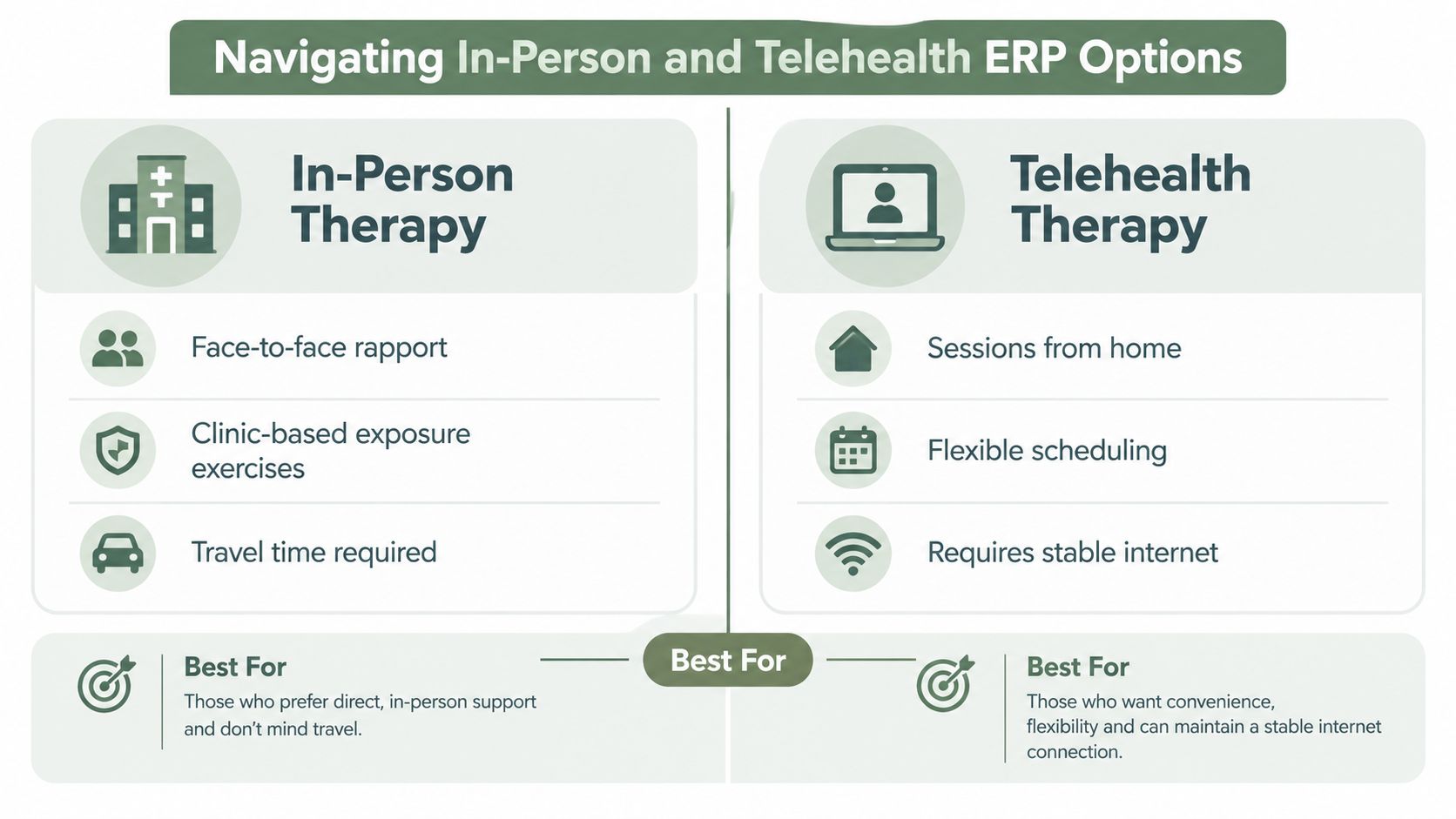
The best treatment format depends on the child's needs, the family's schedule, the clinician's training, and the type of exposure required. In-person care may make it easier to establish rapport, observe behavior directly, and practice certain exposures in a clinic or community setting. It also creates travel demands and may not be practical for families who live far from a clinician with OCD expertise.
Telehealth can bring ERP into the child's real environment. A therapist may observe a bedroom routine, coach a parent during a reassurance episode, or help a teen practice leaving a message unrevised from the same desk where the compulsion usually occurs. Video treatment can also reduce travel and make it easier for caregivers to participate.

Questions for choosing a format
| Consideration | In-person ERP | Telehealth ERP | |---|---|---| | Environment | Useful when clinic-based practice or direct observation is important | Useful when home routines and family accommodation are central | | Access | Requires travel to the clinician's office | Can connect families with trained providers across permitted jurisdictions | | Parent participation | Parents may join part of the appointment or receive coaching separately | Parents can often practice coaching in the home during or between sessions | | Technology | Fewer video-related interruptions | Requires a private space, suitable device, stable internet, and a backup plan | | Treatment quality | Depends on the therapist's OCD-specific skills | Also depends on therapist training, structure, privacy, and reliable follow-through |
A 2025 observational study describes ERP as the primary evidence-based treatment for OCD while identifying limited access related to scarce trained clinicians, geography, and cost. It also notes that teletherapy ERP for children and adolescents has mostly been studied in small, research-only samples rather than broad real-world settings. The JMIR study on telehealth ERP for youth supports a balanced conclusion: virtual ERP appears promising and clinically beneficial, but youth evidence is less mature than adult evidence.
That doesn't mean online therapy is automatically inferior or automatically appropriate. Before starting, ask whether the clinician has experience delivering ERP to children, how exposures will be selected, how parents will be coached, what happens if the teen refuses a task, and how progress will be measured. Families can also consult this AONMeetings telehealth guide 2026 when evaluating practical video-session requirements, while remembering that a secure platform doesn't replace competent clinical care.
Virtual sessions may not be suitable when a child lacks privacy, cannot participate reliably, has severe symptoms requiring a higher level of support, or needs an exposure that cannot be conducted safely through video. A therapist can help the family decide whether to use one format consistently or combine office visits with remote parent coaching.
A short visual overview of how a video appointment may work can help a teen know what to expect:
Families considering online care can also review guidance on telehealth therapy with teens. The central issue is not how much technology a treatment uses. It's whether the therapist preserves ERP quality, parent coaching, privacy, measurement, and consistent practice.
What to Expect During a Typical Therapy Session
A child may imagine that therapy means being questioned about every frightening thought. A teen may worry that the therapist will force an exposure without warning. In well-structured OCD treatment, the therapist explains the plan, collaborates on goals, and treats the young person as an active participant.

The opening check-in
The session may begin with a brief review of mood, anxiety, sleep, school, family stress, and the week's most difficult OCD moments. The therapist may ask what compulsions occurred, what the child resisted, and whether any new safety or functioning concerns appeared.
This isn't a test the child can fail. It gives the therapist information for adjusting the next practice task. A teen may use a tracking sheet, notes app, simple rating scale, or verbal description rather than documenting every thought in detail.
Reviewing practice between sessions
ERP depends on what happens outside the appointment. The therapist and child review the agreed exposure, what the child did, what the compulsion demanded, and what made practice easier or harder. If the task wasn't completed, the therapist looks for obstacles rather than treating it as defiance.
A parent may join for part of the session to discuss reassurance, checking, bedtime, school communication, or a home plan. The therapist might coach the parent to respond with one consistent phrase instead of offering increasingly detailed answers.
Learning and practicing a new skill
The therapist may introduce a new exposure, rehearse a response to an intrusive thought, or practice delaying a ritual. For a younger child, this might involve a drawing, story, or game that makes the OCD pattern visible. For an adolescent, it may involve a real-life decision, digital communication, school task, or conversation about privacy and values.
The therapist acts more like a coach than a passive listener. They explain the rationale, model a response, notice avoidance or covert rituals, and help the child choose a challenge that is meaningful and manageable.
Therapy should leave the young person with a clearer next step, not just a deeper description of the fear.
At the end, the family should know what to practice, how often to practice it, how parents should respond, and what to do if distress rises. A good plan includes flexibility. The child may need a smaller step, a different setting, or additional support before attempting a harder exposure.
The first appointment may focus mostly on assessment, education, trust, and treatment planning rather than a full exposure. That is still active treatment. A child who understands the OCD cycle and feels safe enough to collaborate has begun developing the skills needed for later practice.
When to Consider Medication and Psychiatric Referral
ERP is central to evidence-based OCD care, but therapy isn't always sufficient by itself. Some young people are so overwhelmed by anxiety, depression, sleep disruption, school impairment, or other symptoms that they can't participate consistently in exposure practice. A psychiatric consultation can help determine whether medication or another level of care should support the behavioral work.
Medication should not be presented as a replacement for learning how to respond to compulsions. A prescriber may consider an SSRI or another medication approach after evaluating the child's symptoms, medical history, age, current medications, family history, side effects, and treatment goals. Parents should ask the prescriber what changes to monitor, how follow-up will occur, and how medication fits with ERP.
Signs that a referral may help
A therapist may recommend psychiatric input when:
- OCD substantially disrupts functioning: Rituals or avoidance interfere with school, sleep, eating, relationships, hygiene, or ordinary family activities.
- Anxiety blocks participation: The child cannot approach even carefully graded exposures despite appropriate preparation and support.
- Mood symptoms are prominent: Depression, hopelessness, irritability, or loss of interest complicates engagement and requires its own assessment.
- Symptoms remain highly impairing: The child has practiced appropriately, yet distress and compulsions continue to limit daily life.
- The presentation is complex: Tics, attention difficulties, trauma symptoms, eating concerns, developmental differences, or medical issues may affect treatment planning.
- Safety concerns arise: Any concern about self-harm, suicidal thinking, abuse, psychosis, or immediate danger requires prompt professional assessment and an appropriate emergency response.
A referral doesn't mean the family has failed or that the child's OCD is untreatable. It means the team is considering whether another support could lower barriers to therapy. Medication decisions belong to a qualified prescriber, and families should never start, stop, or change psychiatric medication without medical guidance.
Build one coordinated plan
The psychologist and prescriber should communicate with appropriate consent. They can coordinate around the same functional goals, such as returning to school, reducing reassurance, sleeping independently, or completing morning routines without repeated checking. The therapist tracks behavioral practice, while the prescriber monitors medication response and adverse effects.
Technology-based care can expand access, but it also requires careful clinical judgment. Recent guidance describes video teletherapy, app-supported practice, internet-delivered CBT, and webcam or mixed-reality approaches as developing options, while noting that lower-intensity and technology-based CBT still need more research on patient perceptions and the features that make these approaches work well. More technology isn't automatically better. The treatment still needs skilled ERP, family coaching, privacy, measurement, and a realistic plan for difficult days.
Recovery usually means gaining freedom rather than never experiencing an intrusive thought again. A child may still notice an OCD alarm, but they can attend class, answer a friend, leave the house, or sleep without allowing the alarm to direct every action. With a plan shaped to their needs, steady practice, and support that refuses to reinforce rituals, families can move from managing each crisis to building durable confidence.
---
Wald Behavioral Health provides evidence-based OCD therapy, parent guidance, and developmentally appropriate care for children, adolescents, young adults, and families through in-person sessions and telehealth. Visit Wald Behavioral Health to request a free 15-minute consultation and discuss treatment fit, family involvement, and scheduling options.
Questions about your child or teen?
Dr. Wald offers a free 15 minute consultation to talk through what you are seeing and whether the practice is a good fit.
Free 15 Minute Consultation