Telehealth Therapy with Teens: A Parent's Guide

A 15-year-old is upstairs with headphones on, attending therapy from a bedroom while a parent waits nearby and tries not to listen through the door. The family chose telehealth because getting across town after school felt impossible, but one question remains difficult to answer: will a teenager open up on camera?
Parents also worry about practical boundaries. Can the therapist keep the conversation private? What happens if the teen joins from a college dorm in another state? And how can a family tell whether online therapy is helping when they aren't sitting in the office?
Telehealth therapy with teens can work well, but it isn't just an office visit transferred to a screen. The quality of care depends on the clinical approach, the therapist's remote-work skills, the teen's environment, and clear agreements about privacy and safety.
## Table of Contents - The First Session on a Screen - The room changes, not the purpose - What Telehealth Therapy for Teens Actually Looks Like - How parents may be included - What the Research Says About Effectiveness - What remains less certain - Privacy, Consent, and the Parent Question - What happens when safety enters the conversation - Questions to ask before treatment begins - Keeping Teens Engaged Through the Screen - Signs of thoughtful engagement - Platform, Setup, and Technical Basics - A simple pre-session routine - State Licensure and PSYPACT Coverage - Plan before the move - Preparing Your Family and Answering Common Questions - The household preparation checklist - Questions parents commonly ask
The First Session on a Screen
A 15-year-old sits on her bed with a laptop propped on a stack of textbooks. She has headphones on, and the bedroom door is cracked open. On the screen, her therapist appears in a small video window. A whiteboard is visible behind the therapist, and a digital activity is ready to share.
Downstairs, the parent is waiting. The parent wasn't invited into the entire session, but hasn't been shut out either. Before treatment begins, the therapist has explained how parent involvement will work and what information may remain private.

The first part of the appointment usually feels more structured than many parents expect. The therapist introduces themselves, confirms where the teen is physically located, checks that the audio and video work, and explains confidentiality and its limits. They may ask what brought the teen to therapy, what has been difficult recently, and what the teen hopes will change.
The first answers might be short. “I don't know.” “Fine.” “My mom wanted me to come.” That guardedness doesn't mean the session has failed. A clinician who works with adolescents expects trust to develop gradually and may use a low-pressure activity, a shared screen, or a question about school, friends, gaming, music, or daily routines to make the conversation less formal.
The room changes, not the purpose
A small moment can shift the session. The teen adjusts the camera so she isn't looking at the bed. The therapist notices and asks whether the new angle feels more comfortable. The teen starts describing an argument with a friend, and the therapist uses the whiteboard to map what happened, what the teen thought, and what she did next.
That moment reveals why telehealth therapy with teens isn't a lesser version of an office visit. It's a different room with the same clinical work happening inside it. The therapist still listens for mood changes, anxiety, avoidance, safety concerns, and patterns in relationships. The teen still learns how to identify thoughts, tolerate difficult feelings, communicate more effectively, or practice new behavior.
Parents shouldn't judge the format by whether the first appointment looks polished. A teen may glance away, speak with a low voice, or seem more relaxed after the first few minutes. The more useful question is whether the therapist creates enough safety and structure for the teen to participate without pretense.
What Telehealth Therapy for Teens Actually Looks Like
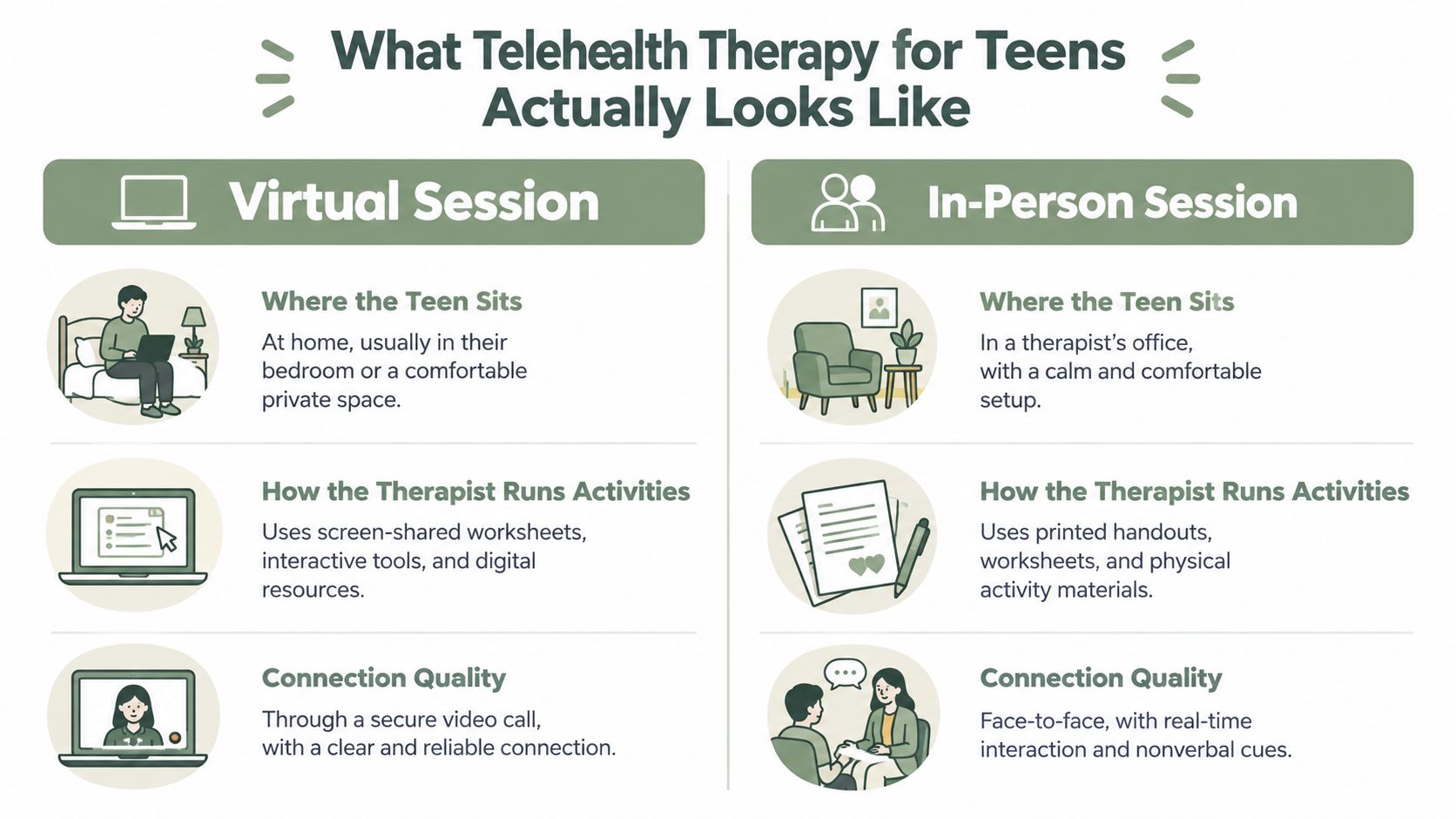
Telehealth therapy means that the adolescent and clinician meet through secure video while the teen remains in an agreed location. The physical setting changes, but the therapist still conducts an assessment, sets goals, chooses interventions, monitors safety, and reviews progress.
A typical session may last roughly the same amount of time as an office appointment, often around 45 to 50 minutes, depending on the clinician, the teen's age, and the treatment plan. A familiar clinical sequence often sits underneath the conversation:
- Check-in: The therapist asks about mood, stress, sleep, school, relationships, and any urgent concerns.
- Agenda setting: The teen and therapist decide what deserves attention that day.
- Therapeutic work: They practice a skill, examine a pattern, process an event, or involve a family member.
- Wrap-up: They summarize what was learned and agree on a manageable practice task.
The screen can support active treatment rather than passive conversation. A cognitive behavioral therapy session might use a shared thought record. The therapist could help the teen identify a situation, automatic thought, emotion, and alternative response directly on the screen. A dialectical behavior therapy clinician might guide a brief mindfulness exercise and share an audio file for later practice.
How parents may be included
Family therapy can also happen online. A clinician might meet privately with the teen first, then ask a parent to join the last part of the appointment to review a communication goal or a plan for the week. In another case, the parent may attend a separate caregiver meeting while the teen has individual time with the therapist.
That arrangement should be explained rather than assumed. Parents need to know when they will participate, what kind of progress update they can expect, and how safety concerns will be communicated. Teens need to know that a parent won't suddenly appear in the video call without warning.
What changes most is the sensory layer, not the clinical model. Talk-based therapies and structured skills work often translate naturally to video. Approaches that depend heavily on play materials, physical observation, movement, or a shared room may require adaptation or may be better suited to in-person care.
What the Research Says About Effectiveness
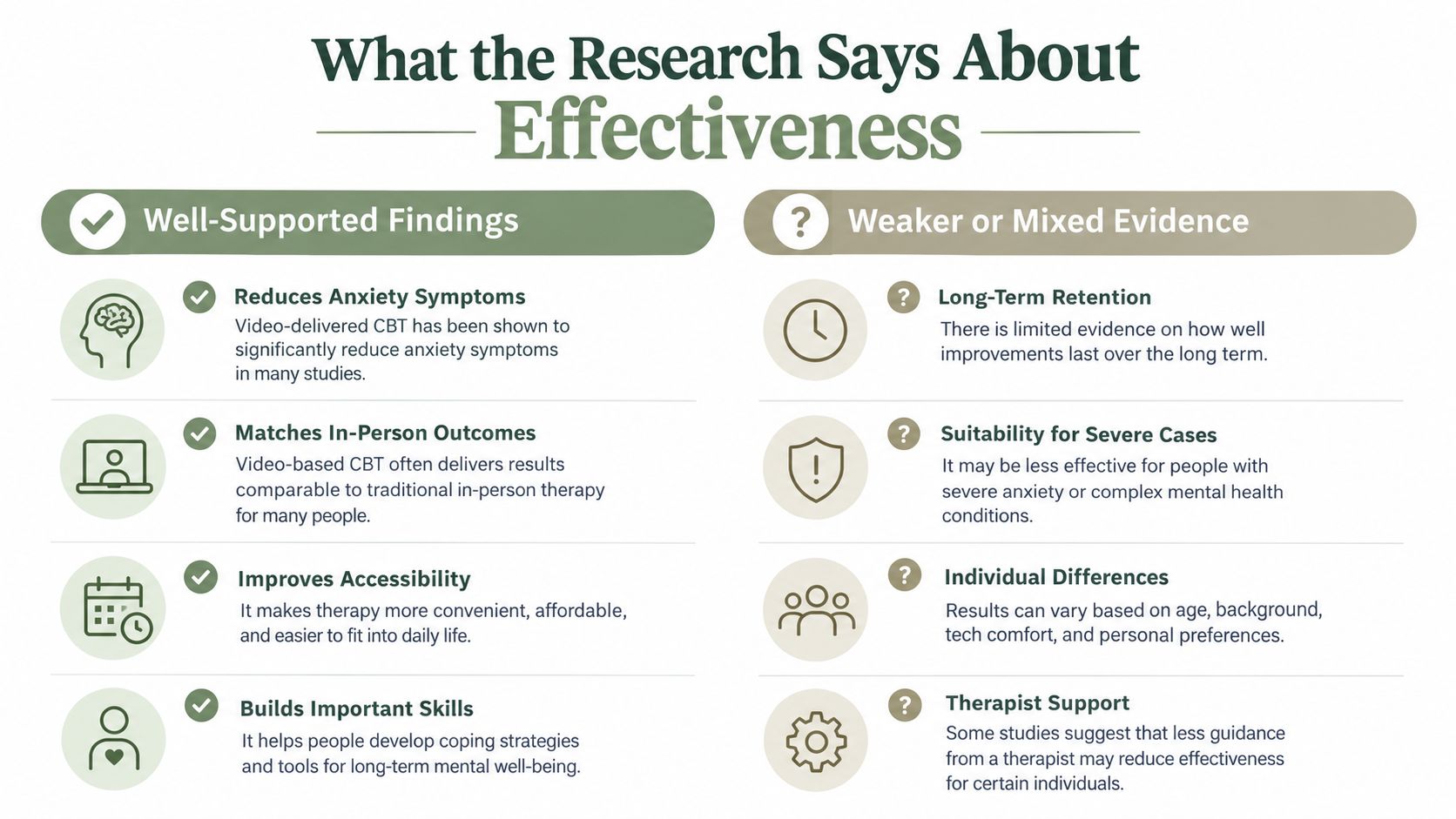
The strongest evidence supports a measured conclusion. Telehealth psychotherapy can produce outcomes comparable to in-person care for adolescents, particularly when the treatment is structured and the clinician maintains the intended protocol.
A meta-analysis summarized in a recent review found a near-zero overall difference between teletherapy and face-to-face psychotherapy, with an overall effect size of g = 0.04 and a 95% confidence interval from -0.12 to 0.20. The same review found a larger benefit for internet-based cognitive behavioral therapy for adolescent anxiety and depression, with an overall effect size of g = 0.72 and a 95% confidence interval from 0.55 to 0.90. These findings support structured, skills-based remote treatment when the therapist delivers it with appropriate clinical fidelity. The review of teletherapy psychotherapy outcomes provides the underlying analysis.
The evidence doesn't mean every teen will prefer video, or that every clinical problem is equally suited to it. A teen needs a workable device, adequate connection, and enough privacy to speak freely. A clinician also needs to know how to assess risk remotely and respond when the camera freezes, the teen goes silent, or someone enters the room.
What remains less certain
The evidence is more limited for younger children, crisis-level situations, treatments that depend on physical presence, and outcomes far beyond the active treatment period. That doesn't make telehealth inappropriate. It means the clinician should match the format to the adolescent, the concern, and the family's ability to create a safe setting.
Access also varies by treatment setting. In a nationally representative U.S. survey of adolescents ages 12 to 17 who received mental health treatment in the prior year, 45.3% received some care through telehealth. Use was much higher in office-based specialty care, where 54.5% of adolescents receiving care in only one setting used telehealth, than in schools at 9.2%, outpatient mental health centers at 5.3%, and general medical care at 3.9%. Among teens receiving care in multiple settings, telehealth use was 71.4% when office-based specialty care was included, compared with 27.6% when it wasn't, indicating that specialty mental health settings were a major driver of access. RAND's summary of the adolescent telehealth survey reports these findings.
Practical rule: Judge telehealth by the fit between the teen, the treatment, and the environment, not by the video format alone.
Telehealth also became a meaningful service channel during the COVID-19 era. In a Washington State analysis, youth substance-use services delivered by telehealth rose from 0% at the beginning of 2020 to an average of 38% between April 2020 and March 2021, then represented 16% of those services in December 2021. Youth mental health outpatient services reached 35% via telehealth in December 2021. The same report describes several sharp early increases, including one clinic moving from an average of 2.5 visits per week to 220, another moving from 0% to 97% of encounters within one month, and one institution reporting a 600% increase in telehealth visits. The Washington State youth behavioral health analysis places those changes in context.
For families comparing options, a practical overview of telehealth benefits for mental health may help, but a consultation should still address the teen's specific needs.
Privacy, Consent, and the Parent Question
Parents often assume that paying for therapy means they should hear everything discussed. Teens often assume that saying anything on camera means a parent will immediately find out. Neither assumption is a reliable starting point.
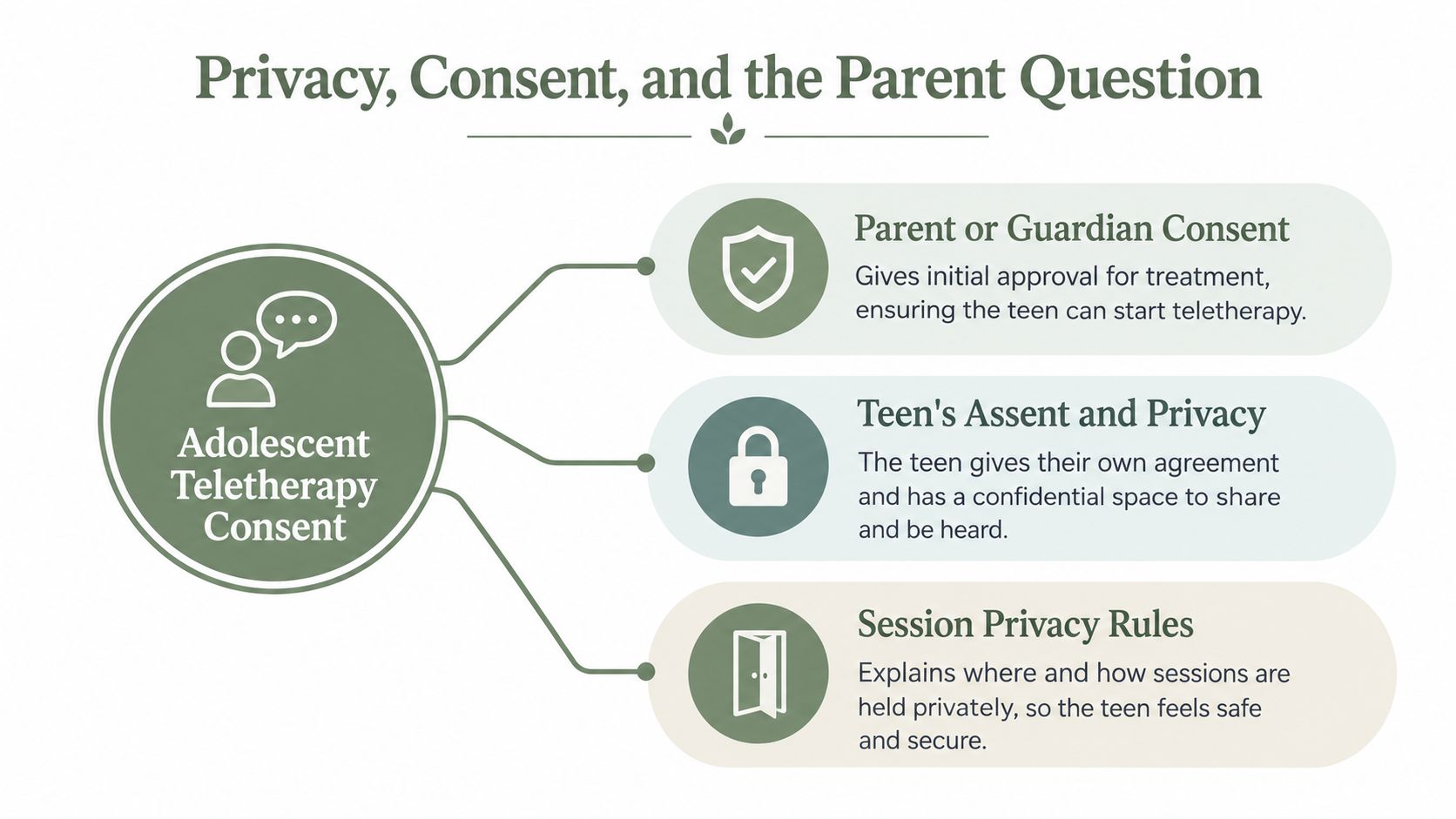
In many arrangements, a parent or guardian provides consent for treatment, while the adolescent receives a confidential portion of the session. The therapist should explain the boundaries in language both people understand. Those boundaries depend on the teen's age, the clinical situation, and applicable state law.
A parent may receive general information about attendance, treatment goals, progress, and ways to support the teen at home. That isn't the same as receiving a detailed account of every disclosure. A therapist may need to share information when there is a serious safety concern, suspected abuse or neglect, or another legal exception.
What happens when safety enters the conversation
Suppose a teen says they have been thinking about suicide. The therapist doesn't promise absolute secrecy and then improvise. They assess immediacy, intent, access to means, protective factors, and the teen's location. They may involve the parent, create a safety plan, recommend urgent evaluation, or contact emergency resources when necessary.
The same principle applies to reported self-harm or a credible risk of harm to someone else. A teen may also disclose substance use, abuse, or severe symptoms. The therapist should explain what must be shared, what can remain private, and how they will include the teen in that conversation whenever possible.
Parents should also ask about access to records. Rules vary, and the therapist should describe the practice's process rather than offering a broad promise. Telehealth adds another privacy question because the therapist must confirm who is present, whether the teen has a private space, and what happens if someone walks into the room.
Questions to ask before treatment begins
Ask these questions during the first consultation:
- Confidentiality: What information stays private, and what situations require parent notification?
- Parent involvement: Will parents join part of the session, attend separate meetings, or receive periodic updates?
- Remote privacy: How will you verify who is in the room, and what should my teen do if privacy disappears?
- Safety response: What is the process if my teen reports suicidal thoughts, self-harm, abuse, or danger to another person?
- Consent documents: How are consent and privacy agreements signed and stored?
Families who want to understand the administrative side can review this resource about healthcare eSignature for telehealth from Closer Innovation Labs Corp. It doesn't replace a clinician's explanation of confidentiality, but it can clarify why consent documentation matters.
A practice's privacy policy can provide another useful point of reference, including how the practice describes information handling and communication. Parents can review telehealth privacy information before asking more specific questions in the consultation.
Research on adolescent telehealth has found that teens and parents may experience the home as less private than a therapist's office. That concern can affect disclosure and the therapeutic relationship unless the clinician deliberately checks the environment, uses headphones when appropriate, confirms who is present, and schedules private teen-only time. Guidance on privacy and confidentiality in child and adolescent telehealth also explains that recording requires legal review and explicit disclosure and written consent.
Keeping Teens Engaged Through the Screen
A teen doesn't need to stare continuously into the camera for therapy to be useful. Looking away can mean they're thinking, embarrassed, distracted, or more comfortable speaking without direct eye contact. A skilled therapist watches the whole pattern rather than treating every camera movement as resistance.
The opening minutes matter. The clinician may begin with a predictable check-in, offer the teen a choice between two topics, use the chat function for a one-word mood rating, or share a simple whiteboard. These small options reduce the pressure of producing a polished answer immediately.
A therapist may also use brief interactive exercises. For example, the teen might drag thoughts into “fact,” “prediction,” and “fear” columns, annotate a recent text exchange, or practice a breathing skill while listening to shared audio. The activity isn't decoration. It gives the adolescent something concrete to do while the therapeutic relationship develops.
Signs of thoughtful engagement
Parents can look for process rather than performance:
- The therapist notices avoidance: If the teen keeps turning away or becomes unusually quiet, the clinician asks about it without shaming them.
- The teen has choices: The therapist offers appropriate control over topics, activities, camera use, or whether a parent joins a planned portion.
- The session has a purpose: The teen can describe what they worked on, even if they don't provide private details.
- The clinician adapts: A younger adolescent may need shorter activities, more movement, or a parent-supported transition into the session.
Gaming in the background, a flat voice, or repeated camera avoidance deserves curiosity. The therapist might ask whether the teen is bored, anxious, tired, uncomfortable at home, or trying to manage an overwhelming conversation. Ignoring those signals is less helpful than addressing them directly.
Parents often ask whether they should sit beside the teen at the start. There isn't one universal answer. A parent may help with the introduction, confirm the location, or remain available nearby, then leave when the therapist and teen agree. Over time, the arrangement can change as trust, safety, and the teen's independence develop.
Engagement is a clinical skill the therapist builds with the adolescent. It isn't a performance the family has to produce before treatment can begin.
Platform, Setup, and Technical Basics
Technology should support the appointment without becoming the main event. Families don't need the newest webcam, but they do need a setup that protects privacy and allows the teen and therapist to hear and see each other reliably.
Before choosing a service, ask the practice what its platform includes. A reasonable verification checklist covers:
- Encryption: The platform should use appropriate security protections for health information.
- Business associate agreement: The provider should have the required contractual arrangement with the relevant technology vendor when applicable.
- Recording settings: Recording should be off by default unless the clinician explains the purpose, obtains the required consent, and follows applicable rules.
- Waiting room: The platform should allow the clinician to control entry so another person can't enter the session accidentally.
A laptop or tablet is usually easier than a phone because the larger screen supports eye contact, shared worksheets, and clinician observation. The teen needs a stable surface, a charged device, working headphones when privacy requires them, and a connection strong enough for uninterrupted audio.
A simple pre-session routine
At least 15 minutes before the first appointment, the teen and parent can check the camera, microphone, battery, headphones, and appointment link. Close unrelated applications, silence notifications, place pets with another household member when possible, and choose a room with a door that closes.
A private room matters more than attractive lighting. The teen should know what to do if a sibling enters, the internet fails, or the family needs to contact the therapist urgently. Keep a backup phone number available, but don't use the phone as a substitute for discussing the practice's emergency procedure.
Families seeking a broader explanation of consent and privacy workflows can review PHIPA video care consent steps from CloudOrbis Inc. The specific legal requirements for a family still depend on the practice, jurisdiction, and clinical arrangement.
The practice's own telehealth information should answer questions about joining sessions, privacy, and technical expectations. Families can also review telehealth services and procedures before scheduling.
State Licensure and PSYPACT Coverage
The answer to “Can my teen attend therapy from a dorm in another state?” begins with one detail many families miss: the teen's physical location during the session matters.
A psychologist generally needs authority to practice in the state where the patient is located at that time. If a teenager attends therapy from home in Florida, then joins the next appointment from a dorm in another state, the legal picture may change even though the therapist, treatment plan, and video platform remain the same.
PSYPACT can help in eligible circumstances. It is an interstate compact that allows appropriately credentialed psychologists to practice across participating member states without obtaining a separate full license in every state. The compact applies to the psychologist, not automatically to the family, so parents still need to verify the clinician's active authority and the destination state's participation.
Plan before the move
Before a school-year move, summer relocation, or college transition, ask the therapist to review three points:
- Credential status: Does the psychologist hold an active PSYPACT authorization for telepsychology, if PSYPACT is the proposed pathway?
- Destination state: Is the state where the teen will sit during sessions a participating member state?
- Emergency coverage: What local crisis resources, supports, and contacts will be used if the teen needs immediate help?
The emergency plan should identify the teen's current address, a reliable local adult when appropriate, nearby emergency services, and the process for reaching the therapist. A home-state plan may not be enough when the adolescent is physically at school.
PSYPACT applies to psychology. It doesn't necessarily cover every related provider, such as a counselor, social worker, or psychiatric prescriber. Some states may also create temporary telehealth permissions, but those rules can change and may have specific conditions.
Before a teen crosses state lines, confirm the clinician's authority in writing. Don't wait until the first difficult week of the semester.
Families should raise licensure during the first consultation, especially when a teen divides time between states. A practice serving Florida, Maryland, and PSYPACT states may be able to explain its coverage, but the family still needs to identify where the teen will physically be for each appointment and what happens in an emergency.
Preparing Your Family and Answering Common Questions
A successful first appointment starts before anyone clicks the video link. The family needs a private setting, a shared understanding of boundaries, and a plan for interruptions.
The household preparation checklist
Set up the room. Choose a private space with a door that closes. Add headphones, charge the device, and keep the therapist's backup phone number accessible. If the teen can't use a private bedroom, discuss alternatives such as a quiet office, a parked car in a safe location, or another agreed setting.
Protect the appointment. Ask siblings not to enter, arrange care for pets, and create a simple household signal that means a session is active. Don't rely on the teen to manage every interruption alone.
Explain privacy clearly. Tell the teen that therapy is their space to speak openly, while safety concerns and legal exceptions may require the therapist to involve a parent or another responsible adult. Avoid promising that nothing will ever be shared.
Agree on parent updates. Decide whether updates will happen briefly after sessions, during scheduled parent meetings, or through another arrangement. Parents can ask how to support treatment without asking the teen to repeat private disclosures.
Questions parents commonly ask
Will insurance cover adolescent telehealth? Coverage depends on the plan, clinician participation, state rules, and the service being provided. Ask the practice for billing information and contact the insurer directly about behavioral health telehealth benefits, deductibles, authorizations, and out-of-network rules.
Can the therapist prescribe medication? Psychologists generally don't prescribe medication. If medication might help, ask whether the clinician coordinates with a pediatrician, psychiatrist, or other qualified prescriber. The family should understand who manages prescriptions and how communication will occur.
What if my teen refuses to attend? Start by asking what the teen dislikes. They may fear being overheard, worry that therapy means they are “the problem,” or dislike the camera format. A brief consultation that includes the teen, a choice of therapist when possible, and a clear explanation of confidentiality may reduce resistance. If refusal continues, ask the clinician whether a parent session or in-person option makes more sense.
How can I tell whether therapy is helping? Look for functional changes, not a cheerful report after every appointment. Your teen may begin returning to school tasks, facing avoided situations, using coping skills, sleeping more consistently, communicating differently, or recovering faster from distress. The therapist should review goals and adjust treatment when progress stalls.
What if the teen is away at school? Tell the therapist before the move. Confirm the teen's physical location, licensure coverage, privacy arrangements, local emergency contacts, and backup plan before continuing sessions.
Telehealth can be a thoughtful option when the clinical approach fits, the teen has enough privacy, and the family understands the legal and safety boundaries. A 15-minute consultation gives parents a practical place to ask about licensure, confidential teen time, parent communication, engagement, emergency planning, and whether video is appropriate for the presenting concern.
---
Wald Behavioral Health offers secure telehealth therapy for children, adolescents, young adults, and families, with care available across Florida, Maryland, and PSYPACT-participating states. Visit Wald Behavioral Health to request a free 15-minute consultation and discuss privacy, fit, scheduling, and your teen's needs.
Questions about your child or teen?
Dr. Wald offers a free 15 minute consultation to talk through what you are seeing and whether the practice is a good fit.
Free 15 Minute Consultation