8 Child Therapy Techniques: Uses and Age Ranges
Your preschooler falls apart when it's time to leave the playground, even after a warning. Your school-age child keeps checking a backpack and asks you to check it again. Your teenager knows the material for a class presentation but feels unable to walk into the classroom.
These hypothetical situations may look like stubbornness, worry, or avoidance from the outside. They call for different kinds of support, and a clinician would need to understand what happens before, during, and after each difficult moment.
Child therapy techniques include complete treatment approaches, such as cognitive behavioral therapy, and specific tools, such as a school-home behavior report. The right fit depends on the concern, the child's developmental abilities, family circumstances, and professional assessment, not age alone.
Change can happen through play and caregiver interactions, child and teen skill-building, or everyday home-school routines. The options below include CBT, exposure and response prevention, parent-child interaction therapy, parent management training, behavioral sleep interventions, play therapy, acceptance and commitment therapy, and daily report cards.
Parents don't need to become therapists. Their role is to understand the plan, offer appropriate support, and tell the clinician what's actually happening between appointments.
These approaches aren't ranked, and they don't all have the same research base. This is educational guidance, not a diagnosis or a self-treatment protocol.
## Table of Contents - 1. Cognitive Behavioral Therapy (CBT) for Children and Adolescents - Make the skill visible - 2. Exposure and Response Prevention (ERP) for Pediatric OCD - Practice without forcing - 3. Parent-Child Interaction Therapy (PCIT) - What a practice moment could look like - 4. Parent Management Training (Triple P and Incredible Years) - Turn a complaint into a workable plan - 5. Behavioral Sleep Interventions for Children - Build a plan the household can use - 6. Play Therapy (Child-Centered Play Therapy) - Follow the child without assigning hidden meanings - 7. Acceptance and Commitment Therapy (ACT) for Adolescents and Young Adults - Connect a value to an action - 8. Daily Report Card (DRC) for ADHD and School Behavior - Design for support, not public judgment - 8 Child Therapy Techniques: Side-by-Side Comparison - Choose One Goal and Build the Right Support Team - Bring a focused consultation checklist
1. Cognitive Behavioral Therapy (CBT) for Children and Adolescents
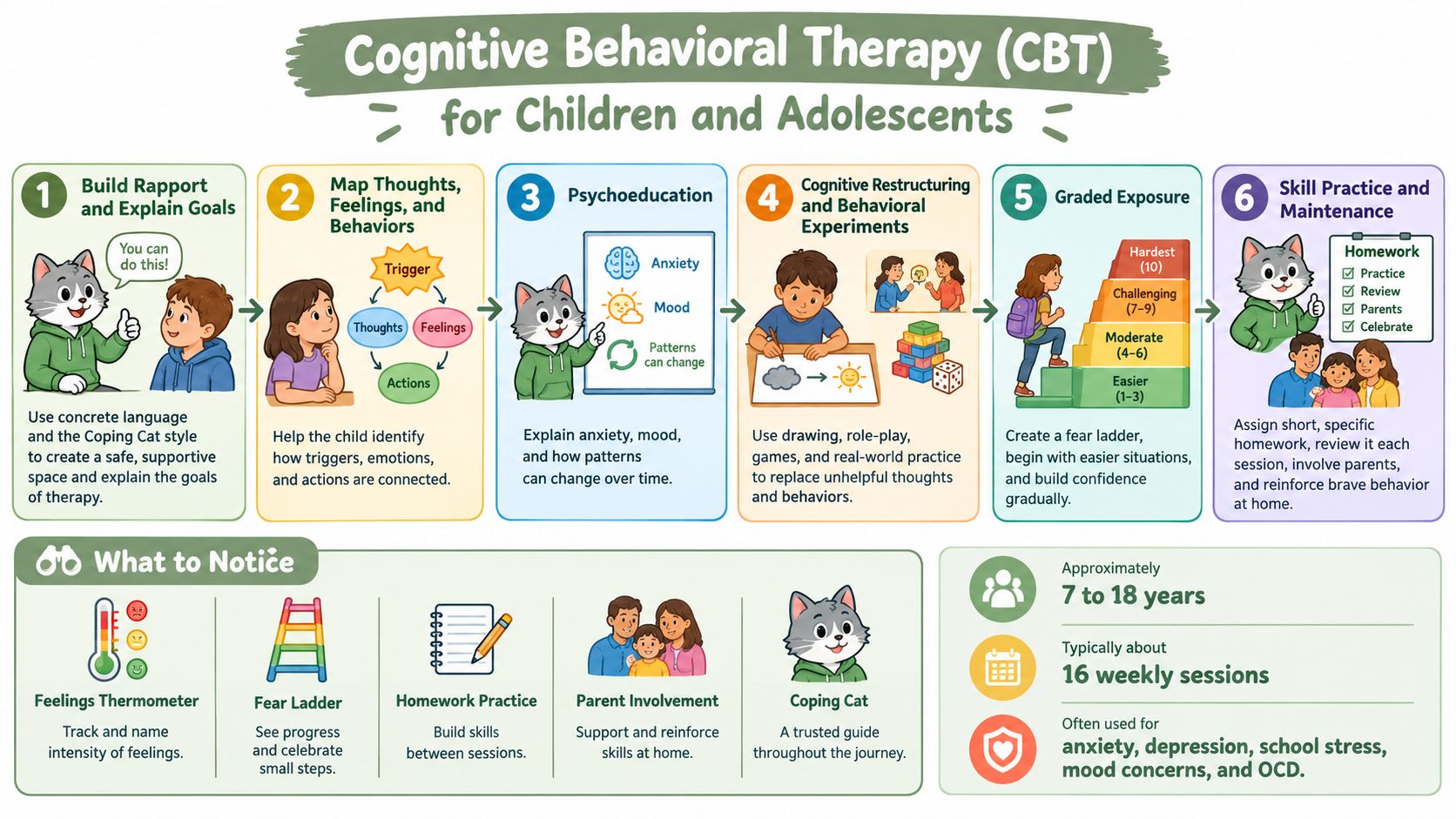
CBT connects thoughts, feelings, and actions. A child might predict that classmates will laugh at a mistake, feel frightened, and avoid answering questions. Treatment can help the child examine that prediction and practice participating despite uncertainty.
CBT belongs primarily in the child and teen skill-building category, although caregivers may help with practice. Developmental fit depends on whether the child can work with the exercises: younger children may need drawings, games, and concrete language, while adolescents may prefer written reflections or collaborative problem-solving.
A network meta-analysis of psychological treatments for pediatric anxiety found benefits for several approaches and particularly favorable results for group CBT. That finding supports considering treatment format rather than assuming every version of CBT is interchangeable.
Make the skill visible
For a hypothetical child who avoids asking a teacher for help, a clinician might use a feelings thermometer, explore the child's prediction, and rehearse a short question. The observable goal could be asking for help when confused, rather than feeling more confident.
- Thought practice: Separate a prediction, such as expecting embarrassment, from something the child knows happened.
- Behavior practice: Try an agreed-upon action and compare the experience with the prediction.
- Caregiver support: Praise participation and effort without demanding that the child stop feeling worried.
For a teenager with low mood, a clinician might instead emphasize activity planning and problem-solving. The approach should follow the assessment, not a worksheet collection.
Professional boundary: Parents can reinforce an agreed practice task, but they shouldn't diagnose distorted thinking or debate every worry. If practice causes escalating distress or repeated conflict, bring that information back to the therapist.
2. Exposure and Response Prevention (ERP) for Pediatric OCD
A child checks that a school folder is packed, then checks again because the first check doesn't feel certain enough. A parent may understandably join in, hoping reassurance will settle the worry.
ERP pairs approaching an OCD trigger with resisting the ritual that usually follows. It belongs in child and teen skill-building, with caregiver participation when rituals involve the family. Developmental fit depends on the child's understanding, communication needs, and ability to participate in a supported plan.
The intended goal isn't perfect certainty or an immediate disappearance of anxiety. An observable goal might be leaving the backpack packed without restarting the checking routine.
Practice without forcing
In a hypothetical treatment plan, a clinician and child could agree on a manageable checking-related exercise. They would identify both visible rituals and less obvious responses, such as mentally replaying the packing process or repeatedly asking a parent for confirmation.
A meta-analysis examining exposure within youth anxiety CBT associated greater therapist-guided, in-session exposure with larger treatment effects. That evidence concerns youth anxiety treatment broadly, not a guarantee about an individual child's OCD treatment.
Supportive boundary: Exposure should be collaborative practice, not a surprise test, punishment, or confrontation.
Caregivers might rehearse a warm response that acknowledges distress without repeatedly answering the same certainty-seeking question. Changes to family participation should be planned rather than abruptly imposed.
For additional context, explore this explanation of OCD therapy techniques. This CBT illustration provides a visual companion to structured skill practice.
Professional boundary: An OCD-trained clinician should guide exposure selection and response prevention. Parents shouldn't invent contamination challenges, remove necessary hygiene, or assume every repeated behavior is a compulsion.
3. Parent-Child Interaction Therapy (PCIT)
PCIT places change in caregiver-child interactions. Instead of giving a parent only general advice, a clinician coaches interaction skills as the caregiver practices with the child.
Its developmental fit is especially relevant to young children whose treatment can center on play and caregiver responses. Assessment still matters: a child's language, sensory needs, family stress, and reasons for resisting a request should shape the work.
PCIT distinguishes child-directed interaction, which emphasizes warm attention during play, from parent-directed interaction, which addresses clear directions and follow-through. A family's observable goal might be moving from play to cleanup with less repeated arguing, alongside improved caregiver skill use.
What a practice moment could look like
During hypothetical block play, a caregiver practices describing the child's actions and offering specific praise rather than asking a stream of questions. Later, the clinician coaches a clear cleanup instruction and helps the caregiver respond predictably.
This video offers a visual introduction to the approach.
Home practice should follow the clinician's instructions, with room to discuss what was difficult. Caregivers may need help adapting practice around work schedules, sibling needs, or disagreement between adults.
- Track the interaction: Notice whether directions are understandable and whether the child has the skills to follow them.
- Name the behavior: Praise putting blocks in the basket rather than labeling the child good or bad.
- Bring back obstacles: Tell the clinician when practice becomes a power struggle.
Professional boundary: Reading about PCIT isn't equivalent to receiving it. Consequence procedures require qualified guidance, particularly when aggression, developmental differences, trauma concerns, or caregiver overwhelm complicate the situation.
4. Parent Management Training (Triple P and Incredible Years)
A morning plan that says “behave better” leaves everyone guessing. A plan that identifies getting dressed, explains the available support, and specifies how caregivers will acknowledge completion gives the family something observable to practice.
Parent management training changes everyday caregiver responses and routines. Named programs include Triple P and Incredible Years, but families should ask which program a clinician uses and how it fits the assessment.
This caregiver-centered approach may fit younger children and school-age children who need adult-supported behavior plans. For older children and teens, collaboration and age-respectful expectations become especially important.
Turn a complaint into a workable plan
For hypothetical morning refusal, the target could be putting on school clothes after the agreed cue, rather than being cooperative all morning. A clinician might help caregivers examine confusing instructions, difficult clothing, rushed transitions, and what happens after refusal.
- Define the task: Make the expected action clear enough that different caregivers recognize it.
- Rehearse the response: Practice brief instructions and specific praise before a stressful morning.
- Coordinate adults: Agree on a feasible plan rather than competing rules.
- Review both sides: Track child behavior and whether caregivers can realistically use the plan.
A systematic review of Parents Plus parent-training programs found improvements in child behavior problems and individualized family goals. Parents Plus is a distinct program, so those findings shouldn't be presented as direct evidence for every Triple P or Incredible Years format.
Professional boundary: Parent training isn't a claim that parents caused the problem. A clinician should help distinguish skill gaps, emotional distress, environmental demands, and behavior patterns before recommending consequences.
5. Behavioral Sleep Interventions for Children
Sleep treatment happens largely in everyday routines, but a difficult bedtime isn't automatically a behavior problem. A clinician needs to understand the sleep pattern, the child's health, and what the family can reasonably implement.
Developmental fit varies considerably. A young child may need caregiver-led routines and visual prompts, while a teenager may need an active role in discussing schedules, privacy, school demands, and barriers to changing habits.
An observable treatment goal could be completing the bedtime routine and settling with the agreed level of caregiver support. That's more useful than asking whether the child was a good sleeper.
Build a plan the household can use
In a hypothetical family, bedtime repeatedly stalls when a child asks for another story and another check-in. A clinician might help the family create a picture sequence, clarify the ending of the routine, and agree on predictable caregiver responses.
The plan might include praise for following the routine, but rewards alone won't answer every sleep concern. Families can use this overview of sleep problems in children to prepare questions for an assessment.
A sleep plan should account for the family's actual living arrangements. Shared bedrooms, shift work, caregiving responsibilities, and cultural preferences belong in the discussion.
Parents can keep notes about bedtime, waking, distress, and daytime functioning without turning the night into a performance test. If caregivers disagree about the plan, that disagreement needs attention before consistency becomes a realistic expectation.
Professional boundary: Seek medical assessment for concerning breathing, pain, unusual nighttime events, or pronounced daytime sleepiness. Don't start restrictive schedules, prolonged distress-based procedures, or medication changes from a general article.
6. Play Therapy (Child-Centered Play Therapy)
A child may readily create a story with animal figures while struggling to answer a direct question about a family change. Play therapy uses a child-accessible way of communicating, rather than requiring an adult-style conversation.
Child-centered play therapy places change in play and the therapeutic relationship. Its developmental fit depends more on how the child expresses and explores experiences than on a rigid birthday cutoff.
The distinction between play at home and clinical play therapy matters. A therapist establishes therapeutic boundaries and considers what happens across sessions; a parent can offer warm, undistracted play without trying to interpret it.

Follow the child without assigning hidden meanings
In a hypothetical session, a child adjusting to parental separation might arrange toy homes and decide where different figures belong. The therapist can respond to the child's expressed feelings without treating the scene as proof of a particular event.
An observable goal might be communicating a need for help during frustration or returning to an activity after becoming upset. The clinician and caregivers should connect therapy goals with daily functioning, rather than relying only on impressions of the play.
- Support at home: Offer predictable play opportunities and simple descriptions of what the child is doing.
- Avoid interrogation: Don't use dolls or drawings to press for disclosures.
- Ask about progress: Discuss which changes outside the therapy room would indicate useful movement.
Professional boundary: Trauma concerns, suspected abuse, severe withdrawal, or persistent impairment need qualified assessment. Play therapy shouldn't be assumed to replace targeted treatment when a child also needs structured work on rituals, avoidance, or daily routines.
7. Acceptance and Commitment Therapy (ACT) for Adolescents and Young Adults
ACT asks what a young person wants to move toward, even when difficult feelings come along. Rather than making every exercise a debate about whether a thought is true, the clinician may help the teen notice the thought without automatically obeying it.
This approach belongs primarily in teen and young-adult skill-building. Developmental fit includes the young person's ability to explore values, notice internal experiences, and choose meaningful actions; concrete metaphors can make those conversations more accessible.
For a hypothetical teenager avoiding presentations, an observable goal might be completing an agreed speaking task while allowing nervousness to be present. Feeling calm isn't the entry requirement.
Connect a value to an action
A clinician might explore whether learning, creativity, or connecting with classmates matters to the teenager. The teen could then choose a manageable presentation-related step that serves that value.
A defusion exercise might involve noticing the prediction that everyone will judge them as a thought, rather than treating it as an instruction to stay home. A bus metaphor can similarly separate the direction the teen chooses from the noisy worries coming along for the ride.
Keep agency central: A values-based goal belongs to the young person. It shouldn't become an adult's demand disguised as the teen's choice.
Caregivers can ask what practical support would help, rather than requesting a report of every private thought. Confidentiality expectations should be discussed openly with the clinician and teenager.
Professional boundary: Acceptance doesn't mean accepting abuse, unsafe conditions, or untreated symptoms. Significant depression, self-harm concerns, or major functional decline require assessment, not mindfulness exercises alone.
8. Daily Report Card (DRC) for ADHD and School Behavior
A daily report card connects school feedback with home support. Unlike a general conduct grade, it identifies concrete behaviors the student and adults can recognize.
This tool belongs in everyday home-school routines. It may fit school-age children who need adult-supported feedback, while older students should have a meaningful voice in selecting goals, protecting privacy, and choosing age-appropriate recognition.
A hypothetical student with ADHD might work on starting the assigned task after the teacher's cue and placing completed work in the designated folder. The observable goal is the action itself, not looking attentive or showing a better attitude.
Design for support, not public judgment
A workable card needs clear expectations and a realistic communication method. Families can explore behavioral therapy for ADHD and this guide to PBIS for caregivers when preparing for a school conversation.
- Choose accessible goals: Confirm that the student understands the task and has the necessary materials and accommodations.
- Keep feedback private: Avoid public comparisons or displaying a child's difficulties to peers.
- Agree on recognition: Select something feasible and acceptable to the child and caregivers.
- Review the pattern: Check whether missed goals reflect unclear instruction, workload, missing skills, or an unsuitable plan.
A meta-analysis of psychotherapy in routine clinical settings found symptom improvements alongside substantial variation in anxiety outcomes. It didn't evaluate daily report cards, but it reinforces the broader importance of reviewing progress rather than assuming a chosen technique will work.
Professional boundary: A report card isn't an ADHD diagnosis or a substitute for educational evaluation. School staff and the treating clinician should help adapt goals when learning difficulties, anxiety, bullying, or disability-related needs affect performance.
8 Child Therapy Techniques: Side-by-Side Comparison
| Approach | Typical age | 🔄 Implementation complexity & resources | ⭐ Key advantage | 📊 Expected outcomes | 💡 Ideal use cases | |---|---|---|---|---|---| | Cognitive Behavioral Therapy (CBT) | About 7, 18 years | Moderate; structured sessions, between-session practice, and often parent involvement; typically about 16 sessions | Strong evidence for youth anxiety, depression, and OCD; teaches reusable coping skills | Improved coping and reduced symptoms; progress can be tracked | Anxiety, depression, school stress, and mood concerns | | Exposure and Response Prevention (ERP) | About 6, 18 years | High; clinician-guided exposure plan, home practice, and substantial family support; typically 12, 20 sessions | Gold-standard psychological treatment for pediatric OCD | Reduced rituals and distress over time; improved daily functioning | OCD, intrusive thoughts, and ritualized behaviors | | Parent-Child Interaction Therapy (PCIT) | About 2, 7 years | Moderate to high; trained therapist provides live parent coaching and home practice; typically 12, 20 sessions | Builds positive parent-child interaction while teaching consistent behavior management | Fewer tantrums and less defiance or noncompliance | Disruptive behavior and parent-child power struggles in young children | | Parent Management Training (Triple P / Incredible Years) | About 2, 12 years, depending on program | Moderate; parent sessions, consistent caregiver follow-through, and home practice; group or individual formats | Practical strategies that can align behavior support across home and school | Reduced noncompliance and conduct problems | Tantrums, aggression, disruptive behavior, and family routines | | Behavioral Sleep Interventions | Infancy through adolescence | Low to moderate; caregiver education, a written sleep plan, and consistent routines; often brief | Non-medication approach that can be implemented at home | Improved sleep onset and fewer night wakings; results may take 1, 2 weeks | Bedtime resistance, night waking, and sleep-onset difficulties | | Child-Centered Play Therapy | About 3, 12 years | Moderate; requires a trained therapist and regular sessions; progress may be less structured to measure | Gives children a nonverbal way to express feelings and build trust | May support emotional expression, coping, and adjustment | Trauma, anxiety, adjustment difficulties, or limited verbal expression | | Acceptance and Commitment Therapy (ACT) | About 12, 25 years | Moderate; trained therapist, experiential exercises, and values-based practice | Focuses on psychological flexibility and meaningful action, not only symptom reduction | Builds skills for responding to difficult thoughts and feelings | Anxiety, depression, perfectionism, stress, and life transitions | | Daily Report Card (DRC) | About 5, 14 years; adaptable for adolescents | Low; simple target goals, teacher ratings, parent feedback, and consistent rewards | Low-cost tool for daily home-school communication and feedback | Can improve targeted classroom behaviors and follow-through | ADHD-related inattention or impulsivity, homework completion, and school behavior |
Choose One Goal and Build the Right Support Team
You don't need to arrive at a consultation knowing which child therapy techniques your family needs. Start with a situation you want help understanding, such as leaving home, completing a bedtime routine, managing checking, or entering a classroom.
Describe what happens, not just what you call it. “School refusal” is useful shorthand, but a clinician also needs to know whether your child is frightened, exhausted, overwhelmed by work, having peer difficulties, or struggling with separation.
Bring a focused consultation checklist
- Describe a difficult situation: Explain what happens before, during, and after it, including how adults respond.
- Note frequency and impact: Bring observations about how often it happens and what it interrupts, without waiting for perfect records.
- Ask about assessment and fit: Find out why the clinician recommends an approach and what alternatives might be appropriate.
- Clarify adult involvement: Discuss caregiver coaching, school communication, and the child's privacy.
- Agree on progress review: Identify an observable goal and ask how the plan will change if it isn't helping.
Family circumstances belong in this conversation. A review of behavioral interventions for young children highlights the prominent role of caregiver-focused work, but caregiver involvement still needs thoughtful boundaries.
Ask how language, disability, family structure, spirituality, and practical constraints will be addressed. A review of intervention adaptations in low- and middle-income countries describes adaptations involving delivery, language, and local context, supporting a conversation that goes beyond translating worksheets.
Seek professional assessment when symptoms persist or interfere with sleep, school, relationships, or daily functioning. Urgent safety concerns need immediate help through emergency services or an appropriate crisis service, rather than a routine consultation.
For families considering local or remote care, Wald Behavioral Health is a Coral Gables psychology practice led by Dr. Emily Wald, Ph.D. The practice provides developmentally informed therapy and parent guidance, with in-person care in Coral Gables and telehealth for eligible clients in Florida, Maryland, and participating PSYPACT states.
Ask which services fit your child's needs rather than assuming every approach described above is available. You can also ask about the free introductory consultation, caregiver participation, school coordination, and eligibility based on your location.
---
Wald Behavioral Health offers therapy for children, adolescents, young adults, and families, with parent guidance as appropriate to support practice between appointments. Visit Wald Behavioral Health to ask about a free 15-minute consultation, discuss treatment fit, and confirm in-person or telehealth eligibility for your location.
Questions about your child or teen?
Dr. Wald offers a free 15 minute consultation to talk through what you are seeing and whether the practice is a good fit.
Free 15 Minute Consultation