Sleep Problems in Children and How Parents Can Help
Nine o'clock arrives, and your child is still calling out for one more glass of water, one more story, one more check on the hallway light. You've already sat beside the bed, answered the same question three times, and watched the clock move while your own energy disappears. If bedtime has turned into a nightly negotiation, you're not alone, and you're not failing.
A big reason this feels so draining is that sleep problems in children often look like behavior problems first. The child may seem oppositional, anxious, hyper, clingy, or "just not tired," while the underlying issue is that the body and bedtime routine aren't lining up well enough for sleep to happen. CDC data from 2020 to 2021 found that 35.0% of children aged 4 months to 14 years did not meet age-specific sleep-duration thresholds, which tells you this isn't a rare family problem, it's a common one CDC children's sleep facts and stats.
The good news is that most families don't need a perfect system. They need a clearer way to tell time in bed from actual sleep, a plan that fits the child's age, and responses that stay steady enough to work. If your nights feel messy, this starts with understanding the pattern, then tracking what's really happening, then using a simpler plan you can keep going even when everyone is tired.
## Table of Contents - Why Bedtime Feels So Hard Right Now - How Common Sleep Problems Look by Age - What to notice first - What Keeps Kids Awake and Waking Up - Learning can maintain night waking - Biology and schedule shape the timing - Environment and health can interrupt sleep - A Simple One Week Sleep Check for Your Family - Track the basics for seven nights - Watch for medical red flags - Bedtime Plans and Scripts That Build Better Sleep - Use a fixed routine and one calm script - Choose the bedtime method that matches the pattern - Make the plan livable for your family - Fixing Late Nights and Early School Mornings - Compare the problem, not just the bedtime - Build a realistic school-night plan - When Home Strategies Are Not Enough - When to get extra help
Why Bedtime Feels So Hard Right Now
At 8:30, your child is already in bed, yet sleep remains out of reach. A request for water becomes a snack, then another trip to the bathroom, while you answer from the doorway with less patience each time. The clock says bedtime has started. Your child's body may not be ready to sleep.
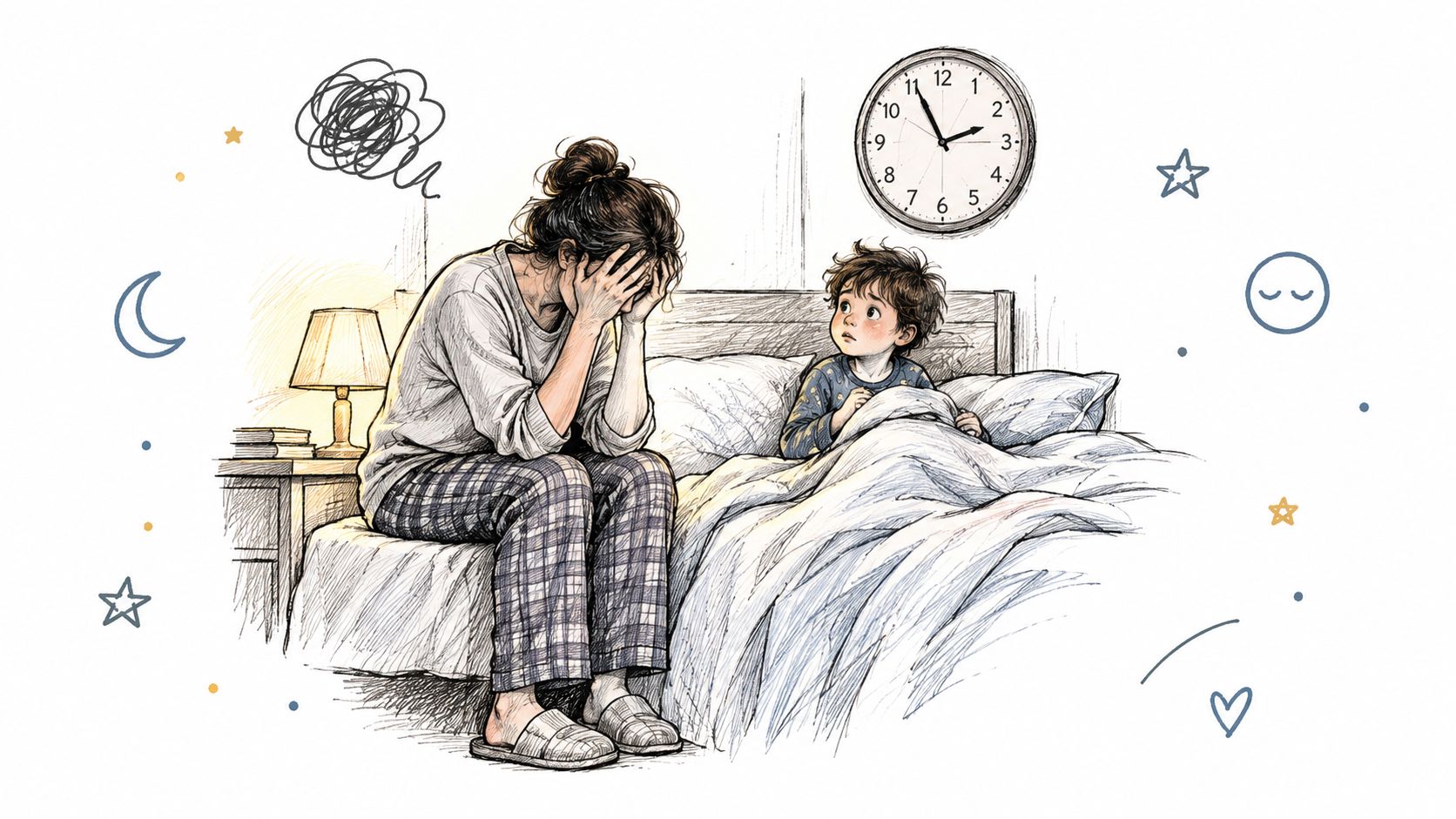
Time in bed is not the same as time asleep. A child can spend an hour under the covers while anxiety, stimulation, discomfort, or a learned need for repeated check-ins keeps sleep away. The CDC found that 35.0% of children aged 4 months to 14 years did not meet age-specific sleep-duration thresholds, showing that insufficient sleep occurs throughout childhood CDC children's sleep facts and stats.
Start by observing the sequence rather than judging the behavior. Note whether calls cluster during the first 20 minutes after lights-out or appear during later night wakings. Early calls may point to timing, separation worries, or a bedtime routine that keeps restarting. Later wakings may require a different response.
Practical rule: if bedtime takes more effort each night, make your response shorter and more predictable rather than adding more explanations.
Your plan also has to account for caregiver exhaustion. Choose one brief script, such as “It is sleep time. You are safe. I will check on you in five minutes,” and repeat it calmly. For loud snoring, gasping, or brief breathing pauses, arrange medical evaluation instead of relying on behavior changes alone. Tonight's goal is a clear observation and one response you can repeat.
How Common Sleep Problems Look by Age
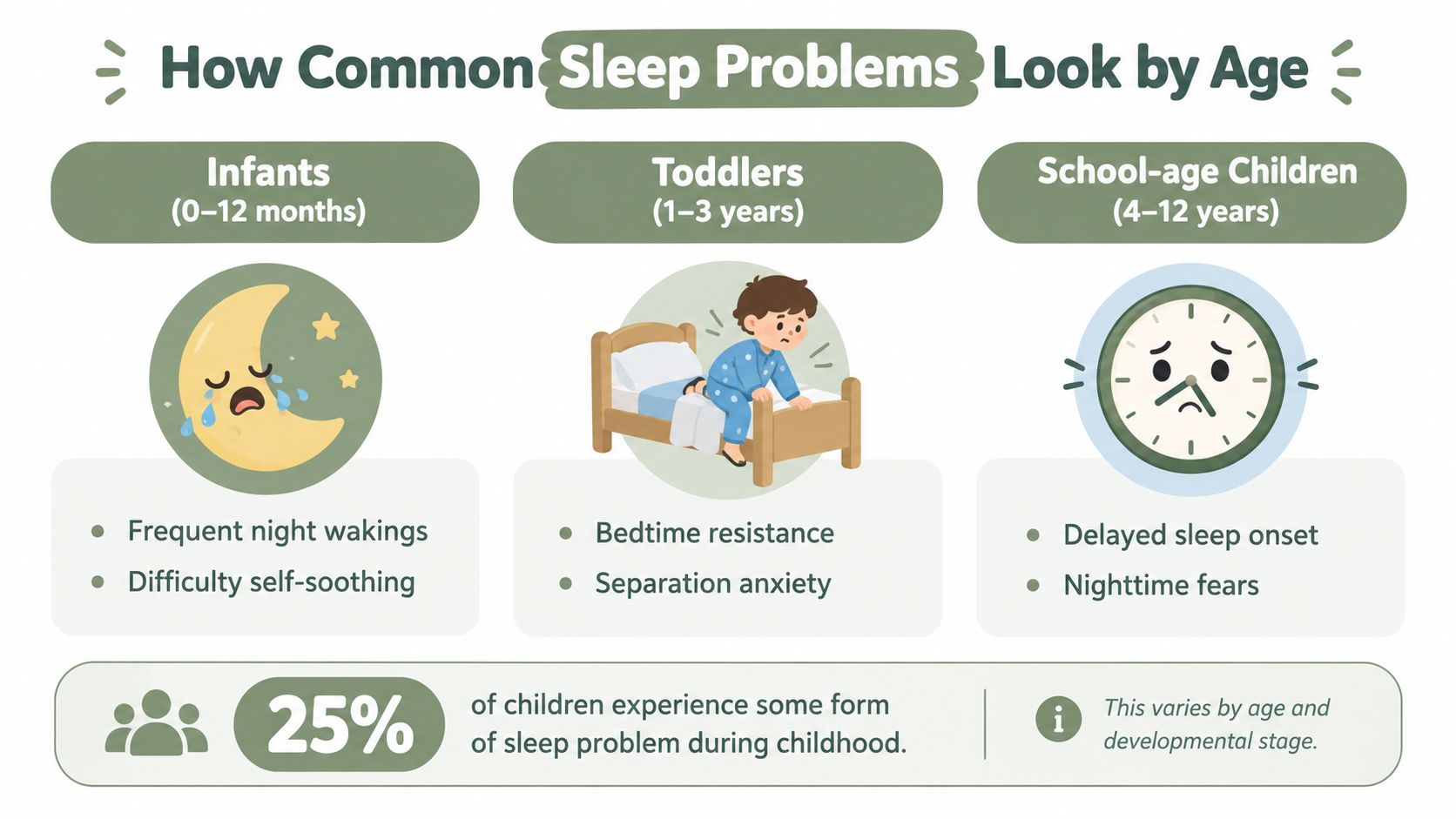
In younger children, sleep trouble often looks like protests, repeated calling out, or needing a parent present to fall asleep. In school-age children, it may look more like fears, stall tactics, or a long time lying awake after lights out. In teens, the problem often shifts toward a later body clock that collides with early school mornings.
The most useful habit for parents is to name the pattern instead of just describing the struggle. “He won't stay in bed” points to a different fix than “She falls asleep late” or “He wakes up several times.” CDC surveillance published in 2018 found that 57.8% of middle-school students reported sleeping less than recommended on school nights, and 72.7% of high-school students reported fewer than 8 hours on school nights CDC student sleep data. That's why sleep loss in older children often shows up as irritability, low motivation, inattention, or school trouble, not just yawning.
What to notice first
- Infants and toddlers: frequent night waking, difficulty settling without help, or strong protest when a caregiver leaves.
- School-age children: bedtime stalling, nighttime fears, and repeated requests for reassurance.
- Older children and teens: trouble falling asleep at a reasonable hour, short school-night sleep, and morning frustration that looks like moodiness.
Children usually aren't choosing fatigue. They're showing it.
If a child is sleepy enough, their behavior changes before they yawn. That's why the pattern matters so much. For families worried about breathing-related sleep issues, a focused resource on child sleep breathing problems can help you recognize when snoring, gasping, or disrupted breathing deserves a medical conversation.
The plain-language takeaway is this, different ages struggle in different ways, and the fix depends on whether the main issue is falling asleep, staying asleep, or getting enough sleep opportunity in the first place.
What Keeps Kids Awake and Waking Up
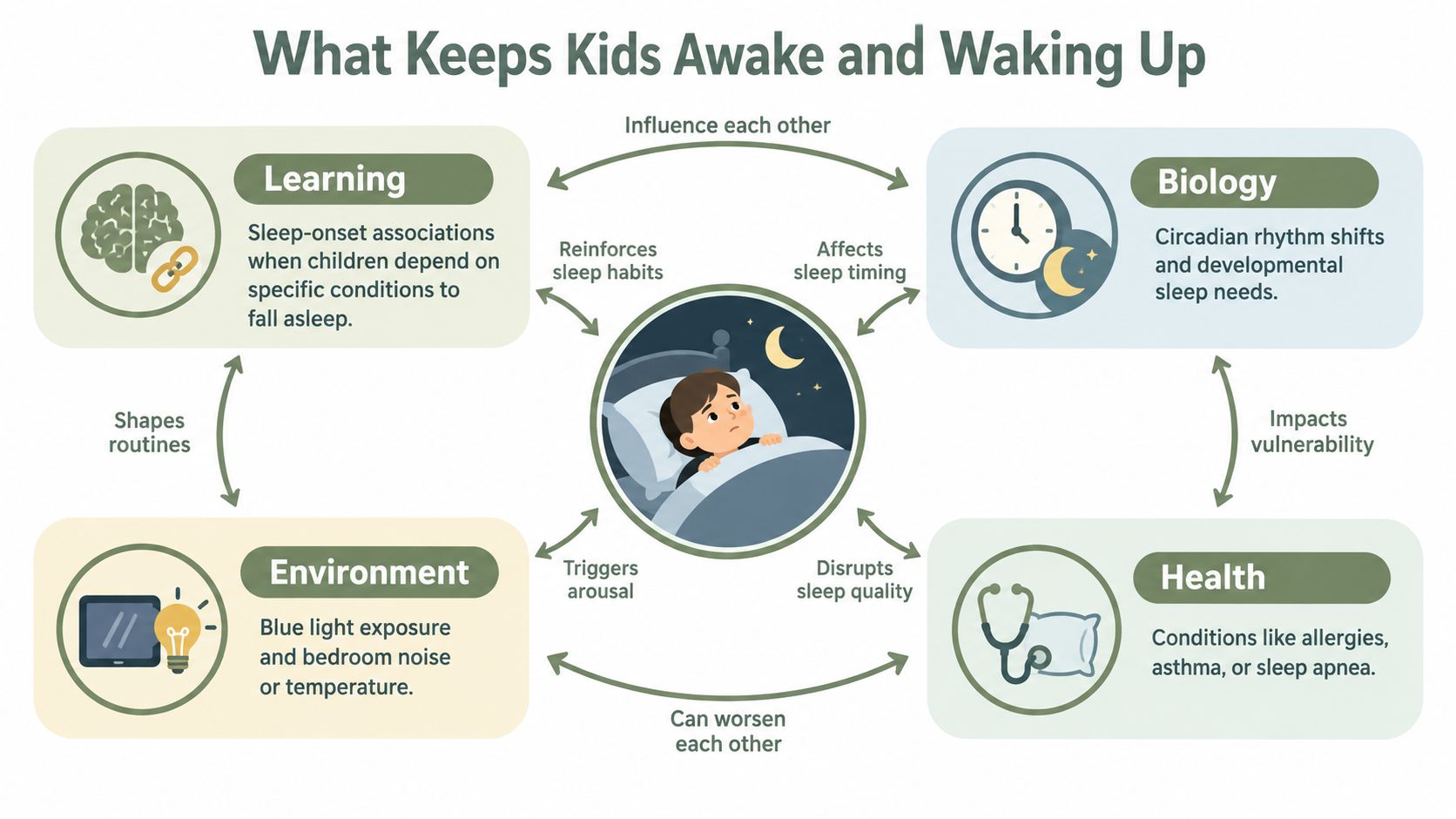
A child can spend a long time in bed and still sleep too little. The missing piece may be a late body clock, repeated wake-ups, an uncomfortable room, or a bedtime routine that makes parental help part of falling asleep. These factors often reinforce one another, so changing the first workable piece is more useful than blaming the child.
Learning can maintain night waking
Some children learn that sleep begins with a parent nearby, rocking, feeding, repeated reassurance, or another specific condition. If that condition disappears between sleep cycles, the child may wake and call for it again. A randomized trial found that graduated extinction and bedtime fading reduced the time children took to fall asleep, while graduated extinction also reduced awakenings behavioral sleep treatment trial.
This is learned expectation, not manipulation. The brain has connected sleep with a particular cue. A gradual change, such as sitting farther away each night, can be easier for an exhausted caregiver to maintain than an ambitious plan that collapses after one difficult evening.
Biology and schedule shape the timing
Some children become sleepy later than their family schedule allows. Early school starts, late activities, and weekend drift can push sleep later while morning wake time stays fixed. The result is less actual sleep, even when bedtime looks early on the clock.
Environment and health can interrupt sleep
Light, noise, screens, room temperature, allergies, asthma, and sleep-disordered breathing may keep a child from settling or returning to sleep. A consistent routine cannot fully solve discomfort or breathing trouble. Snoring, gasping, or pauses in breathing deserve medical advice.
A longitudinal study of nearly 5,000 Australian children found bidirectional links between sleep problems and later externalizing difficulties through ages 12 to 13, while sleep problems were associated with later internalizing difficulties Australian childhood sleep study. Behavior can therefore worsen sleep, while poor sleep can also affect behavior.
Start with the change your family can repeat tonight. If your child needs you in the room, use a brief script and reduce your presence in small stages. If noise or light is the problem, adjust the room. If accidents or cleanup keep everyone tense, Protect-A-Bed mattress protector tips offer practical setup guidance.
A Simple One Week Sleep Check for Your Family
Before changing anything, it helps to see what's happening over a full week. Parents often think their child is “in bed long enough,” but that doesn't always mean the child is asleep long enough. A short sleep check gives you a clearer picture of sleep opportunity, actual sleep, and the daytime signs that tell you whether the schedule is working.
Track the basics for seven nights
Write down bedtime, lights out, how long it takes to fall asleep, night awakenings, morning wake time, naps, and how the child acts during the day. If mornings are hard, note whether your child needs repeated waking, seems sleepy, or starts the day irritable. If school performance is slipping, record that too.
Here's a simple way to think about it. A child can spend plenty of time in bed and still get too little sleep if there are long wake periods, repeated calls, or a late sleep onset. That's why the diary matters more than memory.
| Age group | Recommended total | What to track | |---|---|---| | Infants 4 to 12 months | 12 to 16 hours | Bedtime, night feeds, sleep latency, wake periods | | Ages 1 to 2 years | 11 to 14 hours | Bedtime routine, awakenings, morning mood, naps | | Ages 3 to 5 years | 10 to 13 hours | Sleep onset, bedtime resistance, daytime behavior | | Ages 6 to 12 years | 9 to 12 hours | School-night sleep, wake time, morning alertness | | Ages 13 to 18 years | 8 to 10 hours | Weeknight sleep, screen timing, school functioning |
Recommended 24-hour totals vary by age, and those age-specific targets are the reason a single universal bedtime doesn't work for every child sleep duration recommendations.
Keep this simple: if you can't tell whether the child is asleep, you don't yet know the real problem.
Watch for medical red flags
Persistent loud snoring, witnessed pauses in breathing, gasping, restless sleep, or marked daytime impairment deserves medical evaluation. Those signs point beyond routine behavior work and can't be solved by a bedtime chart alone.
If you finish the week with one clear pattern, use that. If you finish with confusion, that's useful too, because confusion often means sleep is being affected by more than one factor.
Bedtime Plans and Scripts That Build Better Sleep
At 8:30, your child has been in bed for half an hour. They have asked for water twice, called you back three times, and still are not asleep. That is the moment many parents start stretching bedtime longer and longer. A better plan is to make bedtime clearer, shorter, and easier to repeat. Time in bed is only helpful when it leads to sleep.
Use a fixed routine and one calm script
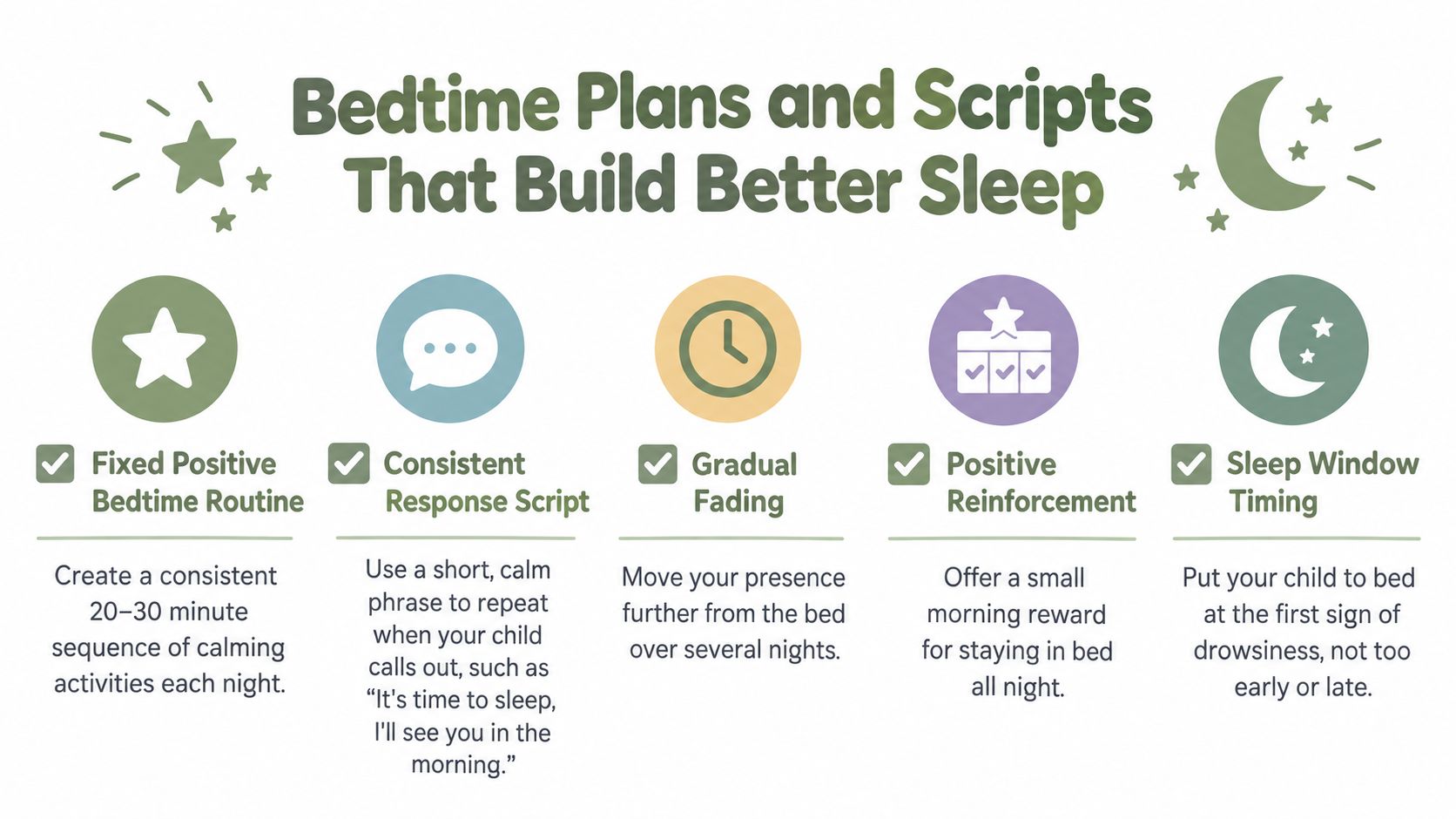
Children settle more easily when the evening runs in the same order each night. A simple sequence works well: bath, pajamas, brush teeth, one short book, lights out. Keep it short enough that you can do it even on a draining day, because a routine only teaches the brain what to expect when it happens over and over.
Then choose one calm sentence and stick with it. You might say, “It's time to sleep. I'll see you in the morning.” Say it the same way each time. Long explanations, bargaining, and fresh answers often act like tiny rewards for staying awake and calling out.
Consistency matters for adults too. If one parent sits for twenty minutes and the other gives repeated reminders from the doorway, the child gets mixed signals. Agree on the words and steps before bedtime begins.
Choose the bedtime method that matches the pattern
Different sleep problems need different tools.
- Graduated extinction: check in after set intervals, keep each check brief, and avoid turning it into a conversation.
- Bedtime fading: begin with a bedtime closer to when your child falls asleep, then move it earlier in small steps as falling asleep becomes easier.
- Scheduled awakenings: for children who wake at predictable times, a brief planned waking before the usual time can sometimes reduce the pattern.
The point is not to pick the strictest method. It is to choose one that fits the pattern you saw during your sleep check and that you can carry out calmly for several nights.
Make the plan livable for your family
A workable plan has to fit the child and the caregiver. A child with separation anxiety, autism, ADHD, or a house full of sibling noise may need smaller steps, visual cues, or shorter check-ins. An exhausted parent may need a version that does not depend on repeated sitting, long talking, or constant watching.
That is not a weakness. It is good planning.
If you can follow a simple routine when you are tired, you are more likely to keep it steady. For a practical example of family structure and home routines, this parent resource from Wald Behavioral Health shows the kind of support many caregivers find useful.
Rule of thumb: long, unpredictable responses can teach a child to keep trying at bedtime.
To keep tracking manageable, start with only two measures, how long it takes your child to fall asleep and how many times they get out of bed or call for you. Those two signs usually tell you whether the plan is working.
Some families also lower evening stimulation by quieting devices and reducing alerts. One example is Sleep Mode for productivity, which can help the house feel calmer during wind-down.
Fixing Late Nights and Early School Mornings
Older kids and teens often don't have the same sleep problem as younger children. Their issue is less about refusing sleep and more about a body clock that wants to run later than school allows. When early mornings collide with late nights, the result is short weeknight sleep even when the child “goes to bed on time.”
Compare the problem, not just the bedtime
A school-age child may resist sleep because they want a parent nearby or they're stuck in a habit of stalling. A teen may be tired but still unable to fall asleep at 9 p.m. because the internal clock isn't ready yet. That's why forcing the same solution on both ages can backfire.
The better move is to protect wake time, reduce late stimulation, and shift the schedule gradually. Morning light helps anchor the day, while late-night screen use and irregular weekend sleeping can push bedtime later. If weekends erase the school-week rhythm, Monday becomes harder than it needs to be.
Build a realistic school-night plan
- Keep wake time steady: this gives the body a consistent anchor.
- Protect the evening wind-down: dim lights and cut the most stimulating activities before bed.
- Shift bedtime slowly: move it earlier in small steps rather than jumping straight to an ideal time.
- Guard the weekend: don't let weekend sleep drift undo the weekday schedule.
The aim is more actual sleep, not just more time spent lying in bed.
Families sometimes expect that an earlier bedtime automatically fixes the problem. For older children, it often doesn't. If the child isn't sleepy yet, bed becomes a place for frustration, not rest.
For parents who want practical behavior support tied to routines and follow-through, Wald Behavioral Health's parent guidance on behavior management strategies is a useful example of the kind of structured family coaching that can support bedtime consistency.
If a child still can't fall asleep despite a stable schedule, that's the point where sleep timing, anxiety, and medical contributors need a closer look. The goal is not just an earlier bedtime: it's a schedule that the child can sleep in.
When Home Strategies Are Not Enough
Some families can improve nights with a consistent routine and a simple tracking sheet. Others need more support because the problem is larger than bedtime behavior. If your child has persistent snoring, breathing pauses, severe daytime sleepiness, mood strain, or a sleep plan that leaves the whole household more depleted, that's a sign to escalate care.
A 2025 Brown University study of 102 elementary-school children using wrist monitors found that children averaged 8 hours 20 minutes of sleep while parents estimated more than 9.5 hours, and only 14% met guidelines even though 83% of parents believed their child slept enough Brown University sleep study. That gap is important because it shows how easy it is to miss the actual sleep picture when you're judging by bedtime alone.
When to get extra help
- The plan hasn't changed sleep after consistent use.
- Nighttime caregiving is overwhelming the parent.
- Anxiety, ADHD, autism, or mood symptoms are part of the picture.
- Breathing symptoms or severe daytime impairment are present.
Telehealth can be a practical option when families need help fitting care into busy schedules, and Wald Behavioral Health's telehealth page explains how remote visits can support families who need structured parent guidance without adding another commute.
If the bedtime plan is making the parent collapse, the plan needs adjusting, not more guilt.
Specialty care can focus on the child and the family together, which matters when sleep problems are tied to stress, conflict, or a parent who's running out of energy. A good evaluation brings the diary, notes about wake times, and a clear list of what's already been tried.
If tonight feels impossible, start with one change. If the problem keeps returning, reach out for support that treats sleep as a family issue, not a character flaw.
---
If you're ready to make bedtime less chaotic, visit Wald Behavioral Health to learn about parent training, child therapy, and telehealth options that can help your family build a steadier sleep plan.
Questions about your child or teen?
Dr. Wald offers a free 15 minute consultation to talk through what you are seeing and whether the practice is a good fit.
Free 15 Minute Consultation