Behavioral Therapy ADHD: A Practical Parent Guide
You've asked three times for shoes, your child is still in pajamas, and the school bus is getting closer. Later, homework turns into an argument, bedtime stretches into another negotiation, and everyone ends the evening feeling as if they failed. These moments can look like defiance, but ADHD often makes starting, stopping, remembering, and shifting between tasks unusually difficult.
Behavioral therapy for ADHD is designed for those ordinary, exhausting moments. It doesn't depend on a child trying harder. Instead, it changes the instructions, routines, rewards, and responses around the behavior so the desired action becomes clearer and easier to repeat. The strongest plans connect home, rewards, and school, rather than treating each setting as a separate problem.
## Table of Contents - Why Behavior Comes First in ADHD Treatment - What Behavioral Therapy for ADHD Actually Means - Three settings that work together - Three core behavioral approaches at a glance - Parent Training in Behavior Management - A worked example from bedtime - Contingency Management and Reward Systems That Work - Building a point chart - Fading without losing progress - Classroom Strategies and School-Aligned Supports - The daily report card bridge - Asking teachers collaboratively - What the Evidence Really Shows - Why newer reviews add caution - Understanding fade-out and sleeper effects - Finding the Right Support and Your Next Steps
Why Behavior Comes First in ADHD Treatment
Behavioral therapy earns its place in ADHD care because it targets the situations where impairment appears. A child may understand that shoes belong by the door and still fail to put them on because the transition from play to leaving requires planning, attention, and inhibition all at once. A behavioral plan breaks that large demand into visible steps and gives the child immediate feedback for completing them.
This approach doesn't mean choosing medication or behavioral support as if one cancels out the other. The CDC's overview of ADHD treatment summarizes guidance from the American Academy of Pediatrics, including parent training in behavior management as the first-line treatment for children younger than 6 years. For children age 6 and older, the guidance recommends combining medication with behavior therapy when appropriate.
That recommendation reflects an important change in how clinicians understand ADHD treatment. Structured behavioral intervention is a core, evidence-based part of care, not an optional extra reserved for families who dislike medication. For young children, parent training can work as well as medication, according to the CDC summary, while older children often benefit from a coordinated plan that addresses symptoms and daily functioning together.
The practical point: Behavioral therapy changes what happens before, during, and after a difficult behavior. It gives adults a repeatable response instead of asking everyone to rely on patience in the middle of a crisis.
The approach is useful for parents, teachers, and children, but each person has a different job. Adults arrange the environment and reinforce progress. Teachers provide classroom cues and feedback. Children practice skills such as following directions, waiting, organizing materials, and recovering after mistakes.
You'll find practical guidance on behavior therapy for children and families, including how structured support can fit everyday routines. The key questions are straightforward: What does the therapy involve, which behaviors should you target first, how do rewards avoid becoming bribes, and how can home and school reinforce the same plan?
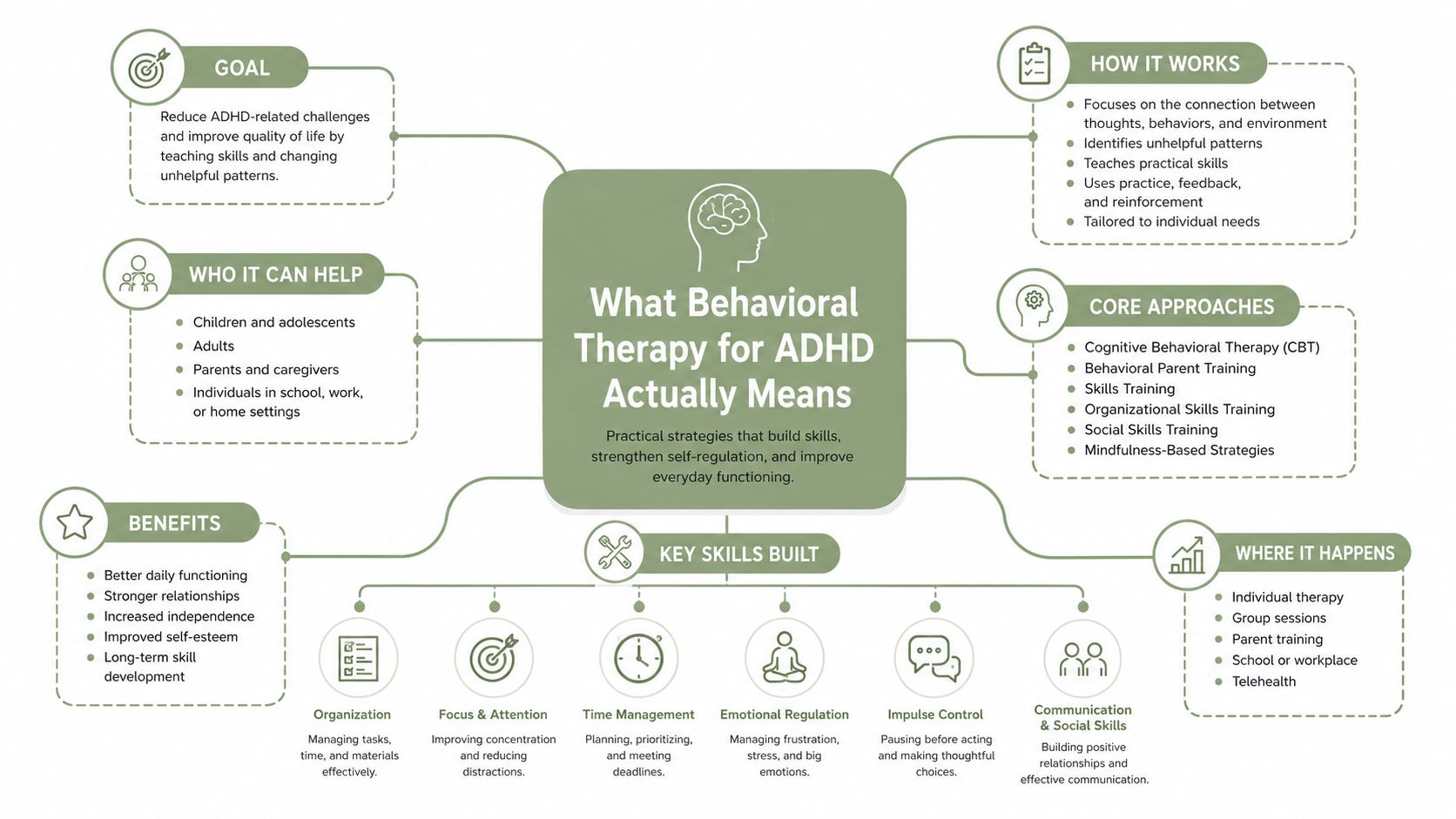
What Behavioral Therapy for ADHD Actually Means
Behavioral therapy is less about explaining why a child misbehaves and more about changing the conditions around a behavior. Think of ADHD behavior like a garden. Scolding the plants won't make them grow differently. You adjust the soil, light, watering schedule, and support so the growth you want becomes more likely.
Children with ADHD often respond best to consequences that are immediate, consistent, and predictable. A general instruction such as “Be responsible” is hard to act on. “Put your folder in the backpack, then place the backpack by the door” gives the child a visible sequence. Specific praise or a reward immediately after completion helps connect the action with its outcome.
The techniques can feel almost too simple because they focus on small, observable behaviors. That simplicity is a strength. Adults can use the same response repeatedly, and children can tell what earns positive attention.
Three settings that work together
Parent training in behavior management teaches caregivers how to give effective commands, notice desired behavior, establish routines, and respond calmly to rule-breaking. The child benefits, but the adult learns the system.
Contingency management creates a planned connection between a specific behavior and a reward. A child might earn points for beginning homework after one reminder, then exchange those points for a chosen privilege.
Classroom strategies make expectations easier to follow during school tasks. Seating, movement breaks, chunked assignments, visual cues, immediate feedback, and home-school communication can support the same skills practiced at home.
Three core behavioral approaches at a glance
| Approach | Where It Happens | Who Leads It | Best Fit | |---|---|---|---| | Parent training in behavior management | Home and family routines | Parent or caregiver, coached by a clinician | Young children and families needing consistent daily responses | | Contingency management | Home, school, or both | Adults who set and monitor the plan | A clearly defined behavior that needs immediate reinforcement | | Classroom strategies | Classroom and school routines | Teacher with caregiver collaboration | Students whose attention, organization, or follow-through affects school participation |
The system works best when the target is concrete. “Improve ADHD” is too broad for a chart or classroom plan. “Start the first math problem within five minutes” is measurable, teachable, and easier to reinforce.
Parent Training in Behavior Management
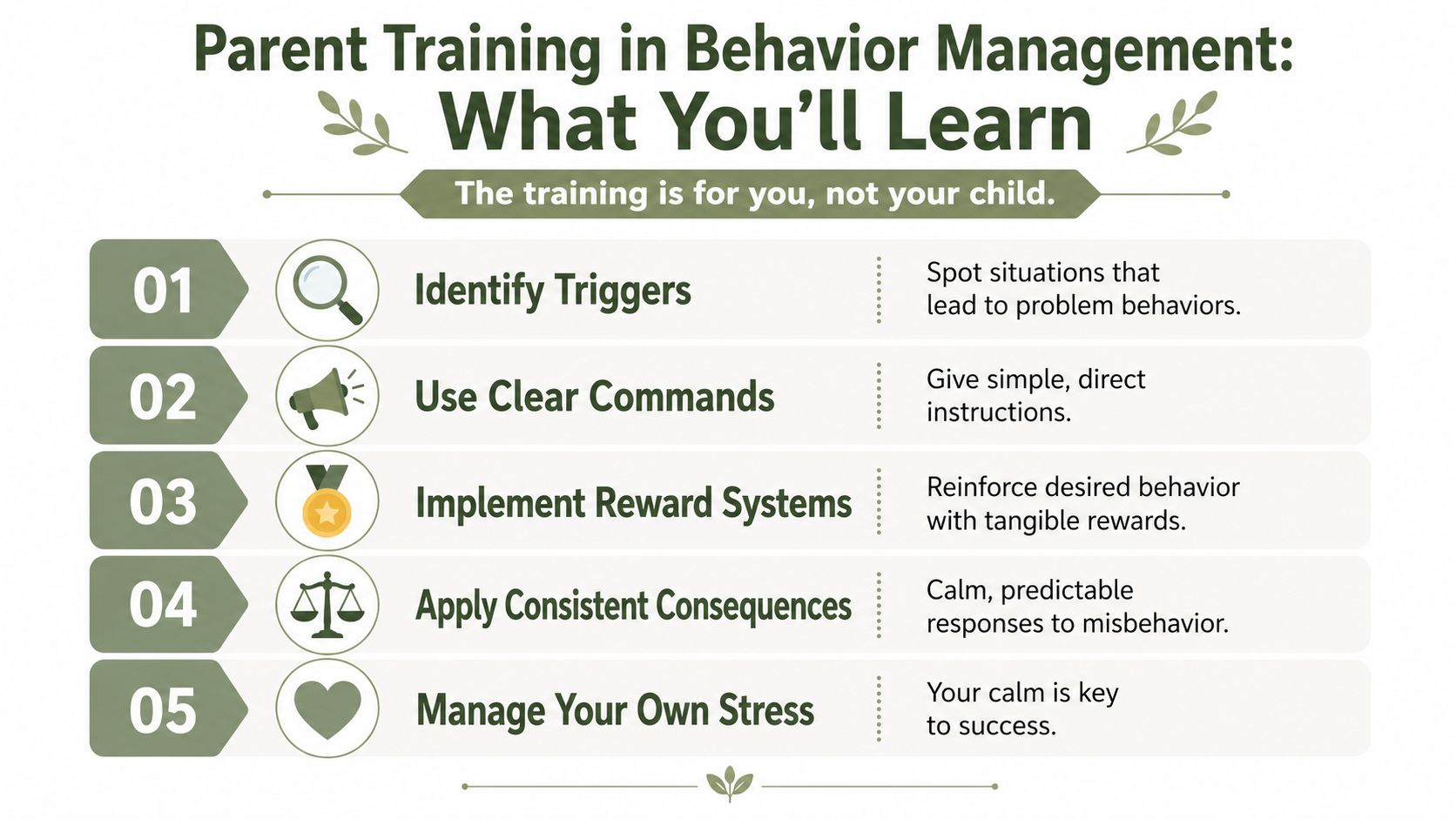
Parent training is often misunderstood because the name sounds as if the child will sit in therapy and receive behavior lessons. In practice, the training is for the adults. A clinician helps caregivers study what happens before a problem, choose a realistic target, practice a new response, and review what happened at home.
A typical program may cover positive attention, clear commands, labeled praise, planned ignoring for minor attention-seeking behavior, predictable consequences, and routines for mornings, homework, and bedtime. Parents also learn to notice triggers. Hunger, fatigue, screen transitions, crowded instructions, and rushed departures can all make follow-through harder.
A worked example from bedtime
Suppose a child leaves bed repeatedly after lights-out. The old pattern may be a long lecture, a threat, a parent returning several times, and eventually an exhausted adult allowing extra attention. The child receives the most interaction after getting up, even though nobody intended to reward the behavior.
A trained parent might first simplify the routine. The child uses a visual sequence, bathroom, pajamas, story, lights out. The parent gives one brief instruction, praises staying in bed, and responds to getting up with a calm, predictable return and minimal conversation. A small reward can follow the next morning when the child meets the agreed target.
The goal isn't instant perfection. The goal is to make the adult response boringly consistent and make the desired behavior easier to recognize.
A useful question: “What does my child need to do next?” usually works better than “Why won't my child behave?”
Parents can expect to build skills such as:
- Identifying triggers: Notice the time, demand, transition, or interaction that precedes a problem.
- Giving clear commands: Use one short, specific direction instead of a string of instructions.
- Using labeled praise: Say “You started your homework when the timer rang,” rather than offering general approval.
- Creating routines: Put morning, homework, and bedtime steps where the child can see them.
- Applying consistent consequences: Respond to rule-breaking with a planned, calm action.
- Managing adult stress: Pause, lower your voice, and follow the plan instead of improvising during conflict.
Evidence supports this structured approach. A 2023 systematic review included 27 studies, 31 interventions, and 217 relevant effect sizes, with a mean follow-up of 5.3 months. It found sustained improvements in ADHD symptoms, behavioral problems, positive parenting, and parents' sense of competence in the review of behavioral parent training.
Parents can find practical examples of this coaching model through ADHD parent coaching resources. Therapy won't remove every difficult evening, but it can replace repeated arguments with a shared routine and a response that everyone understands.
Contingency Management and Reward Systems That Work
A reward system isn't the same as bribery. Bribery usually appears in the heat of a problem: “If you stop yelling right now, I'll give you candy.” Contingency management is planned in advance. The child knows the exact behavior, the reward, and when the exchange will happen.
Start with one behavior. For homework, “finish everything independently” may be too large. A better first target could be open the assignment and begin within five minutes of the agreed start time. Once that becomes reliable, you can add another step.
Building a point chart
Choose a simple point system that the child can understand. The chart might award one point for starting on time, one for working through the first agreed work period, and one for placing completed materials in the backpack. The exchange rate should be clear, and the reward should be available soon enough to matter.
Possible rewards don't need to cost money. Extra time building with LEGO, choosing the family game, selecting the bedtime story, or listening to a preferred playlist can work if the child values them. Ask the child to help choose options, then write the rules where everyone can see them.
The plan should answer four questions:
- What behavior earns a point? Describe an action, not a personality trait.
- When does the child receive feedback? Give it immediately after the behavior whenever possible.
- What can points buy? List the reward and the number of points required.
- What happens after a missed target? Avoid adding a punishment that makes the chart feel unsafe or impossible.
If the chart fails, examine the design before blaming motivation. Rewards that arrive much later may not compete with the immediate pull of play. A chart covering five behaviors at once can become confusing. A target that's too difficult can teach the child that success is out of reach.
Fading without losing progress
A reward system is a teaching tool, not a permanent requirement. Once the behavior becomes more consistent, move from rewarding every successful step to rewarding a larger routine, such as completing the homework start-up sequence. You might also shift from tangible rewards toward privileges, praise, and natural outcomes.
The behavior chart guide can help families turn a vague goal into a visible plan. Keep reviewing whether the chart is still helping. If the child has learned the routine, simplify it rather than adding more rules.
Start smaller than feels necessary. A child who repeatedly succeeds at a modest target can build momentum for the harder behavior that comes next.
Classroom Strategies and School-Aligned Supports
School can reveal ADHD-related impairment because the child must manage many demands at once. They may need to listen, remember directions, begin work, ignore nearby activity, organize materials, and shift tasks while the teacher supports an entire class. Behavioral therapy works better when classroom supports reduce unnecessary friction and provide feedback close to the behavior.
Teachers might use strategic seating, short movement breaks, chunked assignments, visual checklists, immediate feedback, and predictable classroom routines. These supports aren't about lowering expectations. They make the path to meeting expectations more visible.
The daily report card bridge
A daily report card connects school behavior with the home reward plan. The teacher selects a small number of targets, such as beginning independent work, keeping materials ready, or raising a hand before speaking. At an agreed time, the teacher marks whether the child met each target and sends the report home.
The parent then responds according to the home plan. That might mean praise, points, or a privilege linked to the child's effort and progress. The teacher provides feedback while the behavior is still fresh, and the parent reinforces the same goal later.
A report card should be brief enough for a teacher to use consistently. It also needs neutral wording. “Started work after the direction” gives useful information. “Had a good day” doesn't tell the child what to repeat.
Asking teachers collaboratively
Begin with observations rather than demands. You might say, “We're noticing that starting work is hardest after transitions at home. Could we try one clear start target and a brief note at the end of independent work?”
Agree on the target, how it will be measured, and how often you'll review it. Ask what the teacher already sees as workable. A classroom plan that fits the teacher's routine is more likely to continue than a complicated form that creates extra work.
Home and school don't need identical systems. They need shared targets and compatible responses.
Parents can bring a one-page summary of the home plan, including the exact behavior being practiced and the language used for praise. Teachers can then reinforce the same skill without having to reproduce the entire family system.
What the Evidence Really Shows
Behavioral therapy deserves confidence, but not exaggerated promises. The strongest findings concern parent-rated ADHD symptoms, behavior, parenting practices, and parent confidence. The 2023 review found statistically significant improvements between treatment and follow-up for ADHD symptoms, behavioral problems, positive parenting, and parenting sense of competence in its published findings.
The size of those improvements matters. The review reported a standardized mean difference of 0.21 for ADHD symptoms, 0.16 for behavioral problems, 0.60 for positive parenting, and 0.38 for parenting sense of competence. These figures don't mean every family will see the same change. They indicate that, across the included studies, benefits were measurable and extended beyond symptom ratings to the way parents interacted with their children.
Why newer reviews add caution
A 2025 review found short-term improvements in parent-rated ADHD symptoms, but those effects weren't supported by blinded reports. It also found no clear evidence of better child mental health or quality of life, as described in the review of parent-training outcomes published by SAGE.
That distinction is important. A parent who spends weeks practicing new strategies may notice meaningful improvement at home, while an observer who doesn't know which treatment the family received may see a smaller difference. Parent reports remain valuable because parents observe routines closely, but they're only one part of a careful evaluation.
Understanding fade-out and sleeper effects
The 2023 review noted fade-out effects in 16% of individual trials and sleeper effects in 12% in its analysis. In plain language, fade-out means an early benefit became smaller during follow-up. A sleeper effect means the improvement became more visible after treatment ended.
These patterns don't make therapy pointless. They show why families should track several outcomes rather than expecting a straight upward line. Look at morning completion, homework initiation, bedtime conflict, teacher feedback, and the child's ability to recover after frustration. Review the data with a clinician and adjust the plan when gains stall.
Behavioral therapy is worth evaluating by function, not by the promise of perfect symptom removal.
Finding the Right Support and Your Next Steps
A useful ADHD plan links the three settings. At home, caregivers teach routines and respond consistently. The reward structure makes one or two priority behaviors visible and motivating. At school, the teacher uses cues and feedback that support those same skills. When the systems point in different directions, the child has to solve a new behavior puzzle in every environment.
Access can be a real obstacle. A 2026 UW Medicine summary of a study found that only about one-fourth of psychologists advertise ADHD care, which suggests that many adults may struggle to find a clinician who offers ADHD-focused behavioral treatment as summarized by UW Medicine. For adults and late adolescents, CBT can target organization, planning, and time management, and emerging formats include shorter courses and app-based support, although these options aren't equally available everywhere.
Start with one target this week. Choose the moment that causes the most daily conflict, write the desired behavior in observable terms, and ask your child's clinician or teacher how to measure it. For example, “backpack by the door before screen time” gives your family a more useful starting point than “be more organized.”
Wald Behavioral Health offers ADHD-focused therapy and parent guidance for children, adolescents, and young adults, with support for attention, organization, planning, and school-aligned routines through in-person care and telehealth options. Visit Wald Behavioral Health to request a free 15-minute consultation and discuss which behavioral support fits your family's needs.
Questions about your child or teen?
Dr. Wald offers a free 15 minute consultation to talk through what you are seeing and whether the practice is a good fit.
Free 15 Minute Consultation