Child Anxiety Treatment at Home: A Parent's Guide
For mild-to-moderate child anxiety, structured parent-guided exposure and reduced accommodation are the core home treatments with the strongest evidence. Severe or impairing anxiety requires professional care, not a home plan alone.
The pattern often starts before anyone calls it anxiety. Your child wakes with a stomachache, begs to stay home, asks whether something bad will happen, and becomes calmer the moment school is no longer required. By evening, bedtime turns into repeated checking, reassurance questions, and negotiations about sleeping alone.
A useful home plan doesn't demand that fear disappear. It helps your child approach ordinary activities while anxious, while you gradually stop actions that make avoidance easier. The parent's job is neither to dismiss the fear nor to obey it.
## Table of Contents - Understanding What Child Anxiety Looks Like at Home - Track the pattern, not one hard day - A Practical Six-Step Home Protocol for Reducing Anxiety - Shifting from Reassurance to Calm Coaching - Use language that validates without agreeing - Using Digital Tools and Workbooks Safely at Home - Build supervision into the routine - How Telehealth Can Support Your Home Treatment Plan - Red Flags That Mean Home Treatment Is Not Enough - Building Your Family's Long-Term Anxiety Management Plan - A sustainable checklist
Understanding What Child Anxiety Looks Like at Home
A child who refuses school one morning might be tired, ill, upset about a friendship, or anxious about a test. One difficult episode doesn't establish a disorder. The more important question is whether the pattern persists and begins to restrict school, friendships, sleep, family routines, or activities the child previously enjoyed.
Anxiety can appear as morning stomachaches, headaches, crying, irritability, clinging, repeated checking, catastrophic bedtime questions, or avoidance of presentations and social events. Physical symptoms can be genuine even when anxiety contributes to them. A child may feel better after being allowed to stay home, but that immediate relief can make the next refusal more likely.
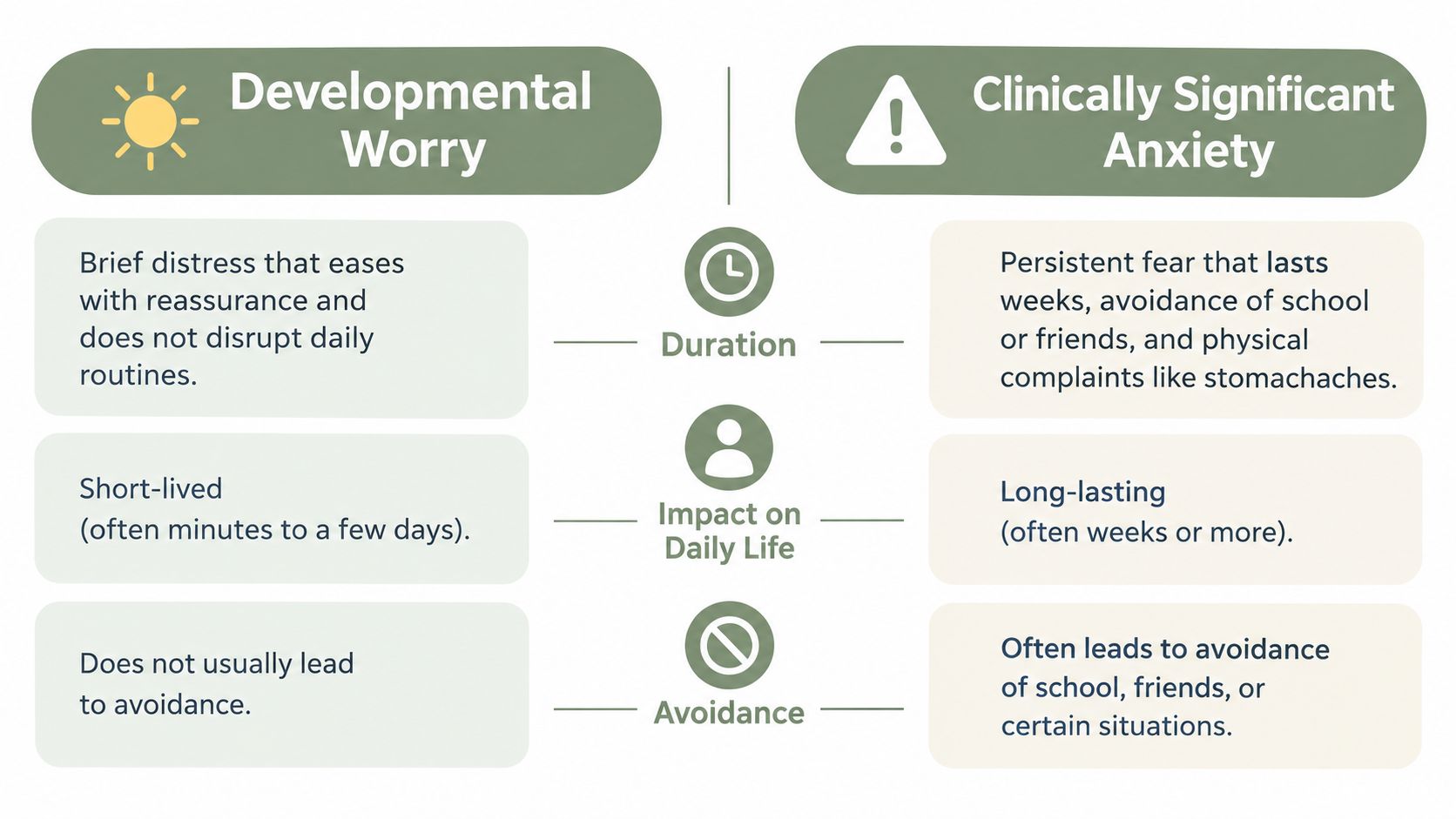
| Typical Worry | Clinically Significant Anxiety | |---|---| | Brief distress that eases and doesn't disrupt ordinary routines | Persistent fear that interferes with daily life | | The child can return to play, school, sleep, or social activity | The child increasingly avoids school, friends, activities, or independence | | Reassurance helps without repeated checking | Reassurance provides only temporary relief, followed by more questions | | Fear fits a situation and gradually settles | Fear lasts, spreads, or produces recurring physical complaints |
Track the pattern, not one hard day
For one to two weeks, note what happened before the anxiety, what your child did, what you did, and what happened afterward. Record the frequency of episodes, the intensity using a simple 0, 10 scale, and the functional effect on attendance, sleep, meals, friendships, and routines.
This record helps separate a temporary developmental worry from an avoidance cycle. It also gives a clinician useful information if assessment becomes necessary. The World Health Organization estimates that anxiety disorders affect 4.1% of children aged 10, 14 and 5.3% of adolescents aged 15, 19 according to its cited figures in the NICE guidance.
Practical rule: Treat impairment as seriously as intensity. A child who reports moderate fear but stops attending school needs attention.
A Practical Six-Step Home Protocol for Reducing Anxiety
Parent-delivered CBT works best when home practice is structured, gradual, and guided. In a randomized trial of 194 children with diagnosed anxiety disorders, the full guided parent-CBT program used four face-to-face sessions and four telephone sessions. After treatment, 50% of children in that group no longer met criteria for their primary anxiety diagnosis, compared with 25% in the wait-list group, with recovery still reported for 76% of assessed children six months later in the trial report. That evidence supports coached practice, not unsupervised exposure.
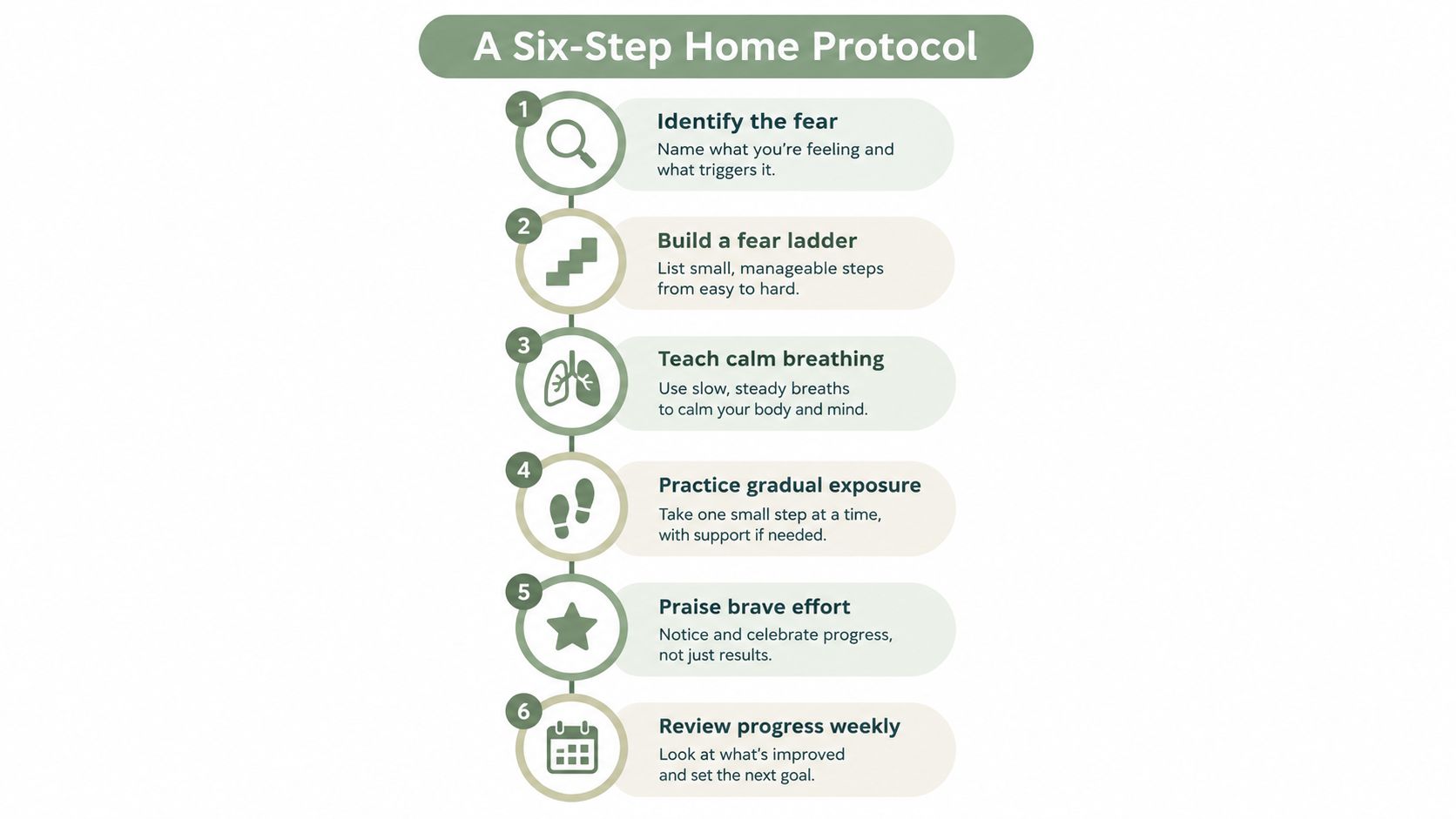
| Step | Action | Example | |---|---|---| | 1. Identify | Name the feared situation and avoidance response | “You worry classmates will laugh during your presentation.” | | 2. Rate | Use a 0, 10 or 0, 100 distress scale | “How hard is practicing one sentence to your parent?” | | 3. Build | Order tasks from manageable to difficult | Mirror, parent, family member, trusted peer, small group | | 4. Practice | Repeat the task while reducing escape or reassurance | Stay with the activity instead of leaving when discomfort rises | | 5. Record | Track approach, distress, and caregiver responses | Note that the child completed the task, even if still nervous | | 6. Review | Discuss progress weekly with a qualified clinician | Adjust the next task rather than improvising during a crisis |
A child afraid of group presentations might first read two sentences to a mirror, then present to you, then to another family member. Later steps could include speaking to one trusted peer and answering a question in a small group. Don't jump to the hardest task because the child completed an easier one.
The technical target is approach and reduced accommodation, not anxiety reaching zero. Teach a coping skill, such as slow breathing or grounding, but don't turn the skill into a ritual the child must perform perfectly before moving forward. Parents looking for additional activity ideas can also review anxiety therapy activities for children, then adapt any exercise to the child's age and treatment plan.
Shifting from Reassurance to Calm Coaching
“Stop reassuring” is incomplete advice. A frightened child still needs connection, and abruptly removing every supportive response can make the family conflict worse. The safer shift is from certainty-seeking to confidence-building.
Family accommodation includes answering the same reassurance question repeatedly, changing routines, helping a child avoid feared situations, completing tasks for them, or sleeping beside them. These actions often reduce distress quickly, but they can teach the child that coping depends on the parent preventing uncertainty. Parent-focused CBT research found that parent-only treatment reduced anxiety more than wait-list care, with 37.96% remission compared with 6.85% in wait-list controls in the cited meta-analysis.
Use language that validates without agreeing
Try these substitutions:
- Instead of, “Nothing bad will happen,” say, “I know this feels scary, and you can handle the next step.”
- Instead of, “You don't have to go if you're too anxious,” say, “I hear that you want to avoid it. Our plan is to go, and I'll help you start.”
- Instead of answering the same question repeatedly, say, “We've answered that once. Now let's use your plan.”
- Instead of completing the task, say, “I'll stay nearby while you do it. I won't do it for you.”
Start with one accommodation. If you answer ten repeated questions, agree that you'll answer the first one and then point to the coping plan. Expect a short-term increase in protest or distress. That reaction doesn't automatically mean the boundary is harmful, but it does mean the step may need clinician guidance.
Parents supporting children with developmental differences may also find autism parent coaching resources useful when anxiety, communication, routines, and caregiver responses overlap.
The focus of the exchange is calm coaching, not emotional debate. Speak slowly, keep the expectation brief, and praise brave behavior, not perfect calm.
Using Digital Tools and Workbooks Safely at Home
A workbook or app can help a child practice between hard moments at home, but only if an adult turns it into a routine. NICE lists guided digital CBT self-help as an initial option for children aged 5, 18 with mild-to-moderate anxiety or low mood, while also noting that the evidence base is still developing in its early value assessment.
The key word is guided. Children do better when a parent or clinician helps them use one skill at a time, then applies it in real life. Research findings from coached internet-CBT programs are encouraging, but those studies used screening, follow-up, and active support. They do not describe what usually happens when a child is handed a phone and told to work through anxiety alone.
Use digital tools as a treatment aid, not as a babysitter.
Build supervision into the routine
Set a simple structure: 1. Establish a baseline for anxiety, avoidance, sleep, school attendance, and family accommodation. 2. Schedule brief, predictable practice sessions. 3. Teach one coping skill, then use it during a graded exposure. 4. Reinforce effort and participation, not symptom elimination. 5. Reassess function every one to two weeks, not just the child's anxiety rating. 6. Share concerning changes with a licensed clinician.
Watch what improves in daily life. A child may still look anxious while getting on the school bus, sleeping in their own room, or answering one question in class. Those are meaningful gains.
Common mistakes are easy to miss. Parents often stop an exposure after one spike in distress, change the rules from one day to the next, or keep switching tools before the child has practiced enough to learn anything from them.
Families can pair home practice with Wald Behavioral Health's resources, but digital support on its own is often too little when avoidance is entrenched, sleep or school is disrupted, or the child cannot engage consistently.
How Telehealth Can Support Your Home Treatment Plan
A parent is trying to get a child through the morning routine, the child is in tears, and everyone is arguing about school. That is often the moment families need more than general advice. Telehealth can help because a licensed clinician can see the patterns around the anxiety, not just hear a summary after the fact.
Used well, virtual care helps make home treatment more specific. A clinician can sort out whether the main problem is anxiety, OCD, trauma, depression, learning difficulty, a medical issue, or family stress that calls for a different approach. They can also coach parents on the missing piece many families struggle with, what to say in the moment, how to respond without feeding the cycle, and how to reduce accommodation gradually rather than all at once.
Telehealth also lets treatment happen where the problem shows up. A clinician may watch part of a morning routine, help parents practice a response to school refusal, review a symptom log, or adjust an exposure ladder between visits. For families dealing with transportation, scheduling, or privacy barriers, that can make follow-through much more realistic.

Before the first session, gather examples of avoidance, reassurance seeking, accommodation, physical symptoms, school impact, sleep changes, and anything you already tried. Test the setup and check your Zoom connection speed so technical problems do not interrupt a useful session.
Wald Behavioral Health offers telehealth in Florida, Maryland, and PSYPACT-participating states. Families who want a clearer picture of how virtual sessions can fit home care can read about telehealth for anxiety. Telehealth works best when assessment is careful, the connection is secure, and the family is ready to practice between visits.
Red Flags That Mean Home Treatment Is Not Enough
Home strategies may suit mild-to-moderate anxiety when the child can still participate in daily life and the family can follow a consistent plan. Seek professional assessment when anxiety produces persistent school refusal, major sleep disruption, severe social withdrawal, escalating compulsions, or marked impairment in ordinary routines.
Pause self-directed exposure and contact a licensed clinician promptly when:
- Safety concerns appear: The child mentions self-harm, suicide, feeling unsafe, or an inability to stay safe.
- Function collapses: Anxiety prevents school attendance, eating, sleeping, hygiene, or basic family participation.
- The presentation changes: Trauma symptoms, psychosis, severe mood changes, or unusual behavior appear.
- A medical cause is possible: New or intense physical symptoms need medical evaluation rather than an anxiety label.
- Compulsions dominate: Rituals or reassurance cycles consume substantial daily life or make exposure unclear.
- The family is stuck: Parents can't agree on boundaries, accommodation is escalating, or practice repeatedly ends in conflict.
A temporary distress increase during an agreed exposure can be expected. Deterioration is different: worsening impairment, new safety risk, inability to recover after practice, or symptoms spreading into more areas. Contact emergency services or a local crisis service immediately when there is imminent danger.
Building Your Family's Long-Term Anxiety Management Plan
Anxiety management works better as a repeatable family routine than as a collection of emergency responses. Keep the plan visible and simple enough to use on a difficult morning.
A sustainable checklist
- Daily: Use consistent wake, school, meal, and bedtime routines. Respond warmly, but don't repeatedly negotiate with anxiety.
- During episodes: Validate the feeling, name the next action, and stay nearby without completing the feared task.
- Each week: Practice selected exposure tasks and record approach behavior, distress, avoidance, and accommodation.
- Every one to two weeks: Review school attendance, sleep, friendships, physical complaints, and family functioning.
- At follow-up: Share the log with a clinician and adjust the ladder, boundaries, or supports.
- After progress: Keep practicing occasionally so new independence becomes familiar rather than fragile.
The aim is functional improvement, not a childhood without fear. A child who walks into school while nervous has made meaningful progress, even if the stomachache hasn't vanished. A child who asks one question instead of seeking an hour of reassurance is practicing independence.
Setbacks often follow illness, school transitions, conflict, exams, or other changes. Return to the last manageable step, restore consistency, and seek guidance if the setback persists or impairment grows. Don't respond by removing every expectation, and don't punish the child for having anxiety.
---
Wald Behavioral Health offers evidence-based anxiety therapy, parent guidance, and secure telehealth for children and adolescents in Florida, Maryland, and PSYPACT-participating states. Visit Wald Behavioral Health to arrange a free 15-minute consultation and discuss a practical home treatment plan with a licensed clinician.
Questions about your child or teen?
Dr. Wald offers a free 15 minute consultation to talk through what you are seeing and whether the practice is a good fit.
Free 15 Minute Consultation