Telehealth for Anxiety: What to Know and How It Works

At 7:30 in the morning, a parent may be sitting at the kitchen counter with a laptop open to a clinician's virtual waiting room while a hesitant teenager lingers just outside the camera frame. Nobody has had to fight traffic, miss a full day of work, or persuade the teen to walk into an unfamiliar office. The first challenge is helping them take the seat.
That small change can matter. Telehealth for anxiety preserves access to evidence-based care when travel, scheduling, avoidance, or local clinician shortages make office treatment difficult. It isn't automatically better than in-person therapy, and it isn't right for every situation. It's one way to deliver structured treatment, then add in-person or technology-supported care when the clinical picture calls for it.
## Table of Contents - When the Living Room Becomes the Therapy Room - What Telehealth for Anxiety Actually Means - Three kinds of digital contact - The Evidence Behind Telehealth for Anxiety - Telehealth for Anxiety Evidence Snapshot by Condition - Who Telehealth for Anxiety Is a Good Fit For - Situations that need closer review - Setting Up a Video Session That Actually Works - A practical setup - Where Telehealth for Anxiety Shines in Real Life - A connected path of care - When Telehealth Needs a Backup Plan - Signs the level of care should change - Starting Telehealth for Anxiety at Wald Behavioral Health - What the intake process may include
When the Living Room Becomes the Therapy Room
A child may freeze at the front door before school, a college student may avoid leaving the apartment, or a new parent may have no childcare for an office visit. The family can recognize that support is needed while travel, timing, and avoidance keep treatment out of reach.
A video appointment can change that first step. Meeting in a familiar room may help a client speak more openly and may show the clinician how anxiety appears in daily life. A teenager who says little in a clinic might talk from a bedroom desk. A parent might point to the doorway where school-morning distress begins. These details can guide treatment, while the clinician still needs to assess whether the home environment gives the session enough privacy and attention.
Practical rule: Convenience only helps when the home setting supports privacy, attention, and honest participation.
Telehealth use grew sharply during the COVID-19 pandemic, when mental health services moved away from routine office visits. Among commercially insured U.S. adults, overall telehealth mental health use multiplied 16 to 20 times, while anxiety visits rose from 0.20 to 9.3 per 10,000 adults, the highest increase among the conditions examined in that analysis (CIDRAP's report on pandemic-era mental telehealth use). In the cited comparison, anxiety and fear-related disorders also had higher telehealth use than in-person care, 27.5% versus 25.5%.
The emergency response became an ongoing way to preserve access. For anxiety, care commonly consists of live video therapy with a licensed clinician. Secure messages, digital worksheets, symptom logs, and app exercises can support practice between visits. They do not replace assessment, treatment planning, guidance, or accountability.
Home practice helps turn a useful session into lasting progress. Families can agree on a quiet space, protect the appointment time, and help the client complete assigned exercises without taking over. The living room does not replace the therapy room. It offers another setting for treatment, with in-person support added when the person's needs or safety require it.
What Telehealth for Anxiety Actually Means
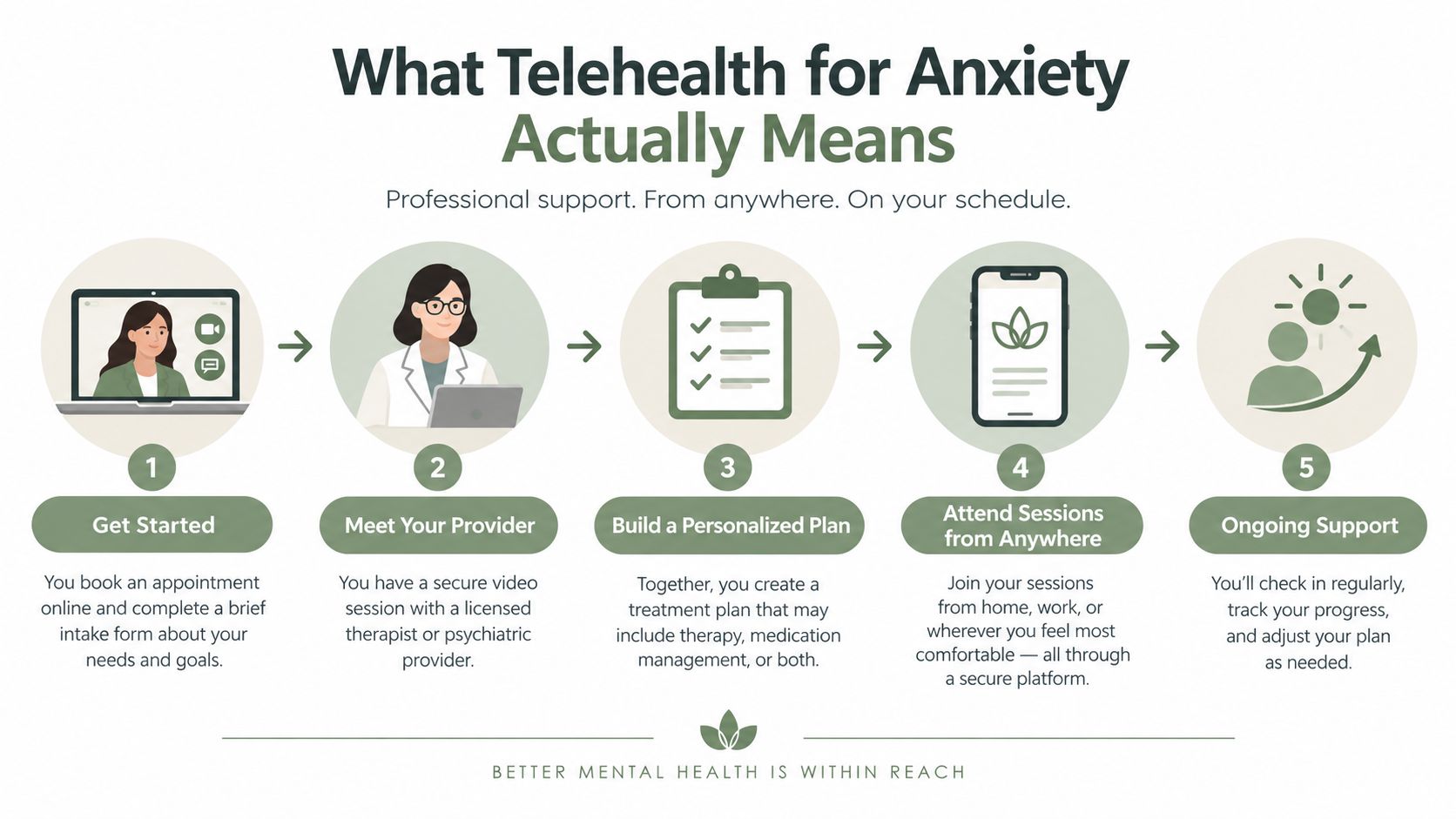
Telehealth for anxiety is psychotherapy delivered through secure communication technology. The core service is usually a live video appointment. Messaging and digital homework can extend the treatment, but they generally supplement rather than replace the clinical conversation.
A first appointment often follows a familiar sequence:
- Understand the problem. The clinician asks about symptoms, triggers, avoidance, sleep, school or work functioning, relationships, medical history, and previous treatment.
- Clarify safety. The provider checks for urgent risks and discusses what to do if distress becomes overwhelming between sessions.
- Set useful goals. “Feel less anxious” may become “return to class,” “sleep without repeated reassurance,” or “enter a feared social situation.”
- Choose a treatment direction. Cognitive behavioral therapy, exposure-based treatment, acceptance and commitment therapy, parent coaching, or a combination may be considered.
- Check the technology. The clinician confirms that the camera, microphone, connection, and private setting are adequate.
The structure resembles an in-person appointment. Think of the clinician as a coach working through a screen. They listen for patterns, point out unhelpful responses, model skills, and help the client practice a different response while the experience is still fresh.
Three kinds of digital contact
Synchronous care happens in real time. Live video is usually the main setting for assessment, skills teaching, exposure planning, and reviewing progress.
Asynchronous communication happens later. Secure messages can clarify an assignment, confirm an appointment, or alert the clinician to a developing concern. Messaging should follow the provider's response policy, because it isn't the same as emergency support.
Digital homework may include a thought record, exposure hierarchy, breathing practice, values exercise, or brief anxiety log. The tool matters less than whether the client uses it consistently and discusses what happened with the therapist.
Medication management can also take place through telehealth with an appropriate prescriber. This article focuses on therapy, where the relationship, practice, and follow-through remain central. Families exploring service options can review Wald Behavioral Health's telehealth services as one example of secure video-based care.
The Evidence Behind Telehealth for Anxiety
A person may be sitting at a kitchen table, yet still receive structured anxiety treatment. The evidence has developed in stages. Early research asked whether therapy could work remotely at all. Later studies compared virtual and face-to-face care more directly. Taken together, the findings support a careful conclusion: for many anxiety presentations, telehealth can preserve the clinical effect of therapy while reducing access friction.
A 2008 meta-analytic review of remotely delivered psychotherapy found a pooled effect size of 1.15 for anxiety-related disorders, with a 95% confidence interval of 0.81 to 1.49, across 3 comparisons and 168 participants (the review in BMC Psychiatry). Because this work came before the pandemic, it also challenged the assumption that meaningful anxiety treatment requires therapist and client to share an office.
The pandemic expanded remote care quickly. Earlier utilization findings showed how sharply anxiety services shifted online. People with anxiety and/or depression were also more likely to use telehealth than people without those diagnoses, as described earlier. That pattern helps explain why virtual care became an access-preserving option, especially for people facing travel, scheduling, or limited local availability.
For a broader overview of continuity and access, see benefits of telehealth for mental health.
More recent research has focused on whether outcomes are comparable, rather than treating remote care as a new idea. A systematic review and meta-analysis found that video-delivered treatment in three trials and telephone treatment in two trials produced outcomes comparable to face-to-face care for symptom severity, functioning, working alliance, and satisfaction at post-treatment and later follow-up points, with no significant differences reported (PubMed's review record). A separate synthesis likewise found no statistically significant difference between remote and face-to-face anxiety treatment, with SMD −0.06, 95% CI −0.34 to 0.21, and I² = 0% (the remote psychological intervention synthesis).
Telehealth for Anxiety Evidence Snapshot by Condition
| Anxiety Presentation | Evidence Strength | Key Findings | Notes for Virtual Delivery | |---|---|---|---| | Generalized anxiety | Supported | Remote care can produce outcomes comparable to in-person treatment | Regular video sessions and between-session monitoring can support worry work | | Social anxiety | Supported | Video treatment can preserve therapeutic benefit while reducing travel and office barriers | The therapist can plan gradual social practice rather than allowing the screen to become permanent avoidance | | Panic disorder | Promising and clinically applicable | Treatment can be structured around symptom education, behavioral change, and carefully planned practice | The provider must assess safety and whether home-based work is sufficient | | Pediatric anxiety and OCD | Supported, with important limits | Family-supported virtual CBT can sustain reductions in anxiety and impairment | Parent participation and structured home practice are particularly important | | Severe avoidance or complex comorbidity | Requires individual assessment | Virtual-only care may not provide enough observation, monitoring, or exposure support | Hybrid treatment may be more appropriate |
Telehealth is not automatically better than office-based therapy. One broader meta-analysis found that telehealth reduced anxiety compared with a waitlist with a small-to-moderate effect, d = −0.48, 95% CI −0.89 to −0.09 (the remote psychological intervention synthesis). The practical comparison is access and fit, not a contest between screens and offices.
Important questions remain for very young children, complex comorbidities, and therapist training for virtual exposure. Those limits point toward thoughtful care planning. Virtual sessions may work well as the main setting, a bridge to in-person support, or one part of a hybrid plan. Families can help maintain progress by treating home practice as part of treatment, not an optional extra between appointments.
Who Telehealth for Anxiety Is a Good Fit For
A strong fit depends on more than diagnosis. It depends on what the person needs to practice, what the home environment allows, and whether the clinician can observe enough to guide treatment safely.
A college student with generalized anxiety may join from a private room between classes, review a worry cycle, and complete a planned behavioral experiment before the next appointment. A new parent may avoid losing hours to transportation and use therapy to work on health worries or panic while the baby is nearby. A rural adult who would otherwise drive two hours to the nearest therapist may attend consistently from home instead.
Telehealth often fits people who can:
- Use a private space: The client can speak without family members overhearing or interrupting.
- Stay engaged on screen: The person can look at the therapist, answer questions, and participate in exercises.
- Practice between sessions: Home-based assignments are realistic rather than another source of avoidance.
- Manage basic technology: The client can open the link, use the microphone, and contact the practice if the connection fails.
- Benefit from real-world context: Parent coaching, school routines, and home exposures may be easier to address where they occur.
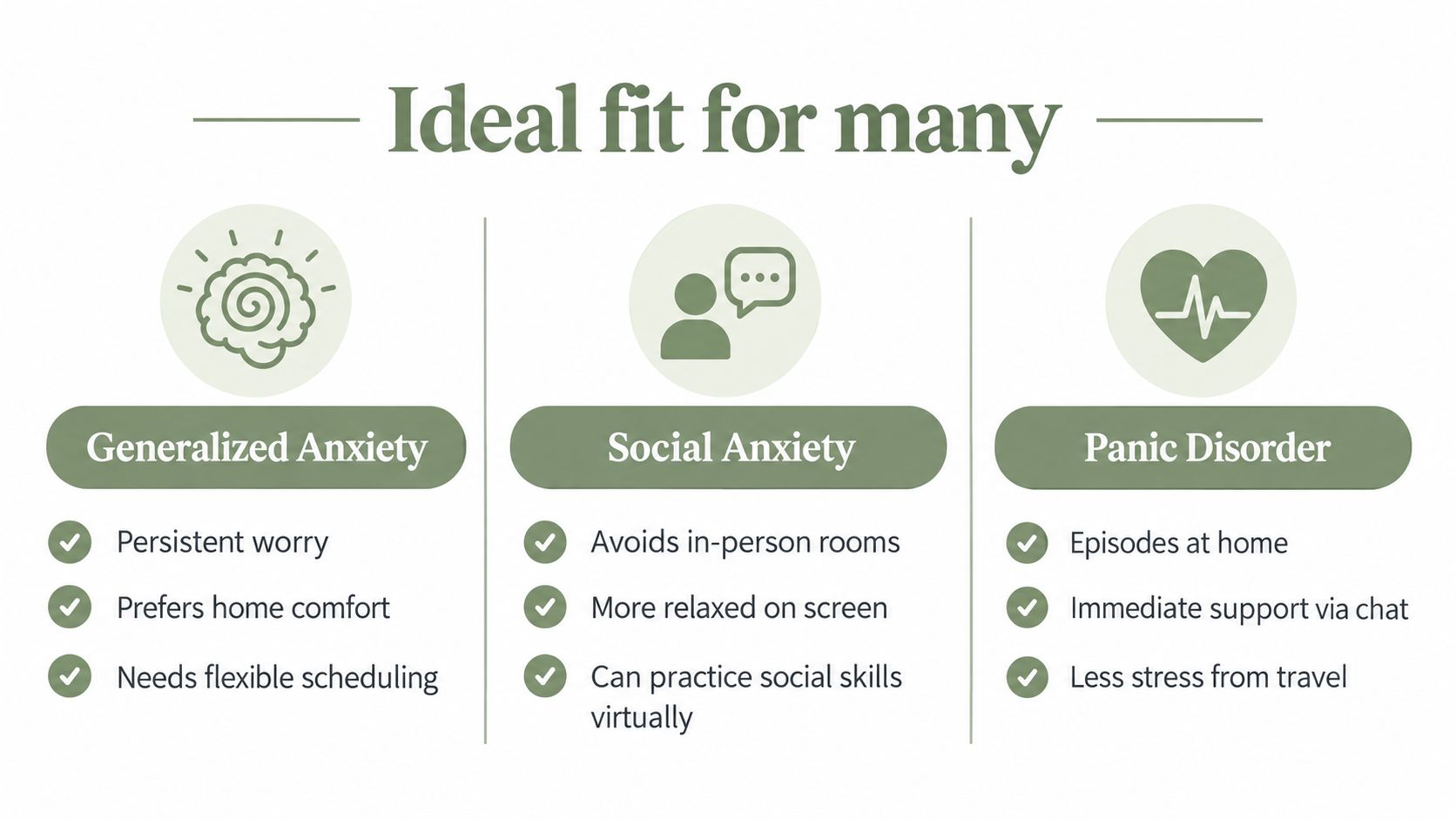
Generalized anxiety, social anxiety, panic symptoms, health anxiety, and school-avoidance patterns can all be appropriate for virtual treatment when the clinician can build a clear plan. For a young person refusing school, the therapist might coach the parent through morning routines, help the child approach a feared step gradually, and coordinate a return-to-school plan.
Situations that need closer review
Virtual care can strain when someone has severe agoraphobia and needs carefully supervised in-person exposure, active suicidal thoughts requiring same-day safety planning, untreated substance withdrawal, or a home environment without confidentiality. Very young children may also struggle to sustain screen engagement without a caregiver who can participate consistently.
A good clinician won't treat the first appointment as a permanent verdict. Fit is a working hypothesis. The provider and family can reassess after the first few sessions by asking whether symptoms are changing, assignments are getting completed, and the format allows enough clinical observation. If not, the answer may be a different therapist, a different structure, or a hybrid plan.
Setting Up a Video Session That Actually Works
The technology doesn't need to be elaborate. It needs to protect privacy, support communication, and stay out of the way.
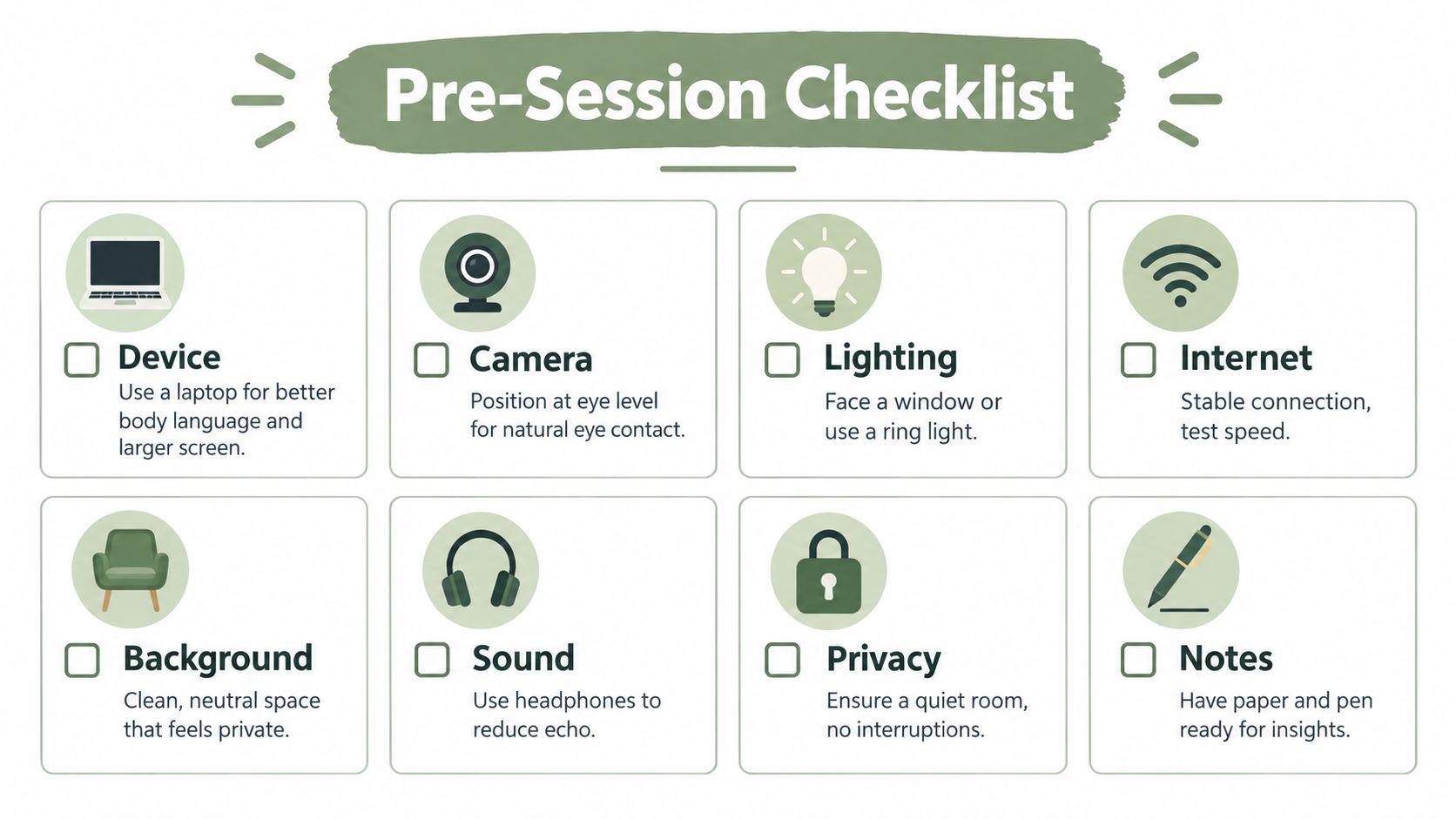
Start with a laptop if possible. A larger screen gives the clinician more room to observe facial expressions and body language than a phone, while a stable surface prevents the camera from shaking. Raise the camera to eye level, place lighting in front of your face rather than behind you, and choose a room where a closed door can protect confidentiality.
A practical setup
- Test the platform early: Open the appointment link before the session day and confirm that the camera and microphone work.
- Use headphones: They reduce echo and make it less likely that someone nearby will hear the conversation.
- Plan for interruptions: If a child, pet, roommate, or delivery appears, decide in advance how you'll pause, mute, or move.
- Keep essentials nearby: Have your insurance card, medication list, water, and a pen available.
- Write down questions: Two or three prompts can prevent important concerns from disappearing once the session begins.
- Charge the device: Close unrelated browser tabs and silence notifications so the appointment doesn't fragment.
The room can be ordinary. A kitchen table may work if the household understands that the appointment is private. For a teenager, agree beforehand on whether a caregiver begins the appointment, joins for part of it, or remains available outside the room.
Before the appointment: Write down the situation that triggered the strongest anxiety, what you did next, and what you wish you'd done differently.
Between visits, a simple log can make therapy more precise. Record the trigger, the anxious prediction, the response you used, and what happened afterward. Your therapist may then assign a brief exposure, a cognitive exercise, or a routine change based on actual patterns rather than a vague memory of the week.
Two quiet minutes after the appointment can help, too. Close the laptop, take a few slow breaths, write down the agreed practice, and decide when you'll do it. That small decompression routine turns a video call into a treatment step rather than another online task.
Where Telehealth for Anxiety Shines in Real Life
Telehealth's central advantage is practical: it can preserve treatment effect while making attendance and follow-through easier. That matters because anxiety often attacks the very behaviors required to reach care. A person who fears public places may avoid the clinic. A parent may miss appointments because a child's morning routine collapses. A student may postpone therapy until the problem affects grades and relationships.
Exposure work can benefit from the home setting when the therapist uses it deliberately. A client with social anxiety might practice making a phone call, entering an online meeting, or speaking while the therapist observes in real time. The clinician can pause, ask what the client predicted, and review what occurred. The screen becomes a bridge to practice, not a permanent hiding place.
Parent coaching is another strong example. A therapist can see the kitchen routine, the bedtime struggle, or the sequence that follows a child's request for reassurance. That context can make the guidance more concrete. For pediatric anxiety, OCD, and family routines, the evidence supports structured programs that combine therapist support with family-based CBT rather than unstructured video conversations (the pediatric anxiety and OCD treatment report).
A connected path of care
Telehealth can also support stepped care. Someone may begin with education and a self-guided exercise, move to weekly video CBT when symptoms persist, and then receive a more intensive or partly in-person plan if avoidance remains high. Secure messaging or brief check-ins can help the client report a barrier before the next full appointment instead of disappearing.
For a school-avoidant child, virtual work may begin with parent coaching and small routine changes at home. The clinician can then help the family prepare for contact with the school and a gradual return. The goal isn't to keep treatment inside the home. The goal is to use the home as a starting point for functioning beyond it.
When Telehealth Needs a Backup Plan
Video therapy isn't “less than” by definition. It becomes insufficient when the clinician can't safely assess the person, observe the needed behavior, or provide the level of support the treatment requires.
Consider a person with severe OCD contamination rituals who needs supervised exposure to locations outside the home. A video session may help plan the exercise, but an in-person component could provide better observation and coaching. Someone with eating-related medical risk may need physical monitoring that psychotherapy through a screen can't provide. A young child who can't sustain attention virtually may make more progress through play-based in-person work with caregiver participation.
Urgent safety concerns also change the plan. Active suicidal thoughts, immediate danger, severe intoxication, or untreated withdrawal require direct safety assessment and appropriate emergency or medical support. Telehealth can be part of a broader system, but it shouldn't be treated as a substitute for urgent services.
Signs the level of care should change
A clinician may recommend backup or a step up when:
- Symptoms are escalating: Panic, avoidance, compulsions, or impairment are worsening despite attendance.
- Progress has plateaued: After a reasonable course of consistent work, the agreed goals remain out of reach.
- The treatment target needs direct observation: The feared situation can't be recreated or safely approached through video alone.
- A new concern emerges: Medical risk, substance use, mood instability, or safety problems changes the clinical picture.
- The home setting is no longer workable: Privacy, supervision, or reliable technology has deteriorated.
Hybrid care can take several forms. A family might keep weekly video therapy while adding periodic in-person exposure sessions. A child might receive home-based parent coaching alongside coordinated school sessions. Some clients may use wearable biofeedback during carefully planned exposure work, while others may benefit from an intensive in-person block followed by virtual maintenance.
Adding in-person care doesn't mean telehealth failed. It means the treatment is being adjusted to the person's needs. A transparent clinician should explain what isn't working, what the added support is intended to change, and how everyone will know whether the new arrangement helps.
Starting Telehealth for Anxiety at Wald Behavioral Health
A sensible first step is a brief conversation about fit, not an immediate commitment to a full course of treatment. Families can use a free 15-minute consultation to describe the anxiety concern, explain current barriers, ask about scheduling, and determine whether virtual care makes sense for the child, teen, young adult, or family.
Before booking, confirm that the clinician can legally provide care where the client is located. Wald Behavioral Health offers telehealth in Florida and Maryland, as well as through PSYPACT-participating states when applicable. Families should verify current coverage and provider availability directly with the practice.
What the intake process may include
Secure intake forms usually gather information about symptoms, developmental history, medical and treatment background, family context, and goals. The practice can then provide a secure video link and a prompt for testing the technology before the first full appointment.
That first session may include:
- Developmental history: The clinician learns how anxiety has appeared across home, school, work, and relationships.
- Anxiety mapping: The family identifies triggers, physical sensations, thoughts, avoidance, reassurance seeking, and functional effects.
- Brief screening tools: Questionnaires can add structure to the initial assessment, but they don't replace clinical judgment.
- Shared treatment planning: The clinician and client choose goals that can be observed in daily life.
- Family guidance: For children and adolescents, caregivers may receive specific ways to support practice without reinforcing avoidance.
Wald Behavioral Health describes care from licensed psychologists and clinical psychologists using evidence-based approaches such as CBT, exposure therapy, ACT, and parent coaching. Families can ask about insurance participation, expected copays, self-pay arrangements, and superbills for possible out-of-network reimbursement. Coverage depends on the individual plan, so the practice and insurer should confirm the details.
The consultation is a useful low-pressure test. Notice whether the clinician explains limits clearly, listens to the family's priorities, and offers a treatment structure that can work outside the appointment. To ask about fit and scheduling, families can contact Wald Behavioral Health.
---
Wald Behavioral Health provides secure telehealth for anxiety support to children, adolescents, young adults, and families across Florida, Maryland, and eligible PSYPACT states, with parent guidance when appropriate. Visit Wald Behavioral Health to request the free 15-minute consultation and discuss whether virtual, in-person, or hybrid care fits your needs.
Questions about your child or teen?
Dr. Wald offers a free 15 minute consultation to talk through what you are seeing and whether the practice is a good fit.
Free 15 Minute Consultation