What Is Parent Management Training and How It Works
Parent management training is a structured, evidence-based program in which a clinician coaches caregivers to change the home responses that keep a child's disruptive behavior going. It commonly serves caregivers of children with noncompliance, tantrums, sleep resistance, ADHD-related difficulties, school refusal, or oppositional and conduct concerns.
At 9 p.m., your child is still out of bed. You've already asked for pajamas, offered one last drink, repeated the bedtime instruction, and promised that the morning will be awful if sleep doesn't happen soon. Your child cries, shouts, or runs back into the hallway. You raise your voice, then give in to one more story because everyone is exhausted.
That scene doesn't mean you're a bad parent or that your child is choosing defiance. It may mean the routine has taught both of you an unhelpful pattern. The instruction changes, the follow-through varies, and the biggest burst of attention arrives after the child escalates. Parent management training, or PMT, treats that interaction pattern as the place to intervene.
## Table of Contents - The 9 p.m. Tantrum That Looks Like Defiance - What Parent Management Training Actually Is - The five core moves of PMT - What a Parent Actually Does During a Real Episode - The recovery matters too - What the Research Actually Shows - Why the informant matters - Common Targets, Tantrums, Sleep, Noncompliance, School Refusal - Caregiver Stress, Cultural Fit, and Format Choices - Choosing a delivery format - How Wald Behavioral Health Implements Parent Management Training
The 9 p.m. Tantrum That Looks Like Defiance
The evening often starts normally. Dinner is finished, teeth are brushed, and your child gets into pajamas. Then you say, “Time for bed,” and the room changes. Your child asks for water. You answer. Then comes another request, followed by crying, arguing, or a dramatic collapse on the floor.
By the time the child is shouting, the original instruction has disappeared beneath negotiation. You may repeat yourself, explain the rule, threaten a consequence, or offer an exception. If the child eventually receives another story, more screen time, or an extended conversation, the escalation has produced something valuable: your attention and a delay in bedtime.
That doesn't mean your child is manipulating you in a calculated adult sense. Behavior becomes more likely when it reliably changes what happens next. A tired child may also be dealing with anxiety, difficulty shifting activities, sensory discomfort, poor sleep, or limited self-regulation. PMT asks what the behavior is accomplishing and how the adults' responses may be unintentionally keeping the cycle alive.
Practical rule: A parenting plan should make cooperation easier to start and escalation less useful, not make the child feel punished for having strong emotions.
The solution isn't harsher discipline or perfect parental calm. It's a clearer routine: one observable target, one brief instruction, quick recognition of cooperation, and a predictable response when the child refuses. That gives the child repeated practice with success and gives the caregiver something concrete to do when the evening becomes difficult.
What Parent Management Training Actually Is
Parent management training is a structured behavioral intervention in which caregivers learn to change the environmental contingencies that maintain disruptive behavior. In plain language, a clinician helps parents notice what happens before a behavior, what the child does, and what follows. The parent then practices changing the response so desirable behavior receives faster reinforcement and coercive cycles lose their payoff. The NICE guidance on antisocial behavior and conduct disorders recommends parent-training programs for caregivers of children aged 3 to 11 who have, or are at high risk for, oppositional defiant or conduct disorder.
PMT isn't a collection of inspirational parenting tips. It's coached practice. A clinician might ask you to define “bedtime refusal” as “doesn't begin pajamas within five minutes of the instruction,” then help you choose the exact prompt, reward, consequence, and measurement window. The clearer the target, the easier it is to tell whether the plan is helping.
The five core moves of PMT
| PMT move | What it means at home | Bedtime refusal example | |---|---|---| | Define the target | Describe behavior that can be seen or counted | “Starts pajamas within five minutes” | | Give a brief instruction | Use one clear, achievable direction | “Please put on your pajamas now” | | Reinforce quickly | Notice and reward cooperation soon after it happens | “You started right away. That earns your bedtime point” | | Apply a predictable consequence | Respond calmly and consistently when the child refuses | Remove a planned privilege or repeat the same routine step without bargaining | | Review data | Track what happened instead of relying on memory | Record whether pajamas began within five minutes each night |
Reinforcement means anything that makes a behavior more likely to happen again. It might be praise, attention, a point, or access to a preferred activity. A consequence is what follows behavior and changes what happens next. PMT doesn't treat consequences as revenge. It uses them to make the family response predictable.
Group and individual programs can both be appropriate. NICE notes that individual formats are especially relevant when difficulties are severe or complex. The essential feature is not the setting alone. It's whether caregivers learn a specific skill, practice it, collect home-based information, and adjust the plan with clinical guidance.
What a Parent Actually Does During a Real Episode
Suppose bedtime begins with a calm instruction: “Please put your pajamas on and place your clothes in the basket.” You move close enough to be heard, wait briefly, and avoid adding five more directions. When your child picks up the pajamas, you respond immediately: “You started. That was cooperative.” The praise is specific because it tells the child exactly what earned positive attention.
If your child says no, you don't launch into a lecture. You repeat the instruction once in the same calm voice. If the child begins yelling, you acknowledge the feeling without changing the limit: “You're upset. Pajamas still need to go on.” Then you stop debating. Your role is to keep the response brief and predictable.
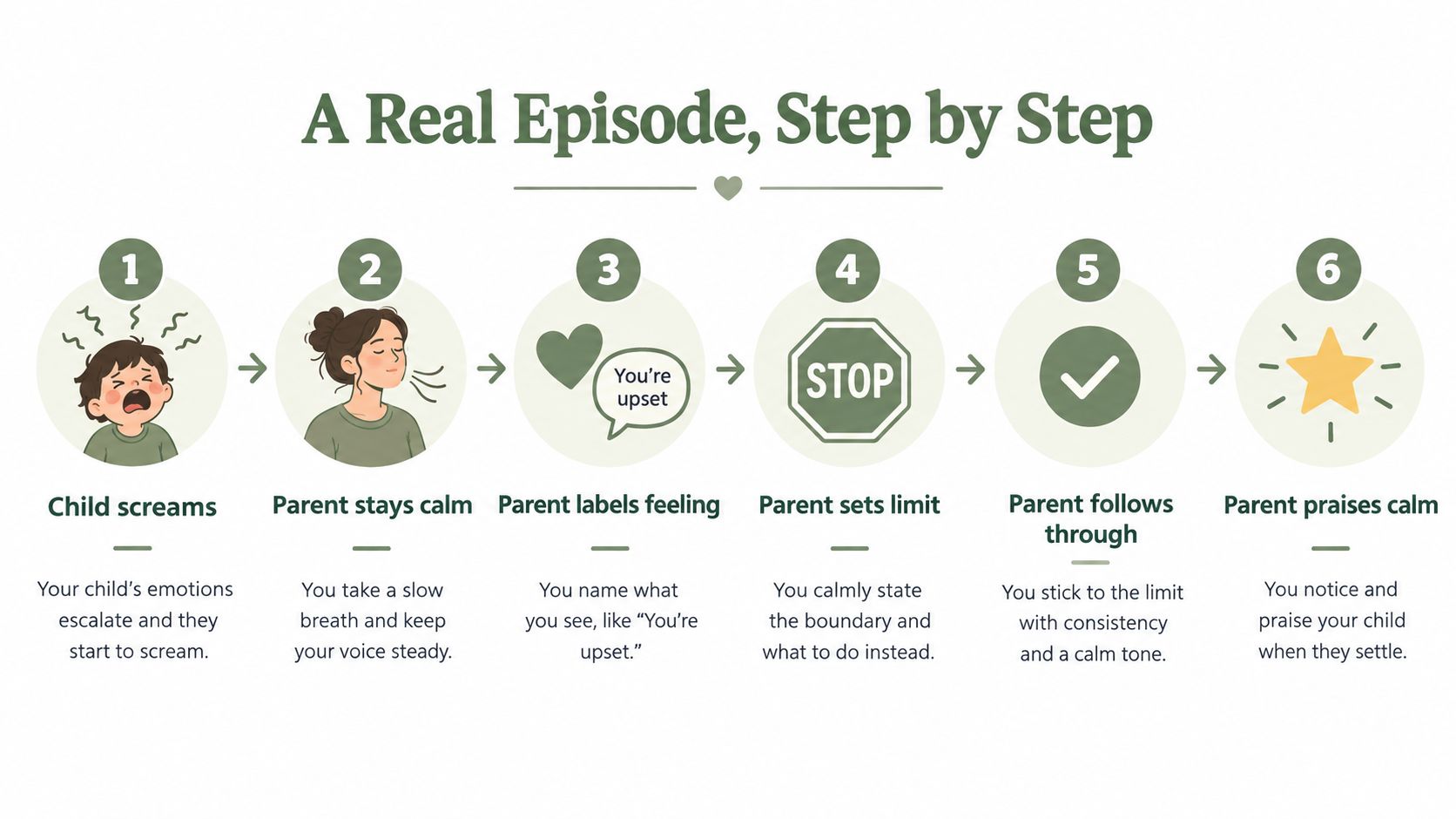
When the child continues refusing, follow the plan you agreed on with the clinician. For example, the routine might pause at the same step rather than expanding into another story, drink, negotiation, or screen. The consequence should be feasible, proportionate, and safe. It shouldn't be invented while you're angry.
The recovery matters too
As soon as your child begins to settle or takes the first cooperative action, notice it. “Your body is calmer. You put on one pajama shirt.” This isn't rewarding the tantrum. It's reinforcing recovery and showing the child what to do next.
A good PMT plan also asks whether the demand was realistic. If the child was hungry, overtired, anxious, in pain, or overwhelmed by sensory input, increasing firmness may miss the problem. Parents can compare their approach with practical behavior management strategies for parents, but a clinician should help adapt the plan when the same response keeps failing.
Watch for warning signs that the intervention needs adjustment:
- The target is vague: “Behaves better” can't guide a decision.
- The reward arrives too late: Young children and children with ADHD often need faster feedback.
- The consequence is impossible to maintain: A plan that requires constant supervision won't survive a busy evening.
- The behavior signals distress: Anxiety, sleep problems, developmental differences, or neurodevelopmental needs may require more than a compliance strategy.
The aim is not to eliminate emotion. It's to make the caregiver response steady enough that the child can learn a different pattern.
What the Research Actually Shows
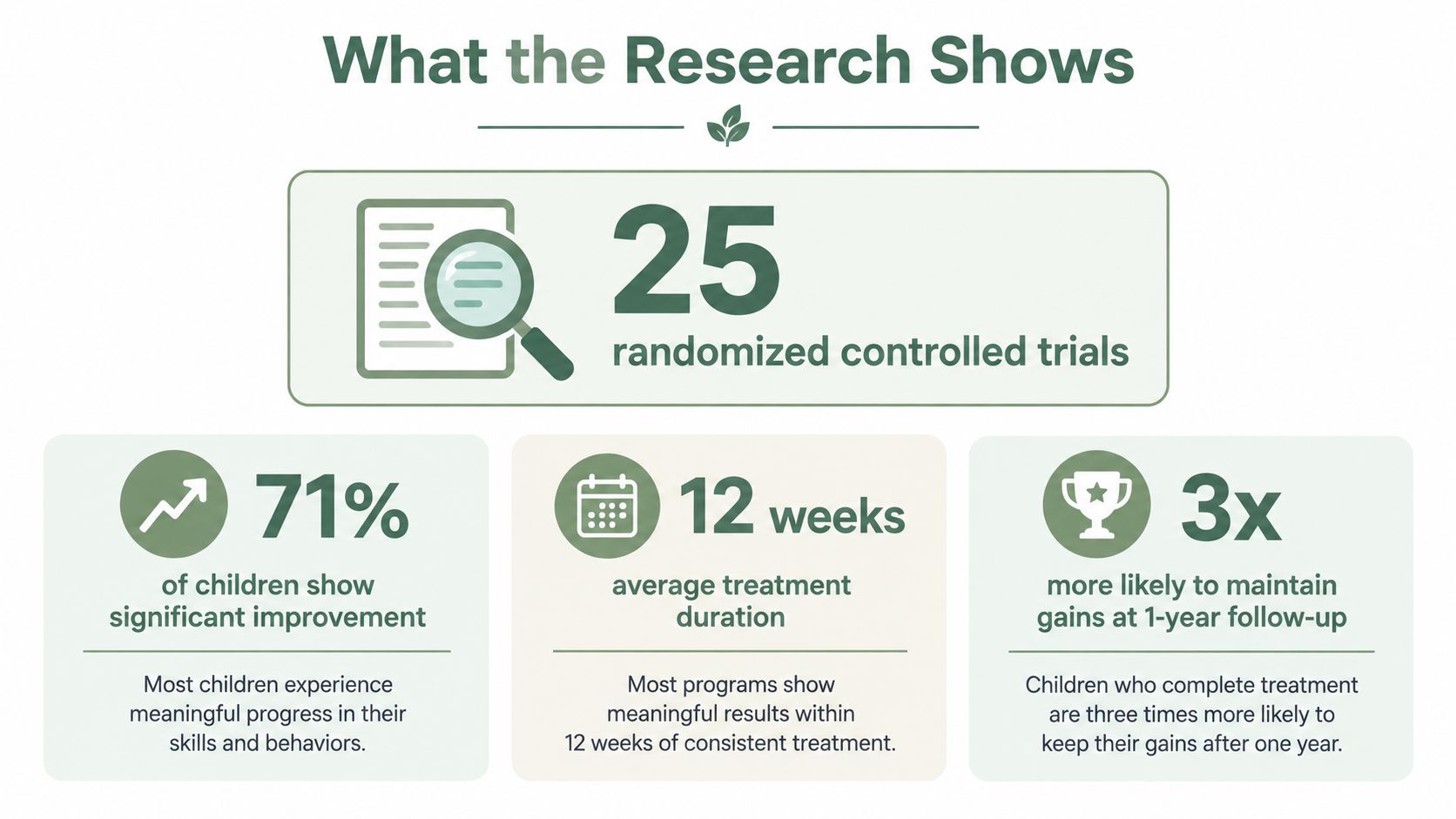
Parents deserve more than the promise that PMT “works.” A systematic review and meta-analysis examined 25 randomized controlled trials involving children aged 2 to 13 with clinically significant disruptive behavior. Standard PMT outperformed wait-list controls for parent-rated disruptive behavior, with a Hedges' g of 0.64, and improved parental skills, with g = 0.83. Child social skills also improved, with g = 0.49. These results are reported in the systematic review and meta-analysis of parent training interventions.
An effect size isn't a promise about what will happen in one household. It's a way of describing the difference between groups across studies. The pattern supports a practical conclusion: changing caregiver behavior is a direct treatment target, not merely an optional addition to work with the child.
Why the informant matters
Parents, clinicians, and observers often report small-to-medium improvements, but teacher-rated outcomes can be weaker or null in some analyses. That matters if your main concern is classroom behavior, school refusal, or morning transitions. A child may cooperate more at home while still struggling in a classroom with different demands, staffing, sensory conditions, or reinforcement.
Track at least two settings when possible. You might record home compliance and school arrival, using frequency, latency, or duration rather than a general impression such as “the week was better.” If a teacher or pediatrician sees a different pattern, that disagreement is useful information. It may show that the plan hasn't generalized or that the behavior serves a different function outside the home.
A 2025 updated review of Parents Plus programs found benefits for child behavior, with g = 0.42, parental satisfaction, with g = 0.67, parental stress, with g = 0.45, and parent goal attainment, with g = 1.22, as reported in the updated Parents Plus systematic review. The family-level message is important. PMT isn't about parents “fixing” children. More confident, less overwhelmed caregivers may be better able to respond consistently.
Common Targets, Tantrums, Sleep, Noncompliance, School Refusal
The same behavioral principles can look different depending on the problem. A toddler's tantrum, an ADHD-related failure to start homework, and anxiety-driven school refusal shouldn't receive an identical script. PMT begins by identifying the behavior and then asks what support or consequence fits its function.
| Presenting concern | Observable target | What changes in the plan | |---|---|---| | Tantrums | Uses a calm-down response or accepts a small limit | Reinforce recovery and communication, while avoiding lengthy negotiation during screaming | | Bedtime resistance | Starts the bedtime routine within five minutes of the instruction | Use a fixed sequence, rapid praise, and a response that doesn't create extra bedtime attention | | ADHD-related noncompliance | Begins one assigned task after a brief prompt | Break tasks into smaller actions, use faster feedback, and reduce working-memory demands | | School refusal | Moves through the morning routine and enters school as planned | Coordinate with school staff and assess anxiety rather than treating every delay as defiance |
For tantrums, the caregiver may need to reinforce words, gestures, or calm body behavior. During the peak of the episode, reasoning usually won't teach much. The parent can keep everyone safe, state the limit briefly, and return attention to cooperation as soon as the child recovers.
For sleep resistance, the target might be “stays in bed with the door closed for five minutes.” The plan could reward that interval and respond to repeated leaving with a quiet return, rather than adding conversation. Families comparing routines may find it helpful to find the right sleep training approach, while remembering that persistent sleep problems can also require medical or developmental evaluation.
ADHD-related noncompliance often reflects difficulty starting, sequencing, or sustaining a task. A short instruction, visual cue, immediate praise, and manageable reward may be more effective than repeating the full demand louder.
School refusal needs special care. Anxiety, bullying, learning difficulties, sleep deprivation, sensory distress, and separation concerns can all contribute. A parent-training plan should be coordinated with the school and may need child therapy. Resources such as help for parents dealing with school refusal can support planning, but escalating consequences alone may intensify avoidance.
PMT can be a front-line approach for behavior maintained by inconsistent prompts and consequences. It should sit alongside child therapy, school coordination, or medical evaluation when distress, neurodevelopmental differences, physical symptoms, or safety concerns are central.
Caregiver Stress, Cultural Fit, and Format Choices
Parents often ask, “Is this treatment saying I caused the problem?” A responsible program answers no. Caregivers influence the environment, but children also bring temperament, development, anxiety, ADHD, sleep needs, communication differences, and other factors into the interaction. PMT gives adults more effective tools without turning them into the target of blame.
The Parents Plus findings on caregiver stress and goal attainment support a broader view of treatment. A family may benefit not only because a child follows directions more often, but because the caregiver feels less trapped in repeated conflict. Lower stress can make it easier to notice early cooperation, deliver reinforcement quickly, and follow a plan when the child protests.

Cultural fit also deserves direct attention. A 2025 systematic review examined parent-training programs for immigrant families in Europe, highlighting why language, migration stress, cultural expectations, and access barriers shouldn't be treated as side issues. A plan may need translated materials, examples that fit the family's routines, sensitivity to extended-family caregiving, and discussion of what respectful authority looks like in that household.
Choosing a delivery format
Group programs can offer peer normalization and shared problem-solving. Parents may discover that other families face similar struggles, which can reduce shame.
Individual sessions allow closer tailoring when behavior is severe, complex, private, or connected to multiple diagnoses. The clinician can adjust the plan to the child's developmental level and the family's schedule.
Telehealth can bring coaching into the home environment and remove travel barriers. It may also be useful when a child struggles with transitions or when specialized care isn't available nearby.
Ask how both caregivers will participate, especially when parents live separately. A clinician should clarify which data each adult tracks, how information is shared, and how the plan handles different household routines.
The practical question isn't whether one format is universally best. It's whether the program respects your family's language, values, resources, privacy needs, and daily realities.
How Wald Behavioral Health Implements Parent Management Training
At Wald Behavioral Health, the process can begin with a free 15-minute consultation about the child's behavior, family needs, and scheduling. A first clinical session can then clarify the pattern, identify one or two observable targets, and decide what information to collect at home. The plan might focus on bedtime initiation, morning compliance, tantrum recovery, or school arrival rather than trying to change everything at once.
A week of home data could include whether the child started after the first instruction, how long the behavior lasted, and what happened immediately before and after it. The clinician reviews that information with the caregiver and adjusts the prompt, reinforcement, or consequence. If a teacher or pediatrician describes a different pattern, that perspective helps determine whether the behavior is setting-specific.
The practice provides parent training for concerns including sleep, tantrums, school refusal, separation, and noncompliance. It also integrates parent guidance with individual therapy for older children and adolescents when the child needs direct support. Families can ask about weekday evening or weekend scheduling, in-person care in Coral Gables, and telehealth across Florida, Maryland, and PSYPACT-participating states.
For young children with ADHD, CDC guidance on behavior therapy and parent training identifies parent training in behavior management as the recommended first-line treatment for children under six and notes that it can work as well as medication for managing symptoms. That guidance doesn't mean every child needs the same intervention. It reinforces the value of matching the plan to developmental level and clinical context.

A typical treatment arc may involve several sessions of teaching, rehearsal, home practice, and data review, with the exact pace determined by the family's needs. Parents can learn more about the practice's clinical approach before deciding whether a consultation is appropriate.
---
Wald Behavioral Health offers structured parent guidance for sleep difficulties, tantrums, school refusal, separation, and noncompliance, with telehealth and in-person options for eligible families. To discuss your child's pattern and build a practical home plan, visit Wald Behavioral Health and request the free 15-minute consultation.
Questions about your child or teen?
Dr. Wald offers a free 15 minute consultation to talk through what you are seeing and whether the practice is a good fit.
Free 15 Minute Consultation