What Is OCD Treatment and How ERP Helps You Heal
A child may spend the morning checking the lock, washing their hands, or asking the same question until everyone in the home feels exhausted. A teenager may know the fear sounds unreasonable and still feel unable to stop the ritual. Parents often wonder whether they should reassure, set firmer limits, or wait for the anxiety to pass.
OCD treatment is not about blaming a child for intrusive thoughts or forcing someone to “just stop.” It teaches the person to respond differently when the brain sends a false alarm. The central skill is learning that an obsession can be present without requiring a compulsion, avoidance, or repeated reassurance.
For families asking, “What is OCD treatment?” the answer includes cognitive behavioral therapy, especially exposure and response prevention, medication when clinically appropriate, family support, and a plan that matches the person's age and level of impairment. This guide explains the obsession-compulsion loop, how ERP interrupts it, what treatment may feel like, how clinicians choose intensity, and what families can do when specialized care is difficult to find.
OCD can affect children, teens, and young adults in many forms. Some symptoms are visible, such as washing or checking. Others happen privately, including mental reviewing, praying, counting, confessing, or seeking certainty. None of these experiences means a young person is dangerous, difficult, or choosing distress. Effective care starts by treating the symptoms seriously while protecting the child's dignity.
## Table of Contents - Introduction to What OCD Treatment Really Means - Understanding OCD and Why Compulsions Keep It Going - The short-term relief trap - How ERP and CBT Work as First Line Treatments - A step-by-step example - Matching Treatment Intensity to Severity and Needs - Developmental fit matters - What to Expect in Therapy From First Visit to Progress - The early sessions - Finding Quality Care and Navigating Next Steps When Treatment Stalls - How to verify an ERP provider - When first-line care isn't enough - Taking the Next Step Toward Support for Your Family
Introduction to What OCD Treatment Really Means
OCD treatment begins with a change in the question. Instead of asking, “How do we make this thought disappear?” a therapist helps the child and family ask, “How can we stop letting this thought control what we do?”
Consider a teenager who worries that they might accidentally hurt someone. They may replay conversations, search online for reassurance, avoid being alone with younger children, or ask a parent, “You know I'd never do that, right?” The reassurance brings relief, but the relief fades. Soon the question returns, often with greater urgency. The teen may then believe the thought must be important because it keeps coming back.
That pattern can frighten parents. They may answer repeatedly because they want their child to feel safe. They may also participate in checking, washing, or avoidance to reduce conflict. These responses are understandable, but they can unintentionally give OCD more influence over family life.
Treatment focuses on helping the young person tolerate uncertainty and choose actions based on values rather than fear. For a child, that might mean touching a familiar object and waiting before washing. For a teen, it might mean allowing an intrusive thought to remain unanswered while returning attention to homework, sports, friends, or sleep. The steps are planned carefully, not sprung on the child.
Recovery doesn't require liking the anxious feeling. It means building confidence that anxiety can rise and fall without a ritual directing every decision.
The process is collaborative. A pediatric psychologist considers developmental level, family routines, school demands, co-occurring concerns, and the specific compulsions maintaining the problem. Parents often learn how to support practice without becoming part of the OCD cycle. Teens and young adults learn language for separating “my values” from “the alarm my OCD is sending.”
The sections ahead offer a practical roadmap. You'll learn what obsessions and compulsions are, why ERP is central, how stepped care matches treatment to impairment, what a first course of therapy may involve, and how to evaluate care when access is limited.
Understanding OCD and Why Compulsions Keep It Going
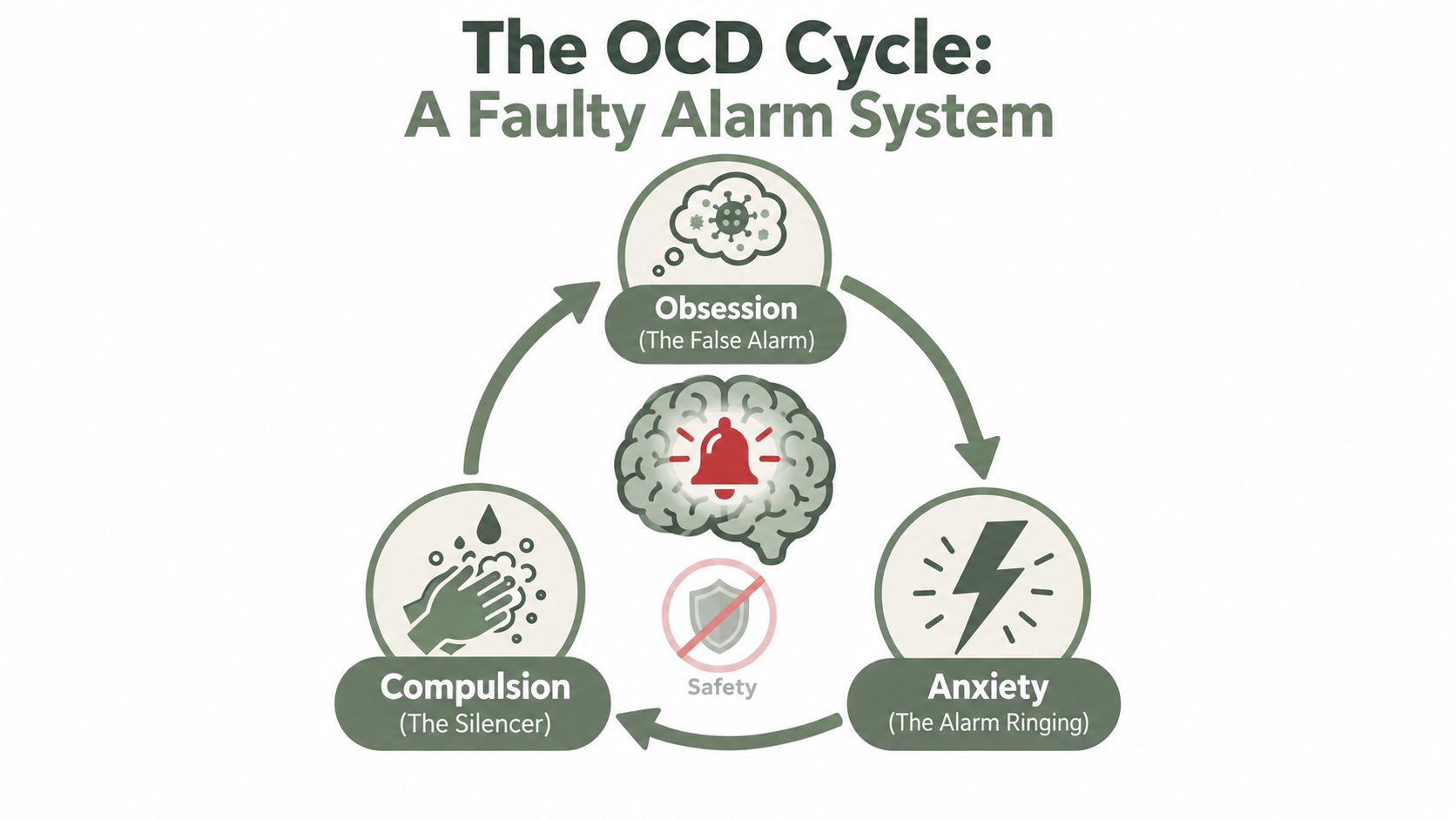
OCD can be understood as a faulty alarm system. The brain detects a possibility, such as contamination, harm, forgetting, or making a mistake, and responds as though danger is already present. The alarm feels urgent even when the person's behavior, surroundings, or intentions don't support the feared conclusion.
An obsession is an intrusive thought, image, urge, doubt, or feeling that creates distress. A child might think, “What if I caused an accident?” A teen might experience an unwanted image or fear they're secretly immoral. A young adult might feel compelled to review a decision until it feels perfectly certain.
A compulsion is what the person does to reduce that distress or prevent a feared outcome. Compulsions can be visible, such as washing, checking, arranging, or asking questions. They can also be mental, such as replaying memories, comparing feelings, repeating words, or trying to cancel a thought with another thought.
The short-term relief trap
The compulsion often works briefly. The child washes and feels less contaminated. The parent answers and the teen feels less responsible. The student checks the assignment and experiences a moment of certainty.
That relief teaches the brain, “The ritual protected me.” The next obsession then feels more urgent, because the brain has learned to depend on the compulsion. This is negative reinforcement, meaning an action becomes more likely because it removes an unpleasant feeling in the short term.
The OCD loop: An intrusive thought triggers distress, the compulsion lowers distress briefly, and that temporary relief teaches OCD to return with more demands.
Reassurance can become a compulsion when the person needs another person to provide certainty repeatedly. A parent might say, “You're fine,” but OCD may quickly ask, “Are you completely sure?” Responding once with warmth is different from entering an endless certainty ritual.
OCD also differs from ordinary preferences. Someone who enjoys an orderly desk may rearrange items because it feels satisfying. Someone with OCD may feel driven to arrange items to prevent catastrophe or to escape unbearable doubt. The context, distress, loss of control, and impact on daily functioning matter more than the behavior's appearance.
Families can use this guide to helping with OCD thoughts to learn supportive language, but a clinician should assess symptoms and recommend treatment. OCD is not a character flaw, and intrusive thoughts aren't evidence of intent. The treatment target is the cycle, not the person.
How ERP and CBT Work as First Line Treatments
Exposure and response prevention, or ERP, is a specialized form of cognitive behavioral therapy for OCD. The therapist helps a person approach triggers gradually while refraining from the ritual that usually follows. With repeated practice, the person learns that anxiety and uncertainty can be handled without compulsions.
ERP doesn't mean flooding someone with the most frightening situation immediately. A therapist first assesses the pattern and creates a hierarchy, which is a list of situations or thoughts arranged from more manageable to more challenging. The child or teen participates in choosing starting points, so the plan remains difficult enough to build learning but structured enough to feel possible.
A step-by-step example
Suppose a child fears contamination from a doorknob. Their ritual is washing immediately and asking a parent whether they're clean. A treatment plan might begin with touching a less-feared household object, delaying washing, and practicing a response such as, “Maybe I'm clean, and maybe I'm not. I can continue with my activity.”
The therapist watches for hidden rituals as well. The child might avoid touching the object directly, mentally repeat a phrase, scan their hands for signs of danger, or ask a parent for reassurance. Response prevention includes reducing these safety behaviors when the therapist determines the child is ready.
A session may follow this sequence:
- Review the pattern. The therapist identifies what happened, what the OCD predicted, and what the child did next.
- Practice an exposure. The child approaches a planned trigger in the office, at home, or in another relevant setting.
- Prevent the response. The child delays or skips the ritual while noticing thoughts, body sensations, and urges.
- Reflect on learning. The family records what happened without treating the result as a demand for perfect certainty.
- Plan home practice. The next exercise fits naturally into routines, such as bedtime, school preparation, or meals.
CBT may also include cognitive strategies. These don't involve debating every obsession until the child feels certain. Instead, the therapist helps the person notice inflated responsibility, perfectionism, threat overestimation, or the belief that thoughts are morally meaningful. The young person practices responding to OCD without needing to prove the thought wrong.
Practical rule: The purpose of ERP isn't to make every intrusive thought disappear. It's to help the person stop organizing life around the thought.
ERP can feel uncomfortable because it asks the brain to learn through experience. The therapist adjusts the pace, explains the rationale, and supports willingness rather than demanding confidence. A child-focused guide to exposure therapy can help parents understand why gradual practice is different from punishment or forced exposure.
The evidence base supports ERP as a durable treatment approach. A 2019 review of ERP for OCD reported that about 50% to 60% of patients who complete ERP achieve clinically significant improvement, with gains tending to persist long-term. The same review reported symptom recurrence after stopping serotonin reuptake inhibitors in 45% to 89% of patients, which helps explain why clinicians may discuss ERP when durable symptom reduction is an important goal.
The process is often demanding, but it is also hopeful. Each planned practice gives the child evidence that an obsession can be present without becoming a command.
Matching Treatment Intensity to Severity and Needs
Treatment intensity should match functional impairment, not only the number of symptoms. A child whose rituals take a small amount of time but interfere with school, sleep, eating, friendships, or family routines may need more support than a symptom checklist alone suggests. Clinicians also consider age, insight, co-occurring anxiety or depression, family accommodation, medical factors, and the person's ability to practice between sessions.
The UK NICE recommendations for OCD established a stepped-care framework, with ERP-based CBT as the main psychological treatment. NICE recommends low-intensity ERP for adults with mild functional impairment at up to 10 therapist hours per patient. For adults with mild impairment who can't use low-intensity CBT or don't improve sufficiently, the guideline recommends either an SSRI or more intensive CBT including ERP, because the approaches appeared comparably efficacious.
The table below is a discussion guide, not a prescription. A qualified clinician should decide what fits a particular person.
| Severity level | Recommended first line option | Therapist time and format | When to consider combination or next step | |---|---|---|---| | Mild functional impairment | Low-intensity CBT with ERP | Up to 10 therapist hours per patient, using guided practice and structured home exercises | Consider an SSRI or more intensive CBT with ERP if low-intensity care isn't usable or isn't sufficient | | Mild to moderate impairment | SSRI monotherapy or more intensive CBT with ERP | More support than low-intensity care, with regular clinical review | Discuss the alternative or combination when response is incomplete, access affects choice, or symptoms remain disruptive | | Severe functional impairment | Combined CBT with ERP and an SSRI | Intensive, coordinated care with close monitoring | Review diagnosis, adherence, side effects, family accommodation, and specialist options if improvement remains limited |
Developmental fit matters
Children often need concrete language, visual tools, games, and caregiver participation. A therapist may help parents identify reassurance, checking, or avoidance that has become part of the routine. The goal isn't to withdraw warmth. It's to offer support without helping OCD complete its ritual.
Teens may want more privacy and control, especially when intrusive thoughts feel embarrassing. The clinician can include parents while protecting appropriate confidentiality and teaching caregivers how to respond consistently. School collaboration may be useful when OCD affects attendance, tests, transitions, or classroom participation.
Medication is a medical decision. SSRIs may be considered at different levels of impairment, and a prescriber should discuss expected benefits, side effects, monitoring, and how medication fits with ERP. Families shouldn't start, stop, or change medication without the prescribing clinician.
The NICE guidelines summarized by OCD UK also describe low-intensity ERP as capped at up to 10 therapist hours per patient, while more intensive CBT with ERP exceeds that threshold. That operational distinction helps families ask a practical question: does the proposed treatment provide enough therapist involvement and between-session practice for the level of disruption OCD is causing?
What to Expect in Therapy From First Visit to Progress
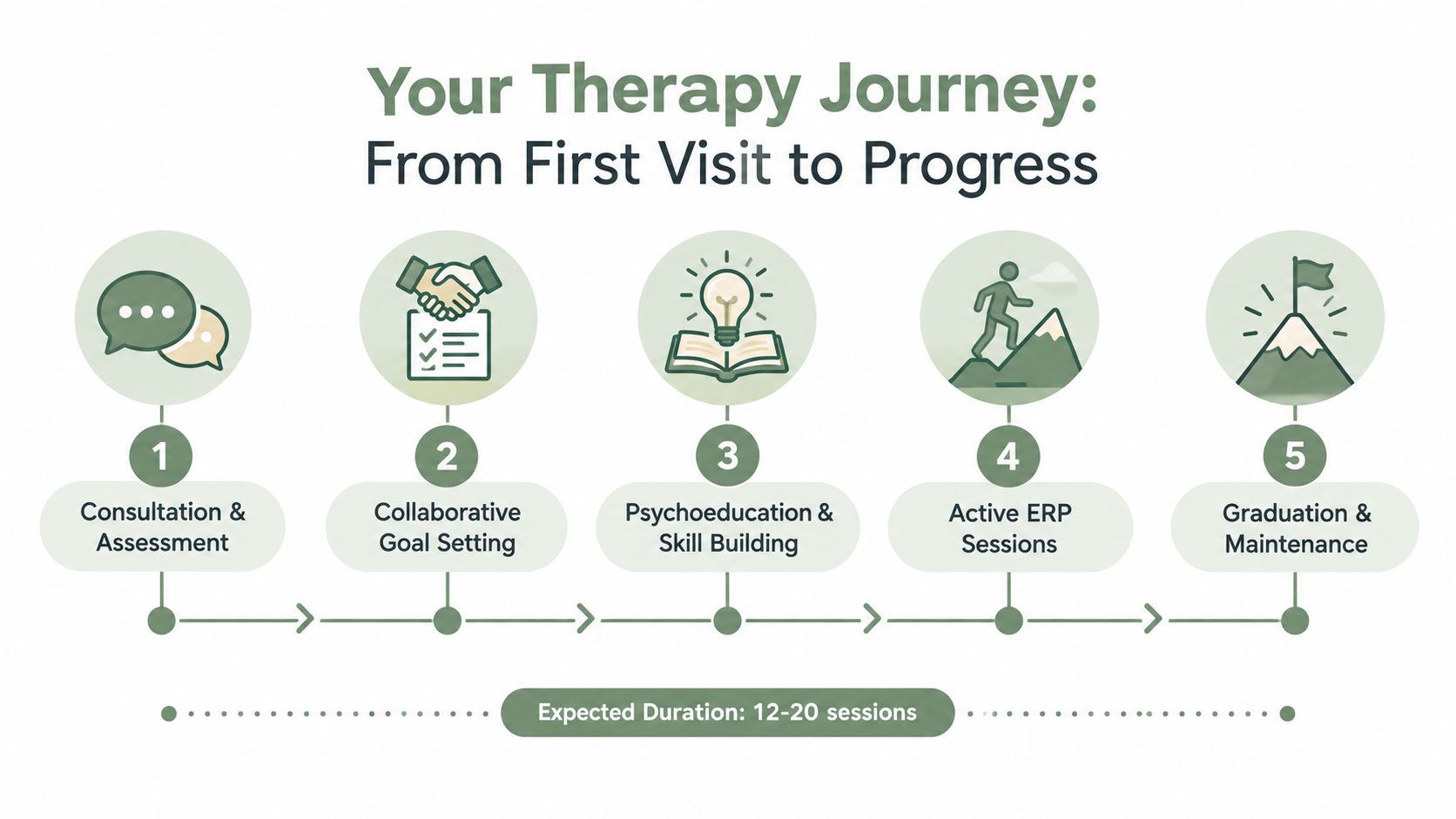
The first appointment usually feels more like careful mapping than immediate exposure. The therapist asks about intrusive thoughts, rituals, avoidance, reassurance, mental compulsions, family responses, school or work functioning, sleep, and safety. A good assessment makes room for symptoms that a young person may fear will sound shocking or shameful.
The clinician then explains the OCD cycle in language the child can understand. A younger child might call it a “bossy worry,” while a teen may prefer a more direct description of intrusive thoughts and compulsions. The family identifies a few meaningful goals, such as getting ready for school without repeated checking, sleeping without a parent present, or completing homework without endless reviewing.
The early sessions
Early treatment often combines education, motivation, and small practice exercises. The therapist may help the child build a hierarchy and teach the parent how to respond when reassurance requests begin. Home practice is usually brief and specific, such as leaving a door checked once or waiting before asking a question.
Active ERP becomes more central as the family gains confidence. Sessions may include role-play, in-office exposures, planning for school situations, and review of what happened between visits. Parents may keep a simple record of the trigger, the ritual urge, the chosen response, and what the child did next.
Progress rarely moves in a perfectly straight line. A child may manage a difficult exposure one day and struggle with an easier task later because of fatigue, stress, illness, or a new OCD theme. The therapist treats setbacks as information, not failure.
Progress can look like a young person noticing the urge, naming it as OCD, and returning to life before feeling completely calm.
Families can ask prospective providers:
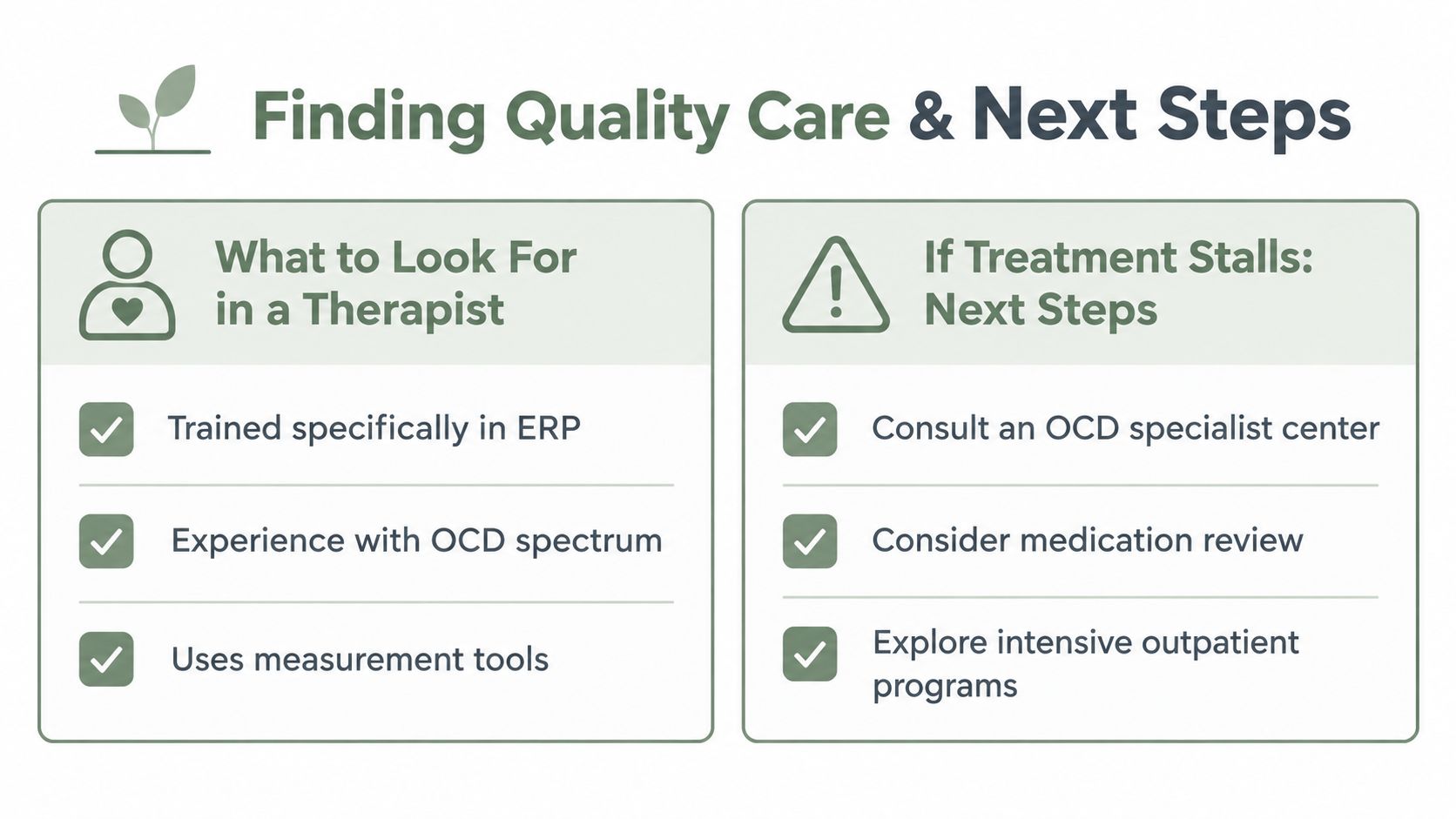
- Training: Do you have specific training in ERP for OCD?
- Experience: Do you work with children and teens whose compulsions are mental or reassurance-based?
- Measurement: How will we track impairment and progress?
- Parent role: How will you coach caregivers without making them responsible for eliminating anxiety?
- Coordination: How do you communicate with prescribers or schools when appropriate?
- Flexibility: Can sessions be adapted for developmental level, culture, language, and family routines?
Near the end of a course, the therapist helps the young person identify warning signs, refresh exposure skills, and plan for future spikes. Graduation doesn't mean the person must never feel anxious again. It means they have a response plan that keeps OCD from reclaiming the family's daily life.
Finding Quality Care and Navigating Next Steps When Treatment Stalls
A major challenge is that knowing ERP works doesn't guarantee finding a clinician who provides it. The Psychiatric Services review on OCD treatment access reported that only 30% to 40% of people with OCD seek specialized treatment. It also described an average 17-year delay before treatment begins in the United States, an estimated 55% treatment gap, and a 57% worldwide treatment gap cited by the World Health Organization in 2004.
The same review noted that OCD is among the ten most disabling illnesses globally. An NIH OCD fact sheet says OCD affects about 2.2 million Americans, roughly 1 in 100 adults and 1 in 40 children, and that about 51% of diagnosed adults experience serious impairment in work, home, and relationships. These facts make specialized access a clinical concern, not a convenience.
A recent IOCDF analysis of OCD care access reported that 75% of people with OCD are never identified, 72% of identified patients didn't receive a CBT referral, and 95% to 98% hadn't received ERP specifically. The analysis was published in 2026, so families should view those figures as evidence of a serious access problem rather than a reason to give up.
How to verify an ERP provider
Ask direct questions before scheduling regular treatment:
- Specific training: Does the clinician use exposure and response prevention as a core intervention?
- Actual practice: How are exposures selected, paced, and reviewed?
- Compulsions: Does the clinician address reassurance, avoidance, mental rituals, and family accommodation?
- Measurement: Are symptoms and functional changes tracked over time?
- Development: Can the provider adapt ERP for a child, teen, or young adult?
- Coordination: Can the provider work with a prescriber when medication is part of care?
Telehealth may help families reach a specialist outside their immediate area, although privacy, licensing, technology, and the suitability of home-based practice require discussion. Waitlists and cost can still be substantial, particularly in major markets, as Harvard's 2026 coverage of OCD care access describes.
When first-line care isn't enough
Persistent symptoms deserve a structured review, not an assumption that the person is hopeless. The clinician may revisit the diagnosis, confirm that ERP targeted the actual compulsions, examine avoidance and family accommodation, review adherence and tolerability, and assess co-occurring conditions.
Treatment resistance and refractoriness don't have one consistently standardized definition. The 2026 CANMAT and ICOCS guideline update identifies this lack of consistency as an urgent knowledge gap. A specialist may discuss medication review, augmentation, intensive outpatient care, or circuit-based neuromodulation when appropriate.
Emerging options include rTMS and other neuromodulation approaches. The same guideline update describes circuit-based neuromodulation as promising and cites a meta-analysis of 21 randomized controlled trials showing greater Y-BOCS improvement with rTMS than sham treatment. These options require specialist assessment, and they don't replace a careful review of first-line treatment quality.
Taking the Next Step Toward Support for Your Family
OCD treatment becomes easier to understand when you see it as a change in response, not a battle to eliminate every thought. ERP helps children, teens, and adults practice facing uncertainty while stepping out of the compulsion loop. CBT adds language and strategies for recognizing the beliefs that keep rituals feeling necessary. Medication may be part of the plan, especially when impairment is substantial, but a prescriber should guide that decision.
Parents can begin with a calm conversation: “I've noticed how much time these worries and rituals are taking. You're not in trouble, and you don't have to solve this alone. Let's find someone who understands OCD.” Avoid asking for every detail before the young person feels ready. A simple description of the pattern is enough for an initial consultation.
Bring concrete examples to the appointment. Note what triggers distress, what rituals follow, how family members respond, and which routines have changed. Ask whether the clinician provides ERP, how parents participate, how progress is measured, and what happens if symptoms remain severe.
Families can also use parent-focused support for children's mental health to think through reassurance, routines, communication, and home practice. Support should reduce shame while making room for brave, gradual behavior change.
Wald Behavioral Health provides evidence-based therapy for children, adolescents, young adults, and families, including OCD-focused strategies and parent guidance, through in-person care in Coral Gables and telehealth where available. A free 15-minute consultation gives families a chance to discuss concerns, treatment fit, and scheduling before beginning care.
---
If your child, teen, or family is caught in an OCD cycle, visit Wald Behavioral Health to learn about developmentally informed therapy, ERP-based support, and parent guidance. You can use the free 15-minute consultation to describe what's happening and explore a practical next step.
Questions about your child or teen?
Dr. Wald offers a free 15 minute consultation to talk through what you are seeing and whether the practice is a good fit.
Free 15 Minute Consultation