How to Help OCD Thoughts: Real Strategies That Work
Most advice about OCD thoughts is backwards. Telling someone to stop thinking about it, prove the thought is false, or ask for reassurance may calm the moment, but it teaches the brain that the thought is dangerous and must be neutralized. That pattern keeps children, teens, adults, and entire families trapped in the same loop.
The practical answer to how to help OCD thoughts isn't thought elimination. It's learning to notice the intrusion, resist the ritual, tolerate uncertainty, and return to the life OCD keeps interrupting. OCD is common, affecting an estimated 1.2% of U.S. adults in a given year and 2.3% over a lifetime, while global lifetime prevalence is commonly estimated around 1% to 3%, according to the National Institute of Mental Health's OCD statistics. Effective care exists, but it requires changing the response to the thought rather than winning an argument with it.
## Table of Contents - Why Trying to Stop OCD Thoughts Usually Backfires - Measure progress by your response - Understanding What Intrusive OCD Thoughts Actually Are - The compulsion may be invisible - How Exposure and Response Prevention Works in Practice - Build the ladder before climbing it - Practice the response prevention - What Family Support Looks Like Without Accommodation - Validate emotion without joining the ritual - Unhelpful Responses to Recognize and Replace - Building a Response Plan and Knowing When to Escalate - Put the plan in writing - Escalate before the crisis - Putting It Together and Taking the First Step
Why Trying to Stop OCD Thoughts Usually Backfires
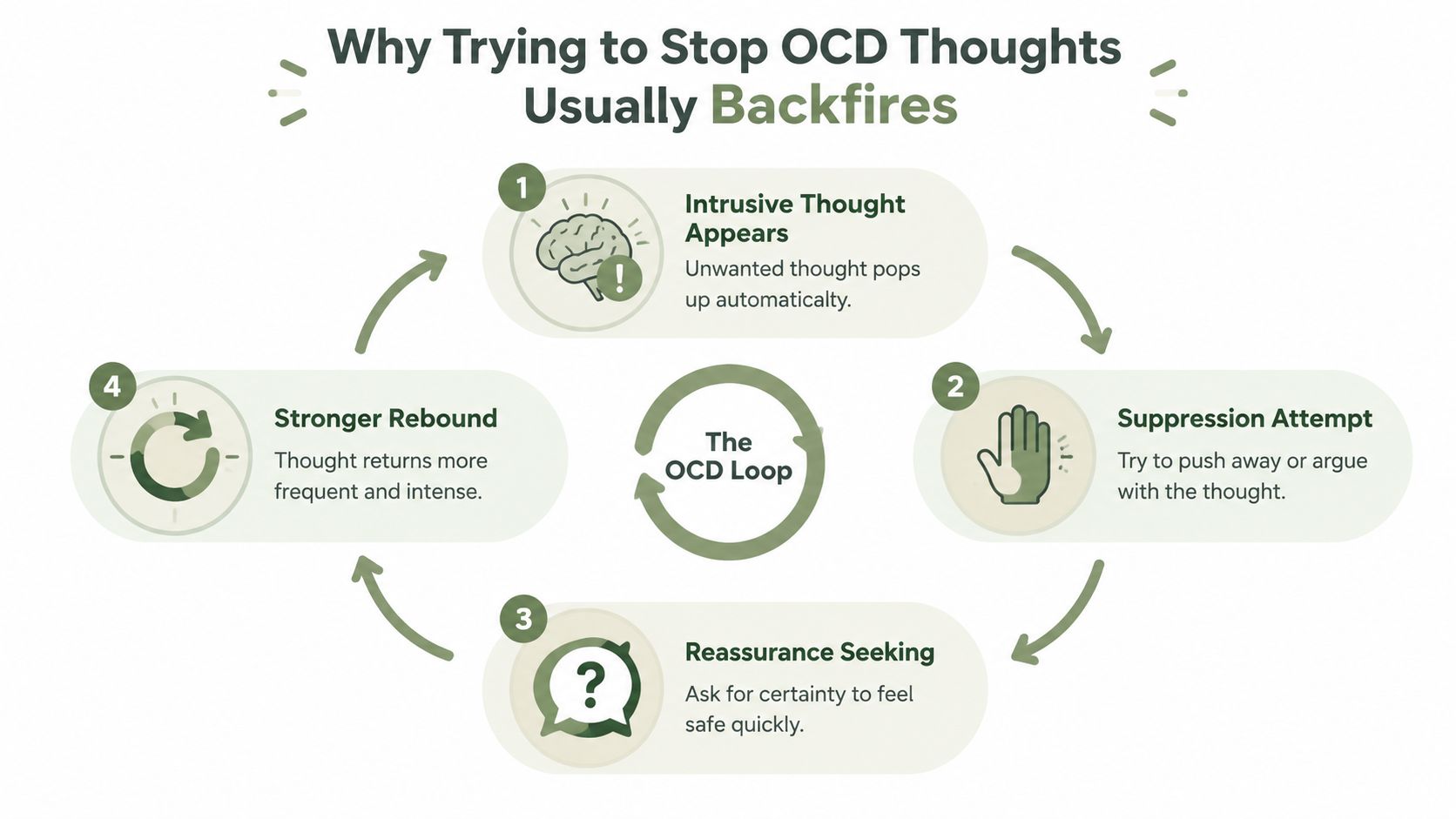
The assumption that an intrusive thought must disappear before you can feel safe is the first problem. OCD doesn't require you to believe a thought completely. It only needs you to treat the thought as urgent, meaningful, or dangerous enough to investigate.
Suppression often makes the mind monitor for the very thought you're trying to avoid. A teenager who commands, “Don't think about contamination,” has to keep checking whether contamination is present in their mind. An adult who mentally reviews a drive to prove they didn't hit anyone keeps returning to the feared event. A parent who debates every unlikely danger with a child teaches the child to bring the next danger for another debate.
Reassurance creates the same trap. It produces quick relief, and that relief reinforces the question, the checking, or the request for certainty. The next intrusive thought then feels like a fresh emergency because the person hasn't learned that anxiety can rise and fall without a ritual.
Measure progress by your response
The better target is response flexibility. You may still have a disturbing image, doubt, urge, or question. Progress means you spend less time analyzing it, avoid fewer situations, ask for less reassurance, and return to what matters sooner.
The goal isn't to feel certain. The goal is to act without performing the ritual that promises certainty.
This doesn't mean dismissing genuine safety issues. It means separating ordinary responsible action from repeated attempts to reach a feeling of absolute safety. Locking a door once is a practical behavior. Rechecking it repeatedly because the thought still feels unresolved is an OCD response.
ERP, or exposure and response prevention, grew from behavioral treatment approaches recognized in the 1960s and remains one of the oldest and most effective treatments for OCD, according to NIMH's overview of OCD. Its central lesson is direct: intrusive thoughts can be present without controlling what you do.
Understanding What Intrusive OCD Thoughts Actually Are
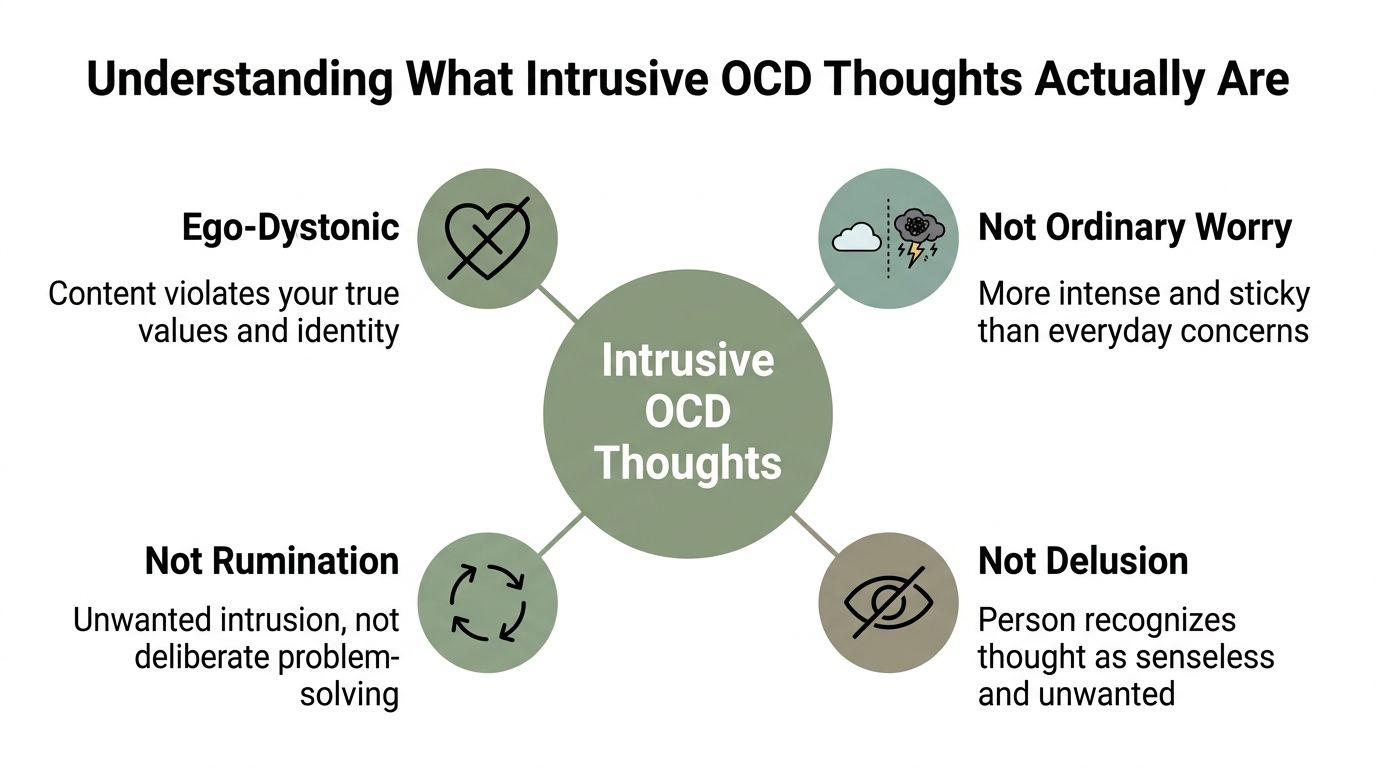
Intrusive OCD thoughts are unwanted mental events that can appear as words, images, impulses, sensations, or doubts. Their content may involve harm, contamination, sexuality, religion, morality, relationships, health, mistakes, or responsibility. The theme matters less than the pattern that follows: the thought arrives, distress rises, and the person feels compelled to analyze, avoid, check, confess, or seek reassurance.
These thoughts are often ego-dystonic, meaning they conflict with the person's values and identity. A loving parent may fear harming a child. A careful driver may fear hitting someone without noticing. A religious person may experience blasphemous thoughts. The distress comes partly from the mismatch between the content and what the person cares about.
Intrusive thoughts themselves aren't proof of OCD. Many people experience unwanted mental content. OCD becomes clinically significant when the thought becomes sticky and the person feels unable to move on without completing a ritual or reaching certainty.
The compulsion may be invisible
Families often notice handwashing, checking, arranging, or avoidance. They miss the rituals happening inside the person's head:
- Silent reviewing: Replaying a conversation or event to determine whether harm occurred.
- Mental replacement: Pushing away a bad image and replacing it with a “safe” image.
- Internal checking: Scanning feelings to see whether the person feels guilty, attracted, dangerous, or certain enough.
- Counting and repeating: Saying words, prayers, or phrases mentally until the feeling changes.
- Reassurance research: Searching online or asking questions to settle the same doubt again.
That distinction is essential when learning how OCD is treated in children and adolescents. A child who sits still may still be performing a demanding mental ritual. “Nothing happened” doesn't necessarily mean the child is coping well.
OCD thoughts also differ from delusions. A person with an obsession usually recognizes that the thought is unwanted, excessive, or inconsistent with their values, even when it feels emotionally convincing. A clinician should assess confusing or frightening experiences carefully, especially when insight is limited or safety concerns are present.
How Exposure and Response Prevention Works in Practice
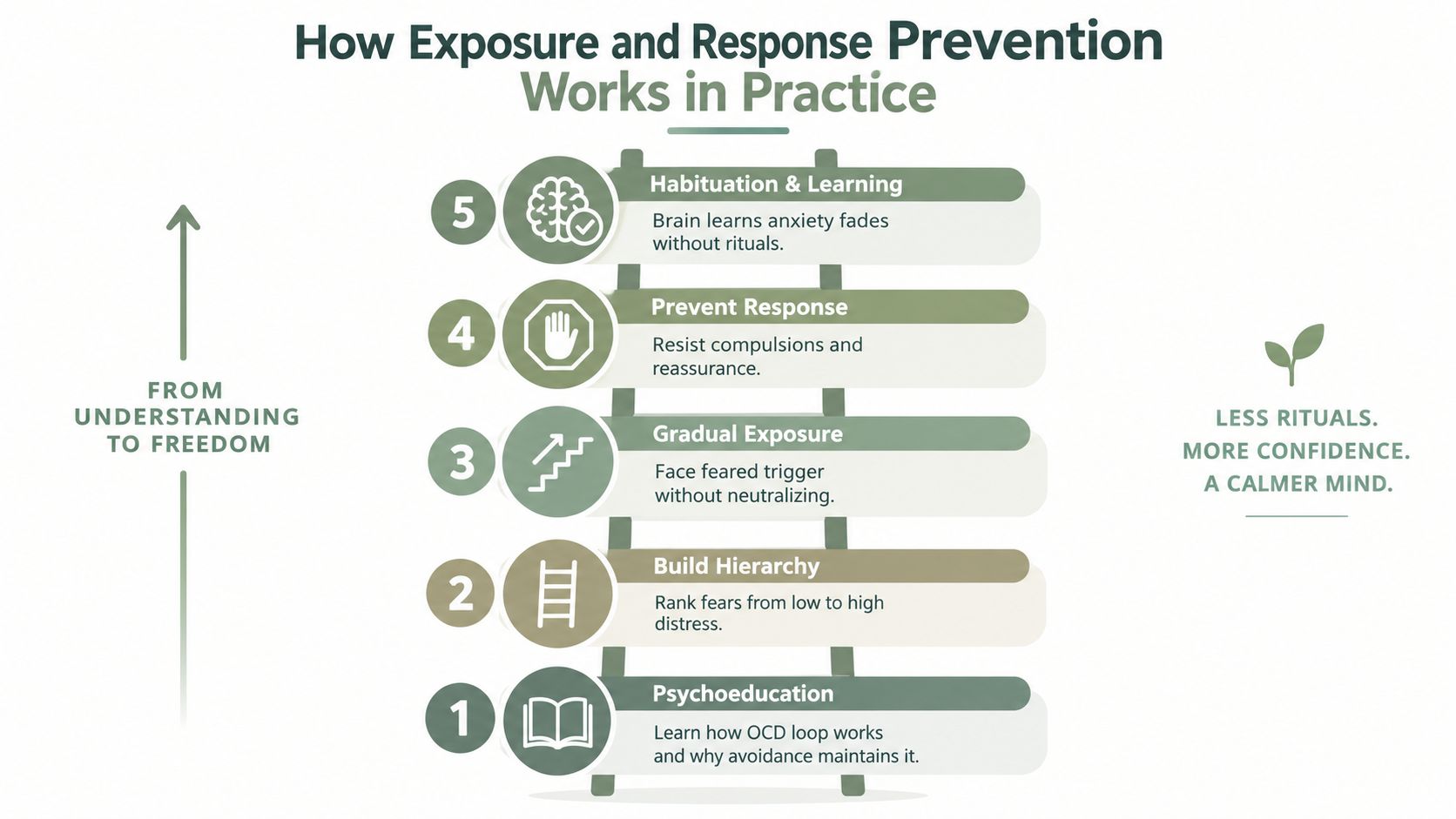
ERP works by helping a person face an obsession-related trigger while dropping the ritual that normally follows. It isn't a dare, a punishment, or forced flooding. Done properly, it is planned, collaborative practice that teaches the brain a new response.
Build the ladder before climbing it
Start with psychoeducation. The child, teen, adult, and caregiver should understand the loop: trigger, obsession, distress, compulsion, temporary relief, and stronger future urgency. Then list feared situations and rank them by expected distress using a 0 to 100 scale.
A teenager with contamination fears might create a ladder such as:
- Touching a clean desk and waiting before washing.
- Touching a doorknob and eating a snack without washing.
- Sitting near a backpack placed on the floor.
- Using a shared household item without repeated cleaning.
The first practice should be challenging but workable, not the most terrifying item. The therapist and patient decide what counts as exposure and what counts as a ritual. That includes mental rituals, reassurance questions, body scanning, and “just one quick check.”
Practice the response prevention
During exposure, anxiety may rise sharply. That rise isn't evidence that the exercise is unsafe or failing. The person stays with the trigger, notices the urge to ritualize, and lets the urge exist without obeying it. Anxiety may change on its own, but the deeper learning is that the person can continue without performing the ritual.
A session might involve touching a doorknob, using an agreed script such as “Maybe, maybe not,” and returning to homework without washing. Home practice repeats the exercise often enough for the new response to become familiar. The point isn't to perform exposure perfectly. The point is to stop giving OCD the final decision.
ERP with CBT has produced a large overall effect compared with control conditions, with a meta-analysis reporting g = 0.74, and ERP was superior to psychological placebo at g = 1.13, as reported in this meta-analysis of CBT and ERP for OCD. For children, exposure therapy guidance for families should include developmentally appropriate steps and caregiver participation.
Watch for partial rituals. A person may stop washing but internally review whether the doorknob was contaminated. They may complete the exposure while holding a “safe” object or repeatedly asking, “Was that enough?” Those behaviors still teach the brain that the trigger requires neutralization.
Reviews report that roughly 50% to 60% of patients who complete ERP achieve clinically significant improvement, about two-thirds improve overall, and about one-third recover, according to this review of OCD treatment outcomes. ERP is powerful, but it isn't effortless, and home responses can either strengthen or undermine the work.
What Family Support Looks Like Without Accommodation
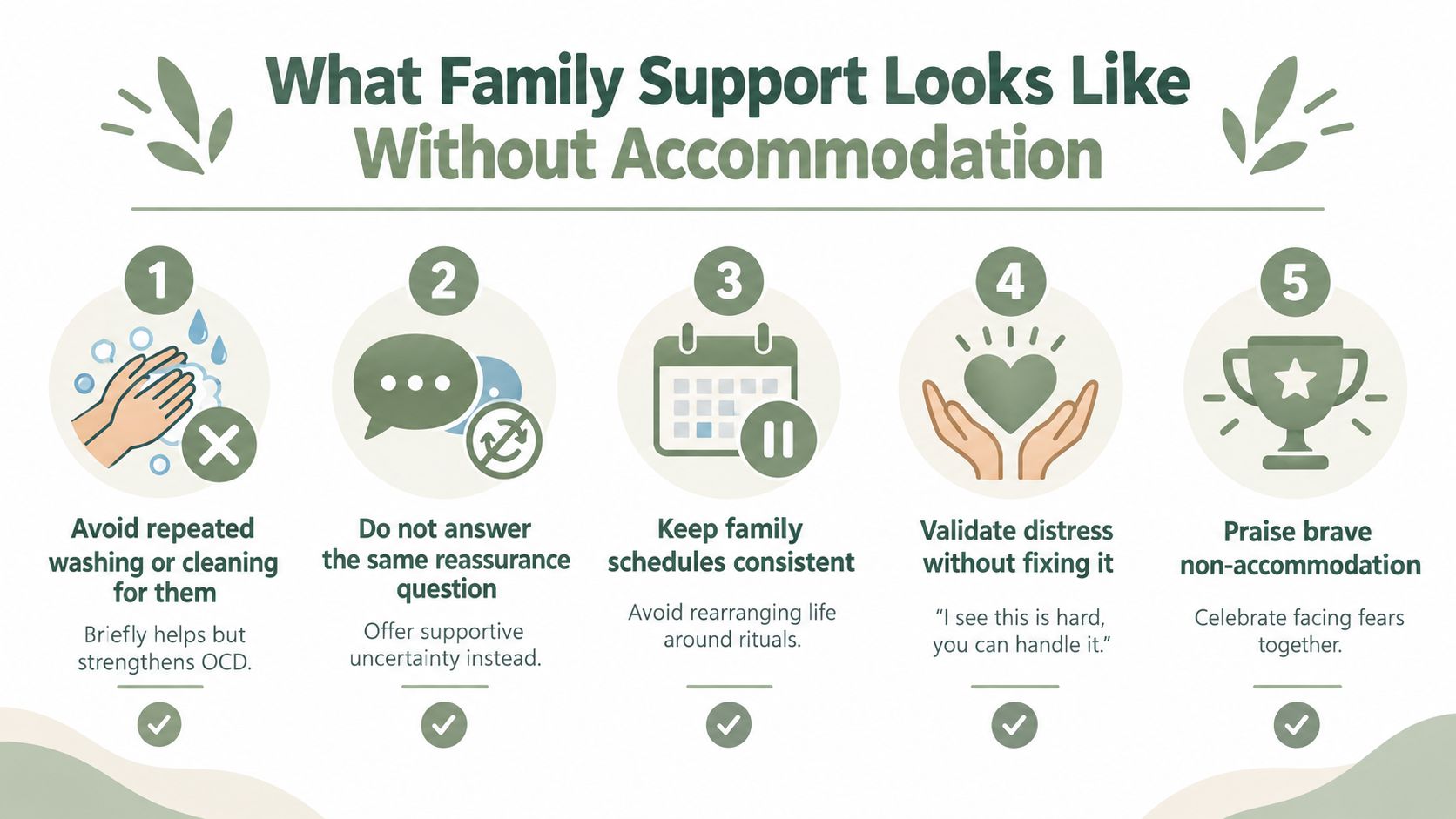
A parent often accommodates before realizing it. They wash a child's hands again, answer the same question repeatedly, check the lock for a teen, change the family schedule, or avoid mentioning a trigger. The parent sees distress and tries to remove it. The child experiences temporary relief, and OCD learns that the ritual works.
Consider a teen who asks, “Did you lock the back door?” The parent answers yes. Two minutes later, the teen asks again. The parent gives a longer explanation, checks the door, and sends a photo. Everyone feels calmer briefly, but the teen hasn't learned to tolerate doubt.
A steadier response sounds like this: “I answered that once. I know the uncertainty feels intense, and I'm not going to check again. You can handle the feeling.” Then the parent returns to the evening instead of arguing.
Validate emotion without joining the ritual
Refusing accommodation isn't the same as being cold. Say what you see, name the limit, and stay present:
- Validate: “I can see that this feels frightening.”
- Decline: “I won't answer the question again or do the check for OCD.”
- Support: “You can sit with this feeling while we finish dinner.”
- Redirect: “Your next step is to return to your activity.”
When accommodation decreases, distress may increase before it improves. That escalation doesn't mean the boundary is wrong. It means the old strategy is no longer producing its usual result.
Children and teens often need coordinated parent guidance, not just individual sessions. More than 50% of affected people have symptom onset before their mid-20s, and childhood OCD in the United States has been estimated at 1% to 2%, with about 1 in 200 children affected, according to the American Academy of Family Physicians' clinical review. Families can find developmentally informed support and parent resources through Wald Behavioral Health's parent guidance.
Praise effort rather than calmness. “You asked once and waited” is more useful than “You look less anxious.” The family isn't trying to make every moment comfortable. It's helping the young person practice doing hard things without allowing OCD to run the household.
Unhelpful Responses to Recognize and Replace
The most common mistakes are understandable. They also keep the cycle alive. Use the table below as a family audit, not as a list for blaming anyone.
| Unhelpful Response | Why It Backfires | Effective Replacement | |---|---|---| | “Don't think about it.” | Suppression makes the mind monitor for the thought and can increase distress and rebound. | Name it briefly, such as “That's an OCD thought,” then return attention to the task. | | Repeated reassurance | Relief reinforces the question, making future certainty-seeking more urgent. | Give one practical answer when appropriate, then use supportive uncertainty: “Maybe, maybe not. You can handle not knowing.” | | Mental checking | Reviewing memories, feelings, or intentions functions as a covert compulsion, even when no outward behavior occurs. | Notice the urge to check and allow the doubt to remain unresolved. | | Thought neutralizing | Repeating phrases, prayers, images, or “good thoughts” teaches the brain that the original thought must be canceled. | Let the thought coexist with the next value-based action. | | Avoiding every trigger | Avoidance prevents corrective learning and can shrink school, work, relationships, and family life. | Create a graded exposure plan with an ERP-trained clinician. |
The ironic process behind suppression is simple: to detect whether a thought is absent, the mind keeps checking for it. That is why “stop thinking about contamination” can keep contamination mentally active.
Reassurance has a negative reinforcement pattern. The person asks, anxiety falls after the answer, and the brain assigns value to asking again. The parent may believe they're helping because the child settles. The short-term calm hides the long-term cost.
Mental rituals deserve the same seriousness as visible compulsions. A teen may look relaxed while repeatedly testing whether they feel attracted to someone. An adult may appear productive while reviewing a past interaction for moral certainty. If the action is designed to remove doubt or distress, it belongs in the response plan.
Building a Response Plan and Knowing When to Escalate
A useful plan fits on one page. It should identify common triggers, the ritual that usually follows, the alternative response, and the family's agreed language. Write it when everyone is calm, not during the tenth reassurance request of the evening.
Put the plan in writing
Include:
- The trigger: “Touching the school desk.”
- The obsession: “What if I become contaminated and make someone sick?”
- The ritual: Washing, researching, asking, or mentally reviewing.
- The exposure: Touch the desk and continue the next activity.
- The family response: One brief acknowledgment, no repeated reassurance.
- The recovery activity: Homework, dinner, sports, music, or conversation.
A distress-tolerance window can help caregivers avoid stepping in too quickly. Families may agree to wait 20 to 45 minutes before changing plans or offering additional support, provided there isn't a genuine safety issue. The window isn't a test of willpower. It's a predictable opportunity to practice staying with discomfort.
Use a safety plan when there are genuine safety concerns, self-harm thoughts with intent, or uncertainty about immediate safety. Don't use a behavioral contract to punish symptoms. Frame exposure as a team project with clearly defined actions, rewards for participation when appropriate, and a plan for setbacks.
Escalate before the crisis
Professional care is warranted when rituals continue to expand despite consistent responses, avoidance begins affecting school or work, sleep or appetite changes, or depression and anxiety make exposure difficult. Any mention of self-harm as a solution to intrusive content requires direct assessment and prompt professional support.
ERP programs also have meaningful limitations. Approximately 25% of patients drop out, and only about 40% to 52% may reach remission even when 75% to 80% respond, according to this review of treatment resistance and outcomes in OCD. That isn't a reason to abandon treatment. It is a reason to examine adherence, hidden rituals, comorbid depression, insight, therapist training, and the need for a higher level of care.
Current guidance continues to place CBT with ERP and SSRIs among first-line treatments. Recent guideline summaries specify a 12-week SSRI trial at the maximum tolerated authorized dose and recommend continuing effective SRI treatment for at least 12 months to reduce relapse risk, as described in this CANMAT and International College of OCD guideline summary. Medication decisions belong with a qualified prescriber, especially for children and adolescents.
Putting It Together and Taking the First Step
Use this sequence when an OCD thought appears:
- Notice it: Identify the thought, image, urge, or doubt.
- Label it: “This may be an OCD intrusion.”
- Pause: Don't rush into checking, arguing, Googling, or asking.
- Choose: Take the next non-compulsive action that fits your values.
- Practice: Complete the next planned ERP step and allow uncertainty to remain.
For a child, that might mean returning to homework after one handwashing. For a teen, it might mean leaving a lock unchecked after the agreed check. For an adult, it might mean continuing a conversation without mentally reviewing every word.
Self-help has limits. Bring in a professional when symptoms persist despite consistent practice, avoidance cuts into school, work, or relationships, or distress creates safety concerns. Choose a clinician specifically trained in ERP for OCD, not just someone who offers general talk therapy.
This week, write down one recurring thought and the ritual that follows it. Then identify one small response you can stop repeating, and tell a trusted caregiver or support person exactly how you want them to respond.
---
Wald Behavioral Health provides evidence-based OCD support for children, adolescents, young adults, and families, including structured coping skills, exposure work, and caregiver guidance. Visit Wald Behavioral Health to explore in-person care in Coral Gables or telehealth options across eligible states, and request a free 15-minute consultation.
Questions about your child or teen?
Dr. Wald offers a free 15 minute consultation to talk through what you are seeing and whether the practice is a good fit.
Free 15 Minute Consultation