School Refusal in Teens: A Practical Guide for Parents
It's 7:18 a.m. Your teen is upstairs, dressed but motionless. Or half-dressed and crying. Or suddenly sick, again, with a stomachache that appears every school day and fades by late morning. You've tried calm reassurance, stern consequences, pep talks, bribes, extra sleep, mental health days, and promising that tomorrow will be different. Instead, the mornings have gotten tighter, louder, and more defeated.
This is the moment many families find themselves in with school refusal in teens. Not laziness. Not simple defiance. Not a problem that gets solved by one good conversation. If your teen is stuck in a pattern of not getting to school, getting there and melting down, or attending only in fragments, you need a plan that is bigger than “help them feel less anxious.”
That's because school refusal is usually not one problem. It's a multi-system problem. The teen brings distress, avoidance, and often shame. The family starts adjusting routines to keep the peace. The school may respond inconsistently, sometimes helping and sometimes accidentally reinforcing absence. If you work on only one part, the pattern tends to hold.
## Table of Contents - What This Guide Covers and Why Now - The part most guides miss - Defining School Refusal and Why It Is Not Truancy - The three features clinicians look for - Why the distinction matters - Terms worth knowing - The Four Patterns of School Refusal in Adolescents - Pattern one avoids social threat - Pattern two escapes internal distress - Pattern three gains something more rewarding at home - Pattern four escapes a specific school problem - How to tell which pattern fits - What Is Driving the Refusal in Your Teen - Side by side differences that matter - What parents usually miss - Questions that cut through the fog - How a Clinician Assesses School Refusal - What usually happens in the first phase - What to bring instead of showing up overwhelmed - What you should expect after the first visit - What Actually Works in Treatment - The treatment approach I trust - The school has to be in the plan - What does not work - A Practical School Re-Entry Plan You Can Run - The week before return - The first five school days - The next two weeks - The month after - Working With Wald Behavioral Health to Re-Engage Your Teen - What support often includes - Common concerns before the first appointment
What This Guide Covers and Why Now
The most common mistake I see is that parents wait too long because they're using the wrong model. They think, “My teen is overwhelmed. If I reduce pressure and give this a little time, they'll reset.” Sometimes a brief pause helps. More often, repeated absence teaches the brain that escape works.
That's why school refusal in teens needs an active response. The problem has been documented for decades as a distinct attendance issue tied to emotional distress, not ordinary skipping. Published prevalence estimates range from 1% to 7% in the general youth population depending on definitions and samples, and one community study found 6.9% of 11- to 17-year-olds reported fear of going to school, while another found 3.6% of 11- to 15-year-olds had absent episodes in the prior three months often for school-refusal reasons, according to this clinical review of school refusal literature.
The part most guides miss
Most online advice treats this as an anxiety article. Anxiety matters, but that frame is too narrow for many teens. Older kids often refuse school because of a mix of anxiety, depression, bullying, social fallout, academic mismatch, family accommodation, and school factors that have already snowballed.
Practical rule: Stop waiting for one perfect explanation before you act. You can assess the cause and build attendance at the same time.
A useful guide has to do five things at once:
- Name the problem clearly so you stop calling it “just a phase.”
- Separate school refusal from truancy because those are not treated the same way.
- Identify the main pattern driving your teen's avoidance.
- Look past anxiety alone to mood, peers, learning, and medical issues.
- Build a re-entry pathway that involves home, school, and clinician in parallel.
If you've been waking up every weekday bracing for another fight, you don't need more reassurance. You need a cleaner map and firmer steps.
Defining School Refusal and Why It Is Not Truancy
Parents often use the words interchangeably. Clinicians shouldn't. The difference changes what you do next.
School refusal means a young person has serious difficulty attending school, feels distressed about attendance, and the parent usually knows they're home. Truancy means the student skips without parental knowledge, often to do something more appealing elsewhere, and the main picture is not fear-driven morning distress.
Historically, school refusal has been recognized as separate from truancy for exactly this reason. Foundational family medicine guidance described school refusal as affecting about 1% to 5% of school-aged children, and child psychiatry guidance similarly estimates 1% to 5% are affected at some point, with peaks around school transitions. A review also notes another peak in ages 11 to 14, which is why the adolescent years deserve special attention. You can read that discussion in this review on school refusal in children and adolescents.
The three features clinicians look for
A workable definition usually includes these pieces:
1. Attendance difficulty that persists or repeats Two weeks is a common threshold in practice, but don't hide behind the calendar. If your younger teen is unraveling every school morning, that still deserves action now.
2. Clear emotional distress around school Panic, tears, anger, nausea, headaches, pleading, shutdown, or explosive conflict on school-facing mornings all count.
3. Antisocial behavior is not the primary driver The teen isn't mainly sneaking out, skipping for thrills, or disappearing without your knowledge.
Why the distinction matters
If you mislabel school refusal as truancy, adults often move too quickly to lectures, punishments, and attendance enforcement. Those can be part of a broader plan, but by themselves they usually miss the engine of the problem.
If you correctly identify school refusal, you start using better language:
| Feature | School Refusal | Truancy | |---|---|---| | Parent awareness | Usually yes | Often no | | Emotional state | Distress about attending | Often little anticipatory distress | | Typical morning pattern | Panic, shutdown, somatic complaints, conflict | Evasion, concealment, leaving for preferred activity | | Main function | Escape from distress or aversive school conditions | Skipping rules or seeking preferred alternatives | | First response needed | Clinical assessment and school plan | Attendance enforcement plus broader behavior assessment |
Terms worth knowing
- Avoidance means the teen escapes school-related distress by not attending.
- Accommodation means the family changes routines in ways that unintentionally make avoidance easier.
- Functional profile means what the refusal accomplishes for the teen.
- Exposure-based re-entry means gradual practice facing school rather than waiting to feel ready.
- Graded return means attendance is rebuilt in steps, not left to chance.
Calling all school non-attendance “truancy” is one of the fastest ways to push a distressed teen away from the help that fits.
The Four Patterns of School Refusal in Adolescents
A teenager can refuse school for very different reasons while looking exactly the same at 7:00 a.m. That's why I care less about the label and more about the function. What does staying home do for this teen?
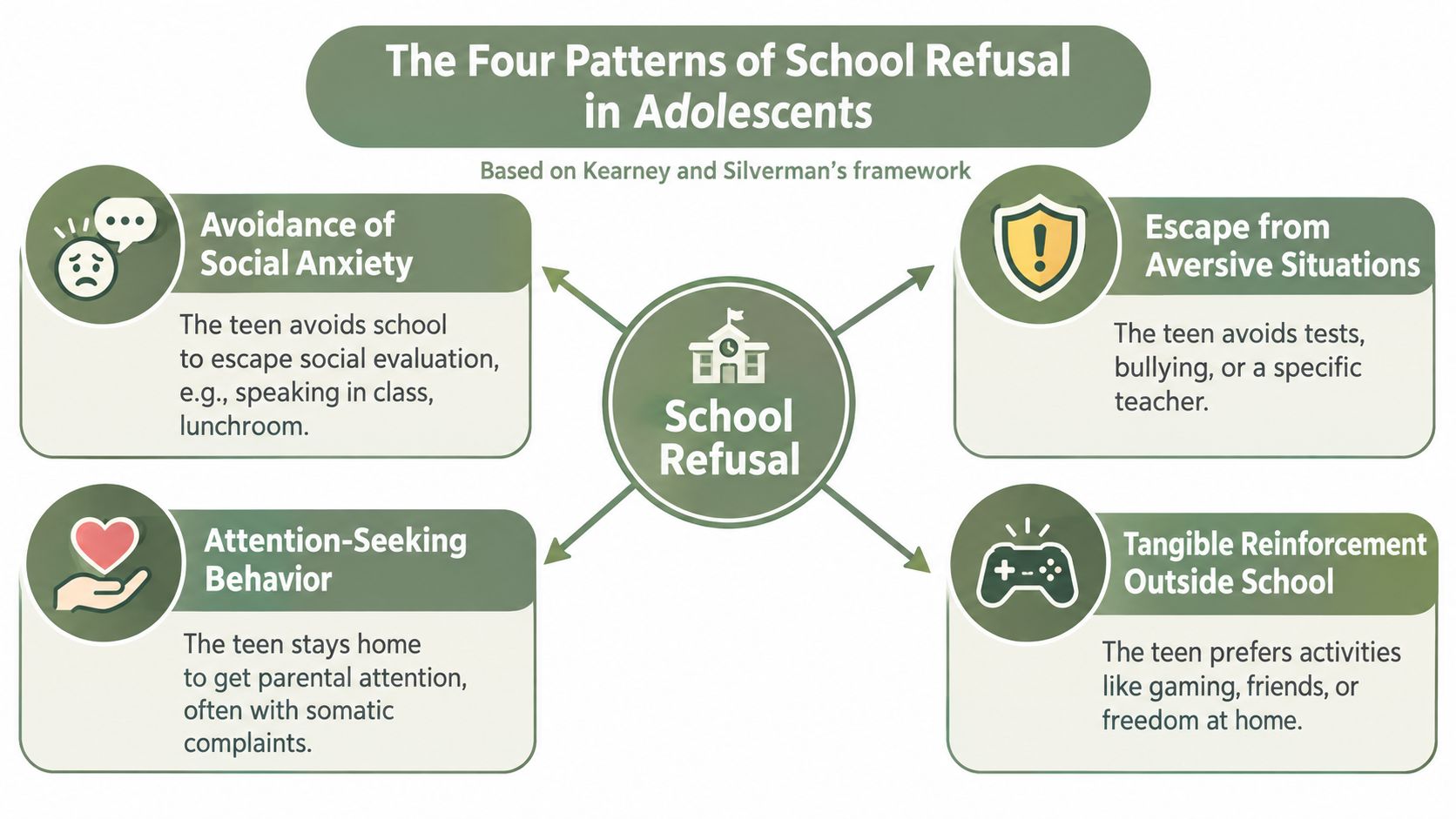
Pattern one avoids social threat
Some teens are trying to escape scrutiny. They dread presentations, lunch, crowded hallways, group work, or even being seen walking into class late. The home morning often includes intense bargaining, tears, or complaints that sound irrational to adults but feel huge to the teen.
Listen for statements like: - “Everyone stares at me.” - “I can't do lunch.” - “If I panic in class, it'll be humiliating.”
Pattern two escapes internal distress
This group often gets lumped under “anxiety,” but the picture can be broader. A teen may fear separation, catastrophize about performance, feel physically sick from panic, or wake up already defeated because depression has flattened their energy and hope.
These teens often say little. They may shrug, stay in bed, or insist they're too exhausted to function.
Pattern three gains something more rewarding at home
Parents often get angry, and I understand why. If your teen refuses school and then spends the day sleeping, gaming, texting friends, or scrolling, it's easy to conclude they're manipulating you. Sometimes they are taking advantage of the opening. But don't miss the sequence. A fear-based pattern can harden into a home-preference pattern fast.
Pattern four escapes a specific school problem
This teen isn't avoiding school in the abstract. They're avoiding that class, that teacher, that bathroom, that lunch table, that bully, or the impossible workload they no longer know how to manage.
When a teen can't explain the refusal cleanly, look at what improves the moment school is removed. Relief is a clue.
How to tell which pattern fits
Ask three blunt questions:
- What is your teen escaping? Social exposure, panic, sadness, humiliation, overload, a person, a place?
- What is your teen getting? Comfort, sleep, your attention, screens, freedom, relief from pressure?
- What has the family changed? Sleeping arrangements, morning demands, school expectations, device rules, transport, contact with school?
Most teens don't fit one pure box. They blend. A socially anxious teen may also be depressed. A bullied teen may also discover that home is far easier than re-entry. What matters is not finding a perfect category. It's identifying the loops that keep the pattern alive.
What Is Driving the Refusal in Your Teen
Parents usually get stuck arguing about behavior. “She's avoiding.” “He's lazy.” “They're manipulative.” That argument goes nowhere. The better question is: what problem is attendance solving for your teen right now?
Recent child psychiatry guidance makes this point clearly. School refusal is not a formal diagnosis, and while anxiety is common, older children and teens may be dealing with friends, bullying, depression, or other emerging mental health concerns. That broader frame matters, especially when content online reduces everything to anxiety. See this AACAP-related review on school refusal and adolescent mental health factors.
Side by side differences that matter
| Driver | Morning Presentation | What the Teen Says | Home Signals | |---|---|---|---| | Anxiety | Panic, nausea, freezing, repeated reassurance-seeking | “I can't do it,” “Something bad will happen,” “I'll freak out” | Relief after staying home, anticipatory dread the night before | | Depression and low motivation | Slow, flat, withdrawn, irritable, can't get moving | “What's the point,” “I'm too tired,” “I don't care” | Sleep changes, loss of interest, isolation, hopeless tone | | Bullying or peer victimization | Refusal spikes on certain days or classes | “People are awful,” “It's lunch,” “You don't get it” | Guarded phone use, social withdrawal, sudden friend drama | | Learning or neurodevelopmental struggles | Avoidance around tests, homework-heavy days, or specific classes | “I'm stupid,” “I can't keep up,” “It takes me forever” | Homework battles, disorganization, chronic overwhelm | | Medical issues | Genuine physical symptoms that worsen with school demands | “My head hurts,” “I'm dizzy,” “I'm exhausted” | Symptom patterns, specialist visits, uneven stamina |
What parents usually miss
Two teens can both say “I feel sick” and mean completely different things. One is panicking. One is depressed. One is being tormented at lunch. One has untreated ADHD and can't survive the academic load. One may need medical workup for migraines, sleep problems, or post-viral symptoms.
If you already know your teen struggles with worry, this anxiety treatment overview gives a useful framework for understanding how avoidance and fear feed each other. But don't force every case into the anxiety box.
Questions that cut through the fog
Use these at home:
- “What part of the day feels worst?” If the answer is lunch, PE, math, or the bus, you've learned something.
- “What gets easier the minute school is off the table?” Relief points to function.
- “When did this start changing?” Look for transitions, losses, conflict, academic slips, health changes, or peer ruptures.
- “What are weekends like?” A teen who's miserable all week and lively all weekend may still be depressed. A teen who dreads Sunday night may be signaling school-specific fear.
Don't keep debating the symptom. Investigate the source.
How a Clinician Assesses School Refusal
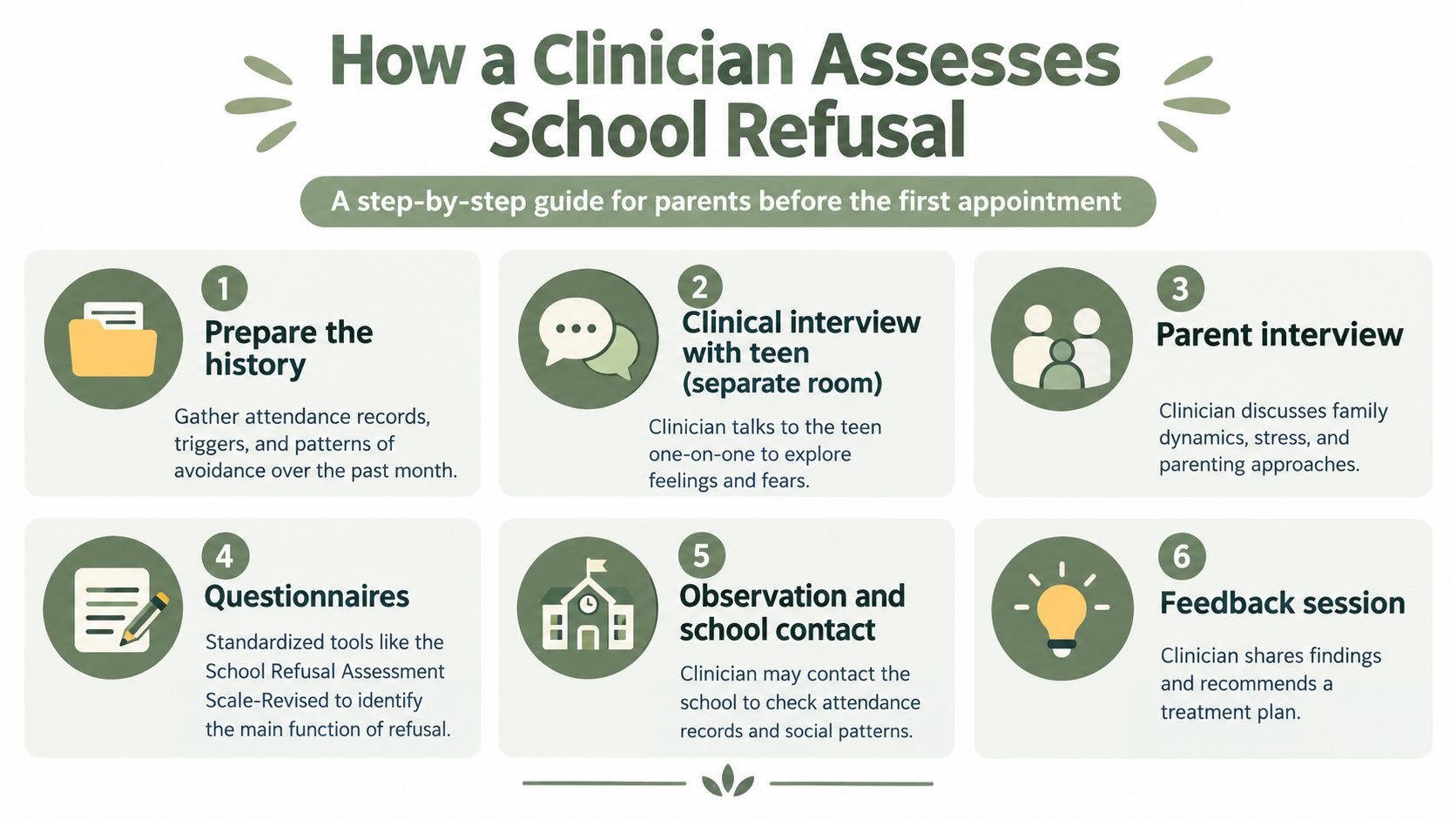
A good assessment is not a lecture about attendance. It's a structured effort to find out what's driving the pattern, what's maintaining it, and what needs to change first.
What usually happens in the first phase
Clinicians often meet with parents and teen together, then separately. That matters. Teens will say some things in front of parents and very different things alone.
The assessment usually looks at:
- Triggers and timeline such as school transitions, bullying incidents, illness, family stress, or academic decline
- Avoidance pattern including missed classes, late arrivals, nurse visits, early pickups, and full absences
- Maintaining factors such as parent accommodation, screen access, sleep reversal, or inconsistent school responses
- Mental health symptoms related to anxiety, depression, OCD, trauma, attention, and safety concerns
- Medical contributors if physical symptoms, fatigue, dizziness, headaches, or sleep issues are part of the picture
For families who aren't sure what kind of specialist they need, this explanation of what a pediatric psychologist does can help clarify who typically handles these evaluations.
What to bring instead of showing up overwhelmed
Come prepared with evidence, not just frustration.
- Attendance records that show the pattern clearly
- Recent report cards and teacher messages
- Prior testing or school evaluations
- A one-week morning log with wake time, complaints, conflict points, and whether symptoms eased once school was dropped
- A short question list so you don't forget the practical concerns
Bring data, not just distress. A simple log of mornings often reveals the pattern faster than an hour of arguing about memory.
What you should expect after the first visit
You should leave with a working formulation, not a vague “let's see.” That may include the likely drivers, immediate safety concerns if any, what to rule out medically, and the first attendance target.
Confidentiality has limits. If a teen reports safety risk, the clinician will involve parents appropriately. That's not a betrayal. That's the job.
What Actually Works in Treatment
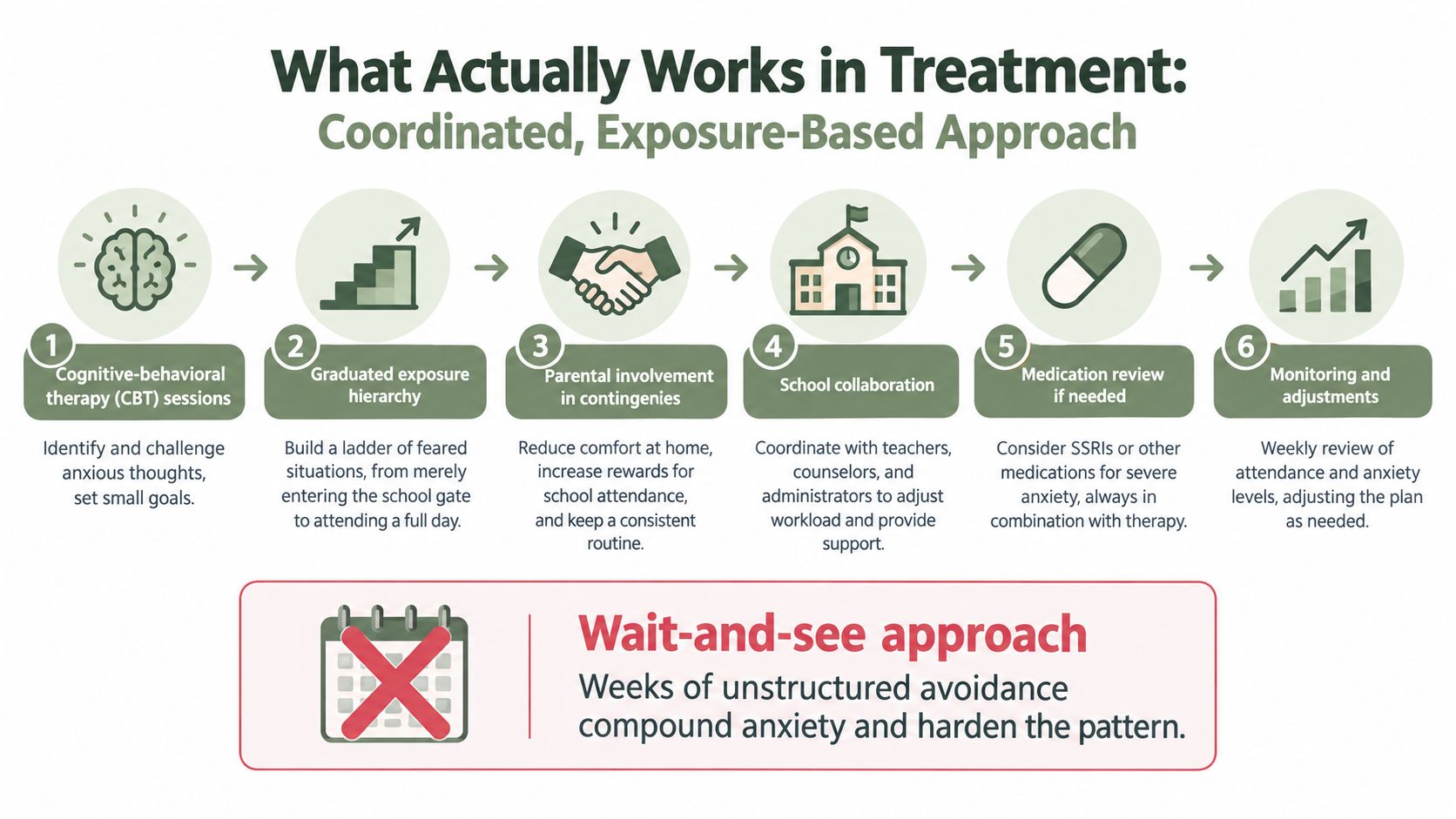
The core principle is simple. Avoidance shrinks life. Exposure rebuilds it. If your teen has already missed substantial school, waiting for motivation to magically return is a losing strategy.
A recent review described school refusal as affecting about 2% to 5% of school-aged children and adolescents and emphasized it as a public health concern. That same discussion noted that school absence has increased since COVID-19 among young people with socio-emotional difficulties and those who do not like school, which is one reason entrenched cases are now so common. That summary appears in this review discussing post-pandemic school refusal and re-engagement.
The treatment approach I trust
Cognitive behavioral therapy is often the backbone. Not because it's trendy, but because it directly targets the fear-avoidance loop. A therapist helps the teen identify feared situations, predict what they think will happen, test those predictions, and build a ladder of increasingly hard school-related steps.
That exposure ladder might start with: - Driving past campus - Walking onto school grounds after hours - Entering the office - Attending one class - Staying through lunch - Building toward a fuller day
Then there's parent training, which is not an optional add-on. Parents need help reducing accommodation without becoming harsh. That usually means setting predictable wake times, tightening device access during absences, stopping repeated morning debates, and reinforcing brave behavior quickly and concretely.
A practice like Wald Behavioral Health may fit for some families, since its services include parent training for school refusal, child and adolescent therapy, and telehealth in Florida, Maryland, and PSYPACT-participating states.
Here's a brief explanation of the exposure-based mindset in action:
The school has to be in the plan
Treatment fails when the school isn't coordinated. Teens often need:
- A designated safe adult they can check in with
- A modified start such as partial days or targeted class attendance
- Workload triage so make-up work doesn't become impossible
- Practical supports like altered transport, lunch options, or pass-based breaks
- Formal accommodations through a 504 plan or IEP when appropriate
What does not work
Reassurance alone feels kind. In entrenched school refusal, it often becomes a sophisticated way of helping avoidance win.
Three things I'm blunt about:
- Indefinite time off hardens the pattern
- Online school as the default exit often locks in avoidance unless used very deliberately
- Medication can help severe anxiety or depression, but pills do not teach attendance
The useful question is never “How do we make school feel easy first?” It's “How do we help this teen face school in a tolerable, structured, supported way while addressing the drivers?”
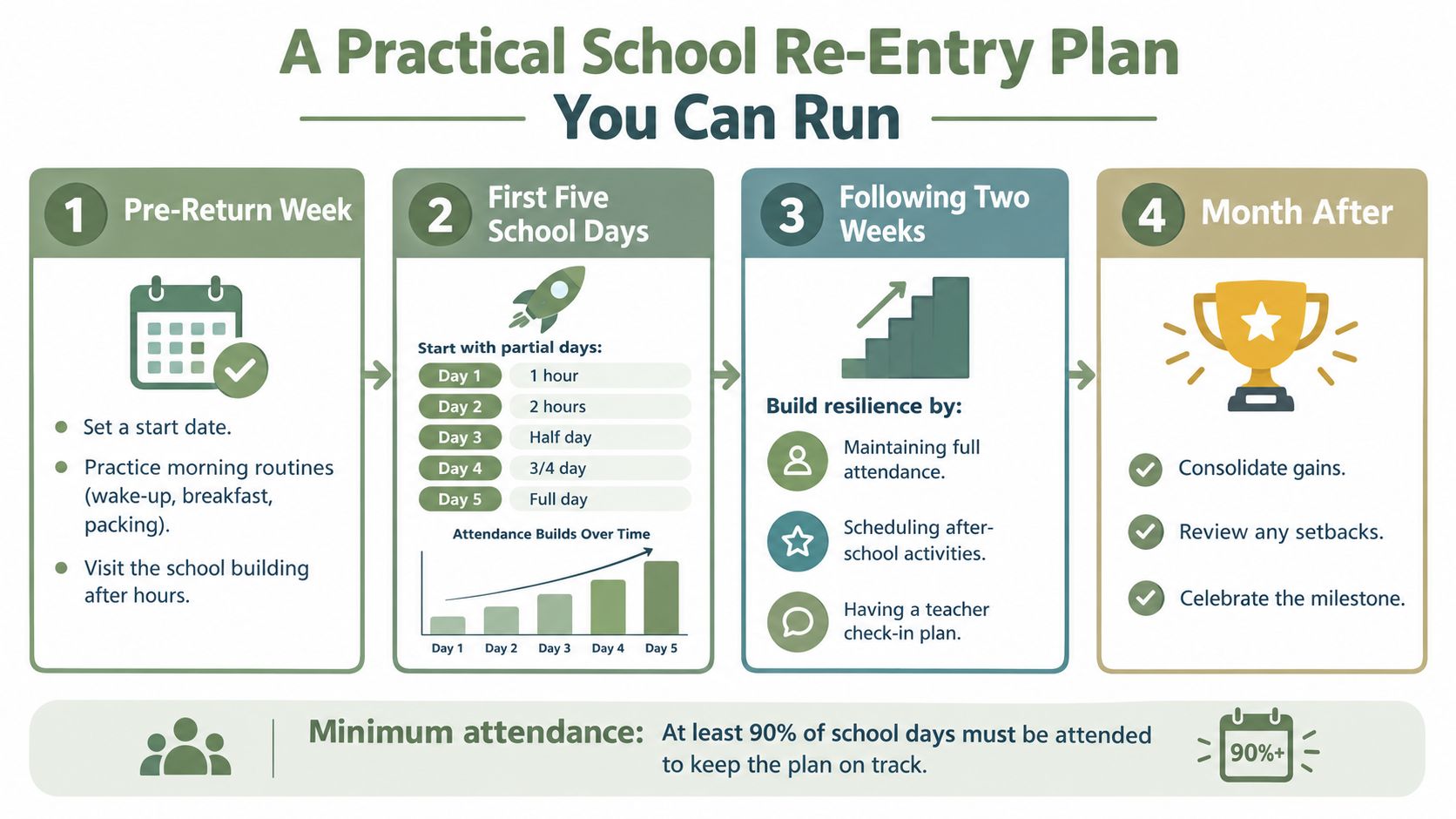
A Practical School Re-Entry Plan You Can Run
Families need a runbook. Not inspiration. Not one dramatic Monday where everyone vows to do better. A runbook.
The week before return
Set a start date. Don't leave it vague. Rehearse the mechanics before you ask for attendance.
Use the pre-return week to: - Reset sleep and wake time - Pack the bag the night before - Practice the drive or walk - Visit the school building if possible - Confirm the safe adult and first check-in point - Clarify what classes matter most at first
If you need a visible reinforcement system at home, a simple behavior chart for children and teens can help track routines and follow-through, especially in the early re-entry phase.
The first five school days
Don't aim for emotional comfort. Aim for showing up.
A practical sequence might look like this: 1. Day one means entering the building and staying for a defined block. 2. Day two extends that block or adds one hard class. 3. Day three includes a check-in and one independent transition. 4. Day four stretches toward the most avoided part of the day. 5. Day five consolidates gains instead of renegotiating from scratch.
Set a cutoff time for morning debate. After that, the script gets shorter, not longer: “I know this is hard. The plan is still school. Let's move.”
The next two weeks
Many parents accidentally wreck progress by overreacting to one rough day. Expect wobbling. Don't expect a clean upward line.
Keep these pieces stable: - Minimum attendance target agreed with school and clinician - Daily check-in with one designated adult at school - Homework triage so the teen isn't buried by backlog - Home routine that makes school absence boring and structured, not cozy and open-ended
Relapse script: “Today was rough. Rough does not mean stop. We adjust the step, not the goal.”
The month after
Once attendance improves, parents often relax too fast. Don't. Consolidation matters.
Review what still triggers distress. Tighten weak spots like sleep, unfinished assignments, lunch, or transport. Keep rewarding consistency longer than you think you need to. School refusal in teens often returns through the side door, with late arrivals, frequent nurse visits, and “just this one day” exceptions.
The plan should bend when needed. It should not collapse.
Working With Wald Behavioral Health to Re-Engage Your Teen
If you're in Coral Gables, Miami-Dade, elsewhere in Florida, Maryland, or a PSYPACT state, the practical question is usually not “Does my teen need support?” It's “What happens if I call, and what if my teen refuses to participate?”
The usual starting point is a brief consultation to clarify fit, urgency, and scheduling. From there, the intake process generally focuses on the attendance pattern, emotional symptoms, school context, parent responses, and the barriers that are keeping the refusal going. For school refusal, parent involvement matters early because home routines and accommodation often need to change before school attendance improves.
What support often includes
Families looking for help with school refusal in teens usually need several things at once:
- Individual therapy for the teen using evidence-based strategies such as CBT and exposure practice
- Parent coaching to change the morning pattern, reduce accommodation, and respond consistently
- School collaboration so the re-entry plan is realistic instead of theoretical
- Coordination with pediatricians when sleep, medical symptoms, medication questions, or broader health concerns are part of the picture
Common concerns before the first appointment
Parents often worry about three practical issues.
First, what if my teen refuses the first session? That happens. In many cases, parent-focused work can begin even if the teen is ambivalent. Second, will telehealth work? Sometimes yes, especially for assessment, parent coaching, and early engagement, though school re-entry planning still has to connect tightly to the school environment. Third, how soon should we act? Sooner than feels comfortable.
If your mornings have turned into a cycle of dread, conflict, and missed school, treat that as a clinical problem with a systems plan. Don't wait for the pattern to become your family's normal.
---
If your teen is stuck in school avoidance, Wald Behavioral Health offers evidence-based therapy, parent coaching, and school-focused planning designed for exactly this kind of problem. If you want help building a realistic re-entry plan instead of repeating the same painful mornings, visit Wald Behavioral Health.
Questions about your child or teen?
Dr. Wald offers a free 15 minute consultation to talk through what you are seeing and whether the practice is a good fit.
Free 15 Minute Consultation