How to Make a Behavior Chart That Actually Works
It's 7:15 on a Tuesday night. The behavior chart is still taped to the refrigerator, the markers are nearby, and your child is arguing about brushing teeth while you're trying to get dinner cleared and everyone ready for bed. The chart looked promising on Sunday. By now, it feels like one more household task.
That experience doesn't mean you chose the wrong stickers or failed to explain the rules. It usually means the chart was asked to do too much by itself. A useful behavior chart is a visible part of a larger system that defines the behavior, delivers feedback quickly, and helps caregivers respond consistently.
## Table of Contents - Why Most Behavior Charts Stop Working After Week One - Three ways a chart loses its effect - Picking the Right Behavior, Reward, and Time Window - Use a window that matches the problem - Building the Chart Step by Step - Put the chart where the routine happens - Adapting Charts for Younger Kids, Older Kids, and Teens - Change the ownership, not the clarity - When a Chart Helps and When It Does Not - Troubleshooting a Chart That Has Lost Its Spark - Fix the system before blaming motivation - Know when adjustment isn't enough - Bringing It All Together and Knowing When to Ask for More Help - Short answers for common decisions
Why Most Behavior Charts Stop Working After Week One
A parent points to the color-coded grid. The child shrugs. Several stickers remain unused, and the original target, “have a better morning,” hasn't become any clearer. The chart looks organized, but the family still doesn't know exactly what earns a mark or what happens immediately afterward.
This is the problem many quick guides skip. A sticker chart is often introduced as a one-off motivational tool, while the broader token-economy approach was developed as a system in which target behaviors were made measurable, reinforced, and exchangeable for rewards. Teodoro Ayllon and Nathan Azrin formalized that approach in the 1960s as a motivational system for therapy and rehabilitation, and token-economy programs later spread across schools, hospitals, and other settings. You can read the historical overview in the American Journal of Psychiatry discussion of token economies.
Three ways a chart loses its effect
The first failure is delay. A reward promised at the end of a long week may not compete with the immediate pull of a video, a sibling, or avoiding a difficult task. Younger children usually need the behavior and the reinforcement to sit close together in time.
The second is vagueness. “Be respectful,” “try harder,” and “control your emotions” describe broad goals, not actions a child can reliably demonstrate and a caregiver can rate fairly. The third is a missing routine. If nobody checks the chart during the morning rush or evening cleanup, it becomes decoration rather than feedback.
Daily behavior report cards have shown measurable benefit for children with ADHD in classroom settings, particularly when they specify behaviors, provide immediate feedback, and are used consistently. The research summarized in this meta-analysis of daily behavior report cards supports a practical conclusion: the tracking tool matters less than the structure around it.
Practical rule: If the chart creates more negotiation than useful information, simplify the behavior, shorten the feedback interval, or reconsider whether a chart is the right intervention.
A chart that lasts beyond the first week doesn't rely on novelty. It fits a real routine, uses a reward the child values, and gives adults a repeatable response when the child succeeds, misses, or argues.
Picking the Right Behavior, Reward, and Time Window
Start with one or two observable behaviors, not a list of everything you want to change. A child can show “puts dirty clothes in the hamper after changing” or “starts the first homework task when the timer ends.” A child can't directly display “feels motivated,” “is less anxious,” or “has a better attitude.”
The practical setup recommended by HealthyChildren.org's guidance on positive reinforcement is straightforward:
- Name the action. Use words another adult could rate the same way.
- Choose the rating window. Decide whether you'll rate the behavior during the morning routine, after school, homework time, or bedtime.
- Select the rating method. Use yes or no for a single behavior, or a small scale when partial completion matters.
- Attach immediate reinforcement. Younger children usually benefit from small same-day rewards. Older children can use points or a contract system.
- Review it daily. The child should see how a specific action connects to a specific outcome.
For an eight-year-old, a short period of screen choice may be more useful than a distant prize. A teenager might prefer choosing Friday lunch, selecting a family activity, or earning a privilege that supports independence. The reward doesn't need to cost money. Time with a parent, choosing music in the car, or selecting the weekend breakfast can work if the child values it.
Use a window that matches the problem
A morning target should be rated during the morning, not remembered vaguely at bedtime. Homework follow-through can be rated after the agreed work period. If the window is too broad, the child won't know when success is possible, and the caregiver will have to reconstruct the day from memory.
| Common Parent Goal | Chart-Ready Behavior | Suggested Window | |---|---|---| | Have a better morning | Gets dressed, eats, and places the backpack by the door after the routine prompt | Morning routine | | Improve homework | Begins the assigned task and stays with the agreed work period | After school or homework period | | Help with chores | Completes the named chore and checks it with the caregiver | Chore period | | Reduce bedtime conflict | Completes the listed bedtime steps after the routine begins | Evening routine |
“Be more responsible” is a poor target because it combines several skills and invites disagreement. “Puts shoes on and waits by the door after the morning reminder” is chart-ready because the action, prompt, and window are visible.
If you're trying to understand whether a broader behavior concern needs more than a home chart, review common child behavior problems alongside the specific behavior you're tracking. A chart should clarify a manageable action, not label the child.
Building the Chart Step by Step
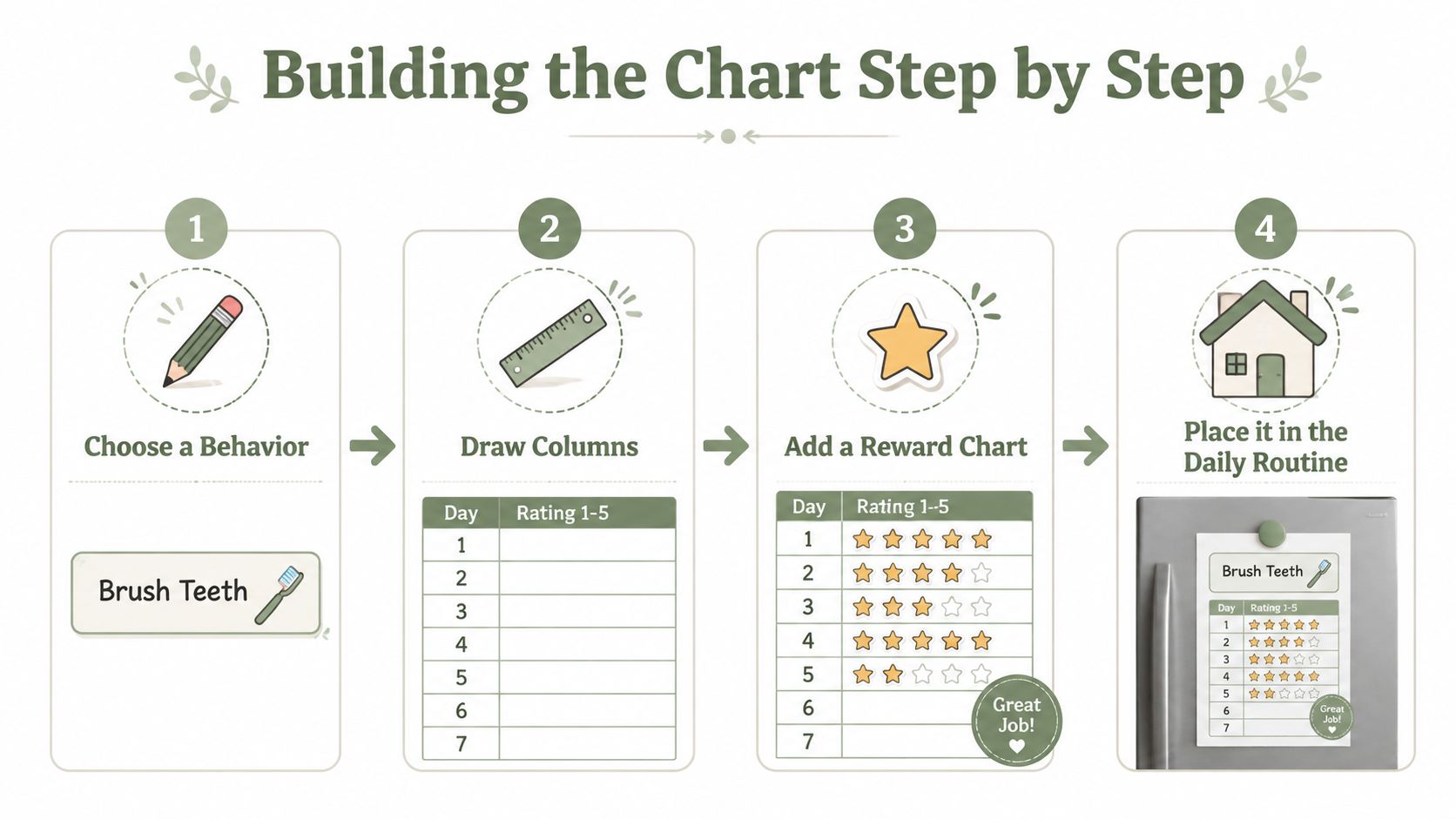
You can make a behavior chart with paper, a whiteboard, or a simple printable template. The format matters less than whether the family can complete it quickly and accurately during an actual weekday.
Begin with a plain layout:
- Child's name and dates: Identify who is using the chart and which period it covers.
- Behavior column: List the one or two actions in concrete language.
- Rating column: Choose yes or no, or a simple rating such as 1 through 3.
- Reward tally: Show what the child has earned and what remains available.
- Caregiver check: Add a small space for an adult's initials if more than one caregiver will use it.
Younger children need large boxes, clear words, and picture cues if reading is still developing. A daily row works well for a short routine. A weekly grid can help with a habit that occurs repeatedly, but don't make the child wait too long for every sign of progress. The chart should make success easy to see, not turn tracking into paperwork.
Put the chart where the routine happens
Place it at the child's eye level in a high-traffic location, such as the kitchen or near the entryway. Keep it away from screens and from places where it will be buried under mail or school papers. The location should cue the next step, not compete with another activity.
Before day one, decide who will rate the behavior, when the mark will be made, and what happens if a caregiver misses the rating. A missed mark should be recorded as “not rated,” not treated as failure. Otherwise, the chart becomes a guilt document for adults and a source of unfair consequences for children.
A printable chart is a useful starting point, but no template can decide whether the target is realistic, whether the reward is meaningful, or how caregivers will respond to resistance. Write those decisions beside the chart before introducing it.
Adapting Charts for Younger Kids, Older Kids, and Teens
A six-year-old and a teenager may use the same basic system, but they shouldn't receive the same design. Age changes the amount of reading, privacy, independence, and delay a child can reasonably manage.
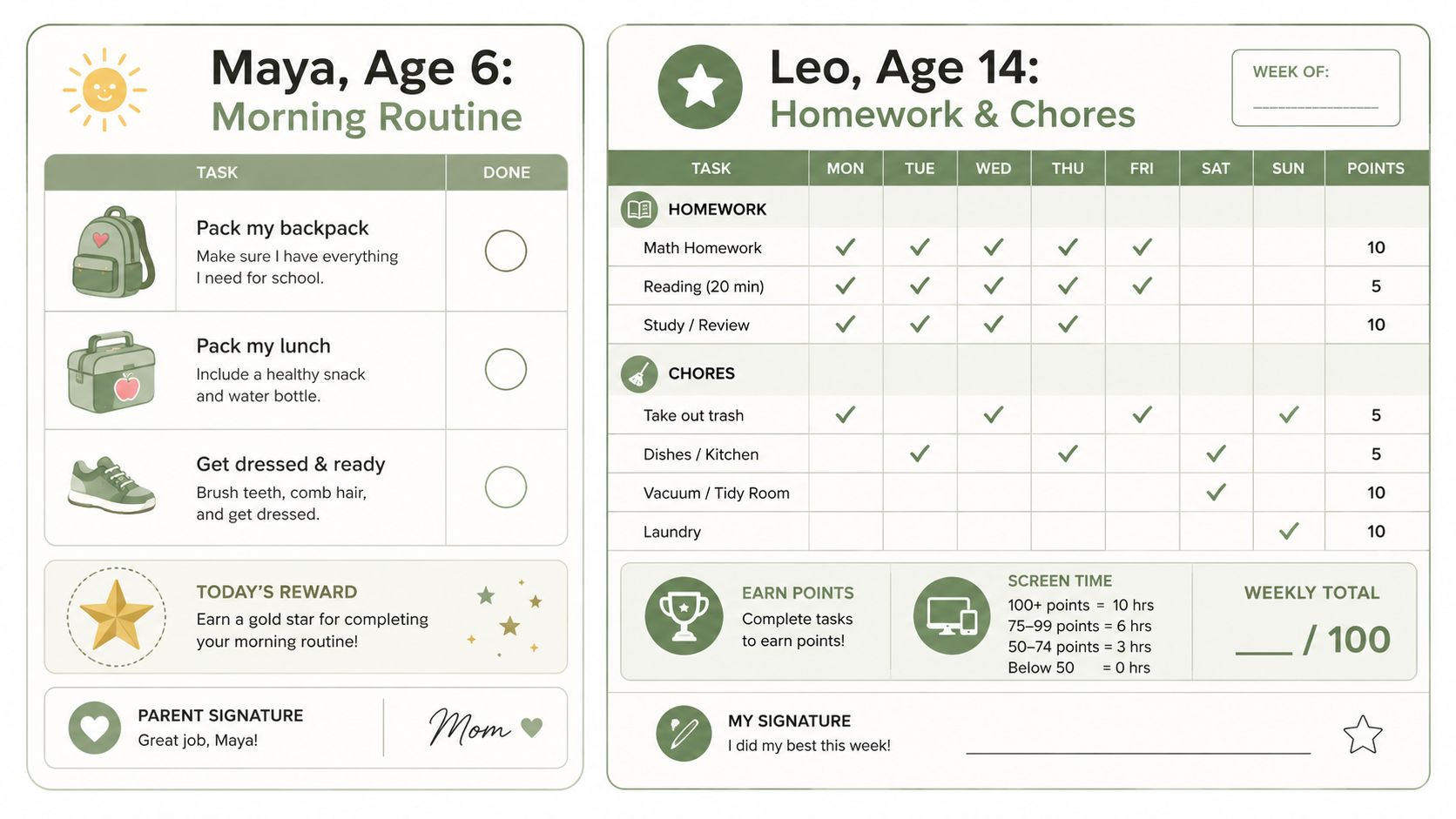
Maya is six, and her morning routine chart uses picture icons for dressing, brushing teeth, packing her bag, and waiting by the door. Her caregiver gives a simple daily rating, then lets Maya choose the Friday bedtime story when she meets the agreed routine goal. Maya helps place the star, but the parent remains responsible for defining the behavior and checking it calmly.
Leo is fourteen, and his challenge is homework follow-through. His chart is a private points ledger rather than a colorful refrigerator display. He completes a self-rating after the homework period, and a parent checks the rating against the agreed task. His reward is delayed longer, such as choosing a movie night with friends, because the system is designed to support independence rather than make a teenager collect cartoon stickers.
Change the ownership, not the clarity
For younger children, the adult usually marks the chart and delivers reinforcement right away. The child's job is to understand the action and participate in the celebration. For older children and teens, the child can record progress, help choose rewards, and review the data with a parent.
That autonomy shouldn't turn into an argument about every score. Agree in advance what counts, and allow a brief review rather than repeated renegotiation. A private ledger may also protect dignity when a public chart feels childish or embarrassing.
Families managing attention and follow-through concerns may need more than a reward display. Guidance about ADHD therapy for teens can help parents think about routines, executive skills, and age-appropriate support alongside any tracking system.
The design principle stays stable across ages: keep the behavior observable, the chart simple, and the reward matched to what the child values now.
When a Chart Helps and When It Does Not
A chart is most useful when the child can perform the target action, the caregiver can observe it, and reinforcement can follow without a complicated interpretation. It's less useful when the target describes an internal experience or when the behavior reflects a skill gap that rewards alone won't address.
Research on token-economy and classroom systems supports a cautious interpretation. These systems can reduce disruptive or off-task behavior, but effects may remain narrow. One evaluation found a significant reduction in disruptive behavior without a significant improvement in completing work outside class, and a separate systematic review concluded that the evidence did not meet best-practice criteria under What Works Clearinghouse standards. The ERIC evaluation of behavior interventions illustrates why parents should measure the exact behavior they care about instead of assuming improvement will generalize.
| Behavior Example | Chart Fit | Limiting Factor or Risk | Recommended Next Step | |---|---|---|---| | Morning routine | Strong fit | Too many steps can overwhelm the child | Start with a small routine and add structure gradually | | Chores | Strong fit | The task may be unclear or too difficult | Define completion and demonstrate the task | | Homework completion | Moderate fit | Avoidance may reflect attention, learning, or executive-function needs | Coordinate with school supports and consider parent training | | Screen-time rules | Moderate fit | The reward can become the only focus | Pair tracking with predictable limits and transition support | | Anxiety or avoidance | Limited fit alone | The child may not be choosing the behavior freely | Use a clinical plan that addresses anxiety and avoidance | | Mood regulation | Limited fit alone | Feelings aren't directly observable or fully voluntary | Seek assessment and teach regulation skills | | Aggression | Limited fit alone | Safety and escalation require more than points | Obtain professional guidance and create a safety plan |
A chart can record an action. It can't, by itself, teach a missing skill or resolve fear.
The rule of thumb is simple. If the child can show the behavior on demand and the reward matters, a chart is worth considering. If anxiety, school refusal, severe conflict, or emotional dysregulation drives the behavior, the chart should sit inside a broader plan. Behavioral therapy for kids may include parent guidance, antecedent changes, skill-building, and coordination with other adults.
Troubleshooting a Chart That Has Lost Its Spark
The chart is still on the refrigerator. The child is still earning stars, but the original behavior has plateaued. Sometimes the child has also learned to negotiate the rating, complete the smallest possible version of the task, or demand the reward without doing the behavior.
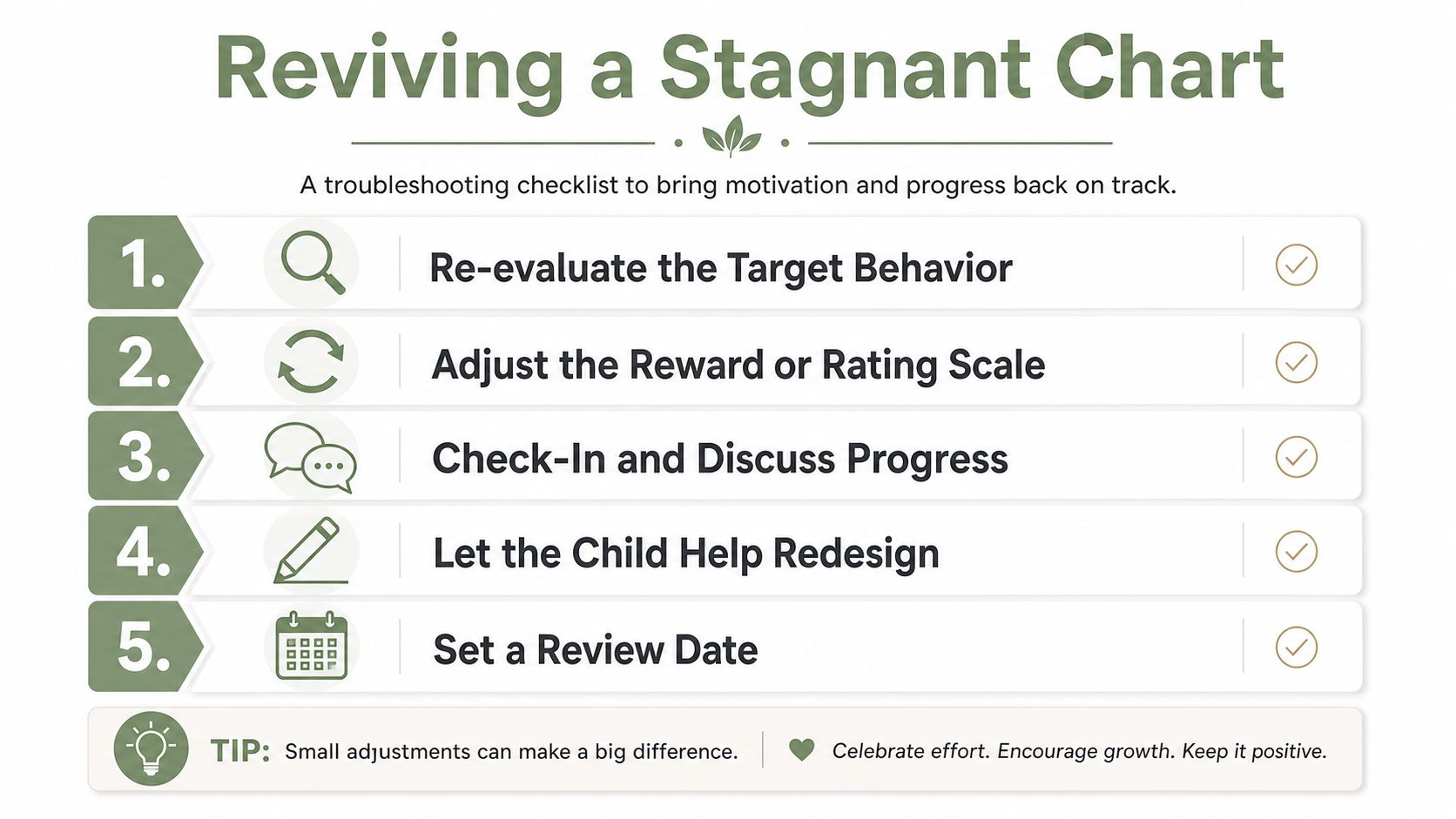
Don't respond by adding more stickers or making the prize bigger immediately. First, identify which part of the system stopped matching the behavior.
Fix the system before blaming motivation
Novelty has worn off. Invite the child to choose between several existing rewards, change the chart's appearance, or move to a points ledger that feels more age-appropriate. Keep the target stable if it remains useful.
The reward no longer matters. Ask what the child would choose now, then offer rewards that can be delivered reliably. A reward that requires a special purchase or a calm weekend may fail on a busy Tuesday.
The target is too loose. Replace “do homework” with a defined action, such as opening the assignment, starting the first task, or completing the agreed work period. Don't track effort if you can't explain what effort looks like.
Caregivers aren't following through. Decide who checks the chart and when. If one adult gives points and another ignores the system, the child receives conflicting information.
The child argues about every rating. Establish the rating rule in advance, let the child ask one brief clarification question, and postpone redesign discussions until the planned review. A chart shouldn't become a courtroom.
Know when adjustment isn't enough
A narrow plateau calls for a narrow change. Escalating aggression, growing discouragement, intense anxiety, school refusal, or persistent conflict means the family needs more than a chart revision. The full parent-training model includes antecedent management, consistent contingencies, and coaching on caregiver responses, not just a graphic record of rewards. A review of flow-chart interventions for families describes the chart as a representation of stepwise parent behavior-management skills, with improvements reported when the full package is implemented. See the review of behavior-management flow-chart interventions for that broader framework.
Bringing It All Together and Knowing When to Ask for More Help
Before launching a chart, write the plan on one page. You should be able to answer each question without debating it during the next difficult routine.
- What is the one observable behavior?
- When will it be rated?
- What does success look like?
- What reward fits the child's age and interests?
- Where will the chart stay?
- Who will mark it?
- When will the family review it?
- What signs would mean the family needs more support?
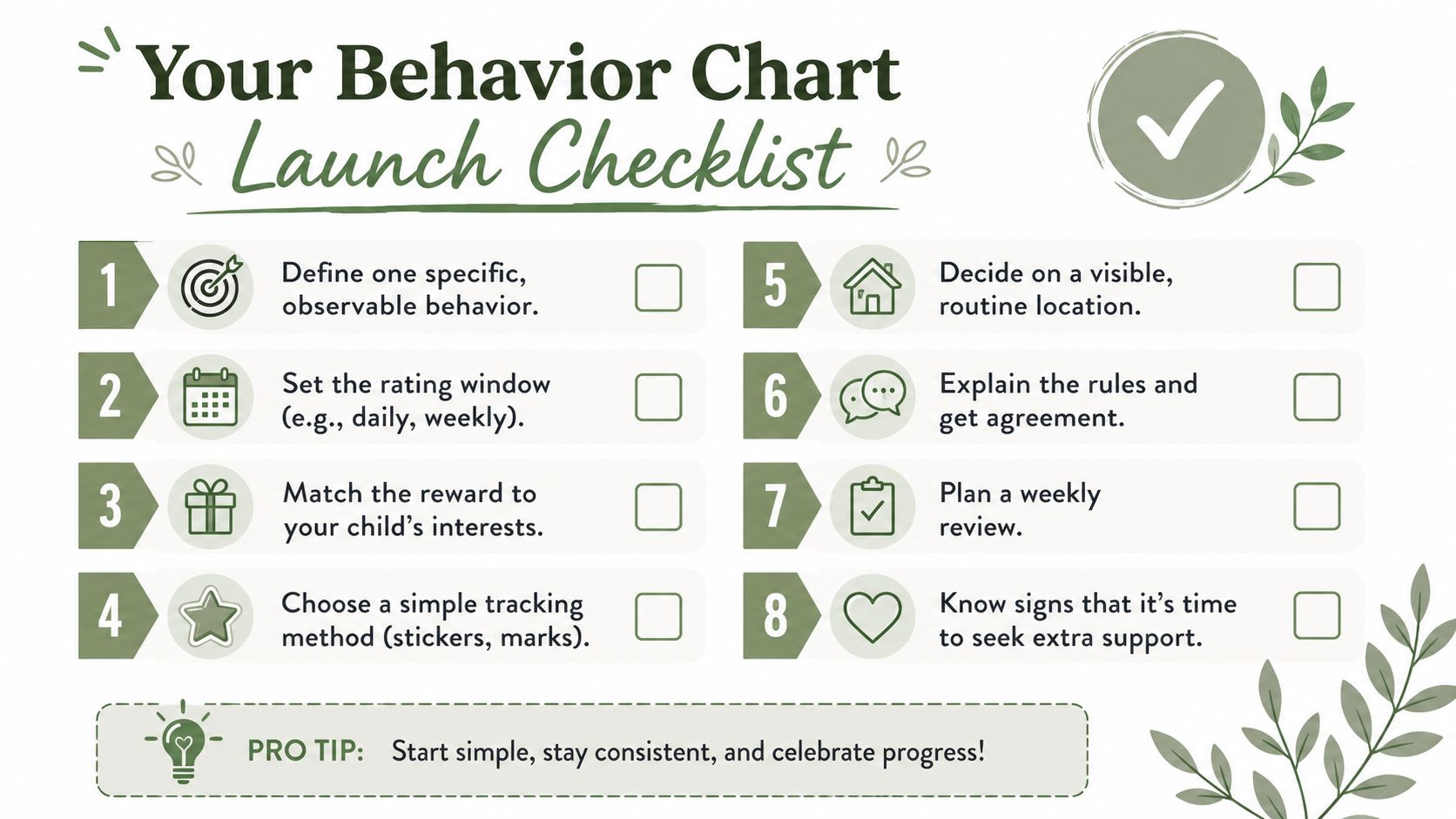
Use the chart long enough to see a pattern rather than reacting to one difficult evening. Record the behavior consistently, review what happened before and after it, and adjust one feature at a time. The chart should help caregivers respond with calm, predictable follow-through when the child succeeds and when the child misses.
A broader parent-training system may be appropriate when the same behavior appears across routines, caregivers can't agree on responses, or the child needs skills the chart doesn't teach. Recent evidence on behavioral parent training suggests that benefits can persist, but long-term changes in ADHD symptoms and family functioning are modest and depend on consistent follow-through. The review of behavioral parent training for ADHD reinforces the need to treat the chart as one component of care rather than a universal solution.
Short answers for common decisions
Is a chart enough for an isolated routine problem? Often, it's reasonable to try when the behavior is external, specific, and reinforceable, such as completing a morning step or putting away a named item.
When should I ask for help? Seek guidance for aggression, anxiety-driven avoidance, school refusal, significant ADHD patterns, or escalation that continues despite consistent tracking and follow-through. A pediatrician, school psychologist, or clinician trained in parent-child interaction therapy can help determine whether the problem is motivation, skill, anxiety, learning, or family interaction.
What should I do if the chart becomes a daily argument? Pause the reward negotiation, simplify the target, and schedule a calm review. If conflict remains the central outcome, move toward structured parent training rather than adding consequences.
---
Wald Behavioral Health provides child and adolescent therapy, parent training, and family guidance for concerns such as noncompliance, sleep difficulties, school refusal, ADHD-related follow-through, anxiety, and mood concerns. Visit Wald Behavioral Health to explore in-person care in Coral Gables or telehealth options and request a free 15-minute consultation.
Questions about your child or teen?
Dr. Wald offers a free 15 minute consultation to talk through what you are seeing and whether the practice is a good fit.
Free 15 Minute Consultation