Parent Child Interaction Therapy How It Works for Families

The morning starts with a request that sounds simple: “Please put on your shoes.” Your child ignores it, argues, drops to the floor, or lashes out. By bedtime, you've repeated yourself so many times that you're questioning your parenting, your child's behavior, and whether anything will change.
Parent Child Interaction Therapy (PCIT) offers a different path. Instead of sending a young child into a room to talk with a therapist alone, PCIT teaches the caregiver what to do during real interactions, then provides live coaching while the parent and child are together. The therapist watches, listens, and gives brief guidance through an earpiece or another private communication system.
The approach begins with connection and play. Later, it adds clear directions, calm limits, and consistent follow-through. That order matters. Children are more prepared to accept structure when the relationship feels safe, predictable, and positive.
## Table of Contents - Introduction to Parent Child Interaction Therapy - What Parent Child Interaction Therapy Is and How It Works - The live feedback loop - Why the parent-child relationship is central - The Two Phases of PCIT and What Each Teaches - Child Directed Interaction - Parent Directed Interaction - CDI versus PDI at a glance - Inside a Typical PCIT Session and Home Practice - What happens during the visit - Who Parent Child Interaction Therapy Helps Most - Signs that coaching may fit - When another service may be needed - Evidence Behind PCIT and What Sustains Progress - Improvement and maintenance are different questions - What helps progress continue - Starting PCIT and Making It Work at Home and via Telehealth
Introduction to Parent Child Interaction Therapy
Consider a parent named Maya preparing her preschooler for daycare. She asks him to get dressed. He says no. She asks again, raises her voice, and threatens to cancel a favorite activity. He cries, she feels guilty, and both of them leave the house upset. The same pattern repeats at meals, during transitions, and whenever she asks him to stop playing.
Maya doesn't need another lecture about being consistent. She needs someone to help her use a different response in the moment, while the problem is happening. That's the central idea behind parent child interaction therapy. The therapist doesn't explain parenting skills and hope they're remembered later. The therapist coaches the caregiver during play and everyday interactions, helping the parent notice what the child is doing and respond with greater clarity.
PCIT was originally developed by Sheila Eyberg in the 1970s for families of children ages 2 to 7 with disruptive behavior disorders. That early-childhood focus remains important. A historical review reported that 53% of children receiving PCIT were younger than 7, and it described PCIT as effective for strengthening caregiver-child relationships. You can read the historical overview in this review of PCIT's development and evidence.
The model treats the parent and child as the treatment relationship, not as two separate problems. The child practices cooperation, communication, and emotional regulation. The caregiver practices noticing positive behavior, giving directions, and responding to refusal without escalating the conflict.
A useful expectation: PCIT isn't about becoming a perfectly calm parent. It's about learning a repeatable response when your child is struggling.
This guide will show what the coaching feels like, how the two treatment phases differ, what home practice involves, who tends to benefit, and why telehealth can be a practical option for some families.
What Parent Child Interaction Therapy Is and How It Works
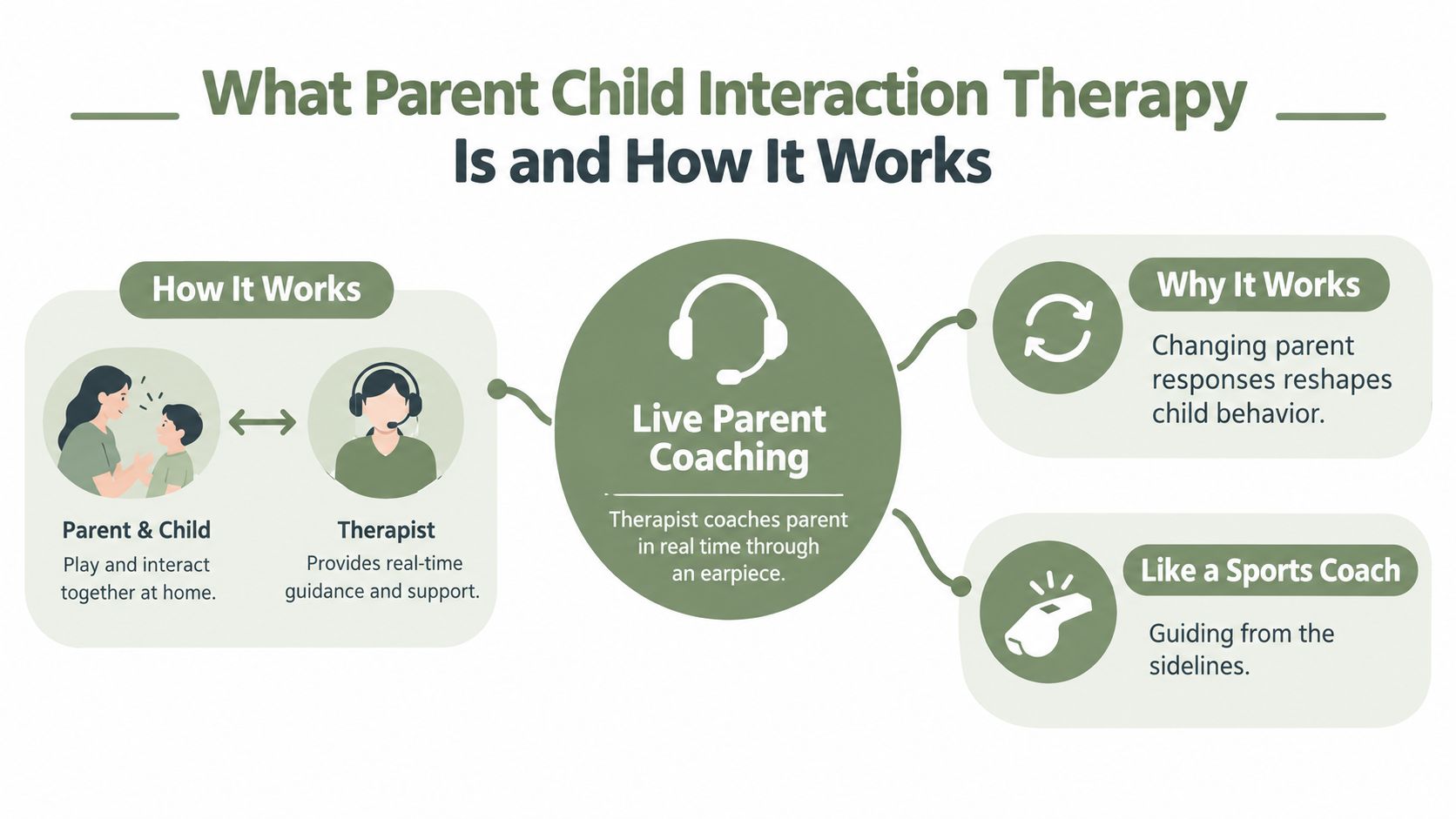
PCIT is easiest to understand as live parent coaching. The child and caregiver interact while the therapist observes. The therapist then offers short, specific prompts that help the parent use a skill immediately.
A sports coach provides a useful analogy. The coach doesn't run onto the field and play every position. The coach watches the athlete, identifies the next adjustment, and offers guidance through a headset or from the sidelines. In PCIT, the caregiver remains the person interacting with the child. The therapist supplies timing, feedback, and support.
The live feedback loop
The process usually follows a simple loop:
- The child behaves in a natural way during play or a routine.
- The caregiver responds using the skill being practiced.
- The therapist observes the interaction.
- The therapist gives a brief prompt, encouragement, or correction.
- The caregiver tries the response again.
- The child experiences a more predictable interaction.
That immediate loop makes PCIT different from advice given after the fact. A parent might understand the phrase “praise positive behavior,” but live coaching helps answer practical questions: What exactly should I praise? How quickly should I say it? What should I do when my child ignores me? How can I avoid turning praise into a long lecture?
Why the parent-child relationship is central
PCIT assumes that behavior changes within relationships. When a child receives more attention for cooperation, communication, and appropriate play, those behaviors have more opportunity to become part of the interaction. When caregivers respond to refusal with clear, predictable steps, the child gets less mixed information about what a direction means.
This isn't child-only therapy, and it isn't ordinary talk therapy with a child sitting across from an adult. The caregiver is practicing the intervention with the child present. The therapist helps the family build skills that can transfer to toys, meals, dressing, transitions, public outings, and other routines.
The therapist may coach a parent to describe what the child is doing, reflect the child's words, offer specific praise, avoid unnecessary questions, and give a direction in a way the child can understand. Later, the therapist may help the parent give one clear instruction, wait, and respond consistently if the child complies or refuses.
The goal isn't to control every moment. It's to make the caregiver's responses warmer, clearer, and more predictable, so the child has a better chance to understand what's expected and how to succeed.
The Two Phases of PCIT and What Each Teaches
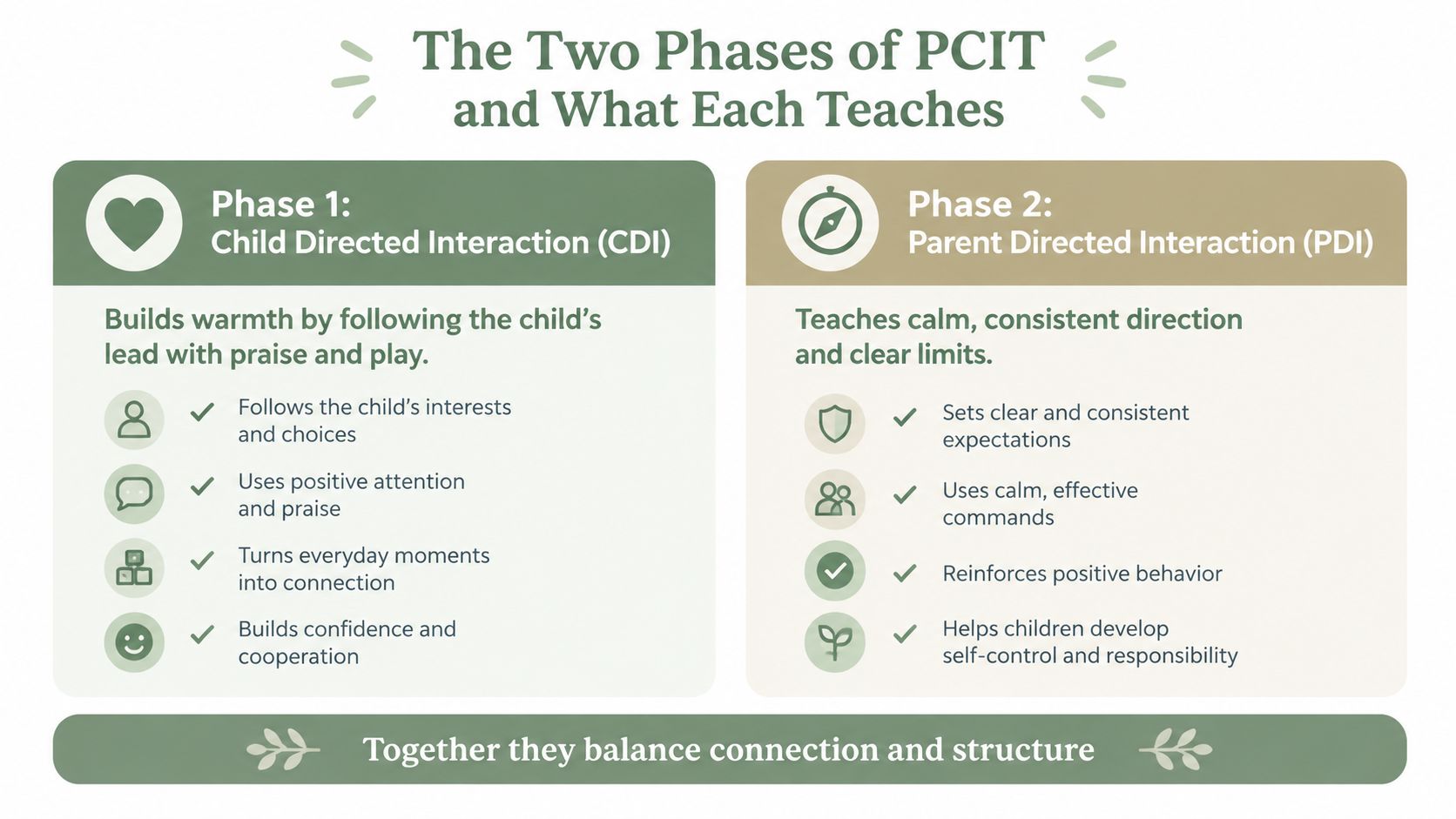
PCIT has two distinct phases. Child Directed Interaction (CDI) focuses on connection and positive interaction. Parent Directed Interaction (PDI) adds structure, directions, and calm limit setting. The phases work together, but they don't ask the caregiver to do the same job.
Child Directed Interaction
In CDI, the caregiver follows the child's lead during a short, structured play period. The parent doesn't direct the game, quiz the child, or correct every detail. Instead, the caregiver uses the PRIDE skills:
- Praise: Notice specific behavior, such as “You put the red block on top.”
- Reflection: Repeat or restate the child's words to show attention.
- Imitation: Copy appropriate play to communicate interest.
- Description: Put the child's actions into words.
- Enjoyment: Let warmth and genuine pleasure show in your voice and face.
The caregiver also learns to reduce questions, commands, criticism, and unnecessary attention to minor behaviors. That doesn't mean ignoring safety concerns or accepting harmful conduct. It means creating a play environment where the child receives focused attention for appropriate engagement.
Parent Directed Interaction
PDI addresses situations where the child needs to follow a direction, stop an unsafe behavior, or respect a limit. The caregiver learns to make a command clear, direct, and realistic, rather than asking a question that allows accidental ambiguity.
For example, “Can you put your cup on the table?” may sound polite, but it can be unclear whether the child has a choice. A direct instruction such as “Put your cup on the table” gives the child a specific action. The caregiver then waits and follows the planned response for compliance or refusal.
The therapist coaches the parent through this sequence so the interaction doesn't turn into repeated commands, arguing, pleading, or escalating threats. The emphasis is on calm repetition and predictable consequences, not intimidation.
CDI versus PDI at a glance
| Element | Child Directed Interaction | Parent Directed Interaction | |---|---|---| | Primary purpose | Build warmth, attention, and cooperation through child-led play | Teach following directions and accepting limits | | Caregiver role | Follow the child's lead | Lead the child through a clear instruction | | Main tools | PRIDE skills and selective attention | Clear commands, praise for compliance, and consistent follow-through | | Typical setting | Special play time | Routines, transitions, safety situations, and structured tasks | | Mastery signal | The caregiver uses relationship-building skills with growing consistency | The caregiver manages directions and refusal calmly and predictably |
The sequence protects the relationship from becoming only about correction. A child who experiences positive attention and shared enjoyment has more than a list of rules. A caregiver who learns connection first can bring warmth into discipline instead of treating discipline as a contest.
For a visual explanation of how these skills look in practice, watch this PCIT overview video.
Inside a Typical PCIT Session and Home Practice
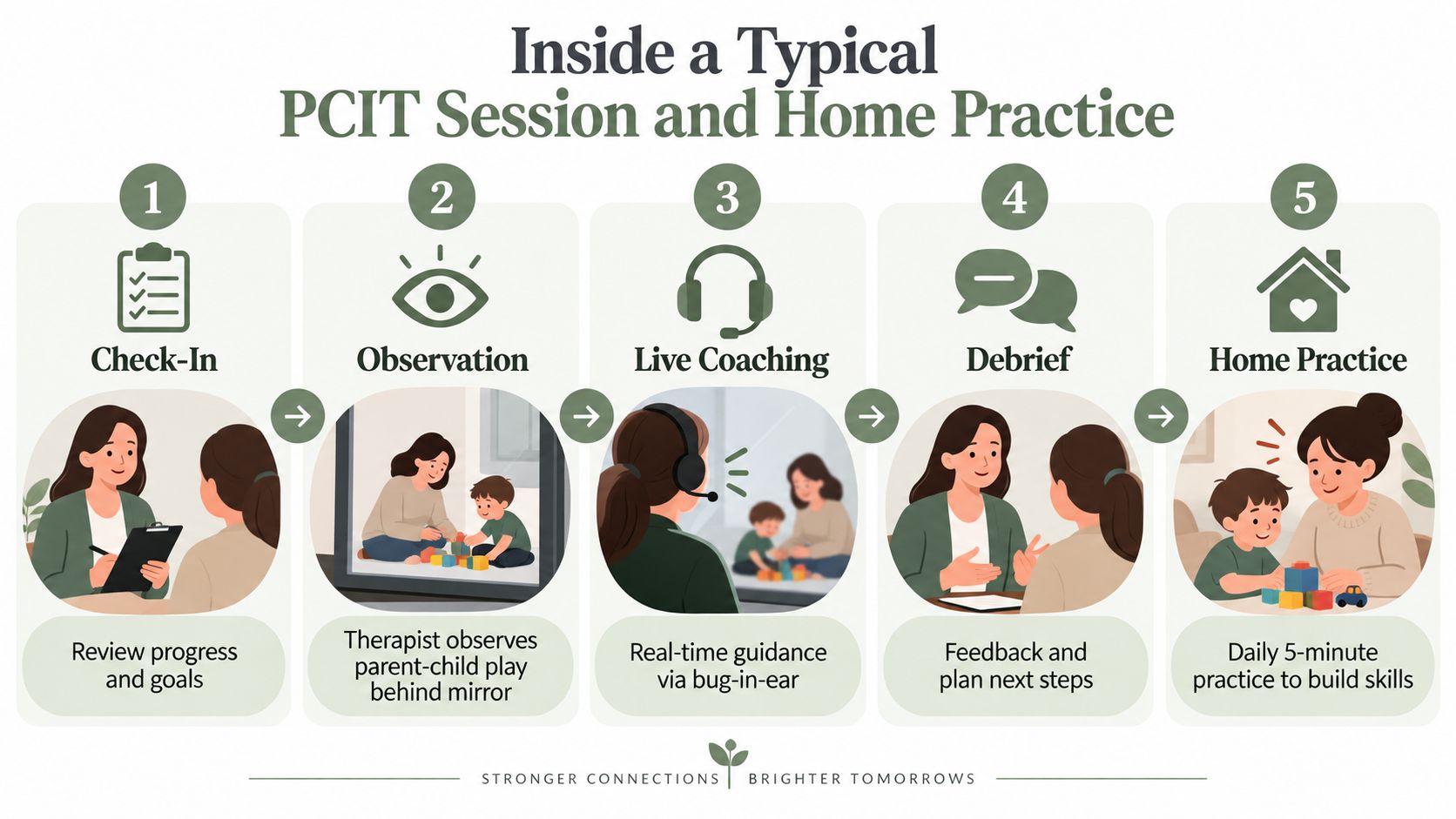
A PCIT session is active rather than purely conversational. The child and caregiver interact while the therapist watches closely, identifies teachable moments, and offers coaching that can be used immediately.
What happens during the visit
Check-in: The therapist asks about recent routines, successes, difficult moments, and the skill the caregiver wants to practice. This might involve morning preparation, sibling conflict, mealtime refusal, or a bedtime transition.
Observation: The caregiver and child play or complete a structured interaction while the therapist observes. In an office, the therapist may sit behind a one-way mirror. The room is arranged so the clinician can see and hear the interaction without taking over.
Live coaching: The caregiver wears a small earpiece, often called a bug-in-the-ear system. The therapist may say, “Praise that,” “Reflect his words,” or “Give one clear direction.” The prompts are usually brief because the caregiver needs to stay engaged with the child rather than hold a long conversation with the therapist.
Debrief: After the coached interaction, the therapist reviews what worked, answers questions, and identifies one or two skills for continued practice. Feedback should be specific enough to repeat at home.
Home practice: Families use the skills during short, planned interactions and ordinary routines. The point isn't to perform perfectly. Repeated practice helps the caregiver recognize opportunities for praise, choose clearer directions, and recover more quickly after a difficult moment.
A parent might set aside a small period for child-led play, then use the same attention skills while the child helps with a household task. The caregiver can also practice giving one direction during a transition instead of stacking several requests together.
Practical rule: Practice the skill when the child is reasonably regulated, not only during the hardest crisis of the day.
Parents sometimes use a behavior chart alongside therapy, but a chart doesn't replace live relationship practice. This guide to making a behavior chart can help families think through how visual reminders fit into a broader home plan.
Home practice may feel awkward at first. A parent who has spent years correcting behavior might find it unnatural to describe play or praise small acts of cooperation. That discomfort usually signals that the caregiver is trying a new communication pattern, not that the approach is failing.
The therapist can help adapt practice to the family's schedule. A caregiver might practice during floor play, getting dressed, preparing a snack, or cleaning up toys. The most useful routine is the one the family can repeat consistently.
Who Parent Child Interaction Therapy Helps Most
PCIT was developed for young children with disruptive behavior concerns, particularly children in the foundational age range of 2 to 7. A child may be a possible fit when daily life includes frequent tantrums, defiance, aggression, refusal, impulsive behavior, or difficulty following ordinary directions.
The concern isn't one isolated tantrum. Young children sometimes protest, lose control, or test limits. PCIT becomes more relevant when the pattern is persistent, intense, and disruptive to family routines, school participation, relationships, or safety.
Signs that coaching may fit
A consultation may be useful if your child:
- Refuses routine requests: Getting dressed, brushing teeth, cleaning up, or leaving the playground regularly leads to prolonged conflict.
- Escalates quickly: A small disappointment becomes screaming, hitting, throwing, or another intense reaction.
- Struggles with transitions: Moving from preferred activities to meals, school, errands, or sleep repeatedly ends in a battle.
- Needs repeated commands: You find yourself asking over and over, raising your voice, or adding threats to get a basic task started.
- Affects the whole household: Siblings avoid certain activities, caregivers disagree about responses, or family outings have become difficult to manage.
Families don't need to wait for a formal diagnosis before asking about support. PCIT may be considered alongside evaluation or treatment for concerns such as ADHD, autism, trauma exposure, anxiety, or other developmental and behavioral needs. The clinician should determine whether standard PCIT fits or whether modifications and additional services are needed.

When another service may be needed
PCIT focuses on caregiver-child interaction and disruptive behavior. A child with significant language delay may need speech-language services. A child with safety risks, severe mood symptoms, trauma-related symptoms, or complex developmental needs may benefit from coordinated care rather than one intervention alone.
Older children may also need a different adaptation or treatment format. Although later evidence has examined children ages 2 to 13, the original model's early-childhood focus remains important, and families should ask a trained clinician how age and developmental level affect the treatment plan. The broader findings are discussed in this overview of child behavior problems.
Bring concrete examples to a consultation. Describe what happens before the behavior, what your child does, how adults respond, and what happens next. Also mention sleep, communication, school feedback, medical concerns, family stress, and any safety issue. These details help the clinician decide whether PCIT alone is appropriate or whether it should be combined with another form of care.
Evidence Behind PCIT and What Sustains Progress
PCIT has a substantial quantitative evidence base. A 2017 meta-analysis pooled 23 studies involving 1,144 participants and found that PCIT outperformed control conditions for child externalizing behavior, with a standardized mean difference of -0.87. The same analysis found reductions in parent stress, with a mean difference of -6.98, and child stress, with a mean difference of -9.87. Children also showed greater compliance with parent requests, with a standardized mean difference of 0.89. These figures are reported in the PubMed record for the 2017 meta-analysis.
Put plainly, the research suggests that PCIT can produce meaningful short-term improvements in disruptive behavior, caregiver stress, and cooperation. A later meta-analysis reported a similar overall effect versus control or treatment as usual, d = -0.87, and a pre-post change of d = -1.40, supporting PCIT as an established intervention for disruptive, hyperactive, negative, and externalizing behavior problems.
Improvement and maintenance are different questions
Families often ask whether progress will last after sessions end. A later analysis found a large between-group effect for clinically disruptive behavior in children ages 2 to 13, with g = 1.22 and a 95% confidence interval of 0.75 to 1.69. It also reported a large pre-post change, d = -1.40, with a 95% confidence interval of -1.69 to -1.10. At follow-up, however, the effect was much smaller and not statistically significant, d = -0.23, with a 95% confidence interval of -0.49 to 0.04. See the 2021 meta-analysis findings on PubMed.
That follow-up result doesn't mean families can't maintain progress. It means improvement doesn't automatically sustain itself because sessions have ended. Durable gains likely depend on completing treatment, using the skills accurately, receiving coaching with fidelity, and continuing to apply the skills after graduation.
What helps progress continue
A family is more likely to protect its gains when caregivers:
- Keep noticing positive behavior: Praise and attention remain useful after formal coaching ends.
- Use directions consistently: A clear instruction followed by a predictable response is easier for a child to understand.
- Practice during real routines: Skills become more available when they're used beyond the therapy room.
- Coordinate adult responses: Caregivers don't need identical personalities, but they benefit from a shared plan.
- Return for support when needed: A brief setback can become a learning opportunity instead of a reason to abandon the approach.
Progress may look less like a permanently quiet household and more like quicker recovery, fewer repeated commands, and greater caregiver confidence during difficult transitions.
Starting PCIT and Making It Work at Home and via Telehealth
A bedtime routine may end with repeated directions, a tantrum, and a parent unsure what to try next. Before contacting a provider, note two or three routines that create the most stress. Record the exact direction, your child's response, what you do next, and what follows. These details give the clinician a practical starting point.
Ask a potential provider whether sessions include live coaching, how progress is measured, and how caregivers practice between visits. Also ask how the therapist adapts PCIT for developmental differences, language needs, or co-occurring concerns. PCIT should feel like guided practice, not child-only treatment. During an interaction, the therapist may speak through an earpiece with brief prompts such as praising a specific behavior or giving a clear direction. You try the skill immediately, much like having a driving instructor offer a quiet correction while you remain at the wheel.
Telehealth can help when travel, childcare, scheduling, or distance makes office visits difficult. A 2025 review described PCIT as effective across disruptive behavior conditions and in specialized and community settings, while noting that access barriers remain. Digital evidence is still developing. One online pocket-PCIT program reported improved child behavior, Cohen's d = 0.87, and reduced parenting distress, d = -0.3, as described in this 2025 telehealth PCIT review.
The review also described a community study in which time-limited telehealth PCIT produced child behavior and compliance outcomes no worse than in-person care among a socioeconomically, linguistically, and culturally diverse sample. Remote coaching still requires preparation. Reliable technology, a camera that shows the interaction, privacy, caregiver participation, and a therapist experienced in telehealth all support useful sessions.
Wald Behavioral Health provides parent guidance for tantrums, sleep, school refusal, separation, and noncompliance, with in-person and telehealth services available across Florida, Maryland, and PSYPACT-participating states. Ask how the practice supports skill use between visits and whether the format fits your family's routines.
Begin with one consultation, one routine to observe, and one interaction you most want to change. Perfect notes are unnecessary. A trained clinician can help turn what happens at home into a practical next step.
Wald Behavioral Health offers structured parent guidance and child-focused therapy for these concerns, with in-person and telehealth options. Visit Wald Behavioral Health to request a free 15-minute consultation and discuss whether parent child interaction therapy fits your family.
Questions about your child or teen?
Dr. Wald offers a free 15 minute consultation to talk through what you are seeing and whether the practice is a good fit.
Free 15 Minute Consultation