Child Behavior Problems: A Parent's Guide
A child screams in the grocery store because the available cup is the “wrong” color. You try to stay calm, but the aisle feels smaller with every stare, your child's distress rises, and your own patience starts to disappear. By the time you reach the checkout, you may be wondering whether you caused this, whether everyone is judging you, and how many more difficult moments your family can manage.
You're not alone, and your child's behavior isn't proof that you're a bad parent. In the United States, the CDC reported that 8% of children ages 3 to 17 had a current, diagnosed behavior disorder, including 10% of males and 5% of females. The same CDC data found that 7.4% had a current behavioral or conduct problem, representing about 4.5 million children in 2016. Between 2016 and 2021, the lifetime prevalence of mental, behavioral, and developmental disorders among U.S. children ages 3 to 17 rose from 25.3% to 27.7%, according to the CDC's child mental health data.
Those figures don't define your child. They do show that child behavior problems are a significant pediatric health concern, not a private failure happening in your home. The useful question isn't “How do I make my child obey?” It's “What is this behavior communicating, and what skill or support does my child need next?”
## Table of Contents - When Behavior Problems Feel Overwhelming - Understanding the Spectrum of Child Behavior Problems - Typical developmental behavior - Emerging difficulties - Clinical-level concerns - The Hidden Factors Driving Modern Behavior Challenges - Sleep and daily regulation - Anxiety and school stress - Recognizing When to Seek Help - Use the ABC pattern - Look for impact and persistence - Evidence-Based Approaches That Actually Work - Practical Strategies for Daily Life - Prevent avoidable escalation - Respond without adding fuel - Finding the Right Professional Support
When Behavior Problems Feel Overwhelming
After the grocery-store meltdown, you might replay the scene on the drive home. You may remember the raised voice, the kicking feet, and the moment you gave your child the preferred cup to end the ordeal. Then guilt arrives. You wonder whether you rewarded the outburst, whether you should have left the store, or whether another parent would have handled it better.
These thoughts are understandable, especially when challenging behavior appears repeatedly. A child who refuses school, hits a sibling, screams through bedtime, or collapses during screen transitions can leave caregivers feeling powerless. Parents often search late at night for answers, moving between discipline advice, diagnostic checklists, and alarming stories that make ordinary uncertainty feel like an emergency.
Your child's behavior is information, not a verdict on your parenting.
Child behavior problems have also been recognized as a broad public-health concern for many years. A CDC summary of older U.S. survey data reported that, in 2003, about 2.7 million children ages 4 to 17, or roughly 4.8% to 5%, had definite or severe difficulties involving emotions, concentration, behavior, or relationships with others. Earlier national estimates found that 13.4% of children ages 3 to 17 had an emotional or behavioral problem lasting at least three months or requiring psychological treatment, while 19.5% had one or more developmental, learning, or emotional disorders, as summarized in this CDC National Health Statistics report.
Numbers can normalize the experience, but they don't tell you what your child needs. A tantrum may reflect hunger, fatigue, limited language, anxiety, sensory overload, or an immature ability to shift plans. Aggression may signal frustration, fear, impulsivity, or a learned pattern that has accidentally helped the child escape a demand.
Your task isn't to excuse harmful behavior. It's to respond without shame and investigate the pattern with curiosity. When parents understand the message beneath the action, they can set firm limits while teaching the missing skill.
Understanding the Spectrum of Child Behavior Problems
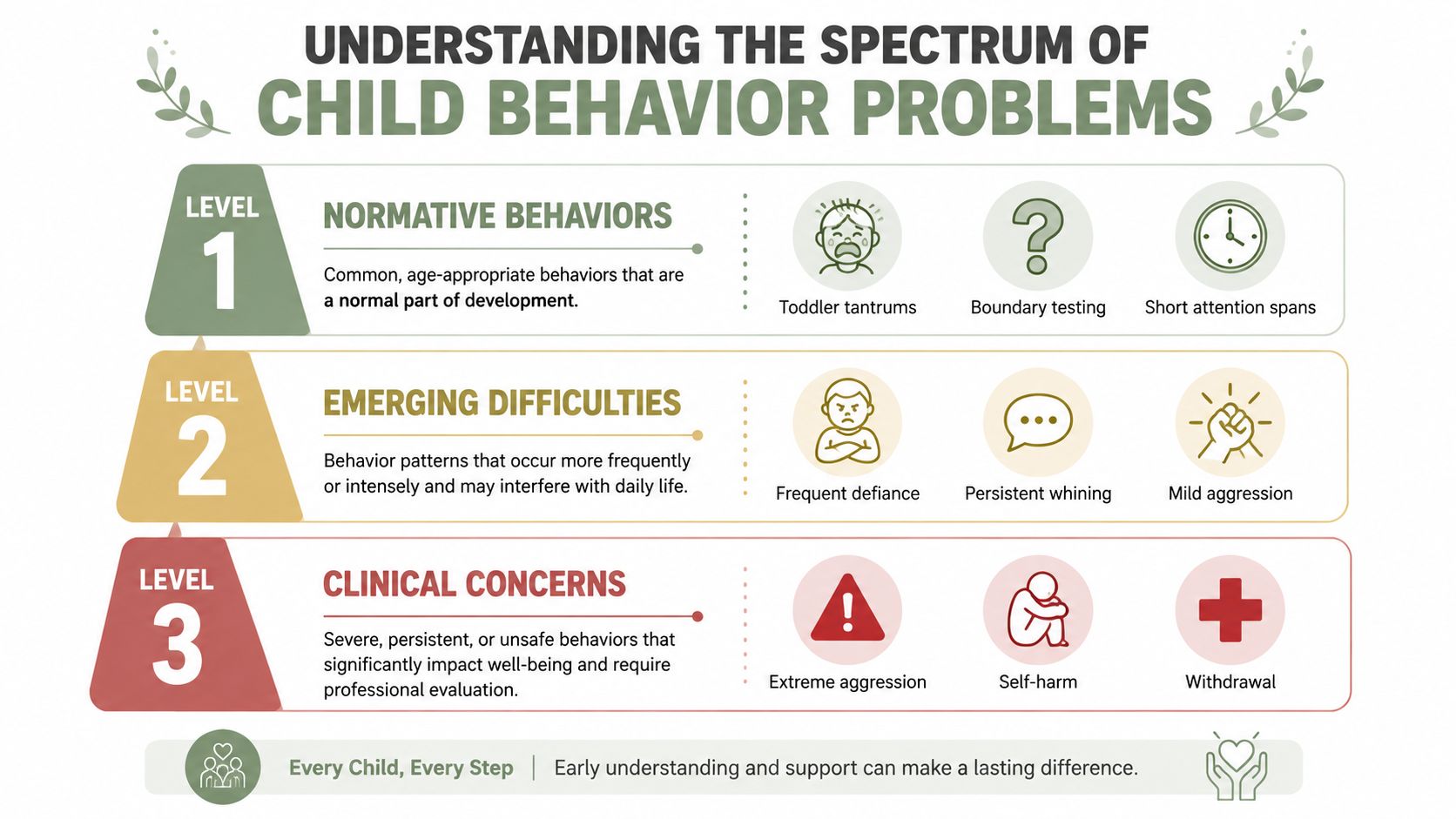
Child behavior problems sit on a spectrum. A behavior becomes more concerning when it is more intense, more frequent, longer-lasting, less flexible, or more disruptive than expected for the child's developmental stage. The same action can be ordinary at one age and a sign of difficulty at another.
Typical developmental behavior
Young children may have tantrums because they cannot yet regulate strong emotions or explain what they need. A toddler might cry when a parent says no, throw a toy after losing a turn, or resist putting on shoes. A school-age child may test rules, argue about chores, or lose focus during a long task.
These behaviors can exhaust a family, yet they often ease with sleep, predictable routines, connection, and consistent limits. The child usually returns to play, accepts comfort eventually, and functions reasonably well across settings. A difficult moment is not automatically a disorder.
Emerging difficulties
Concern grows when a behavior happens often, lasts longer, spreads across settings, or interferes with family life, learning, friendships, or sleep. Examples include frequent aggression toward siblings, persistent defiance around ordinary requests, intense whining that dominates routines, or withdrawal from activities the child once enjoyed.
Context changes the meaning. Hitting a sibling once after a conflict differs from repeated aggression that causes injury or makes the family avoid shared spaces. Refusing school after a major transition may be a temporary reaction. Ongoing avoidance with stomachaches, panic, or disrupted sleep suggests that anxiety or another stressor may need attention.
The behavior may also reflect several pressures working together. Poor sleep, heavy screen use, worry, and school stress can lower a child's capacity to cope, especially as many families continue adjusting to post-pandemic changes in routines and expectations. In that situation, discipline alone may miss part of the problem.
Clinical-level concerns
Clinical concerns can include extreme aggression, self-harm, severe withdrawal, conduct problems, oppositional defiant disorder, or behavior connected with anxiety, attention difficulties, trauma, or another developmental condition. A qualified professional considers the child's age, how long the pattern has lasted, its effect on daily functioning, developmental history, and behavior across settings before making a diagnosis.
The goal is to identify the pattern early and match support to the underlying need. A child who hits may have difficulty controlling impulses, feel threatened, seek attention, avoid a difficult demand, or repeat an interaction they have observed. Labels such as “difficult” or “bad” close off that investigation.
Describe what happened, when it happened, what came before it, and what followed. That information helps adults set firm limits while teaching the skill the child is still developing.
The Hidden Factors Driving Modern Behavior Challenges
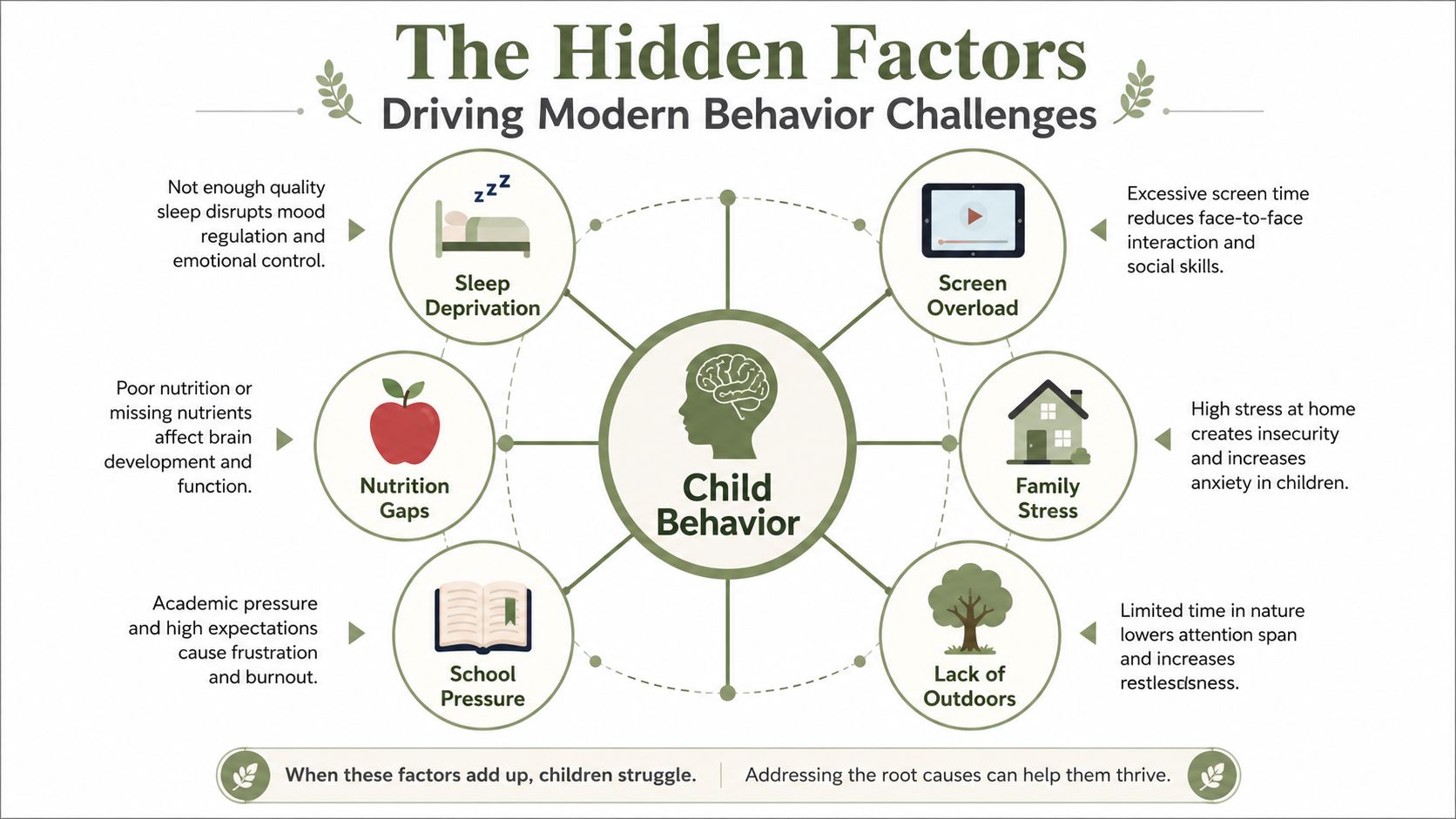
A child who melts down at bedtime may not be refusing sleep to challenge authority. The child may be overtired, overstimulated by a fast-paced video, worried about the next school day, or seeking connection after a day with little unhurried family time. Several small pressures can meet at the same moment and appear as one dramatic behavior.
Sleep and daily regulation
Sleep supports attention, mood control, and flexible thinking. When a child sleeps poorly, ordinary frustrations can feel unmanageable. A tired child may look hyperactive rather than sleepy, argue over small requests, or lose control during transitions.
Screens can add another layer. Digital media may provide enjoyment and connection, but fast stimulation can make slower activities feel boring. Screen use can also displace outdoor play, conversation, movement, and predictable family routines. The goal isn't to treat every screen as harmful. It's to notice whether screens are crowding out the experiences your child needs for regulation.
Anxiety and school stress
Children don't always say, “I'm anxious.” Worry may appear as irritability, refusal, perfectionism, physical complaints, clinginess, or anger when adults mention school. A child who avoids a classroom may be trying to escape embarrassment, separation, academic pressure, social conflict, or an unknown situation.
Recent post-pandemic data reinforce the need to look beyond isolated discipline problems. A 2025 report found behavioral and conduct problems rose from 9.2% in 2019 to 10.3% in 2022, while ADHD reached 12.8% in 2022. In a 2025 educator survey, 48% of educators said student behavior was a lot worse than before the pandemic, and nearly half said behavior problems had become more serious, as reported by HealthDay's child health coverage.
Problematic social media use also rose from 7% to 11% across 44 countries in Europe, Central Asia, and Canada, according to the same report. These findings don't prove that screens cause a particular child's behavior. They do support asking how online experiences, sleep, anxiety, peer relationships, and school demands interact.
For concerns involving attention, impulsivity, or regulation, parents may also find an overview of ADHD and related concerns useful. A child's behavior becomes easier to understand when adults examine the full ecosystem rather than focusing only on the visible outburst.
Recognizing When to Seek Help
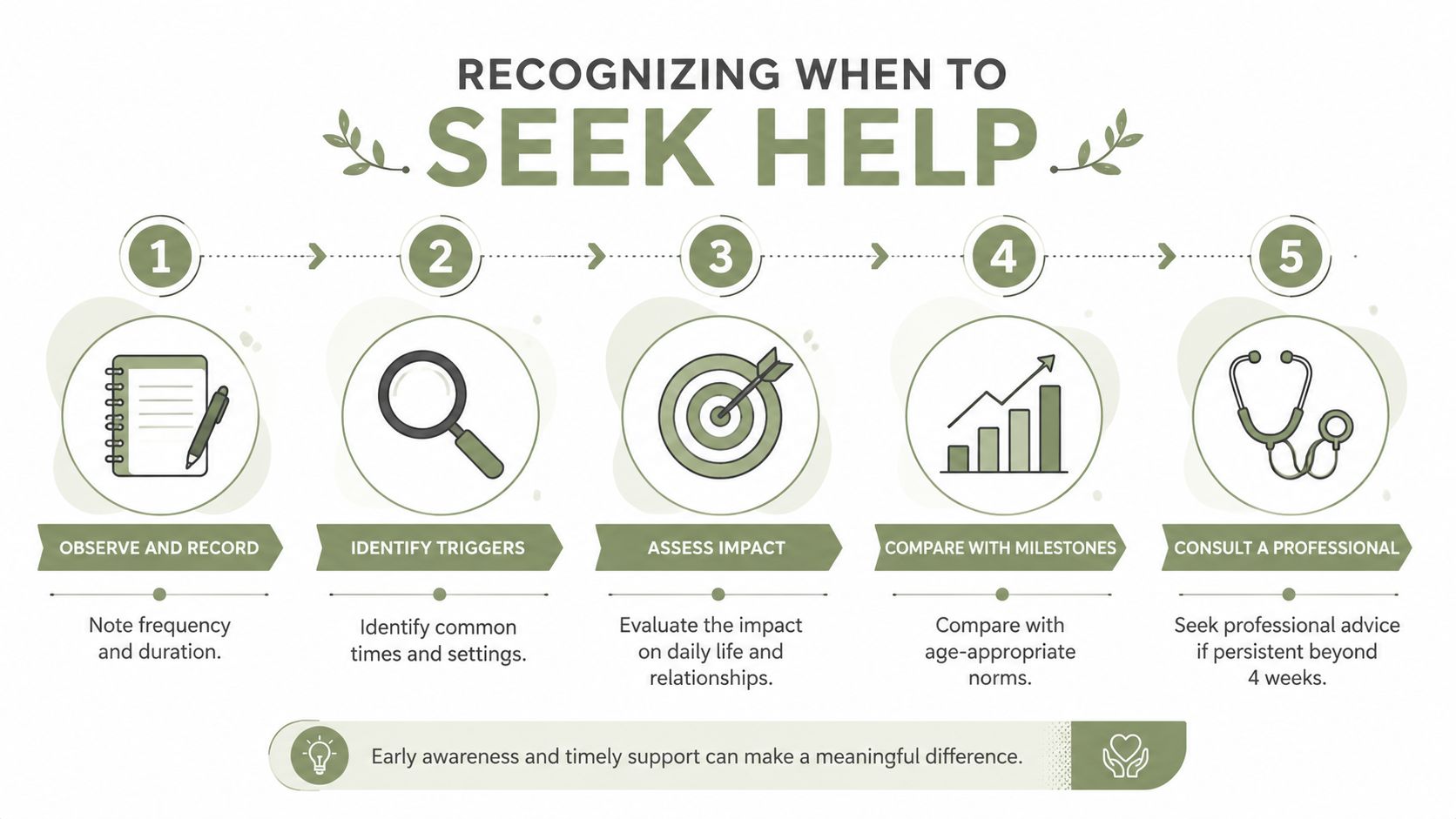
Parents don't need to diagnose a disorder at home. They can collect useful observations that show whether a pattern is occasional, situational, or interfering with daily life.
Start with four questions:
- Frequency: How often does the behavior occur?
- Intensity: How severe is it, and does anyone get hurt?
- Duration: How long does recovery take?
- Context: Does it happen at home, school, bedtime, with siblings, or during transitions?
Use the ABC pattern
The ABC model helps organize what happens around a behavior:
- Antecedent: What happened immediately before?
- Behavior: What did the child say or do, using observable details?
- Consequence: What happened afterward, including how adults and siblings responded?
For example, a parent might record: “After the tablet was turned off, Maya screamed, threw the controller, and kicked the sofa. Dad returned the tablet for five minutes. Maya stopped crying.” This record suggests that the behavior may be maintained by regaining access, but it doesn't establish a diagnosis. It gives a clinician a starting point for changing the transition plan.
Look for impact and persistence
Seek professional guidance when aggression continues beyond the preschool years, when a child withdraws from previously enjoyed activities, or when behavior disrupts school attendance, learning, friendships, sleep, or family safety. Immediate help is appropriate for self-harm, threats of serious harm, dangerous aggression, or behavior that puts a child or another person at risk.
A short log can include the date, setting, trigger, sleep quality, food or medication changes, behavior, adult response, and recovery. School observations matter because a child may hold it together in class and unravel at home, or show the opposite pattern. Bring teacher notes, report cards, and your own examples to the pediatrician or behavioral clinician.
A new sibling, classroom change, move, or family stressor can produce a temporary reaction. If the behavior remains intense after the situation settles, spreads across settings, or continues to limit the child's life, an assessment can clarify whether anxiety, ADHD, learning difficulty, mood concerns, or a behavior disorder is contributing.
Evidence-Based Approaches That Actually Work
Effective behavioral treatment usually changes the interaction between the child and the adults around them. That doesn't mean parents caused the problem. It means caregivers have frequent opportunities to shape routines, reinforce useful behavior, respond consistently, and teach regulation skills.
Parent training has particularly strong support for early conduct and disruptive behavior problems. A Cochrane review found statistically significant reductions in child conduct problems when group-based behavioral or cognitive-behavioral parent training was used. The review reported parent-rated effects around SMD -0.53 and independent-assessment effects around SMD -0.44, along with short-term improvements in parenting skills and parental mental health. It estimated program delivery costs at about $2,500 per family, as summarized in this Cochrane review of parent-training interventions.
| Approach | Core method | Best for | Evidence level | |---|---|---|---| | Parent-Child Interaction Therapy | A therapist coaches the caregiver during live parent-child interactions | Young children with disruptive behavior, defiance, or intense parent-child conflict | Strong evidence-based approach | | Triple P Positive Parenting Program | Structured parent education with support matched to family need | Parents seeking practical skills for routines, limits, and recurring behavior concerns | Evidence-based parent-training model | | Collaborative and Proactive Solutions | Identifies lagging skills and solves problems collaboratively | Children whose behavior reflects inflexibility, frustration, or difficulty meeting expectations | Structured, skills-focused approach | | Traditional behavior modification | Uses clear expectations, reinforcement, and predictable consequences | Specific behaviors that respond to consistent environmental changes | Useful when applied thoughtfully and developmentally |
Punishment-heavy approaches can backfire when they increase fear, shame, or conflict without teaching the child what to do instead. A calmer plan might reinforce a child for asking for help, use a brief predictable consequence for hitting, and practice the replacement skill when everyone is regulated.
Parents who want practical ideas for supporting parents with behavior management can use that resource as a supplement, not a substitute for individualized care. For a clinical overview of treatment options, see behavioral therapy for kids. Look for providers who explain the rationale, measure progress, involve caregivers, and adapt the plan when a strategy isn't working.
Practical Strategies for Daily Life
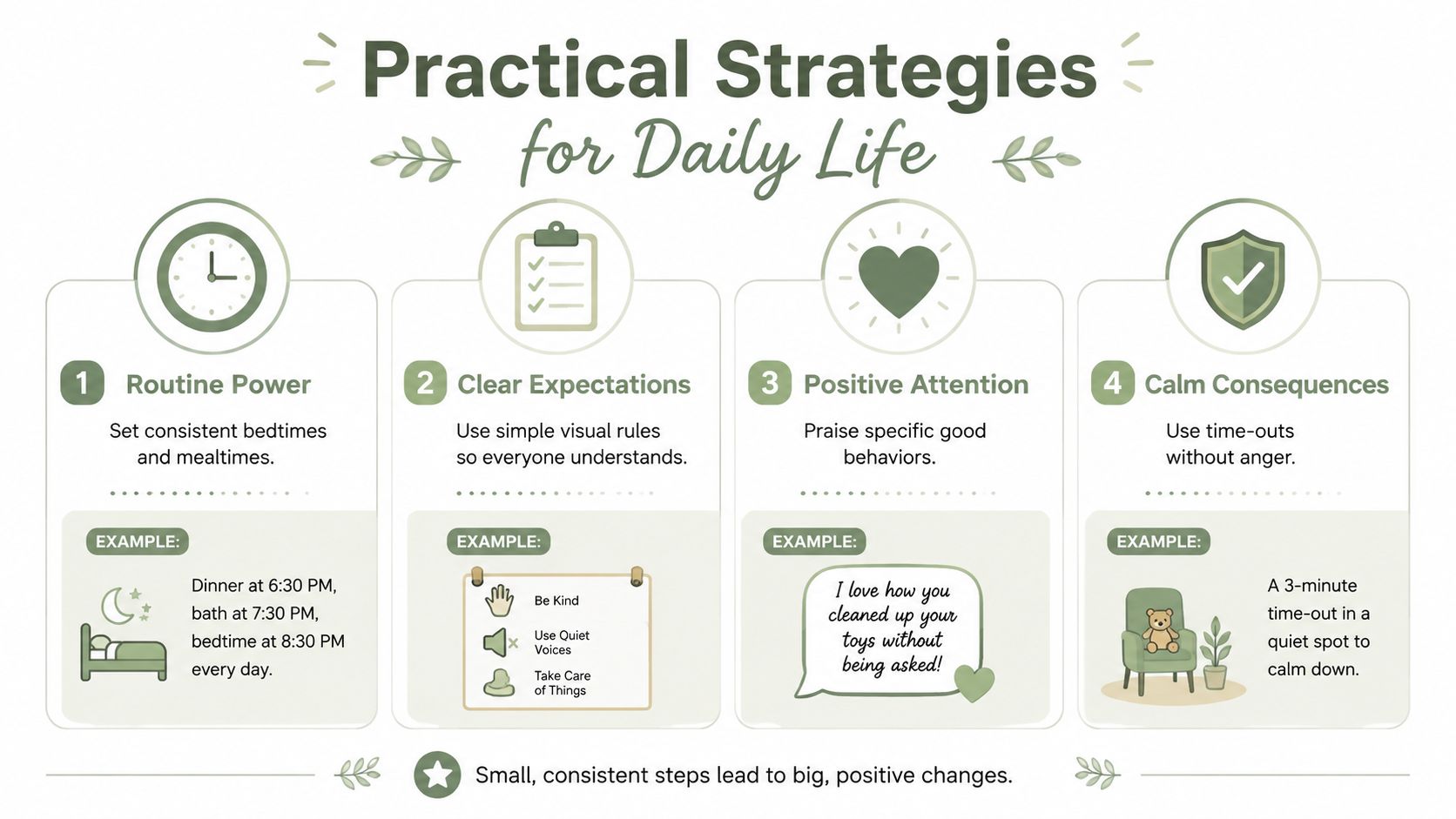
Small changes work best when parents introduce them one at a time. Start with the routine that causes the most conflict, such as bedtime, morning preparation, or ending screen use.
Prevent avoidable escalation
Create a short visual sequence for the morning: toilet, clothes, breakfast, teeth, shoes. Give one direction at a time, move close to your child, and ask them to repeat the first step. Before turning off a screen, give a clear warning and offer a concrete next activity, such as “When the timer ends, the tablet goes on the shelf and we'll choose pajamas.”
Specific praise is more useful than general approval. Say, “You stopped your body when I said freeze,” or “You came back to the table even though you were frustrated.” Positive attention teaches your child which behaviors help the family function.
Respond without adding fuel
For minor attention-seeking whining, planned ignoring can help if you first teach the acceptable request and remain consistent. Don't ignore aggression, destruction, dangerous behavior, or distress that suggests fear. Use a calm, brief consequence connected to the action, then return to teaching and repair.
Try these scripts:
- Bedtime: “You want more play. It's sleep time. You can walk to bed or I can help you.”
- Sibling aggression: “I won't let you hit. Hands are for safety. You can say, ‘Move please,’ or take space with me.”
- Screen transition: “The show is ending. You can turn it off, or I'll help. Then we'll have snack.”
- Public tantrum: “You're upset about the cup. I won't change the limit. We can breathe here, or we can leave.”
During a crisis, regulate first and teach later.
Lower your voice, relax your shoulders, and take one slow breath before speaking. If you're close to shouting, secure the children, step back briefly, and ask another adult for support when possible. Afterward, reconnect: “We both had a hard moment. I'm sorry I yelled. Next time we'll practice asking for a break.”
For broader parent guidance, families can explore resources for parents. If a calm-out space is useful, focus on safety and supervision rather than buying a special product, though parents comparing options may review guidance on how to find the best time out chair. Practice one strategy consistently before adding another.
Finding the Right Professional Support
Seeking help doesn't mean you've failed. It means the behavior has become difficult to understand or manage with the tools currently available, and your child deserves a more precise plan.
A pediatrician can screen for medical, developmental, sleep, medication, hearing, or learning factors and refer you onward. A pediatric psychologist may assess behavior, anxiety, mood, attention, development, and family interaction. A child psychiatrist can evaluate psychiatric conditions and medication needs. A behavioral therapist may provide structured skill-building, while a school counselor can coordinate classroom supports and monitor school-based impairment.
The right professional depends on the pattern. Severe parent-child conflict may fit Parent-Child Interaction Therapy. Worry and avoidance may call for Cognitive Behavioral Therapy. School refusal may require coordination among the family, clinician, and school. Families seeking regional services can also review options for Columbus family counseling, especially when conflict affects several relationships.
During an initial assessment, expect questions about development, health, sleep, school, friendships, family stress, strengths, triggers, and what adults have already tried. A provider should explain the treatment model, invite parent participation when appropriate, discuss safety, and describe how progress will be tracked. Be cautious if someone blames the child or parent, promises instant results, dismisses school information, or refuses to adjust an ineffective plan.
Wald Behavioral Health provides evidence-based therapy and parent guidance for concerns including tantrums, sleep difficulties, school refusal, separation, noncompliance, anxiety, ADHD, and school stress, with in-person care in Coral Gables and telehealth options for eligible clients.
---
If child behavior problems are disrupting sleep, school, safety, or family relationships, schedule a consultation rather than waiting for the next crisis. Visit Wald Behavioral Health to learn about child therapy, parent training, family involvement, and a free 15-minute consultation to discuss your needs and fit.
Questions about your child or teen?
Dr. Wald offers a free 15 minute consultation to talk through what you are seeing and whether the practice is a good fit.
Free 15 Minute Consultation