Miami Child Psychologist: A Parent Guide

Your child has started complaining about stomachaches every Sunday night. Mornings have become negotiations, homework takes far longer than it used to, or tantrums seem impossible to settle. You may be searching for a Miami child psychologist because you want practical help, not another list of symptoms.
A good evaluation looks beyond the behavior itself. It asks what happens before and after it, how your child functions at school and home, what caregivers are doing under pressure, and whether language, culture, medical factors, or a recent transition are shaping the problem. Effective care should give your family specific skills to practice, not just a place to talk.
## Table of Contents - Understanding the Need for Pediatric Mental Health Care - Miami context matters - How Evidence-Based Treatment Actually Works - Parent training changes the environment - Exposure makes anxiety treatment practical - Evaluating Cultural and Linguistic Responsiveness - Questions worth asking before treatment - Navigating School Refusal and Acute Distress - Use a stepwise escalation plan - Choosing Between In-Person and Telehealth Sessions - Compare the practical trade-offs - Taking the First Step with Wald Behavioral Health - Make the consultation useful
Understanding the Need for Pediatric Mental Health Care
Childhood mental-health concerns are common, and seeking support doesn't mean you've failed as a parent. National CDC data on children's mental health indicate that nearly 1 in 5 U.S. children ages 3, 17, approximately 21% in 2021, had ever been diagnosed with a mental, emotional, or behavioral condition. The same source reports current diagnosed anxiety in 11% of children in that age range and current diagnosed depression in 4%.
Those figures aren't a local prevalence estimate for Miami-Dade, and they don't mean every child needs therapy. Diagnosis and reporting are influenced by access to care, recognition, family reporting, and clinical practice. Still, the data provide a useful national benchmark: anxiety, depression, behavioral difficulties, school impairment, and family stress affect children across developmental stages.
Miami context matters
Miami-Dade families may be managing relocation, changing schools, immigration-related stress, multigenerational households, cultural transitions, or differences between the language used at home and the language used in school. These circumstances can show up as irritability, sleep disruption, school avoidance, physical complaints, or conflict rather than a child saying, “I feel anxious.”
Miami-Dade's population has also shifted. Reporting on the 2020 Census and Florida's changing demographics found that the county lost approximately 22,000 residents under age 18 during the preceding decade, the largest absolute decline among Florida counties. That shift doesn't mean children are scarce or that demand for care has disappeared. It can affect school enrollment, family mobility, neighborhood composition, and where services are easiest to reach.
Census QuickFacts reports that 5.4% of Miami-Dade residents were under age 5 in the cited profile. Young children need developmentally appropriate observation and caregiver guidance because they often can't describe internal experiences with the precision expected of older children.
Practical rule: Get help when a pattern is interfering with school participation, sleep, relationships, safety, or family functioning, even if you aren't sure which diagnosis fits.
Language access deserves attention during assessment and treatment. If your family uses more than one language, ask how the clinician will handle interpretation, caregiver communication, and a child's preferred language. For families evaluating healthcare interpreting options, information about video remote interpreting for hospitals can also clarify why accurate communication matters in clinical settings.
How Evidence-Based Treatment Actually Works
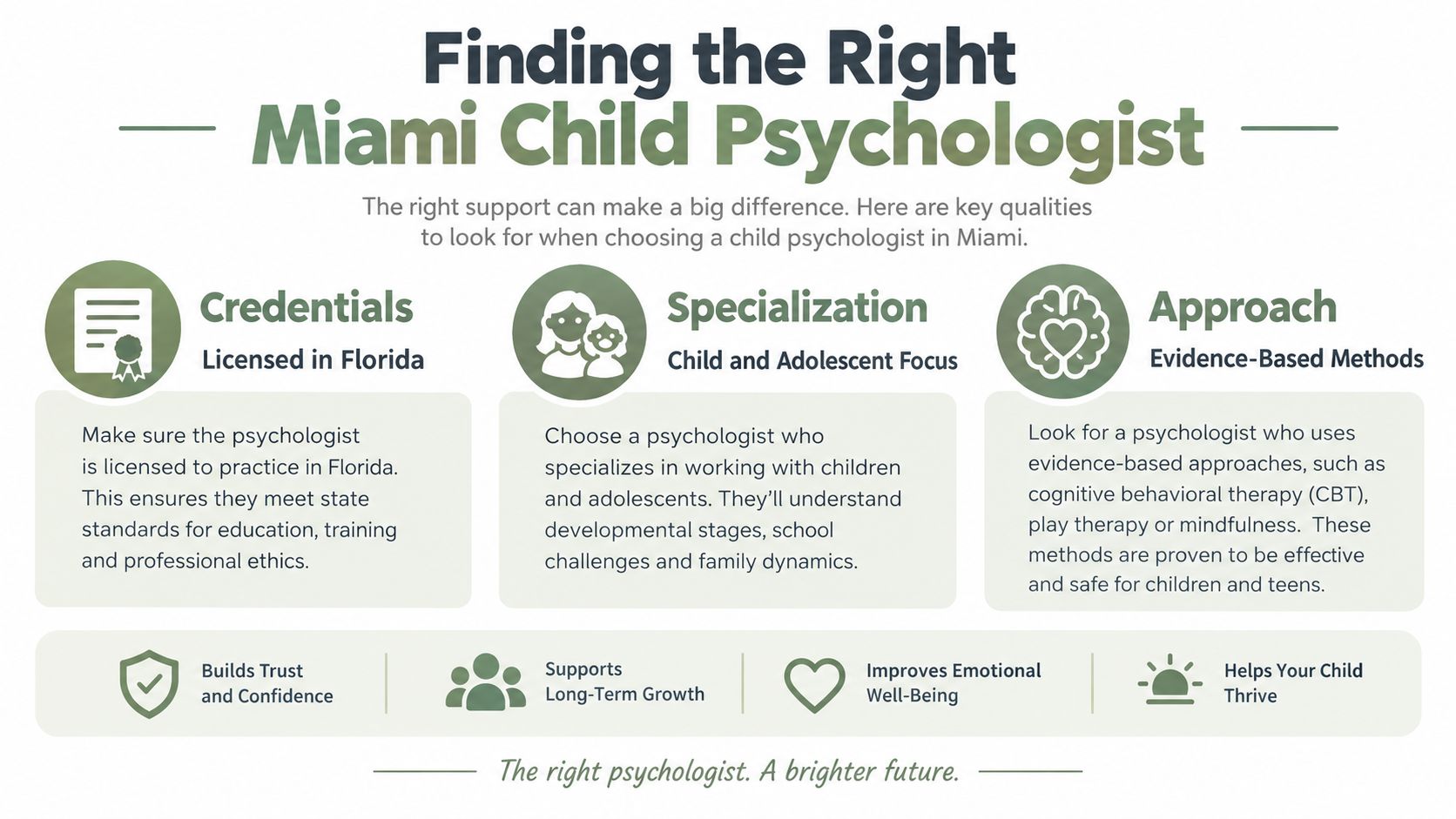
Therapy for children should be active, developmentally matched, and connected to daily life. A preschooler may learn through play and caregiver-led routines, while an adolescent may use cognitive restructuring, exposure exercises, mood tracking, or direct problem-solving. The clinician's job is to select the mechanism that changes the maintaining pattern.
Parent training changes the environment
For children younger than six with ADHD, behavioral parent training is the recommended first-line psychological intervention according to CDC guidance on behavior therapy for ADHD. The treatment doesn't ask a developmentally immature child to manage everything independently. Instead, caregivers learn to make expectations clearer and consequences more predictable.
A psychologist might define a target such as completing the morning routine, then establish a baseline for how often the child completes it and how long it takes. Caregivers practice immediate reinforcement, consistent consequences, and brief instructions. The clinician reviews what happened at home and adjusts the plan. The same principles can address tantrums, noncompliance, unsafe impulsivity, and bedtime resistance.
This is why parent participation isn't an optional add-on for many young children. The caregiver carries the intervention into breakfast, school preparation, errands, and bedtime.
For a broader explanation of how age-appropriate care is structured, parents can review what pediatric therapy involves. The useful question isn't whether a provider offers “therapy,” but what your family will do between appointments.
Exposure makes anxiety treatment practical
For school-age children and adolescents with anxiety or OCD, CBT works best when it reduces avoidance and restores functioning. A clinician and child create a graded exposure hierarchy, ranking feared situations from more manageable to more difficult. The child then practices approaching those situations repeatedly, while caregivers reduce reassurance or accommodations that unintentionally keep avoidance in place.
The American Academy of Pediatrics guidance on treating anxiety in children describes CBT as useful for children and adolescents ages 8, 18 with mild-to-moderate anxiety and emphasizes family involvement. Progress might be tracked through school attendance, sleep, participation in activities, and avoidance frequency, not only a symptom score.
Therapy that consists only of discussing worries may feel supportive but won't necessarily change the cycle. Effective care gives the child and caregivers a written plan, practices skills in real situations, and reviews whether the plan is producing functional improvement.
Evaluating Cultural and Linguistic Responsiveness
A bilingual clinician can improve access, but translation alone isn't cultural responsiveness. A provider may speak Spanish or Haitian Creole fluently and still misunderstand how a family expresses distress, approaches discipline, interprets privacy, or makes decisions across generations.
Miami-Dade families may include caregivers who prefer Spanish, Haitian Creole, or English, while a teenager prefers another language. The clinician should be able to work with that arrangement without treating one language as more legitimate than another. The pediatric mental-health literature on culturally responsive care identifies barriers that include limited coverage, provider shortages, fragmented systems, and insufficiently culturally and linguistically responsive services.
Questions worth asking before treatment
During a consultation, ask direct questions rather than relying on a directory label:
- Assessment: How do you account for cultural expressions of anxiety, depression, or physical distress?
- Family structure: How would you adapt recommendations for a multigenerational household?
- Language: Can caregivers and the child use different languages during sessions, and how will information be shared accurately?
- Immigration and identity: Are you comfortable discussing relocation stress, documentation concerns, religion, race, or stigma when they affect treatment?
- Confidentiality: How do you explain adolescent privacy to both the teenager and caregivers?
- Treatment fit: How will evidence-based methods be adapted without abandoning their core therapeutic purpose?
A culturally responsive psychologist doesn't excuse impairment as “just cultural,” nor impose a family model that doesn't fit. They separate clinical risk from culturally shaped communication and explain why a recommendation is appropriate.
A family should be able to ask, “How does this plan fit our household?” and receive a specific answer.
Pay attention to whether the provider invites correction. A clinician who asks how your family defines respect, independence, obedience, privacy, and wellness is gathering information needed for accurate care. That conversation can improve engagement and reduce the chance that a child is misunderstood because distress appears as somatic complaints, silence, anger, or resistance.
Navigating School Refusal and Acute Distress
School refusal needs a coordinated response, not a morning argument repeated indefinitely. Start by documenting the pattern: what happens before departure, which class or setting is involved, whether physical complaints appear, what helps the child enter school, and what happens after staying home. Avoid turning the record into a punishment log. Its purpose is to identify triggers and maintaining consequences.
Use a stepwise escalation plan
First, address immediate safety. If your child may hurt themselves or someone else, cannot remain safely supervised, or is experiencing a psychiatric emergency, contact emergency services or seek urgent evaluation. Routine therapy and telehealth aren't substitutes for immediate crisis care.
Next, activate the school team. Contact the school counselor, teacher, and relevant administrator. Share observable information about attendance, triggers, sleep, physical complaints, and successful transitions. Ask the school to identify what happens after arrival and whether a consistent check-in, modified transition, or designated support person is available.
Then, involve healthcare providers. A pediatrician can evaluate medical contributors to physical complaints, sleep changes, or appetite changes. A child psychologist can assess anxiety, learning concerns, ADHD, mood symptoms, family stress, and reinforcement patterns, then build a plan that works across home and school.
Finally, reassess the level of care. Outpatient behavioral treatment may fit persistent avoidance without immediate danger. Acute safety concerns require urgent assessment. Miami-Dade behavioral-health officials reported that school-initiated mobile response teams assessed crises, connected children with outpatient or alternative services, and reduced Baker Act petitions and pediatric inpatient admissions, while also noting reduced children's bed capacity and increased demand on public facilities. The Miami-Dade school refusal guidance for parents can help families think through the home and school coordination piece.
This short video can reinforce the importance of responding to school refusal with a structured plan rather than escalating conflict.
A psychologist should help define the next morning's plan in concrete terms. That might include who gives the instruction, what the child earns for each step, how the school receives the child, and what caregivers do if distress rises. The plan should include safety thresholds and a follow-up schedule.
Choosing Between In-Person and Telehealth Sessions
In-person and telehealth treatment can both be appropriate, but they offer different clinical information. An office visit gives the psychologist direct access to the child's behavior in a controlled setting. It may be preferable when a child needs a clear separation from home, has difficulty engaging through a screen, or requires assessment that depends on in-person interaction.
A Coral Gables appointment at 1390 S Dixie Hwy, Suite 1305 may suit families who want a consistent professional setting near the University of Miami. Travel, school schedules, traffic, and caregiver work responsibilities still matter. A theoretically ideal appointment isn't useful if the family can't attend consistently.
Compare the practical trade-offs
| Consideration | In-person care | Telehealth care | |---|---|---| | Observation | Shows how a child engages in the office | Can reveal routines and caregiver-child interaction at home | | Parent coaching | Allows direct practice in the clinic | Lets the clinician coach during real bedtime, morning, or homework routines | | Privacy | Provides a dedicated clinical environment | Requires a quiet, private space and reliable technology | | Access | Requires travel to the office | Can reduce travel for eligible families | | Engagement | Often easier for children who dislike screens | May work well for teens and families already comfortable with video |
Telehealth can have strong ecological validity because the clinician may observe the setting where the problem occurs. A parent struggling with bedtime can receive coaching during the routine instead of trying to recreate it from memory later. This doesn't make virtual care universally better. It makes the home environment clinically relevant.
Families considering parent-mediated remote care may find a practical overview in this FriendlyABA telehealth parent guide. The same decision principle applies broadly: choose the format that supports participation, privacy, skill practice, and continuity.
Eligibility also matters. Wald Behavioral Health provides secure telehealth for clients in Florida, Maryland, and PSYPACT-participating states, subject to applicable licensing and authorization requirements. Parents can review the practice's telehealth information and ask whether their location, concern, and preferred participants fit virtual treatment.
Taking the First Step with Wald Behavioral Health
The first contact should answer practical questions, not force you to commit before you understand the fit. Wald Behavioral Health, led by Dr. Emily Wald, provides developmentally informed therapy for children, adolescents, young adults, and families through in-person care in Coral Gables and secure telehealth for eligible clients.
The practice addresses anxiety, depression and mood concerns, OCD, ADHD, school stress, sleep difficulties, tantrums, noncompliance, bullying experiences, and adjustment to pediatric medical conditions. Services can include individual therapy, family involvement, and structured parent training for routines such as sleep, separation, school refusal, and morning transitions.
Make the consultation useful
Bring a concise description of:
- The current problem: What your child does, says, avoids, or cannot complete.
- The setting: Whether it occurs at home, school, activities, or more than one place.
- The timeline: What changed, what preceded it, and whether the pattern is worsening.
- Your goal: For example, returning to school, completing bedtime steps, reducing reassurance, or improving family communication.
- Relevant context: Medical concerns, medications, learning history, language preferences, cultural factors, and previous services.
A free 15-minute consultation can help clarify immediate needs, scheduling, modality, and whether the practice's developmental focus matches your child's situation. Flexible weekday evening and weekend appointments may be available by arrangement. If administrative coordination feels difficult, an overview of the patient intake coordinator role may help you understand the kind of information an intake process should organize.
The next step after intake should be measurable. A psychologist might establish a baseline for school attendance, bedtime duration, tantrum frequency, avoidance, or caregiver accommodations, then review progress and adjust treatment. You don't need to solve the whole problem before calling. You need enough information to start a focused conversation.
---
Wald Behavioral Health offers developmentally informed therapy, parent training, family guidance, and secure telehealth for children and adolescents facing anxiety, school refusal, ADHD, sleep difficulties, and related concerns. Visit Wald Behavioral Health to request a free 15-minute consultation and discuss the right starting point for your family.
Questions about your child or teen?
Dr. Wald offers a free 15 minute consultation to talk through what you are seeing and whether the practice is a good fit.
Free 15 Minute Consultation