What Is Pediatric Therapy and How It Helps Kids Thrive

You're in the kitchen, dinner's half-eaten, and your child is already melting down over homework, bedtime, or the idea of going to school tomorrow. You're not looking for a label as much as a way to help. That's usually where the question starts, what is pediatric therapy, and the most useful answer is simpler than it sounds.
Pediatric therapy is support for a child's growth, but it isn't one fixed service. It can mean helping a preschooler separate from a parent at drop-off, coaching a school-age child through anxiety at bedtime, or helping a teen rebuild motivation after a hard year. The child's age changes the plan, the parent's role, and even what a session looks like.
## Table of Contents - Introduction to Pediatric Therapy for Families - Understanding What Pediatric Therapy Really Means - Development changes the method - Pediatric therapy is family work too - How Pediatric Therapy Works Across Individual Family and Parent Training Formats - Common Concerns Pediatric Therapy Supports From Anxiety to ADHD - Anxiety, mood, and OCD - ADHD, sleep, and school stress - What to Expect in Pediatric Therapy Sessions Step by Step - Accessing Pediatric Therapy in Coral Gables and Through Telehealth - Taking the Next Step Toward Support for Your Child and Family
Introduction to Pediatric Therapy for Families
A lot of parents first reach for therapy after a pattern becomes hard to ignore. Maybe your child cries every morning before school, has big reactions that seem out of proportion, or keeps getting stuck on the same worry. Maybe your teen looks withdrawn and says very little, but the grades, sleep, or mood have changed enough that you know something's off.
Pediatric therapy meets those concerns in a way that fits development. A four-year-old doesn't need the same conversation style as a fourteen-year-old, and a parent usually plays a much bigger role when the child is younger. That's why pediatric therapy feels more like guided skill-building than a single conversation in an office.
Practical rule: if the problem is affecting home, school, sleep, friendships, or family routines, it's worth asking whether the issue is about coping skills, behavior patterns, anxiety, mood, or a mix of all four.
For many families, the first relief comes from realizing therapy isn't about blaming the child or the parent. It's about understanding what's getting in the way, then building a plan that makes daily life easier. A child who is overwhelmed, avoidant, impulsive, or stuck in routines often needs support that is both emotional and practical.
You'll see how that works in real life, how therapy changes with age, and what to expect if you decide to reach out. The goal is not to make every child “perfectly behaved” or “always happy.” The goal is to help them function, cope, and grow with more confidence.
Understanding What Pediatric Therapy Really Means
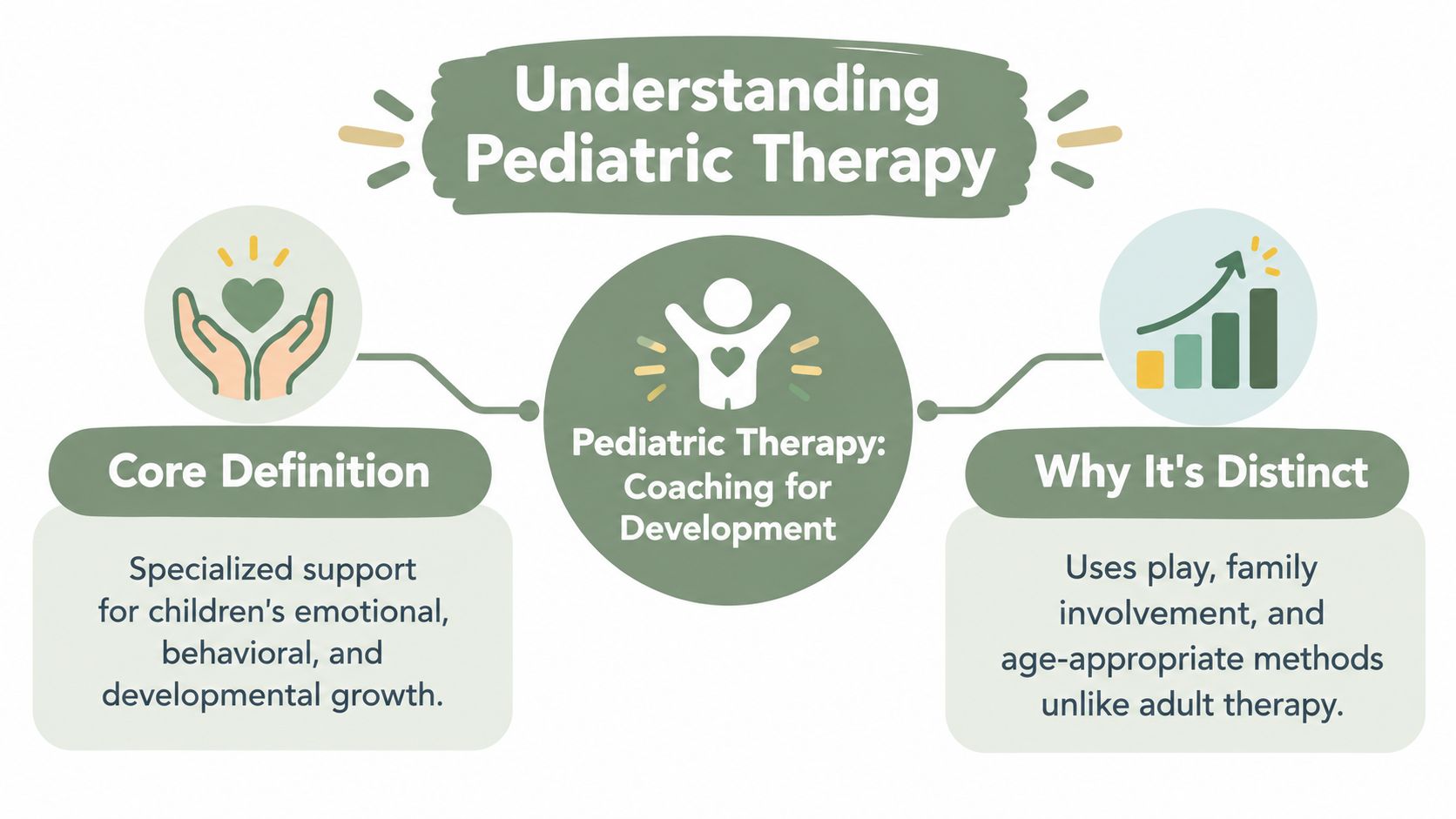
Pediatric therapy is specialized mental health care for children, adolescents, and often young adults, delivered in a way that matches how they learn. Think of it less like a lecture and more like coaching for development. A coach doesn't just talk about the game, they break skills into steps, practice them in context, and adjust the plan when the player is younger, older, shy, impulsive, or discouraged.
That's what makes this field different from adult therapy. Children are still building emotional regulation, attention, language, social judgment, and coping habits. So the therapist isn't only helping a child feel better in the moment, they're also helping the family build routines that support lasting change.
Development changes the method
A younger child usually learns through play, simple language, repetition, and parent participation. A school-age child can start naming thoughts, spotting body clues, and practicing coping tools with more structure. An adolescent may work more directly on independence, identity, motivation, and the pressure that comes with school, friends, sports, or work.
That developmental shift matters because the same concern can look very different at different ages. Separation anxiety in a preschooler may show up as crying at drop-off, while in a teen it can look like school refusal, stomachaches, or intense reassurance seeking. The need is still real, but the path into care changes.
Pediatric therapy is family work too
Young children rarely improve through child-only treatment alone. Parents usually help by carrying the plan into mornings, mealtimes, bedtime, and school communication. For older children and teens, the parent role often changes from active coach to support person, with more direct work happening with the child or adolescent.
Bottom line: therapy for children is rarely just about the child sitting in a room and talking. It's a developmental system that includes caregivers, routines, and the settings where problems actually happen.
If you want a clinical overview of how a pediatric psychologist fits into that picture, this guide from Wald Behavioral Health is a useful companion. The main idea is consistent across settings, the work is adjusted to the child's stage, the family's role, and the problem in front of them.
How Pediatric Therapy Works Across Individual Family and Parent Training Formats
Families often assume therapy is one thing, but the delivery format matters just as much as the diagnosis. Some children need individual sessions to build coping skills directly. Others need family sessions because conflict, routines, or communication patterns are part of the problem. Many younger children benefit most when caregivers get clear coaching on what to do at home.
| Format | Who Participates | Best Fit by Age and Concern | |---|---|---| | Individual therapy | Child or teen, sometimes with brief parent check-ins | Older children and adolescents working on anxiety, mood, OCD, self-esteem, school stress, or adjustment | | Family therapy | Child, parent, and sometimes siblings or caregivers | Concerns tied to conflict, routines, transitions, communication, or stress across the home system | | Parent training | Parent or caregiver, sometimes with the child present for part of the visit | Sleep problems, tantrums, school refusal, separation difficulty, and noncompliance, especially in younger children |
Individual therapy gives the child a place to practice skills at their own pace. A therapist might use drawing, role-play, worksheets, coping practice, or structured conversation depending on age. The point is not to entertain the child, it's to help them notice patterns and try new responses.
Family work is different because the problem often lives in the interaction. A child who escalates at bedtime, for example, may not need more talking in the moment, they may need the household response to become calmer and more predictable. A therapist helps the family reduce accidental reinforcement, cut down on conflict, and create a plan everyone can follow.
Parent training is especially important when the child is younger or the behavior happens mostly in daily routines. It can help with sleep resistance, tantrums, separation, school refusal, and noncompliance. If you want a practical explanation of caregiver coaching, the overview at Wald Behavioral Health is a helpful reference point.
The right format often blends all three. A child may meet individually, while parents get separate guidance on how to respond at home, and the family comes together when routines or conflict need direct repair. That flexibility is one reason pediatric care tends to work best when it fits the family's real life, not an idealized one.
Common Concerns Pediatric Therapy Supports From Anxiety to ADHD
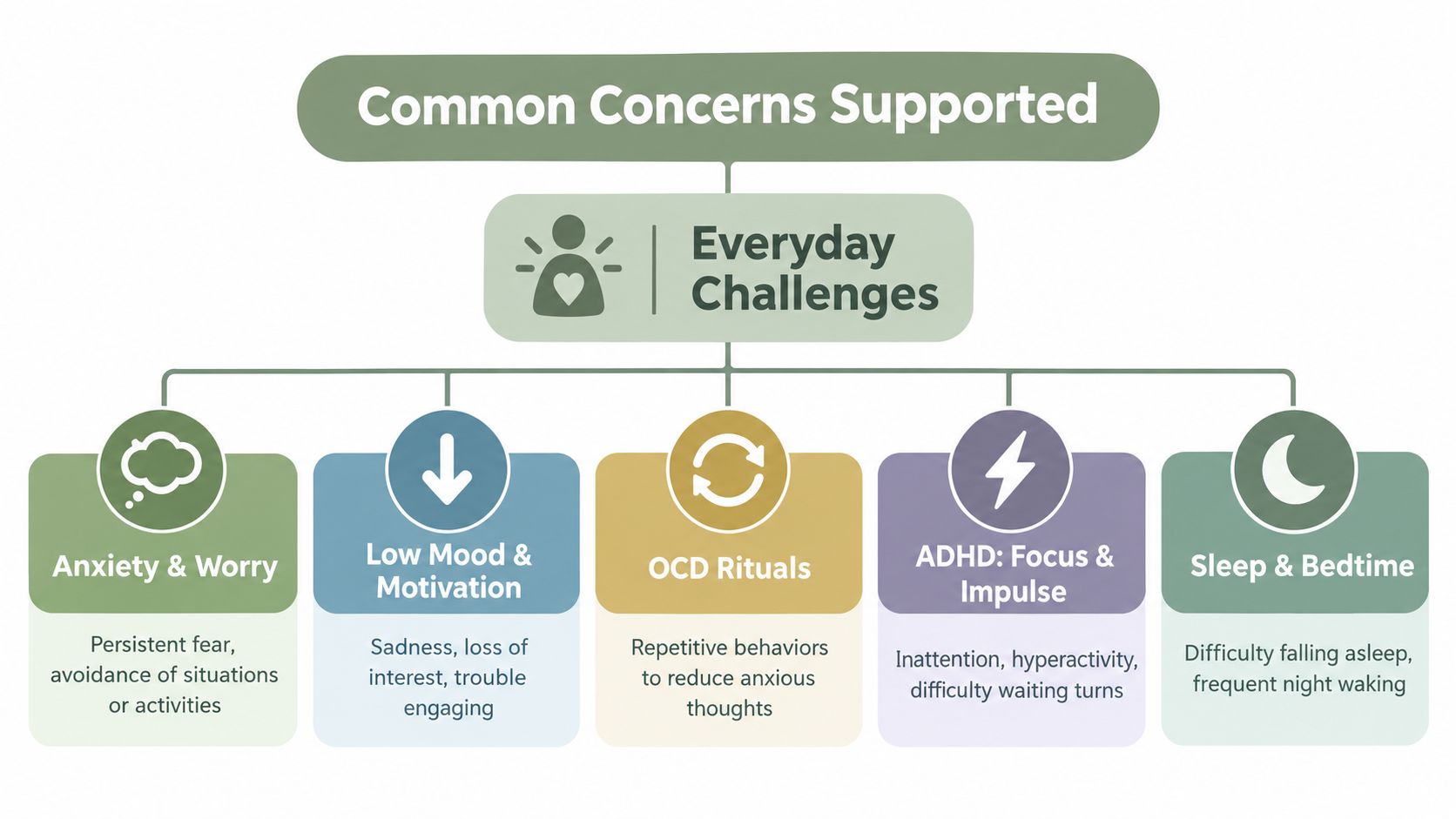
Parents usually don't search for a diagnosis first, they search for a pattern. The child worries too much, avoids school, can't settle at night, melts down over transitions, or seems chronically distracted. Therapy starts by translating that pattern into what's happening functionally, then choosing tools that match the problem.
Anxiety, mood, and OCD
For anxiety, therapy often focuses on coping skills, exposure, and reducing avoidance. A child who won't go to birthday parties, sleep alone, or answer questions at school isn't just “being difficult,” they may be trying to escape a fear that feels very real. The therapy goal is to help the child tolerate discomfort without having the fear run the whole day.
Low mood calls for a different lens. Here the concern may be less about fear and more about withdrawal, irritability, low motivation, or giving up on things that used to matter. Therapy often tries to restore routines, activity, and connection so the child has more chances to feel success again.
OCD can look like rituals, reassurance loops, or a need to repeat actions until they feel “right.” The work usually targets both intrusive thoughts and the compulsions that keep the cycle going. That's why therapists often focus on changing the behavior pattern, not just talking about the fear.
ADHD, sleep, and school stress
With ADHD, the issue isn't laziness or a lack of caring. It's often follow-through, impulse control, time management, and the ability to pause before reacting. Therapy may include parent strategies, routines, rewards that work for the child, and support around school expectations.
Sleep and bedtime problems often need behavioral plans more than endless negotiating. A predictable evening routine, clear limits, and calm caregiver responses can matter more than repeated explanations at 9:30 p.m. School stress, bullying, and low self-esteem also fit here, because therapy has to address how the child functions in real environments.
For adolescent anxiety and depression, the evidence is strongest for cognitive behavioral therapy, medication management, and CBT plus medication management, especially when the goal is to improve both symptoms and daily functioning (PMC9072253). That's a good reminder that therapy is not only about feeling less distressed, it's about helping kids participate more fully in school, home, and relationships.
What to Expect in Pediatric Therapy Sessions Step by Step
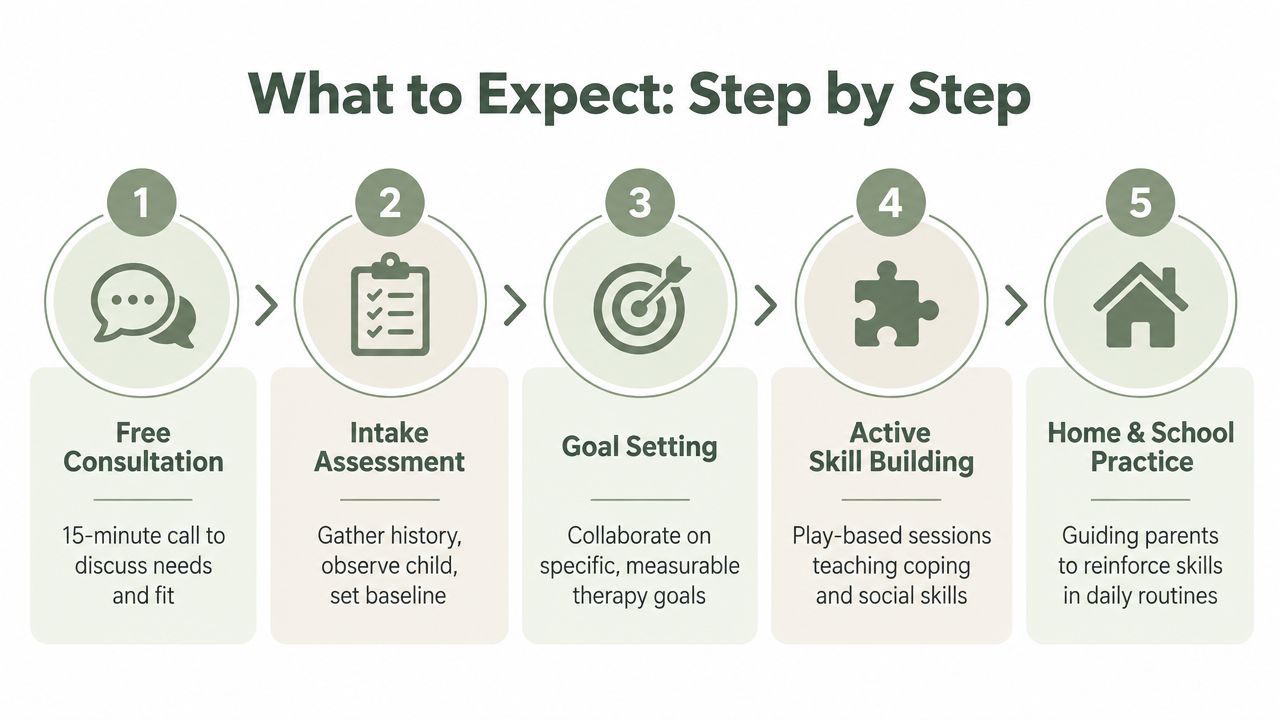
The first contact is usually a consultation, often a short call to see whether the concern, the therapist's approach, and the schedule fit your family. After that comes intake, where the therapist gathers history, learns what happens at home and school, and starts to identify patterns. The child may talk, play, draw, or answer questions depending on age.
Here's what that often looks like in practice:
- Free consultation to discuss what's going on and whether the match feels right.
- Intake assessment to understand history, strengths, stressors, and current routines.
- Goal setting so everyone knows what change should look like in daily life.
- Active skill building with practice, role-play, play-based methods, or coaching.
- Home and school practice so progress doesn't stop when the session ends.
A preschooler with bedtime resistance might spend part of a session practicing a calmer routine and part of it helping the parent learn how to respond consistently. A school-age child with anxiety may practice facing a small fear in a planned way, then repeat that step at home. A teen working on mood and motivation may track sleep, school engagement, and activities that help rebuild momentum.
Progress in pediatric therapy is usually measured by what changes outside the office. Does morning time get easier? Does the child need less reassurance? Are homework battles shorter, or is sleep less of a fight? Those are the kinds of signs that matter most to families.
If your child is more comfortable meeting from home, video can be a practical option. Some families prefer that format because it lowers the barrier to getting started, especially when schedules are tight or travel is difficult. Others do better in person because the office provides a calmer, more structured setting.
Accessing Pediatric Therapy in Coral Gables and Through Telehealth
A child may need support, while the family still has to solve practical questions: Where will sessions happen? Can the schedule work? Will the child participate in that setting? Access is part of treatment because a plan only helps when the family can attend and continue it.

Wald Behavioral Health provides in-person care at 1390 S Dixie Hwy, Suite 1305, Coral Gables, FL 33146, near the University of Miami. It also offers secure telehealth for families in Florida, Maryland, and PSYPACT states. Evening and weekend appointments may be available by arrangement, which can help families fit therapy around school, work, and caregiving.
The best format is the one your child can attend consistently.
Age changes what access looks like. A preschool child may need a parent nearby to help with attention, play, or transitions. A school-age child may participate more independently while still needing an adult to support routines between visits. An adolescent may want greater privacy, although the family may still help with scheduling, safety, and follow-through.
Families can also face waitlists, insurance limits, and coordination problems before care begins. These barriers are especially relevant for families seeking services for children younger than age 5. National research describes uneven access related to coverage and care coordination (PMC11323596).
Telehealth gives some families another workable route. A video visit can remove travel time and let a therapist observe parts of the child's usual environment, such as a bedroom routine or homework setup. It may be less suitable when privacy is limited, distractions are high, or a child needs the structure of an office.
Choose the setting where your child can be present, comfortable, and ready to practice. Families can review technology, privacy, and appointment details on Wald Behavioral Health's telehealth information page before scheduling.
Taking the Next Step Toward Support for Your Child and Family
Pediatric therapy works best when it's treated as a partnership. The child brings the struggle, the parent brings context, and the therapist helps turn both into a workable plan. That's why the process often feels less like “fixing a kid” and more like building a more supportive system around the child.
A good time to reach out is when a concern keeps repeating, interferes with daily routines, or starts to narrow a child's world. You don't need to wait until things are severe. Early support can keep a small pattern from hardening into a bigger one.
Before a consultation, it helps to write down three things, what the problem looks like, when it happens most, and what you've already tried. Ask how the therapist involves parents, how they measure progress, and whether sessions are in person, virtual, or both. Those questions tell you a lot about fit.
The right setting should feel safe, approachable, and non-stigmatizing. Your child doesn't need to be “bad enough” to deserve help, and you don't need to have every answer before you ask for it. What matters is that you're paying attention and want something better for your family.
---
If you're ready to talk through your child's needs, Wald Behavioral Health offers evidence-based therapy for children, adolescents, young adults, and families, with in-person care in Coral Gables and telehealth across Florida, Maryland, and PSYPACT states. Visit Wald Behavioral Health to learn more or schedule a consultation.
Questions about your child or teen?
Dr. Wald offers a free 15 minute consultation to talk through what you are seeing and whether the practice is a good fit.
Free 15 Minute Consultation