Intrusive Thoughts Therapy: How CBT and ERP Help
Your child may be sitting at the kitchen table, staring at homework, while asking, “What if I hurt someone?” Or your teenager may keep replaying a disturbing image and then look at you for the tenth time that evening: “You're sure that thought doesn't mean I want it, right?” These moments can frighten the whole family, especially when the thought seems completely unlike the child you know.
Intrusive thoughts therapy starts with an important distinction. A thought can be upsetting without being an intention, prediction, memory, or sign of character. The clinical question is not just whether a child has an unwanted thought. It's what happens afterward, including the distress, avoidance, rituals, reassurance seeking, and disruption to family or school life.
## Table of Contents - What Intrusive Thoughts Actually Are - A thought alone isn't a diagnosis - The Obsession and Compulsion Cycle Explained - The same pattern changes with age - Why CBT and ERP Lead the Evidence Base - Talking about thoughts isn't the same as practicing differently - What an ERP Session Looks Like Step by Step - A contamination example - When Reassurance Quietly Keeps the Problem Going - Two responses that look similar but teach different lessons - Telehealth ERP Without Losing What Makes It Work - What quality remote care requires - A Practical Triage Guide for Parents - Six questions to ask calmly - When to seek urgent help - Starting Intrusive Thoughts Therapy With Wald Behavioral Health
What Intrusive Thoughts Actually Are
A nine-year-old may suddenly picture a loved one getting hurt. An adolescent may notice a frightening thought about contamination, sexuality, religion, or losing control. The child might whisper, “I don't want to think this,” then spend the rest of the evening trying to prove that the thought isn't meaningful.
That thought is a mental event, not a plan. Intrusive thoughts can arrive without invitation as words, images, urges, doubts, or “what if” questions. Their content often feels especially alarming because it conflicts with the child's values and sense of self. A caring child may be disturbed by a harm-related image precisely because caring about others matters greatly to them.
A thought alone isn't a diagnosis
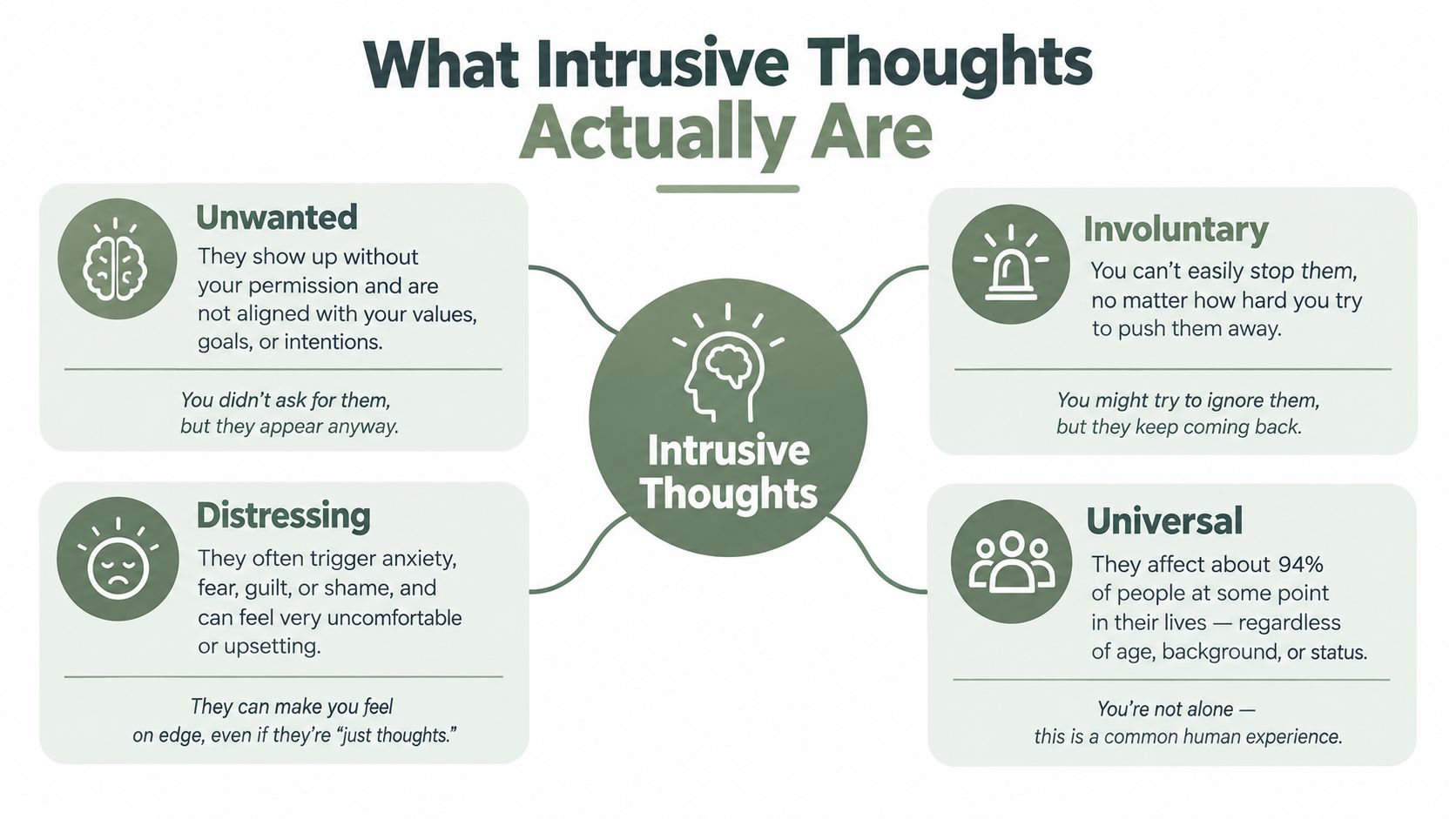
Many people experience odd, unwanted mental content. Having a disturbing thought by itself doesn't indicate OCD. Clinicians look at the child's relationship with the thought and its effect on daily functioning.
A thought becomes more clinically important when it is:
- Persistent: It returns often or captures attention for long periods.
- Distressing: It creates intense fear, disgust, shame, or guilt.
- Unwanted: The child experiences it as inconsistent with what they want.
- Linked to neutralizing: The child checks, confesses, avoids, reviews, prays, or asks for certainty.
- Impairing: It interferes with sleep, school, friendships, meals, activities, or independence.
The National Institute of Mental Health reports that OCD has a lifetime prevalence of 2.3% among U.S. adults, while 1.0% of adults experience OCD within a 12-month period. Approximately 50.6% of 12-month cases are classified as severe. These figures show that clinically significant OCD is not rare, but they don't mean every unwanted thought signals a disorder. The NIMH OCD statistics page explains why impairment and compulsive responses matter in assessment.
A useful starting point: Ask, “How much is this thought changing what my child does?” rather than, “What does this thought say about my child?”
Parents also need to notice the relationship around the thought. A child may become afraid of the thought, a parent may provide certainty, and both may feel temporary relief. That interaction can become important even before anyone has a diagnosis.
The Obsession and Compulsion Cycle Explained
An intrusive thought becomes sticky when the child's brain treats it as a danger that must be solved. A useful analogy is a smoke alarm that keeps beeping after the toast is no longer burning. The alarm feels urgent, so everyone searches for a way to silence it, even though the signal doesn't accurately describe the level of danger.
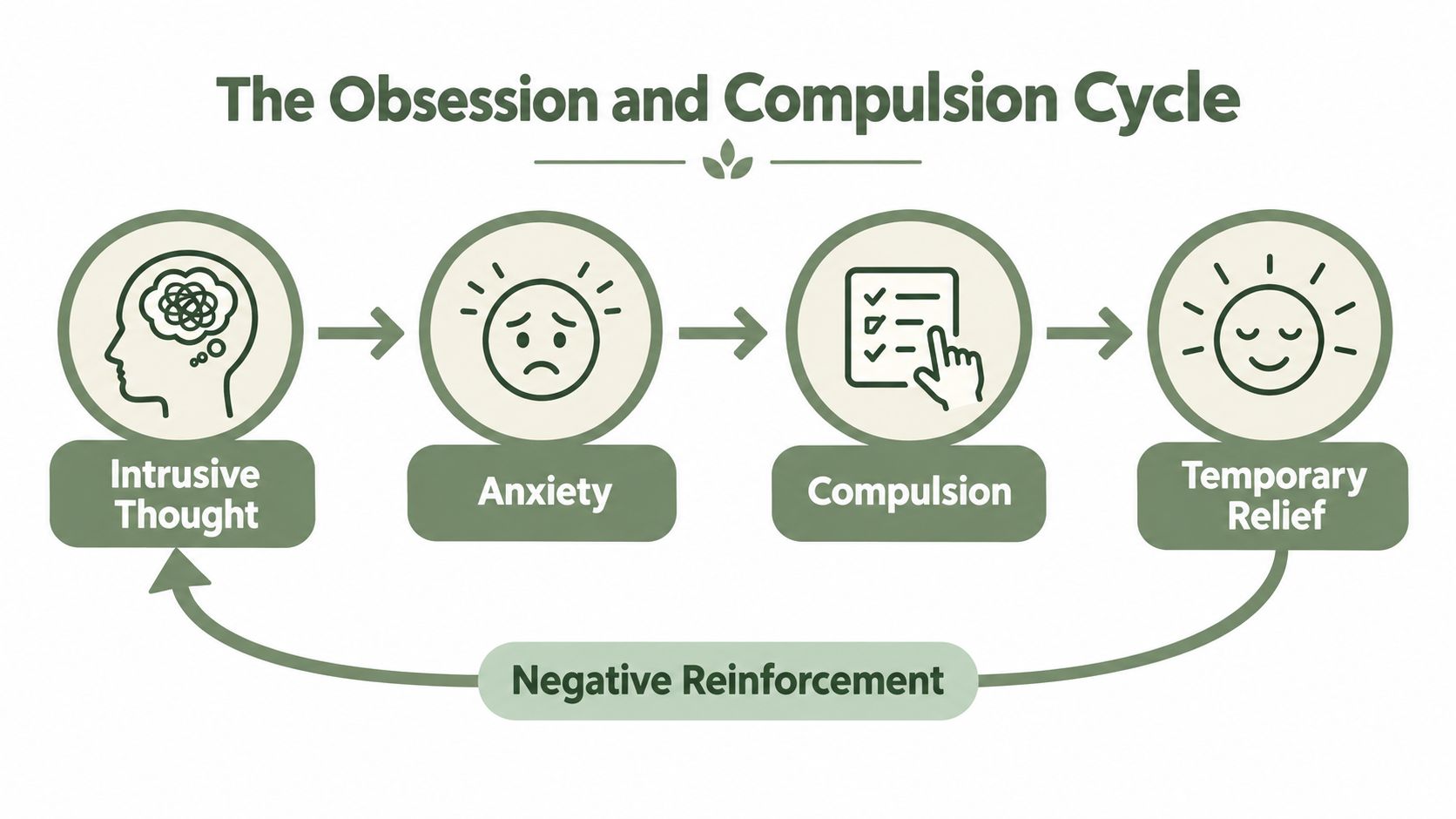
The cycle often unfolds like this:
- An intrusive thought appears. “What if I'm contaminated?” or “What if I lose control?”
- Distress rises. The child feels anxious, guilty, disgusted, or unsure.
- A neutralizing response follows. They wash, check, ask for reassurance, mentally review, confess, or avoid.
- Relief arrives briefly. The anxiety drops, at least for a moment.
- The brain learns a lesson. It links the thought with danger and the ritual with safety.
The same pattern changes with age
A seven-year-old might ask a parent to check the closet repeatedly after imagining an intruder. A fourteen-year-old might send messages asking whether they sounded rude, then reread the conversation to search for certainty. A young adult might mentally replay an interaction, avoid driving, or monitor their feelings for evidence that something is wrong.
These behaviors can look different on the outside, but they serve a similar function. The person is trying to neutralize uncertainty or distress. The response may be physical, social, or entirely internal. Mental reviewing, replacing a “bad” thought with a “good” one, counting without making a sound, and testing one's feelings can all function as compulsions.
The short-term relief is understandable. It's also what keeps the pattern active. Each ritual teaches the brain that the thought required a response, so the next occurrence feels more urgent.
Treatment doesn't try to debate every frightening thought or prove its content false. It focuses on helping the child change the response. The target is the relationship among child, thought, and caregiver, not the elimination of every unusual thought.
Why CBT and ERP Lead the Evidence Base
Cognitive behavioral therapy, or CBT, helps people understand the connection among thoughts, feelings, actions, and avoidance. For OCD-related intrusive thoughts, the most important form is CBT with exposure and response prevention, commonly called ERP.
Exposure means approaching a feared thought, situation, image, sensation, or uncertainty in a planned way. Response prevention means not performing the usual ritual afterward. The child learns through practice that distress can be present without checking, avoiding, confessing, or asking for certainty.
A 2022 systematic review and meta-analysis included 30 studies, 39 randomized controlled trials, and 1,793 participants. Compared with control conditions, ERP produced a statistically significant overall effect on OCD symptoms, with Hedges' g = 0.37. The effect was larger against placebo conditions, g = 0.97, and remained meaningful compared with medication controls, g = 0.59. The analysis also found reductions in associated depression, g = 0.15, and anxiety, g = 0.23. These findings are reported in the 2022 ERP systematic review and meta-analysis.
Talking about thoughts isn't the same as practicing differently
Supportive counseling can reduce loneliness. Education can reduce shame. General coping skills may help a child regulate their body. Those tools can have a place in care, but reassurance alone doesn't interrupt the learning loop when reassurance has become the ritual.
Thought suppression creates a similar problem. Telling a child, “Don't think about that,” can make the thought more noticeable because the child must keep checking whether it has returned. Repeatedly analyzing what the thought means can also become mental reviewing.
A separate meta-analysis of 36 randomized controlled trials involving 2,020 patients, including 537 children or adolescents and 1,483 adults, found a large pooled benefit for CBT with ERP over control conditions, g = 0.74, with a 95% confidence interval of 0.51 to 0.97. CBT with ERP was not statistically superior to other active psychological therapies, which shows why comparison conditions and treatment quality matter. The practical message isn't that every child needs the same protocol. It's that families should ask whether treatment includes planned exposure and behavioral response prevention, not only discussion.
For families comparing approaches, OCD therapy techniques explained by Wald Behavioral Health can provide additional context. A qualified clinician should still assess the child's symptoms, developmental level, safety, impairment, and family patterns before recommending ERP.
What an ERP Session Looks Like Step by Step
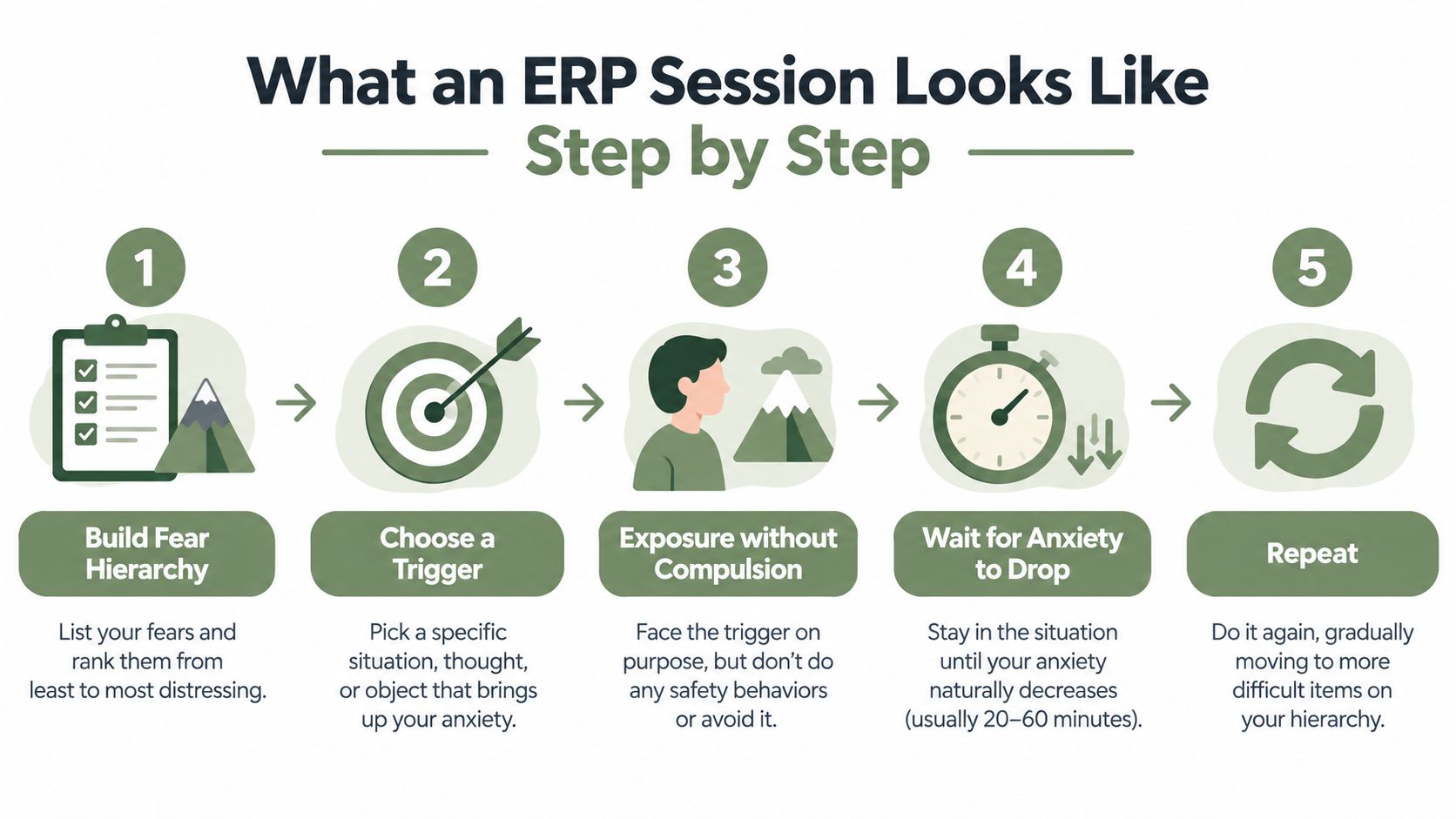
ERP should feel structured, collaborative, and developmentally appropriate. A therapist won't usually begin by choosing the most frightening trigger. The child and therapist first identify feared situations, rituals, avoidance, and the ways caregivers may be pulled into the cycle.
A contamination example
Suppose a child fears that touching a doorknob will make them dangerously dirty. Their rituals include washing immediately, asking a parent whether they're clean, and avoiding shared objects at school.
The therapist might help create a graded hierarchy:
- Touching a familiar object at home, then waiting before washing.
- Touching a household doorknob and continuing with a normal activity.
- Using a shared classroom item while delaying reassurance.
- Practicing a harder situation while resisting washing, checking, or mental review.
The exposure is chosen with the child, not forced on them. Response prevention is defined in observable terms. For example, the child might delay washing, avoid asking the parent for confirmation, and return to homework while uncertainty remains.
Parents have an active role, but they aren't the therapist. They can sit nearby, use calm and brief language, and praise approach behavior. They shouldn't secretly alter the exercise, provide repeated certainty, or turn practice into a confrontation.
Practical rule: Support the child's willingness to face uncertainty, not the child's demand for a guarantee.
A parent might say, “I know this feels hard, and I'm proud that you're practicing,” rather than, “I promise there are no germs.” The family can record what happened afterward, including whether the child completed the task and what they did without a ritual. The purpose isn't to prove the fear impossible. It's to help the child build confidence in coping.
The NICE guidance on CBT with ERP for young people recommends developmentally adapted treatment with caregiver involvement for young people with meaningful impairment.
This video offers a visual introduction to the treatment process:
When Reassurance Quietly Keeps the Problem Going
Most parents reassure because they want to reduce suffering. A child asks, “I'm not dangerous, right?” The parent answers, “Of course not.” The child relaxes, then asks again a few minutes later. The parent gives a more detailed answer, but the question returns the next day with a new variation.
The parent's response is loving. The pattern may still function as a compulsion.
Two responses that look similar but teach different lessons
Reassurance loop
Child: “Did I sound mean when I answered my teacher?”
Parent: “No, you sounded fine.”
Child: “Are you sure?”
Parent: “Yes, completely sure.”
The child receives relief, but also learns that uncertainty requires the parent to settle it.
ERP-informed response
Child: “Did I sound mean?”
Parent: “You're having the worry that you sounded mean. You can let that question be there while you finish your work.”
This answer doesn't dismiss the child. It acknowledges distress without entering an endless investigation. Over time, the child practices living without a perfect answer.
Family accommodation can include answering repeated questions, checking locks for a child, washing items according to the child's rules, changing family routines, participating in rituals, or helping avoid triggers. These actions may keep the household calm in the moment while allowing the fear-compulsion relationship to grow.
The change should be gradual and coordinated with treatment. Abruptly refusing every request can overwhelm a child and damage trust. A therapist can help parents move from certainty-giving to supportive nonparticipation, using language that validates emotion without confirming the feared meaning.
For additional parent-focused guidance, Wald Behavioral Health's resource on helping with OCD thoughts discusses ways to respond without strengthening reassurance cycles.
Telehealth ERP Without Losing What Makes It Work
ERP doesn't have to happen in a therapist's office to be real treatment. A child's actual routines often provide useful practice settings, including the bedroom, bathroom, kitchen, schoolwork area, and family car. Video sessions can let the clinician observe those environments and coach caregivers during the moments when accommodation usually occurs.
A 2025 observational study of 2,173 children and adolescents receiving live video ERP reported a median symptom reduction of 38.5%, with 54.0% achieving a full response and 64.6% achieving either partial or full response. Treatment commonly began with weekly or twice-weekly sessions before continuing weekly sessions for roughly 10 to 14 weeks. These findings come from the peer-reviewed live video ERP study, and they describe observed outcomes, not a guarantee for any individual child.
What quality remote care requires
Remote delivery should preserve the active ingredients of ERP rather than become supportive conversation with occasional advice.
- A private setting: The child needs enough privacy to speak openly and practice without interruptions.
- Reliable encrypted video: Technical problems shouldn't repeatedly interrupt exposure or response prevention.
- Caregiver participation: Parents may need coaching about reassurance, accommodation, and between-session practice.
- A written hierarchy: The family should know which exposures they're practicing and what counts as a ritual.
- Practice tracking: A simple record can capture the task, the response prevented, and the child's return to normal activity.
- A distress plan: The clinician and family need a clear response if distress escalates or impairment is severe.
The National Library of Medicine's evidence review of psychological treatments for OCD reports that remote ERP is equivalent to in-person ERP for OCD symptoms in network meta-analytic comparisons. That doesn't mean every child or every family is suited to video care. School attendance, bedtime independence, family accommodation, and time lost to rituals should be monitored alongside symptom ratings.
Families considering this format can review telehealth therapy at Wald Behavioral Health and ask how the clinician handles privacy, caregiver coaching, exposure practice, and higher levels of need.
A Practical Triage Guide for Parents
A frightening thought deserves attention, but it doesn't deserve an automatic label. Parents can begin by observing the pattern over time and asking simple questions without interrogating the child.
Six questions to ask calmly
- Is the thought unwanted? Does the child feel alarmed by it, or do they describe it as a chosen belief or intention?
- How distressed are they? Look for fear, shame, disgust, guilt, physical anxiety, or repeated attempts to escape the thought.
- How convinced are they? A child with OCD often doubts and seeks certainty. A child losing reality testing may hold a fixed belief despite clear evidence.
- What happens next? Check for washing, checking, avoidance, reassurance seeking, confession, mental reviewing, counting, or other neutralizing actions.
- What is the impact? Has the child stopped sleeping independently, attending school, eating normally, using shared spaces, or participating with friends?
- Is anyone unsafe? Ask directly about self-harm, harm to others, abuse, access to dangerous means, and whether the child feels able to stay safe.
Intrusive thoughts can appear in OCD, anxiety, depression, trauma-related conditions, and ordinary development. Content alone doesn't distinguish them. The child's distress, conviction, behavior, impairment, developmental context, and safety provide more useful information.
When to seek urgent help
Seek immediate emergency support when there is imminent risk of self-harm or harm to another person, a loss of reality testing, or sudden inability to function. If the situation is urgent, contact local emergency services or go to the nearest emergency department. For nonurgent concerns, arrange an assessment with a licensed mental health professional who works with children and understands OCD and related conditions.
Parents who need help organizing observations can also explore the Ekipa AI healthtech assistant as a general information and preparation resource. It shouldn't replace a clinical evaluation, crisis service, or professional judgment.
Starting Intrusive Thoughts Therapy With Wald Behavioral Health
An initial assessment should make room for the child's experience and the family's experience. A clinician may ask when the thoughts began, what triggers them, how the child responds, which routines have changed, and how much time the family spends reassuring, checking, avoiding, or accommodating. The assessment should also consider mood, trauma, attention, developmental level, school functioning, and safety.
For a younger child, treatment may use play, drawings, stories, simple language, and caregiver coaching. An adolescent may help build an exposure hierarchy, track rituals privately, and practice responding to uncertainty at school or home. A young adult may focus on independence, relationships, academic demands, and mental rituals that are harder for parents to observe.
Wald Behavioral Health provides developmentally informed CBT with ERP for children, adolescents, and young adults. The practice is based in Coral Gables, with in-person appointments at 1390 S Dixie Hwy, Suite 1305, Coral Gables, Florida, and telehealth for clients in Florida, Maryland, and PSYPACT-participating states. Parent involvement is included when appropriate, especially when reassurance, household routines, or accommodation affect the cycle.
Scheduling can include weekday evenings and weekend appointments by arrangement. A free 15-minute consultation gives families a low-pressure opportunity to describe what they're seeing, ask whether the practice's approach fits their needs, and discuss available scheduling.
The first step doesn't require certainty about the diagnosis. It requires enough information to understand the pattern and decide what support makes sense.
---
Wald Behavioral Health offers assessment and evidence-based CBT with ERP for children, adolescents, and young adults experiencing intrusive thoughts, compulsions, and related anxiety. Visit Wald Behavioral Health to request a free 15-minute consultation and discuss whether in-person or telehealth care is the right starting point for your family.
Questions about your child or teen?
Dr. Wald offers a free 15 minute consultation to talk through what you are seeing and whether the practice is a good fit.
Free 15 Minute Consultation