Behavioral Therapy for Kids: A Practical Parent Guide

Your child has been staring at the same homework page for ten minutes. You offer help, they push the pencil away, and a small disagreement turns into shouting, tears, or a slammed door. By bedtime, everyone is exhausted, and you're left wondering whether this is a passing phase, a parenting problem, or a sign that your child needs professional support.
Those questions are common. Parents often begin looking for behavioral therapy for kids after repeated struggles start affecting mornings, homework, sleep, sibling relationships, or school participation. The purpose of therapy isn't to label a child or demand perfect behavior. It's to understand what happens before and after difficult moments, teach practical skills, and help caregivers respond in ways that make positive behavior easier to repeat.
The right approach depends on your child's age, concerns, communication style, and daily environment. You'll find guidance here on what behavioral therapy means, how CBT and parent training differ, how reinforcement works at home, what evidence remains limited for younger children, and how to choose care that your family can realistically continue.
## Table of Contents - The Moment Parents Start Looking for Help - Notice the pattern, not only the outburst - When professional input makes sense - What Behavioral Therapy Actually Means - What therapy is and isn't - The Main Approaches Used With Children - How the approaches overlap - Reinforcement and Consequences You Can Use at Home - Three tools for the coming week - Consequences need a clear purpose - What CBT Looks Like in Everyday Family Life - A worried thought before a test - A gradual plan for speaking - Adapting CBT for younger children - Where the Evidence Is Still Thin and Access Gets Hard - Telehealth improves reach, not automatically completion - Choosing a Provider and Making Therapy Stick - Use a focused provider checklist - Prepare for the first session - Practice between appointments
The Moment Parents Start Looking for Help
The search for help often begins with a very ordinary evening. A seven-year-old refuses to start math homework, the parent repeats the instruction, the child argues, and the parent raises their voice. The child may be tired, worried about making mistakes, unsure how to begin, or responding to a pattern in which delaying the assignment reliably brings intense attention.
One difficult night doesn't automatically mean therapy is needed. Children have bad days, and behavior changes with sleep, hunger, transitions, stress, and developmental expectations. Concern grows when the same pattern keeps returning, causes significant distress, or appears across settings such as home and school.
Notice the pattern, not only the outburst
Before focusing on the behavior itself, write down what surrounds it:
- What happened first: Was there a demand, transition, correction, social problem, or confusing task?
- What your child did: Describe the observable action, such as yelling, leaving the table, hitting, refusing, or crying.
- What happened next: Did the task disappear, did an adult negotiate, did the child receive comfort, or did siblings react?
This simple record can reveal why a behavior continues without blaming anyone. A child who escapes a difficult task after refusing may learn that refusal works. A child who receives prolonged conversation after whining may learn that whining reliably creates connection.
When professional input makes sense
Consider speaking with a pediatrician, school counselor, or child therapist when behavior interferes with learning, friendships, family routines, safety, or participation in ordinary activities. You don't need to wait until a problem becomes severe, and you don't need to arrive with a diagnosis.
A clinician may assess attention, anxiety, mood, developmental skills, learning demands, sleep, family stress, and the responses that follow challenging behavior. Parents are usually central to that process because the goal is to create change in the places where the child lives.
A useful starting point: Ask, “What does my child need to learn, and what can I change around the behavior?” rather than, “How do I make this stop immediately?”
What Behavioral Therapy Actually Means
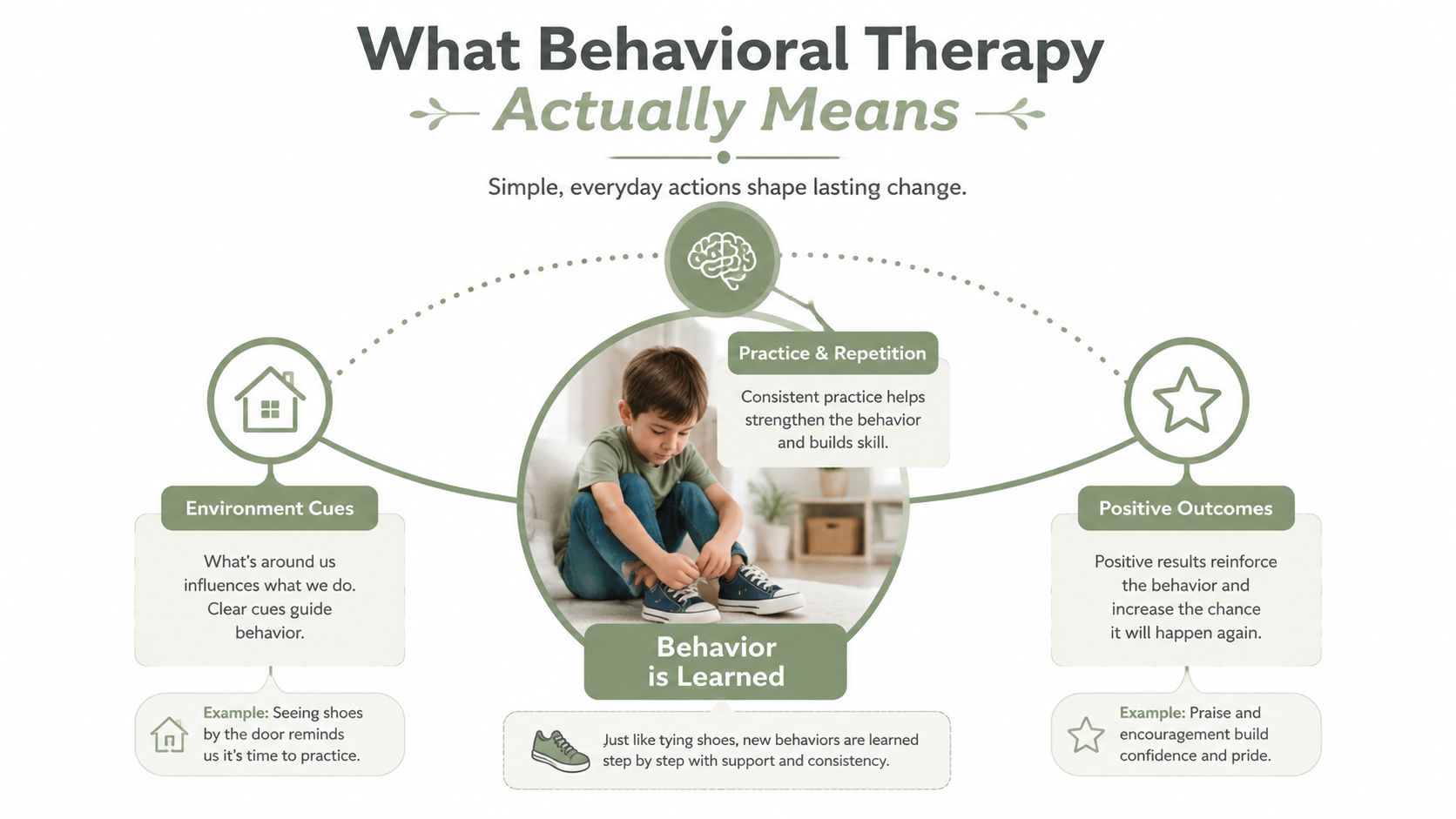
Behavioral therapy starts with a practical idea. Children learn patterns through repeated interactions with people, tasks, routines, and consequences. If a pattern has been learned, adults can help shape a different pattern by changing the cues around it, teaching a replacement skill, and making the desired response worthwhile.
Think about teaching a child to wash their hands. You might begin with one instruction, guide them to the sink, help them turn on the water, and praise each completed step. Over time, the child learns the sequence. The same learning principle can support behaviors such as starting homework, asking for a break, waiting for a turn, or moving through bedtime without repeated arguments.
Clinicians often describe this sequence as antecedent, behavior, and consequence:
- Antecedent: What happens immediately before the behavior, such as “Time to turn off the tablet.”
- Behavior: What the child does, such as arguing, complying, or asking for more time appropriately.
- Consequence: What happens afterward, such as attention, escape from the task, praise, or access to a reward.
What therapy is and isn't
Behavioral therapy can include structured practice, parent coaching, play, exposure exercises, problem-solving, emotion labeling, and home assignments. A psychologist, licensed clinical social worker, counselor, or behavior specialist may deliver services depending on the treatment model and local licensing rules. Qualified providers should adapt activities to the child's developmental level rather than expecting a young child to sit through an adult-style conversation.
It isn't punishment or a demand for obedience. It also isn't identical to medication, although a child's care team may discuss behavioral treatment and medication as separate or complementary options when appropriate. In the United States, national survey data found that 14.9% of children ages 5 to 17 received some mental health treatment in 2021, including counseling, therapy, or medication, as reported in the CDC National Health Statistics report.
Parents aren't passive observers. They practice the therapist's strategies, arrange routines, notice early signs of escalation, and respond consistently. That active role is why parent training, CBT, and reinforcement plans often overlap rather than function as completely separate treatments.
The Main Approaches Used With Children
No single treatment fits every child. A nine-year-old who fears tests may need a different starting point from a preschooler who hits during transitions or a child with ADHD who loses materials and cannot complete routines. The provider should match the intervention to the child's developmental abilities and the function of the behavior.
| Approach | Best For Ages | Primary Concerns | Who Attends Sessions | Core Mechanism | |---|---|---|---|---| | Cognitive Behavioral Therapy, or CBT | Usually school-age children and adolescents, adapted for younger children | Anxiety, worries, avoidance, mood concerns, coping difficulties, some ADHD-related challenges | Child, often with parent participation | Identifies thoughts, feelings, and actions, then practices more helpful responses | | Parent Management Training, or PMT | Especially useful when caregivers shape much of the daily environment | Defiance, noncompliance, disruptive behavior, impulsivity, routines, and family conflict | Parent or caregiver, with child involvement varying by model | Teaches clear instructions, reinforcement, planned responses, and consistent limits | | Parent-Child Interaction Therapy, or PCIT | Young children through early school years, depending on provider and model | Disruptive behavior, tantrums, aggression, noncompliance, and relationship strain | Parent and child together | Coaches caregivers in real time while they practice interaction and behavior skills | | Reinforcement-based behavior plans | Any age when the target behavior can be clearly observed and measured | Routines, communication, task completion, social behavior, and skill building | Child and caregivers, sometimes school staff | Makes desired behavior more likely by connecting it with meaningful positive outcomes |
Parents seeking a broader overview of clinical models can review Wald Behavioral Health's approach to therapy, then ask a prospective provider which methods they use with children of a similar age.
How the approaches overlap
CBT usually gives the child language and coping tools. Parent training gives caregivers a structure for prompting, reinforcing, and responding. A behavior plan turns a broad goal, such as “listen better,” into an observable action, such as “begin the first step within a few minutes of the instruction.”
A child might use a CBT coping statement before a feared school activity while a parent reinforces the child for approaching rather than avoiding it. Another child might need little formal thought work but benefit from PCIT-style coaching, predictable routines, and praise for safe, cooperative behavior.
The diagnosis alone shouldn't determine the treatment. A provider should consider what maintains the behavior, what the child can understand, how caregivers can participate, and whether school or medical factors also need attention.
Reinforcement and Consequences You Can Use at Home
Parents can begin with small, observable changes rather than redesigning the entire household. Choose one target behavior, describe it clearly, and reinforce it soon after it happens. “Be good” is too vague. “Put your shoes by the door after school” gives a child something they can recognize and practice.
Three tools for the coming week
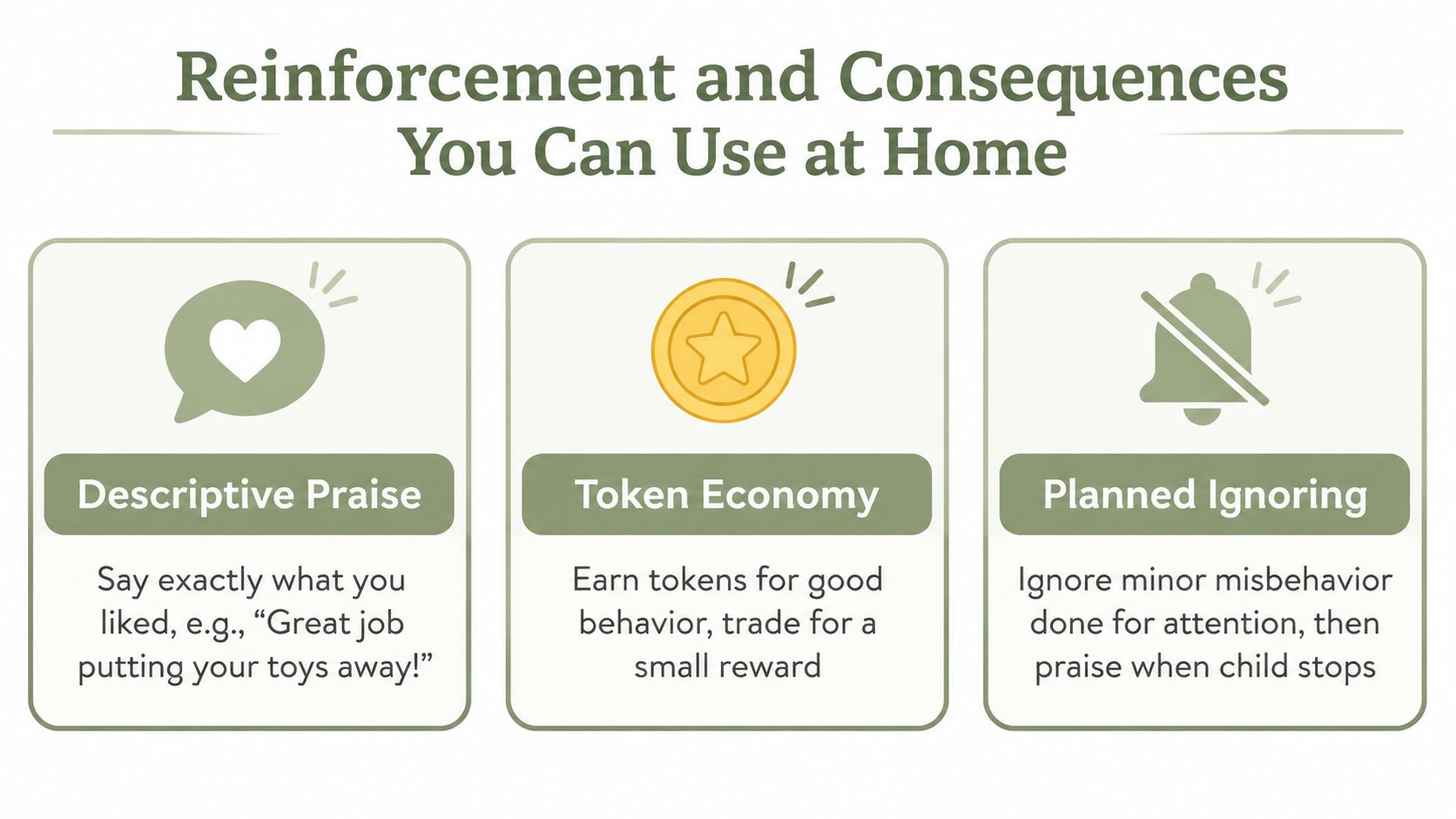
Descriptive praise tells the child exactly what worked. Instead of saying only “Good job,” try, “You started your homework after I gave one reminder,” or, “You handed the toy to your brother instead of grabbing it.” Specific praise helps the child connect the positive outcome with the action you want repeated.
A simple token economy can make progress visible. A child might earn a star for beginning a routine, using a calm request, or completing a small responsibility. After earning an agreed number of stars, the child exchanges them for a modest privilege, such as choosing the bedtime story or selecting a family game. A Family Xchange reward chart guide can help families create a concrete chart without making the system complicated.
Planned ignoring is reserved for minor behavior maintained by attention, such as repetitive whining after a limit has already been stated. If the child complains about an unavailable snack, the parent can keep their response brief, avoid arguing, and give attention when the child stops and asks appropriately. Don't use planned ignoring for aggression, dangerous actions, distress that requires support, or behavior caused by a need the child cannot yet communicate.
Consequences need a clear purpose
Positive reinforcement means adding something the child values after a desired behavior. Punishment means adding an unpleasant consequence or removing something valued after an unwanted behavior. Extinction means stopping the outcome that has been maintaining a behavior, which can temporarily make that behavior more intense before it decreases.
Effective home plans generally depend more on frequent reinforcement and consistent teaching than on harsh punishment. State the expectation before the difficult moment, choose a consequence you can follow through with, and avoid giving the original payoff after a prolonged escalation.
Practical rule: Reinforce the replacement behavior, not just the absence of the problem. Praise “You asked for help” more clearly than “You didn't complain.”
A clinician can help you decide whether a token system, response cost, timeout, or another consequence is developmentally appropriate. Additional guidance on behavior-focused treatment is available through Wald Behavioral Health's behavioral therapy information.
A short video can make the difference between understanding a technique and seeing how it sounds in practice. Use it as a conversation starter with your clinician, not as a substitute for individualized assessment.
What CBT Looks Like in Everyday Family Life
CBT becomes useful when a child can use its language during an actual challenge. The therapist may teach the skill, but the parent helps weave it into breakfast, car rides, homework, and bedtime.
A worried thought before a test
A nine-year-old says, “I'm going to get everything wrong,” before a spelling quiz. Her parent doesn't respond with a forced assurance such as “You'll definitely be fine.” Instead, they help label the thought as a worry prediction and ask what evidence supports it. Together, they choose a realistic coping statement: “I can study the words I know, take one breath, and try the first question.”
The parent might draw a small feelings thermometer on an index card. The child rates her worry, practices slow breathing, and carries the card in her backpack. The goal isn't to eliminate every anxious feeling. It's to help her approach the task while using a skill.
A gradual plan for speaking
An eight-year-old with selective mutism may speak comfortably at home but remain silent at school. A therapist and parent might create a graded exposure ladder, beginning with a manageable action, such as greeting the teacher privately at drop-off. Later steps could involve speaking to the teacher near a trusted adult, answering a quiet question, and eventually raising a hand in class.
The parent supports practice without turning each attempt into a high-pressure performance. They can say, “We're practicing the next small step,” then praise effort and brave participation rather than demanding a particular volume or speed.
Adapting CBT for younger children
Children under seven may not be ready for lengthy discussions about distorted thinking. CBT-informed work at that age often relies more on play, stories, modeling, simple feeling words, visual cues, and parent coaching. A feelings thermometer, puppets, or a “stop, breathe, choose” card may communicate more effectively than an abstract explanation.
Parents who want low-pressure ways to practice emotion language can explore these fun EQ activities for children, then adapt any activity to the child's therapist-guided goals. The central question remains practical: what skill should the child use next time, and how will the adults notice and reinforce it?
Where the Evidence Is Still Thin and Access Gets Hard
Behavioral therapy has a long development history. Reviews describe guiding principles emerging in the early twentieth century, behavior modification techniques developing in the 1920s, and formal parent training emerging in the 1960s. One historical review describes an empirically validated development process beginning with the 1960 to 1975 period, when parent training formats were established and tested for child problem behaviors, as outlined in this historical review of behavioral health training.
That history supports confidence in the field, but it doesn't mean every question has been answered. For children under six, evidence gaps remain around which behavioral treatments work best, how models compare, and when parent training should be combined with school-based or medication approaches. A current evidence-gap review notes limited data on the relative efficacy of psychosocial treatments for preschool children with disruptive behavior disorder or ADHD, along with limited research on multimodal interventions and adverse events or noncompliance in this age group.
| Age Group | Evidence Strength | Common Format | Typical Access Barriers | |---|---|---|---| | Preschool children | Parent-focused treatments are useful, but important questions remain about comparison, sequencing, and subgroups | Parent coaching, PCIT-style work, play-based practice, and structured routines | Limited specialists, transportation, caregiver time, language access, and uncertainty about fit | | School-age children | Broader support exists for behavioral approaches addressing anxiety, ADHD, and disruptive behavior | Individual CBT, parent training, family participation, and school coordination | Waitlists, insurance restrictions, scheduling conflicts, and limited local providers | | Adolescents | Individual skills work and family involvement may be combined according to the concern | CBT, family sessions, behavior planning, and coordination with school or medical care | Privacy concerns, transportation, availability, and maintaining engagement |
Telehealth improves reach, not automatically completion
Telehealth can reduce travel and make parent coaching possible when local services are limited. Yet access depends on more than whether a video appointment exists. Families may still struggle with device access, privacy, internet reliability, language needs, competing responsibilities, or confidence using coaching techniques in real time.
A 2025 review reported that behavioral healthcare use in primary care rose sharply among children and adolescents from 2019 to 2021. It also reported that telehealth visits for behavioral providers rose to over 50% in April 2020 and remained around 40% by the end of 2021, as described in this review of pediatric behavioral healthcare and telehealth. A 2025 trial of Pocket PCIT Online found the model promising and scalable while emphasizing that retention and reach still require improvement for historically underserved families.
Ask not only, “Does this work online?” Ask, “Can our family attend, practice, and receive support when obstacles appear?”
Choosing a Provider and Making Therapy Stick
A good first appointment should leave you with a clearer target, a workable plan, and a sense that the clinician understands your child in context. The provider should explain the treatment model in plain language and describe how progress will be monitored.
Use a focused provider checklist
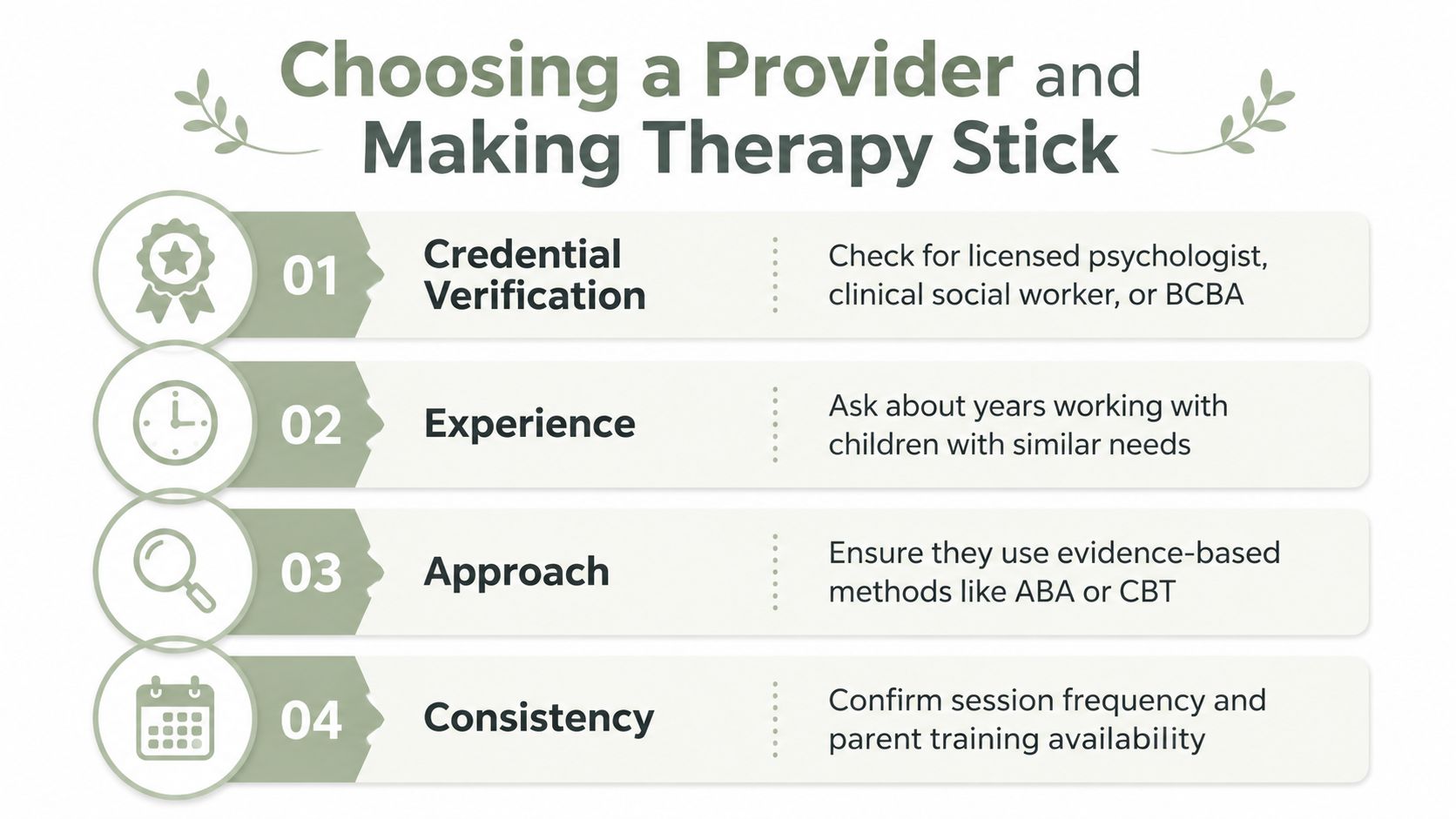
- Verify credentials: Ask whether the clinician is a licensed psychologist, clinical social worker, counselor, or board-certified behavior analyst, and confirm that their training matches the service being offered.
- Check relevant experience: Ask about work with children who have similar concerns, developmental needs, communication styles, or school challenges.
- Clarify the method: Ask whether the provider uses an evidence-based protocol such as CBT, PCIT, PMT, or another clearly defined behavioral model. If trauma is central, ask about trauma-focused care rather than assuming every behavioral approach addresses it.
- Understand participation: Find out whether parents attend sessions, receive coaching, complete home practice, or meet separately with the clinician.
- Discuss logistics: Confirm appointment format, communication between visits, scheduling, cancellation policies, and whether telehealth is appropriate for your family.
- Define progress: Ask how the team will decide whether the plan is helping and what happens if the first strategy doesn't fit.
Prepare for the first session
Bring three specific target behaviors, not a long list of everything that feels difficult. For example, you might identify leaving the table during dinner, refusing the bedtime routine, and shouting when homework begins. Note when each behavior happens, what usually comes before it, and what adults do afterward.
School reports, teacher observations, medication information, sleep patterns, and developmental history can help the clinician see the full picture. Also write down what your child already does well. Strengths, interests, preferred activities, and successful routines often provide the best reinforcers and teaching opportunities.
Practice between appointments
Set aside a brief daily check-in to review one skill. Keep it concrete: “What helped you ask for a break today?” or “I noticed you put your backpack away without a reminder.” Record small wins in a notebook or phone app, along with situations that were harder.
Consistency matters more than complicated charts. If the therapist recommends a specific response, make sure the adults who care for the child understand it and use similar language. Wald Behavioral Health's parent resources describe parent involvement as part of supporting children's skills in everyday routines.
Behavioral therapy is a skill-building process, not a test of whether your family can produce perfect days. A qualified provider can help you adjust the plan, protect the parent-child relationship, and turn difficult moments into repeated opportunities for learning.
---
Wald Behavioral Health provides evidence-based therapy for children, adolescents, young adults, and families, with parent training for concerns such as tantrums, sleep, school refusal, separation, and noncompliance. Visit Wald Behavioral Health to explore in-person care in Coral Gables, telehealth availability, and a free 15-minute consultation about fit and scheduling.
Questions about your child or teen?
Dr. Wald offers a free 15 minute consultation to talk through what you are seeing and whether the practice is a good fit.
Free 15 Minute Consultation