How to Help Anxiety Nausea in Kids and Teens
Your child says, “I feel sick,” just as the school bus arrives. By the time you reach the pediatrician's office, the nausea has eased, only to return the next Monday morning. You're left wondering whether anxiety is causing the stomach symptoms, whether a medical problem has been missed, and whether keeping your child home is helping or making the pattern stronger.
The safest answer isn't to assume. Anxiety nausea is physically real, but persistent or worsening nausea still deserves medical attention. The most useful plan combines medical screening, calm in-the-moment support, gradual return to normal activities, and treatment for the worry and avoidance that keep the cycle going.
## Table of Contents - Why Anxiety Can Make a Child Feel Physically Sick - How to Tell Anxiety Nausea From a Medical Problem - Look for the pattern, not one episode - Immediate Relief Strategies During a Nausea Episode - Use the body without making it a ritual - Cognitive and Behavioral Strategies That Actually Work - Challenge the prediction collaboratively - Build exposure around normal life - Family Routines and Parent Coaching That Reduce Nausea - Make mornings boring and consistent - Coach without accommodating - What to Watch for When Nausea Starts After a New Medication - Keep a medication-specific record - When to Seek Professional Help and What to Expect Next
Why Anxiety Can Make a Child Feel Physically Sick
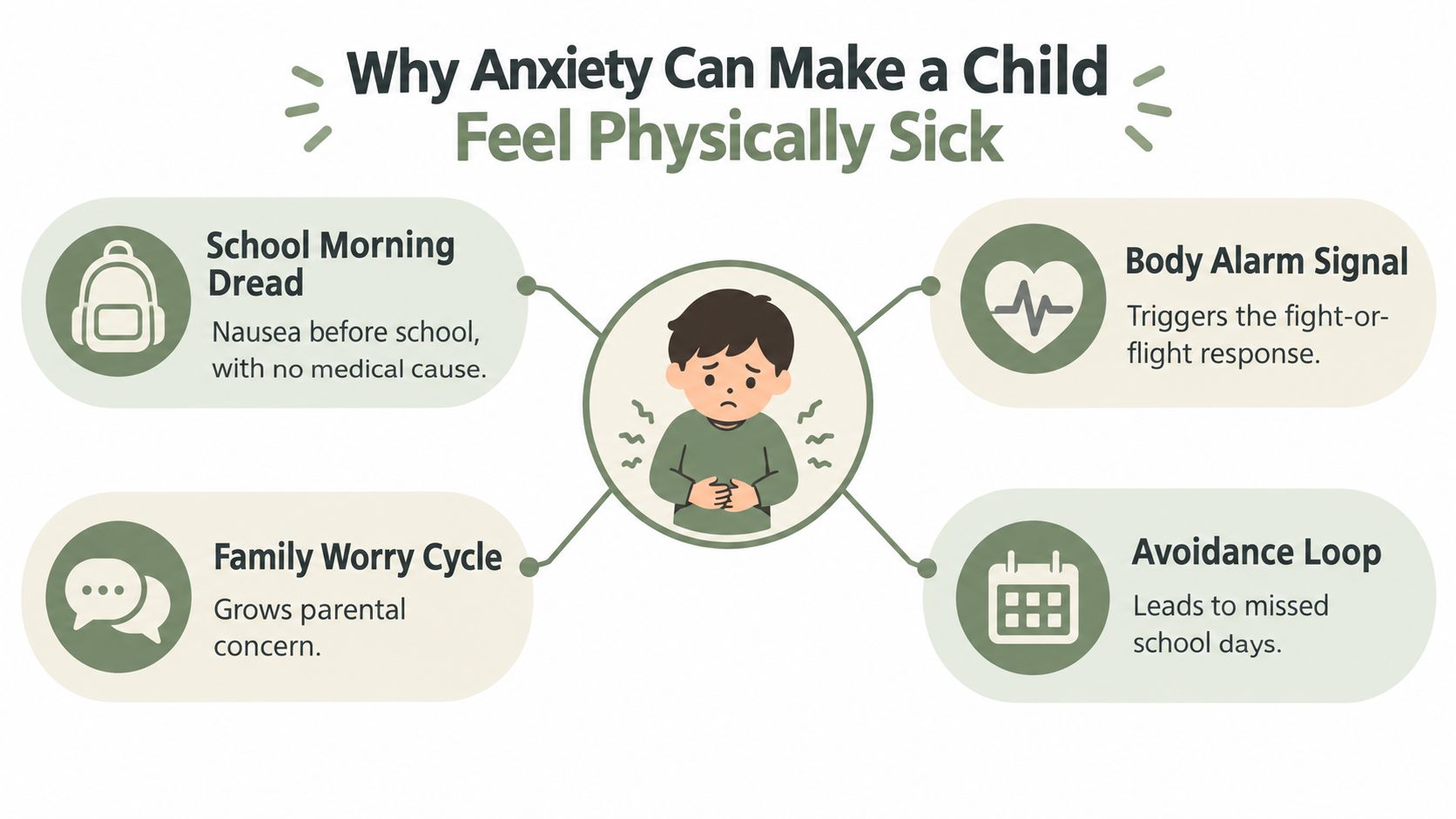
It's Monday morning. Your child has slept poorly, skipped breakfast, and is clutching their stomach while watching the clock. There's no obvious fever or stomach bug, but the closer school gets, the worse the nausea becomes. After a long goodbye, a trip to the nurse, or a decision to stay home, the symptoms settle. The next school morning, the same sequence starts again.
That pattern doesn't mean your child is pretending. The brain and digestive system communicate continuously, so fear can produce genuine gastrointestinal sensations. Anxiety activates the body's alarm response, changes breathing, affects gut movement, and makes ordinary sensations feel threatening. If the child then worries, “What if I vomit?” the fear itself can intensify the nausea.
Common triggers include school separation, tests, social situations, performance demands, travel, unfamiliar meals, and fear of vomiting. A child may notice a small stomach sensation, interpret it as danger, scan the body for more evidence, and seek escape. Relief after leaving the situation teaches the nervous system that avoidance worked, even though the original threat may have been anxiety rather than illness.
A large Norwegian community study included 60,998 valid participants. In the preceding year, 12.5% reported nausea and 48% reported at least one gastrointestinal symptom. After researchers considered demographic, lifestyle, and other health factors, anxiety was the strongest predictor of nausea, with a reported odds ratio of 3.42 (Norwegian community study).
Parents often find it helpful to name the experience without arguing about it: “Your stomach feels sick, and I believe you. We'll check that your body is safe, then we'll help your alarm system settle.” Information about child anxiety symptoms and treatment can also help families recognize when nausea belongs to a broader pattern of worry, avoidance, or physical distress.
How to Tell Anxiety Nausea From a Medical Problem
Start with a medical safety check, not a psychological conclusion. Pediatric gastrointestinal symptoms and anxiety can influence each other, and current pediatric evidence supports a bidirectional model. Gastrointestinal symptoms may increase later anxiety, while anxiety may worsen gastrointestinal symptoms, so nausea can reflect one process, the other, or both (pediatric review of nausea and anxiety).
Look for the pattern, not one episode
An anxiety-linked pattern may include nausea that appears before school, tests, social events, separation, travel, or feared vomiting. Rapid breathing, visible worry, skipped meals, repeated checking, and improvement after the anticipated event passes can add useful context. None of these signs proves that anxiety is the cause.
Arrange medical evaluation when nausea is persistent, worsening, severe, or interfering with eating, hydration, sleep, growth, school, or ordinary activities. Seek prompt clinical attention for repeated vomiting, dehydration, weight loss, blood, fever, significant abdominal pain, nighttime symptoms, abnormal growth, or symptoms that don't fit the child's usual anxiety pattern.
| Anxiety-Linked Nausea | Medical Red Flag | |---|---| | Appears predictably before school, social events, tests, or separation | Persists regardless of emotional context or continues to worsen | | Occurs with worry, rapid breathing, body scanning, or fear of vomiting | Repeated vomiting, inability to keep fluids down, or signs of dehydration | | May ease after reassurance is reduced and the child approaches the situation | Blood, fever, severe abdominal pain, or nighttime symptoms | | Often leads to avoidance or repeated requests to go home | Weight loss, abnormal growth, food restriction, or ongoing functional decline |
Keep a brief record for one to two weeks, unless symptoms require earlier care. Write down the time nausea starts, what happened beforehand, food and fluid intake, sleep, bowel symptoms, medications, school or social demands, distress level, and what the child did next. This gives the pediatrician and therapist a more reliable picture than trying to reconstruct every episode from memory.
Safety rule: Anxiety may be part of the explanation, but it shouldn't become a reason to delay evaluation for persistent, severe, or function-limiting symptoms.
Medical and psychological care often work best in parallel. A pediatrician can assess physical causes, medications, hydration, growth, and gastrointestinal symptoms while a qualified therapist addresses worry, avoidance, fear of vomiting, and family responses.
Immediate Relief Strategies During a Nausea Episode
During an active wave, your job isn't to force the nausea away. It's to help your child lower the alarm response while continuing safe, ordinary behavior.
Begin with a calm voice and a short plan: “You're having a nausea wave. Let's help your body settle, take a few sips, and decide what the next small step is.” Keep the room quiet if possible, loosen tight clothing, and let the child sit upright or move gently.

Use the body without making it a ritual
Try slow breathing with a relaxed inhale and a slightly longer, unforced exhale. The goal is to avoid over-breathing, not to take dramatic deep breaths that make the child lightheaded. Grounding can follow: name a few things you see, hear, and feel, or ask the child to describe the chair, their shoes, and the temperature of the room.
Offer small, frequent sips of fluid rather than a large drink all at once. If the child can eat, choose familiar, easy-to-digest food and avoid both an empty stomach and pressure to finish a full meal. A cool cloth on the forehead or wrists may feel soothing. Ginger tea or another familiar comfort routine can be included if it doesn't become a required condition for leaving the house; families exploring calming self-care ideas may find this wellness gift for shower lovers useful for general relaxation, but it isn't a treatment for an undiagnosed medical problem.
This short video can provide a child-friendly breathing prompt, but practice it when your child is calm so it doesn't become an emergency-only ritual.
The most common parental trap is repeated checking: “Are you still nauseous? How bad is it now? Are you sure you won't vomit?” Reassurance can briefly reduce distress, but constant reassurance teaches the child that nausea is dangerous and that they need an adult to confirm safety.
Write a one-page protocol and keep it visible:
- Check for urgent symptoms.
- Sit upright and slow the exhale.
- Take small sips.
- Use one grounding activity.
- Continue the next safe step, unless medical symptoms require stopping.
- Review the episode later, not through repeated questioning during it.
Cognitive and Behavioral Strategies That Actually Work
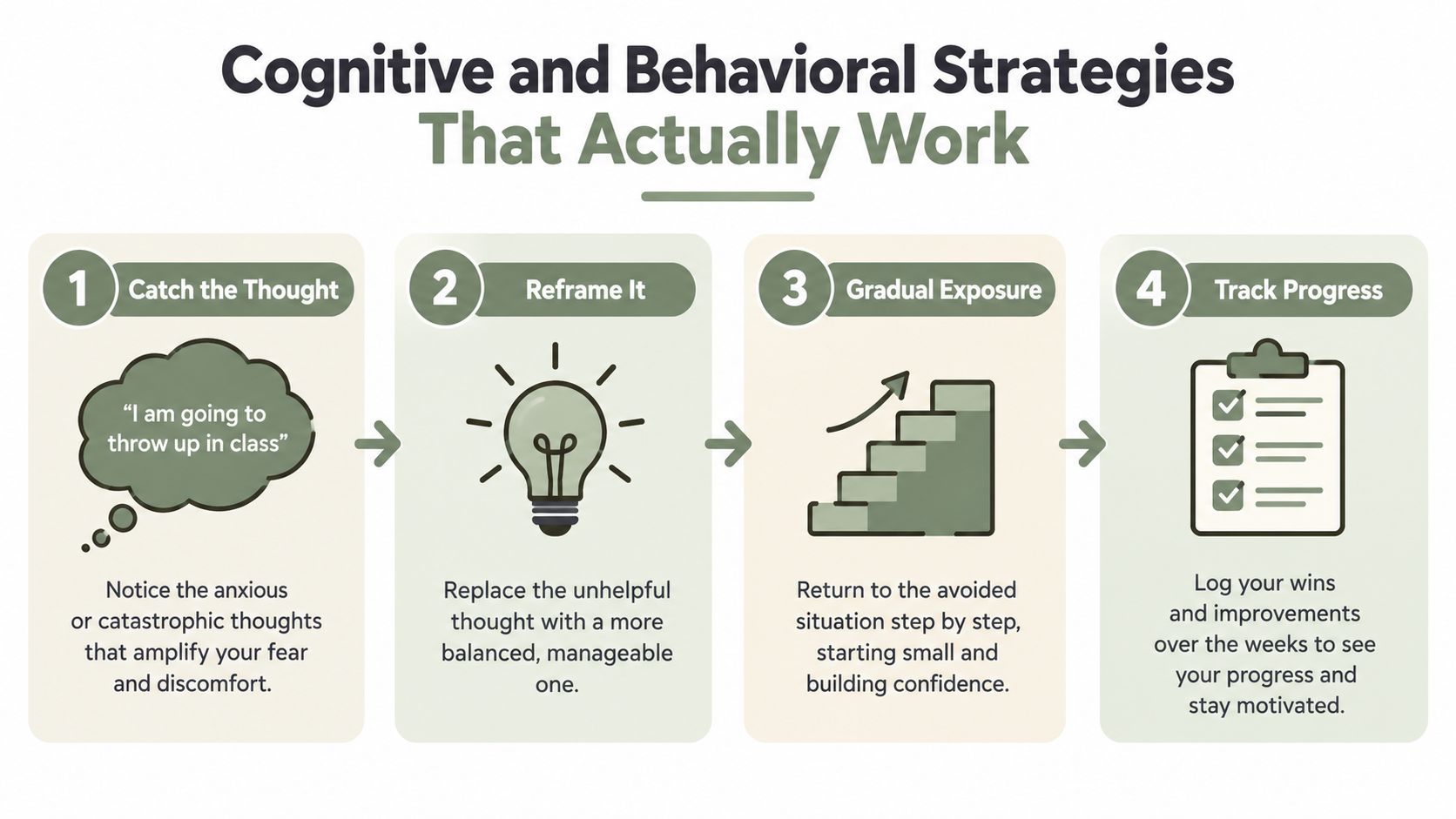
A child who thinks, “I'm going to throw up in class,” may experience the thought as a prediction rather than a fear. The body responds to that prediction with more alarm, the child monitors the stomach, and the increased attention makes nausea more noticeable. Treatment works by changing both the interpretation and the behavior that follows it.
Challenge the prediction collaboratively
Don't respond with, “That won't happen.” Your child may hear that as a promise you can't guarantee. Try questions that create space for uncertainty: “What is your worry predicting? What signs would tell us your body is anxious? If nausea shows up, what could you do while staying in class?”
A more workable thought might be, “I may feel queasy, and I can stay seated, breathe normally, take a sip of water, and ask for help if I need it.” The aim isn't forced positivity. It's a statement that recognizes discomfort without treating it as an emergency.
Build exposure around normal life
Avoidance keeps the fear persuasive. A therapist may create a graded plan that starts with manageable steps and moves toward the activities the child has abandoned. For example, a child avoiding school might first enter the building with a caregiver, then stay for part of the morning, then return for a full day. A child avoiding meals might begin with a tolerated food near the family table, then add small variations.
Breathing, distraction, and water can support approach behavior, but they shouldn't become safety rules such as “I can only enter class if I count breaths exactly or carry five emergency items.” If the child believes the tool prevented catastrophe, the fear remains untested.
A review of functional gastrointestinal disorders reports that psychological treatments, including CBT, gut-directed hypnotherapy, relaxation, and mindfulness, have a number needed to treat of roughly 3 to 6, with one cited estimate placing CBT near 3 for meaningful symptom reduction. Internet-delivered CBT has also outperformed wait-list controls for gastrointestinal symptoms, quality of life, school absenteeism, avoidant behavior, medication use, and symptom-related fear, with an NNT of 4.06 (review of psychological treatments for functional gastrointestinal disorders).
For families facing limited local access, a structured non medication anxiety treatment resource can help clarify therapy options, though a child with red-flag symptoms still needs medical assessment.
Track progress by function, not only by nausea intensity. Useful measures include school attendance, meals completed, time spent avoiding, willingness to travel, and recovery after a nausea wave. A child may still notice occasional queasiness while making substantial progress because they're no longer organizing life around it.
Family Routines and Parent Coaching That Reduce Nausea
Children manage nausea better when the day has predictable anchors. Rushed mornings, skipped breakfast, irregular sleep, and repeated negotiations at the front door create more opportunities for the alarm system to take over.
Make mornings boring and consistent
Prepare clothes, bags, and lunch the night before. Allow enough time for a small breakfast and an unhurried departure. At drop-off, use a brief script: “I know your stomach feels uncomfortable. You have your plan, and I'll see you after school.” A long goodbye, repeated symptom questions, or a last-minute decision to stay home may provide immediate relief while strengthening avoidance.
After school, ask about the day before asking for a symptom report: “What was one ordinary or enjoyable part of school?” This doesn't mean ignoring nausea. It prevents the stomach from becoming the central topic of every family interaction.
Coach without accommodating
NICE guidance recommends CBT for moderate-to-severe panic disorder and describes a typical adult course as weekly sessions lasting one to two hours, completed within a maximum of four months. The guidance also emphasizes parent participation for children and adolescents, particularly because repeated reassurance and accommodation can reinforce the anxiety cycle (NICE recommendations for panic disorder).
At home, parent coaching may involve:
- Calm validation: “I believe that you feel sick, and we're going to follow the plan.”
- Limited checking: Ask once about safety concerns, then shift toward the next action.
- Predictable attendance: Keep school and activities in the routine when medically appropriate.
- Regular nourishment: Offer dependable meals and fluids without turning eating into a contest.
- Evening decompression: Use a consistent bedtime, a short worry-writing period, and a predictable wind-down.
A weekly rhythm might include regular meal times, school attendance, gentle activity, planned relaxation, and one family activity unrelated to symptoms. Parent sessions can translate therapy language into these routines. Families can also review family therapy techniques when conflict, accommodation, or communication problems are keeping the pattern active.
The parent's task isn't to guarantee that nausea won't happen. It's to show the child that discomfort can be handled safely and without surrendering the day.
What to Watch for When Nausea Starts After a New Medication
A new nausea symptom after an SSRI creates a genuine clinical puzzle. It may reflect the child's anxiety, a medication effect, increased attention to bodily sensations, or several factors at once. Stopping the medication abruptly without speaking with the prescriber can create its own problems, but dismissing severe symptoms is also unsafe.
In a prospective pediatric study, escitalopram was associated with transient changes in nausea and vomiting during the first two weeks of treatment. Broader gastrointestinal symptom frequency and severity didn't differ from placebo, and the authors characterized the SSRI-related gastrointestinal effects as transient rather than sustained (prospective pediatric escitalopram study).
Keep a medication-specific record
Write down the medication name, dose, start date, any dose increase, and the exact time nausea occurs. Add whether your child is keeping fluids down, whether symptoms are improving or escalating, and whether nausea is causing food restriction, school refusal, skipped doses, or fear of taking the next dose.
A general resource on side effects of citalopram explained may help families prepare questions, but it doesn't replace advice from the prescribing clinician. Contact the prescriber before changing or stopping treatment, especially if symptoms are mild but persistent or the child is becoming avoidant.
Seek urgent medical help for dehydration, persistent vomiting, blood, severe abdominal pain, fainting, confusion, or an inability to keep fluids down. Medication management works best when paired with developmentally appropriate CBT and parent coaching, so the family can address side effects, fear, reassurance-seeking, and avoidance rather than treating each episode as a separate crisis.
When to Seek Professional Help and What to Expect Next
Professional help makes sense when nausea keeps returning, limits school or meals, drives repeated reassurance, or remains difficult to interpret after a medical check. A coordinated team may include the pediatrician, prescribing clinician when relevant, pediatric psychologist, school staff, and caregivers.
Therapy commonly begins with assessment and education, followed by parent coaching, cognitive work, and graded exposure to avoided situations. Gut-directed hypnotherapy can be a structured adjunct after appropriate medical assessment, especially when functional nausea persists. In a randomized trial of 100 children aged 8 to 18, adequate relief at six months in the functional-nausea subgroup was higher with hypnotherapy than usual care, 81% versus 55% by child report and 79% versus 53% by parent report, although the advantage wasn't maintained at twelve months (randomized trial of pediatric gut-directed hypnotherapy).
Telehealth may fit families who need parent coaching, CBT, and exposure planning across ordinary home and school routines. In-person medical evaluation is preferable when red flags, growth concerns, dehydration, persistent vomiting, or diagnostic uncertainty are present. Families can learn more about what a pediatric psychologist does before deciding which professional to contact.
---
Wald Behavioral Health offers evidence-based anxiety therapy, CBT-informed exposure work, parent guidance, and telehealth or in-person care for children, adolescents, young adults, and families. If your child's nausea is affecting school, meals, sleep, or family routines, visit Wald Behavioral Health to request a free 15-minute consultation about symptoms, fit, and scheduling.
Questions about your child or teen?
Dr. Wald offers a free 15 minute consultation to talk through what you are seeing and whether the practice is a good fit.
Free 15 Minute Consultation