How to Explain Anxiety to a Child: A Calm Caregiver Guide
Your child is standing outside the classroom, gripping your hand and saying, “I can't go in.” Or perhaps bedtime has stretched into an hour of stomachaches, questions, and requests for one more check of the closet. In these moments, how to explain anxiety to a child matters less as a perfect definition and more as a calm translation: what the body is doing, what the child can do next, and how you'll practice together.
A useful explanation should reduce shame without dismissing fear. It should help a child notice the alarm, separate discomfort from immediate danger, use one manageable skill, and take a small step toward the activity anxiety is trying to avoid.
## Table of Contents - Recognizing Anxiety as a Normal Alarm System - Worry versus disruptive anxiety - A Five-Step Script for Explaining Anxiety - 1. Validate the experience - 2. Separate alarm from danger - 3. Give anxiety a neutral name - 4. Choose one regulation skill - 5. Take a small approach step - Simple Regulation Skills Children Can Practice - Slow breathing without pressure - Sensory grounding - Building Confidence Through Gradual Practice - A separation ladder - Repetition matters more than intensity - What to Reinforce and What to Avoid - Coordinate the adults - Putting It All Together in Real Conversations
Recognizing Anxiety as a Normal Alarm System
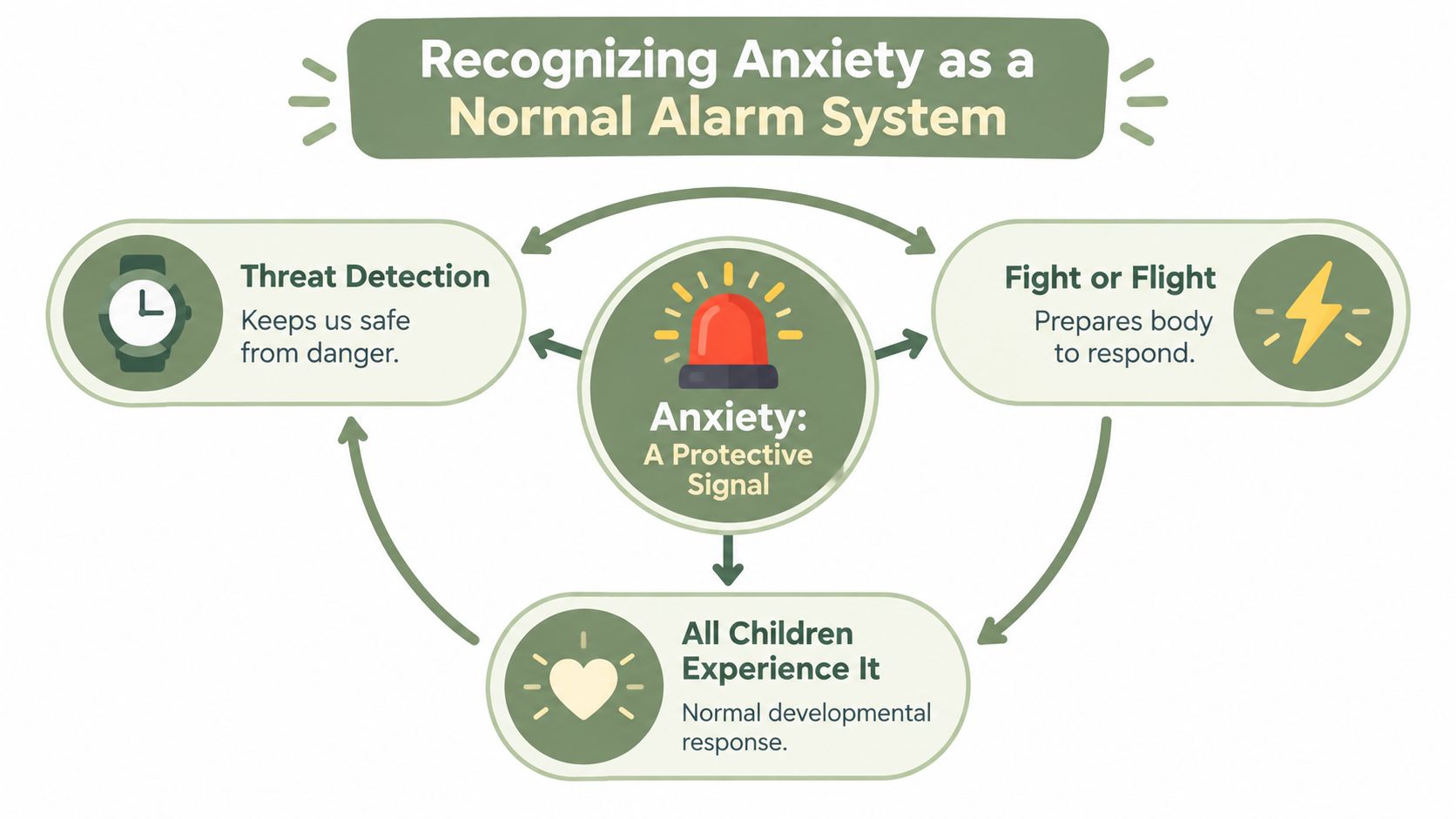
Start with normalization. A child who thinks anxiety means something is wrong with them may resist every strategy as proof that they're defective. Anxiety is better described as a protective alarm system that sometimes becomes too sensitive, like a smoke detector reacting to toast instead of a house fire.
You might say, “Your brain has an alarm that looks for danger. Sometimes it rings when you're not in danger. The alarm feels real, but a feeling isn't always a prediction.”
For a younger child, keep the language physical: “Your heart is beating fast because your body thinks it needs to get ready.” For an older child, add the cycle: “Your brain notices a possible threat, your body reacts, and then you may want to escape. Avoiding the situation can teach the alarm to ring even more loudly next time.”
The World Health Organization estimates that 4.1% of children ages 10, 14 and 5.3% of adolescents ages 15, 19 experience an anxiety disorder. WHO also reports that about 1 in 7 people ages 10, 19 experience a mental-health condition, while WHO and UNICEF report that one-third of mental-health conditions emerge before age 14 and half before age 18. These figures can support a simple message: “Lots of children have an alarm that reacts strongly.” They shouldn't become a label you place on your child before an assessment. (World Health Organization guidance on adolescent mental health)
Worry versus disruptive anxiety
Ordinary worry may appear before a test, a sleepover, or a new activity, then ease as the child adjusts. Anxiety deserves closer attention when fear persistently interferes with school, sleep, friendships, family routines, or ordinary activities. A child may not say “I'm anxious.” They may stall, become irritable, complain of a stomachache, cling at separation, or refuse a familiar task.
Ask four quiet questions:
- What was happening when the alarm started?
- What did your child predict would happen?
- What did your child do next?
- What did anxiety stop them from doing?
That pattern gives you more useful information than arguing about whether the fear is rational. If impairment persists, or if there are panic-like episodes, school refusal, severe sleep disruption, compulsive rituals, or safety concerns, seek professional assessment. Parent-focused resources such as Wald Behavioral Health's child anxiety guidance can help caregivers think through symptoms, triggers, and next steps without treating a conversation at home as a diagnosis.
A Five-Step Script for Explaining Anxiety
Use the same sequence repeatedly so your child doesn't have to invent a response while distressed. The words should change with age, but the order matters: validate, distinguish, label, regulate, approach.
1. Validate the experience
Validation isn't agreement that danger is present. It means acknowledging what the child is genuinely experiencing.
- Younger child: “Your tummy feels tight. That feels scary.”
- School-age child: “Your body is sending a very strong worry signal right now.”
- Teenager: “I can see your anxiety is intense. I'm not going to make fun of it or pretend it feels small.”
Avoid starting with “There's nothing to be afraid of.” That may sound reassuring to you but can tell the child that their body is wrong and that you don't understand.
2. Separate alarm from danger
Next, check the situation without demanding certainty.
- Younger child: “Let's look. Are we safe right now?”
- School-age child: “Your alarm says something bad might happen. What evidence do we have about what's happening now?”
- Teenager: “Anxiety is giving you a prediction, not a fact. We can assess the actual risk and decide what response fits.”
Don't promise, “Nothing bad will happen.” Life doesn't offer that guarantee, and repeated reassurance can become a safety behavior. The child may keep asking until you provide certainty again.
3. Give anxiety a neutral name
External language reduces shame. Try the alarm, the worry voice, or the threat detector. Let your child choose the term if they prefer.
“Your worry voice is predicting that everyone will laugh,” is more workable than, “You're being irrational.” The label creates distance without turning anxiety into an enemy your child must defeat.
4. Choose one regulation skill
Keep it brief: “Let's make the exhale longer,” or “Name three things you can see.” Don't teach a full lesson while your child is highly activated. One short sentence and one observable action work better than a lecture.
5. Take a small approach step
End with movement toward the situation, not immediate escape. “We'll walk to the school gate and stand together for two minutes,” is more useful than “You have to go in and stop being scared.” The step should be challenging but achievable, then repeated before you increase it.
Practical rule: Your child doesn't need to feel completely calm before taking a supported step. The skill is learning to act while some anxiety is present.
Simple Regulation Skills Children Can Practice
A regulation skill is most useful when your child has practiced it during calm moments. If you introduce breathing for the first time during a morning meltdown, the child may conclude that it “doesn't work” after one hurried attempt. Practice briefly during ordinary routines, then use the same skill when the alarm rises.

Slow breathing without pressure
Tell your child, “We're not trying to force the worry away. We're giving your body a slower signal.” Invite a gentle inhale through the nose and a longer, comfortable exhale. A preschooler can pretend to smell hot cocoa and cool it with a slow breath. An older child can count to themselves, as long as counting doesn't become another performance test.
Keep your voice slower than usual. Children often borrow the pace of the adult beside them, so your posture and breathing are part of the intervention.
Sensory grounding
Grounding shifts attention from a racing prediction to information available now. Say, “Find three things you can see, two things you can feel, and one sound you can hear.” For a younger child, turn it into a detective game. For a teenager, suggest noticing the pressure of both feet on the floor, the temperature of the air, and the shape of nearby objects.
“We're not asking your body to prove that everything is safe. We're helping it notice what is happening right now.”
After the exercise, ask what changed by even a small amount. Don't require the child to report feeling calm. A useful outcome may be, “I still feel nervous, but I can put on my shoes,” or “My stomach still hurts, but I can sit at the table.”
For physical comfort, some families use a familiar soft object or a weighted product. Safety and fit matter, especially for young children, so review That Blanket Co sizing and safety tips before choosing a blanket for a toddler bed. A comfort item should support coping, not become the only condition under which the child can sleep or separate.
Children benefit from repetition, play, and choice. You can draw an alarm dial, blow cotton balls across a table, or practice grounding while waiting for dinner. For more activity ideas, see these child anxiety therapy activities, then select one skill that fits your child instead of offering an overwhelming menu.
Building Confidence Through Gradual Practice
Confidence usually follows approach, rather than arriving first. In the Child/Adolescent Anxiety Multimodal Study, 488 children ages 7, 17 were assigned to treatment conditions over 12 weeks. Improvement occurred in 60% receiving CBT alone, 81% receiving combined CBT and sertraline, 55% receiving sertraline alone, and 24% receiving placebo. CBT included identifying unhelpful thoughts, understanding body signals, and facing feared situations through structured, gradual tasks. (National Institute of Mental Health report on CBT and childhood anxiety)
The practical translation is simple: don't force the biggest feared task, and don't let avoidance make every decision. Build a ladder of steps that your child can repeat.
A separation ladder
Suppose your child cries whenever you leave the room. A ladder might begin with sitting nearby while the child plays, then moving to the doorway, then stepping out briefly while another trusted adult remains present. Later steps might involve a longer separation or a different setting. The exact sequence depends on the child's fear and functioning.
Use the child's predictions to design the ladder. Ask, “Which step feels uncomfortable but possible?” If the child chooses a step that is too easy, anxiety may not get enough opportunity to learn. If the step is overwhelming, the child may escape and conclude that the situation was unmanageable. A clinician can help calibrate the ladder when avoidance is severe.
Repetition matters more than intensity
Repeat a manageable step until participation becomes more ordinary, then move upward. Praise the behavior that builds learning:
- “You stayed with the feeling and kept playing.”
- “You used your breathing before asking me to check.”
- “You walked to the door even though your alarm was loud.”
Don't make calmness the pass mark. Anxiety can remain present while the child learns that they can function. Temporary setbacks are expected, especially after illness, transitions, conflict, or poor sleep. Return to a previous step, practice again, and describe the adjustment as problem-solving rather than failure.
Gradual exposure is a structured component of CBT, and exposure therapy for children can provide guidance when home practice becomes confusing, highly distressing, or difficult to maintain.
What to Reinforce and What to Avoid
Your response can either reward courage or make escape the most reliable way to obtain relief. The distinction is subtle because compassionate parents naturally want to remove distress. The most helpful response validates the feeling while supporting participation.
| Reinforce | Avoid | |---|---| | “You're worried, and you're taking the next step.” | “There's nothing to worry about.” | | Staying present while the child practices | Repeatedly checking, researching, or answering the same question | | Effort, skill use, and willingness to remain | Perfect calm as the only sign of success | | A planned break that leads back to the task | An unplanned escape that ends the task | | One consistent caregiver plan | Different rules from different adults |
Excessive reassurance often feels effective because the child settles briefly. But if the child returns with the same question, reassurance may have become part of the anxiety cycle. Replace certainty with confidence in coping: “I can't promise exactly what will happen. I can help you handle the next part.”
Criticism creates a different problem. Calling a fear silly, irrational, or dramatic adds shame without teaching a response. Try, “The fear feels convincing, and we're going to test what happens while using your plan.”
Coordinate the adults
Children notice contradictions quickly. One caregiver may insist on school attendance while another routinely allows avoidance, or one may answer every reassurance question while the other refuses all support. Agree on the language, the practice step, the acceptable break, and what happens after the child completes it.
Caregivers should also watch for digital-device distress without treating screens as the enemy. OECD evidence reports that approximately 17% of 15-year-olds feel anxious or nervous at least half the time when separated from their digital devices, with higher rates among girls, at 22%, than boys, at 13%. The same evidence connects problematic internet use with anxiety and notes that device conflict can strain parent-child relationships. (OECD report on children in the digital age)
Ask whether the device is helping the child recover, or helping them avoid a feared feeling. Then set collaborative limits and teach another coping option, especially after upsetting videos, peer conflict, frightening news, or compulsive checking.
Putting It All Together in Real Conversations
At bedtime, a child says, “My stomach hurts. I can't sleep unless you stay here.” You might answer, “I believe your stomach feels tight. That's your alarm sending a danger message, but we're safe in your room. Let's name three things we see, then I'll sit by the door while you take five slow breaths.”
Afterward, choose a small approach step: you remain by the door rather than beside the bed, and your child stays in bed while the alarm settles. The next evening, repeat the same step before making the separation slightly larger. You aren't promising a worry-free night. You're teaching, through practice, “I can feel anxious and still do the next part.”
If anxiety repeatedly disrupts school, sleep, friendships, or family life, parent coaching and child therapy can add structure. Wald Behavioral Health provides developmentally informed therapy, parent training, and family guidance for anxiety, school refusal, sleep concerns, and related challenges through in-person care and telehealth where available.
---
If your child's anxiety is affecting daily routines, contact Wald Behavioral Health to discuss child therapy, parent guidance, or a free 15-minute consultation. A clinician can help you turn these conversations into a practical plan suited to your child and family.
Questions about your child or teen?
Dr. Wald offers a free 15 minute consultation to talk through what you are seeing and whether the practice is a good fit.
Free 15 Minute Consultation