How to Deal with Anxiety at School: Practical Strategies
The backpack is ready, but your child is still at the kitchen table, saying their stomach hurts. Or you're the student staring at a classroom door, trying to decide whether you can walk in without crying. Another reminder that school is important won't resolve what's happening. You need to understand what feels threatening, what support makes participation possible, and when anxiety needs professional attention.
## Table of Contents - What This Guide Covers and Who It Is For - Give Each Person a Clear Role - Match the Approach to the Student - How Common School Anxiety Really Is - Look Beyond the Student Who Says They're Worried - Distinguish Worry From Impairment - Everyday Coping Skills Students Can Use - Use a Skill, Then Take an Action - Keep Practice Predictable and Private - Supporting Without Reinforcing Avoidance - Ask What the Adjustment Makes Possible - Validate Without Entering Endless Negotiations - Graded Exposure and Return-to-School Plans - Start With the Reason Attendance Is Difficult - Put the Return Plan in Writing - What School-Based Programs Can and Cannot Do - What School-Based Anxiety Programs Deliver Over Time - Ask About Follow-Through - When Anxiety Warrants Professional Help - Signs That Need More Than Everyday Coaching - What a Useful Evaluation Should Clarify - Make the Next Step Concrete
What This Guide Covers and Who It Is For
Learning how to deal with anxiety at school means more than finding a technique that makes someone feel calmer. A useful plan helps a student keep learning, maintain relationships, and approach situations that anxiety has made difficult. Feeling better matters, but functioning matters too.
Students, caregivers, and school staff have different jobs. Problems arise when everyone responds separately, or when the student becomes responsible for carrying messages between adults.
Give Each Person a Clear Role
- Students identify the difficult moment. “School is stressful” is a starting point. “I panic when the teacher calls on me without warning” gives adults something specific to address.
- Caregivers notice patterns outside school. Morning distress, homework battles, and sleep changes can provide information teachers don't see.
- School staff describe what happens during the day. A student who appears composed in class may still avoid lunch, repeatedly visit the nurse, or spend the day seeking reassurance.
Coordinate those observations without turning every conversation into an anxiety interview. Agree on what the student will try, what adults will do, and how everyone will know whether the support is helping.
Practical rule: Judge a plan by whether it helps the student participate, not simply by whether it prevents visible distress.
Match the Approach to the Student
A young child may need pictures, play, and a caregiver's coaching. A teenager may want discreet support and a say in what teachers know. A college student may need help navigating academic demands and arranging care independently.
There's also an important boundary: ordinary worry and anxiety-driven school refusal don't call for identical responses. A coping exercise may help before a test, but it isn't a complete treatment plan when leaving home has become unmanageable.
Evidence-based practice combines research-supported methods with an individualized assessment. It doesn't mean applying the same worksheet to every student or insisting that a struggling child should manage alone.
How Common School Anxiety Really Is
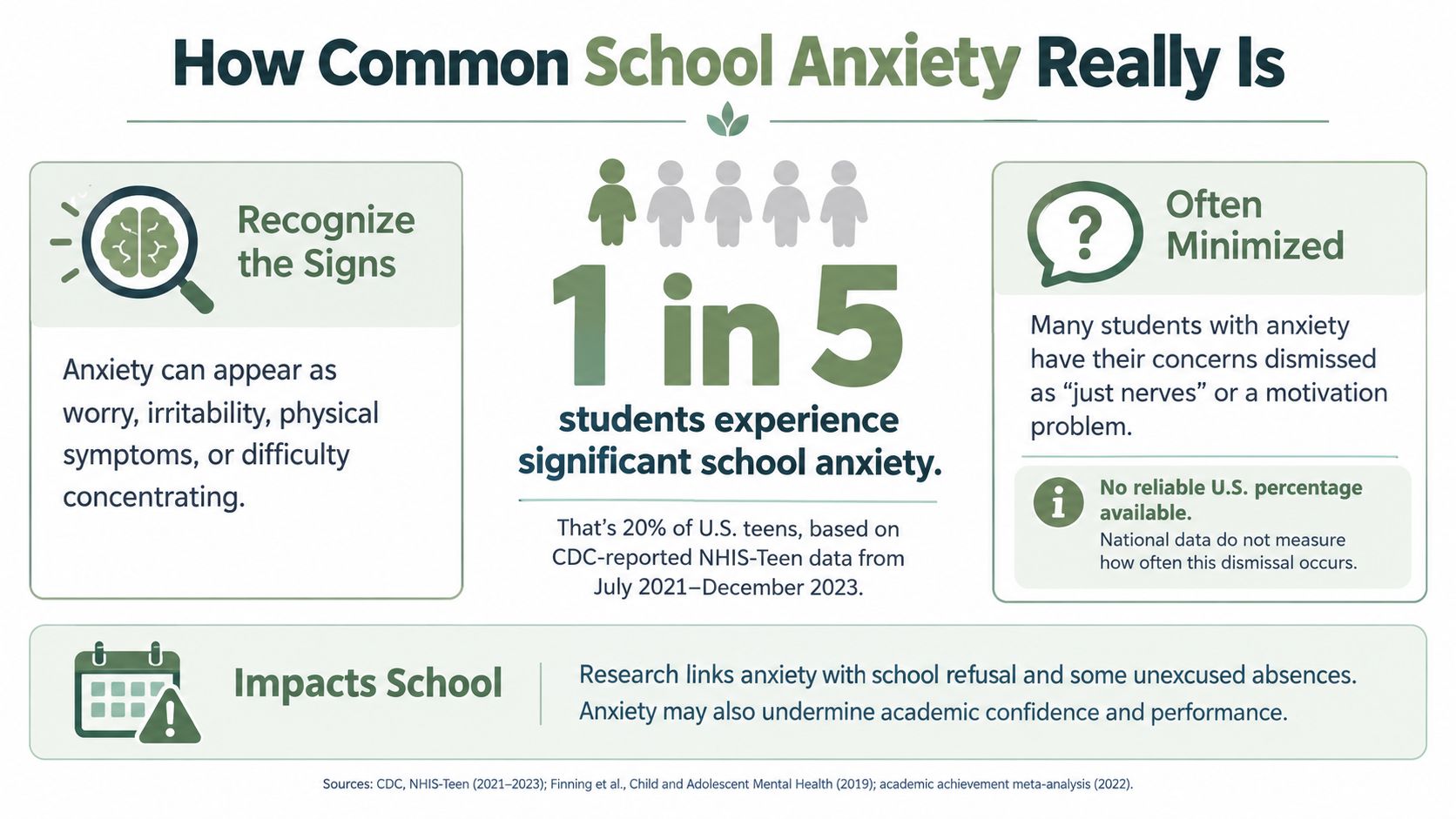
School-related anxiety deserves attention as a health and learning concern, not an automatic judgment about motivation. The CDC's data on anxiety symptoms and care indicate that approximately 20%, or 1 in 5, U.S. adolescents ages 12, 17 experienced anxiety symptoms during the previous two weeks in 2021, 2023. That statistic describes anxiety symptoms generally, not the proportion with a diagnosed school-anxiety disorder.
The World Health Organization's estimates describe a different measure: anxiety disorders affecting about 4.1% of children ages 10, 14 and 5.3% of adolescents ages 15, 19 globally, as summarized alongside the adolescent anxiety figures in the linked reference. Symptoms and diagnoses aren't interchangeable, and these populations shouldn't be combined.
The visual below highlights recognition and school impact. Its central figure should be understood as the adolescent anxiety-symptom estimate, not a school-specific prevalence rate.
Look Beyond the Student Who Says They're Worried
Anxiety may be visible through behavior or physical discomfort before a student can explain it.
- Physical complaints: Repeated stomachaches or headaches, especially around particular school demands, warrant attention rather than accusations of pretending.
- Avoidance: Skipping presentations, delaying tests, or struggling to separate from a caregiver can signal a specific fear.
- Perfectionism and reassurance-seeking: Rewriting acceptable work or repeatedly asking whether an answer is correct may conceal substantial distress.
- Changes in functioning: Irritability, difficulty concentrating, and school refusal matter even when the student doesn't use the word anxiety.
Younger students may struggle most with separation; teenagers may describe embarrassment, evaluation, or academic pressure. For college students, ask about the actual transition or demand rather than assuming that greater independence means less need for support.
Distinguish Worry From Impairment
A student can feel nervous and still attend, attempt work, and recover afterward. Concern increases when distress repeatedly disrupts those activities, narrows participation, or requires adults to reorganize the day around preventing anxiety.
For students studying the subject academically, MasteryMind offers a place to find A-level psychology study materials. Keep educational learning separate from self-diagnosis: understanding psychological concepts doesn't replace an assessment of an individual student.
Everyday Coping Skills Students Can Use
Choose a small toolkit the student can remember under stress. Teach it when they're relatively settled, then rehearse it in a school-like situation. Introducing an elaborate exercise during an overwhelming moment usually creates another demand.
Breathing practice can be discreet enough to use at a desk.

Use a Skill, Then Take an Action
Slow breathing means gentle, comfortable breaths, not repeatedly taking the biggest breath possible. Before a test, a student might breathe in softly and let the exhale last a little longer. If focusing on breathing feels uncomfortable, choose another tool rather than making it compulsory.
Sensory grounding redirects attention toward the immediate environment. In a crowded lunchroom, a student can notice colors around them, feel their feet against the floor, and listen for nearby sounds. Treat this as a practical attention exercise, not a guarantee that panic will disappear.
Naming anxious predictions creates room to think. “I'm having the thought that everyone will laugh” is different from treating that prediction as established fact. Follow it with a workable response: “I can read my opening sentence even if my voice shakes.”
Step-by-step problem-solving turns an overwhelming assignment into an observable action. Instead of “finish the project,” begin with opening the instructions, choosing the topic, or writing an imperfect first sentence.
The important link is between coping and participation.
A coping skill is a bridge into the task, not a test the student must pass before they're allowed to begin.
For additional activity ideas to discuss with a clinician, explore these anxiety therapy activities.
Keep Practice Predictable and Private
Prepare bags and materials before the morning rush. Give homework a predictable starting point, with an agreed plan for what happens when the student gets stuck. These routines reduce the number of decisions adults and students must negotiate under pressure.
Teachers can agree on a quiet cue instead of asking publicly whether a student is anxious. Caregivers can practice alongside a child without checking constantly whether the technique “worked.”
This video provides an additional resource to consider alongside guided practice.
Supporting Without Reinforcing Avoidance
The fastest way to stop distress isn't always the most helpful long-term response. Canceling a feared presentation may make that afternoon easier. If cancellation becomes the standard response, the student loses opportunities to discover what they can manage with support.
That doesn't mean accommodations are bad. Supportive accommodations enable access and participation. The concern is an arrangement that removes feared experiences indefinitely without a plan for learning, review, or re-engagement. The CDC's overview of children's mental-health data and protective factors provides context for taking school and community support seriously rather than expecting students to cope in isolation.
Ask What the Adjustment Makes Possible
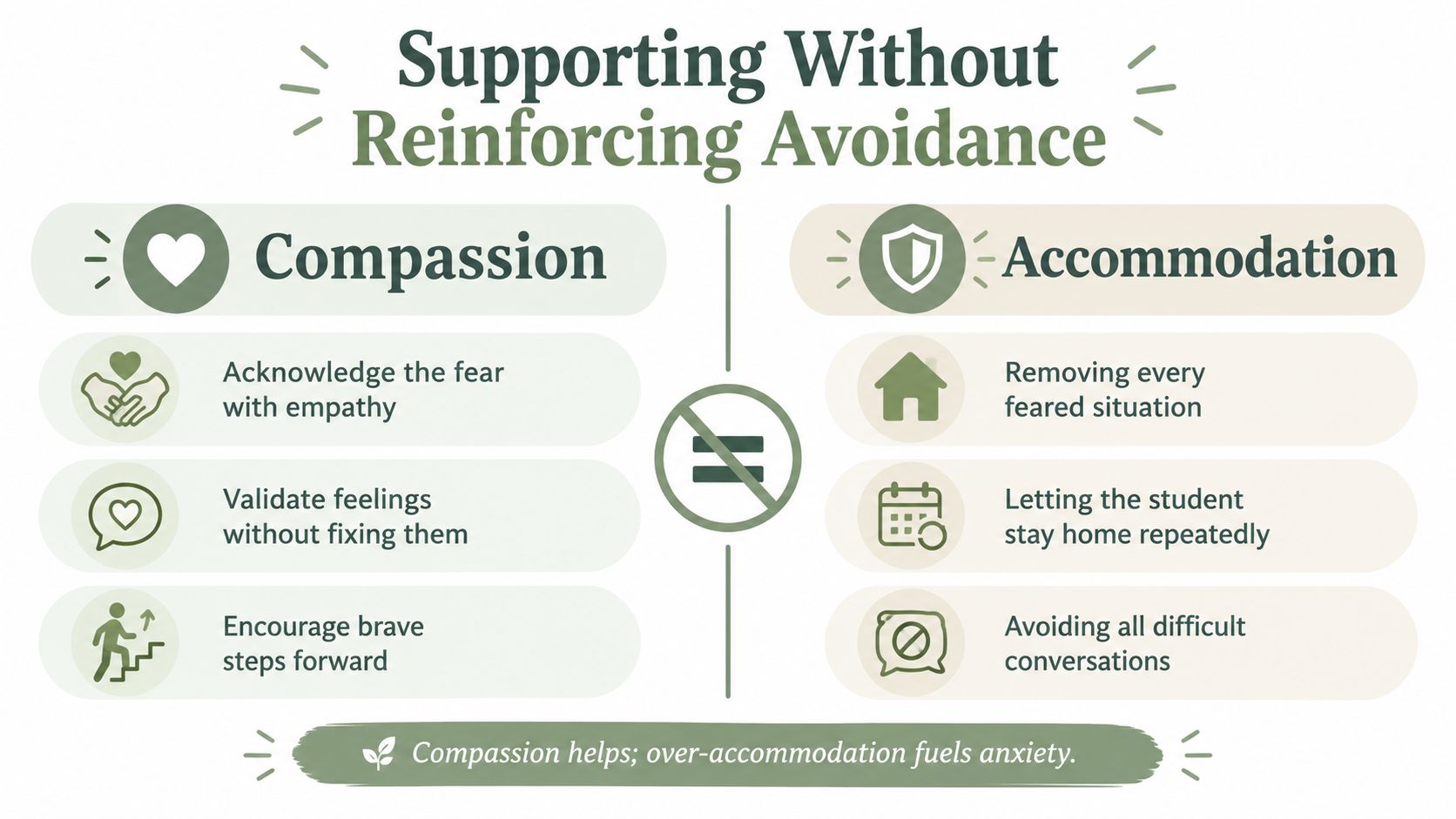
| Situation | Support that enables participation | Pattern to reconsider | |---|---|---| | Presentation anxiety | Rehearse privately, then present to a smaller audience | Remove every speaking task indefinitely | | Difficult arrival | Arrange a predictable handoff and review the plan | Let arrival drift later without an agreed next step | | Distress during class | Use a planned break with a return procedure | Leave whenever anxiety rises, with no supported return |
An adjustment needed for a disability or genuine environmental barrier isn't automatically an anxiety-maintaining accommodation. Some supports remain necessary. The useful question is whether the arrangement addresses a real access need, enables progress, or has become the only way the student can avoid discomfort.
This comparison illustrates the distinction, although its accommodation column refers to over-accommodation, not all educational accommodations.
Validate Without Entering Endless Negotiations
Try language that recognizes distress and keeps the next action clear:
- For a caregiver: “I believe this feels scary, and I will help you take the next step.”
- For a teacher: “You don't have to feel confident to start. Would you rather rehearse with me or begin with your notes?”
- For repeated reassurance: “We've answered that question. Let's use the plan instead of checking again.”
These are suggested scripts, not promises that distress will immediately settle. Avoid arguing until the student admits their fear is unreasonable.
Teenagers also need privacy and autonomy. Ask which staff member they're comfortable approaching, explain what information must be shared, and avoid announcing their anxiety to classmates. Collaboration isn't the same as giving anxiety unlimited veto power, but it does require listening.
Graded Exposure and Return-to-School Plans
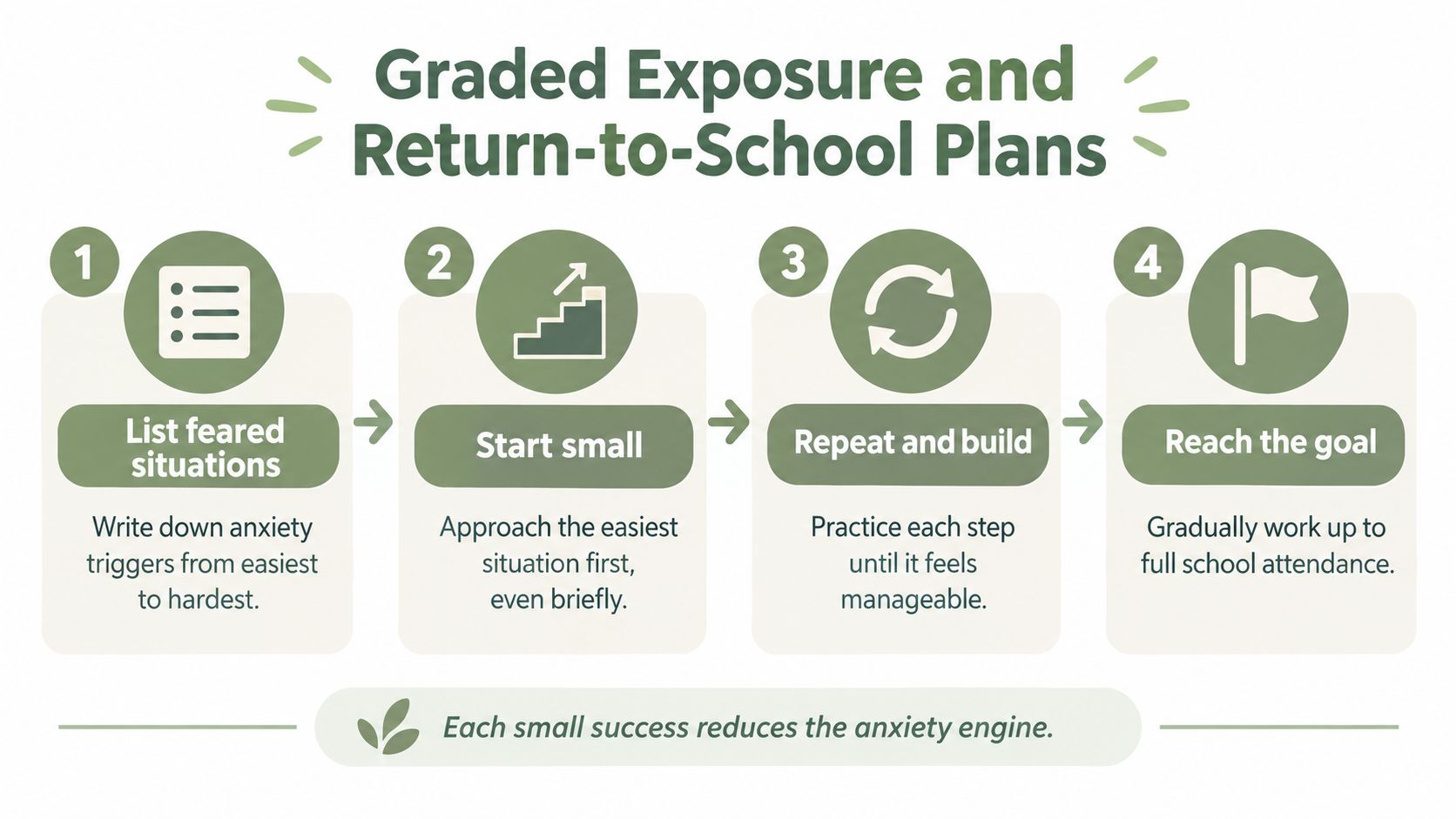
Graded exposure means approaching a feared situation through planned, achievable steps. It isn't flooding a student with their hardest fear, physically forcing attendance, or waiting until they feel entirely ready. The task should be challenging enough to practice, but supported enough to attempt.
School refusal requires particular care. A systematic review of school-involved interventions for high-school school refusal examined 10 interventions and found that cognitive behavioral therapy generally improved attendance and anxiety, but only three studies met high-quality methodological standards. School involvement was inconsistently described, so families shouldn't assume that any attendance plan is equally well supported.
Start With the Reason Attendance Is Difficult
Before setting targets, identify the maintaining factor. Separation fear needs a different plan from bullying, confusing coursework, sensory overload, panic symptoms, or fear of being judged after an absence.
Address actual threats and unmet learning needs first. Exposure shouldn't mean teaching a child to tolerate bullying or removing supports they need to access education.
Use the following visual as a general framework, not a fixed timetable.
Put the Return Plan in Writing
- Define the starting target. Depending on the assessment, this might be visiting the campus, meeting a staff member, or attending an achievable lesson.
- Assign responsibilities. Name the trusted adult, describe the arrival routine, and specify who communicates with the family.
- Plan adjustments and progression. Record the support available, the intended next step, and when the team will review progress.
- Recognize approach behavior. Notice entering, attempting, and staying engaged, even when the student remains anxious.
For presentation anxiety, a ladder might move from reading aloud privately to rehearsing with a familiar peer and then speaking to a larger audience. For separation, the plan might gradually reduce caregiver involvement during handoff. These are examples, not prescriptions.
Families can explore exposure therapy for children before discussing an individualized ladder with a clinician.
Measure progress by participation: A student who attends while anxious may be making meaningful progress, even before their distress decreases.
If mornings repeatedly end in physical symptoms or missed school, arrange assessment rather than escalating punishment. Also seek medical guidance for new, severe, or unexplained physical symptoms instead of assuming every complaint is anxiety.
What School-Based Programs Can and Cannot Do
School-based skills programs can help, but they're not a substitute for every kind of anxiety treatment. A classroom lesson, a targeted group, and individualized therapy involve different levels of assessment and support. Families should ask what the school is offering.
A review of 18 studies of school-based indicated prevention programs found modest average reductions in anxiety symptoms: an immediate standardized mean difference of −0.28, with a 95% confidence interval from −0.50 to −0.05, followed by the outcomes summarized below.
What School-Based Anxiety Programs Deliver Over Time
The following results come from that review; negative standardized mean differences indicate lower anxiety symptoms in the intervention groups.
| Follow-up window | Standardized mean difference | Statistical significance | |---|---:|---| | Immediately after intervention | −0.28 | Statistically significant | | During the first six months | −0.35 | Benefits observed | | At 6, 12 months | −0.24 | Smaller benefit observed | | More than 12 months | Not specified in the summary | No longer statistically significant |
These values aren't percentage improvements. They describe group-level differences, not a prediction of how much an individual child will improve. The later result also doesn't prove that every student lost their skills.
Ask About Follow-Through
A useful program teaches concrete skills and gives students opportunities to apply them. Families should ask:
- Who is it designed for? Is it general education about emotions or targeted support for students already experiencing symptoms?
- How is practice reinforced? Can caregivers and teachers use compatible prompts outside the group?
- What triggers referral? Who notices when attendance, distress, or avoidance requires more individualized attention?
The follow-up findings support planning for continued practice and review rather than assuming a completed program resolves the problem. They don't establish which reinforcement schedule works best.
Families comparing educational settings may also encounter Queens Online School's information about online school for anxious children. Consider such options in relation to learning access, social participation, and treatment goals. Changing settings deserves a deliberate decision, not an automatic assumption that either staying or leaving will solve anxiety.
When Anxiety Warrants Professional Help
Don't wait for a crisis or a failing report card. Persistent distress, substantial impairment, panic symptoms, and school refusal warrant professional assessment. A student can earn good grades while spending an exhausting amount of time managing fear, seeking reassurance, or completing rituals.
Consider the student's overall functioning, not just whether they made it through the school door. Escalate when school and family supports aren't restoring workable participation, or when symptoms are becoming more restrictive.
Signs That Need More Than Everyday Coaching
- Repeated inability to attend: The family is regularly unable to complete the morning routine or return after absences.
- Academic or social decline: Anxiety interferes with completing work, maintaining friendships, or participating in ordinary activities.
- Panic or persistent physical distress: Episodes are recurrent, disruptive, or difficult to distinguish from a medical concern.
- Compulsions or intrusive thoughts: Checking, repeating, or other rituals are interfering with daily life and need targeted assessment.
- Sleep disruption or broader deterioration: School-related distress is affecting recovery at home and the student's ability to function.
Self-harm thoughts or immediate safety concerns require urgent help. If there's immediate danger, contact emergency services or seek emergency evaluation. Stay with the young person when safety is uncertain rather than leaving them to manage alone.
What a Useful Evaluation Should Clarify
A thorough evaluation should build a timeline: when the difficulties began, which situations trigger them, what the student fears, and what happens afterward. Bring attendance records, examples of avoided tasks, relevant school communications, and a description of supports already attempted.
Ask the clinician to consider co-occurring concerns and unmet needs, including learning difficulties, attention problems, mood symptoms, bullying, and medical issues. The purpose isn't to collect labels. It's to avoid treating every difficulty as the same anxiety problem.
A treatment plan should explain the approach, caregiver involvement, school coordination when appropriate, and how progress will be monitored. Cognitive behavioral and exposure-based work should connect to the student's actual difficulties, not remain limited to conversation in the therapy room. This overview of child anxiety therapy can help families prepare questions.
If medication is being considered, use Empire Medical Wellness's anxiety medication safety guide as a starting point for questions to a qualified prescriber. Don't start, stop, or change medication based on an article.
Make the Next Step Concrete
Students can choose a coping skill to rehearse before a real stressor and note whether it helped them attempt the task. Caregivers can bring a concise description of the difficult pattern to a school meeting and request a written agreement. School staff can document attendance concerns early and identify who will coordinate support.
For families seeking care, ask about in-person availability, telehealth eligibility in the student's location, and how parent guidance fits into treatment. Access matters, but so does finding care matched to the student's developmental stage and level of impairment.
---
Wald Behavioral Health offers developmentally informed anxiety therapy and parent guidance, with in-person care in Coral Gables and telehealth across Florida, Maryland, and PSYPACT-participating states. If school anxiety or refusal is disrupting your family's routine, visit the practice to request its free 15-minute consultation and discuss needs, fit, and next steps.
Questions about your child or teen?
Dr. Wald offers a free 15 minute consultation to talk through what you are seeing and whether the practice is a good fit.
Free 15 Minute Consultation