Therapy for Family Issues What Helps and When to Seek Care
Most parents who look up therapy for family issues aren't starting from a calm place. They're usually coming off another rough evening. Homework turned into yelling. Bedtime stretched into tears. One child shut down, another got louder, and the adults ended the night wondering, “How did we get here again?”
That question matters. Families often assume the problem is one person. The stubborn child. The anxious teen. The inconsistent parent. In practice, what keeps distress going is often a pattern. One person gets overwhelmed, another steps in quickly, someone else withdraws, and the same loop repeats tomorrow.
That doesn't mean anyone is failing. It means the family is stuck in a cycle that needs a better map.
Therapy for family issues can help in more than one way. Sometimes the right fit is whole-family work because the main problem is conflict, communication, or a strained relationship. Other times the most effective route is structured parent coaching because the main problem is a child symptom, such as anxiety, ADHD-related struggles, sleep problems, or noncompliance, and caregivers are the ones who can change what happens between sessions.
The key is matching the approach to the problem.
## Table of Contents - When Family Stress Becomes a Pattern Worth Addressing - Everyday stress versus a stuck pattern - What therapy can help with - What progress usually looks like - How Family Therapy Works and Why Patterns Matter - The loop therapists look for - Why patterns matter more than labels - What the therapist actually does - Common Approaches to Therapy for Family Issues - Three common models - Which family therapy approach fits which problem - Whole family or mostly parents - What Benefits to Expect and How Long Gains Last - What the evidence shows - What improvement often looks like at home - How long gains last - When to Seek Help and How to Decide on Next Steps - Signs a pattern is probably stuck - How to choose whole-family sessions or parent coaching - Questions to ask a provider - How Wald Behavioral Health Integrates Family Guidance Into Care - What integrated family guidance looks like - How Wald Behavioral Health applies this model - Why this matters in real life - Moving Forward Together With the Right Support
When Family Stress Becomes a Pattern Worth Addressing
A lot of family stress is normal. Kids are tired after school. Parents are stretched thin. Siblings annoy each other. Hard moments happen in every home.
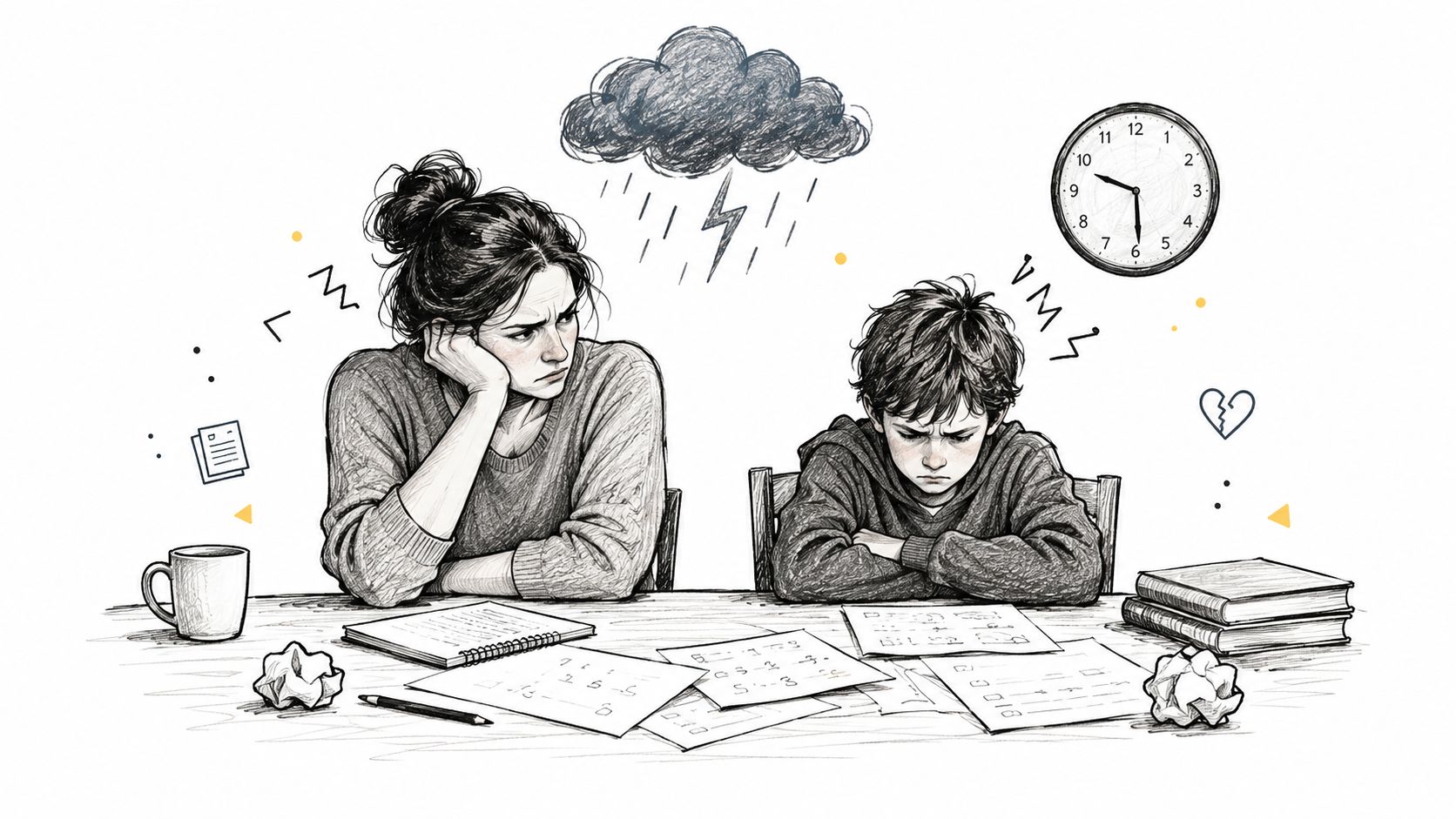
The concern starts when the same hard moment keeps showing up in the same way. A child refuses homework, a parent gives three reminders, voices rise, someone cries, and the night ends with unfinished work and guilt all around. Or bedtime becomes a nightly negotiation that leaves everyone worn out before the next day even begins.
Everyday stress versus a stuck pattern
A useful way to tell the difference is to look for repetition, predictability, and spillover.
- Repetition: The same conflict keeps coming back.
- Predictability: You can almost script who will say what next.
- Spillover: The tension starts affecting sleep, school, meals, or how family members feel around one another.
When families come to therapy, they often say some version of, “We've tried everything.” Usually that means they've tried many things in the moment, but they haven't yet changed the larger pattern around the problem.
Families rarely need blame. They need a clearer view of what keeps happening between the trigger and the fallout.
What therapy can help with
Therapy for family issues isn't about proving who's right. It also isn't about forcing everyone into one emotional group hug. Good care helps a family notice the loop they're in, understand what each person is reacting to, and practice a different response.
That may include work on:
- Parent-child conflict around routines, limits, or behavior
- Sibling tension that keeps escalating
- School-related struggles that spill into home life
- Mood or anxiety symptoms that affect the whole household
- Major changes such as separation, illness, grief, or a move
What progress usually looks like
Progress doesn't always start with a dramatic breakthrough. It often looks smaller and more practical.
A morning routine gets shorter. A parent gives one calm instruction instead of five escalating ones. A child tolerates disappointment without the whole evening collapsing. Family members recover faster after conflict.
Those changes matter because they tell you the home is becoming less reactive and more predictable. That's often the first real sign that therapy is helping.
How Family Therapy Works and Why Patterns Matter
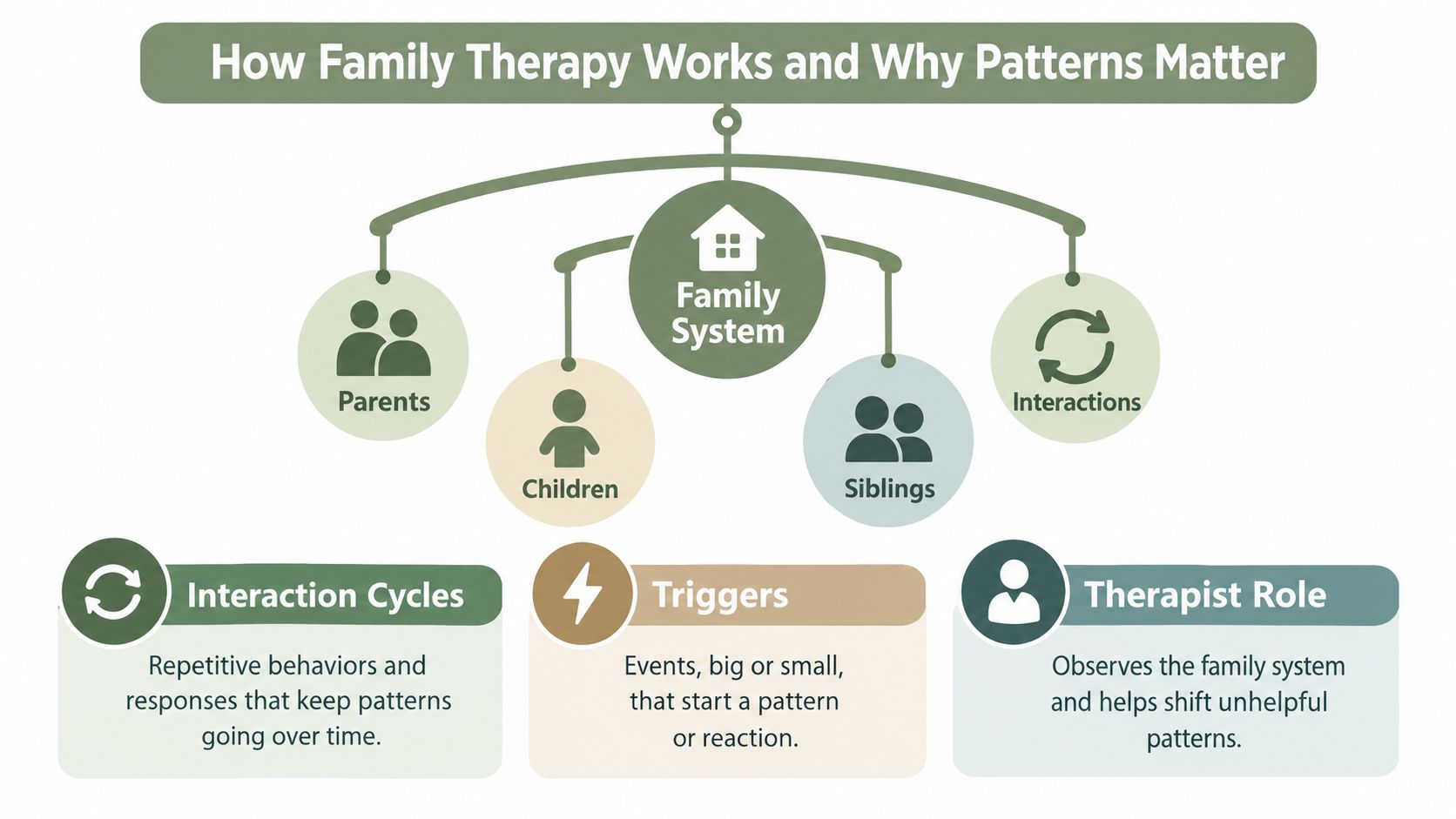
Family therapy makes more sense when you stop thinking about one person as “the problem” and start thinking about the home as an interconnected system.
A simple analogy helps. Think of a hanging mobile over a crib. If you tug one piece, the whole structure moves. Families work like that. When one person changes, everyone else adjusts. Sometimes those adjustments help. Sometimes they accidentally keep the problem going.
The loop therapists look for
Here's a common example. A child feels anxious about school. Morning comes, the child complains of a stomachache, the parent worries and offers extra reassurance, the child stays home or gets lots of help escaping the feared task, and the anxiety gets stronger next time.
No one in that loop is doing anything unkind. In fact, each person is trying to help. But the pattern teaches the child's nervous system that the situation really is too dangerous to face.
Key idea: Therapy often works by changing the responses around a symptom, not only the symptom itself.
Another example looks different. Two parents disagree about discipline. One gets stricter, the other softens to protect the child, the child learns to move between those positions, and the conflict between adults grows. The child's behavior may be real, but the family tension around the behavior becomes part of what keeps it active.
Why patterns matter more than labels
A diagnosis can be useful. It can explain why a child struggles with attention, worry, sleep, or mood. But a diagnosis alone doesn't tell you what happens at 7:40 a.m. when shoes are missing, a parent is late for work, and everyone's stress is peaking.
That's where family-focused work matters. Review-level guidance from the American Academy of Child and Adolescent Psychiatry notes that systemic or family-based approaches can help across a wide range of child and adolescent concerns, including conduct problems, ADHD-related difficulties, anxiety, depression, grief, self-harm, sleep and feeding problems, and some somatic presentations, especially when treatment targets interaction patterns and caregiver responses that maintain symptoms rather than focusing only on the identified child (AACAP overview of the family evidence base).
A short visual often helps parents connect the dots:
- Trigger: Homework demand, bedtime, sibling conflict, school separation.
- Child response: Refusal, meltdown, withdrawal, reassurance-seeking.
- Caregiver response: Repeating, rescuing, arguing, giving in, over-explaining.
- Short-term relief: Everyone gets through the moment.
- Long-term cost: The pattern gets stronger.
Later in the process, many families find it helpful to hear the same concepts explained aloud. This video gives a simple overview:
What the therapist actually does
The therapist listens for patterns, not just content. They watch who interrupts, who softens conflict, who withdraws, and what happens right before the problem spikes.
Then they help the family do something different. That might mean coaching parents to respond more consistently, slowing down a heated exchange, changing routines, or bringing in family members who affect the cycle even if they aren't the ones with the obvious symptoms.
Common Approaches to Therapy for Family Issues
Not all therapy for family issues looks the same. Parents often assume the whole family must attend every session. Sometimes that's true. Often it isn't.
The better question is, what is driving the problem? If the main issue is a strained relationship or recurring conflict, whole-family sessions may be the most direct route. If the main issue is a child symptom that plays out at home, structured parent coaching may be the active ingredient.
Three common models
Family systems therapy looks at recurring interaction patterns. Sessions often focus on communication, roles, alliances, and how each person reacts to stress. This can be a strong fit when the family feels tense, disconnected, or locked into the same fight.
Structural family therapy pays close attention to boundaries and roles. Who's in charge? Who gets pulled into adult conflict? Is a child carrying too much emotional weight? This approach is often useful when the household feels disorganized, conflict crosses generations, or parents have trouble holding a steady leadership role.
Parent-management training or parent coaching is more targeted. The therapist teaches caregivers concrete strategies for responding to behavior, anxiety, avoidance, bedtime resistance, or oppositional moments. The child may still attend some sessions, but the parents often do much of the skill practice because they're the ones shaping daily routines.
For younger children with behavior concerns, some families also explore approaches that directly coach parent-child interactions, such as parent-child interaction therapy.
Which family therapy approach fits which problem
| Approach | Primary Goal | Who Attends | Best Fit For | |---|---|---|---| | Family systems therapy | Change repeated interaction cycles | Often several family members | Ongoing conflict, communication breakdowns, sibling tension, emotional distance | | Structural family therapy | Improve roles, boundaries, and leadership | Usually parents and children together at key points | Parent-child power struggles, blurred boundaries, households that feel chaotic | | Parent-management training or parent coaching | Teach caregivers specific response strategies | Mostly parents, with child involvement as needed | ADHD-related difficulties, disruptive behavior, anxiety accommodation, sleep problems, noncompliance |
Whole family or mostly parents
Many parents get confused, so here's the simplest version.
Use whole-family sessions when the problem lives mainly in the relationship. For example:
- Frequent arguments that involve several family members
- Sibling hostility that pulls everyone in
- Co-parenting conflict that spills into discipline
- Disconnection after a major stressor such as grief or divorce
Use parent-mediated work when the problem lives mainly in a child symptom and parents can change what happens around it. For example:
- Anxiety that leads to reassurance loops or avoidance
- ADHD-related struggles with routines, follow-through, and escalation
- Sleep refusal where caregiver responses shape the bedtime pattern
- Tantrums or noncompliance where consistency changes the outcome
The whole family doesn't always need to be in the room for family treatment to work. In many child cases, the home changes because parents learn what to do differently between sessions.
That distinction can save families time, money, and frustration. It also helps explain why some children improve most when the adults get coaching first.
What Benefits to Expect and How Long Gains Last
A common family question sounds like this: “If we put time and energy into therapy, what will change at home, and will it last after sessions end?”
The most honest answer is that families usually see the best results when the treatment fits the problem. If the main issue is conflict between family members, whole-family sessions often help reduce the friction. If the main issue is a child symptom, such as anxiety, bedtime refusal, or disruptive behavior, progress often depends more on what parents learn to do between sessions than on having everyone in the room each week.
What the evidence shows
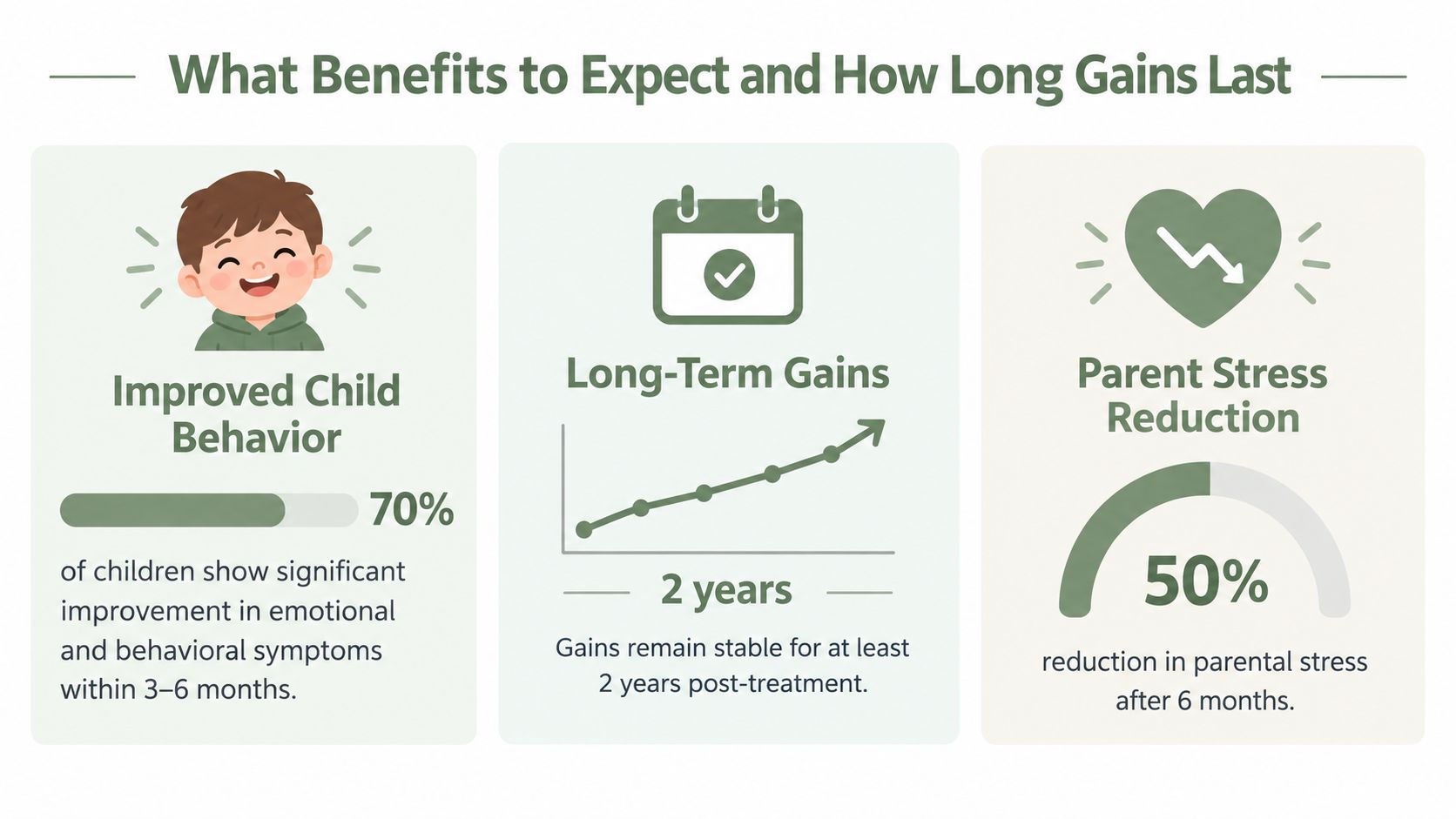
Research on family and systemic treatment for child-focused problems points to meaningful improvement after treatment, with benefits that often remain at follow-up. One review reported an average effect size of 0.65 after treatment and 0.52 at 6 to 12 months, and also found systemic therapy outperformed some comparison conditions, including waiting-list controls and some alternative interventions (Wiley review of systemic interventions).
Those numbers are useful, but parents usually experience the results in simpler terms. The same argument happens less often. Recovery after a hard moment gets faster. Home starts to feel more predictable.
A separate body of research helps explain why parent coaching is often the active ingredient in child-symptom-driven cases. A meta-analysis of 63 studies found small-to-moderate post-treatment effects for parent training, with smaller follow-up effects for behavioral programs. Another meta-analysis reported mean weighted effect sizes of 0.30 for between-subjects designs and 0.68 for within-subjects designs (PubMed summary of parent training meta-analysis).
What improvement often looks like at home
Therapy rarely changes family life all at once. It works more like straightening a crooked bike wheel. First the wobble gets smaller, then the ride gets smoother.
You might notice:
- Calmer routines: Mornings, homework, meals, or bedtime involve less arguing and less panic
- More useful parent responses: Adults set limits more clearly, repeat themselves less, and get pulled into fewer long power struggles
- Better child follow-through: A child handles frustration, separation, bedtime, or school demands with less avoidance
- Less spillover across the house: One person's hard moment is less likely to turn into a family-wide blowup
- Faster repair after conflict: People recover, reconnect, and return to the routine more easily
The pattern of improvement can also tell you whether the treatment target makes sense. In conflict-driven family problems, the first gains are often better communication, less triangling, and fewer repeat fights. In child-symptom-driven cases, the first gains may show up in parent consistency, reduced accommodation, and smoother routines before the child's symptoms fully settle.
How long gains last
Gains tend to last longest when families keep using the new responses after therapy ends. That is true for the same reason physical therapy works. The session teaches the skill, but the body changes through repeated practice at home.
This is why therapists often ask parents to do small, specific things between visits. A shorter bedtime script. One response to reassurance seeking. A calmer limit during tantrums. Those repeated moments are what help new patterns hold.
Expect progress to be uneven. Bedtime may improve before school mornings. Sibling fights may cool down before co-parenting feels easier. A child may protest less even while still feeling anxious inside.
A practical way to measure success is to watch for three signs: fewer repeats of the same problem, less intensity when it does happen, and quicker recovery afterward. Those changes usually mean the family is building a pattern that can last, not just having a lucky week.
When to Seek Help and How to Decide on Next Steps
Many parents wait because they're hoping things will pass. Sometimes they do. Kids move through phases, stress eases, and routines improve.
The harder situations are the ones that keep tightening over time. The conflict gets louder. The avoidance spreads. More of family life starts revolving around preventing the next blowup.
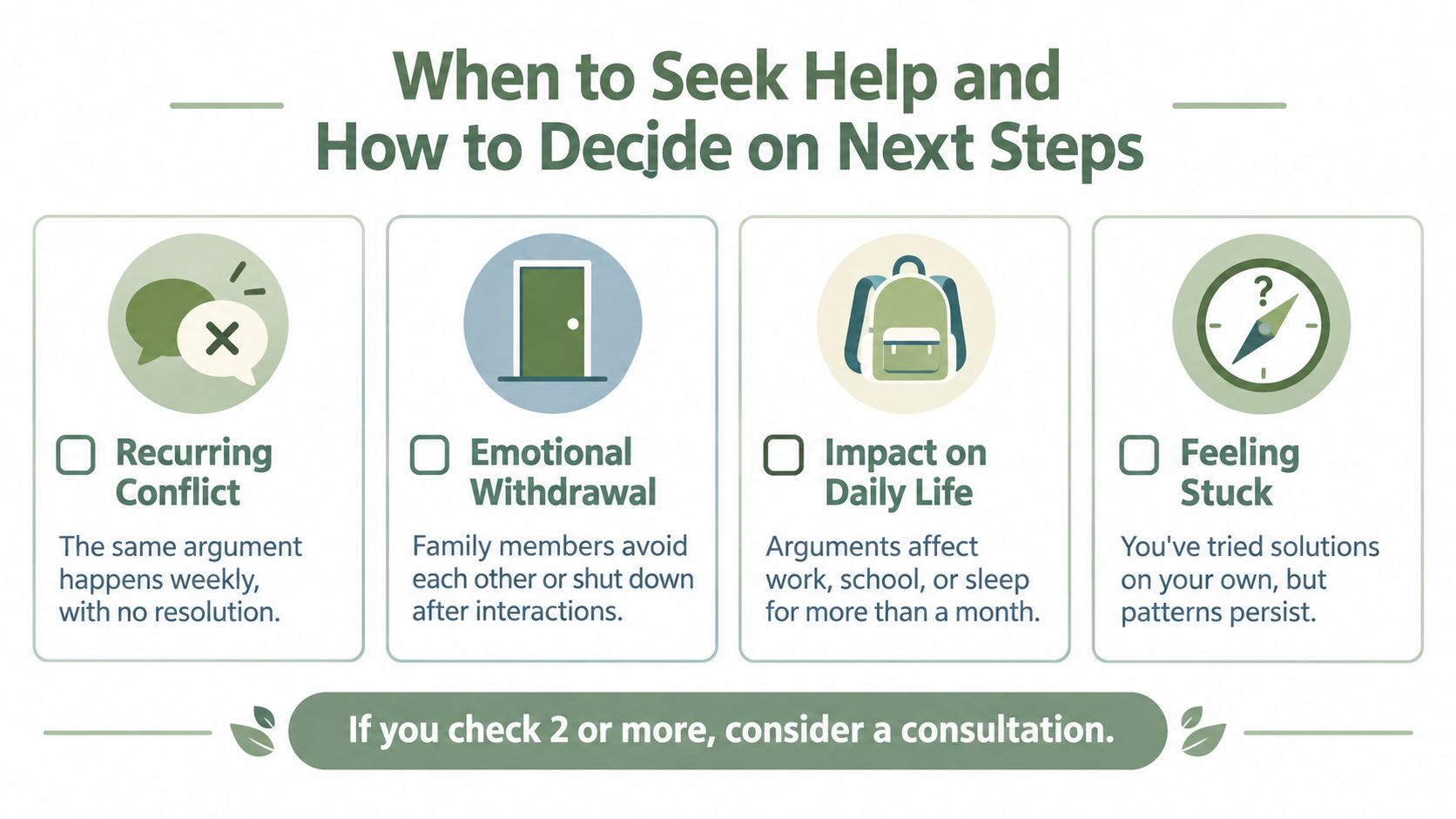
Signs a pattern is probably stuck
Use this as a practical filter at home.
- The same conflict repeats: You keep having the same argument and no one's approach is changing the outcome.
- Someone is withdrawing: A child hides, shuts down, refuses school, or a parent starts avoiding certain routines because they know they'll explode.
- Daily life is getting disrupted: Sleep, school attendance, homework, meals, or sibling relationships are being affected.
- You've become overly reactive or overly accommodating: The household starts revolving around avoiding distress rather than building coping.
If you're noticing several of those signs, it's reasonable to seek guidance. Parents can also review family-focused support options through Wald Behavioral Health's parent resources.
How to choose whole-family sessions or parent coaching
The decision often becomes easier if you ask one question: Is the main problem relational conflict, or is it a child symptom that changes with caregiver response?
Choose whole-family work when: - Arguments are the main event - Multiple family members are caught in the same pattern - Repairing trust, communication, or boundaries is the central need
Choose parent-focused treatment when: - The child's anxiety, behavior, sleep, or avoidance is driving the stress - Parents need a clearer plan for what to say and do at home - The family has already talked plenty, but talking hasn't changed the pattern
Recent review work has also pointed to a growing shift toward parent-mediated and home-based intervention, especially in autism and child mental health, while describing 2020 to 2024 as a period when research hotspots moved toward family wellbeing, caregiver psychology, and telemedicine (APA PsycNet bibliometric review record). That trend fits what many families experience. Sometimes the fastest path to change is helping caregivers respond differently in daily moments.
Questions to ask a provider
A brief consultation can tell you a lot. Ask:
- How do you decide whether the whole family should attend?
- What part of treatment is directed at parent coaching?
- How will we know if the current approach is the right fit?
- What should we track at home between sessions?
Write down a few recent examples before you call. The best notes are concrete. What happened, when it happened, who was involved, and what each person did next.
How Wald Behavioral Health Integrates Family Guidance Into Care
Many families don't need separate silos, one provider for the child, another for the parents, and vague advice to “work on communication” at home. They need treatment that fits the child's developmental stage and also changes what happens in daily routines.
That's where integrated care can be especially practical.
What integrated family guidance looks like
For a younger child, treatment may center on individual work that's paired with parent sessions focused on tantrums, separation, bedtime, or noncompliance. The child learns coping or behavior skills. The parents learn how to respond in ways that reinforce those same skills at home.
For an older child, teen, or young adult, family involvement may be more selective. A therapist might meet individually with the patient while also using parent guidance or family meetings to reduce conflict, support school follow-through, and improve routines without making the young person feel over-managed.
This blended model fits the clinical reality that symptoms don't stay inside the therapy office. Anxiety shows up at school drop-off. OCD strains morning routines. ADHD affects homework and organization. Sleep problems take over evenings.
How Wald Behavioral Health applies this model
One local option is Wald Behavioral Health's services, which include evidence-based therapy for children, adolescents, and young adults with parent training for sleep, tantrums, school refusal, separation, and noncompliance, along with family guidance to reinforce skills between sessions. The practice offers in-person care in Coral Gables and telehealth in Florida, Maryland, and PSYPACT-participating states.
That kind of setup can be useful when families need both pieces at once:
- Child-focused treatment for anxiety, mood concerns, OCD, ADHD, or school stress
- Parent guidance so home responses stay consistent
- Family involvement when conflict or communication is part of what's keeping the problem active
Why this matters in real life
Parents often feel they're being asked to do two jobs at once. They have to support their child emotionally while also setting limits and keeping life moving. Without guidance, those jobs can clash.
A developmentally informed therapist helps families sort that out. With a preschooler, that may mean a structured sleep plan and consistent responses to bedtime protest. With a school-age child, it may mean clear routines and a plan for refusal or reassurance-seeking. With a teen, it may mean balancing support with independence, so the parent isn't either hovering or disengaging.
When treatment includes that home layer, therapy stops being something that happens only once a week. It becomes something the family can use.
Moving Forward Together With the Right Support
It is 7:45 on a school morning. One child cannot find a shoe, another is already arguing, a parent is repeating the same reminder for the fourth time, and everyone leaves the house upset. By bedtime, the topic has changed, but the feeling has not. The family is caught in a loop.
That is often the moment to get support. Not because anyone has failed, but because the same pattern keeps winning.
A useful first step is to watch one recurring problem the way you would watch a traffic jam. You are looking for what sets it off, who reacts first, what eases the tension for a few minutes, and what sets the same cycle up again later. That kind of close observation can answer an important question: Is this mainly a relationship problem, or is a child symptom driving the pattern at home?
That difference matters.
If the main problem is frequent arguments, strained communication, or a parent and child getting pulled into the same fight again and again, whole-family sessions often help most. The work focuses on how family members respond to one another, how conflict grows, and how to interrupt it before it takes over.
If the main problem starts with a child symptom, such as anxiety at separation, bedtime resistance, school refusal, compulsive reassurance-seeking, or tantrums that follow a predictable path, parent coaching is often the active ingredient. In those cases, therapy may still involve the child, but change usually depends on helping adults respond in a steady, planned way at home. It works a lot like physical therapy after an injury. The appointment matters, but the repeated practice between visits is what builds strength.
Many families need both. A child may have anxiety, and the anxiety may be increasing conflict between siblings or between parent and child. A brief consultation can sort out which part needs the lead role in treatment and which part should support it.
If you want to start the conversation at home, keep it short and concrete: “We keep getting pulled into the same pattern. I want us to work on it together.” That wording lowers blame. It names the cycle as the problem, not one person.
One 2023 study found that young patients who had any family therapy were more likely to complete treatment and attended a greater share of visits than those without family therapy (2023 study on family therapy and treatment completion). That fits everyday clinical experience. When the people at home understand the plan and know how to respond, treatment is easier to carry into real life.
Wald Behavioral Health offers evidence-based therapy for children, adolescents, young adults, and families, with structured parent guidance when home routines or parent responses are part of what is keeping the problem going. You can learn more about the practice and request a consultation through Wald Behavioral Health.
Questions about your child or teen?
Dr. Wald offers a free 15 minute consultation to talk through what you are seeing and whether the practice is a good fit.
Free 15 Minute Consultation