Child Therapy Services: What Families Should Expect in 2026
You're standing in the hallway after another rough bedtime. Your eight-year-old has asked for water twice, says their stomach hurts, and melts down the minute the lights go off. Part of you wonders whether this is a phase. Another part is already searching “child therapy services” on your phone, trying to figure out what therapy even means for a child.
That uncertainty is common. Parents rarely seek help because one thing happened once. They reach out because a pattern starts taking over family life. Mornings turn into battles. Homework stretches into tears. School avoidance creeps in. Siblings start reacting to the stress too.
It helps to know that looking into therapy isn't a last-resort move. It's a parenting decision. Child therapy services exist to make daily life more manageable, to reduce suffering, and to give both children and caregivers a clearer plan.
## Table of Contents - What Child Therapy Services Actually Are - More than a child talking in an office - What therapy is not - Why early attention matters - How Child Therapy Has Evolved Into Family-Centered Care - Family-inclusive care versus family therapy - Why this change matters in real life - Common Presenting Problems and Age-Appropriate Methods - The same label can look different at different ages - Presenting problems and age-appropriate methods - What these approaches look like - Diagnosis helps, but development guides the method - Choosing the Right Therapy Format for Your Family - Don't default to individual therapy - Child therapy formats compared - How to decide - One format can support another - What to Expect From Intake Through Ongoing Sessions - The first steps usually feel more organized than parents expect - What a session may actually look like - How families know therapy is working - Navigating Real-World Access Barriers to Care - Availability and access are not the same thing - A layered plan while you wait - The telehealth question - Working With Wald Behavioral Health - How families are matched and treated - What access and logistics look like - How this fits the decision criteria parents actually use
What Child Therapy Services Actually Are
More than a child talking in an office
Child therapy services are a continuum of care, not one single kind of appointment. Depending on the child and the problem, that care can include assessment, short-term skill building, parent coaching, prevention-focused support, or longer-term treatment. A child might see a psychologist, clinical social worker, counselor, marriage and family therapist, or psychiatrist, with each profession playing a somewhat different role.
Parents often picture therapy as a child sitting on a couch answering questions about feelings. Sometimes talking is part of it, especially for older kids. But with children, treatment often happens through play, drawing, role-play, behavior practice, routines, and parent guidance. The goal is to make skills usable in real life, not just understandable in theory.
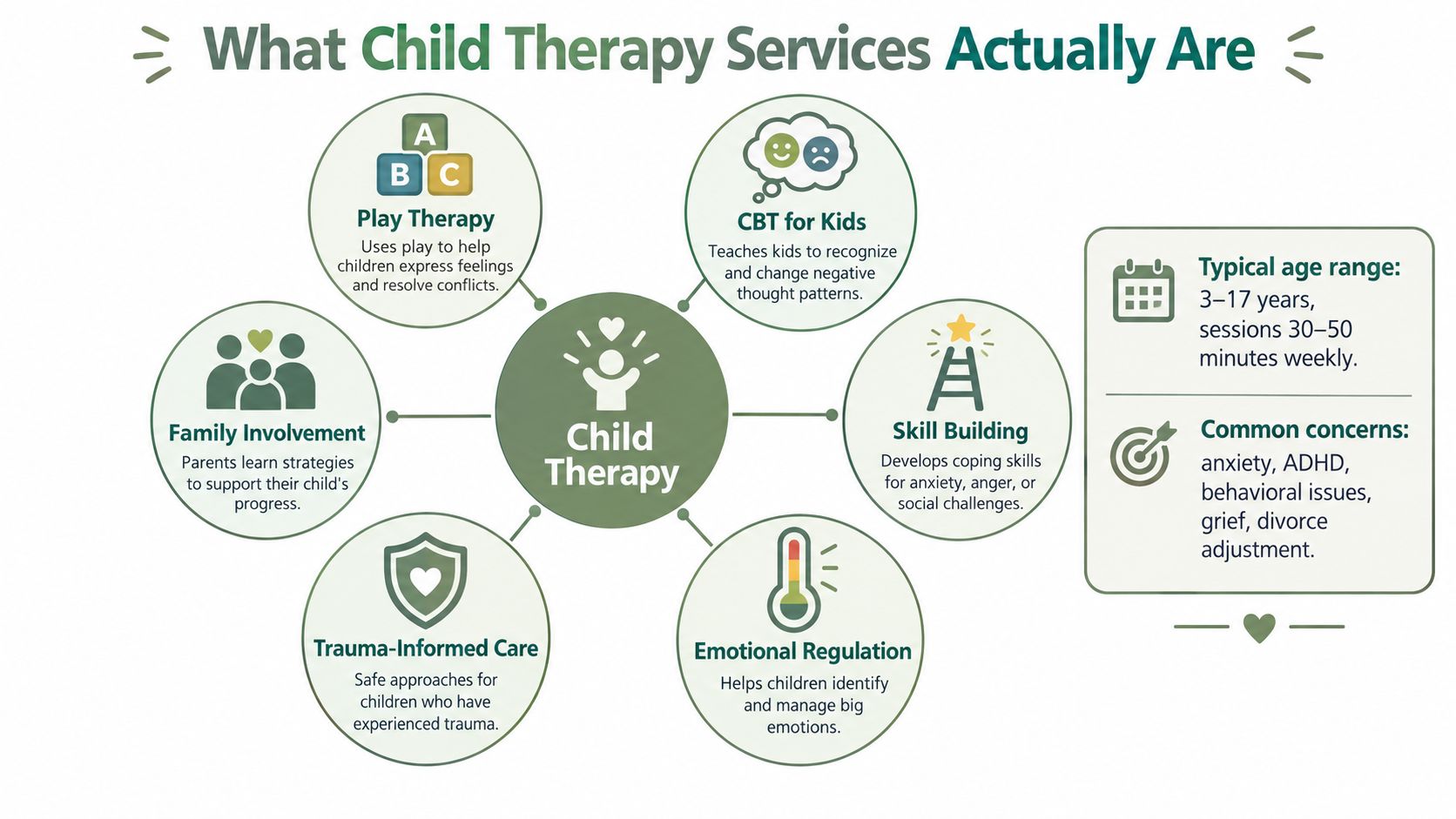
If you're sorting out which professional might fit your child's needs, this overview of what a pediatric psychologist does can make things less confusing.
What therapy is not
A few things often get mixed together:
- School accommodations help a child function in the classroom. They matter, but they aren't the same as treatment.
- Pediatrician advice can be a useful first step, especially for screening and referrals, but it usually isn't ongoing psychotherapy.
- Crisis services are for immediate safety concerns. Outpatient therapy is different. It focuses on steady improvement over time.
That distinction matters because families sometimes expect school supports or a short medical visit to solve problems that need repeated practice, coaching, and follow-through across home and school.
Practical rule: If a child's emotions or behavior keep interfering with sleep, school, friendships, or family routines, it's reasonable to explore therapy even if you're not sure whether the issue is “serious enough.”
Why early attention matters
Child mental health isn't a niche issue. It's a broad public-health concern. About 1 in 7 children and adolescents ages 10 to 19 live with a mental health condition, and one-third of mental health conditions begin before age 14 while half begin before age 18, according to WHO and UNICEF guidance on children's mental health care.
That's why reaching out early can help. You're not overreacting by paying attention to patterns when they're still forming. You're responding to something that often starts in childhood, when habits, fears, family routines, and school expectations are all shaping one another at the same time.
How Child Therapy Has Evolved Into Family-Centered Care
A parent brings in an eight-year-old for tantrums. By the second or third conversation, the treatment plan includes the morning routine, homework battles, how adults respond to yelling, and what the teacher sees by 2 p.m. That can surprise families who expected therapy to stay inside one room with one child.
There is a good reason for that shift. In child treatment, the child is often the most visible part of the problem, but rarely the only part affecting it. Clinicians used to describe a child as the “identified patient,” the person carrying symptoms for a larger pattern around them. Current child therapy services usually start with a wider question: what in this child's relationships, routines, settings, and stress load is helping the problem stick around?
That broader view has a long history. Early behavior work, including Mary Cover Jones' research on childhood fear, and later parent-focused programs such as those developed through the Oregon Social Learning Center, helped move treatment away from insight alone and toward coached practice in real life. Attachment-informed psychotherapy added another layer by focusing on safety, co-regulation, and the caregiver-child relationship, as summarized in this Oxford academic overview of child and adolescent therapy history.
In plain terms, children do not control many of the conditions shaping their behavior. A six-year-old is not setting bedtime, arranging rides, managing school demands, or deciding how adults react during a meltdown. Adults are.
Family-inclusive care versus family therapy
Parents often hear “family-centered” and picture everyone sitting on one couch every week. Sometimes that happens. Often it does not.
Two approaches can sound similar but serve different purposes:
- Family-inclusive child treatment means the therapist works with the child and also spends time guiding caregivers so new skills carry into home, school, and community routines.
- Family therapy focuses more directly on the relationships themselves, such as conflict cycles, sibling tension, parent-child communication, or co-parenting strain.
A child with separation anxiety may spend part of session practicing coping while parents learn how to make drop-off calmer and avoid reinforcing panic. A family caught in nightly shouting matches may need treatment aimed at the pattern between family members, not only the child's distress.
Therapy for children works a lot like physical therapy after an injury. The session teaches and rehearses. Progress depends on what happens between appointments, with the people who help the child practice.
Why this change matters in real life
This model also fits the way families get help. National survey data reported by SAMHSA in the 2021 NSDUH detailed tables show that use of mental health services among U.S. adolescents increased over time, including care delivered by specialty providers and in school settings.
That pattern matters because children live across multiple systems at once. A problem may begin as bedtime fear, then spill into missed sleep, rough mornings, school refusal, and tense parent-child interactions by the end of the week. If treatment targets only the child's words in session, it can miss the machinery around the symptom.
Access barriers make the family-centered approach even more practical. Many parents are trying to fit care around work schedules, long waitlists, transportation limits, custody arrangements, school demands, and uneven insurance coverage. When treatment includes caregiver coaching and coordination across settings, families often get more usable help from fewer appointments. The goal is not to give parents more blame. It is to give them a map.
Modern child therapy treats caregivers less like bystanders and more like active partners. They become the people who help a child use a calming skill at bedtime, keep an exposure plan going after school, or respond to avoidance in a steady way when a teen wants to stay home. For many children, that is where change starts to hold.
Common Presenting Problems and Age-Appropriate Methods
The same label can look different at different ages
Parents often ask, “What kind of therapy does my child need?” The more useful question is usually, “How does this problem show up at my child's developmental stage?”
A preschooler with anxiety may cling, cry, or refuse separation. A teen with anxiety may look “moody” but spend hours avoiding school, social events, or sleep because their mind won't slow down. Same broad category. Different treatment feel.
Four concerns bring many families to child therapy services: anxiety, ADHD-related struggles, disruptive behavior, and sleep problems.
Presenting problems and age-appropriate methods
| Presenting Problem | Ages 3-6 | Ages 7-12 | Ages 13-17 | |---|---|---|---| | Anxiety | Play-based regulation, parent coaching, gradual separation practice | CBT skills, exposure practice, parent support for routines and avoidance reduction | CBT, exposure-based work, more direct thought and behavior tracking | | ADHD | Parent-led behavior plans, simple routines, visual supports | Behavioral parent training, school consultation, homework systems | Organization coaching, school supports, behavior strategies, skill practice | | Disruptive behavior | Parent-Child Interaction Therapy style work, clear commands, coached praise and limits | Behavior plans, emotion coaching, problem-solving practice | Family work, behavior contracts, communication repair, accountability | | Sleep difficulties | Bedtime routines, caregiver consistency, comfort fading, calming transitions | Structured sleep plan, routine shaping, worry management if anxiety is part of it | Sleep habit reset, anxiety management, CBT-informed sleep strategies |
What these approaches look like
For anxiety, good treatment usually asks children to practice approaching what they fear in manageable steps. For a school-age child, that may mean exposure-based CBT with parents helping the child face, rather than escape, the feared situation. For a younger child, the therapist may use games, stories, and parent coaching to build brave behavior.
For ADHD, treatment often works best when the adults change the environment. That can include shorter instructions, immediate rewards, visual routines, school coordination, and consistent consequences. For many families, behavioral therapy for kids is less about “making a child listen” and more about building a system the child can succeed in.
For disruptive behavior, the key question is usually what happens right before and right after the behavior. Preschool treatment often leans heavily on caregiver coaching because adults set the emotional tone, the structure, and the follow-through. With older children, treatment may add direct work on frustration tolerance, flexible thinking, and conflict repair.
For sleep problems, therapy often focuses on habits, body cues, and predictable responses. A child who gets out of bed repeatedly may need a very different plan than a teen whose insomnia is driven by racing thoughts.
A seven-year-old with school anxiety might complain of stomach aches every morning and need parent-assisted exposure steps. A fifteen-year-old with the same fear profile may need a more direct CBT approach focused on catastrophic thinking, avoidance, and independence.
Diagnosis helps, but development guides the method
Parents understandably get tripped up. They hear a diagnosis and assume there's one standard treatment package. In practice, clinicians choose methods based on age, language level, self-awareness, family routines, school demands, and how much the child can carry independently.
That's why the same symptom can lead to a very different session plan depending on whether the child is in preschool, elementary school, or high school.
Choosing the Right Therapy Format for Your Family
Don't default to individual therapy
Many families assume therapy means one child, one therapist, one office. Sometimes that's the right fit. Often it isn't.
The format should match the problem. It should also match the family's logistics, because a good plan that nobody can attend consistently won't help much.
Child therapy formats compared
| Format | Best For | Caregiver Time | Typical Age Range | Access | |---|---|---|---|---| | Individual child sessions | Anxiety, mood concerns, OCD, coping skills work | Moderate, often includes check-ins | Usually school age through teens, sometimes younger with play-based work | In person or telehealth depending on child's age and attention | | Structured parent training | ADHD, tantrums, noncompliance, sleep, separation issues | High, because parents practice the plan at home | Especially helpful for younger children | Can be more flexible and often works well remotely | | Family therapy | Conflict, communication problems, divorce stress, sibling strain | High, multiple family members participate | Broad age range | Scheduling can be harder but useful when dynamics are central | | Telehealth or hybrid care | Parent coaching, older kids, follow-up work, families with travel or scheduling barriers | Varies by model | Depends on attention, privacy, and concern | Often expands options beyond local commuting distance |
How to decide
Start with the child's age. Younger children usually improve fastest when caregivers are heavily involved, because parents control routines, rewards, transitions, and practice opportunities. If your child is under ten and the main concerns are tantrums, ADHD-related conflict, bedtime resistance, or refusal, parent training is often the active ingredient, not an add-on.
For older children with anxiety, OCD, or depression, individual sessions can make more sense because the child can reflect, track thoughts, and practice skills more independently. Even then, most children still benefit when parents know how to respond at home.
A few practical filters help narrow the choice:
- Severity and safety: More complex symptoms may require a broader team or more intensive referral.
- Caregiver availability: Some effective treatments ask a lot of parents. That isn't bad, but it needs to be realistic.
- School schedule and transportation: Long drives and missed classes can derail treatment.
- Privacy at home: Telehealth works better when a child can talk or practice without siblings interrupting.
- Geography: Families outside major metro areas may need remote options from the start.
For some households, a hybrid model solves the problem. Parent coaching can happen by secure video, while the child comes in periodically for direct work. If you're considering that route, it helps to review how telehealth therapy can be structured for families.
One format can support another
Therapy formats aren't competing products. They often stack. A child might have individual CBT, parents might attend coaching sessions, and the therapist may also coordinate with school. The better question isn't “Which single format is best?” It's “Which combination gets this child practicing skills where life happens?”
What to Expect From Intake Through Ongoing Sessions
The first steps usually feel more organized than parents expect
The first contact is often a brief intake call. You describe what's been happening, ask about fit, and sort out basics like scheduling and payment. After that comes a fuller evaluation that includes caregiver interview, child observation or conversation, and questions about home, school, development, and current stressors.
This visual gives the big picture of that flow.
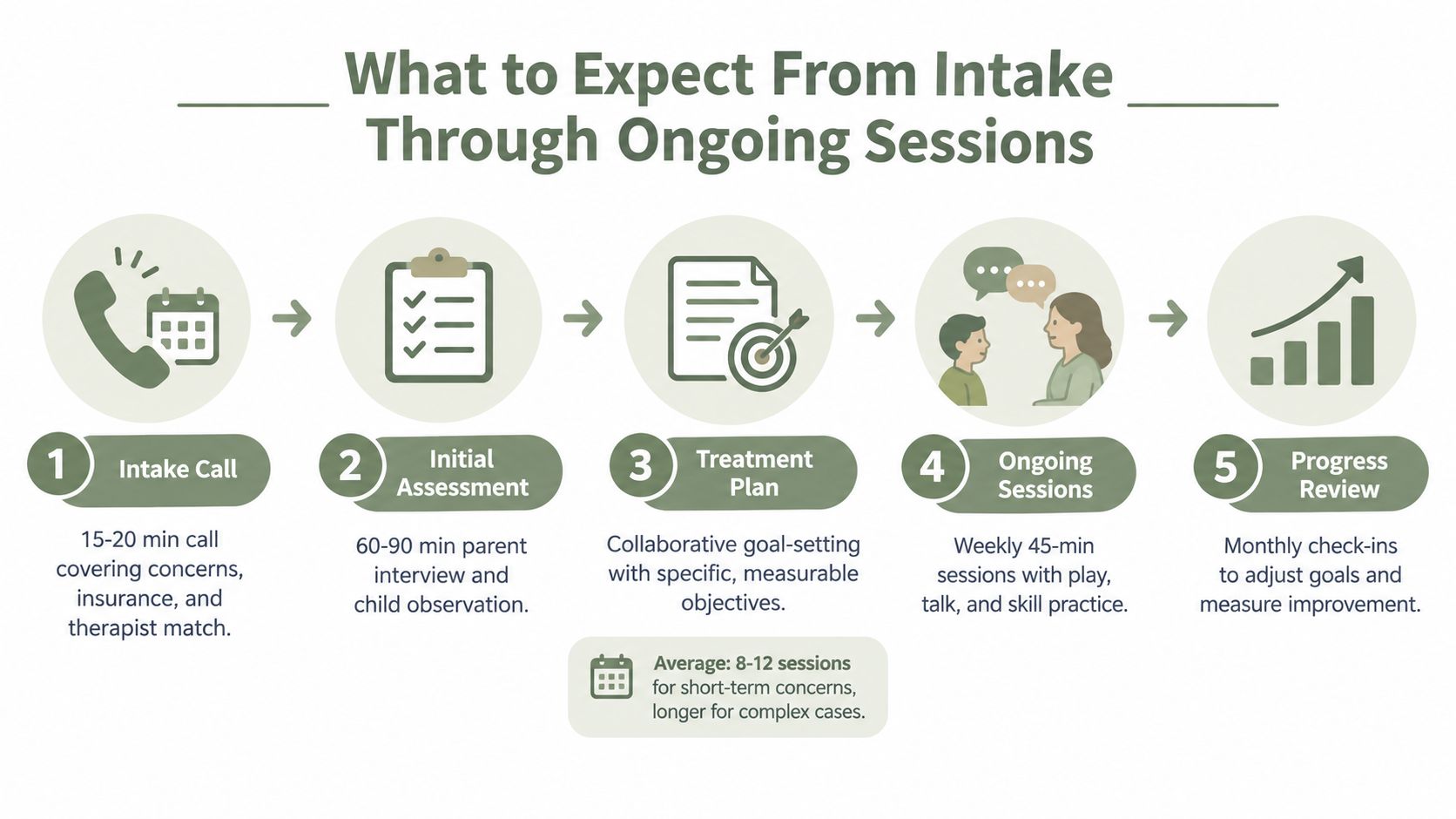
The early sessions are less about instantly “fixing” the issue and more about forming a map. What is the problem? When does it happen? What keeps it going? What should improve first?
What a session may actually look like
Parents are often surprised by how active child sessions can be. A younger child may play a game while practicing frustration tolerance. A school-age child may draw a fear ladder or rehearse what to say to a teacher. A teen may track mood, avoidance, or rituals and then practice specific coping steps.
This short video helps make that process feel less abstract.
A treatment plan usually includes goals that are observable. “Fewer bedtime battles.” “Gets to school with less avoidance.” “Completes homework with one prompt instead of repeated arguing.” Those targets matter more than whether a child says they “feel better” in session.
How families know therapy is working
Expectations need to stay realistic. In routine care, youth psychotherapy shows small but statistically significant effects for internalizing symptoms, with pre-to-post benefits for anxiety and depression, according to this review of psychotherapy outcomes in routine youth care. That means therapy can help, but average improvement isn't magic or automatic.
Progress is easier to spot when families and clinicians measure it. That can include:
- Rating scales: Brief symptom check-ins over time
- Teacher input: Useful when school refusal, attention, or peer problems are involved
- Behavioral markers: How long bedtime takes, how often meltdowns happen, whether avoidance is shrinking
- Parent feedback: Whether the home plan is workable
If you leave several sessions still unclear about the goals, ask for the plan in plain language. Good therapy should be explainable.
Confidentiality also has limits. Children usually need some privacy to build trust, but therapists must act when there are safety concerns, abuse concerns, or serious risk. If the fit doesn't feel right, parents can say so. Switching clinicians is sometimes the most helpful next step, not a failure.
Navigating Real-World Access Barriers to Care
Availability and access are not the same thing
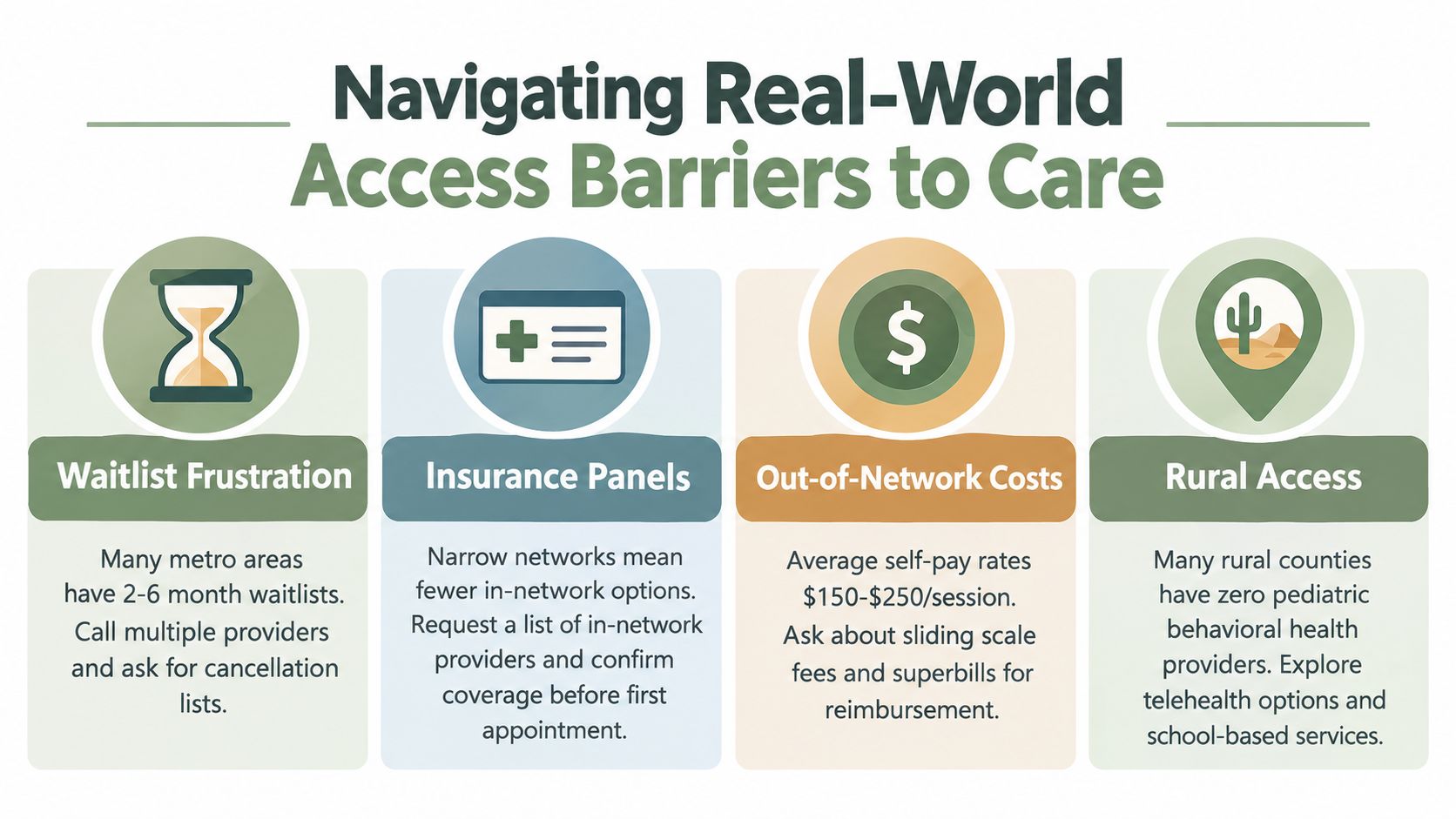
Families often hear that services exist, then run into full voicemail boxes, long waitlists, insurance dead ends, or appointment times that clash with school and work. That gap between theory and reality is one of the most frustrating parts of seeking child therapy services.
The access problem is measurable. A large U.S. nationally representative study found that 19.6% of households reported a child needing mental health treatment, 24.8% of those households reported unmet need, and 21.8% said difficulty accessing care was the reason the child did not receive treatment, as reported in this analysis of unmet child mental health treatment need.
That finding lands for many parents because it matches lived experience. The issue often isn't whether therapy exists somewhere. It's whether your family can get to it, afford it, fit it into the week, and keep it going.
A layered plan while you wait
When access is slow, it helps to think in layers instead of waiting passively.
1. Start with near-at-hand supports Ask the pediatrician about screening, functional impairment, and referral options. Contact the school counselor or student support team if the problem is showing up during the school day. Community mental health centers may also have different intake pathways than private practices.
2. Build skills before formal treatment starts Parents don't need to freeze until the first appointment. You can begin with routine cleanup, sleep consistency, reduced accommodation of anxiety, calmer behavior responses, and simple tracking of triggers and patterns.
3. Widen the search Expand beyond the nearest office if telehealth is appropriate. Look at training clinics, group programs, and clinicians who specialize in the specific problem rather than general counseling alone.
The telehealth question
Families often ask whether remote care is now “normal.” It is increasingly common. One industry analysis reported that 63% of licensed therapists treating children offered teletherapy in the U.S. by late 2025, up from 18% in 2019, according to this market analysis on child psychological counseling services. That source also notes ongoing strain in other systems, including long waiting lists abroad, which reflects a broader access challenge.
Telehealth isn't right for every child. A very young child, a child with limited attention, or a child needing more direct behavioral coaching in the room may do better in person or in hybrid care. But telehealth can work well for parent training, anxiety treatment for older children, follow-up sessions, and families dealing with transportation or geography barriers.
Care delayed is stressful for children and adults alike. While you're searching, support the parent system too. Tired, overwhelmed caregivers have a harder time carrying out even good plans.
Working With Wald Behavioral Health
Parents often want to know what these ideas look like inside an actual practice. The clearest answer is to look for fit across four things: developmental expertise, parent involvement, treatment methods, and practical access.
Wald Behavioral Health is a psychology practice led by Dr. Emily Wald, Ph.D., serving children, adolescents, young adults, and families. The model reflects the family-and-systems approach discussed above. Treatment is developmentally informed, and parent guidance is built in when it's relevant to the problem, especially for concerns like sleep, tantrums, school refusal, separation, and noncompliance.
How families are matched and treated
The practice offers individual therapy for children and adolescents using age-appropriate methods, along with parent training and family guidance to help skills carry into daily routines. Concerns addressed include anxiety, depression and mood concerns, OCD, ADHD, behavioral struggles, school stress, low self-esteem, bullying experiences, and adjustment to pediatric medical conditions.
Modalities are described in practical, evidence-based terms. That includes CBT for anxiety and mood concerns, exposure-based work when avoidance is central, and structured parent strategies for behavior and sleep challenges. The matching process is based on age, presenting concern, and family context, which matters because a child with bedtime resistance needs a different setup than a teen with intrusive thoughts or school-related panic.
What access and logistics look like
Wald Behavioral Health provides in-person care in Coral Gables and telehealth for clients in Florida, Maryland, and PSYPACT-participating states. That wider telehealth reach can help families who need pediatric specialization but don't have the right fit nearby.
Practical details are often what determine whether a family follows through, so the logistics matter. The practice offers a free 15-minute consultation to discuss fit, scheduling, and next steps. Families can pursue insurance-compatible or self-pay pathways depending on their situation, and scheduling includes flexible options, including weekday evenings and some weekend arrangements.
How this fits the decision criteria parents actually use
For a younger child, the useful question is often whether the therapist will coach the caregiver enough to change what happens between sessions. For an older child or teen, parents may care more about whether the clinician can build rapport while still using structured, evidence-based methods. For many families, telehealth access, developmental specialization, and clarity about the treatment plan matter just as much as the therapist's title.
That's where a good fit becomes concrete. Not “Is this therapy in general?” but “Can this clinician treat my child's actual problem, at my child's age, in a format my family can sustain?”
---
If you're trying to sort out whether your child needs support for anxiety, ADHD, sleep, behavior, or school stress, Wald Behavioral Health offers evidence-based therapy for children, adolescents, and families with parent involvement built in when it helps the treatment work. You can learn more about the practice's in-person and telehealth options, and see whether the fit makes sense for your family, by visiting Wald Behavioral Health.
Questions about your child or teen?
Dr. Wald offers a free 15 minute consultation to talk through what you are seeing and whether the practice is a good fit.
Free 15 Minute Consultation