Child Depression Therapy: A Parent's Guide to Help
Your child is lying on the couch with headphones on. A favorite birthday invitation sits unopened nearby, and the usual attempts to help, snacks, jokes, questions, only produce a shrug. You may be wondering whether this is a passing rough patch, normal teenage behavior, or a sign that your child needs professional support.
Child depression therapy is not a punishment or a last resort. It's a structured, age-appropriate way to understand what has changed, reduce distress, rebuild daily routines, and help the whole family respond more effectively. Parents aren't expected to stand outside the process. Your observations, communication, and support between sessions often become part of the treatment itself.
## Table of Contents - What Child Depression Therapy Actually Looks Like - A predictable rhythm - Understanding Depression in Children and Teens - Why pediatricians ask structured questions - Signs Parents and Teachers Often Notice First - School-age children - Adolescents - Evidence-Based Approaches That Work - Cognitive behavioral therapy - Behavioral activation - Family-based work - How a Pediatric Psychologist Assesses Your Child - The main parts of the evaluation - The Younger-Child and Access Gaps - Access changes the treatment decision - Choosing the Right Therapist and Starting Strong - Crisis Resources and Common Parent Questions - Questions parents often ask
What Child Depression Therapy Actually Looks Like
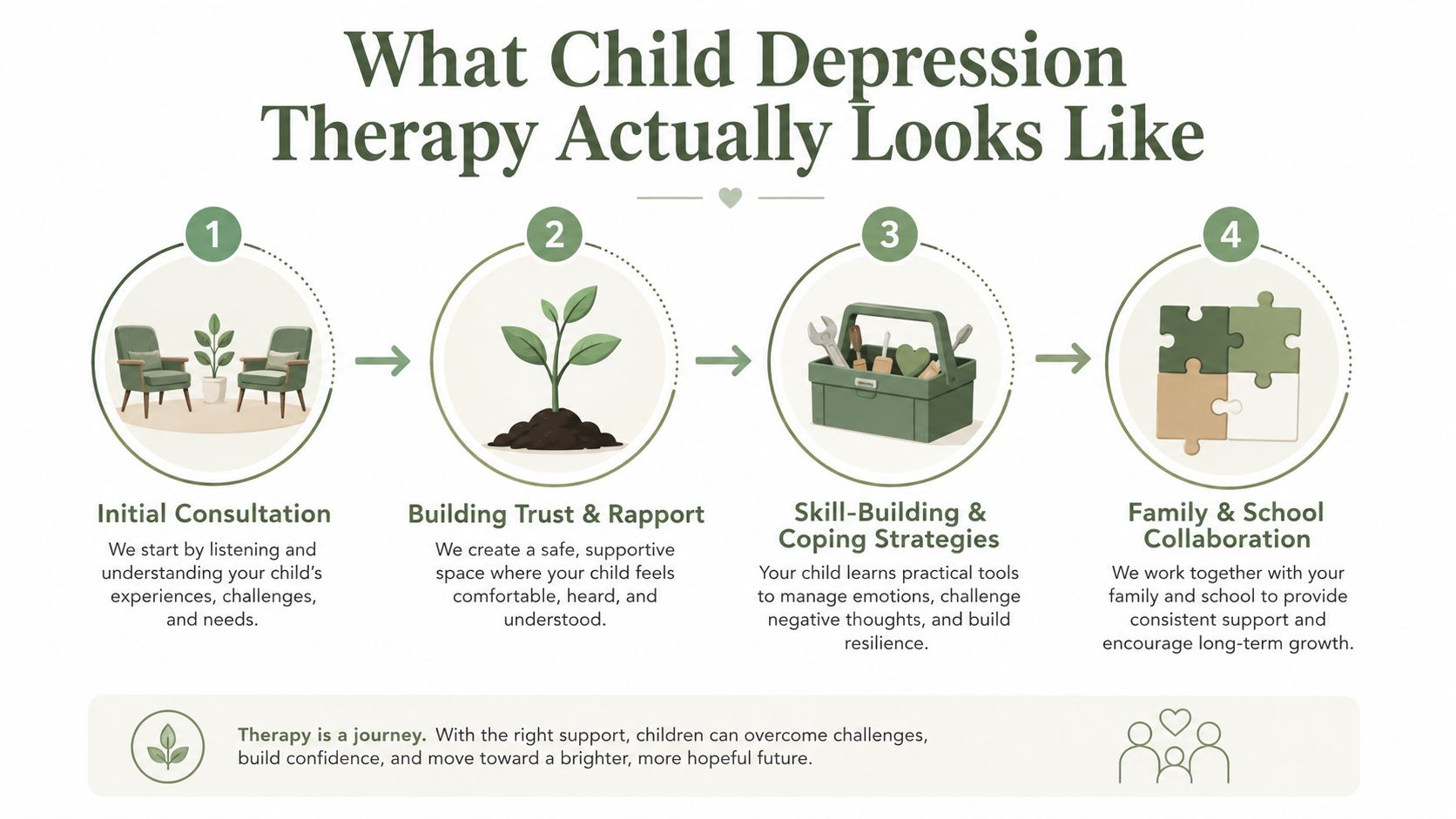
A first appointment usually feels less dramatic than parents expect. A psychologist may begin by meeting with the parent or caregiver alone, listening to the timeline: when the withdrawal began, what sleep looks like, whether school has changed, and what happens during difficult moments. This conversation gives the clinician context before asking the child to explain experiences they may not yet have words for.
The child then has space to participate at a developmentally appropriate pace. A younger child may communicate through drawing, play, stories, or simple feeling scales. An adolescent may prefer direct conversation about mood, friendships, identity, school pressure, and hopeless thoughts. Early sessions focus heavily on trust and understanding, not on forcing a child to reveal everything immediately.
A predictable rhythm
Once the assessment is complete, many practices use regular weekly sessions lasting roughly 45 to 50 minutes, although the exact format depends on age, severity, insurance, and the clinician's approach. A session might include reviewing the week, identifying a difficult situation, practising a skill, and choosing a small task to try before the next visit.
That task shouldn't feel like extra schoolwork. A therapist might ask a child to notice when they withdraw, schedule one enjoyable activity, practise a calmer conversation with a parent, or record changes in sleep and energy. The purpose is to carry therapy into ordinary life, where depression affects mornings, homework, meals, friendships, and family conversations.
Practical rule: A good plan should make clear what the child will practise, what the parent will do, and how progress will be reviewed.
Parents may join part of a session, receive a brief update, or meet separately for coaching. With appropriate consent, the therapist may also coordinate with a pediatrician or school. Families looking for a related overview can read about behavioral therapy for kids, especially when mood concerns overlap with avoidance, sleep problems, or difficult routines.
Understanding Depression in Children and Teens
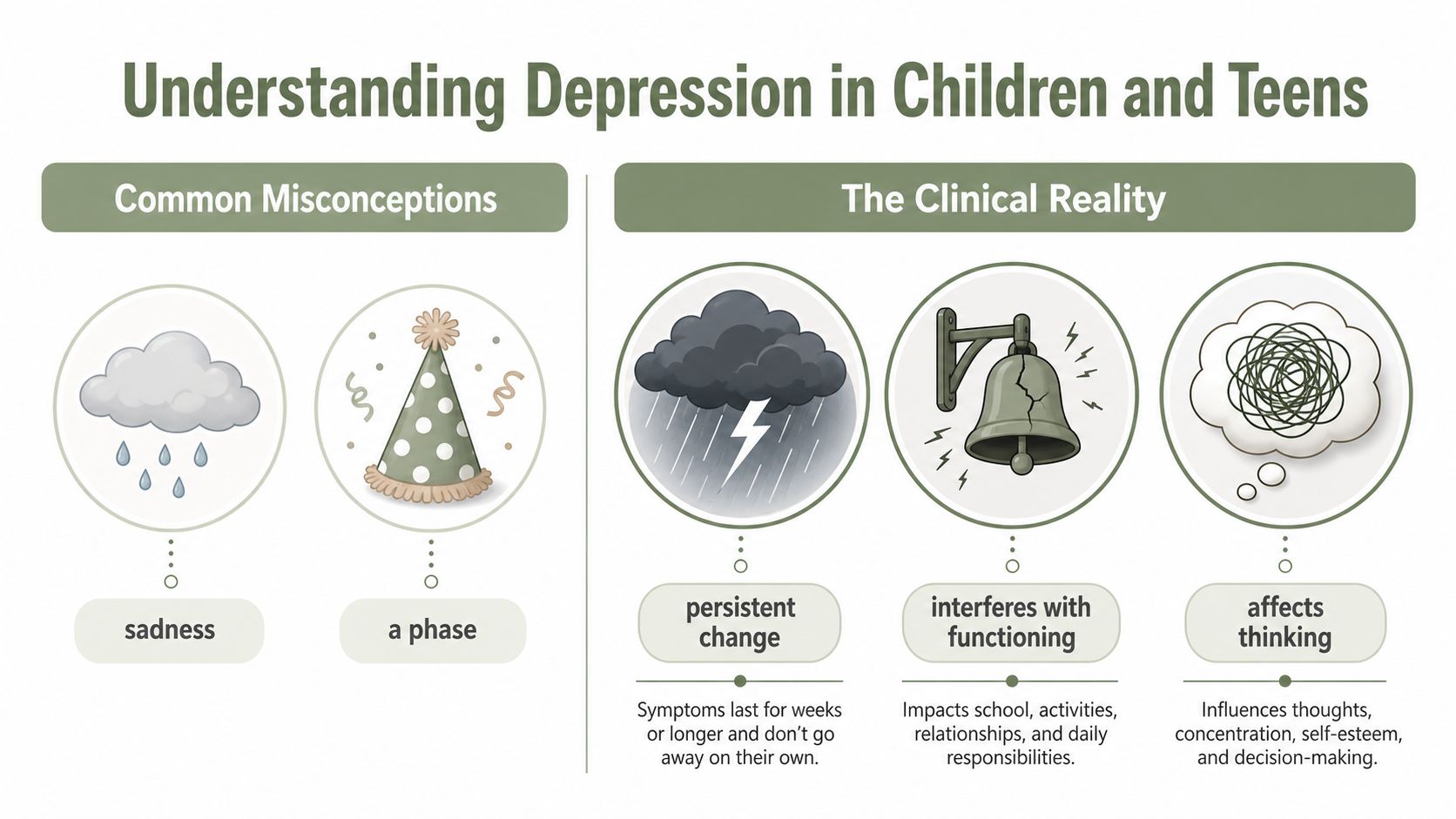
Depression in a child is more than a sad afternoon or a difficult week. Clinicians look for a persistent change in mood, energy, thinking, or behavior that interferes with functioning. A child may seem sad, but may also become irritable, unusually tired, withdrawn, self-critical, or physically uncomfortable.
The distinction matters because children often communicate depression indirectly. Instead of saying, “I feel depressed,” they may complain of stomachaches, resist school, stop playing, argue more often, or say they're no good at everything. A teenager may describe numbness, exhaustion, or feeling disconnected rather than using the word sadness.
Why pediatricians ask structured questions
The American Academy of Pediatrics' GLAD-PC guidance, published in 2018, recommends annual depression screening for adolescents beginning at age 12. The guidance reflects the need to identify symptoms earlier and to use a consistent process rather than relying only on whether a young person volunteers concerns. You can review the AAFP summary of the GLAD-PC guidance for its screening and treatment framework.
Screening isn't the same as diagnosis. A questionnaire can identify concerns, but a qualified clinician still needs to consider development, medical factors, anxiety, trauma, attention difficulties, substance use, grief, and family circumstances. For mild depression, GLAD-PC describes active support and monitoring for 6 to 8 weeks before escalating treatment when appropriate. Psychotherapy or antidepressants may be considered if symptoms don't improve.
One summary cited a prevalence of about 20% by age 20, helping explain why pediatric practices treat depression as a significant, treatable health condition rather than a character flaw. The causes are usually layered, involving biology, stress, relationships, development, and the child's environment.
A short educational video can also help families understand how depression may appear in young people:
Signs Parents and Teachers Often Notice First
A single bad grade or tearful evening doesn't establish depression. Patterns are more informative. Ask whether the change has continued, whether it appears in more than one setting, and whether it is interfering with school, relationships, self-care, or activities your child once enjoyed.
School-age children
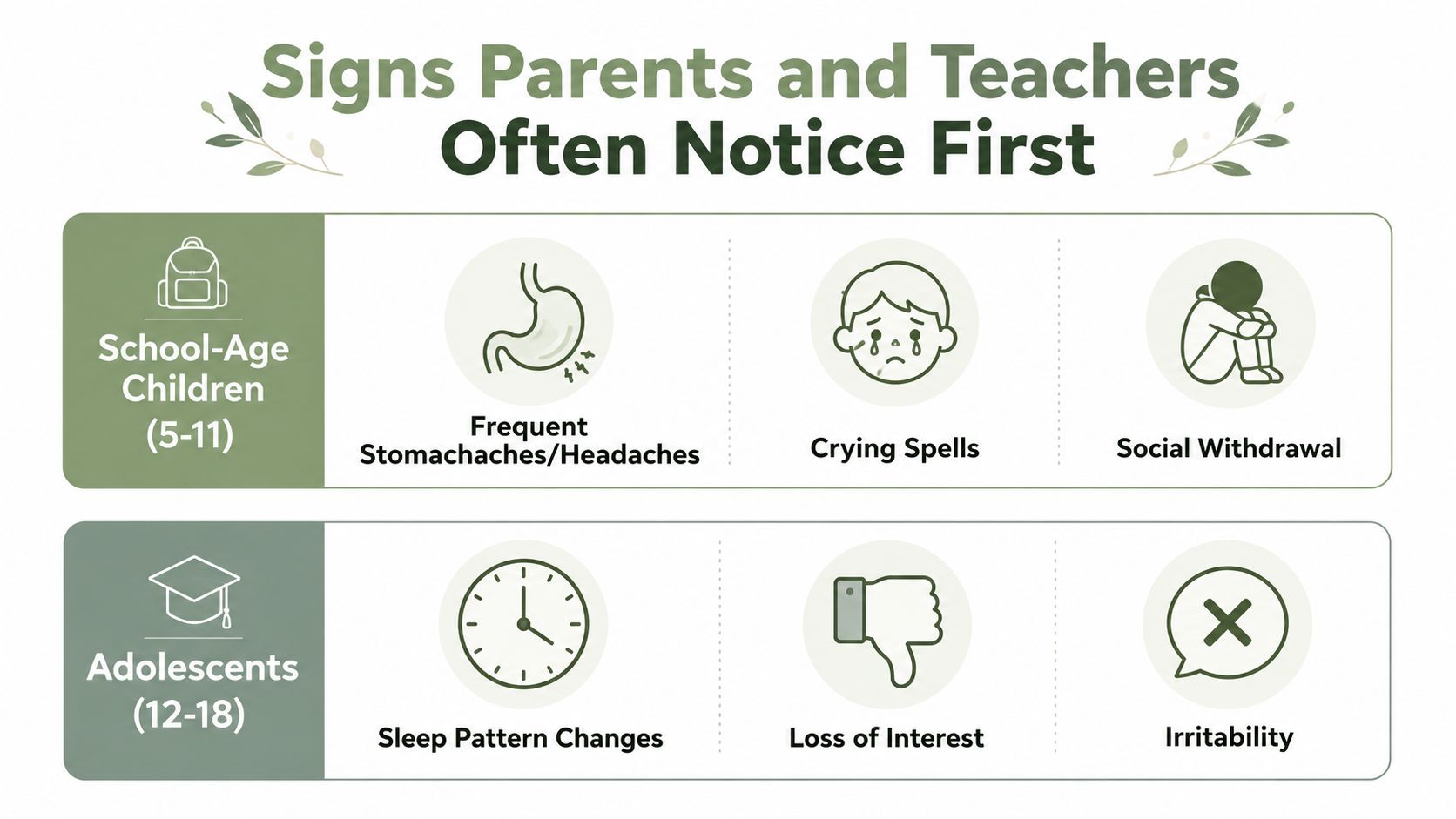
Children in elementary and middle school may show distress through their bodies and behavior before they describe a mood change. Parents and teachers may notice:
- Physical complaints: Frequent headaches or stomachaches without a clear medical explanation.
- School resistance: More morning distress, avoidance, lateness, or requests to go home.
- Reduced play: Less interest in toys, sports, friends, or imaginative activities.
- Academic change: Unfinished work, difficulty concentrating, or a noticeable drop in performance.
- Emotional sensitivity: More crying, frustration, or intense reactions to ordinary setbacks.
- Negative self-talk: Statements suggesting worthlessness, guilt, or being a burden.
A child who stops joining family games may be showing reduced energy, not defiance. A student who stares out the window may be struggling to concentrate, not deliberately refusing to work.
Adolescents
Teen depression often looks like irritability rather than visible sadness. Look for sustained changes such as:
- Sleep disruption: Sleeping far more, sleeping poorly, or struggling to maintain a regular routine.
- Loss of enjoyment: Dropping music, sports, gaming with friends, or other previously valued activities.
- Social isolation: Spending much more time alone or withdrawing from peers.
- Appetite changes: Eating substantially differently without an obvious explanation.
- School decline: Missed assignments, lower grades, or reduced attendance.
- Hopeless language: Comments about the future, life, or personal worth that suggest despair.
Teachers may be the first to see fatigue, withdrawal during class, missed homework, or a student who no longer participates. Share observations across home and school when possible. If your child talks about self-harm or not wanting to live, treat that as an immediate safety concern rather than waiting to see whether the pattern continues.
Evidence-Based Approaches That Work
The strongest treatment plan isn't a branded technique applied identically to every child. It matches the child's developmental level, symptoms, family context, and capacity to participate. Three approaches appear especially useful in child depression therapy: cognitive behavioral therapy, behavioral activation, and family-based care.
Cognitive behavioral therapy
CBT helps children notice the connection between situations, thoughts, feelings, body sensations, and actions. A therapist may teach a teenager to identify an automatic thought such as “Nobody wants me around,” examine the evidence, and develop a more balanced response. The work is practical, not forced positivity.
A session can include psychoeducation, mood tracking, cognitive restructuring, and planning activities that create opportunities for pleasure or mastery. A meta-analysis of 10 randomized controlled trials, involving 267 intervention participants and 256 controls, found a moderate pooled between-group benefit, with Cohen's d = 0.66, and a within-group effect of d = 1.02 (CBT meta-analysis). The analysis also linked larger effects with older age and more sessions, which supports adapting the protocol rather than assuming one format suits every child.
Behavioral activation
Behavioral activation starts with a simple observation: depression often reduces activity, and reduced activity can deepen depression. The therapist and child identify manageable actions connected to enjoyment, achievement, connection, or routine. For one child, that might mean walking the dog with a parent. For another, it might mean returning to art for a short period or eating breakfast before school.
The child doesn't wait to feel motivated first. The therapist helps the family make the action small enough to attempt, then reviews what happened without blame.
Family-based work
Family involvement can address communication, conflict, routines, and reinforcement. Parents may learn how to respond to withdrawal without repeated interrogation, set predictable expectations, notice effort, and create opportunities for connection. A broader review found better long-term outcomes when CBT included caregiver involvement, behavioral activation, and cognitive restructuring (systematic review and meta-regression).
| Approach | Core mechanism | Session format | Evidence strength | Best-fit age | |---|---|---|---|---| | CBT | Changes unhelpful thinking and behavior patterns | Skills practice, thought review, mood tracking, activity planning | Moderate pooled benefit across pediatric trials | Often adaptable for school-age children and adolescents | | Behavioral activation | Rebuilds daily activity, reward, and connection | Activity scheduling, review, reinforcement | Useful component within broader youth depression care | Children, teens, and young adults with low motivation | | Family-based care | Improves communication, routines, and caregiver responses | Parent coaching, joint problem-solving, conflict reduction | Particularly valuable when family interaction affects recovery | Especially important for younger children and family-involved care |
Psychotherapy doesn't help every child equally. A 2021 systematic review and meta-analysis found a 39% response rate around two months after baseline with psychotherapy, compared with 24% in control conditions, and reported a number needed to treat of 6.2 (systematic review of psychological treatments). Because many young people don't respond fully, clinicians should monitor progress and discuss additional options, including medication evaluation for more severe or persistent depression.
How a Pediatric Psychologist Assesses Your Child
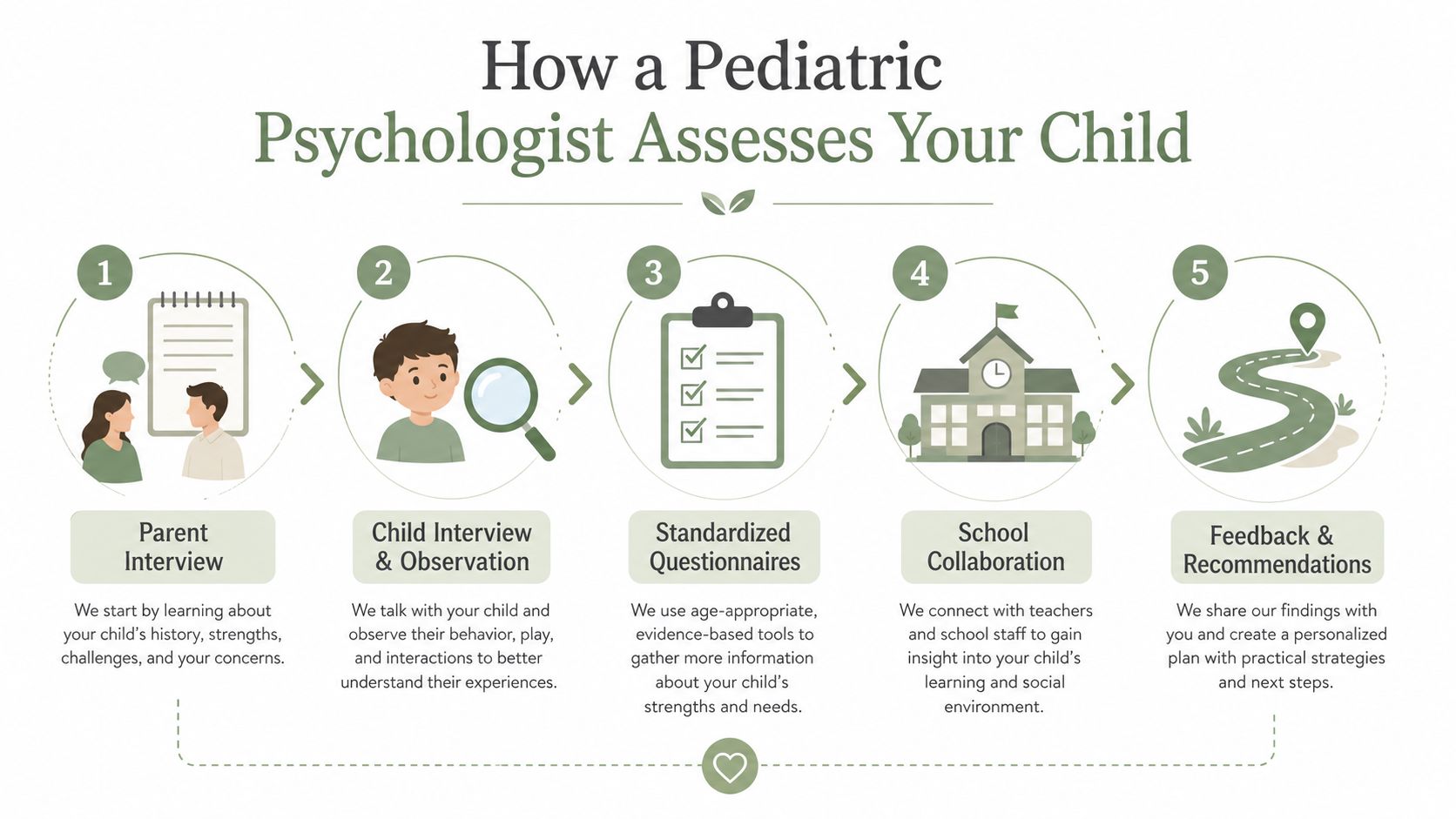
A thorough assessment should make the first appointment feel organized rather than mysterious. The psychologist is trying to answer several questions at once: What changed? How severe is it? What else could be contributing? What support will allow the child to participate safely and consistently?
The main parts of the evaluation
- Parent interview: The clinician gathers developmental history, medical information, sleep patterns, school functioning, family mental health history, major stressors, and possible trauma exposure. Parents should bring observations, not a polished explanation.
- Child interview and observation: A younger child may use play or drawing to communicate. An older child may complete a structured interview and discuss mood, friendships, school, safety, and goals privately.
- Standardized questionnaires: Tools such as the Children's Depression Inventory, the Patient Health Questionnaire for Adolescents, or the Revised Child Anxiety and Depression Scale can add structure. They don't replace clinical judgment.
- Collateral information: Teacher forms or school communication can show whether symptoms appear in class, during transitions, or around peers. The therapist should explain what information will be shared and obtain appropriate permissions.
- Feedback and recommendations: The psychologist explains impressions, diagnostic reasoning, severity, treatment frequency, modality, family participation, and safety planning. Parents should ask for a written summary of the recommendations.
The full process may take more than one meeting. Some practices schedule feedback within a few weeks, while others move faster or slower depending on urgency, school coordination, and the information required. You can ask before booking how many appointments assessment includes, what the child will be told, and how urgent concerns are handled.
Before the first visit: Write down changes in sleep, appetite, attendance, friendships, energy, self-criticism, and safety-related statements. Concrete examples help more than a general description such as “They aren't themselves.”
The Younger-Child and Access Gaps
Most public discussion of depression therapy centers on adolescents, where talk-based CBT protocols are easier to describe and study. Very young children need a different pathway. A recent evidence-base update found that child treatments have weaker support than adolescent treatments, with no child treatments reaching well-established status and CBT for depressed children described as only possibly efficacious (evidence-base update).
That doesn't mean younger children can't receive effective help. It means clinicians must adapt carefully. Sessions may use play, emotion pictures, stories, movement, and simpler language. Parents may act as co-therapists, helping practise skills at home, structure routines, respond to distress, and create secure opportunities for connection. A protocol that works for a teenager can't be reduced in length and handed to a preschooler.
The evidence update also points to age-specific approaches, including parent-child interaction therapy with emotion development for children ages 3 to 6. Psychotherapy remains the primary treatment across ages, but the exact form of participation should match the child's development.
Access changes the treatment decision
Families don't choose care from a perfect menu. A 2026 U.S. analysis reported that diagnosed child mental health conditions rose 35% from 2016 to 2023, and that nearly 40% of children ages 12 to 17 with a major depressive episode did not receive treatment in the past year (access analysis). The same source described 6 to 8 week waits in youth-serving programs and found that only 36% were designed specifically for children and adolescents.
If a local specialist isn't available, ask a pediatrician about integrated behavioral health, contact a university training clinic, explore community mental health services, and ask the school about counseling or referral pathways. Telehealth may reduce travel and scheduling barriers, but families should confirm privacy, emergency procedures, caregiver availability, and whether the clinician is licensed to provide care where the child is located.
Choosing the Right Therapist and Starting Strong
The first month should produce more than a pleasant conversation. It should give the family a shared map. The child learns what therapy is for, the parent understands how to support practice, and the clinician begins measuring whether the plan is helping.
A strong beginning often includes:
- A concrete goal: “Get back to eating breakfast and attending school more consistently” is more useful than “Feel happier.”
- One practice skill: The child may track mood, schedule an activity, challenge a harsh thought, or practise asking for support.
- A parent check-in: The therapist explains how to respond at home without turning every interaction into an evaluation.
- A plan review: The clinician checks engagement, symptoms, functioning, safety, and fit, then adjusts the approach when needed.
Ask prospective providers direct questions:
- Do you use a structured or manualized CBT protocol when it fits the child's needs?
- How do you involve caregivers, and how much of a typical session includes parents?
- What tools do you use to measure progress?
- How do you handle between-session questions or safety concerns?
- Will you coordinate with the pediatrician or school when appropriate?
- How do you adapt sessions for younger children?
- What happens if the child doesn't connect with the therapist?
Look for a licensed clinical psychologist, a licensed clinical social worker with child specialization, or a psychiatrist when medication consultation is needed. Credentials matter, but so does the provider's ability to explain the treatment in language your family understands.
A vague plan isn't automatically poor care, especially during an early assessment. However, persistent uncertainty about goals, no way to monitor change, or refusal to involve caregivers when parent participation is clinically appropriate should prompt questions. Wald Behavioral Health's pediatric psychology services are one example of a practice model that includes developmentally informed therapy and parent involvement.
Crisis Resources and Common Parent Questions
If your child expresses hopelessness, talks about self-harm, describes a suicide plan, or suddenly becomes unsafe, stay with them and treat the situation as urgent. Remove access to potential means of harm when you can do so safely, ask directly about immediate danger, and contact emergency support.
In the United States, call or text 988 to reach the Suicide and Crisis Lifeline. You can also text HOME to 741741 for the Crisis Text Line, or go to the nearest emergency room. For child protection concerns, contact the Childhelp National Child Abuse Hotline at 1-800-422-4453. Families can also use NAMI's family support resources to find guidance and local options.
Questions parents often ask
How long will therapy take? There isn't one correct duration. It depends on symptom severity, safety, developmental level, family participation, response to treatment, and whether depression occurs alongside anxiety or another concern. A clinician should review progress rather than keep treatment open-ended without discussion.
Will my child need medication? Some children improve with psychotherapy and family support. For moderate or severe depression, persistent symptoms, safety concerns, or insufficient response, a prescriber may discuss antidepressants. The decision requires individualized evaluation and careful monitoring. Antidepressants carry an FDA boxed warning about suicidal thoughts and behaviors in some children, adolescents, and young adults, so parents should ask how follow-up will work.
What if my child refuses therapy? Start with the problem they want solved, such as sleep, school pressure, anger, or feeling exhausted. Offer choices about the therapist, appointment format, and whether a parent joins the first meeting. Avoid presenting therapy as proof that something is wrong with them.
What if the first therapist isn't a good fit? Tell the clinician what feels off. A useful therapist can adjust communication, structure, or caregiver involvement. If the mismatch continues, seek another provider without treating the first attempt as a failure.
Seeking help early isn't an overreaction. It gives your family more opportunities to understand the pattern, protect safety, and restore ordinary parts of childhood.
---
Wald Behavioral Health provides evidence-based therapy for children, adolescents, young adults, and families dealing with depression, mood concerns, anxiety, and related challenges, with parent guidance included when appropriate. Visit Wald Behavioral Health to explore in-person and telehealth care, or request a free 15-minute consultation to discuss fit and scheduling.
Questions about your child or teen?
Dr. Wald offers a free 15 minute consultation to talk through what you are seeing and whether the practice is a good fit.
Free 15 Minute Consultation