Telehealth Psychologist: How Virtual Therapy Works

You're trying to answer a simple question in the middle of a busy day, but it doesn't feel simple at all. Your child needs help, your teen won't miss more school than necessary, and your own schedule is already packed with work, rides, dinners, and chores. A telehealth psychologist can make that first step feel possible, because therapy happens through a secure video visit instead of another drive across town.
For many families, that matters more than convenience. It means fewer missed pickups, less time spent in traffic, and a better chance of keeping therapy consistent when life gets messy. It also gives parents a way to stay involved without turning every session into a logistical project.
## Table of Contents - Why Families Are Choosing Virtual Therapy - What a Telehealth Psychologist Actually Does - What the session usually looks like - Age changes the approach - Virtual Therapy Versus In-Person Sessions - The Evidence Behind Telehealth Effectiveness - Technology and Privacy Requirements for Sessions - A simple home checklist - How PSYPACT Expands Access Across State Lines - Why this changes the search process - The Critical Role of Parent Involvement in Virtual Care - What good parent involvement looks like - When Telehealth Is Not the Right Fit
Why Families Are Choosing Virtual Therapy
The first time a parent looks into therapy, the calendar usually becomes the main obstacle. School dismissal, practices, work calls, sibling needs, and the drive to an office can make even a good treatment plan hard to follow. Virtual care removes a lot of that friction, which is one reason telehealth psychologists have become a practical option for children, teens, and young adults who need support without adding another commute.
The shift is no longer a temporary response to a crisis. FAIR Health reported that mental health conditions were the number one telehealth diagnostic category nationally and in every U.S. census region from July to December 2024, and mental health conditions made up about two-thirds of telehealth claim lines during that period, moving from 67.01% to 66.70% as telehealth utilization rose from 4.74% to 5.04% of medical claim lines. That pattern shows virtual behavioral health has become part of everyday care, not a backup plan. The top five diagnoses in that channel were generalized anxiety disorder, major depressive disorder, adjustment disorders, ADHD, and PTSD in the FAIR Health 2024 telehealth report.
Practical rule: If the hardest part of therapy is getting to therapy, telehealth may solve the problem before treatment even begins.
Families often start with a child who's already overwhelmed by school stress, social anxiety, or behavioral conflict at home. For those situations, a virtual visit can be the difference between starting care this month and putting it off for months. For ADHD-specific support, a helpful companion resource is this guide on online ADHD therapy, which fits well with the kind of structured parent support many families need.
What a Telehealth Psychologist Actually Does
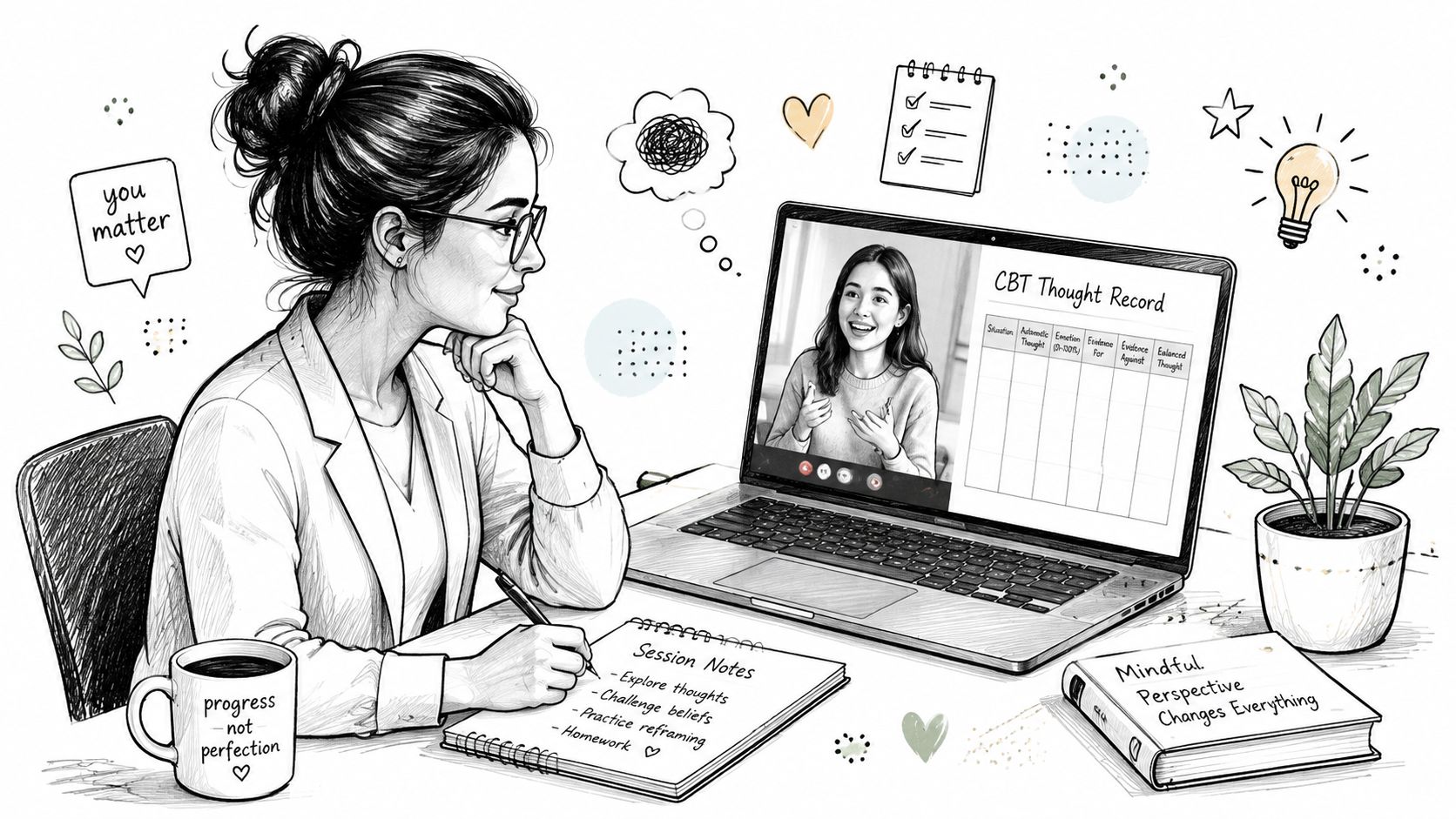
A good telehealth psychologist does much more than talk into a webcam. The work still centers on assessment, skill-building, behavior change, and family guidance, but the delivery changes so the child can learn in a video setting. For a younger child, that might mean using drawings, screen-shared worksheets, or a parent nearby to help keep the child engaged. For a teen or college student, it may look more like direct coaching, problem-solving, and checking how real-life routines are going between visits.
What the session usually looks like
The structure is often predictable, because predictability helps kids feel safer. A psychologist may start by checking mood, school stress, sleep, or conflict at home, then move into a focused skill like coping statements, exposure practice, behavioral activation, or parent coaching. If a child is avoidant, the screen can help lower pressure, because the child gets to stay in a familiar room while learning hard skills.
That doesn't mean the clinician is only watching a face on a screen. Many psychologists pay close attention to tone of voice, pacing, eye contact, posture, and whether a child is shutting down, joking, distracting, or seeking reassurance. Those cues still matter, even when they're filtered through video.
Age changes the approach
A 7-year-old usually needs shorter tasks, more visual support, and active parent participation. A 19-year-old may want privacy, direct feedback, and a plan that fits classes, work, and friendships. The same evidence-based treatment can be used in both cases, but the delivery has to match the developmental stage.
A child doesn't need a perfect setup to benefit from telehealth. They need a session that fits how they communicate, learn, and tolerate stress.
If you want to see how a practice organizes those services, Wald Behavioral Health's service overview is a useful example of how child, teen, and young adult therapy can be structured across different needs.
Virtual Therapy Versus In-Person Sessions
Parents often ask whether virtual therapy is “as good” as office visits. The honest answer is that both formats can work well, but they solve different problems. The right choice depends on your child's symptoms, your home setup, and how much hands-on support the family needs.
| Dimension | Telehealth | In-Person | | --- | --- | --- | | Comfort at the start | Often easier for anxious or avoidant kids because they stay in a familiar space | Can feel more formal, which some children prefer | | Scheduling | Usually easier around school, work, and sports | Requires travel and more coordination | | Parent observation | Parents can hear portions of care when appropriate and help with home routines | Parents may receive updates separately, depending on the visit | | Clinician observation | The psychologist can see a child's room, routines, and family interaction in a natural setting | The psychologist sees the child in a clinic environment | | Privacy needs | Works best when the home has a quiet, private room | Better when home privacy is limited | | Physical support | Limited by the screen | Better when hands-on observation or close management is needed |
Virtual care can be especially useful when the child's environment is part of the clinical picture. A messy bedroom, a sibling interrupting every few minutes, or a teen who can't find private time can tell the psychologist a lot about what treatment needs to address. In-person care, though, still matters when a child needs a highly structured setting or when the home environment makes privacy nearly impossible.
The best choice isn't always either-or. Many families do well with a blended model, using virtual visits for weekly skills work and in-person visits when a more direct clinical presence is useful.
The Evidence Behind Telehealth Effectiveness
Parents want proof, not reassurance alone. That's fair, especially when they're trusting someone with their child's mental health. The strongest answer is that telehealth has been studied across common psychiatric conditions, and the results are generally reassuring.
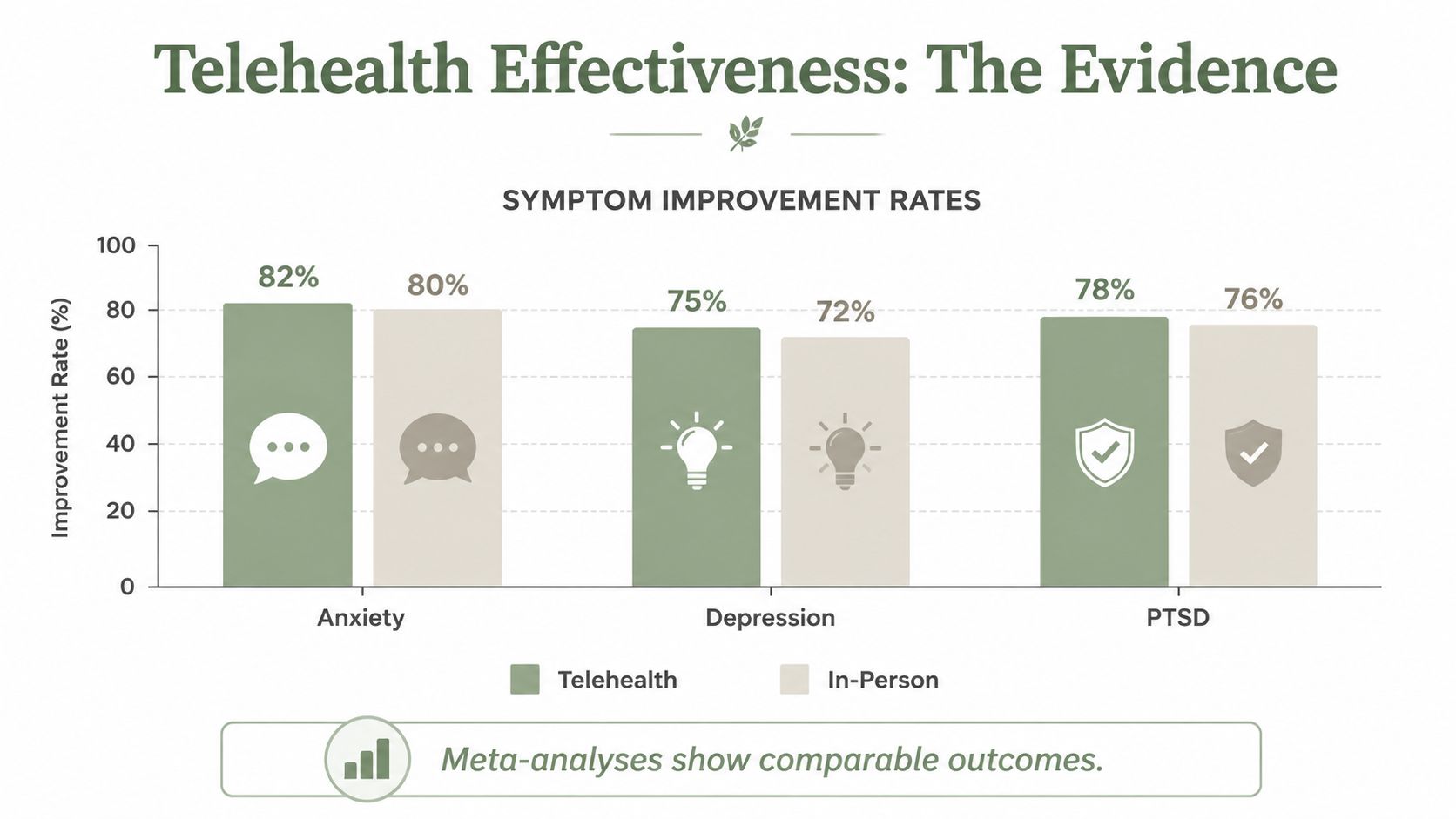
A 2023 systematic review found that telehealth across modalities was as effective as usual care, and that telepsychiatry was mostly equivalent to in-person treatment for efficacy and completion rates across 26 randomized trials with n=2,290 participants, according to the review in SAGE Journals. The same review found a small but statistically significant advantage for telepsychiatry in depressive disorders, while the single included eating disorder study favored in-person care. That's a nuanced result, not a sales pitch, and it matches what many clinicians see in practice.
The broader lesson is simple. For common concerns like anxiety, depression, and related behavioral health needs, telehealth can deliver real treatment, not watered-down care. The format doesn't erase the therapeutic relationship. It changes the room.
When a family asks whether virtual sessions “count,” this is the answer I'd give as a clinician. If the psychologist is using evidence-based methods, collaborating with parents when needed, and building skills between sessions, telehealth can be a solid path for many children and teens.
Technology and Privacy Requirements for Sessions
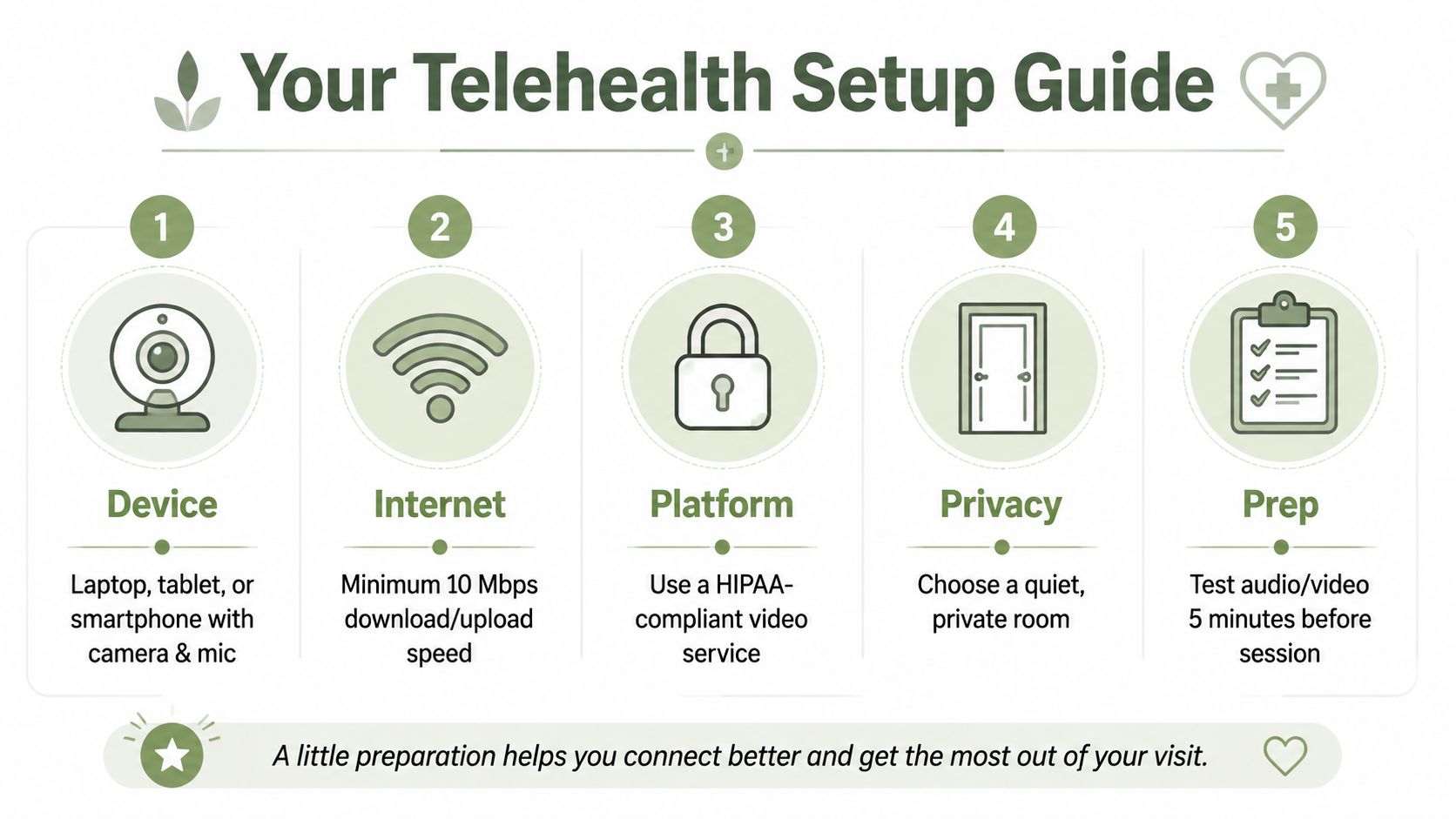
A virtual session works best when the setup feels boring. That means a charged device, a stable connection, and a room where your child can speak freely without worrying who's listening. Families don't need a fancy studio, but they do need a setup that protects privacy and lets the psychologist hear and see clearly.
A simple home checklist
- Device: Use a laptop, tablet, or smartphone with a working camera and microphone.
- Internet: Test the connection before the session, especially if more than one person is online at home.
- Platform: Ask whether the video service will sign a HIPAA business associate agreement with the practice, and confirm the login process ahead of time.
- Privacy: Pick a quiet room, close the door, and let siblings know not to interrupt.
- Prep: Open the app, check audio, and have water or tissues nearby before the appointment starts.
If your teen doesn't have a private bedroom, that doesn't automatically rule out telehealth. Some families use a parked car, a quiet corner, or a temporary private space at a relative's home. The key is to make sure the conversation can stay confidential enough for real therapy to happen. For a practice-level explanation of privacy expectations, Wald Behavioral Health's privacy information is a useful starting point.
A dropped connection usually isn't a disaster. Most clinicians have a backup plan, such as reconnecting by video, calling by phone to finish the session if appropriate, or rescheduling if the visit can't continue safely. Families in areas with limited broadband should tell the office early, so the psychologist can plan around the weakest part of the setup instead of discovering it mid-session.
How PSYPACT Expands Access Across State Lines
For families who move often, split time between homes, or have a college student away from home, licensing matters as much as convenience. PSYPACT is the interstate framework that lets psychologists licensed in participating states provide telepsychology across state lines after they obtain an Authority to Practice Interjurisdictional Telepsychology, or APIT, and an ASPPB E.Passport certificate. The compact's 2026 materials list 40 states plus the District of Columbia as enacted and effective for telepsychology, according to the compact materials in the 2021 PSYPACT guidance.
That matters in everyday family life. A high school student might live in one state during the school year and another during breaks. A military family may move before treatment is finished. A college student may want to keep seeing the same psychologist after leaving home for school. PSYPACT makes it possible for a psychologist to follow the patient across those transitions, as long as the licensure rules are met.
Why this changes the search process
Instead of limiting your options to the handful of clinicians in one zip code, you can look for someone who fits your child's age, diagnosis, and personality. That can be a big deal for families dealing with anxiety, OCD, ADHD, or complex behavior patterns, where the right fit often matters as much as the location.
For many families, PSYPACT doesn't just add convenience. It keeps care from breaking apart every time life changes.
It's still important to check whether the psychologist is licensed in your state and authorized to serve you where you live. But for the right family, PSYPACT can turn a narrow local search into a much larger pool of qualified specialists.
The Critical Role of Parent Involvement in Virtual Care
For children and teens, telehealth is rarely just the child and the psychologist. Parents shape the environment, help carry out plans at home, and often decide whether skills from session stick. That's why parent involvement isn't a side issue. It's usually part of the treatment itself.
Recent evidence from telehealth-delivered CBT for parents of adolescents found that app add-ons did not automatically improve parent skill practice. In that study, parents in the app-enhanced arm reported fewer skill practices than those receiving standard telehealth CBT, while stronger parent engagement was still linked with better parent distress and adolescent psychiatric outcomes, according to the report in PubMed. The message is clear. A digital tool can support care, but it doesn't replace real coaching, clear expectations, and follow-through.
What good parent involvement looks like
- Coaching, not hovering: Parents learn how to respond to avoidance, tantrums, school refusal, sleep problems, or reassurance seeking.
- Home practice: The psychologist gives concrete assignments, and parents help make sure they happen.
- Accountability: The family tracks what was tried, what worked, and what got in the way.
- Developmental fit: Younger children need more direct adult support, while teens may need a smaller but still active parent role.
Families often worry that parent involvement means “doing therapy wrong” if the child isn't independent enough. It doesn't. For many problems, parents are part of the mechanism that makes treatment work.
Ask a provider how parent coaching is built into the plan, not just added on at the end.
That question tells you a lot about the clinician's style. If the answer is specific, practical, and suited to your child's age, that's a good sign.
When Telehealth Is Not the Right Fit
Telehealth is useful, but it's not a universal answer. Some children and teens need a setting where the psychologist can observe more directly, respond in a more hands-on way, or manage risk with less delay. Other families can't get enough privacy at home for honest sessions.
A mixed picture also shows up in rural and transition-age youth. A review of tele-mental health interventions for young adults in rural areas noted that some youth prefer in-person mental health care and may see telehealth as an adjunct rather than a replacement, especially when privacy, internet access, stigma, or digital literacy become barriers, according to the review in WJARR. That lines up with what many clinicians hear from families in real life.
Telehealth may be a weaker fit when:
- The child or teen needs immediate physical safety support.
- Home privacy is too limited for open conversation.
- Internet access is too unstable for consistent sessions.
- The young person strongly prefers in-person contact.
- The family situation makes it hard to complete home practice without support.
A hybrid plan can solve some of those problems. Some families start virtually, then move to office visits when trust is built. Others do the reverse, using in-person sessions for assessment and telehealth for ongoing coaching. The right plan is the one that fits the child's needs, not the one that sounds most convenient on paper.
If you're unsure which format makes sense for your child, schedule a consultation with a psychologist who works with children and teens every day. A thoughtful clinician can help you decide whether virtual care, office visits, or a hybrid approach will support your family best.
---
Wald Behavioral Health offers evidence-based therapy for children, adolescents, young adults, and families, with telehealth available across Florida, Maryland, and PSYPACT states. If you're weighing virtual care for anxiety, ADHD, school stress, or family conflict, visit Wald Behavioral Health to ask about a consultation and find out whether telehealth or in-person treatment is the better fit for your child.
Questions about your child or teen?
Dr. Wald offers a free 15 minute consultation to talk through what you are seeing and whether the practice is a good fit.
Free 15 Minute Consultation