Telehealth Therapy with Insurance: Coverage Guide

Many plans cover telehealth therapy, but reimbursement varies widely by plan, provider network status, and state. Families must verify benefits before the first session because “covered” doesn't necessarily mean the visit will be free or even processed as expected.
You may be arranging a video appointment for your child after a difficult week. The clinician is licensed, the platform is secure, and the appointment fits between school and work. Then an explanation of benefits arrives, and the amount due is higher than expected. The problem usually isn't that telehealth failed. It's that insurance coverage and your actual financial responsibility are different questions.
Telehealth became a durable part of behavioral-health care rather than a temporary substitute for office visits. In 2021, telehealth represented 35% of visits to behavioral-health specialists among Medicare beneficiaries, the Medicare service category with the highest sustained telehealth use, according to federal research on telehealth and behavioral health. That widespread use makes online therapy easier to find, but it doesn't create one national payment rule.
Your payer, your plan's network, the clinician's credentials, your physical location during the session, the service type, and state requirements can all affect the claim. The safest approach is to treat insurance verification like checking a flight itinerary. A general statement that “telehealth is covered” tells you the destination, but not the fare, restrictions, or baggage fees.

## Table of Contents - Understanding Telehealth Therapy Coverage Basics - Why broad acceptance doesn't guarantee payment - In-Network Versus Out-of-Network Telehealth Benefits - What the numbers reveal - A practical comparison - How to Verify Your Telehealth Therapy Benefits - Ask these questions in order - Ask for something you can save - PSYPACT, Medicare, and Medicaid Rules for Telehealth - Travel and interstate checklist - Public insurance and claim accuracy - Real-World Examples of Telehealth Claims and Denials - Common failure points - Preparing for Telehealth Therapy With Insurance
Understanding Telehealth Therapy Coverage Basics
A parent calls member services before booking a video session. The representative says, “Telehealth is covered,” and the parent expects the bill to be settled. That answer may only mean the plan recognizes remote care as a benefit category. It may not confirm the therapist's network status, the psychotherapy code, the deductible, or whether the child's location during the appointment is allowed.
Telehealth therapy with insurance works like a chain. The payer must recognize the service, the clinician must meet participation and licensing rules, the patient must be in an eligible location, and the claim must accurately describe how care was delivered. If one link fails, a covered type of care can still produce a denial or an unexpected balance.
Why broad acceptance doesn't guarantee payment
Federal oversight found that, across Traditional Medicare, Medicare Advantage, and Medicaid, 40% to 47% of enrollees who received behavioral-health care used at least one provider through telehealth. Approximately half of those telehealth users relied exclusively on remote visits, while the rest combined remote and in-person care, according to the HHS behavioral-health telehealth research recap.
For a family, that combination can be practical. A child may use video for regular follow-up or parent coaching, then attend an office appointment when an in-person assessment is appropriate. The availability of both formats does not show whether the plan applies the same deductible, copay, or coinsurance to each one.
Billing workflow adds another layer. Claims must identify the service, provider, patient, and delivery method accurately. Families seeking a plain-language explanation of claims, denials, and payment processes can consult this Jacksonville CPA firm's RCM guide. A clinically appropriate session can still require corrected insurance or billing information.
Practical rule: “Telehealth is covered” confirms possible eligibility. It does not promise a particular payment amount.
Before scheduling, review the provider's telehealth details, such as Wald Behavioral Health's telehealth page, then ask the insurer about virtual psychotherapy specifically. Confirm the provider, code, network status, patient location, and expected cost sharing.
Because coverage and reimbursement are separate questions, verification must address both before care begins.
Here's a short explanation of the patient and provider locations that can affect billing:
In-Network Versus Out-of-Network Telehealth Benefits
Network status often determines the difference between a predictable copay and a large balance. An in-network clinician has an agreement with the insurer about participation and allowed amounts. An out-of-network clinician may still provide a covered service, but the plan can apply a separate deductible, coinsurance structure, reduced reimbursement, or no benefit at all.
That distinction applies to the virtual service itself. A therapist may be listed in a directory, yet the directory may not clearly confirm telehealth credentialing, the patient's state, or the relevant behavioral-health benefit. Ask the insurer to verify the specific clinician and the specific modality.
What the numbers reveal
The KFF 2022 survey shows why “accepted insurance” isn't the same as “fully paid.” Among privately insured women who had received mental-health services during the prior two years, 81% said their provider accepted their insurance, while 19% said the provider didn't accept it. Among those whose provider accepted their insurance, 36% said insurance covered the full cost of their most recent mental-health visit, 52% said it covered some of the cost, and 3% said it covered none of the cost, according to the KFF women's mental-health coverage survey.
Those figures describe survey respondents' most recent mental-health visits, not a guarantee for every telehealth appointment. They do show why families should expect cost sharing to remain possible even when a provider participates.

A practical comparison
| Question | In-network provider | Out-of-network provider | |---|---|---| | Allowed amount | Usually governed by the plan's negotiated arrangement | May be based on a separate plan formula | | Patient cost | Often follows the in-network deductible, copay, or coinsurance | May involve higher cost sharing or a separate deductible | | Claim outcome | More predictable when the service and claim are correct | Depends on out-of-network benefits and plan rules | | Family responsibility | Still requires verification | May include balance billing or a larger unpaid portion |
Coverage parity also isn't universal. AHRQ's telehealth topic brief explains that behavioral-health telehealth may be reimbursed differently from in-person care, with Medicaid, Medicare, commercial plans, and jurisdictions applying different rules. HRSA likewise reports that telebehavioral services may be excluded or reimbursed at lower rates than in-person care, while limited network participation can reflect reimbursement challenges, as described in its 2025 behavioral-health workforce brief.
For a plain-language explanation of out-of-network billing and related payment disputes, families can review RevGuard's explanation of out-of-network care. You can also review a practice's stated fees and payment expectations, such as the information on Wald Behavioral Health's fees page, before scheduling.
How to Verify Your Telehealth Therapy Benefits
Call the number on the insurance card and keep a notebook open. Ask the representative to document the call reference number, the date, and the representative's name or identification details. A phone answer isn't a guarantee of payment, but a careful record gives you something concrete to compare with later claim processing.
Start with the exact service rather than the broad word “telehealth.” Ask whether video psychotherapy with a psychologist is covered for the child's plan, whether audio-only care is allowed, and whether the benefit is handled under behavioral health or another department.
Ask these questions in order
- Is the clinician in network for this plan? Give the provider's full name, practice name, and national provider identifier if available. Confirm that the network status applies to behavioral health and virtual sessions.
- What will the family pay? Ask whether the visit is subject to a deductible, copay, coinsurance, or a combination. Request the allowed amount if the representative can provide it, and ask whether the telehealth amount differs from the in-person amount.
- Does the plan require authorization? Confirm whether prior authorization, a referral, a treatment plan, or recurring utilization review is required. Ask who submits the authorization and when it must be approved.
- Which codes and billing rules apply? Ask about covered psychotherapy codes, place-of-service requirements, modifiers, and whether the plan accepts claims from an out-of-network clinician.
- Does the clinician have to be approved where the child is located? Tell the representative the state where the child will physically be during the appointment. A provider's license and the plan's network rules may both depend on that location.
Ask for something you can save
Request a written benefit quote or secure-message response. It should identify the member, the plan, telehealth behavioral-health coverage, network status, cost-sharing rules, authorization requirements, and any location restrictions. Save the response with the explanation of benefits and the provider's estimate.
Eligibility means the policy is active. It doesn't calculate the amount the family will owe for a particular session. If the representative can't provide a patient-specific estimate, ask the practice what it will collect at the visit and how it handles superbills or claim submissions.
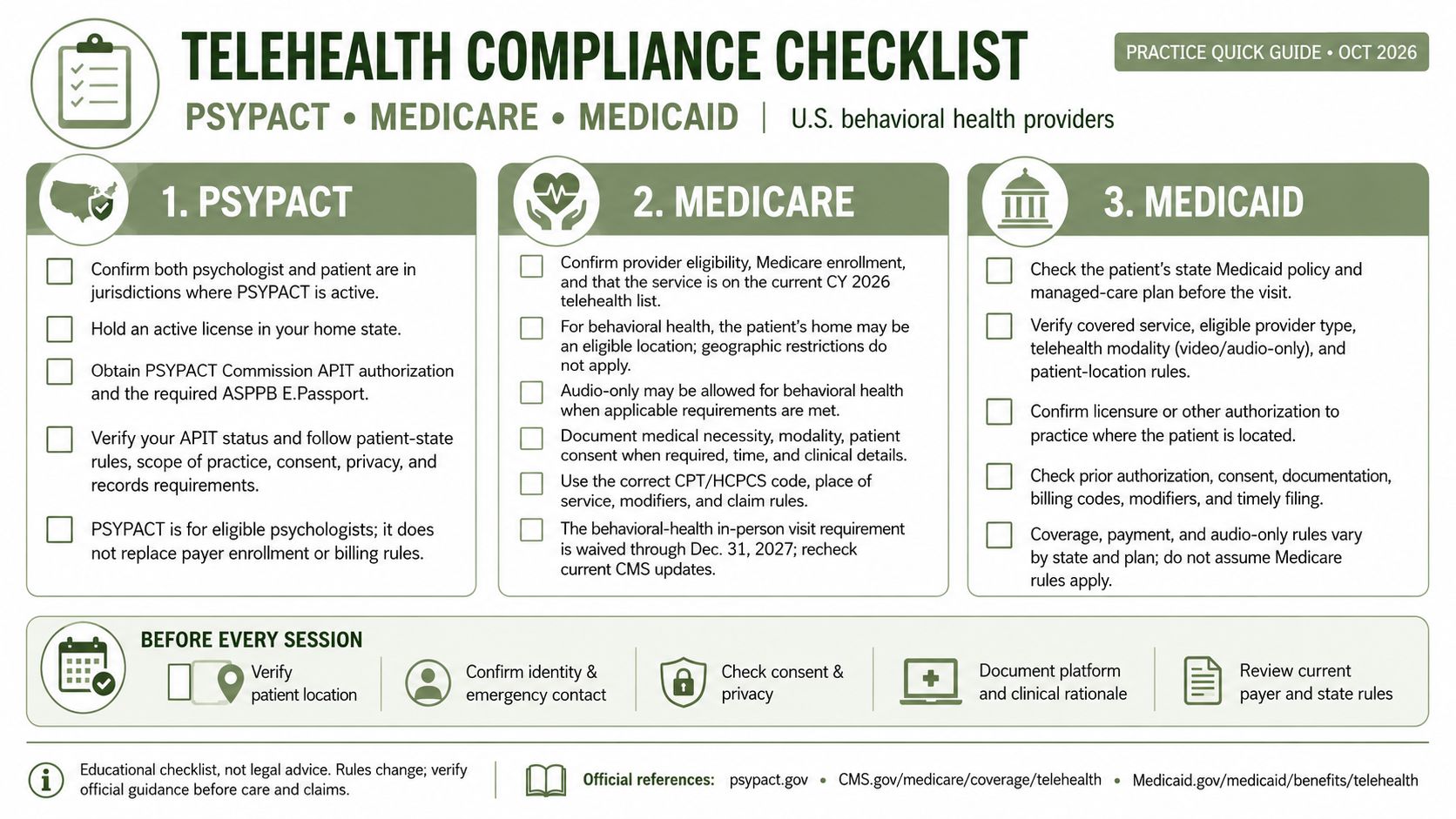
PSYPACT, Medicare, and Medicaid Rules for Telehealth
A child may begin therapy in Florida, spend several weeks in Maryland, or attend college in another state. The location where the child physically sits on the appointment date can affect whether the psychologist may legally provide care, whether the insurer will process the claim, and how the family should prepare for an emergency. Coverage and payment are separate questions: a plan may list telehealth as a covered service while the clinician still lacks authority to practice in that location, or the family may owe cost sharing.
PSYPACT can allow psychologists to provide telehealth across participating states when they hold the required authorization. It does not replace state requirements or require an insurance plan to reimburse the visit. Before an interstate appointment, confirm the psychologist's authorization for the child's location, then verify the plan's network and reimbursement rules separately.
Travel and interstate checklist
Before the appointment, the practice and insurer should address:
- The child's exact location: Provide the state where the child will be, not only the family's home address.
- Provider authorization: Ask whether the psychologist may practice remotely there through a license or PSYPACT authority.
- Plan recognition: Confirm that the insurer recognizes both the clinician and the temporary patient location.
- Continuity and emergencies: Establish whom the parent and child should contact if urgent concerns arise while away.
- Changes in residence: Notify the practice before a move, school attendance, or extended stay.
This matters especially for families in Florida, Maryland, and other PSYPACT states. A directory may say “telehealth covered,” yet state law or provider authorization can still prevent a legally permitted session. The pediatric telehealth policy review explains how payment parity, audio-only rules, interstate compacts, and jurisdictional policies differ.
Public insurance and claim accuracy
Medicare, Medicaid, and commercial plans use different reimbursement rules. Medicare telehealth claims therefore require attention to the patient's setting and the documentation supporting the service. CMS identifies POS 10 for telehealth provided to a patient in the patient's home and POS 02 for telehealth provided somewhere other than the patient's home, as explained in the CMS telehealth FAQ.
The claim should match the clinical record. Documentation can include consent, the date and service, practitioner, both locations, participants, technology modality, and any applicable exception. A secure platform alone does not establish compliance. Practices also need records that connect medical necessity, participants, locations, modality, and billing details.
Technology vendors can add privacy and contracting obligations. Practices and families reviewing those arrangements can consult this healthcare vendor compliance guide from BoloSign.
For state-specific context, families can review this guide to telehealth therapy in Florida, then confirm current requirements with the clinician and insurer. Rules and plan policies can change, so the written confirmation should match the child's location on the appointment date.
Real-World Examples of Telehealth Claims and Denials
Consider a family whose insurer confirms that the psychologist is in network and that video psychotherapy is covered. The parent records the call, checks whether authorization is required, confirms the child's home address as the session location, and receives a written estimate of cost sharing. The clinician documents consent, the date, the participants, the modality, and both locations. When the claim arrives, the details agree, so the insurer has a coherent record to process.
A different family receives a denial even though the therapist provided appropriate care. The claim used a place-of-service designation that didn't match where the child attended the session. The family can ask the practice to review the note and claim, request a corrected submission if appropriate, and contact the insurer to learn whether the denial is administrative or reflects a benefit exclusion.
Common failure points
- Network mismatch: The insurer's general directory listed the practice, but the specific clinician wasn't participating in the relevant network.
- Modality restriction: The plan covered video but didn't cover the form of audio-only service billed.
- Missing authorization: The plan required approval before treatment or after a specified course of care.
- Location conflict: The child attended from a state where the clinician lacked authorization or the plan imposed a geographic restriction.
- Inconsistent documentation: The note, claim, patient location, or submitted place of service didn't agree.
If a claim is denied: Ask for the denial reason in writing, compare it with your benefit verification, and request the next appeal or correction step before paying a disputed balance.
Keep the insurer's written response, the superbill or claim form, the explanation of benefits, and all messages with the practice. If the provider is out of network, ask whether the practice submits claims or supplies a superbill for the family to submit. Don't assume a corrected claim will be accepted, and don't ignore a bill while waiting for an appeal. Ask the billing office how the account is handled during review.
Preparing for Telehealth Therapy With Insurance
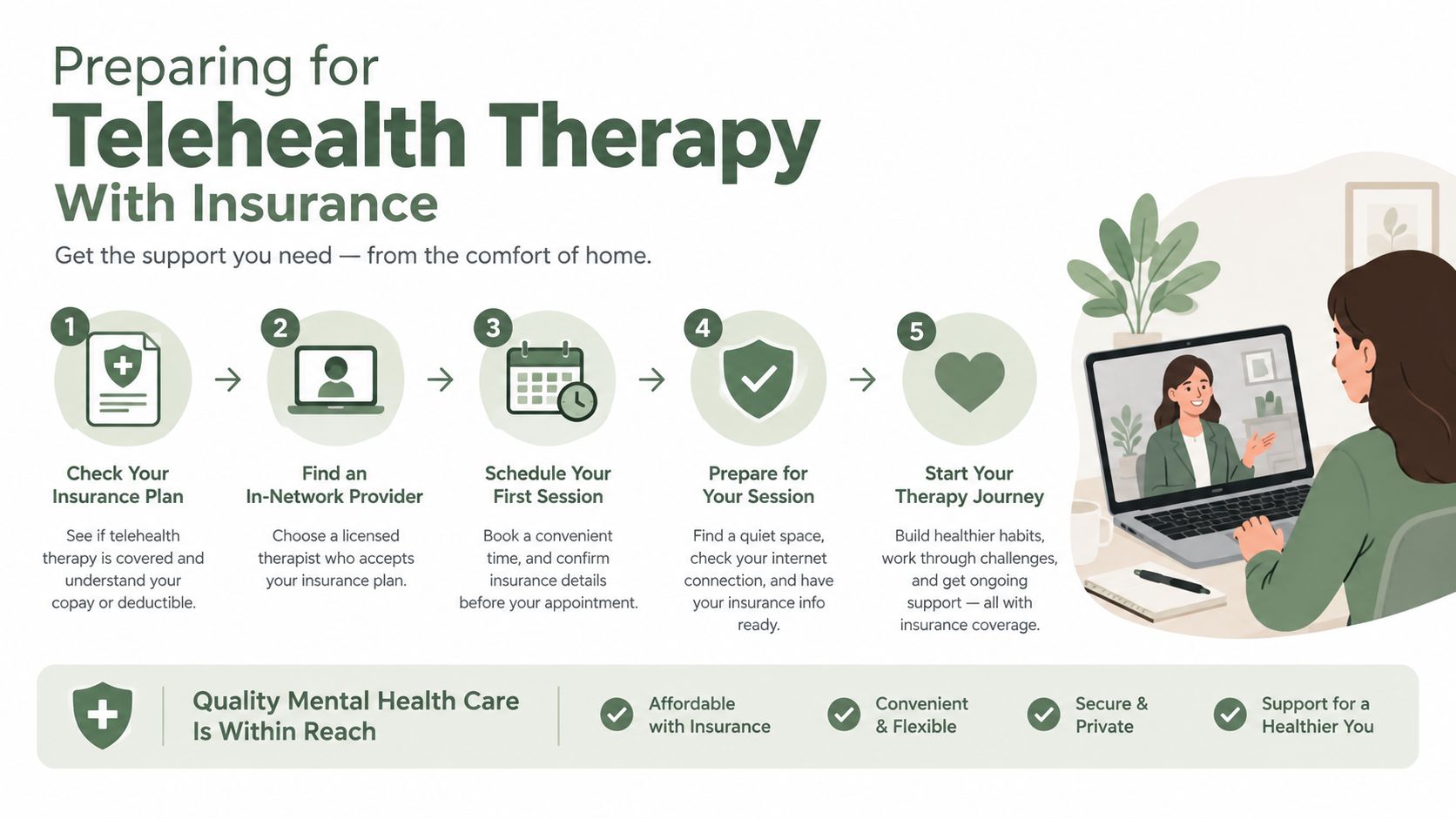
The most reliable way to reduce billing surprises is to prepare before care begins. Convenience is one of telehealth's strengths, but convenience doesn't guarantee a lower charge. A family still needs a clear answer about network participation, benefit design, authorization, location, and documentation.
Use this compact preparation list:
- Identify the exact service. Confirm that the plan covers video psychotherapy with the type of clinician your child will see.
- Verify the provider. Ask whether the specific psychologist is in network and credentialed for the child's location. If care may cross state lines, confirm licensure or PSYPACT authorization before the appointment.
- Separate coverage from cost. Ask about deductible status, copay, coinsurance, allowed amount, out-of-network reimbursement, and whether telehealth and in-person care use different cost-sharing rules.
- Get authorization details. Find out whether a referral, prior authorization, treatment plan, or continuing review applies.
- Save the paperwork. Keep the written benefit quote, call reference, consent records, superbill, claim information, and explanation of benefits in one folder.
- Check every location change. Tell the practice before travel, relocation, college attendance, or a temporary stay in another state. The child's physical location can affect both legal authority and reimbursement.
- Create a denial plan. Know whether the practice will submit claims, provide a superbill, correct administrative errors, or help identify the appeal route.
Families can also ask the clinician whether telehealth fits the child's needs, whether parent participation is appropriate, and how privacy will be maintained at home. Those clinical questions belong beside the insurance questions, not after them.
Wald Behavioral Health provides secure video therapy for children, adolescents, young adults, and families in Florida, Maryland, and PSYPACT-participating states, with insurance reimbursement support through out-of-network billing and superbills. Visit Wald Behavioral Health to review telehealth options, request a benefits check, and schedule a consultation about your child's care.
Questions about your child or teen?
Dr. Wald offers a free 15 minute consultation to talk through what you are seeing and whether the practice is a good fit.
Free 15 Minute Consultation