Telehealth Therapy Florida: How to Access Care Online
A parent in Coral Gables may be trying to help a child manage school refusal while balancing work, traffic, and a crowded afternoon schedule. A college student may need therapy between classes, from a dorm room or apartment, without losing time traveling across Miami. For both, telehealth therapy in Florida can remove practical obstacles that often interrupt care.
Online therapy still requires thoughtful planning. You need the right provider, a private setting, reliable technology, a clear emergency plan, and an understanding of where the therapist is legally allowed to practice. When those pieces are in place, video psychotherapy can be a legitimate, evidence-supported option rather than a lesser substitute for an office visit.
## Table of Contents - Why Telehealth Therapy Has Become the Norm in Florida - What the evidence means for families - Understanding Licensure and PSYPACT Eligibility - A practical verification sequence - Navigating Insurance Coverage and Payment Options - When private payment may be simpler - Setting Up Your Space and Technology for Success - The fifteen-minute preparation check - If the connection fails - What to Expect During Your First Telehealth Session - The opening part of the appointment - Your Action Plan for Starting Telehealth Therapy in Florida - Start with the clinical need - Verify before you schedule - Prepare for the first visit
Why Telehealth Therapy Has Become the Norm in Florida
Florida's behavioral health system changed quickly during the first months of COVID-19. By April 2020, behavioral health providers reported telehealth use rising from 842 to 29,173 instances, an increase of more than 3,000%, and more than 30% of all services had shifted to telehealth by the end of that month, according to the Florida behavioral health services assessment. In July 2020, 31.6% of Floridians receiving behavioral health safety-net services used telehealth, and the number of people using telehealth for behavioral health care increased by 130% from March to July 2020, as documented in the same state report.
Those figures describe a shift in how care is delivered. Telehealth became useful because Florida families often face long travel distances, changing school schedules, work demands, transportation problems, and periods away from home. A child can sometimes attend a session from a familiar room instead of spending an afternoon commuting and waiting.

What the evidence means for families
The strongest argument for video therapy isn't convenience alone. A meta-analysis of 17 trials involving 1,814 participants found telemedicine psychotherapy comparable with in-person treatment for efficacy, patient satisfaction, working alliance, and attrition. The comparison found particularly equivalent outcomes for PTSD, mood disorders, and anxiety disorders, with an efficacy result of SMD -0.01 and a 95% confidence interval of -0.12 to 0.09, reported in the comparative psychotherapy evidence review.
That doesn't mean every client or every concern is suited to video. A young child who needs extensive play-based observation, a person in acute danger, or a family without privacy may need a different arrangement. But for many children, adolescents, college students, and parents, the clinical method can remain evidence-based while the setting changes.
The therapist still assesses symptoms, teaches skills, tracks progress, and adjusts treatment. The video format adds responsibilities around privacy, location, identity verification, emergency contacts, and technology. Good telehealth is structured care delivered through a different doorway.
Understanding Licensure and PSYPACT Eligibility
Before discussing symptoms, ask a basic legal question: Is this provider authorized to treat the client in the location where the client will be during the session? For telehealth, the client's physical location matters. A therapist who can treat someone in Florida may not automatically be permitted to treat that same person while they're visiting another state.
Florida joined the Psychology Interjurisdictional Compact, or PSYPACT, effective July 1, 2023. PSYPACT is designed to support telepsychology and temporary in-person practice across participating state boundaries, allowing eligible licensed psychologists to serve clients across jurisdictions without obtaining a separate license in every participating state. The Florida Psychology Board's PSYPACT announcement explains the state's participation and identifies the compact's role in interstate practice.
A practical verification sequence
Start with the provider's professional designation. Psychologists, mental health counselors, and clinical social workers follow different licensing pathways, so ask which license the clinician holds and whether it's active in Florida. Then ask where the clinician is authorized to provide telehealth, especially if your family spends time outside Florida.
Use this checklist before booking:
- Ask about the Florida license: Request the clinician's name and license information, then verify the active status through the relevant Florida licensing system.
- Clarify PSYPACT status: If the provider is a psychologist, ask whether they hold the authorization needed for telepsychology in the state where the client will be located.
- Check location rules: Tell the therapist where the client will physically be at each appointment. A college student should identify the state of the campus, not the state where the family home is located.
- Discuss planned travel: Snowbirds, families visiting relatives, and students who move between states should ask how temporary changes will be handled.
- Review telehealth consent: The provider should explain privacy, technology limitations, emergency procedures, and what happens if the connection fails.
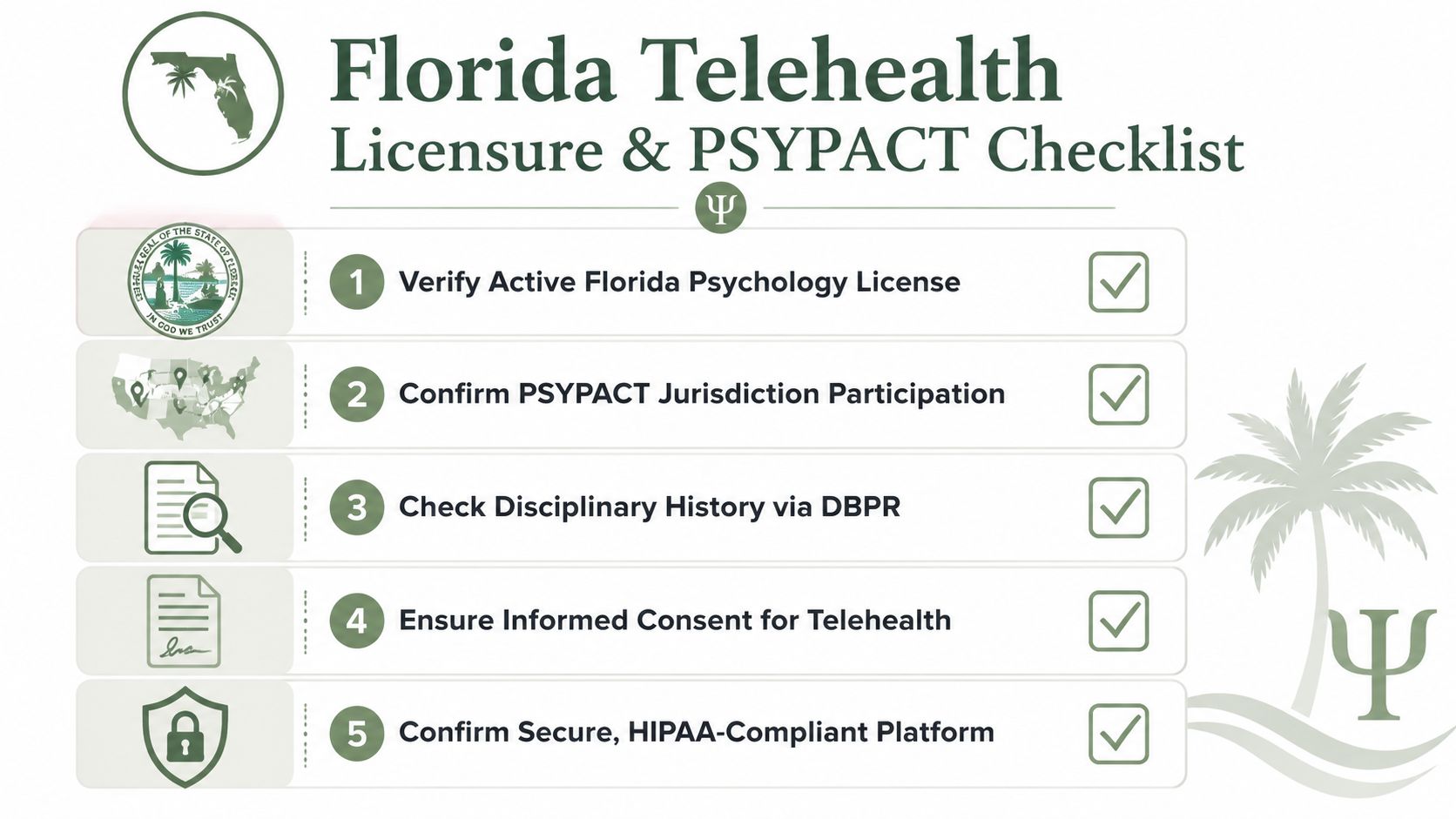
Florida's interstate access has become substantial. By January 2025, the state had 29,177 total interstate telehealth registrants, including 2,728 out-of-state psychologist telehealth registrants, as well as 5,573 licensed mental health counselors and 4,833 licensed clinical social workers, according to the Florida Psychology Board's PSYPACT information. These figures indicate a broad professional infrastructure, but they don't replace checking an individual provider's authorization.
Families comparing options can review a practice's areas served, then confirm the specific clinician's license and interstate permissions directly. Legal eligibility should be settled before intake, not after a family has shared sensitive information or built expectations around ongoing care.
Practical rule: Tell your therapist the client's physical location at the start of every session, particularly when travel or college attendance changes the state involved.
Navigating Insurance Coverage and Payment Options
Payment questions should be answered before the first full appointment. Telehealth may be covered under a behavioral health benefit, but the details depend on the plan, the provider's network status, the client's diagnosis and benefits, and the insurer's current billing requirements. Don't assume that a plan covering office therapy will handle every online service in the same way.
Call the member-services number on the insurance card and ask focused questions:
- Telehealth benefit: Does the plan cover video psychotherapy for this client's age and service type?
- Network status: Is the specific clinician in network, or is the practice listed under a different billing entity?
- Cost sharing: What deductible, copayment, or coinsurance applies?
- Authorization: Does the plan require a referral or prior authorization?
- Location rules: Are there restrictions connected to the client's location during treatment?
- Claims process: If the therapist is out of network, what documentation must accompany a claim?
A superbill is an itemized statement from the practice that can help a client request out-of-network reimbursement. It generally contains provider, client, service, and payment details. Reimbursement isn't guaranteed, so ask the insurer whether the plan accepts superbills and how the claim should be submitted.
Billing terminology can also create confusion. For a plain-language explanation of telehealth coding and the use of billing 90834 with modifier 95, families can review the resource from Happy Billing, then ask the practice which service and billing rules apply to their appointment.
When private payment may be simpler
Some families choose private pay because it can reduce network restrictions, avoid waiting for authorization, or give them access to a clinician who isn't contracted with their plan. Others need insurance because recurring therapy costs must fit an existing household budget. Neither choice is automatically better.
Ask for the practice's written fee policy, cancellation terms, consultation details, and payment timing. A practice's fees and payment information should be easy to locate or explain. If affordability is a concern, ask whether the practice offers a limited sliding-scale arrangement, a brief consultation, or referrals to lower-cost services. Get the answer in writing so the family knows what to expect.
Setting Up Your Space and Technology for Success
A calm therapy space does more than improve the picture. It helps a child stay engaged, gives an adolescent room to speak privately, and allows a therapist to notice facial expression and behavior without constant interruption.
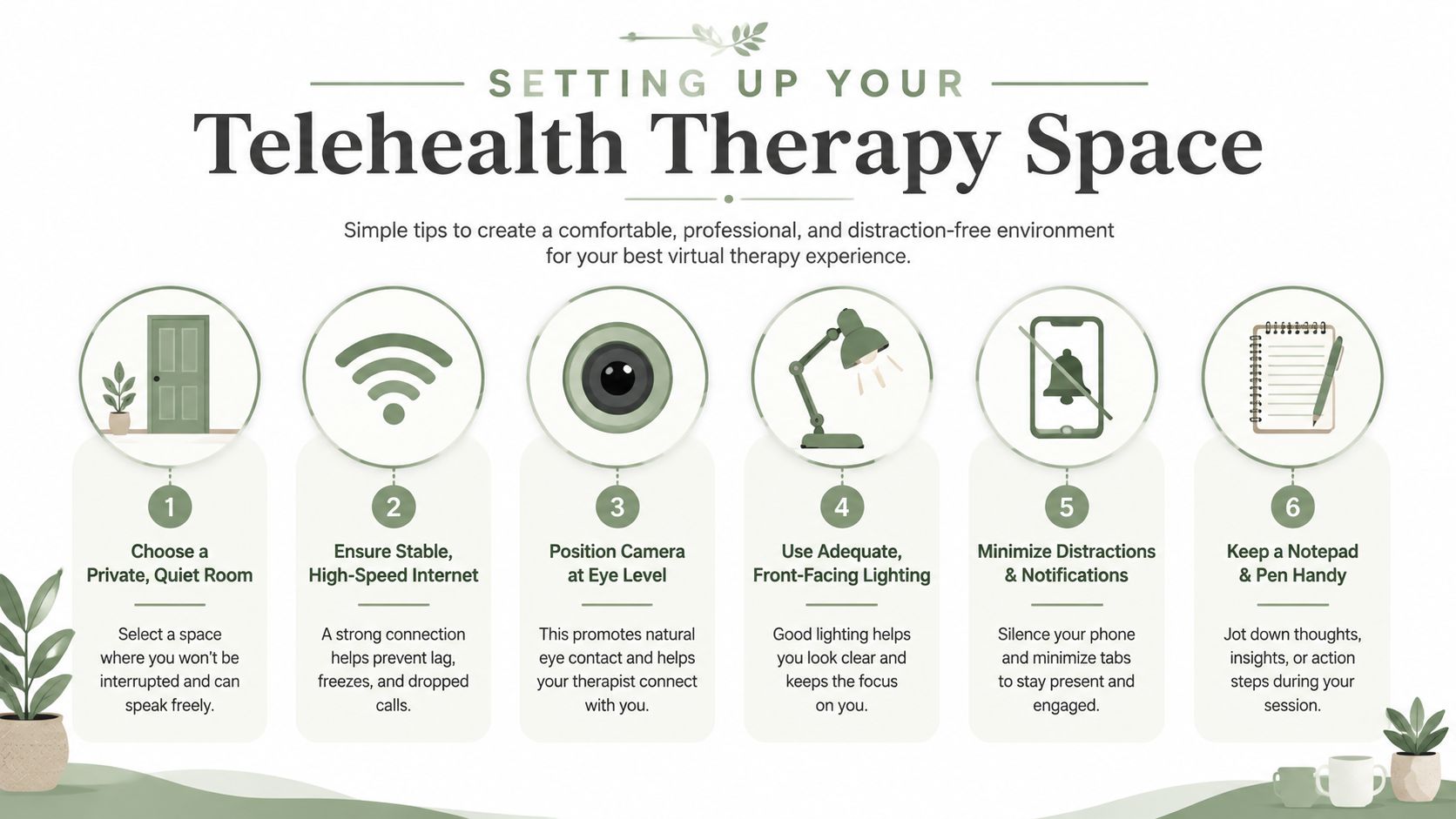
Choose a room with a door and reduce the chance that siblings, roommates, pets, or household activity will enter unexpectedly. For a younger child, a familiar table with paper, pencils, or simple objects may feel more natural than sitting stiffly at a desk. Parents should agree in advance about when they'll be present and when they'll step away.
The fifteen-minute preparation check
Before the appointment, open the platform link and test the camera and microphone. A laptop or tablet usually offers a more workable view than a phone, but use the device that gives the client a stable connection and a comfortable position. Keep the camera close to eye level, place light in front of the face rather than behind it, and use headphones when confidentiality matters.
Use this short preparation routine:
- Privacy: Close the door, silence household interruptions, and tell others not to enter.
- Connection: Join from a stable internet connection and keep a phone available for backup contact.
- Camera: Frame the client's face and upper body clearly without placing the device on an unstable surface.
- Sound: Test the microphone, choose headphones if appropriate, and disable unrelated audio.
- Notifications: Turn off message previews, calls, and computer alerts that could expose private information or break concentration.
- Materials: Keep water, tissues, a notebook, and any treatment-related forms nearby.
If the connection fails
Decide on the backup plan before discussing difficult material. The therapist may call the client, send a secure message, or reconnect through the same platform. Keep the clinician's office number accessible, but don't move to ordinary text messaging for sensitive clinical information unless the practice specifically directs you to do so.
Platform security deserves attention, too. Families comparing video tools can read AONMeetings' HIPAA compliance insights, then ask the therapist which platform is used and how privacy is protected. A practice's telehealth service information should also explain the basic process without requiring families to guess which application to download.
For children, technology is only half the setup. Give the child a simple explanation of who will be on screen, allow a few minutes to explore the format, and avoid turning the session into a performance. The therapist should adapt activities, pacing, and caregiver involvement to the child's developmental level.
What to Expect During Your First Telehealth Session
The first appointment usually starts before the video opens. During a consultation or scheduling call, the practice may ask what brought you in, who needs treatment, where the client will be located, and whether there are urgent safety concerns. This is also the right time to ask about fees, insurance, availability, treatment style, parent participation, and the platform used for sessions.
For a child or teenager, the therapist may begin with the parent or caregiver, meet with the young person alone, or move between both formats. The arrangement depends on age, presenting concern, safety needs, and the treatment plan. Parent training may be scheduled alongside individual work when sleep problems, tantrums, school refusal, separation, or noncompliance require changes in the home routine.
The opening part of the appointment
Expect practical questions first. The therapist will usually confirm identity, physical location, emergency contact information, privacy, and what to do if the video disconnects. They may review telehealth consent and explain confidentiality, including the limits that apply when someone may be at risk of serious harm.
The clinical conversation then becomes more detailed. You may discuss symptoms, school or work functioning, relationships, medical history, previous treatment, strengths, and the family's goals. A parent might describe a child's morning routine while the adolescent explains what happens internally before avoiding school or a social situation.
A useful first session doesn't require you to tell your entire story perfectly. Bring a short list of concerns, recent examples, current medications if relevant, prior treatment information, and questions about the therapist's approach. If the client is young, parents can prepare examples from home and school without speaking over the child.
Good fit is practical: You should understand what the therapist is recommending, why it may help, how caregivers will participate, and how progress will be monitored.
Later in the visit, the therapist may suggest an initial formulation and treatment direction. For anxiety, that could involve coping skills, routines, and gradual exposure work. For ADHD-related difficulties, the plan may include environmental supports and parent strategies. For mood concerns, the clinician may discuss monitoring, activity changes, family support, and safety planning.
The therapist should also explain when telehealth may not be enough. A crisis, escalating safety concern, inability to maintain privacy, or need for a higher level of care may require in-person evaluation or emergency support. Ask directly how the practice handles those situations in Florida and while the client is traveling.
At the end, clarify the next appointment, between-session tasks, caregiver roles, and the best way to contact the practice. Afterward, consider whether the therapist listened carefully, explained the plan clearly, respected the client's privacy, and seemed comfortable working with the child's or young adult's developmental needs.
Your Action Plan for Starting Telehealth Therapy in Florida
You don't need to solve every detail in one phone call. A short, organized sequence reduces preventable problems and gives the family a better basis for judging fit.
Start with the clinical need
Write down the main concern in ordinary language. “My teenager is avoiding school and panicking in the morning” gives a prospective therapist more useful information than a broad request for “counseling.” Include the client's age, preferred appointment times, current state, and whether parent involvement is needed.
Then compare providers by specialty, developmental experience, format, availability, and payment arrangements. Ask whether the clinician treats the concern through telehealth and what would prompt a recommendation for in-person care.
Verify before you schedule
Confirm the clinician's Florida license or other applicable authorization. If travel, college, or relocation is involved, ask about PSYPACT eligibility and the states where the provider can legally offer telepsychology. Don't rely on a directory profile alone.
Contact the insurer, request the practice's fee information, and clarify cancellation and payment policies. During the consultation, ask about emergency procedures, confidentiality, caregiver participation, and the technology platform.
Prepare for the first visit
Choose the room, test the device, place the camera at eye level, and keep a backup phone number available. For children, explain the session in simple terms and gather any materials the therapist requested. After the appointment, decide whether the clinician's communication style and treatment plan feel appropriate.
Red flags include pressure to book without answering licensure or fee questions, unclear emergency procedures, repeated technology failures without a backup plan, or a therapist who dismisses the family's concerns. Stronger signs include clear boundaries, developmentally appropriate communication, a specific plan, and willingness to adjust caregiver involvement as treatment progresses.
Wald Behavioral Health offers secure telehealth therapy for children, adolescents, young adults, and families in Florida, Maryland, and PSYPACT-participating states. The Coral Gables practice provides evidence-based care, parent guidance when appropriate, a free 15-minute consultation, and flexible weekday evening and weekend scheduling by arrangement.
Take one step today. Write your client-location and treatment-needs checklist, then contact two qualified practices and ask the same questions so you can compare answers rather than guess.
---
Wald Behavioral Health provides secure video therapy for children, adolescents, young adults, and families, with parent guidance and flexible scheduling for clients who need care around school, work, or family routines. Visit Wald Behavioral Health to request a free 15-minute consultation and discuss telehealth therapy in Florida, provider fit, and next steps.
Questions about your child or teen?
Dr. Wald offers a free 15 minute consultation to talk through what you are seeing and whether the practice is a good fit.
Free 15 Minute Consultation