Separation Anxiety Causes: What Truly Drives the Fear
Your child's hand tightens around yours at the classroom door. You've explained who will pick them up, packed their favorite snack, and left enough time for a calm goodbye. Still, they ask you to stay, and you're left wondering whether leaving is the right thing to do.
## Table of Contents - The Moment Every Parent Recognizes - Look beneath the behavior - How Clinicians Define Separation Anxiety Today - Think in layers, not competing explanations - The Biological and Temperamental Layer - Sensitivity isn't something a parent created - Attachment, Parenting, and the Family System - Comfort and accommodation aren't identical - Life Stressors and Environmental Triggers - Common Triggers and Their Typical Roles - How the Causes Interact in Real Families - A young child after a move - A teenager resisting school - What Understanding Causes Changes About Treatment - Match the task to the difficulty - Common Myths and a Clearer Way Forward - A struggling child doesn't prove parental failure
The Moment Every Parent Recognizes
The hardest part may come afterward. You replay the goodbye on your drive home, wondering whether your child was frightened, whether you pushed too hard, or whether staying longer would have helped. Another parent might face the same uncertainty when a teenager refuses camp or a college student calls from a dorm because being away feels unbearable.
These are illustrative situations, not accounts of particular patients. They capture an important distinction: what adults see is resistance to separation, but what the young person experiences may be fear, uncertainty, or concern about someone's safety.
Look beneath the behavior
Calling a child clingy describes proximity, not its meaning. It doesn't tell you whether the child fears that you won't return, feels overwhelmed in an unfamiliar setting, or wants to avoid something happening at school. Those possibilities call for different questions.
A useful starting point is to notice what happens around the goodbye:
- Before separation: What does your child predict will happen?
- During separation: Can they accept support from another trusted adult?
- After reunion: Do they return to their usual activities, or remain preoccupied with the next departure?
For younger children who struggle to explain their experience, resources on understanding play-based therapy methods from reVIBE Mental Health offer context for discussing developmentally appropriate support. You don't need a polished explanation from your child before taking their distress seriously.
Separation anxiety causes are best understood as interacting influences, not a single culprit. A child's sensitivity, the support available in close relationships, and the family's circumstances all deserve attention. The task isn't to identify who caused the fear. It's to understand what makes separation feel difficult for this particular child.
How Clinicians Define Separation Anxiety Today
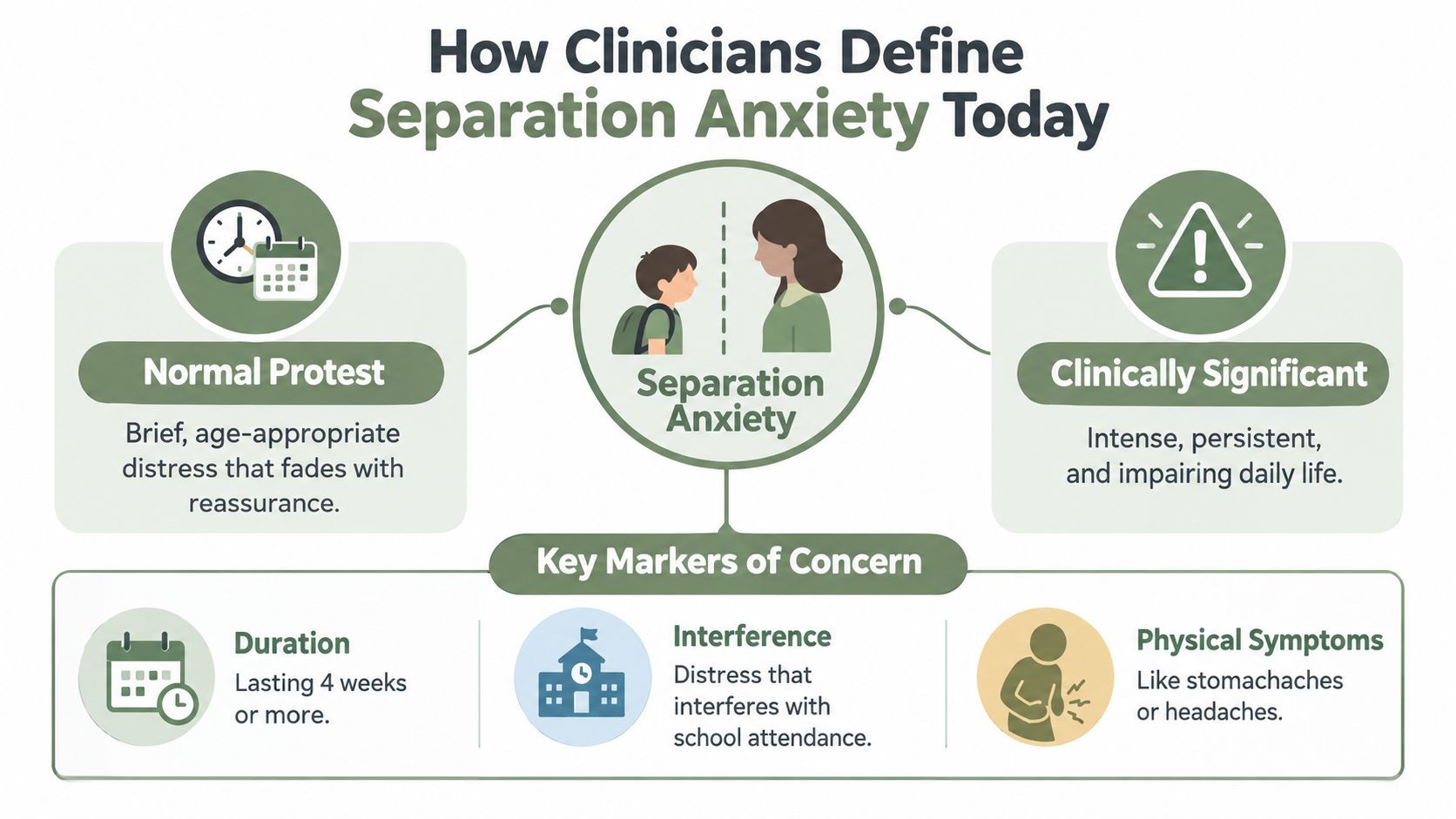
Separation anxiety refers to distress associated with being apart from an important caregiver or loved one. The clinical question isn't whether a child cries at goodbye. It's whether the response fits their developmental stage and whether it prevents them from participating in ordinary life.
A clinician considers duration, intensity, and impairment together. A difficult transition that gradually becomes manageable is different from a persistent pattern that disrupts attendance, sleep, or activities. A single upsetting morning doesn't establish a disorder, and a quiet child isn't necessarily free of distress.
The visual below summarizes the distinction, but it shouldn't be used as a stand-alone diagnostic checklist.
Think in layers, not competing explanations
Clinicians use a biopsychosocial model to organize the assessment. In plain language, that means considering the child's predispositions, their relationships, and the conditions in which they live. These aren't competing explanations where choosing biology means ignoring parenting, or choosing family stress means discounting temperament.
A useful explanation connects the child's vulnerability with their experience. It doesn't reduce either the child or the caregiver to the problem.
Assessment also asks whether the child's difficulty appears broadly or in a particular setting. Someone who separates comfortably for enjoyable activities but struggles with school needs a different conversation from someone distressed whenever a caregiver leaves.
For families exploring care, information about anxiety assessment and therapy can help frame that conversation. A geographically relevant resource, such as California Teen Center's page on anxiety help in Yuba City, can also help parents consider where to seek adolescent support.
The purpose of consultation is clarification, not automatic labeling. Parents should leave understanding what the clinician thinks is happening, what remains uncertain, and which observations would help distinguish separation-related fear from other concerns.
The Biological and Temperamental Layer
Some children approach unfamiliar situations readily. Others watch from the edge, study who is present, and hesitate before joining. That difference offers a way to understand temperament without treating cautiousness as a flaw.
The following illustration captures hesitation, not a diagnosis.
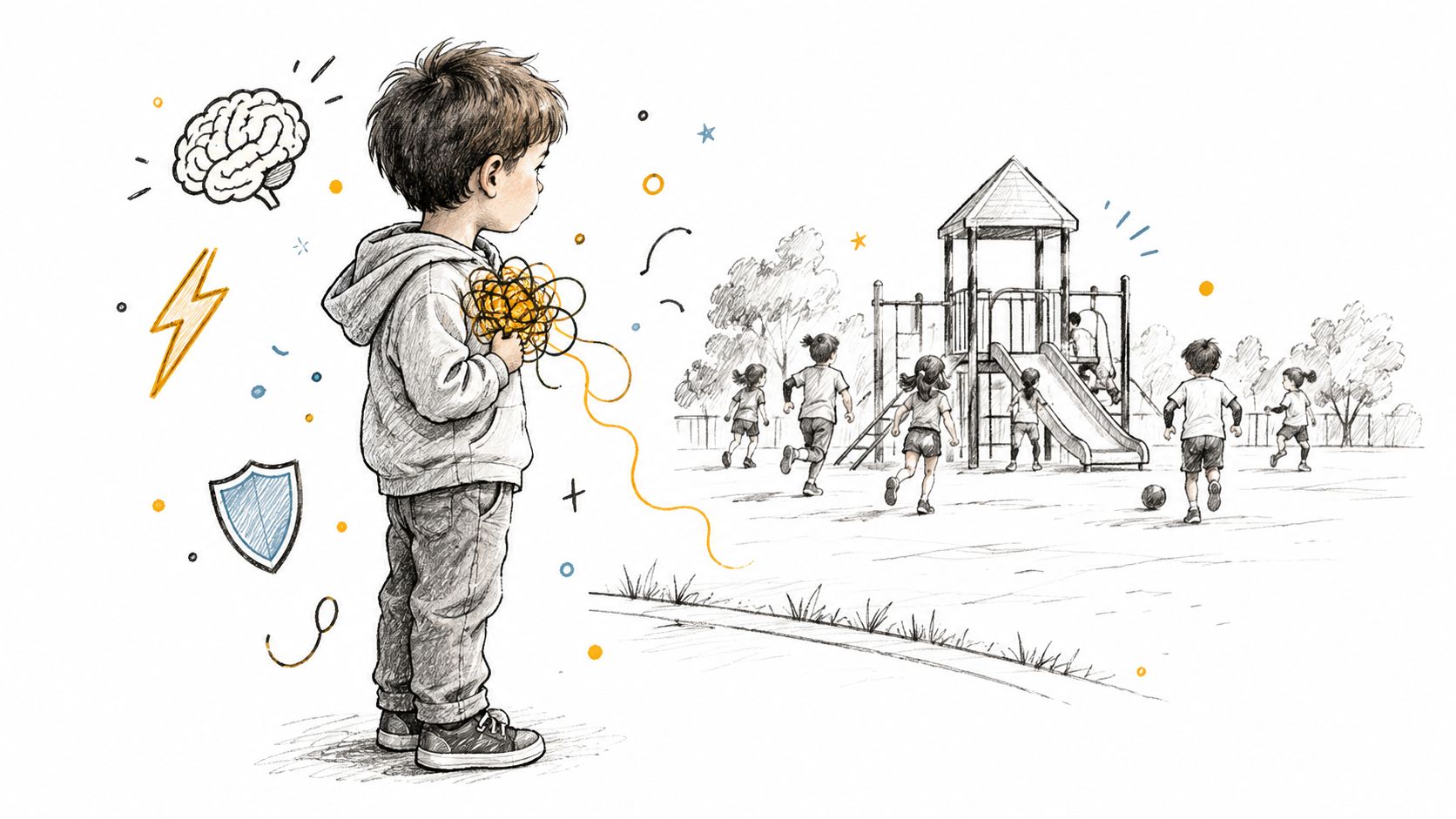
Inherited anxiety vulnerability, behavioral inhibition, and a tendency toward strong negative emotions are recognized predispositions in the clinical review of separation anxiety disorder. None means that a child will develop a disorder. They help explain why the same unfamiliar classroom may feel inviting to one child and threatening to another.
Sensitivity isn't something a parent created
Behavioral inhibition describes a tendency to hold back around novelty. Negative affect refers to a tendency to experience distressing emotions strongly. Neither term means the child is intentionally difficult or lacks motivation.
You can describe these differences without medicalizing every reaction:
- Approaching novelty: Does your child need time to observe before participating?
- Responding to uncertainty: Is an unclear pickup plan harder than a familiar arrangement?
- Recovering from distress: Once supported, can your child reengage, or do they remain focused on the separation?
These observations help parents describe their child to a clinician. They aren't substitutes for assessment, and a preference for familiarity isn't itself a diagnosis.
Family resemblance can be confusing. An anxious parent may recognize their own childhood in their child's behavior and assume they've transmitted anxiety through something they did. A more accurate interpretation leaves room for inherited vulnerability as well as shared experiences.
For an additional visual resource, the embedded video is available below.
The practical implication is adjusting support to sensitivity, not expecting a child to become a different person. A cautious child may need carefully planned opportunities to experience competence. Temperament describes a starting point, not a fixed destination.
Attachment, Parenting, and the Family System
A caregiver who stays beside a distressed child is usually trying to help. That response may bring immediate relief, which makes it understandable that both child and adult want to repeat it. The difficulty arises when relieving distress becomes the only available response.
Reviews of parent, child interactions in separation anxiety associate childhood anxiety with overprotection, autonomy-discouraging behavior, low warmth, and intrusiveness. These are associations and proposed pathways, not proof that a particular parent caused a particular child's disorder.
Comfort and accommodation aren't identical
Comfort acknowledges distress while supporting coping. Accommodation changes expectations or routines so the child can avoid the feared experience. A hug before a planned departure differs from repeatedly canceling departures whenever anxiety appears.
The maintenance pattern can look like this:
- Trigger: A caregiver prepares to leave.
- Child response: The child protests or seeks repeated reassurance.
- Caregiver adjustment: The departure is delayed or canceled.
- Immediate result: Everyone feels calmer, but the child misses an opportunity to discover that separation is tolerable.
Practical distinction: You can take a child's fear seriously without organizing every decision around preventing that fear.
The diagram below summarizes relationship patterns. Its arrows should be read as possible influences, not an inevitable progression or a way to diagnose attachment from a difficult goodbye.
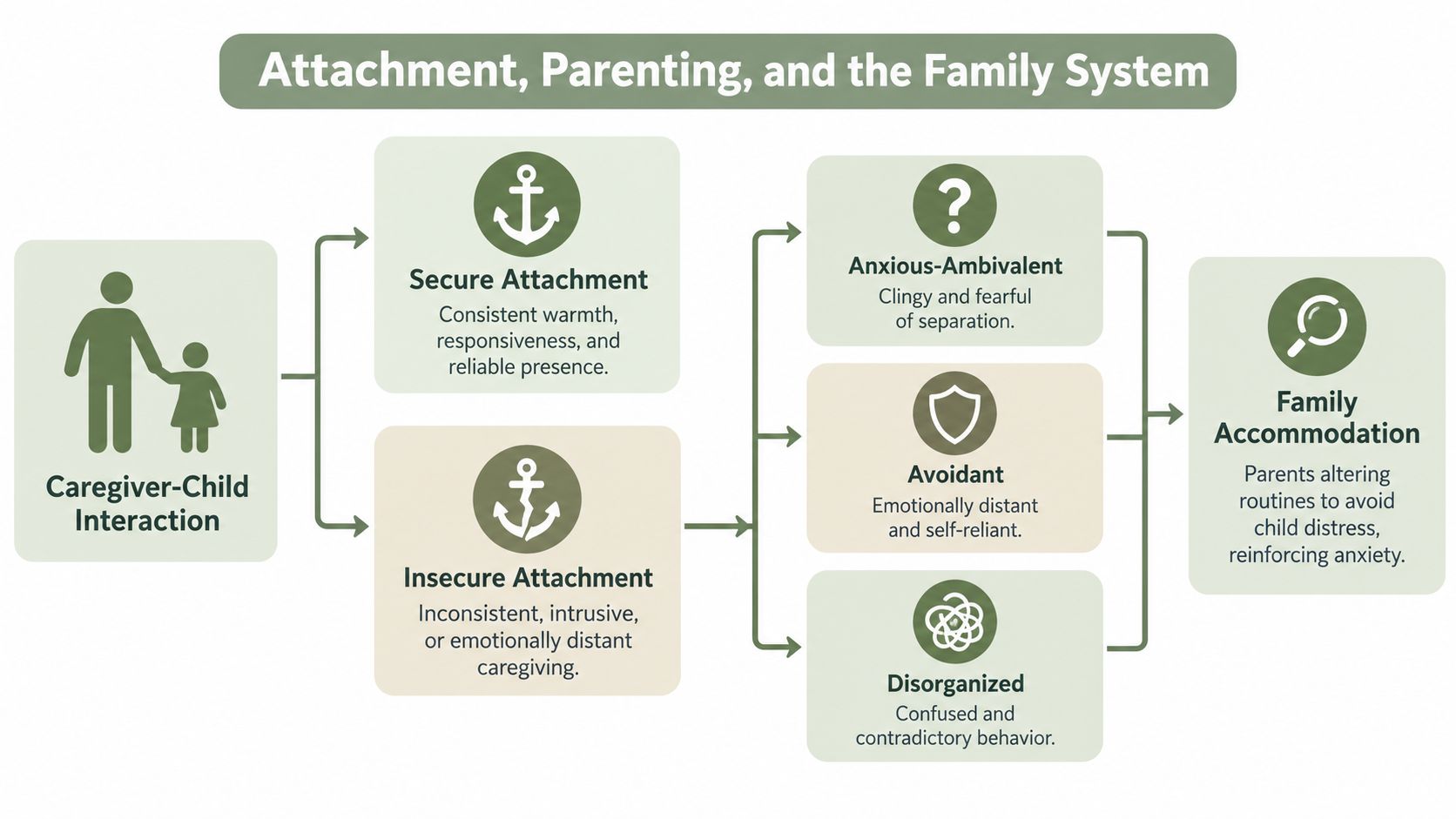
Attachment concerns expectations about a caregiver's responsiveness and availability. Visible distress alone doesn't establish insecure attachment, and independence alone doesn't establish security. Parents shouldn't use attachment labels to judge either their child or themselves.
Caregiver anxiety or depression also deserves compassionate attention. A parent managing their own distress may find it harder to communicate confidence or remain emotionally available during stressful routines. That's a reason to offer support, not assign blame.
Resources describing family therapy techniques can help families think about shared responses. The useful question is which interactions support the child's growing capacity, and which leave everyone increasingly dependent on avoidance.
Life Stressors and Environmental Triggers
A parent may identify the moment everything changed: a move, an illness, or the death of someone close. That timing matters, but it doesn't establish that the event alone caused persistent separation anxiety.
The Mayo Clinic overview of separation anxiety risk factors identifies major disruptions such as divorce, relocation, school changes, illness, bereavement, disasters, and traumatic experiences. These events can threaten continuity or make the possibility of losing someone feel more immediate.
Common Triggers and Their Typical Roles
| Trigger type | Acute vs chronic | Typical role in separation anxiety | |---|---|---| | Moving or changing schools | Often acute, with an adjustment period | Removes familiar people, places, and routines | | Illness, bereavement, or loss of a pet | May begin acutely and have lasting effects | Makes vulnerability and loss more salient | | Divorce or prolonged caregiver separation | May involve both | Changes access to caregivers and expectations about reunion | | Disaster or trauma | Acute event, sometimes ongoing consequences | Disrupts the child's sense of safety | | Financial strain and caregiver distress | Often chronic | Can affect emotional availability and opportunities for coping |
Acute triggers are identifiable events. Chronic background stress involves conditions the family continues to manage. The distinction helps explain why restoring a familiar school routine may not resolve distress when the household remains under substantial pressure.
Ask about what changed around the event, not just the event's name:
- Availability: Who is now caring for the child, and when?
- Predictability: Have departure and reunion arrangements become uncertain?
- Meaning: What does the child believe the change says about safety?
Two siblings can respond differently to the same disruption without either response being wrong. Their vulnerabilities, understanding of the event, and access to support may differ.
When frightening experiences are relevant, information about trauma-focused care can help families prepare questions for an assessment. Don't assume every stressful transition is trauma, but don't overlook a child's account of feeling unsafe.
For an older young person, it's similarly useful to examine changes in living arrangements, relationships, or caregiver health. The assessment should follow the person's actual context rather than assume separation concerns belong only to early childhood.
How the Causes Interact in Real Families
The following scenarios are hypothetical teaching examples, not reported cases or treatment outcomes. Their purpose is to show why similar behavior can require different explanations.
A young child after a move
A child with a family history of anxiety has recently moved and started at an unfamiliar school. At drop-off, a loving grandparent answers the same worried questions repeatedly and sometimes takes the child home. The child's cautious temperament, disrupted familiarity, and departure routine all deserve consideration.
The clinician would want to know what happens after the grandparent leaves. Does the child settle with a teacher and join activities, or remain distressed and unable to participate? That observation helps distinguish difficulty at the transition from a more pervasive pattern.
A useful family map might identify:
- Predisposition: Hesitation around unfamiliar people and places.
- Recent change: Loss of a familiar classroom and routine.
- Maintenance concern: Departures increasingly depend on the child feeling completely calm.
A teenager resisting school
A teenager repeatedly asks to stay home, especially before a particular class. They're concerned about peer mistreatment and academic demands, while a parent is managing depression. The teenager also worries about leaving that parent alone.
This isn't a situation to reduce to dependence. The review of school refusal and family-related factors describes overlapping pathways involving separation anxiety, school and social anxiety, parental mental-health difficulties, and family functioning. An association doesn't establish the cause in an individual family.
Questions should distinguish those pathways. Does the teenager comfortably leave home for other activities? Does distress increase before contact with certain peers, assessments, or periods when the parent is unwell?
The same request to stay home can express different fears. Ask what the young person expects to happen, not just why they won't go.
In the first example, the departure pattern may be central. In the second, school conditions and concern about the parent may require coordinated attention. Neither family benefits from advice that treats all resistance as the same problem.
What Understanding Causes Changes About Treatment
A treatment plan should identify what each intervention is intended to change. Parents shouldn't have to infer whether the clinician is addressing separation-related predictions, avoidance, school difficulties, or family stress.
Planning also needs to account for development. A young child may need concrete routines and caregiver participation, while a teenager may need more privacy and collaboration. The task should fit the young person's abilities, not just their chronological age.
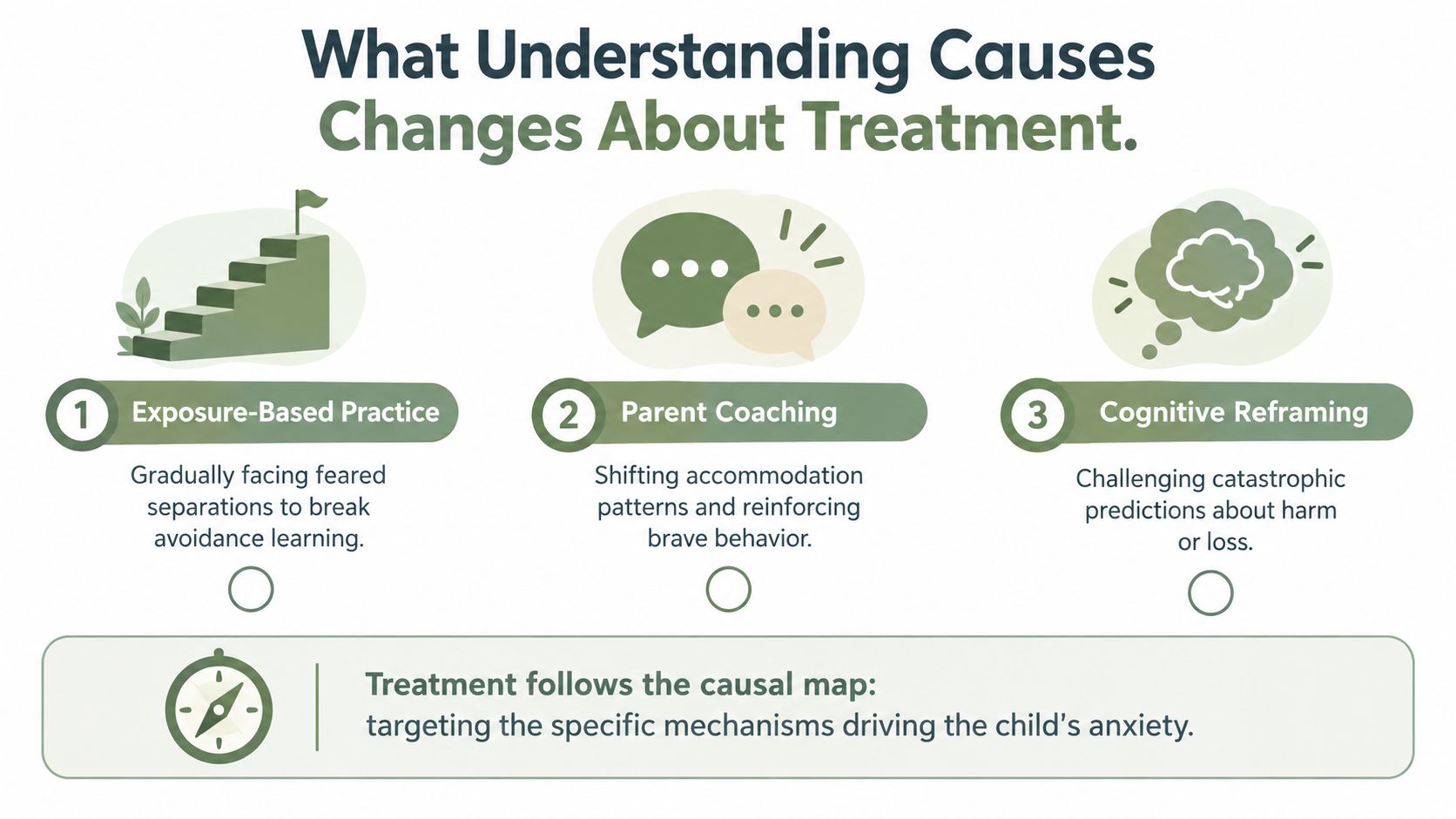
The diagram below outlines possible components of a clinician-guided plan.
Match the task to the difficulty
For avoidance, a clinician may help the family develop graded independence tasks. Rather than making an abrupt, punitive separation, the family agrees on a manageable challenge, the support available, and what will happen afterward. The aim is practice with coping, not a test of obedience.
Useful planning questions include:
- Exposure-based practice: What specific separation are we practicing, and what would make it manageable?
- Parent coaching: Which response should caregivers use consistently?
- Thinking skills: What feared prediction does the child need help examining?
- Contextual support: Is there a genuine school or family problem that needs action alongside anxiety work?
Cognitive reframing shouldn't mean telling a child that nothing bad can ever happen. A more grounded conversation distinguishes a feared possibility from what is likely and identifies how the child can obtain appropriate help.
Clinicians should also assess concerns such as school anxiety, OCD, or ADHD when relevant, rather than assume every difficulty belongs to separation anxiety. Those questions matter because the same outward behavior may have different purposes.
Medication decisions, if considered, belong with an appropriately qualified clinician and require individual discussion. No parent should conclude from a general article that medication is either necessary or unsuitable.
A practical home plan makes responsibilities clear: what the child practices, what the caregiver does, and what the school communicates. Progress should be judged through participation and coping, not only whether a goodbye becomes tear-free.
Common Myths and a Clearer Way Forward
The clingy-child explanation is too small. It treats a visible behavior as though it explains the child's internal experience. Some distress becomes easier as a child adapts, but persistent interference with daily life deserves attention rather than an assumption that maturity will solve it.
Strict attendance pressure isn't a complete plan. Attendance may be an important objective, but adults still need to investigate what makes school difficult. Pushing a young person toward an unresolved threat or giving inconsistent instructions won't provide the understanding needed for coordinated support.
A struggling child doesn't prove parental failure
A parent can be loving, thoughtful, and consistent while their child experiences significant anxiety. Recognizing an unhelpful response pattern doesn't erase that care. It gives the family something specific to adjust.
A clearer next step depends on the pattern you observe:
- Monitor adaptation: If distress is easing and participation remains intact, keep routines steady and notice what helps.
- Seek consultation: If fear persists, spreads to more situations, or repeatedly disrupts attendance, sleep, or activities, request an assessment.
- Investigate safety concerns: If the child reports bullying, conflict, or another concrete problem, address that report rather than treating it only as anxiety.
Bring observations rather than a ready-made diagnosis. Write down when distress starts, what the child predicts, how adults respond, and whether the child can reengage afterward. Include what has changed at home or school and what the child finds easier.
That information helps a clinician consider predisposition, relationships, and context together. It also helps parents distinguish what they can change directly from what requires school collaboration or additional caregiver support.
You don't need to identify the original cause perfectly before asking for help. A useful assessment can clarify the current pattern and establish a realistic starting point. The hopeful message isn't that separations will immediately become effortless. It's that families can move from reacting to each difficult goodbye toward a shared, developmentally appropriate plan.
---
Wald Behavioral Health offers evidence-based therapy for children, adolescents, and young adults, with parent guidance for separation difficulties and school refusal. Visit Wald Behavioral Health to request a consultation about your family's concerns and discuss in-person care in Coral Gables or telehealth options across Florida, Maryland, and PSYPACT-participating states.
Questions about your child or teen?
Dr. Wald offers a free 15 minute consultation to talk through what you are seeing and whether the practice is a good fit.
Free 15 Minute Consultation