Psychology in Miami: A Local Guide to Finding the Right Fit

A nine-year-old in Coral Gables starts refusing school every morning. In Brickell, a young professional is having panic attacks between meetings and wondering whether a psychologist, psychiatrist, or urgent-care service is the right first call. Both families may search for “psychology in Miami,” but a directory of names won't answer the decisions that matter.
The useful questions are more specific: Does my child need therapy or testing? Should medication be part of the plan? Can I find a Spanish-speaking clinician who understands our family routines? Is telehealth legitimate if my college student leaves Florida? This guide treats psychology in Miami as a system you can manage, not a list of offices to scroll through. The right clinician usually isn't the closest one. It's the professional whose training, treatment method, availability, language access, and level of family involvement match the problem.
## Table of Contents - What Miami Families Are Really Searching For - Testing and therapy solve different problems - Mental Health Need and Access in Miami-Dade - Why pediatric access requires a plan - Types of Psychology Providers in Miami - Match the credential to the decision - How to Choose the Right Clinician for Your Family - Start with the presenting concern - Use the consultation to test fit - Telehealth vs In-Person Therapy in Miami - Understand licensing before a student travels - What Evidence-Based Therapy Looks Like in Practice - Anxiety and OCD require practice - ADHD and sleep need coordinated behavior change - Progress needs a definition - Your Next Steps and Local Resources - Still deciding - Ready to schedule - Already in therapy
What Miami Families Are Really Searching For
Parents rarely begin with a credential. They begin with a disruption. A child won't enter the classroom, a teenager stops sleeping, a college student can't manage intrusive thoughts, or an adult begins avoiding elevators, highways, presentations, or crowded places. The search for a psychologist is really a search for a decision: what kind of help fits this concern, and how quickly can we get it?
Start by naming the impairment rather than the suspected diagnosis. “My child refuses school,” “my teen spends hours checking,” or “I can't get through work without panic” gives a clinician more useful information than a label copied from a search result. Ask whether the main need is assessment, skill-building therapy, medication evaluation, parent coaching, crisis stabilization, or coordination with a school or medical team.
Testing and therapy solve different problems
A pediatric psychologist may be appropriate when a diagnosis must guide school accommodations, developmental planning, or treatment selection. Therapy is usually the better starting point when the concern is anxiety, low mood, avoidance, conflict, sleep resistance, or school stress and the family needs practical changes in daily life.
Some children need both. An evaluation can clarify attention, learning, developmental, or emotional factors, while therapy addresses the behaviors and routines that are keeping the child stuck. Don't book testing because it sounds more thorough. Book it when the answers will change what the family, school, or medical team does next.
Language and culture also belong in the first conversation. Ask whether sessions can be conducted in Spanish or another preferred language, whether caregivers can participate comfortably, and how the clinician handles differences between a child's school environment and home expectations. Bilingual care isn't only a translation issue. It affects how symptoms, family roles, discipline, privacy, and progress are understood.
Practical rule: Choose the clinician who can explain what treatment will look like at home, not only what diagnosis might appear in a report.
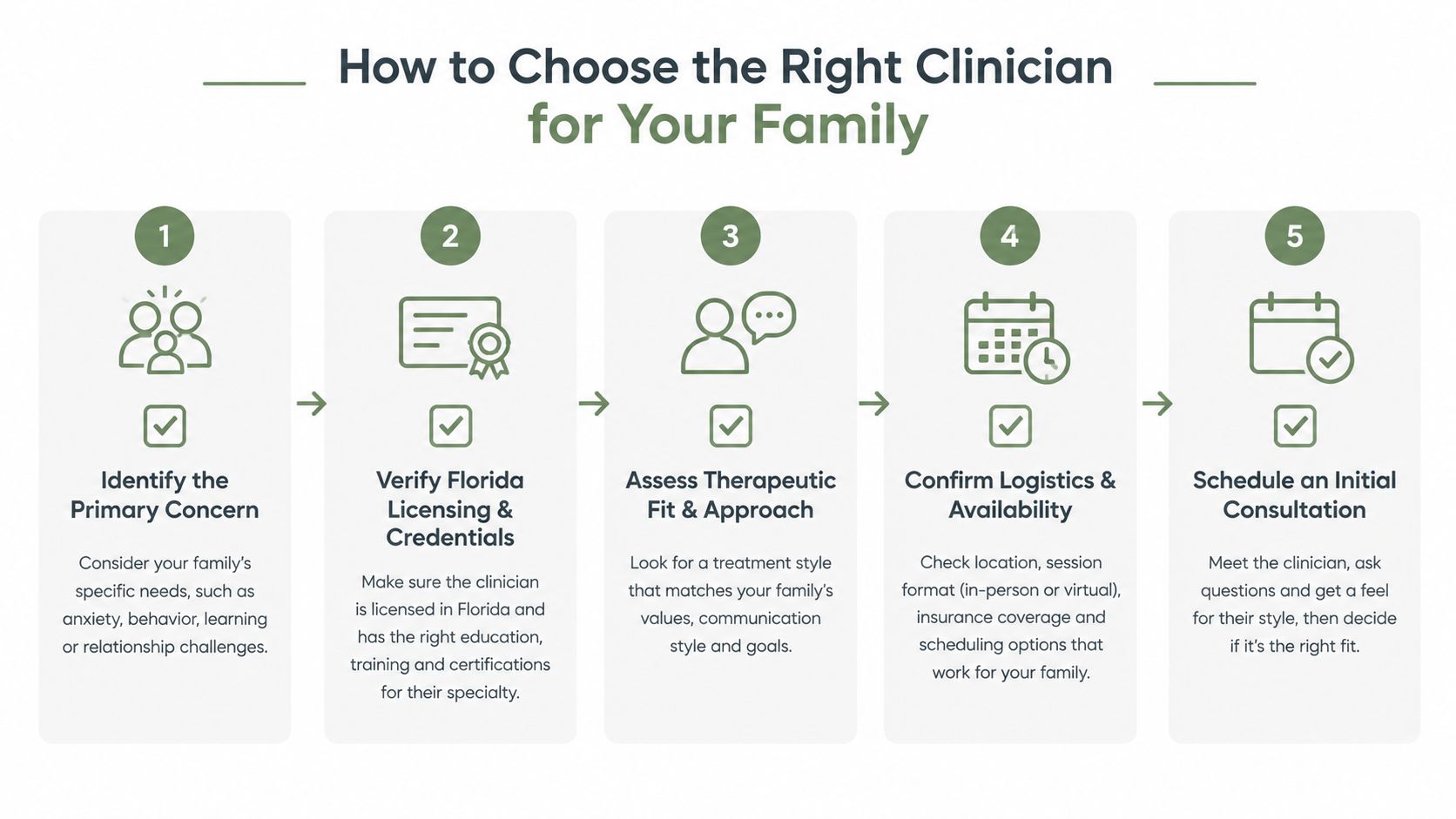
Before scheduling, confirm the clinician's license, specialty population, treatment approach, insurance or private-pay process, and earliest realistic opening. A focused phone consultation can reveal more than a polished profile. Ask what the first few sessions involve, how parents participate, how progress is measured, and what happens if the concern requires psychiatry or a higher level of care.
Mental Health Need and Access in Miami-Dade
A family in Kendall may find a therapist nearby, yet wait weeks for a clinician who treats OCD, evaluates ADHD, speaks Spanish, or works with a child's school. Miami-Dade families are dealing with high need and uneven access. County health indicators reported that 16.7% of adults in Miami reported poor mental health for 14 or more days during the past month in 2022, while a separate county assessment found that 19.2% of adults had received a physician diagnosis of a depressive disorder. The same assessment listed 75.3 mental-health providers per 100,000 people, a service-capacity benchmark that does not show whether a provider accepts a family's insurance or has an opening. (Miami-Dade Matters health indicators)
Need also differs by ZIP code. Miami-Dade's 2025 Mental Health Index was 50.3 overall, while ZIP codes such as 33056 reached 93.6 and 33136 reached 92.8. County averages can hide concentrated local burden, and proximity to a hospital, school cluster, or commercial corridor does not guarantee access to the right specialty. (Miami-Dade Matters Mental Health Index)
| What families should assess | Miami-Dade context | Practical decision | |---|---|---| | Type of need | County indicators show substantial adult mental-health need. | Contact several suitable practices instead of waiting passively for one office. | | Specialty fit | A provider count does not show experience with depression, anxiety, child development, or safety concerns. | Ask whether the clinician regularly treats the specific problem affecting home, school, or work. | | Actual availability | A listed clinician may not accept the family's insurance, offer the preferred language, or have pediatric openings. | Confirm insurance, language, age range, format, and the earliest realistic appointment before completing intake forms. | | Neighborhood differences | The countywide index and ZIP-code examples show that need is not evenly distributed. | Consider telehealth, flexible hours, and providers outside the immediate neighborhood when local options do not fit. |
Why pediatric access requires a plan
Parents seeking timely help for a child are often facing a bottleneck, not a lack of motivation. South Florida reporting and regional needs assessments describe shortages in child psychiatry, hospital beds, doctors, and therapists. One regional assessment reported that the share of students feeling depressed or sad fell from 2021 to 38.5% in 2023, which still signals meaningful demand for guidance and treatment. (WLRN reporting on South Florida child psychiatry access)
Use a broader search radius when necessary, including Coral Gables, Kendall, Miami Beach, Hialeah, and North Miami-Dade. Call practices directly, ask about cancellations, and request a referral pathway when a clinician's scope does not match the concern. For urgent safety issues, ask the practice what level of care is appropriate rather than treating a routine therapy waitlist as the only option.
Types of Psychology Providers in Miami
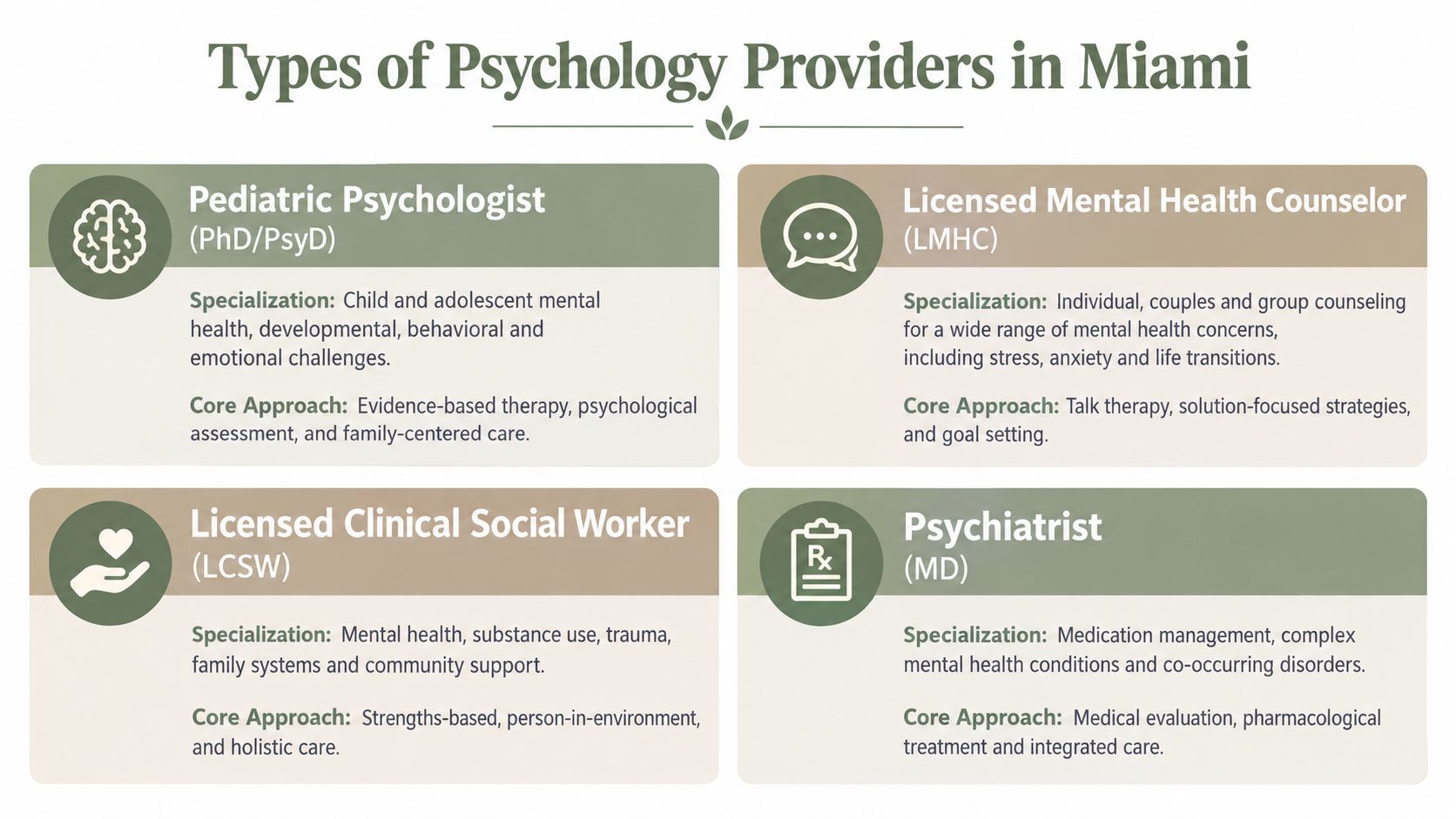
The title on a profile can mislead families if they don't connect it to the work they need done. A pediatric psychologist is often the strongest fit for child assessment, ADHD or autism evaluations, cognitive testing, and therapy that accounts for developmental stage. A PhD or PsyD clinician may also provide structured treatment for anxiety, OCD, mood concerns, behavior, and school-related impairment.
A therapist may hold an LMHC, LMFT, or LCSW license. These professionals provide talk therapy and may have excellent training in specific methods, but their experience can differ substantially by population and specialty. Ask about the clinician's actual work with the presenting concern, not only the license abbreviation.
Match the credential to the decision
Psychologists are useful when assessment, diagnosis, treatment planning, or specialized therapy is central. For a child struggling academically, the key question may be whether the clinician performs the relevant evaluation and translates results into school and home recommendations. For OCD, ask whether the clinician provides exposure and response prevention, rather than assuming every therapist treats OCD in the same way.
Psychiatrists are medical doctors. They evaluate mental-health conditions, prescribe medication, monitor side effects, and manage medical complexity. A psychiatrist may be essential when symptoms are severe, safety is uncertain, a prior medication trial failed, or a condition such as bipolar disorder requires medical oversight. Psychiatry doesn't replace therapy when the person needs behavioral practice, family coaching, or exposure work.
Licensed counselors and social workers can be effective choices for individual, family, and parent-focused therapy. LCSWs may also help coordinate community, school, and medical resources. LMHCs often provide structured counseling for anxiety, mood, adjustment, and behavioral concerns, depending on their training.
School psychologists and behavioral counselors serve narrower roles. They may support students through district systems or behavioral programs, but they aren't automatically substitutes for an independently licensed clinician who can provide outpatient treatment.
For a plain-language overview of the pediatric psychologist role, see what a pediatric psychologist does. Use the explanation to prepare questions, not to decide on a provider without checking licensure and specialty.
How to Choose the Right Clinician for Your Family
The first call should function like a short clinical screening, not a sales conversation. You're trying to determine whether the clinician understands the problem, offers a fitting method, and can work within your family's real schedule.
Start with the presenting concern
Write down what changed, when it began, and where it appears. A child who panics only at school may need school coordination and exposure-based work. A young adult with intrusive thoughts and rituals should be matched with a clinician trained in OCD treatment, not someone who lists anxiety on a profile. Autism or learning questions call for developmental or child psychology assessment experience.
Then verify the professional. Use the Florida Department of Health license lookup to confirm active licensure and the credential listed by the practice. If care may occur across state lines, ask whether the psychologist holds the relevant authorization through the PSYPACT Authority to Practice Interjurisdictional Telepsychology. A clinician should be able to explain where they're legally permitted to provide telepsychology and what happens when a student or family member travels.
Use the consultation to test fit
A free 15-minute consultation is valuable only if you ask concrete questions:
- Treatment method: “Which evidence-based approach would you consider for this concern, and what would sessions involve?”
- Parent role: “Will caregivers join sessions, receive coaching, or practice skills between appointments?”
- Measurement: “How will we know whether treatment is helping?”
- Logistics: “What availability do you have, what happens after a missed appointment, and do you accept our insurance?”
- Coordination: “Can you communicate with a school or medical provider when appropriate and authorized?”
Miami families should also ask about Spanish-language services, experience with Miami-Dade County Public Schools, evening appointments for Brickell and Doral professionals, and participation with plans such as Aetna, Florida Blue, or Cigna. Don't assume a practice accepts a plan because it appears in a directory. Confirm benefits, deductibles, authorization requirements, out-of-network reimbursement, and private-pay policies directly.
The best answer won't always be “yes, I can treat this.” A clinician who identifies the need for psychiatry, testing, crisis support, or a higher level of care is demonstrating responsible scope.
Here's a short video that can help families think through the selection process before making calls:
Telehealth vs In-Person Therapy in Miami
Miami traffic, school pickup, long workdays, and split households make modality a clinical decision and a practical one. Telehealth often works well when the treatment depends on conversation, skills practice, and observation of routines in the home. In-person care provides advantages when the clinician needs standardized testing conditions, hands-on observation, or group interaction.
| Concern or Population | Best Fit | Why It Works | |---|---|---| | Mild-to-moderate anxiety | Telehealth or hybrid care | Weekly CBT can happen without a cross-county commute, while real-life practice occurs between sessions. | | OCD treatment | Telehealth or hybrid care | ERP planning and follow-up can be completed by video, with exposure tasks designed for the person's actual settings. | | Parent coaching for ADHD or behavior | Telehealth | The clinician can discuss routines and observe parts of the home environment while caregivers practice changes between meetings. | | Sleep resistance | Telehealth | Bedtime plans are easier to build around the household's actual evening routine. | | Very young children | In-person care | Younger children may engage more readily through play, movement, and direct interaction. | | Autism diagnostic batteries or neuropsychological testing | In-person care | Standardized assessment requires controlled procedures and direct observation. | | Social-skills groups | In-person care | Group work depends on live peer interaction and immediate coaching. |
Understand licensing before a student travels
A Florida-licensed psychologist can provide care to a client located in Florida, whether that client is at home in Miami or temporarily elsewhere in the state, subject to the practice's procedures and applicable rules. Cross-state care is different. Through PSYPACT, an authorized psychologist may serve eligible clients located in participating jurisdictions, but the clinician must hold the required authorization and follow the rules of the client's location.
That matters for a University of Miami student who spends a term in another state, a young adult who relocates, or a family that travels regularly. Ask before the move, not after a session is missed. The clinician should confirm whether the destination is covered, whether the service is permitted there, and whether insurance will process the visit.
For an overview of secure virtual services and scheduling considerations, review telehealth therapy options. Choose a video platform that will sign a HIPAA business associate agreement with the practice, a private room, and a backup plan for technology or safety concerns. In-person appointments in Coral Gables, Pinecrest, or Aventura may still be preferable for assessment, early-childhood work, or treatment that benefits from direct environmental structure.
A hybrid plan can be especially practical. Some families begin with in-person assessment or an intensive parent meeting, then use video for routine follow-ups. The modality should serve the treatment plan, not merely the calendar.
What Evidence-Based Therapy Looks Like in Practice
Evidence-based therapy should be visible in the session plan. You should know what the clinician is targeting, what the family will practice, and how progress will be reviewed. “Talking about feelings” may be part of therapy, but it shouldn't be the entire treatment model when anxiety, OCD, ADHD, or sleep problems are driving concrete impairment.
Anxiety and OCD require practice
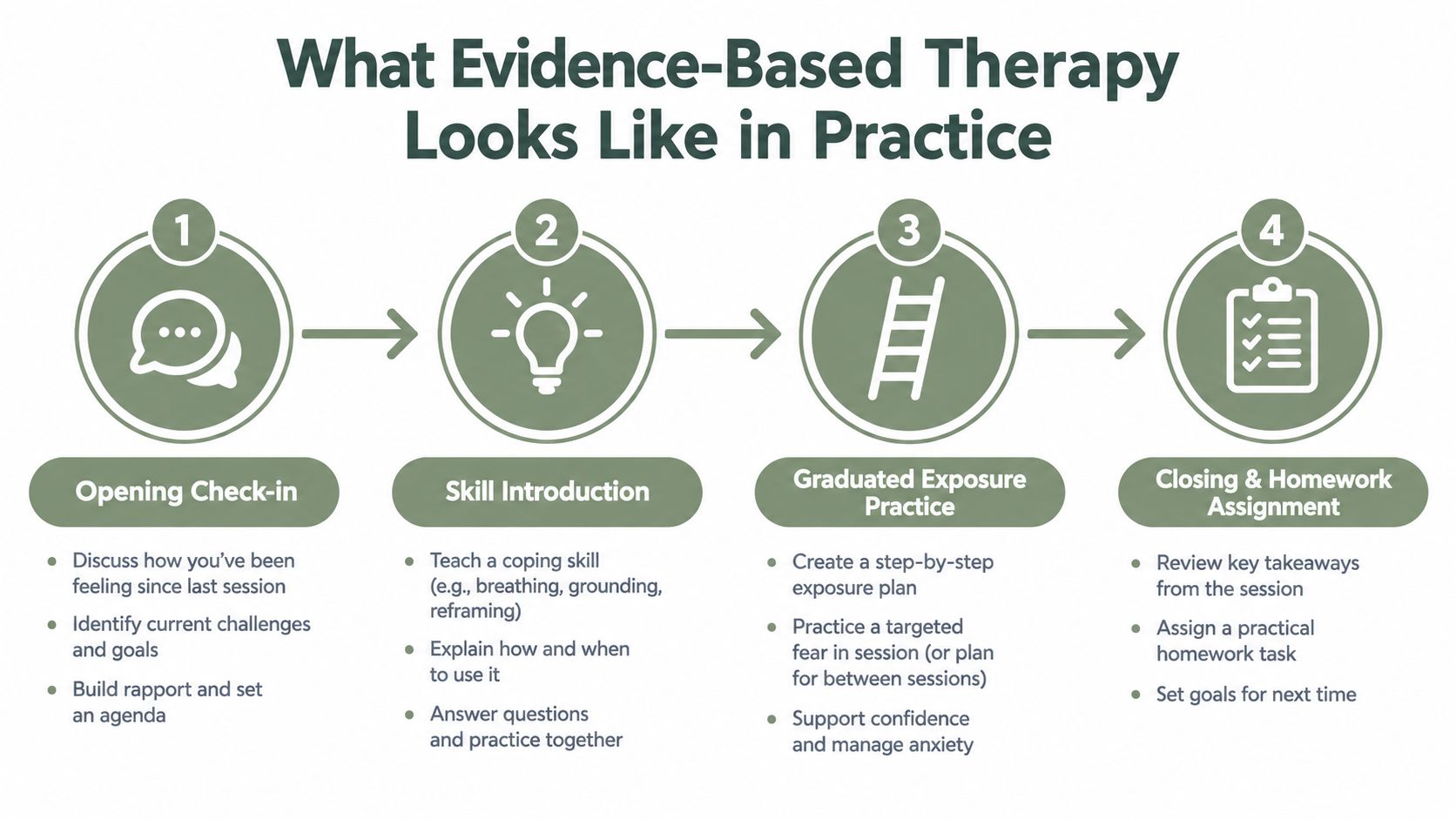
For anxiety, cognitive-behavioral therapy typically combines education, identification of anxious predictions, coping skills, and graduated exposure. The child or adult practices approaching avoided situations instead of waiting to feel completely calm. Parents learn to reduce reassurance and accommodation in a supportive way, because repeated rescuing can unintentionally maintain avoidance.
OCD treatment uses exposure and response prevention, usually called ERP. The clinician and client build a hierarchy of feared triggers, practice exposure, and resist the compulsive response. For a teenager in a high-achieving school environment, that may involve tolerating uncertainty about homework, grades, contamination, mistakes, or social judgment. Parents need guidance on how to respond when rituals or reassurance requests move into the home.
A session may include a brief check-in, review of between-session practice, direct skill teaching, an exposure or behavioral exercise, and a specific assignment. If every meeting ends without a plan for practice, ask why.
ADHD and sleep need coordinated behavior change
ADHD treatment often works best when it connects home, school, and the young person's own skills. Parent training can address instructions, reinforcement, transitions, homework, and morning routines. A clinician may also help a teen use planning tools, break tasks into steps, and communicate with teachers. A psychologist provides therapy and behavioral intervention, while a psychiatrist evaluates and manages medication when medication is clinically appropriate.
Sleep treatment should target the routine that maintains the problem. For bedtime resistance, that may mean predictable cues, consistent caregiver responses, and gradual changes to settling habits. For adolescent insomnia, the plan may address irregular schedules, nighttime stimulation, worry, and the association between bed and wakefulness. Medication or supplements shouldn't become the only strategy without a broader behavioral assessment.
Progress needs a definition
Ask how the clinician measures change. Useful markers might include school attendance, time spent in rituals, frequency of panic, bedtime completion, homework follow-through, mood engagement, or caregiver confidence. The measure should fit the concern and be reviewed openly.
Treatment also needs an endpoint. A clinician should discuss whether the family is moving toward less frequent visits, a maintenance plan, a booster appointment, or a different level of care. That doesn't mean therapy must be rushed. It means the family can see what meaningful improvement looks like and what will happen after the immediate crisis has eased.
Your Next Steps and Local Resources
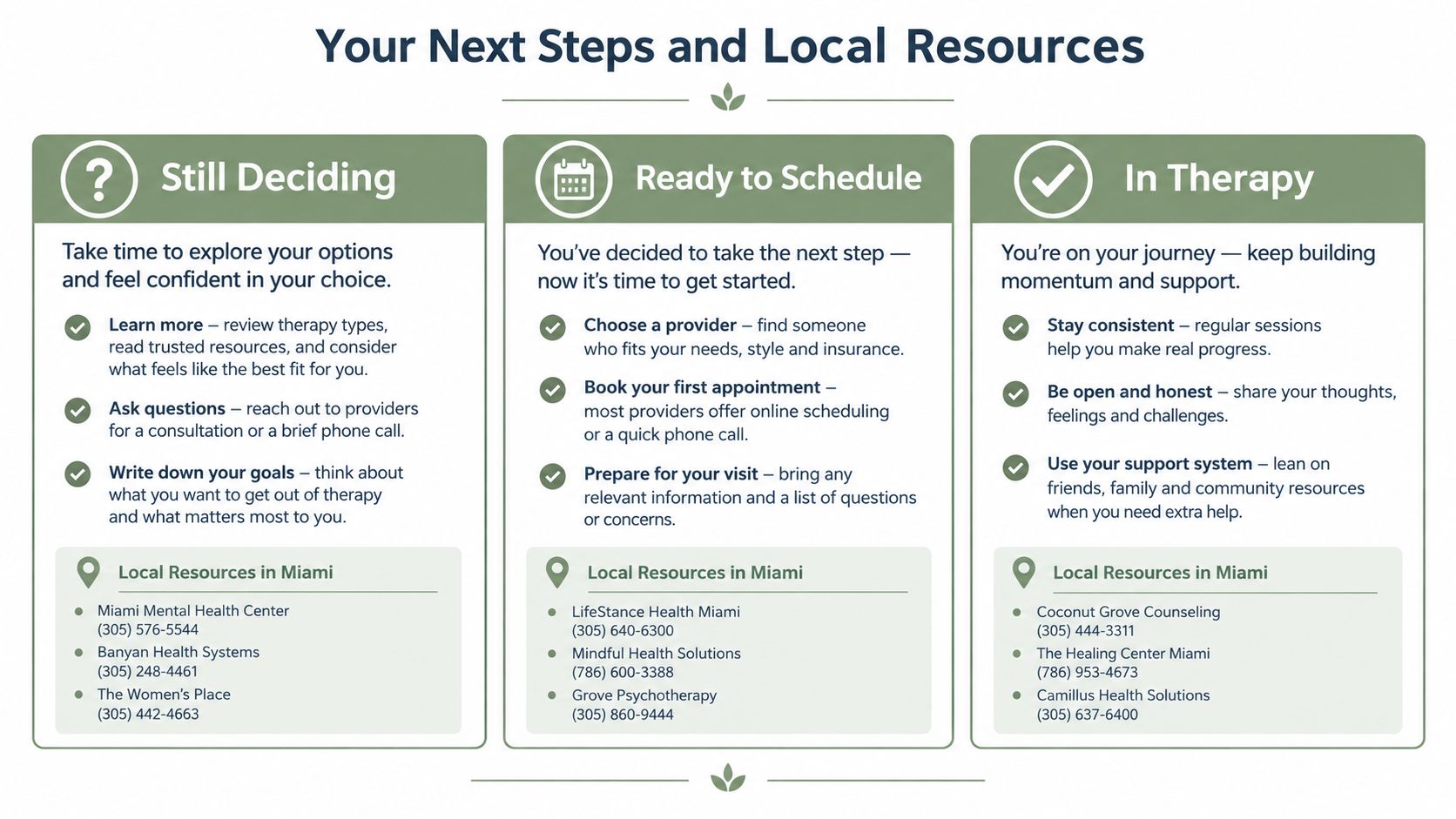
Your next move depends on where you are in the process. If you're still deciding, don't wait for certainty about a diagnosis. Write down the behavior that concerns you, how it affects school, work, sleep, relationships, or safety, and whether the problem is getting worse. Speak with the child's pediatrician, school support team, or a licensed psychologist to determine whether outpatient therapy, testing, psychiatry, or urgent evaluation fits the situation.
If safety is in question, severe symptoms are escalating, or someone may hurt themselves or another person, contact emergency services or a crisis resource immediately. Routine appointment searches aren't appropriate for an acute safety emergency.
Still deciding
Use a short consultation to clarify the level of care. Compare a private practice with university training clinics at the University of Miami or Florida International University when lower-cost services or supervised training settings may be appropriate. The University of Miami also contributes to the regional psychology workforce, awarding 206 bachelor's degrees in general psychology, 16 master's degrees, and 14 doctoral degrees during the 2021-2022 academic year. Its general psychology program was ranked #53 nationally and #6 in Florida by College Factual. (University of Miami psychology program data)
Ready to schedule
Contact several clinicians who match the concern, then ask about licensure, treatment method, parent involvement, insurance, private-pay costs, and openings. Coral Gables families may consider a local pediatric psychology practice such as Wald Behavioral Health, while families outside the immediate area can evaluate PSYPACT-enabled telehealth providers. Verify every clinician's current authorization rather than relying on a website statement.
Already in therapy
Bring the treatment plan back into focus. Ask what target is being measured, what practice should happen between sessions, how caregivers or school staff can support the plan, and when progress will be reviewed. If therapy feels pleasant but the child still refuses school, the teen still spends hours ritualizing, or the household remains trapped in bedtime conflict, request a more structured intervention or a referral for a different level of expertise.
For location and service-area details when comparing Miami options, review Wald Behavioral Health's areas served. The University of Miami and Florida International University may also be relevant for families exploring training-clinic care, while PSYPACT-enabled clinicians can help students and young adults maintain continuity when they're temporarily outside Florida.
---
Wald Behavioral Health provides evidence-based psychology services for children, adolescents, young adults, and families, with in-person appointments in Coral Gables and secure telehealth for eligible clients across Florida, Maryland, and PSYPACT states. If you want help matching the concern, treatment approach, parent involvement, and scheduling needs, use the free consultation option and visit Wald Behavioral Health to take the next step.
Questions about your child or teen?
Dr. Wald offers a free 15 minute consultation to talk through what you are seeing and whether the practice is a good fit.
Free 15 Minute Consultation