How to Find the Right Online Child Psychologist

Your 8-year-old is melting down over homework again. You've tried reminders, rewards, taking away screens, and staying close by, yet another week has passed with the same exhausted arguments. Now you're looking at an online child psychologist and wondering whether a video call can help a child who can barely stay regulated at the kitchen table.
Sometimes virtual therapy is an excellent fit. Sometimes it adds friction to an already difficult situation, and in-person therapy, parent training, or a hybrid plan is the smarter choice. The important question isn't whether online care is convenient. It's whether the format matches your child's age, symptoms, home environment, safety needs, and your willingness to participate.
Online pediatric care became a significant access channel during the pandemic. The CDC's data on telemedicine use among children shows that 17.5% of U.S. children aged 0 to 17 used telemedicine in 2020, rising to 18.3% in 2021 before declining to 14.2% in 2023. That pattern matters. Virtual care is no longer just an emergency substitute, but it also isn't automatically the right answer for every child.
## Table of Contents - What an Online Child Psychologist Does - The work happens in several formats - Whether Your Child Is a Good Fit for Virtual Therapy - Use this preliminary fit screen - Evaluate the home environment with candor - How to Find and Vet the Right Clinician - Use the consultation call as an interview - Notice the red flags - Understanding Licensure and Cross-State Legal Requirements - PSYPACT changes the search - Setting Up Your Home for Successful Online Sessions - Prepare the child, not just the device - Keep a refusal plan ready - What to Expect From the First Months of Online Therapy - Progress should be visible in daily life - Adjust the treatment plan when progress stalls - Making the Decision and Taking the First Step
What an Online Child Psychologist Does
An online child psychologist provides assessment and treatment through secure video, not just a therapy appointment on a screen. The clinician examines development, symptoms, relationships, school functioning, and home routines, then selects methods that fit the child and the format. Care may include individual therapy, parent coaching, family meetings, behavior planning, or consultation with a school.
A doctoral-level child psychologist can assess whether anxiety, attention problems, mood symptoms, learning differences, trauma, family conflict, or another concern is driving the behavior. That training distinguishes a psychologist from a coach or general support provider. A school counselor may offer valuable school-based assistance within the school's role and resources. A coach may support habits or goals, but does not replace psychological assessment, diagnosis, or clinical treatment.
The work happens in several formats
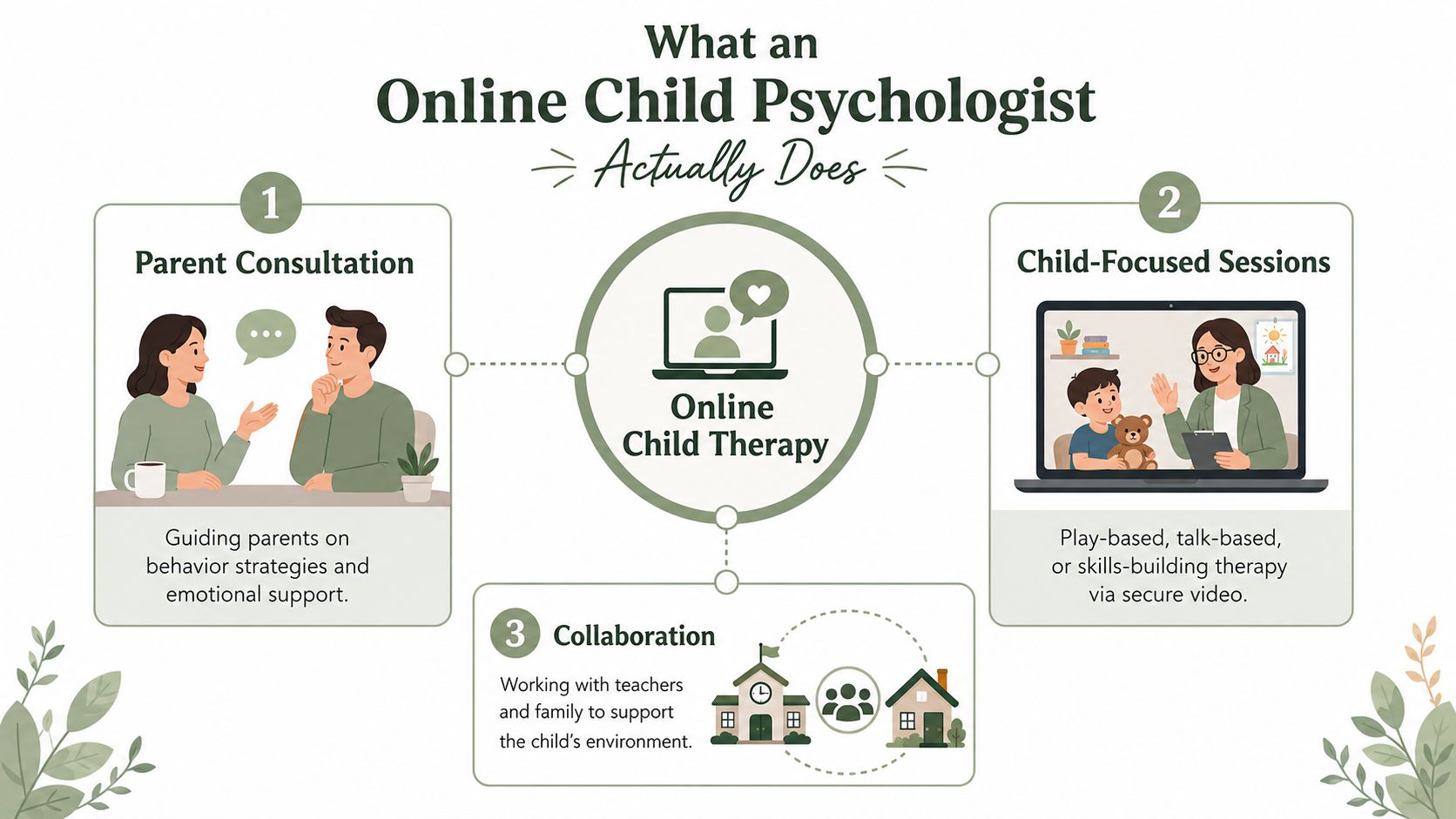
Child-focused sessions may use conversation, drawing, games, emotional education, exposure exercises, or skills practice. Play-informed therapy can work through video, but younger children usually need more caregiver involvement and shorter activities than teenagers. If a child cannot remain engaged on screen, the clinician should change the plan rather than force a child-only format.
Parent consultation often carries the treatment for sleep problems, tantrums, noncompliance, separation anxiety, school refusal, and ADHD-related routines. The psychologist helps caregivers change the environment and their responses. Children's behavior improves more reliably when adults follow one consistent plan between appointments.
Family sessions and collaboration can address conflict, communication, and routines across home and school. With appropriate consent, a clinician may coordinate with a pediatrician, teacher, or school support team. Families should also clarify the provider's emergency procedures, the location where the child is receiving care, and what happens if the child becomes unsafe during a session.
Families considering virtual care can review practical guidance about a telehealth psychologist, but a polished webpage is not enough for choosing a provider. Ask how the clinician adapts therapy to your child's developmental level, how caregivers participate, whether in-person or hybrid care would be more appropriate, and how the clinician handles licensure across state lines.
Before scheduling, answer six questions: Is virtual care appropriate? What type of clinician does my child need? Can this provider legally treat us? What home setup is required? How will progress be measured? What is the backup plan if video care stops working?
Whether Your Child Is a Good Fit for Virtual Therapy
A teenager joins a video session from a quiet bedroom, answers questions directly, and practices coping skills between appointments. A preschooler leaves the screen every few minutes while siblings interrupt and a caregiver struggles to manage the room. Both families may need therapy, but they do not need the same format.
Age helps predict fit. Older children and teenagers usually understand why they are meeting with a psychologist, tolerate video conversation more easily, and practice coping tools with less supervision. School-age children can also benefit when a caregiver prepares the room, remains available, and follows through between sessions.
Younger children often need movement, toys, visual materials, and active parent coaching. Children under school age may have difficulty sustaining attention through a screen. Parent-led treatment or a hybrid arrangement usually serves them better than child-only video appointments.
The presenting concern matters just as much. Research comparing telehealth and in-person CBT for youth anxiety found telehealth non-inferior across self-reported anxiety, caregiver-reported anxiety, functional impairment, and treatment response in that study, while both formats reduced symptoms. Caregivers reported slightly higher post-treatment anxiety in telehealth cases. That finding supports close family monitoring. The comparative CBT study supports structured remote treatment with a clinical plan, not casual video conversations.
Use this preliminary fit screen
| Factor | Good Fit | Sometimes Appropriate | Generally Not Recommended | |---|---|---|---| | Age and development | Teens who can participate independently, and school-age children with caregiver support | Younger children who need short activities and active parent involvement | A child who cannot engage with a screen even briefly | | Anxiety and OCD | Structured CBT, coping skills, and exposure work with caregiver follow-through | Severe avoidance that may require coordinated in-person support | Acute crisis or safety concerns | | Depression | Teen therapy with privacy, monitoring, and a clear safety plan | Younger children who need substantial parent involvement | Active suicidality without immediate in-person or emergency support | | ADHD and behavior | Parent training, routines, problem-solving, and school coordination | Child sessions when attention can be supported at home | Situations where the home environment is too chaotic for observation or coaching | | Family conflict | Parent-child sessions when everyone can participate safely | Hybrid treatment when conflict escalates on camera | Unsafe or coercive situations requiring protected in-person assessment | | Eating and trauma concerns | Stabilization support as part of coordinated care | Hybrid care with medical or specialty involvement | Severe eating disorders or intensive trauma processing without local support |
Evaluate the home environment with candor
Virtual therapy needs a private space, a reliable adult nearby, and a predictable session routine. It becomes difficult when siblings interrupt, a caregiver listens off-camera while contradicting the plan, or the child has no safe place to speak openly. The clinician must also know where the child is physically located during each appointment, since that affects emergency planning and the provider's authority to practice.
Clinical rule: If the clinician can't reliably assess safety, privacy, and behavior in the current format, change the format before you change the child.
A hybrid plan can combine virtual child sessions, in-person assessment, and parent training at home. For tantrums, sleep problems, school refusal, or noncompliance, parent training may carry more of the treatment than asking a young child to manage an entire appointment through a screen. ADHD-related routines may also improve when caregivers receive direct coaching and coordinate expectations with school.
Choose the format that gives the clinician enough access to the child, caregivers, environment, and safety information. Schedule convenience matters, but clinical fit should determine whether care is virtual, in person, parent-led, or hybrid.
How to Find and Vet the Right Clinician
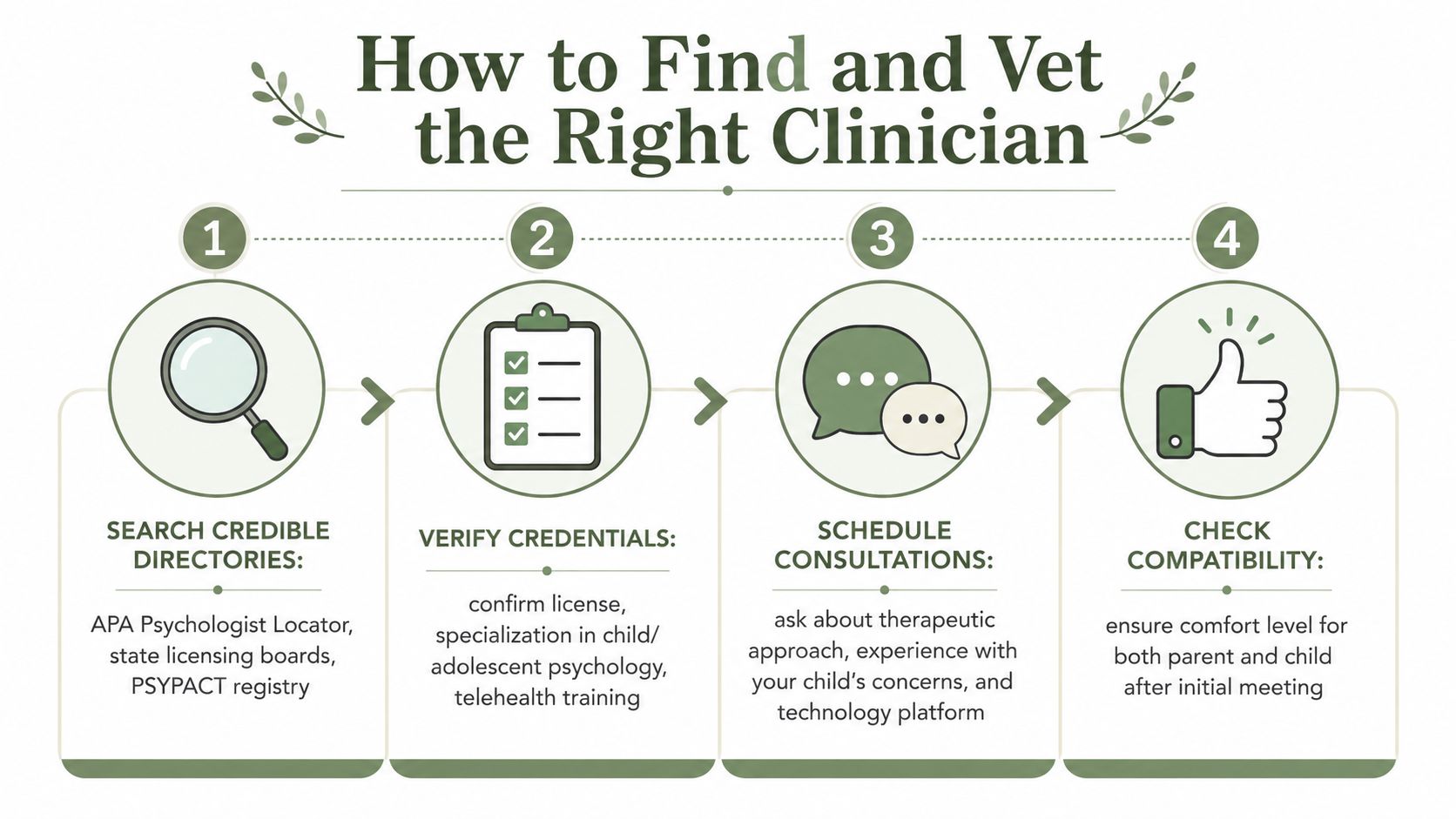
Start with credentials, clinical fit, and legal authority, not the first open appointment. Search the APA Psychologist Locator, your state licensing board, the PSYPACT provider registry, and established telehealth practices. A directory profile identifies a possible clinician, but it does not establish competence.
Verify the license independently through the state board. Check the professional type, active status, jurisdiction, disciplinary information when publicly available, and authorization to provide telehealth. Then look for experience with your child's actual concern and developmental stage. “Works with all ages” tells you very little.
Use the consultation call as an interview
A brief consultation should show whether a full intake is worth scheduling. Ask direct questions:
- Relevant experience: “How do you treat this concern in children my child's age?”
- Treatment method: “Which evidence-based approaches would you consider, and why?”
- Parent role: “How often will I participate, and what will you expect me to do between sessions?”
- Assessment: “How will you distinguish anxiety, ADHD, learning problems, mood concerns, or family stress?”
- Progress tracking: “How will we know treatment is working?”
- Coordination: “With consent, will you communicate with the pediatrician or school?”
- Safety: “What happens if my child discloses self-harm, abuse, or an immediate safety concern?”
- Logistics: “How long are sessions, what is the cancellation policy, and what happens if we travel or move?”
Strong clinicians answer specifically. They should explain how assessment will work, what information they need, and how parents will participate. A consultation is not the place for a rushed diagnosis.
Notice the red flags
Avoid a provider who cannot show an active license, will not explain the treatment plan, promises a guaranteed outcome, or pressures you to sign a long contract before assessment. Be cautious when a clinician dismisses parent involvement, avoids questions about emergency procedures, or refuses reasonable coordination with a pediatrician or school.
The process should feel collaborative from the first call. You should know who attends sessions, what information the clinician needs from caregivers, how progress will be reviewed, and what changes if the initial approach fails. If the clinician cannot answer those questions plainly, keep looking.
Understanding Licensure and Cross-State Legal Requirements
A child's physical location during the appointment determines which licensing rules apply. Telehealth crosses state boundaries, so the psychologist's office address and the family's billing address do not establish legal coverage. Confirm the child's location for every session, especially during travel, school-year moves, shared custody, or a college relocation.
A psychologist licensed in State A generally cannot provide ongoing therapy to a child physically located in State B unless the psychologist satisfies State B's requirements. Treatment that was lawful at home may require a different arrangement during a family trip. Ask about travel before the appointment, not after the family arrives.
PSYPACT changes the search
PSYPACT may let an authorized psychologist practice across participating member states without obtaining a separate license in each state. That permission has limits. Parents must verify the psychologist's current PSYPACT authorization and confirm that the state where the child is located participates.
Temporary-practice rules vary, and pandemic-era emergency waivers may no longer apply. Ask where the clinician is licensed, whether they hold PSYPACT authorization, which states they can serve, and what happens if your child is temporarily elsewhere. A practice's areas served page can show its stated geographic coverage, but verify the arrangement with the relevant licensing authority.
| State Status | Can an Out-of-State PSYPACT Psychologist Treat Your Child? | What Parents Should Do | |---|---|---| | Participating state | Possibly, if the psychologist has current PSYPACT authorization and meets applicable requirements | Confirm the provider's authorization and your child's physical location | | Non-member state | Not automatically through PSYPACT | Ask about a state license, temporary-practice rule, or another lawful pathway | | Travel or relocation | It depends on the destination and the circumstances | Contact the clinician before the appointment, not after arrival | | Emergency situation | Telehealth may be part of a broader response, but it isn't a substitute for immediate local help | Know local emergency services and the clinician's safety protocol |
Licensure is only one part of the legal and safety check. If a child discloses abuse or imminent harm, the psychologist may have reporting and protective duties. The response depends on the child's location and the nature of the disclosure.
Before treatment begins, provide the child's current address, an emergency contact, and a clear escalation plan. For families who travel or share custody across states, a hybrid plan or locally available in-person support may be safer than assuming virtual care can continue everywhere.
Setting Up Your Home for Successful Online Sessions
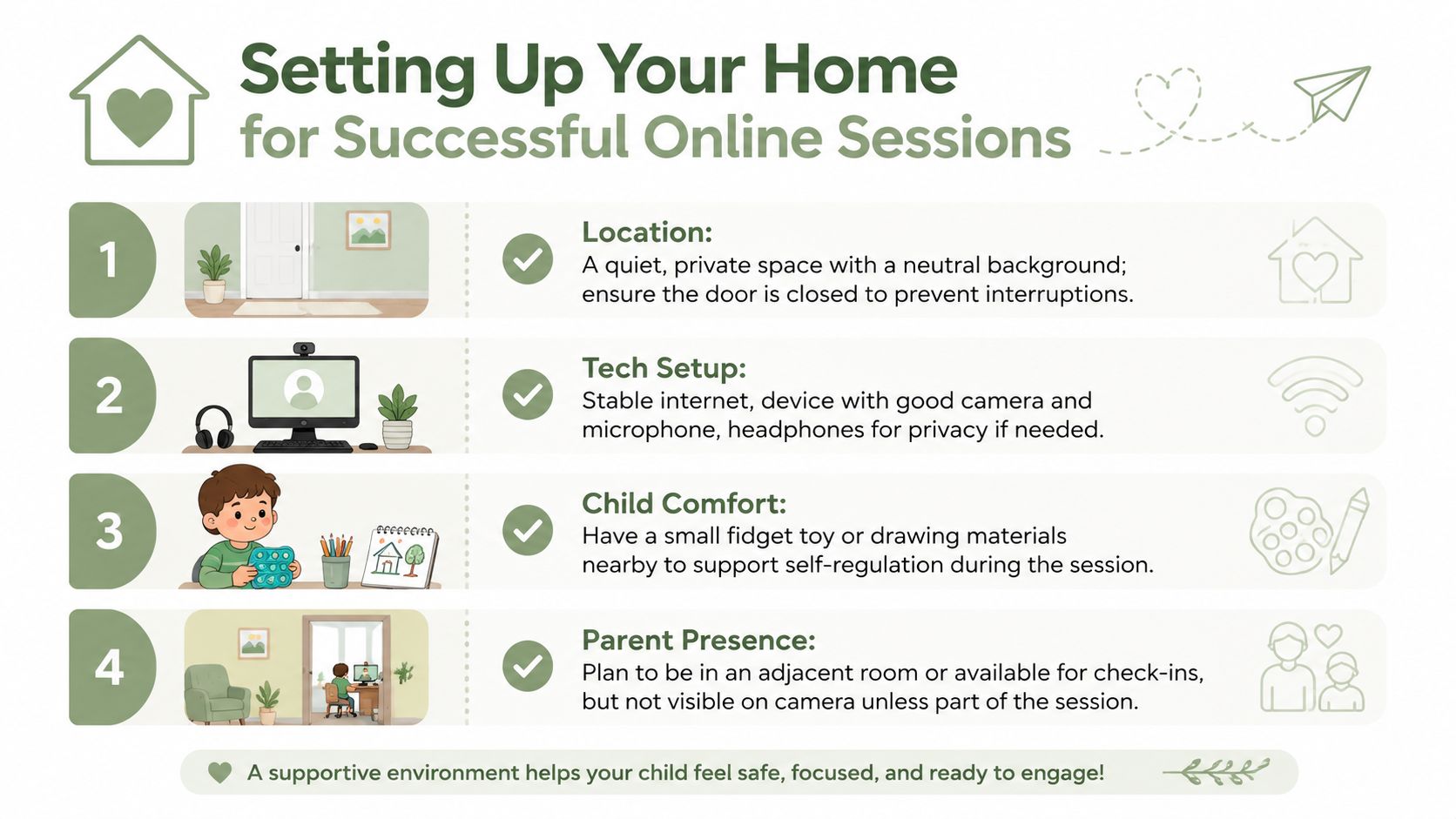
A child therapy space should feel private, calm, and predictable. Choose a quiet room with the door closed, a neutral background, and no siblings or pets crossing the camera view. Place the camera at eye level so the clinician can observe facial expressions and body language without looking up at a device on the floor.
A laptop generally gives children a better setup than a tablet, while a tablet is usually easier than a phone for younger users. Test the microphone, secure the device on a stable surface, and use headphones when privacy matters. Keep the clinician's phone number visible. If the video freezes or audio fails, reconnect once, then use the agreed backup plan instead of letting technology consume the appointment.
Prepare the child, not just the device
Younger children may lose focus during longer appointments, so discuss a realistic session length with the clinician rather than assuming a standard format will fit. Leave a small buffer before and after the session, offer water, and keep a comfort object, drawing materials, or an appropriate fidget nearby.
Parents should usually remain close for younger children, either in the same room or nearby, without hovering on camera. Help with access, safety, and follow-through. Let the child answer for themselves, and avoid correcting every movement unless safety requires it.
Use the same transition ritual each time. A snack, movement break, paper and crayons, and then the therapy space can help the child recognize what comes next. Families seeking practical rollout strategies from Coachful can adapt video routines that make the appointment feel familiar rather than technical.
Privacy also depends on the room and the platform. Close unrelated applications, use a private network when possible, and ask how the clinician protects session information.
Keep a refusal plan ready
Refusal is information, not a reason to force eye contact or threaten consequences. Tell the clinician what happened, allow a short reset, and let the provider shift toward parent coaching or observation. Note whether refusal appears at the same point each time, since that pattern may identify a poor fit, an overwhelming activity, or a need for hybrid or in-person care.
Review the practice's telehealth services, then confirm which platform, privacy safeguards, and backup communication method the clinician uses. Ask what happens if the child cannot participate from home that day.
What to Expect From the First Months of Online Therapy
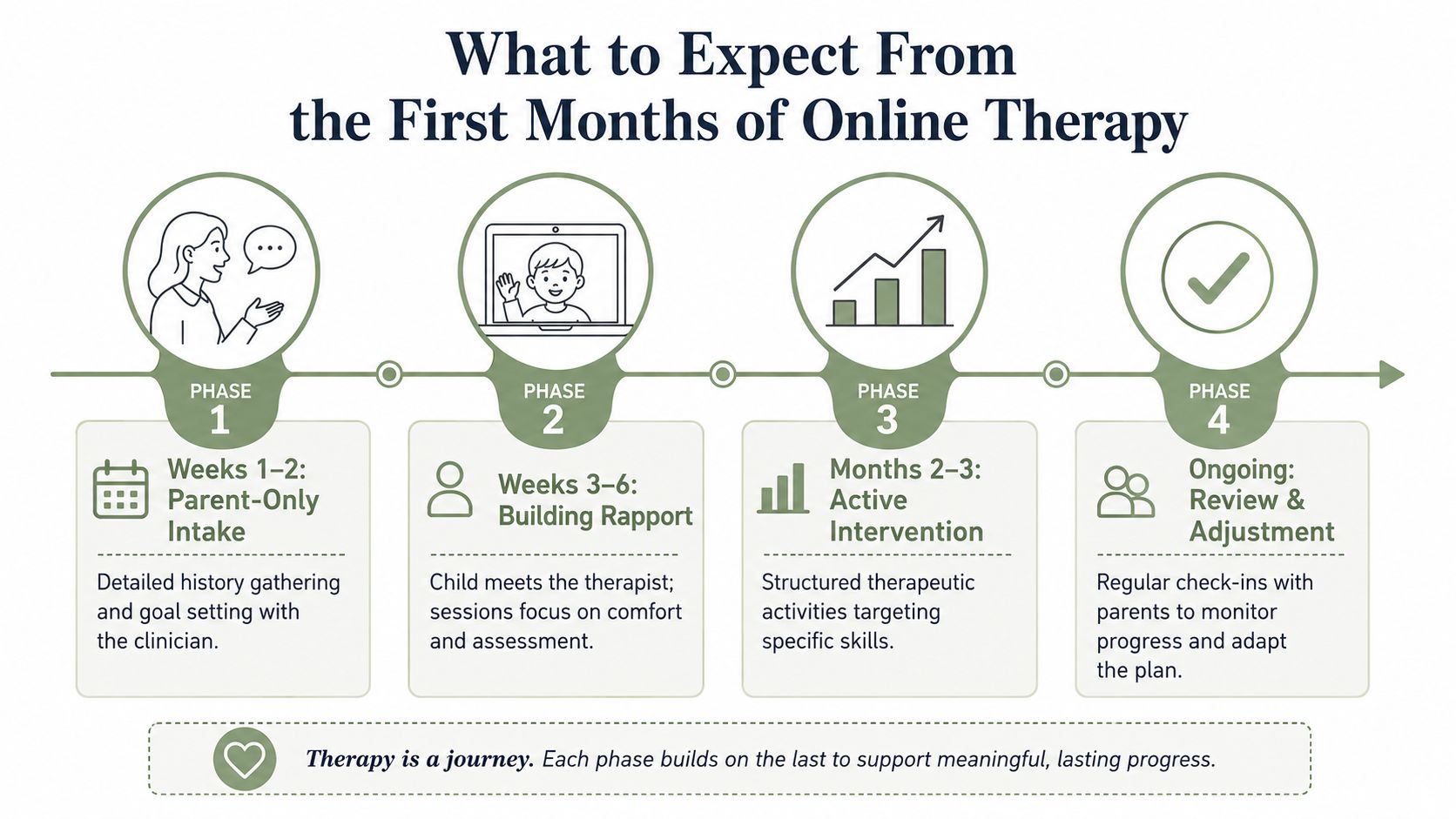
Therapy should begin with careful information gathering, not instant advice. The clinician may schedule a parent-only intake to review development, medical history, school functioning, family patterns, previous treatment, and situations that trigger the current problem. The child then needs time to decide whether the therapist feels safe, understandable, and worth engaging with.
Early sessions often focus on rapport, observation, and narrowing the treatment target. A useful plan states what the child and caregivers will practice, how progress will be tracked, and when the clinician will review the approach. Ask for concrete home practice, not general encouragement.
Progress should be visible in daily life
For a younger child, early improvement may look like fewer bedtime battles, quicker recovery after frustration, easier transitions, or better emotional labeling. Academic performance can take longer because school functioning also depends on learning demands, classroom support, sleep, and the wider environment.
Teens may show less avoidance, fewer physical complaints, clearer communication, or more willingness to resume activities before grades improve. Track the behavior that led you to seek therapy. A pleasant session is not the same as meaningful progress.
The review of digital child and adolescent mental health programs reported mean retention of 79.2%, compared with face-to-face youth outpatient dropout reports ranging from 20% to 60%. It also emphasizes caregiver involvement, clear follow-through, and coordination with schools and local providers. Remaining in treatment helps only when the family knows what to practice and the adults around the child follow compatible plans.
Adjust the treatment plan when progress stalls
During active therapy, ask for a treatment review when symptoms worsen, the plan cannot be implemented, or progress remains limited. Bring specific observations and ask what the clinician expected to change. The next adjustment might involve changing the treatment target, modifying an intervention, adding parent coaching or another modality, or coordinating with school and medical providers.
A medication consultation, more intensive support, or in-person or hybrid care may also belong in that discussion when clinically appropriate. The point is to revise the plan based on the child's response, not to wait passively for the provider to label therapy a failure.
Keep a short record between appointments: what happened, what helped, what the child avoided, and which skills were practiced. Those details give the clinician better information than a general report that the week was “fine.”
Making the Decision and Taking the First Step
A child who enjoys a video session may still need a different treatment format. Decide based on safety, clinical fit, and what your family can carry out at home.
Use this filter before booking:
- Clarify the problem: List the two or three behaviors or symptoms creating the greatest disruption.
- Check risk: Self-harm disclosure, suicidal thinking, abuse concerns, severe restriction, or immediate danger require urgent local support, not a routine online appointment.
- Match the format: Choose child therapy, parent training, family work, in-person assessment, or a hybrid plan according to the child's needs.
- Verify jurisdiction: Confirm the clinician's state license, PSYPACT status when relevant, and authority to treat your child in the state where the child is physically located.
- Confirm participation: Be realistic about attending parent meetings, changing routines, communicating with school staff, and practicing skills between sessions.
- Review logistics: Ask about availability, insurance, fees, cancellation rules, privacy, emergency procedures, and the technology platform.
Book a 15-minute consultation call this week rather than spending another month comparing profile pages. Bring three specific concerns and one recent observation, such as, “Homework starts calmly, but after ten minutes my child tears up the page and refuses to continue.”
Shortlist three clinicians with appropriate licensure or PSYPACT authorization. Contact them on Monday and schedule consultations by Friday. Plan to assess fit after four to six sessions, allowing time for evaluation, rapport, and early treatment rather than judging care from one awkward video call.
Choose the clinician who asks precise questions, explains your role, addresses safety directly, and connects treatment with changes at home. If virtual care is a poor fit, a responsible psychologist should recommend in-person, parent-focused, or hybrid support instead of selling convenience as treatment.
Wald Behavioral Health provides evidence-based therapy, parent training, family guidance, and secure telehealth for children, adolescents, and families in Florida, Maryland, and PSYPACT-participating states. Families comparing virtual, in-person, and hybrid care can visit Wald Behavioral Health to request a free 15-minute consultation about fit, safety, and scheduling.
Questions about your child or teen?
Dr. Wald offers a free 15 minute consultation to talk through what you are seeing and whether the practice is a good fit.
Free 15 Minute Consultation