How to Choose a Therapist for Your Child: A Parent Guide

You're at the kitchen table late at night, laptop open, comparing three therapists who all seem qualified. One has a long waitlist, another doesn't clearly explain insurance, and the third works by video. Meanwhile, you're wondering whether your child will talk to a stranger, whether therapy will help, and whether your family can keep up with the cost and appointments.
You don't need to find the perfect therapist in one search. You need a structured way to narrow the choices. Start with four filters: the clinician's credentials and age fit, the treatment approach, the format of care, and the relationship among the therapist, child, and parents. A therapist who checks only one of those boxes may still be a poor practical match.
The trade-offs are normal. A highly specialized clinician may have a longer wait, while a readily available generalist may be able to help your family start sooner. The right decision balances clinical quality with realistic access and follow-through. Use the checkpoints below to decide what matters most for your child, what questions to ask, and what should make you keep looking.
## Table of Contents - Starting the Search for a Child Therapist - Use four filters in order - Treat access as part of quality - Why the Choice Matters More Than Parents Realize - Think of the search as a funnel - Checking Credentials, Age Fit, and Specialization - Match training to development - Use the consultation to test specificity - Credentials and age-fit quick reference - Matching the Therapy Approach to the Concern - Compare the main options - Comparing Telehealth and In-Person Therapy for Kids - Let the concern guide the format - Evaluating Fit, Parent Involvement, and Cultural Alignment - Judge the first sessions by observable signs - Logistics, Red Flags, and Your Next Steps - Know what should make you pause - Use this same-week plan
Starting the Search for a Child Therapist
Begin with your child's age, main concern, and level of urgency. Don't search for “the best child therapist” as if every clinician treats every problem. Search for a licensed professional who works with your child's developmental stage and has direct experience with the issue you're seeing, whether that's separation anxiety, school refusal, sleep difficulty, ADHD-related behavior, depression, OCD, family conflict, or something else.
Write a one-sentence description before you contact anyone. For example: “My six-year-old cries and refuses school after separation,” or “My sixteen-year-old has withdrawn from friends and stopped enjoying activities.” This helps a therapist tell you quickly whether their training and treatment model match the situation.
Start with the problem, not the directory. A clear presenting concern eliminates more noise than a long list of impressive credentials.
Use four filters in order
First, check clinical fit. Confirm the clinician's license, the ages they treat, and whether they regularly work with the concern you're bringing. A therapist who mainly treats adults may not know how to assess play, family routines, school behavior, or developmental differences in a younger child.
Second, ask about treatment fit. The clinician should be able to name the approach they use for your child's concern and explain what sessions might involve. “I use different methods” isn't enough. Ask what they would recommend first and why.
Third, test format fit. In-person care may be easier for a young child who needs play materials or support with behavior. Telehealth may be more practical for a teenager who needs privacy, an after-school appointment, or access to a specialist outside the local area. A treatment plan that your family can't attend consistently isn't a workable plan.
Fourth, assess relational fit. Your child doesn't need to adore the therapist immediately, but they should gradually feel respected and safe. You should also feel that the clinician listens to your observations and can explain the plan without talking down to you.
Treat access as part of quality
Ask about the earliest available appointment, cancellation openings, insurance, out-of-pocket fees, and the expected frequency of sessions. If the therapist has a long waitlist, ask whether they triage urgent concerns, offer a consultation while you wait, or can recommend another qualified clinician.
You don't have to solve every question before making the first call. Narrow the field by age and presenting concern, then use a brief consultation to investigate the remaining filters. The final decision should reflect both who can help your child and whether your family can begin and sustain care.
Why the Choice Matters More Than Parents Realize
Child therapy isn't a generic service. The clinician needs to match the child's developmental level, symptoms, family environment, and practical circumstances. The American Academy of Pediatrics reports that nearly 20% of children ages 3, 17 have a mental, emotional, or behavioral disorder, while 20% of adolescents ages 12, 17 report unmet mental health care needs. The same source notes that only about 20% of children with these disorders receive care from a specialized mental health provider. You can review the context in the American Academy of Pediatrics mental health initiative.
Those figures don't mean every child needs intensive treatment. They do show why parents often need to make a careful choice in a crowded and uneven system. A therapist may be warm and well reviewed yet lack experience with your child's age, diagnosis, or level of need. Another may be clinically appropriate but unavailable at a time your family can manage.
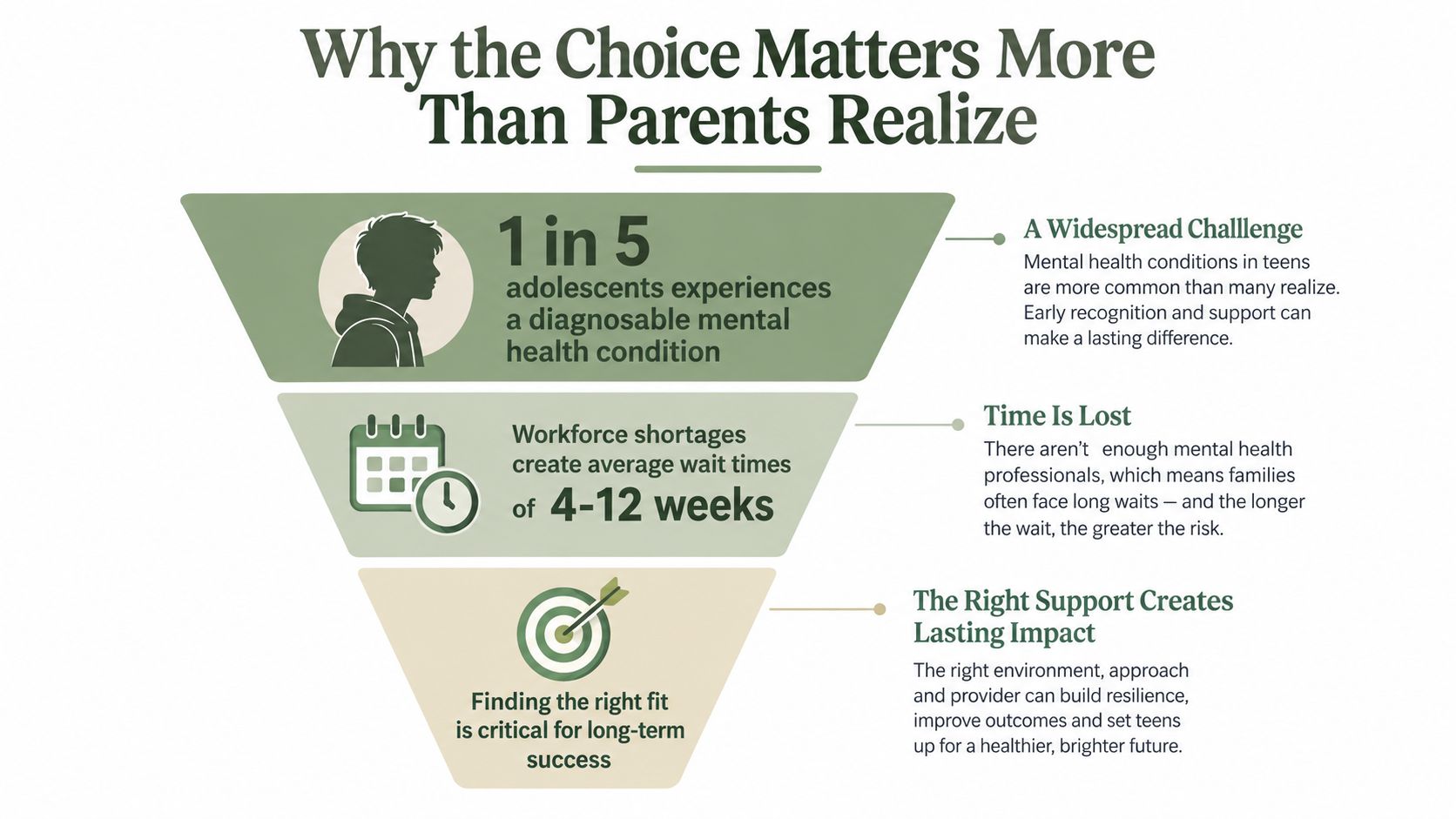
Think of the search as a funnel
Use the filters in sequence rather than judging every therapist on every factor at once.
- Clinical fit: Is the person licensed, trained to work with children, and experienced with the presenting concern?
- Treatment fit: Does the therapist use an approach suited to the problem, rather than applying one favorite method to every child?
- Format fit: Can your child engage through in-person care, telehealth, or a combination of both?
- Relational fit: Does the clinician communicate well with your child and treat caregivers as useful partners?
This funnel protects you from two common mistakes. The first is choosing a therapist only because they have immediate availability. The second is waiting indefinitely for a highly specialized clinician without asking whether another qualified professional can provide appropriate support sooner.
Access problems can affect whether treatment ever starts. The HRSA Pediatric Mental Health Care Access program reported that in FY24, 54 programs expanded pediatric behavioral health access, with more than 9,400 pediatric providers participating across 49 states, tribes, and territories and approximately 15,000 pediatric providers receiving training. Those programs served about 30,000 children and adolescents through contacted providers, according to the HRSA Pediatric Mental Health Care Access fact sheet.
The practical lesson is simple: ask whether the therapist can coordinate with parents, pediatricians, schools, or other providers when appropriate. Child mental health care often works best as a network, not as an isolated weekly conversation.
A strong match is not the person with the most impressive biography. It's the clinician whose training, method, availability, and communication style fit your child and your family.
Checking Credentials, Age Fit, and Specialization
The first serious question is not “Does this therapist seem nice?” It's “Are they qualified to treat this child with this concern?” Verify the clinician's license through the relevant state licensing board. Common professionals include licensed psychologists, licensed clinical social workers, licensed marriage and family therapists, and licensed professional counselors. A board-certified child and adolescent psychiatrist may evaluate medication needs and provide psychiatric treatment.
“Therapist” is a broad description, not always a regulated professional title. Ask what license the person holds, what degree they earned, and whether they completed supervised clinical training with children. Years of experience treating adults don't automatically transfer to a six-year-old, a teenager with school refusal, or a child whose treatment requires extensive caregiver participation.
Match training to development
Age fit changes the work. A young child may communicate through play, behavior, drawing, or parent-child interaction rather than a sustained verbal account of feelings. An adolescent may need privacy, collaborative goals, and a clinician who can discuss mood, identity, peer relationships, risk, and family boundaries without turning every session into a lecture.
For a six-year-old with separation anxiety, look for experience with parent-child approaches, gradual exposure, caregiver coaching, and routines that can be practiced outside the office. For a sixteen-year-old with depression, look for adolescent experience, cognitive behavioral therapy, collaborative goal-setting, mood monitoring, and clear procedures for handling safety concerns.
A generalist may be a sensible choice for mild or unclear concerns. A specialist is more important when symptoms are persistent, impairing, or diagnosis-specific. Ask directly about experience with anxiety, OCD, trauma, eating disorders, depression, ADHD, disruptive behavior, sleep, or school refusal, depending on what your child is experiencing.
Use the consultation to test specificity
Vague answers are a warning sign. If you ask, “How would you work with my child's school refusal?” and hear only “We'll build trust,” you still don't know what treatment will involve. A useful answer should identify the likely assessment process, the role of caregivers, the type of skills or behavioral changes targeted, and how progress will be reviewed.
Be cautious when a clinician has no clear process for child assessment, cannot explain their supervised experience with children, or has a waitlist extending for months without any urgency triage. Availability matters, but an immediate opening isn't a reason to overlook a poor clinical match.
A concise reference can help you understand the distinction between developmental specialization and a general therapy label. See this guide to what a pediatric psychologist does.
Credentials and age-fit quick reference
| Clinician Type | Typical Training | Best Age Range | What They Handle | |---|---|---|---| | Licensed psychologist | Doctoral clinical training, supervised practice, and state licensure | Children, adolescents, or adults depending on specialization | Assessment and evidence-based therapy, with some psychologists specializing in child development | | Licensed clinical social worker | Graduate social work training, supervised clinical hours, and state licensure | Children, adolescents, and families depending on experience | Individual therapy, family work, behavioral support, and care coordination | | Licensed marriage and family therapist | Graduate training focused on relationships and family systems, followed by supervised practice | Children and families when trained in child treatment | Family conflict, parent-child relationships, adjustment, and individual therapy | | Licensed professional counselor | Graduate counseling training, supervised clinical experience, and state licensure | Varies by clinician and specialty | Counseling and psychotherapy for emotional, behavioral, and developmental concerns | | Child and adolescent psychiatrist | Medical training, psychiatry residency, and specialty training in child and adolescent psychiatry | Children and adolescents | Psychiatric evaluation, medication management, and treatment planning, with therapy depending on the clinician |
Matching the Therapy Approach to the Concern
The treatment model should follow the problem. Don't choose a therapist because they advertise one method and then hope that method fits your child. Ask, “What approach do you use for this specific concern, and what will my child and I do between sessions?”
Cognitive behavioral therapy, or CBT, is often structured around the connection among thoughts, feelings, and behavior. It can suit children and adolescents who can discuss internal experiences and practice skills between sessions. For an anxious nine-year-old, CBT may include emotional education, coping strategies, gradual approach toward avoided situations, and family support.
Exposure-based treatment is more targeted. Exposure and response prevention is commonly used for OCD, while exposure strategies can also address anxiety and avoidance. The therapist should explain the process carefully, involve caregivers appropriately, and make sure exercises are gradual and clinically planned. A therapist shouldn't just tell a frightened child to “face the fear” without a thoughtful hierarchy and support plan.
Compare the main options
Parent training makes caregivers the primary agents of change. Approaches such as PCIT, parent management training, and Triple P can be especially useful for tantrums, noncompliance, sleep difficulties, oppositional behavior, and routines. For an oppositional five-year-old, parent coaching may be more useful at the start than child-only talking sessions.
Play-based therapy gives younger children a developmentally suitable way to communicate and practice emotional skills. It can be helpful when a child can't yet describe worries clearly, or when relational safety needs to come before direct skills work. A selectively mute four-year-old may need play-based and gradual communication support rather than pressure to answer questions.
Attachment-informed and family approaches can help when conflict, transitions, caregiving relationships, or chronic stress are central. These methods may take more time to show visible change because they work through patterns between people, not only through individual coping skills.
| Modality | Best Fit For | Typical Age Range | Parent Role | |---|---|---|---| | CBT | Anxiety, depression, school stress, coping difficulties, and some behavior concerns | School-age children through adolescence | Reinforce skills, support practice, and share observations | | Exposure-based work | OCD, anxiety, avoidance, and fear-driven routines | School-age children through adolescence, with developmental adaptations | Support planned exposures and avoid reinforcing compulsions or avoidance | | PCIT and parent training | Tantrums, noncompliance, sleep routines, and disruptive behavior | Young children through early school age, depending on program | Central participant who practices strategies during and between sessions | | Play-based therapy | Emotional expression, adjustment, anxiety, and communication in younger children | Early childhood through early school years | Provide history, practice skills, and support the child's routines | | Family-based therapy | Conflict, transitions, relational stress, and concerns affecting the whole household | Children and adolescents | Participate actively, communicate openly, and work on interaction patterns |
Structured skills work can be efficient, but it usually requires homework and repeated practice. Relational and play-based work can reach children who aren't ready to verbalize their experience, but parents may need patience while the therapist builds communication and safety.
A clinician who uses exactly the same approach for every child deserves careful questioning. Ask what would make them change the plan, how they define progress, and what role you'll play outside the office.
Comparing Telehealth and In-Person Therapy for Kids
The right format is the one that allows your child to engage and your family to attend consistently. Telehealth isn't automatically less effective, and in-person therapy isn't automatically superior. The decision depends on age, concern, privacy, technology, insurance, travel, and the therapist's ability to work effectively in that format.
For many younger children, in-person care offers advantages. The therapist can observe play, movement, transitions, and behavior in the room. They can use toys, drawing materials, and structured activities without asking a caregiver to recreate the office environment at home. In-person sessions are also usually the safer default when behavior is severe or when treatment depends heavily on direct parent-child coaching.
Telehealth can be a strong option for an adolescent who wants privacy and can focus on a conversation. It may also improve access to a clinician with experience in OCD, anxiety, mood concerns, or another specialty that isn't available nearby. The family still needs a quiet, private space, reliable technology, and a plan for what happens if the connection fails.
Let the concern guide the format
Use this decision rule as a starting point:
- Choose in-person first for children under about ten, concerns involving significant behavior, eating-related symptoms, trauma that requires careful containment, or treatment using sensory and play materials.
- Consider telehealth first for teens with anxiety, mood, or OCD concerns when they can participate privately and remain engaged.
- Consider hybrid care when intake, assessment, or parent coaching would benefit from an office visit but regular child sessions are easier online.
A therapist should explain how they adapt treatment to the format rather than treating video sessions as a simple camera substitution. Ask how they assess attention, privacy, safety, caregiver involvement, and progress online.
| Factor | Telehealth | In-Person | |---|---|---| | Access | Can reduce travel and expand the pool of available specialists | Works best when the office is reasonably accessible | | Young-child engagement | Depends heavily on caregiver setup and the child's ability to use the screen | Supports play, movement, observation, and hands-on activities | | Teen engagement | Can feel private and convenient when the teen has a suitable space | Provides a dedicated setting away from home distractions | | Parent participation | Easy to include caregivers when they're available at home | Offers a clear structure for parent coaching and family sessions | | Privacy | Requires a quiet room and protection from interruptions | Provides a separate therapeutic environment | | Clinical limitations | May be harder for severe behavior, eating concerns, or children who can't sustain screen attention | May require more travel, scheduling coordination, and time away from work or school |
Before choosing video care, verify that the clinician is licensed to treat your child where the child is physically located and that your insurance covers the service. You can also review telehealth therapy options when comparing formats and access pathways.
Evaluating Fit, Parent Involvement, and Cultural Alignment
A child doesn't need to leave the first session cheerful. They may be shy, skeptical, irritated, or silent. What matters is whether the therapist responds with patience and respect, adjusts the interaction to the child's age, and gradually creates enough safety for honest participation.
A seven-year-old may show rapport by playing near the therapist, accepting help, or returning to a preferred activity. A fourteen-year-old may test the clinician, disagree with suggestions, or offer short answers before deciding whether the adult is trustworthy. Rapport isn't instant agreement. It's the developing sense that the therapist understands the child without humiliating, dismissing, or forcing them.
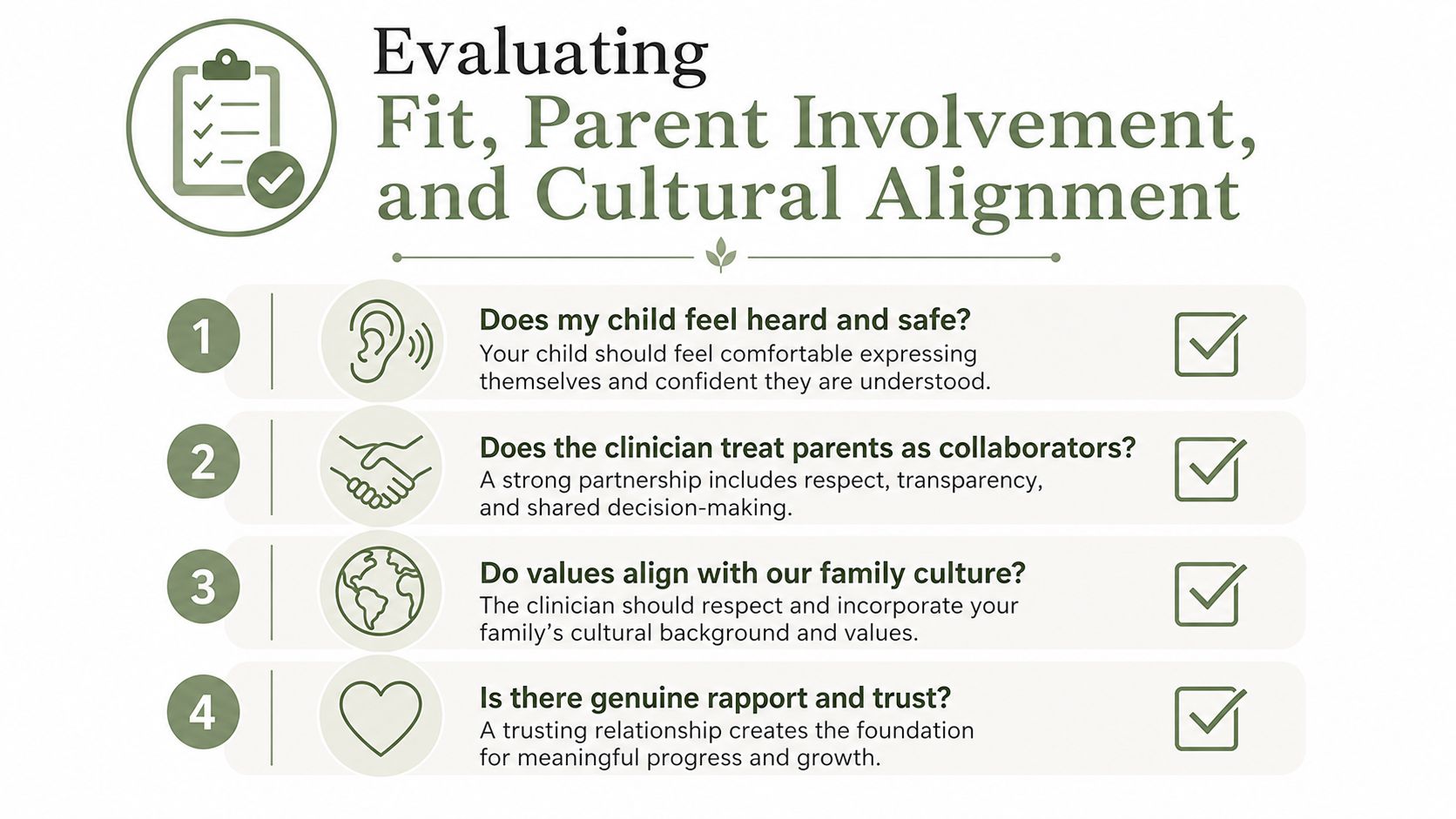
Judge the first sessions by observable signs
During the early sessions, ask yourself:
- Does my child feel heard? They don't have to like every intervention, but they should be able to express discomfort.
- Does the therapist explain the plan? You should understand the concern being addressed and what progress will look like.
- Does the clinician use my information well? Parents see routines, sleep, behavior, and school functioning that may not appear in the office.
- Does my child have an appropriate voice? The therapist should protect confidentiality while explaining its limits and involving caregivers responsibly.
- Can we disagree safely? A good clinician can discuss a parent's concern without becoming defensive.
Parent involvement should match the child's age, concern, and treatment model. Parent training programs require active caregiver participation. Family-based CBT and behavior plans also depend on what happens between appointments. Even in more child-focused therapy, caregivers usually need enough information to support routines, practice skills, and notice changes.
Cultural alignment includes more than language. Ask whether the therapist respects your family's culture, religion, identity, parenting context, neurodiversity, and views about mental health. A clinician who treats a child's identity as a problem, or who ignores the family's values, can lose trust quickly.
For more guidance on the caregiver's role, review parent training and information.
Bring these questions to the consultation call:
- How do you involve parents in treatment for a child of my child's age?
- What approach do you use for this specific concern?
- How do you handle disagreement between a child's goals and a parent's concerns?
- How do you protect an adolescent's privacy while keeping caregivers appropriately informed?
- How do you measure progress?
- What does a typical course of treatment look like for this type of concern?
- How do you coordinate with pediatricians, schools, or other providers when needed?
Logistics, Red Flags, and Your Next Steps
A therapist can be clinically appropriate and still be impossible for your family to use. Ask about appointment times, cancellation policies, insurance participation, out-of-pocket fees, superbills, sliding-scale availability, telehealth coverage, and the frequency of sessions. Confirm whether the practice can coordinate with a pediatrician or school when you provide appropriate consent.
Access remains a major barrier. Among households with children needing treatment, more than 60% reported difficulty obtaining care, and about one in three said it was very difficult or not possible to get treatment, according to the evidence summarized in this national analysis of access to children's mental health care. The same source reports that from June 2023 through September 2024, 19.6% of households reported a child needing mental health treatment, and 24.8% of those households had an unmet need.
Those findings make wait time and coverage part of the clinical decision, not administrative details to handle later. If a therapist can't see your child soon, ask whether they can recommend another provider, offer a short-term consultation, or help you determine whether the situation needs faster evaluation.
Know what should make you pause
Look elsewhere if the clinician:
- Offers vague goals: They can't describe what they'll assess, target, or measure.
- Dismisses parent concerns: They treat your observations as interference instead of useful clinical information.
- Avoids questions about training: They won't explain licensure, child experience, or specialization.
- Uses one method for every child: They can't connect their approach to your child's actual concern.
- Excludes caregivers without explanation: They offer no clear rationale for how parents will support treatment.
- Pressures you into a long commitment: They ask you to sign an extended contract before a meaningful intake.
- Dismisses medical questions: They refuse to coordinate with a pediatrician or acknowledge when medical evaluation may be relevant.
Use this same-week plan
Within seven days: Write the presenting concern, identify your child's age and preferred format, contact several appropriately licensed clinicians, and ask about availability, insurance, treatment approach, parent involvement, and consultation options.
Within thirty days: Complete an intake with the strongest practical match. Agree on the first treatment goals, communication expectations, session format, and the signs that would indicate the plan needs adjustment.
Within ninety days: Review progress with the therapist and your child. Decide whether symptoms, functioning, family routines, or school participation are changing. If there's no clear direction, raise the concern directly and ask whether the treatment model, frequency, format, or clinician match should change.
Choosing a therapist is not a search for a flawless personality or the longest list of credentials. It's a decision about specialization, developmental fit, treatment method, access, and trust. Use those standards before committing, and you'll give your child a better chance of receiving care that can start, continue, and make sense in daily life.
---
Wald Behavioral Health provides evidence-based therapy for children, adolescents, young adults, and families through in-person sessions and telehealth, with parent involvement adapted to the child's needs. Schedule a free 15-minute consultation with Wald Behavioral Health to discuss fit, availability, and the next practical step for your family.
Questions about your child or teen?
Dr. Wald offers a free 15 minute consultation to talk through what you are seeing and whether the practice is a good fit.
Free 15 Minute Consultation