How Does Bullying Cause Low Self Esteem: Key Mechanisms
A child who once ran through the school doors may suddenly ask to stay home. They may stop mentioning friends, abandon a favorite sport, or answer ordinary questions with “I'm fine” while their shoulders and silence say otherwise. Parents often notice the behavior before they recognize the message beneath it: repeated bullying may be teaching the child to doubt their own value.
The question “how does bullying cause low self-esteem?” has a more detailed answer than “mean words hurt.” Bullying can reshape a child's interpretation of belonging, safety, competence, and control. Once hostile treatment starts to feel like proof of a personal flaw, the child may carry that conclusion into classrooms, friendships, activities, and online spaces. Understanding the mechanism helps caregivers respond to the injury rather than only the visible behavior.
## Table of Contents - Understanding the Impact of Bullying on Self-Worth - Why the change can be easy to miss - The Core Mechanism How Rejection Shapes Identity - From an event to a belief - Why social rejection carries unusual weight - Three Psychological Pathways to Low Self-Esteem - Internalization turns insults into identity statements - Social alienation removes corrective experiences - Learned helplessness makes protection seem impossible - What Research Proves About Bullying and Self-Esteem - Why time order matters - Signs Your Child May Be Experiencing Self-Esteem Loss - Changes in participation and confidence - Social, physical, and emotional clues - Intervention Strategies That Actually Work - Protect the child in concrete ways - Challenge the belief, not the child - Restore mastery and belonging
Understanding the Impact of Bullying on Self-Worth
At lunch, a child who once joined any table may begin scanning the room for the safest seat. After classmates mock their appearance, leave them out of group chats, or laugh when they speak, they may stop raising a hand, avoid a favorite activity, and spend more time alone. Asked what happened, the child might answer, “They're right. Nobody wants me there.”
That sentence shows how bullying can move from an outside event into an inner belief. Bullying can lower self-esteem by repeatedly communicating rejection, powerlessness, or social inferiority, according to UNESCO's global review of school violence and bullying. The behavior may include insults, threats, physical aggression, rumors, exclusion, or repeated digital harassment. Over time, the child may internalize the treatment, like a message written so often that it starts to look like a fact about their identity.
The scale is serious. UNESCO estimated that approximately 246 million children and adolescents experience school violence and bullying in some form each year. Estimates for school bullying range from below 10% to above 65%, depending on the country, age group, and measurement method. The variation reflects differences in definitions and measurement, not a reason to dismiss one child's experience.
Why the change can be easy to miss
Low self-esteem does not always appear as sadness. A child may become unusually agreeable, avoid unfamiliar activities, make jokes about being “stupid,” or claim that a once-loved activity is boring. Another may argue constantly because anger feels safer than showing fear or shame.
Repeated bullying can also create learned helplessness. If attempts to speak up, seek help, or join peers seem to lead to more rejection, the child may stop trying, much as someone stops pressing a button they believe no longer works. Withdrawal then removes chances to receive friendship, encouragement, and evidence of competence. Caregivers can support recovery by noticing this pattern rather than treating avoidance as laziness.
Calm, specific questions often open more conversation than a demand for a complete explanation. Ask, “Who feels safest to sit with at lunch?” or “Which part of the school day feels hardest?” Broader guidance for caregivers is available in this resource on children's self-esteem.
Frequently bullied students may feel like outsiders at school and miss school more often than peers who are not frequently bullied. Withdrawing from classes, activities, and friendships can reduce positive feedback and belonging, allowing a social injury to shape the child's wider view of themselves. Recognizing that cycle helps caregivers address both the bullying and the belief it has planted.
The Core Mechanism How Rejection Shapes Identity
Children develop their sense of self partly through other people's responses. A teacher's encouragement can support a belief such as “I can learn this.” A friend's inclusion can reinforce “I belong here.” Repeated bullying supplies the opposite kind of feedback, especially when it happens in front of peers or continues through digital spaces.
The critical shift occurs when the child stops seeing the bullying as something an aggressor is choosing to do and starts seeing it as evidence of an unchangeable personal defect. “They are treating me unfairly” can gradually become “I must be unlikeable.” “They keep targeting me” can become “I'm weak and can't protect myself.” The first interpretation identifies an external problem. The second turns the problem into an identity.
From an event to a belief
A single hostile interaction may cause pain, but repeated experiences give the brain more material to organize into a pattern. If classmates laugh whenever a child speaks, the child may predict embarrassment before speaking. If a group repeatedly excludes them, they may expect rejection from new groups too. The mind begins using past treatment as a shortcut for predicting future treatment.
This doesn't mean the child is choosing negative thinking. The conclusion can feel practical because it seems to explain confusing events. A child may reason, “If the problem is me, then at least I understand why this keeps happening.” Unfortunately, that explanation also produces shame and makes supportive relationships harder to trust.
A useful distinction: The child is not “overreacting” to ordinary teasing when repeated humiliation has changed their sense of safety and belonging.
The mechanism also explains why reassurance alone may not be enough. Telling a child “It's not your fault” is important, but a held belief usually needs repeated corrective experiences. The child may need adults to stop the behavior, peers to offer reliable inclusion, and structured opportunities to succeed before the new evidence feels believable.
Why social rejection carries unusual weight
Adolescence makes peer evaluation especially influential because young people are actively forming identity and social roles. Relational bullying, such as exclusion, rumor-spreading, and damage to friendships, can attack the very relationships a child uses to understand their social worth. A student may still know intellectually that one group's opinion shouldn't define them, yet feel emotionally as though it does.
The same principle applies to witnesses. A student who watches humiliation may not develop low global self-esteem, and a failure to intervene doesn't automatically mean that student is uncaring. Fear of becoming the next target, uncertainty about how adults will respond, or a lack of confidence in a safe intervention may be more relevant than a general opinion of oneself, as discussed in recent research on students who witness bullying. Witnesses may still lose a sense of agency or moral confidence when they repeatedly see harm and believe they cannot change it.
Three Psychological Pathways to Low Self-Esteem
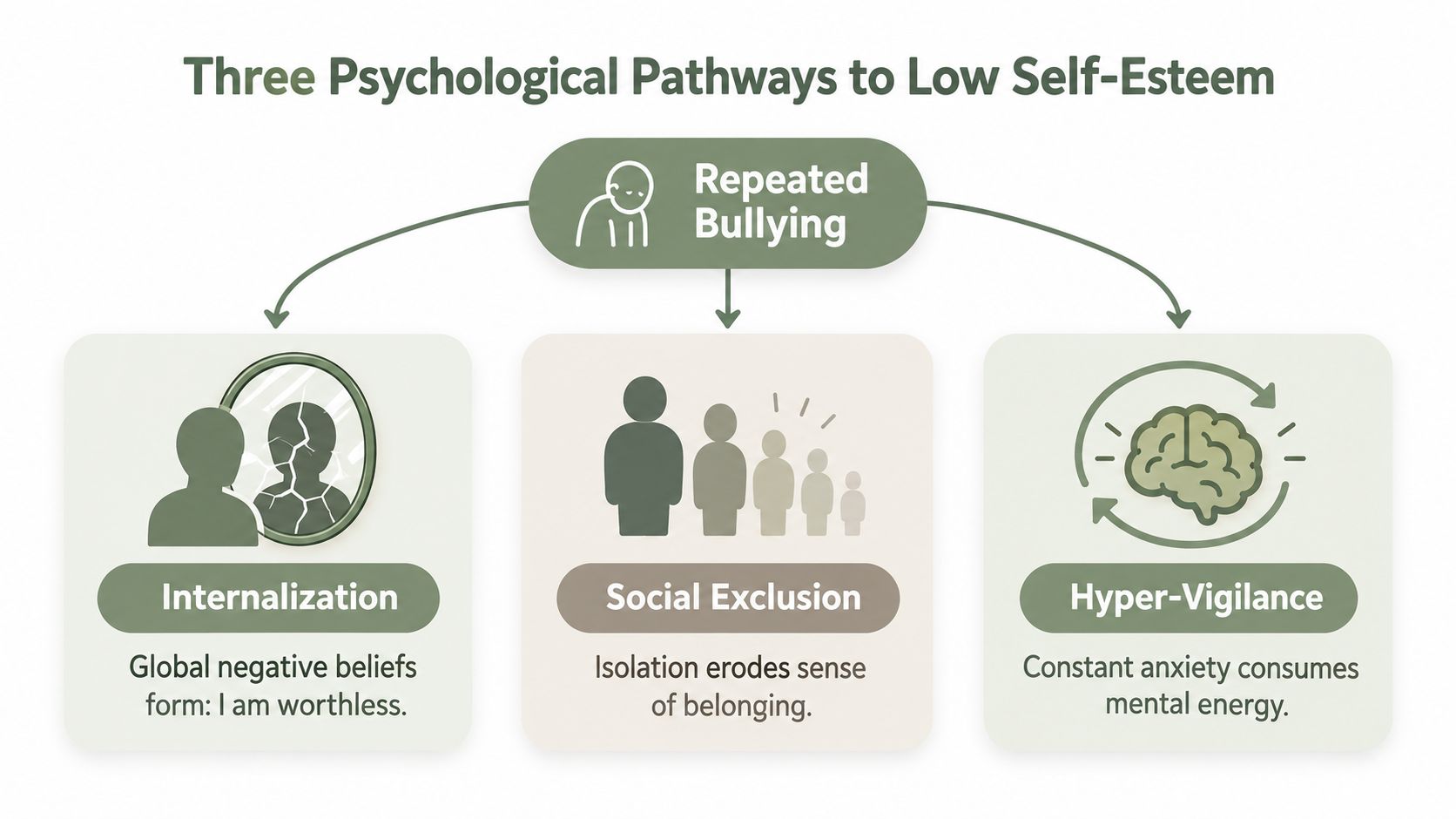
Bullying doesn't damage self-esteem through one single route. Three connected pathways often help explain why a child's confidence changes: internalization, social alienation, and learned helplessness. A child may experience all three, but one may be most visible at a particular time.
Internalization turns insults into identity statements
At first, a child may reject a bully's message. “That's not true” creates distance between the insult and the self. Repetition can wear down that distance, especially when other students laugh, adults miss the behavior, or the child lacks a safe relationship in which to challenge the message.
The child may move from a specific observation to a global judgment:
- “They laughed at my answer” becomes “I'm stupid.”
- “They left me out today” becomes “Nobody likes me.”
- “I couldn't stop them” becomes “I'm powerless.”
- “They criticized my body” becomes “There's something wrong with how I look.”
These beliefs are broad, harsh, and difficult to disprove because they treat one social environment as a verdict on the whole person. The meta-analysis of peer victimization and self-esteem supports the importance of assessing specific beliefs about social competence, academic ability, body image, and safety rather than treating confidence as one undivided trait.
Social alienation removes corrective experiences
A child who expects rejection may stop initiating conversations, decline invitations, or sit apart at lunch. Avoidance can protect them from an immediate uncomfortable moment, but it also removes chances to discover that another peer might be kind, a teacher might listen, or a new activity might go well.
This creates a loop. The child withdraws because they feel unworthy or unsafe. Others may then have fewer opportunities to connect with them, which the child experiences as confirmation that nobody wants them. Online, leaving a group chat or avoiding messages may provide temporary relief while also increasing isolation.
Learned helplessness makes protection seem impossible
When a child reports bullying and nothing changes, or when each attempt to respond leads to more humiliation, the child may conclude that action is pointless. They may stop telling adults, avoid eye contact, surrender belongings, or comply with unreasonable demands because compliance seems less dangerous than resistance.
This is not laziness or a lack of character. It is an adaptation to repeated experiences in which the child has not seen effective protection. Hyper-vigilance can reinforce it by keeping attention focused on threat. The child spends mental energy scanning faces, monitoring messages, and planning escape routes instead of learning, playing, or building relationships.
Support must therefore restore both self-belief and actual control. Adults should not ask a child to prove confidence by confronting an aggressor alone. A safer plan gives the child confidential ways to report, identifies supportive adults, changes supervision, and teaches responses that don't increase risk.
What Research Proves About Bullying and Self-Esteem
A parent may wonder whether a child's low confidence attracted bullying in the first place. The question is understandable, but it can place responsibility on the child. Research that follows students over time offers a clearer way to examine what happens first and what follows.
A two-wave study followed 1,057 13-year-old students over two academic years. Students who reported more victimization at the first measurement had lower self-esteem at the second measurement than students who reported less bullying, according to the longitudinal study published in the Journal of Research on Adolescence. Since victimization was recorded before the later self-esteem score, the findings support the view that bullying can contribute to a decline in self-evaluation.
Why time order matters
A correlation shows that two experiences occur together. Longitudinal evidence also shows their sequence. When victimization comes first and lower self-esteem follows, bullying becomes a more plausible contributor to the change. This pattern does not mean every child will react in the same way, or that bullying is the only influence on self-esteem.
Timing also helps explain internalization. Repeated rejection can act like a steady stream of negative messages. Over time, a child may begin treating those messages as evidence about who they are, rather than as descriptions of someone else's harmful behavior.
The same research describes data from 3,617 South Korean adolescents followed from seventh through ninth grade. When different forms of bullying involvement were examined together, relational victimization, including exclusion, rumor-spreading, and damage to friendships, predicted later reductions in self-esteem, as reported in the same longitudinal study. A child does not need to be physically attacked for social harm to affect identity. Being repeatedly shut out can make isolation feel like proof of personal unworthiness.
A separate meta-analysis combined 16 studies involving 35,032 participants aged 10 to 18 and found a significant negative association between peer victimization and self-esteem, with r = −0.25 and a 95% confidence interval of −0.29 to −0.22, reported in the PLOS ONE analysis. In plain language, greater victimization tended to occur alongside lower self-worth across the studies.
These findings do not prove that bullying permanently damages a child. They show why caregivers should examine the child's environment and restore safe, supportive relationships instead of treating low confidence as a personal weakness.
Signs Your Child May Be Experiencing Self-Esteem Loss
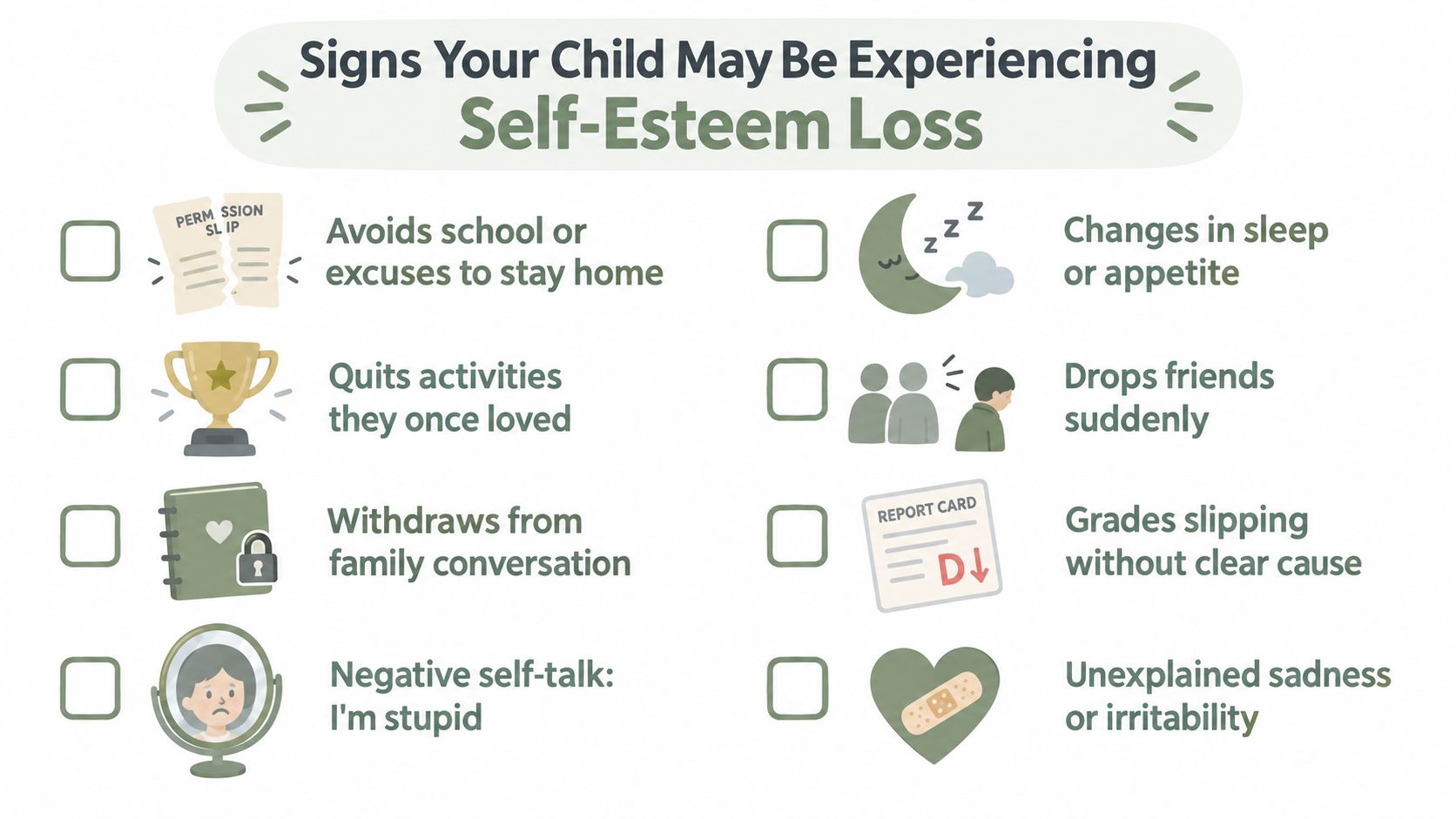
A child may still laugh with family, finish homework, or say everything is fine while avoiding the places and people linked to humiliation. Self-esteem loss often appears in changed routines before a child can describe feeling worthless.
Look for patterns and clusters, not one difficult day. A stomachache before school can have many causes. Repeated physical complaints combined with withdrawal, sleep changes, or fear of peers call for a calm conversation and closer attention.
Changes in participation and confidence
A child may stop volunteering answers, avoid asking for help, or abandon tasks they once managed. Clubs, sports, music, and visits with friends may also disappear because these settings now feel like places where others might judge them. Academic disengagement can reflect stress and reduced concentration, rather than a sudden loss of ability.
Listen for statements that turn one setback into a permanent judgment:
- “I'm bad at everything.”
- “Nobody will ever like me.”
- “There's no point in trying.”
- “I always ruin things.”
- “Everyone is looking at me.”
These statements show internalization. A child is treating a painful experience as evidence of personal identity, much like a temporary label has been pressed into a permanent name tag. Ask, “What happened that made you feel that way?” This invites the child to explain the experience instead of forcing a quick, “That isn't true.”
Social, physical, and emotional clues
Some children become quiet and compliant. Others become angry, argumentative, or unusually controlling at home. A child may withdraw from family conversations, end friendships without explaining why, or focus intensely on pleasing others to prevent further rejection.
The body can signal distress. Sleep or appetite changes, headaches, stomachaches, fatigue, and school avoidance may accompany anxiety and low mood. Research by Schacter and Margolin (2021) specifically assessed sleep, avoidance, mood, anxiety, rumination, self-harm thoughts, and attendance in bullied youth, recommending that clinicians evaluate these areas alongside bullying exposure, as described in research on shame, self-esteem, and internalizing symptoms.
Listen for the meaning behind the behavior: “I don't want to go” may mean “I don't feel safe,” while “I don't care about soccer anymore” may mean “I can't tolerate being judged there.”
Self-harm thoughts, hopelessness, or feeling unable to stay safe require prompt professional evaluation and immediate adult support. For parents seeking practical next steps, parenting guidance from Wald Behavioral Health may be helpful.
Intervention Strategies That Actually Work
Effective help has two parts. Adults must make the environment safer, and the child must receive support to revise the beliefs and emotional habits bullying has created. Building confidence while leaving the harassment in place asks the child to adapt to an ongoing threat. Stopping the behavior without addressing shame and avoidance may leave the child expecting the next rejection.
Protect the child in concrete ways
Start with a factual record of what happened, when it occurred, where it happened, who was present, and how the child responded. Share the information with the appropriate school staff and ask for a specific safety plan. The plan may include adult supervision in vulnerable locations, a trusted person to contact, changes to seating or transitions, and action to stop online harassment.
Don't make the child responsible for confronting the aggressor alone. A response should reduce risk, not create a performance in which the child has to appear fearless.
Challenge the belief, not the child
Validation comes before reframing. Try, “I believe you, and what happened was wrong.” Then separate the behavior from the identity: “Someone choosing to exclude you doesn't prove that you're unlikeable.” Ask for evidence that supports and contradicts the global belief, and help the child develop a more precise statement, such as “That group treated me badly, but I have people who care about me.”
Cognitive-behavioral work can help children identify harsh self-judgments, test them against evidence, and practice balanced interpretations. Caregivers can explore cognitive therapy for low self-esteem as one framework for this process.
Restore mastery and belonging
Choose achievable activities where the child can experience competence without immediate social pressure. Cooking a meal together, caring for a pet, practicing an instrument privately, or returning gradually to a trusted activity can provide evidence that the child is capable and still connected to valued parts of life. Praise effort, persistence, problem-solving, and help-seeking rather than appearance or popularity.
Progress may be uneven. A child can understand that bullying wasn't their fault and still feel anxious at school the next morning. With coordinated protection, patient conversations, supportive relationships, and appropriate therapy, self-worth can become less dependent on the aggressor's voice.
---
Wald Behavioral Health provides evidence-based therapy for children, adolescents, young adults, and families dealing with bullying experiences, low self-esteem, anxiety, depression, and school stress. Families can visit Wald Behavioral Health to learn about in-person and telehealth options, parent guidance, and a free 15-minute consultation.
Questions about your child or teen?
Dr. Wald offers a free 15 minute consultation to talk through what you are seeing and whether the practice is a good fit.
Free 15 Minute Consultation