Cognitive Therapy for Low Self Esteem: Key Facts

You notice it in small moments. Your child deletes a drawing because it “looks stupid,” refuses to raise a hand even when they know the answer, or comes home upset after a minor correction. Your teenager may appear confident with friends yet avoid photographs, applications, sports, or conversations where they might be judged. Parents often wonder whether this is ordinary insecurity or a sign that something deeper is taking hold.
Cognitive therapy for low self-esteem helps children and adolescents examine the beliefs behind those reactions and test whether those beliefs are fair, accurate, and useful. The approach doesn't ask a child to repeat positive statements they don't believe. It teaches them, with support, to notice harsh self-judgments, look at the evidence, try new behaviors, and build a more balanced view of themselves.
## Table of Contents - Recognizing Low Self Esteem in Children and Adolescents - Patterns that deserve attention - How Cognitive Behavioral Therapy Targets Negative Self Beliefs - Finding the thought beneath the reaction - Testing beliefs instead of forcing positivity - What the Research Evidence Actually Shows About CBT Outcomes - The evidence in context - What remains uncertain - Age-Tailored Cognitive Therapy Approaches Across Developmental Stages - Early childhood and elementary years - Middle childhood - Adolescence and young adulthood - In-Session Interventions and Practical Home Practice Exercises - A manageable home practice routine - Encouragement without pressure - When to Seek Professional Care and What to Expect at Wald Behavioral Health - A practical decision guide - What treatment can look like - Questions parents commonly ask
Recognizing Low Self Esteem in Children and Adolescents
Maya is nine. When her teacher praises a story she wrote, Maya shrugs and says the teacher “has to be nice.” At home, she spends a long time erasing homework, then asks her parent to check every answer. If a game doesn't go well, she stops playing and says, “I knew I couldn't do it.” Nothing about one difficult afternoon proves that Maya has a serious emotional disorder. The concern grows when this pattern becomes her usual way of moving through school, friendships, and ordinary challenges.
Low self-esteem often hides behind behaviors adults may misread. A child who refuses new activities might not be lazy. They may be protecting themselves from the shame of making a mistake. A perfectionistic child may seem highly motivated while feeling that one imperfect result proves they aren't good enough. An adolescent who jokes about being “the dumb one” may be trying to control the embarrassment they fear others will cause.
Patterns that deserve attention
Look for persistence and interference rather than one isolated comment. A child may need an evaluation when you repeatedly notice:
- Chronic self-criticism: They describe themselves as stupid, ugly, unlikeable, or incapable, even after ordinary successes.
- Avoidance: They stop trying activities, answering questions, meeting peers, or accepting responsibilities because failure feels unbearable.
- Disproportionate reactions to feedback: A small correction leads to intense shame, tears, anger, or withdrawal.
- Discounting strengths: They explain achievements as luck, easy work, or someone else's help while treating mistakes as proof of personal failure.
- Social retreat: They withdraw from friends or school participation in ways that affect relationships, attendance, or learning.
Development matters. A young child may show self-doubt through play, repeated reassurance-seeking, or giving up quickly. A teenager may hide distress behind irritability, overwork, online comparison, or silence. Bullying, family conflict, academic pressure, anxiety, depression, and major transitions can all shape the way a young person evaluates themselves.
Practical rule: Don't argue with “I'm worthless” by listing achievements. First acknowledge the pain, then help your child investigate the belief with a trained professional.
Parents can begin by observing when the self-criticism appears, what happens immediately before it, and what the child does next. A resource such as parent guidance on supporting children can help caregivers organize those observations and decide whether a consultation makes sense. Professional support is especially important when low self-worth lasts, limits daily functioning, or appears alongside persistent sadness, anxiety, hopelessness, self-harm concerns, or statements about not wanting to live.
How Cognitive Behavioral Therapy Targets Negative Self Beliefs
CBT starts with a simple idea: an event, a thought, a feeling, and a behavior can reinforce one another. The event might be a child receiving a low grade. The automatic thought might be, “I'm bad at everything.” That thought can produce shame or anxiety, followed by avoidance, giving up, or refusing help. Because the child doesn't practice or discover what they can do, the original belief feels even more convincing.
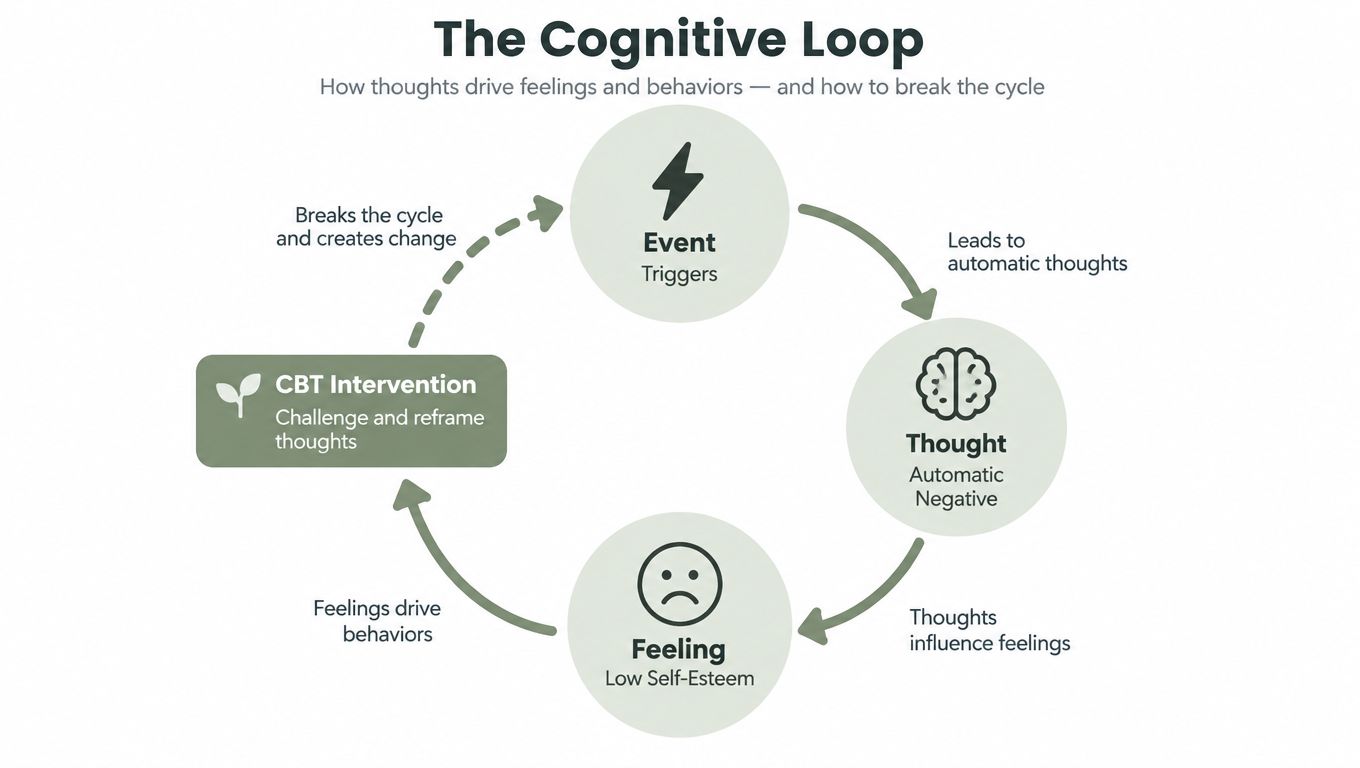
Finding the thought beneath the reaction
A therapist helps the child slow the sequence down. Instead of asking only, “Why are you upset?” the therapist may ask:
- What happened? “You weren't invited into the game.”
- What did your mind say? “Nobody likes me.”
- What feeling followed? Sadness, embarrassment, or fear.
- What did you do next? Walked away, sent angry messages, or stayed home.
- What happened afterward? The child had fewer chances to connect, which seemed to confirm the belief.
Younger children may use drawings, puppets, emotion cards, or characters such as a “mean-mind voice” and a “fair-minded voice.” School-age children can record a situation, thought, feeling, and response in a short worksheet. Adolescents may explore deeper beliefs such as “I must be impressive to deserve respect” or “If I disappoint someone, they'll reject me.”
Testing beliefs instead of forcing positivity
Cognitive restructuring isn't a demand to turn “I'm worthless” into “I'm amazing.” That replacement may feel false and invite resistance. The therapist might help the child create a more defensible thought: “I made a mistake on this assignment, but one assignment doesn't measure my whole ability. I can ask what to practice.”
Behavioral experiments give the new thought a chance to earn credibility. A teen who believes, “If I speak once in class, everyone will laugh,” might make one prepared comment and compare the predicted outcome with the actual outcome. The point isn't to guarantee comfort. It's to help the teen gather a fuller set of experiences.
The therapist may also examine safety behaviors, such as excessive checking, hiding work, seeking repeated reassurance, or avoiding eye contact. These behaviors can reduce anxiety briefly while preventing the child from learning that they can cope without them.
A short explanation can make the process less mysterious:
Parents support CBT best by being curious rather than becoming a constant thought-checking coach. Ask, “What did your mind predict?” and “What else might be true?” Then let the therapist guide the level of challenge, especially when the belief is connected to trauma, bullying, depression, or intense anxiety.
What the Research Evidence Actually Shows About CBT Outcomes
The research supports CBT for low self-esteem, but the most responsible reading is neither “therapy fixes everything” nor “the evidence is too limited to matter.” Studies have found meaningful improvements, particularly when treatment directly addresses negative self-beliefs and includes structured practice. Results also vary by age, delivery format, comparison group, and the length of follow-up.
A 2018 systematic review and meta-analysis identified 8 eligible studies, with 7 included in the quantitative synthesis and 821 participants overall, including 520 people who received CBT-based treatment. About 80% of participants were female. For weekly CBT sessions, the pooled post-treatment effect size was 1.12, with a 95% confidence interval from 0.97 to 1.27. One-day workshops showed a smaller effect size of 0.34, suggesting that sustained, structured work may offer more benefit than a brief standalone event. These findings are reported in the systematic review of CBT-based interventions for low self-esteem.
The evidence in context
A separate adult meta-analysis covering 119 studies found a significant improvement in global self-esteem, with an overall effect size of d = 0.38, and a 95% confidence interval from 0.33 to 0.43. The review found cognitive behavioral therapies among the more effective approaches across individual, group, face-to-face, and online formats, as described in the adult self-esteem intervention meta-analysis.
Digital treatment has also produced encouraging findings for adolescents. In a 2022 internet-based CBT trial, the between-group effect on the Rosenberg Self-Esteem Scale was d = 1.18 at post-treatment. Fifty-eight percent of treated participants showed reliable change, compared with 6 participants in the control group. The adolescent internet-based CBT trial provides evidence that structured digital delivery can produce measurable change, not merely offer general encouragement.
| Study type | Effect size | Format | Key finding | |---|---:|---|---| | 2018 systematic review and meta-analysis | Weekly CBT, 1.12; one-day workshop, 0.34 | Multiple CBT formats | Structured CBT produced substantial short-term gains, with larger pooled effects for weekly sessions. | | 2022 adolescent trial | d = 1.18 | Internet-based CBT | Treated adolescents showed a large between-group post-treatment effect on standardized self-esteem measurement. | | Adult meta-analysis | d = 0.38 | Individual, group, face-to-face, and online | Self-esteem improved across formats, with CBT among the more effective approaches. |
What remains uncertain
The strongest limitation concerns durability. Reviews report improvements in self-esteem and depressive symptoms, but follow-up information is limited. One earlier trial reported maintenance only to an 11-week follow-up, and broader reviews have called for more research on mechanisms and long-term change. A review of treatment outcomes and follow-up evidence also points to the need for more randomized studies and newer approaches.
For parents, that means progress shouldn't be judged only by how confident a child looks after treatment. A good plan includes skill use, behavior change, coping with setbacks, and a strategy for recognizing old patterns early.
Age-Tailored Cognitive Therapy Approaches Across Developmental Stages
A six-year-old and a sixteen-year-old may both say, “I'm no good,” but they don't mean it, understand it, or practice change in the same way. Effective cognitive therapy for low self-esteem matches the child's language, attention, reasoning, emotional regulation, and social world. Parents should expect adaptation, not a miniature adult protocol delivered to every child.
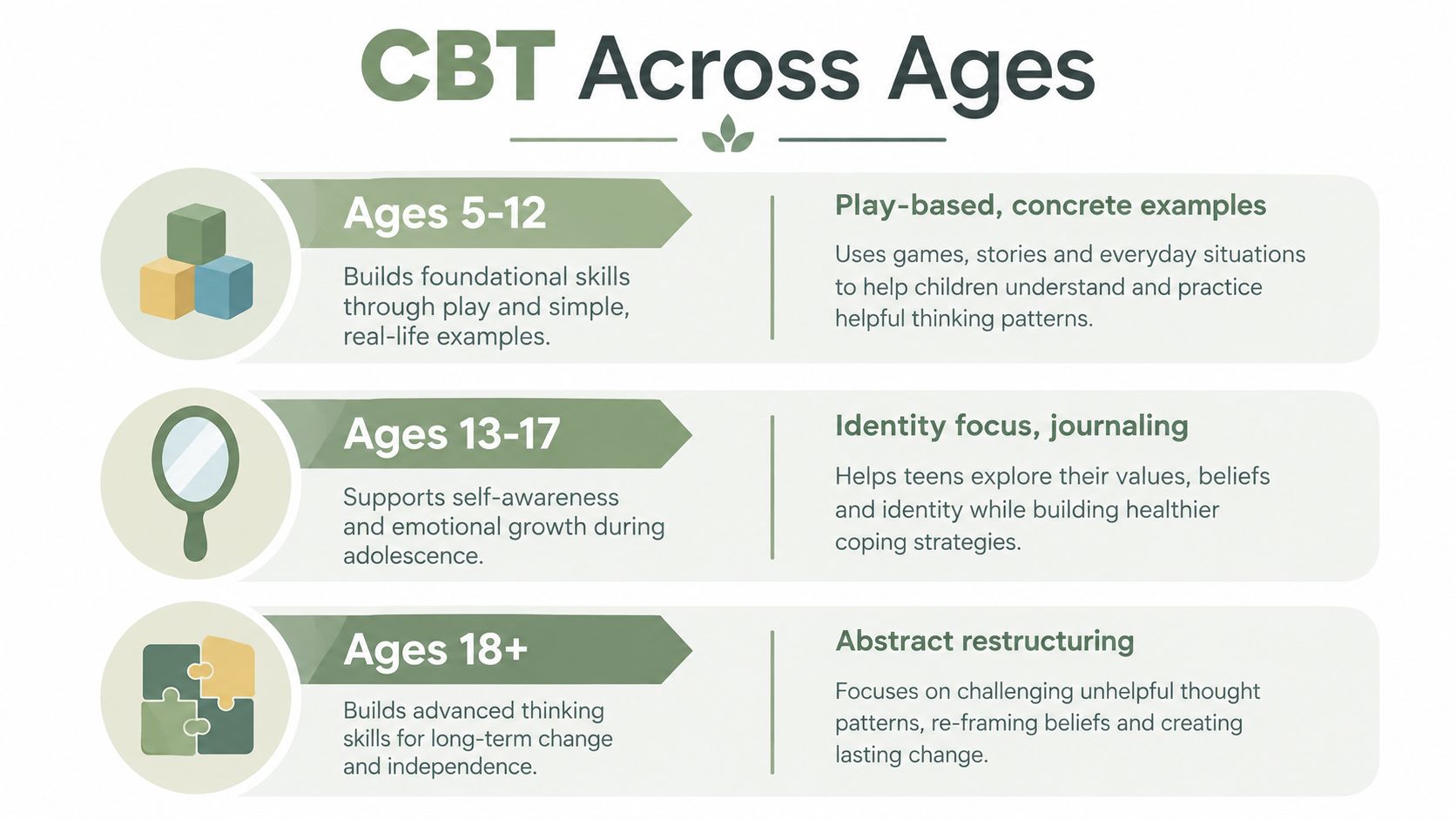
Early childhood and elementary years
For younger children, therapy often happens through play, stories, drawing, movement, and concrete examples. A therapist might use building blocks to show how one difficult experience doesn't define the whole structure of a child's identity. The child may draw a “mistake monster,” practice answering it with a kinder and more accurate voice, or role-play joining a game.
Parents usually have a visible role at this stage. They may practice noticing effort, model recovering from mistakes, and follow a brief home plan. Sessions may be shorter or broken into activities because young children learn through interaction more effectively than through extended abstract discussion.
Middle childhood
School-age children can begin using simple thought records. They might write:
- Situation: I missed the goal.
- First thought: I'm terrible at soccer.
- Feeling: Embarrassed and angry.
- Fairer thought: I missed one goal. I can practice positioning and keep playing.
The therapist may use behavioral experiments, coping cards, confidence ladders, and achievement logs. Parent involvement remains important, but the child gradually takes ownership. A caregiver can ask what skill was practiced without demanding a perfect report.
Adolescence and young adulthood
Teenagers can examine identity, social comparison, conditional rules, and fears about rejection in more abstract language. Journaling, Socratic dialogue, imagery, behavioral experiments, and discussions about online feedback may fit well. The therapist might help a teen test the rule, “I have to be impressive or people won't respect me,” rather than just asking them to list strengths.
Privacy and collaboration matter. Parents may receive general progress guidance while the adolescent has space to discuss sensitive experiences. Families looking for developmentally informed support can learn more about the role of a pediatric psychologist, including how care changes across childhood and adolescence.
| Developmental stage | Common CBT tools | Parent role | |---|---|---| | Younger children | Play, stories, drawings, emotion identification | Participate actively and model flexible self-talk | | School-age children | Simple thought records, coping cards, graded practice | Prompt practice gently and reinforce effort | | Adolescents | Journaling, Socratic questions, behavioral experiments | Support autonomy while staying available | | Young adults | Abstract belief restructuring, values-based experiments, relapse planning | Offer support with consent and respect for independence |
In-Session Interventions and Practical Home Practice Exercises
Therapy becomes useful when a child can carry its skills into a real Tuesday morning. In a session, the therapist may review a recent event, identify the automatic thought, examine the evidence, and design a small experiment. The child might then practice asking for help, returning to an avoided activity, accepting a compliment, or making a mistake without using a familiar safety behavior.

A manageable home practice routine
Home practice should be brief, specific, and connected to the child's treatment goal. A parent might try this sequence:
- Capture one moment. Ask the child to name a situation that triggered self-criticism. For a younger child, draw the event instead of writing it.
- Name the mind's message. Record the exact thought, such as “They'll laugh if I answer.”
- Check the evidence. Ask what supports the prediction and what doesn't. Avoid turning this into a debate.
- Write a balanced response. “I might feel nervous, and I can still answer one question.”
- Choose a small action. The child answers once, submits a drawing without repeated erasing, or stays at an activity for a little longer.
- Review what happened. Compare the prediction with the result, including any discomfort and how the child handled it.
Other exercises can reinforce this work. An achievement log records small acts of persistence, kindness, problem-solving, or courage. A coping card gives the child a short response to carry into a difficult situation. A compassionate letter, written by an older child or dictated by a younger one, answers a mistake with the same fairness they would offer a friend.
Encouragement without pressure
Parents often worry that reminders will sound like nagging. Ask the therapist how frequently to practice, what to do when the child refuses, and which signs indicate that an exercise is too difficult. Praise participation rather than the emotional result: “You felt nervous and still tried,” not “See, there was nothing to worry about.”
A useful home standard: Consistency matters more than intensity. One carefully chosen practice moment can teach more than a long conversation that leaves everyone frustrated.
If a worksheet repeatedly triggers tears, shutdown, anger, or reassurance-seeking, pause and tell the therapist. The clinician may simplify the task, change the target behavior, involve the parent more directly, or address anxiety or depression before asking for additional exposure.
When to Seek Professional Care and What to Expect at Wald Behavioral Health
A consultation makes sense when low self-esteem has become a pattern rather than a passing reaction. Persistent self-criticism, avoidance, withdrawal, school difficulties, or conflict with peers deserve attention when they interfere with everyday life. The concern becomes more urgent when self-doubt appears alongside depression, anxiety, bullying, major developmental transitions, self-harm, hopelessness, or comments about death.
A practical decision guide
Ask yourself:
- How long has this been happening? A repeated pattern matters more than one difficult week.
- Where does it show up? Consider school, friendships, family life, activities, sleep, and eating.
- What does your child avoid? Avoidance can reveal the situations that feel threatening.
- What else is present? Look for persistent sadness, worry, irritability, panic, compulsive behaviors, or loss of interest.
- What has changed recently? Bullying, a school move, puberty, academic demands, illness, family stress, and friendship changes may all affect self-worth.
You don't need to diagnose your child before contacting a psychologist. An assessment should clarify whether low self-esteem is the primary concern, a maintaining factor in anxiety or depression, or part of a broader developmental and family picture. Ask how the clinician measures progress, adapts treatment to age, includes caregivers, protects adolescent privacy, and handles school or bullying concerns.
What treatment can look like
At Wald Behavioral Health, care is individualized for children, adolescents, young adults, and families. A clinician may use CBT to help a young person identify harsh thought patterns, test them against evidence, practice balanced interpretations, and apply those skills in daily situations. Parent guidance can support routines and home practice without turning the caregiver into the therapist.
The practice offers in-person care in Coral Gables and telehealth for clients in Florida, Maryland, and PSYPACT-participating states. A free 15-minute consultation can help a family discuss the concern, consider fit, and review scheduling options. The practice's approach to evidence-based care emphasizes developmentally appropriate treatment and family context.
Questions parents commonly ask
How long will therapy take? There isn't one correct timeline. It depends on the child's age, the depth of the beliefs, co-occurring concerns, stressors, response to practice, and whether treatment needs to address bullying or mood symptoms.
Will my child have homework? Often, yes, but it should be realistic. Home practice may involve noticing a thought, trying one new behavior, completing a short record, or reviewing a coping card.
How will we know whether treatment is helping? Look for changes in behavior as well as words. A child may attempt more activities, recover faster after mistakes, accept help, participate socially, or respond to feedback with less shame. Standardized measures and regular review can add structure, but they shouldn't replace discussion of the child's daily experience.
Does seeking therapy mean we've failed as parents? No. Low self-esteem can develop through many interacting experiences, and support gives families a way to respond skillfully. Seeking help early can reduce the burden on the child and provide caregivers with practical tools.
If your child is in immediate danger, has a plan to self-harm, or says they don't want to live, contact emergency services or a crisis service in your area rather than waiting for a routine consultation.
---
Wald Behavioral Health provides developmentally appropriate therapy for children, adolescents, young adults, and families dealing with low self-esteem, anxiety, depression, bullying, and related concerns. Visit Wald Behavioral Health to request the free consultation and discuss whether in-person or telehealth CBT support fits your family.
Questions about your child or teen?
Dr. Wald offers a free 15 minute consultation to talk through what you are seeing and whether the practice is a good fit.
Free 15 Minute Consultation