Emotional Intensity in Gifted Students: A Parent Guide
Your 9-year-old brings home a B+ and collapses on the kitchen floor, sobbing that they're “bad at everything.” Your 14-year-old reads an ordinary comment from a teammate, goes silent, and locks herself in her room for the rest of the evening. You may find yourself thinking, “Why is this so big?” while your child is experiencing the moment as overwhelming, unfair, or threatening.
Emotional intensity in gifted students can look like dramatic reactions, rapid escalation, strong empathy, perfectionism, rumination, physical distress, or a long recovery after an event that seems small to an adult. It isn't automatically a sign of poor parenting, attention-seeking, or a psychiatric disorder. It may reflect a child who responds to experiences with unusual depth and speed, while still needing to learn how to regulate that response.
The important question isn't whether your child feels strongly. The useful question is whether those feelings remain manageable and meaningful, or whether they begin interfering with sleep, learning, friendships, family life, or self-worth.
## Table of Contents - The Moment a Gifted Child's Feelings Take Over - What Emotional Intensity Actually Means - Trait and behavior are different - How Common Emotional Intensity Really Is in Gifted Learners - Adaptive Intensity Versus Impairing Intensity - Where Emotional Intensity Meets Anxiety Perfectionism and School Stress - School fit changes the pressure - Practical Strategies for Parents and Teachers at Every Age - Ages 5 to 8 - Ages 9 to 12 - Ages 13 to 18 - When Emotional Intensity Becomes a Reason to Seek Therapy - Turning Deep Feelings Into a Strength and Next Steps
The Moment a Gifted Child's Feelings Take Over
A child with emotional intensity may react to an unfair grade as if a major loss has occurred. Their face changes, voice rises, muscles tense, and explanations become difficult to hear. They might argue every detail of the teacher's decision, insist that nobody understands, or move quickly from anger to tears.
Another child may not explode at all. A teenager might withdraw, replay a classmate's comment repeatedly, and avoid the next practice because the embarrassment feels impossible to face. The emotional response may remain largely private, but the impact can still be substantial.
Parents often notice a recognizable pattern:
- The reaction is outsized. The child's response appears much larger than the immediate event.
- Escalation happens quickly. A disappointment becomes a catastrophe before adults can offer perspective.
- Recovery takes time. Even after the problem is resolved, the child may remain upset, ashamed, or preoccupied.
- The body joins in. Headaches, stomachaches, shaking, exhaustion, or difficulty settling may accompany the feeling.
- Relationships become part of the crisis. The child may accuse others of not caring, reject comfort, or later feel guilty about what they said.
A gifted child can also experience intense positive emotions. Excitement may bring rapid speech, restless movement, elaborate plans, and difficulty shifting attention. Compassion may become distress when the child sees someone else suffering. A strong sense of justice may make compromise feel like surrender rather than cooperation.
A useful starting point: Your child's reaction may be understandable even when the behavior isn't acceptable.
The task isn't to prove that the feeling matches an adult's interpretation of the event. It's to understand the response, set boundaries around harmful behavior, and teach recovery. Emotional intensity becomes a concern when it repeatedly drives avoidance, conflict, or impairment. The rest of this guide helps you recognize that difference.
What Emotional Intensity Actually Means
Emotional intensity describes unusually high responsiveness to internal or external stimuli. A child may notice emotional meaning quickly, experience it powerfully, and have trouble returning to a calm state after the stimulus has passed.
One way to understand this is to picture an emotional volume dial. If many children experience a disappointment at volume four, an emotionally intense child may experience the same event at volume nine. The event hasn't necessarily changed. The child's response system is receiving and amplifying more of its emotional significance.
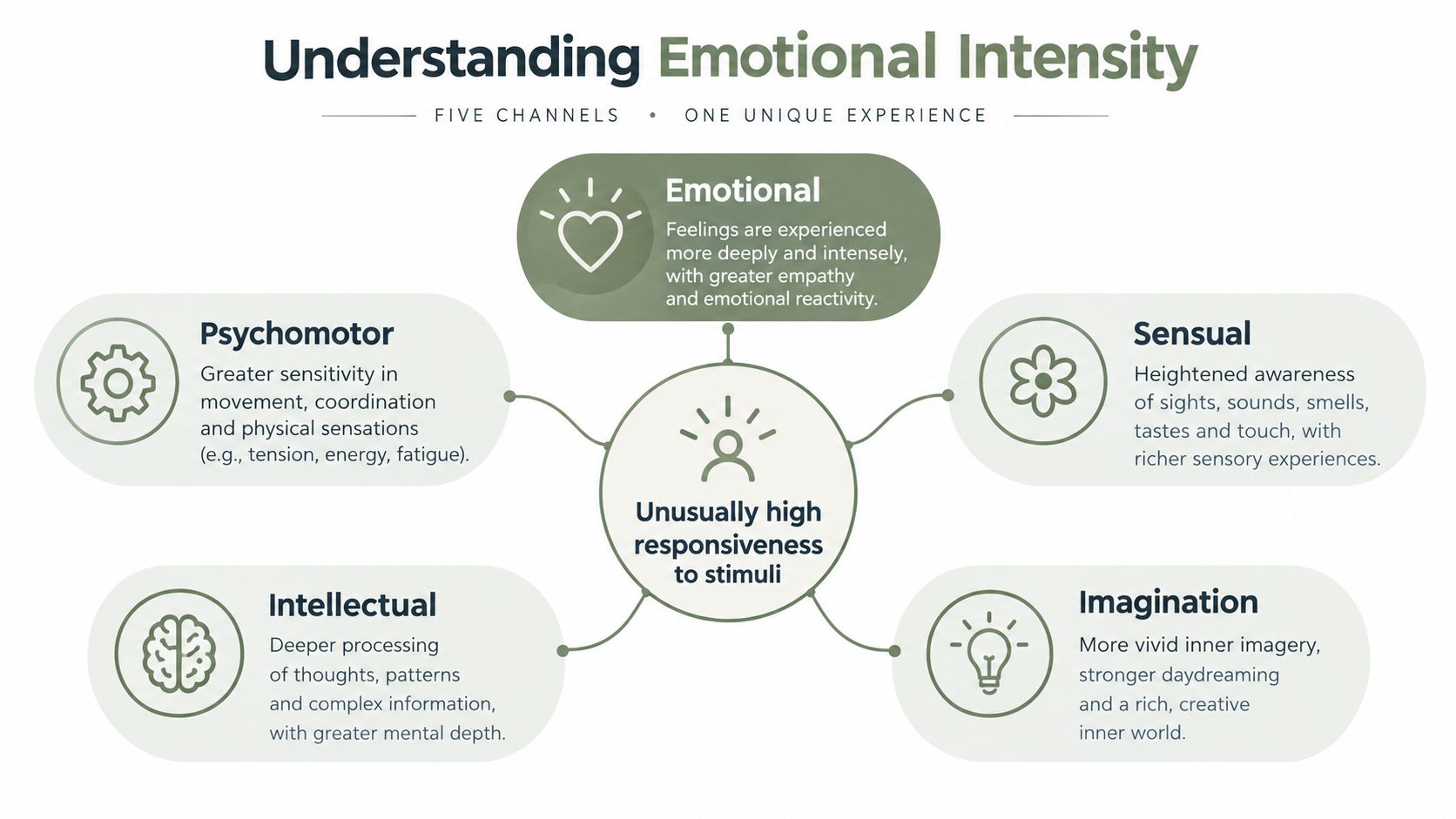
Psychologist Kazimierz Dabrowski described this kind of heightened responsiveness within a broader framework called overexcitabilities. The framework includes five channels:
- Emotional: strong attachment, empathy, concern about justice, and sensitivity to criticism
- Intellectual: persistent questioning, analysis, and a drive to understand
- Imaginational: vivid mental images, stories, possibilities, and feared outcomes
- Sensual: heightened responses to textures, sounds, smells, light, or touch
- Psychomotor: high energy, rapid speech, movement, and difficulty slowing down
Trait and behavior are different
Intensity is a response characteristic. A meltdown, shutdown, insult, or refusal is a behavior layered on top of that response. Children learn those behaviors through experience, modeling, reinforcement, and practice.
That distinction prevents two common mistakes. Adults shouldn't shame a child for having a strong feeling, but they also don't need to permit hitting, cruelty, or endless negotiation. Emotional intensity isn't the same as a mood disorder, deliberate drama, or ineffective parenting. It also isn't a diagnosis of giftedness. A full understanding requires attention to the child's development, environment, learning profile, and functioning.
How Common Emotional Intensity Really Is in Gifted Learners
Research supports a careful conclusion. Emotional intensity appears frequently in highly gifted children, but it isn't universal, and the strength of the difference from other children varies depending on how researchers define giftedness and measure overexcitability.
A 2024 study of highly to profoundly gifted children ages 4 to 13 reported that 76% exhibited three or more high overexcitabilities. Emotional overexcitability was among the most common high forms, present in 82% of the children, while intellectual overexcitability appeared in 86%. The same study reported that 25% showed four high overexcitabilities and 24% showed five, suggesting that emotional intensity often appears alongside intellectual, sensory, imaginative, or psychomotor reactivity rather than in isolation. (2024 study of highly and profoundly gifted children)
A 2016 systematic review found that gifted samples generally scored higher than nongifted samples across all five overexcitability domains. However, the average difference for emotional sensitivity was small, with an effect size of 0.19, while sensual sensitivity also showed a small effect, with an effect size of 0.22. (2016 systematic review of giftedness and overexcitability research)
| Indicator | Gifted sample | Typical sample | Notes | |---|---|---|---| | Emotional overexcitability | Often elevated, especially in highly gifted groups | Less consistently elevated | Group findings don't predict every child | | Emotional sensitivity effect | Small average difference, effect size 0.19 | Comparison group baseline | The size depends on definitions and measures | | Multiple overexcitabilities | Frequently reported in highly gifted children | Less commonly characterized this way | Emotional intensity may coexist with other channels |
These findings don't mean every intense child is gifted, or that every gifted child will have noticeable emotional intensity. A meta-analytic synthesis similarly found that emotional overexcitability was generally a small effect, while intellectual and imaginational overexcitabilities showed medium effects, and psychomotor overexcitability wasn't statistically significant. (Meta-analytic evidence on overexcitability in gifted students)
Parents should treat these findings as context, not a screening test. A child's daily functioning matters more than whether they fit a popular description of a “deep-feeling” gifted learner.
Adaptive Intensity Versus Impairing Intensity
Consider the same 10-year-old receiving a grade they believe is unfair. At home, the child cries, explains the injustice in detail, and needs an adult nearby before settling. After co-regulation, they can discuss what happened, sleep normally, and return to school the next day.
That's strong emotion, but it may still be adaptive. The child's response carries information about values, fairness, and investment. The child also retains the ability to recover, accept repair, and continue participating in ordinary life.
Now consider a different pattern. The child remains distressed for hours, develops a stomachache each morning, refuses school, withdraws from friends, or repeatedly checks the grade portal. Later, they feel ashamed and call themselves weak or stupid. The trigger may be similar, but the emotional response has begun to interfere with functioning.
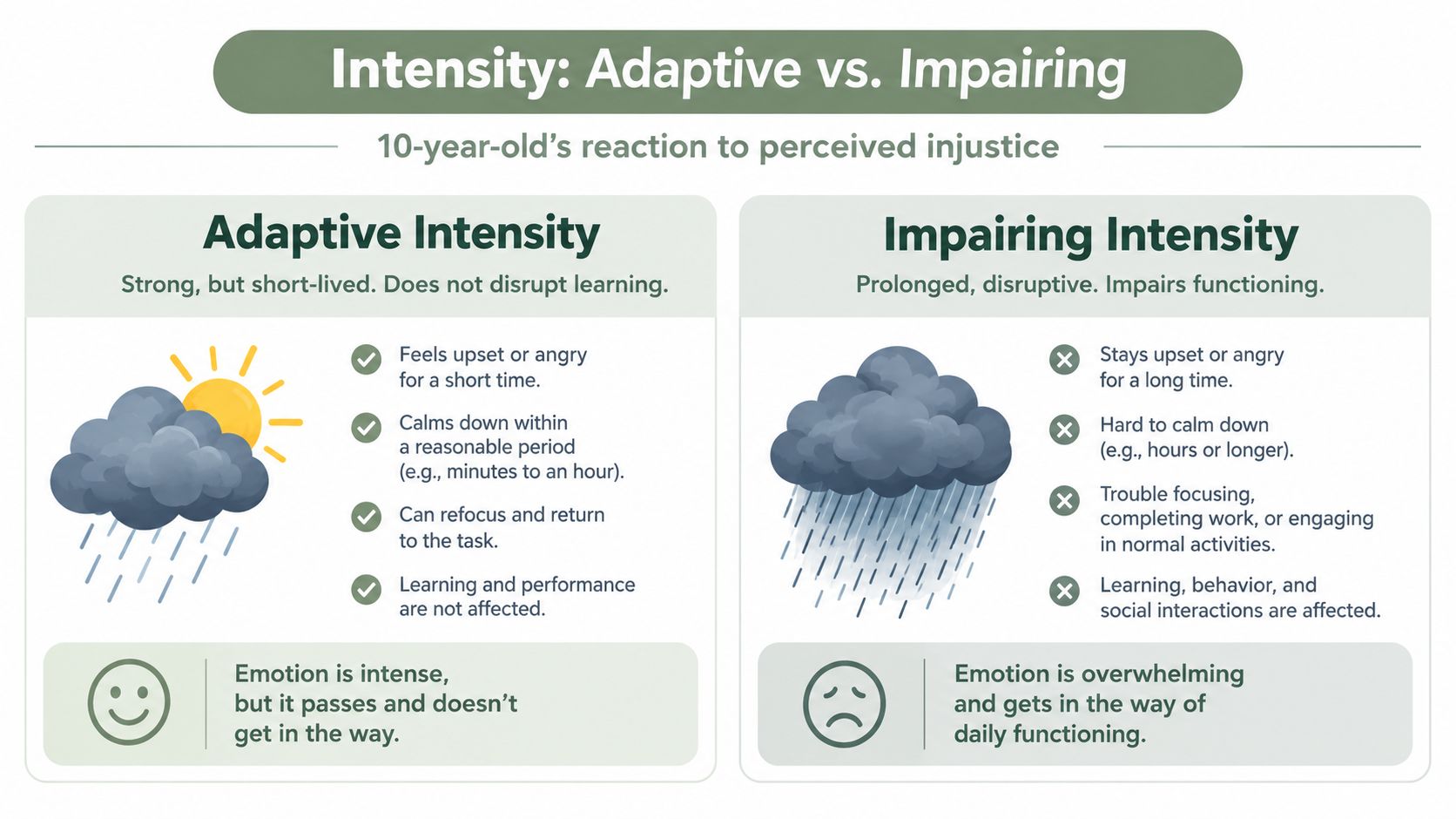
| Adaptive intensity | Impairing intensity | |---|---| | Strong reaction with gradual calming | Escalation continues long after the event | | Child can return to learning or play | Schoolwork, attendance, or activities are disrupted | | Repair remains possible after co-regulation | Shame, withdrawal, or repeated conflict follows | | The feeling identifies a value or concern | Fear of the feeling drives avoidance | | Sleep and relationships remain largely intact | Sleep, friendships, or family routines suffer |
A practical test is to ask two questions: Does the reaction fit the child's experience of the event, and does recovery follow within a reasonable window? You don't need to demand instant calm. You're looking for a developing capacity to regain balance.
Here's a short explanation of adaptive and impairing intensity:
Where Emotional Intensity Meets Anxiety Perfectionism and School Stress
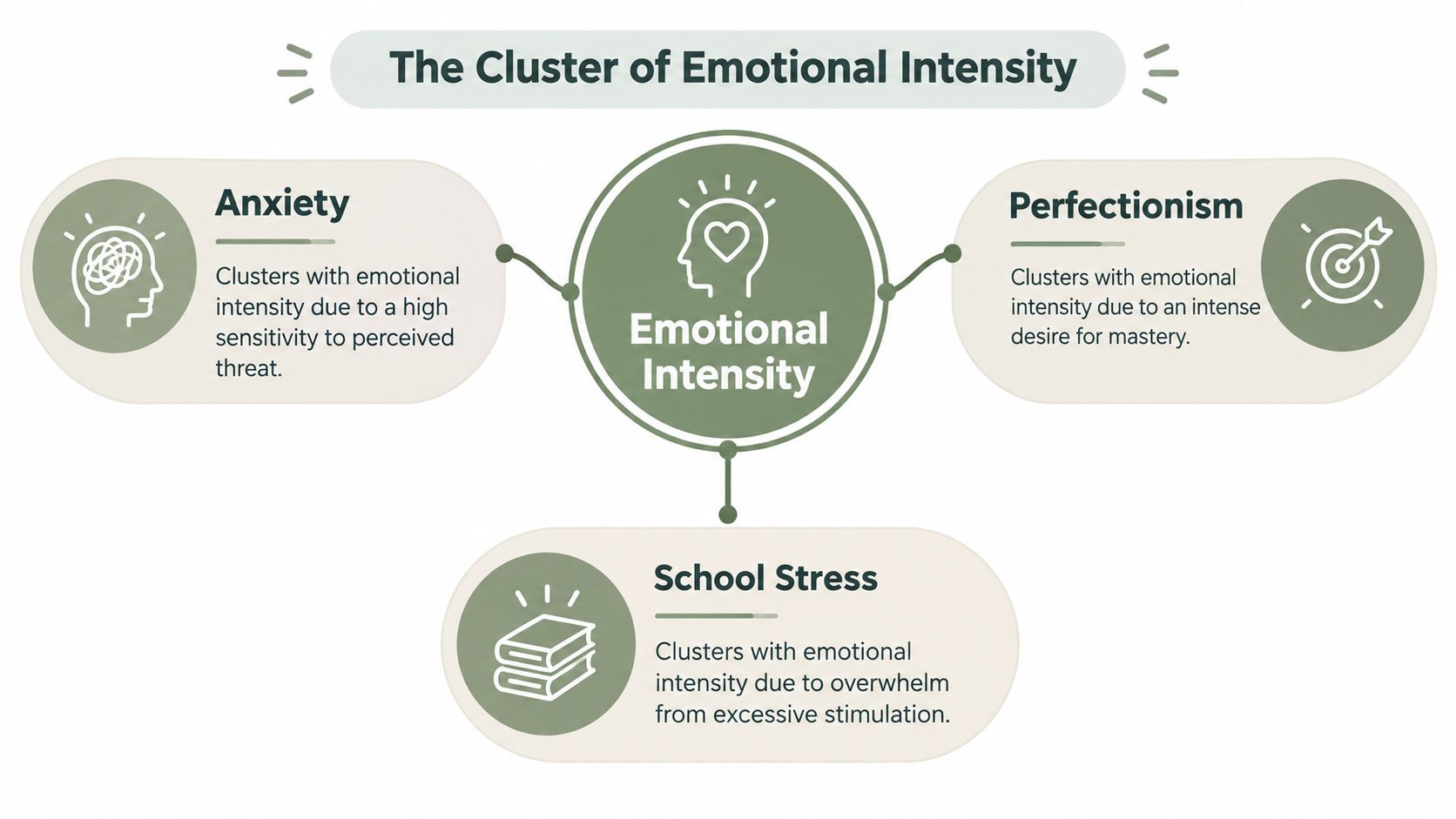
Emotional intensity often becomes harder to understand when anxiety, perfectionism, or school stress enters the picture. These aren't necessarily separate problems stacked neatly beside one another. They can form a feedback loop.
A child who reacts strongly to uncertainty may begin worrying before a test, group project, performance, or social event. Their imagination generates possible failures, their body responds to the anticipated threat, and avoidance then provides short-term relief. The child may appear oppositional when they are trying to escape an experience that feels emotionally unsafe.
Perfectionism adds another layer. A B+ may register as information about one assignment for one child. For another, it may feel like evidence that they aren't intelligent, worthy, or secure. When strong emotion combines with all-or-nothing thinking, a manageable mistake becomes a judgment about the whole self.
School fit changes the pressure
A gifted student may feel distressed because work is too easy, because expectations are too high, or because the classroom doesn't match their developmental profile. Under-challenge can produce boredom, irritability, disengagement, and conflict. A child may also feel socially out of step with classmates or pressured to hide their interests.
Developmental research on highly and profoundly gifted children describes emotional overexcitability alongside stronger reactions to criticism and social evaluation. It also points toward supports that combine emotion-regulation skills with environmental changes, including predictable routines, less invalidation, and explicit coping strategies. (Developmental research on emotional overexcitability and support)
If worry is becoming avoidance, families may also benefit from reviewing resources on child anxiety therapy. The goal isn't to label every reaction as anxiety. It's to identify which pressures are amplifying the child's response and address both regulation and fit.
Practical Strategies for Parents and Teachers at Every Age
Adults support emotional intensity best when they teach skills rather than trying to flatten the child's reactions. The right approach changes as children gain language, self-awareness, and independence.
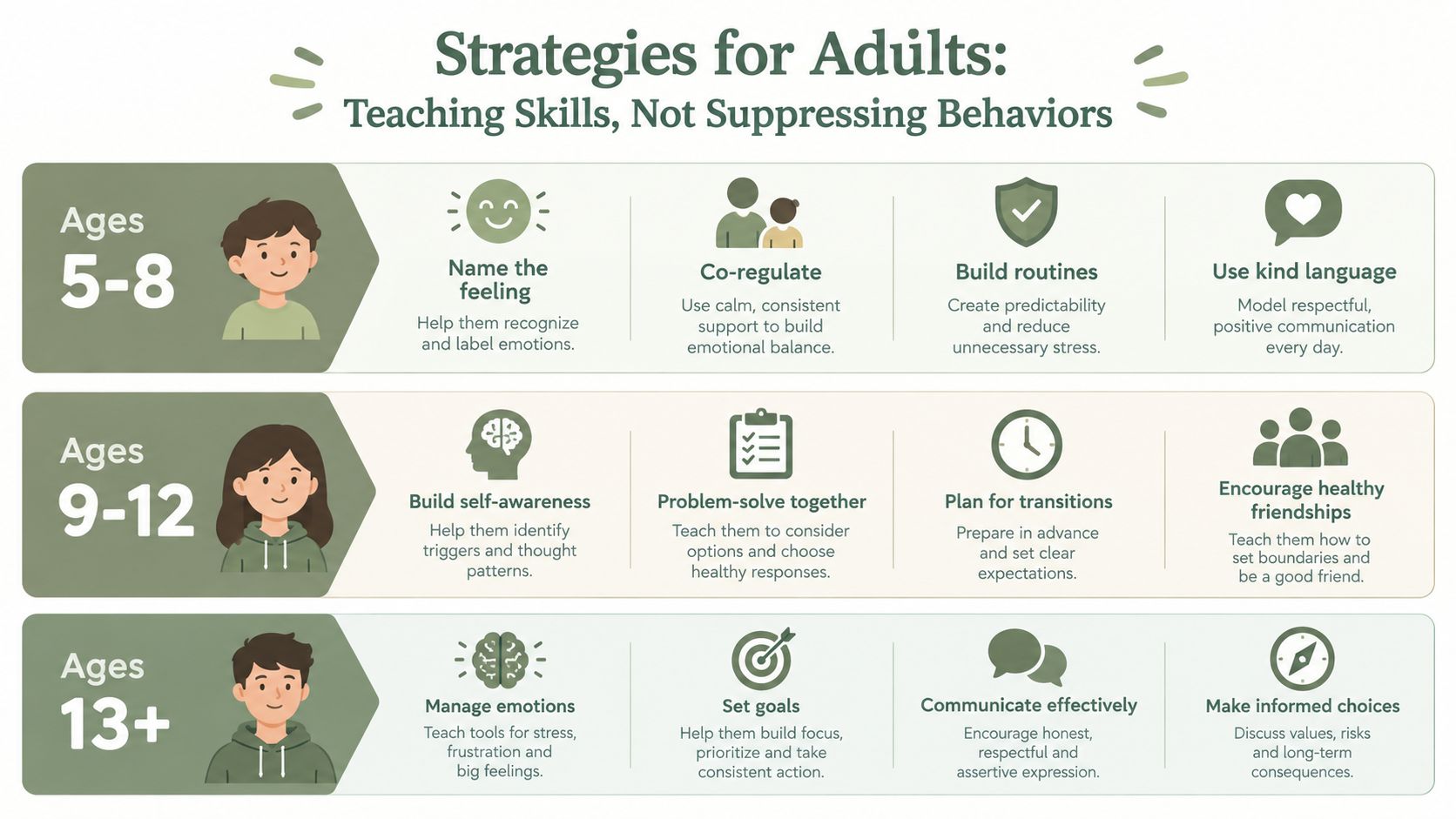
Ages 5 to 8
Young children often need adults to lend them words and nervous-system support.
- Name the feeling: “You're disappointed and angry because the game ended.”
- Create a calm-down space: Keep cushions, drawing materials, and a feelings chart available, without presenting the space as punishment.
- Offer two choices: “Do you want to put on shoes before or after you choose a snack?”
- Practice outside the crisis: Role-play losing a game or changing plans when the child is already calm.
A teacher might preview a transition before recess ends. At home, a parent could say, “Your body is hot, your fists are tight, and your voice is loud. Let's move to the cushion, then choose water or a hug.” The adult isn't arguing with the feeling. They're teaching the sequence of noticing, pausing, and choosing.
Ages 9 to 12
School-age children can begin tracking the connection between body signals and emotional escalation.
Teach a body check that notices heart rate, breathing, muscle tension, and stomach sensations. For difficult subjects, co-create a written plan with a first small step, a request for help, and a planned break. Protect at least one friendship or activity from becoming another performance arena.
A classroom teacher might offer a brief movement break before a challenging task, provide depth options for a student who finishes quickly, and make routines predictable. A parent could write, “When I notice tight shoulders and fast thoughts, I'll take three slow breaths, complete the first problem, and ask for clarification.”
Ages 13 to 18
Adolescents need collaboration and genuine autonomy. Validate the value beneath the reaction, such as fairness, mastery, belonging, or independence, then negotiate practical choices about coursework, deadlines, activities, and recovery time.
A teenager upset about college planning may need an agreed schedule for discussing applications rather than repeated reminders throughout the day. The adult can say, “Your future matters to you. Let's decide which decision is yours, which information we need, and when we'll revisit it.”
Parents can find additional guidance through parent support and resources. Teachers should pair emotional support with appropriate challenge, clear expectations, and a private route for requesting help.
When Emotional Intensity Becomes a Reason to Seek Therapy
Professional support makes sense when intensity starts driving impairment, not only when a child reaches a crisis point. A child may have big feelings and still function well. Concern rises when the pattern repeatedly disrupts sleep, school attendance, friendships, family routines, or the child's sense of self.
Look for changes such as:
- Persistent physical complaints: Stomachaches, headaches, nausea, or exhaustion appear around school, evaluation, transitions, or social demands.
- Avoidance replaces participation: The child stops attending school, refuses assignments, or withdraws from activities they once enjoyed.
- Perfectionism blocks effort: The child won't begin unless success is guaranteed, repeatedly erases work, or treats ordinary mistakes as unbearable.
- Recovery remains limited: The child can't return to ordinary activity after support, or the same crisis repeats across settings.
- Self-worth becomes conditional: The child describes themselves as stupid, bad, disappointing, or unlovable after setbacks.
- Relationships deteriorate: Siblings, peers, or caregivers increasingly avoid the child because conflict feels unpredictable.
A pediatric psychologist can help separate emotional intensity from anxiety, ADHD, autism, mood concerns, or a twice-exceptional profile. Those patterns can overlap, and the same behavior may have different causes. Treatment might include cognitive-behavioral techniques adapted for an abstract thinker, parent coaching, emotional regulation practice, exposure strategies for avoidance, and collaboration with the school.
Families may find it helpful to learn more about what a pediatric psychologist does before scheduling a consultation.
Bring concrete observations to a first appointment:
- What triggers the strongest responses?
- How quickly does escalation occur?
- What helps the child recover?
- Which settings are affected?
- What has changed in sleep, attendance, friendships, or activities?
- Does the clinician understand giftedness and learning differences?
- How will parents and teachers participate in the plan?
A good fit should leave you with a clearer formulation, practical steps, and a way to monitor whether functioning improves.
Turning Deep Feelings Into a Strength and Next Steps
Emotional intensity shouldn't be treated as a defect to extinguish. A child who notices injustice may become a thoughtful advocate. A teenager who experiences relationships intensely may build loyal friendships. Strong imagination and emotional memory can support writing, music, design, leadership, or meaningful service.
The strength appears when the child can direct the feeling instead of being directed by it. A student might turn anger about an unfair school policy into a carefully researched presentation. Another might use empathy to welcome a new classmate, then practice leaving the problem at school rather than carrying it through the night.
A qualitative study of parents of gifted adolescents described intensity as daily friction that could include sensitivity, frustration, oppositional behavior, and high demands. That framing matters because families often need more than reassurance. They need support with regulation, expectations, routines, and the fit between the child and the environment. (Qualitative study of parents of gifted adolescents)
The aim isn't smaller feelings. It's greater choice.
Choose one strategy this week. You might name body signals, schedule a calm conversation about school fit, or create a written plan for one predictable trigger. Tell one trusted adult what you're observing so your child receives a consistent response across settings. If the warning signs above are present, schedule a consultation with a pediatric psychologist rather than waiting for the pattern to worsen.
Wald Behavioral Health provides developmentally informed therapy, parent guidance, and family support for children, adolescents, young adults, and caregivers dealing with anxiety, school stress, perfectionism, and difficult emotions. Visit Wald Behavioral Health to learn about in-person care in Coral Gables, telehealth availability, and a free 15-minute consultation.
Questions about your child or teen?
Dr. Wald offers a free 15 minute consultation to talk through what you are seeing and whether the practice is a good fit.
Free 15 Minute Consultation