ADHD Therapy Interventions: Key Strategies for 2026
You've probably seen the pattern at home. Your child loses track of instructions, resists getting ready for school, fights through homework, and then can't settle at bedtime. A teacher may be reporting incomplete work or impulsive behavior, while your child insists they're trying. These problems look connected, but they often need different supports.
ADHD therapy interventions work best when they're organized around the child's actual day, not treated as a single technique that should fix everything. A younger child may need parent coaching and classroom structure. An adolescent may need cognitive behavioral therapy, planning systems, emotional regulation skills, and a more active role in medical decisions. Sleep, family stress, learning needs, anxiety, and depression can also change the plan.
The American Academy of Pediatrics formalized evidence-based ADHD treatment recommendations for school-age children and adolescents in its 2011 guideline, later adding guidance on coexisting and comorbid conditions through its ADHD clinical guidance. That evolution matters because effective care has to address overlapping concerns, not just attention.
The interventions below are arranged around home, school, sleep, emotional regulation, and medical care. Use them to identify the most urgent functional problem, choose a manageable starting point, and recognize when a pediatric psychologist can coordinate more support.
## Table of Contents - 1. Cognitive Behavioral Therapy for ADHD - What to practice between sessions - 2. Parent Training and Behavior Management - Make the first target observable - 3. Executive Function Coaching and Skills Training - Build external memory - Match the developmental stage - 4. Medication Management Coordination and Psychoeducation - Keep communication concrete - 5. School Consultation and Academic Accommodations Support - Give teachers usable information - 6. Mindfulness and Acceptance-Based Interventions - Keep the practice brief and concrete - 7. Social Skills Training and Peer Relationship Support - Practice performance, not just knowledge - 8. Sleep and Bedtime Behavior Intervention - Treat the routine as a behavior plan - 9. Emotion Regulation and Distress Tolerance Skills Training - Teach the skill before the crisis - 10. Integrated Multimodal ADHD Treatment - Coordinate priorities - Comparison of 10 ADHD Therapy Interventions - Choose the Right Next Step for Your Child
1. Cognitive Behavioral Therapy for ADHD
CBT helps a child, teen, or adult connect thoughts, emotions, and actions to the moments when ADHD creates real difficulty. A student who thinks, “I can't focus, so there's no point starting,” may avoid an assignment until the pressure becomes overwhelming. Therapy challenges the defeatist thought, then adds a concrete action, such as opening the assignment, identifying the first step, and working with a timer.
For children, CBT needs developmental adaptation. Sessions may use drawings, games, visual calendars, written summaries, and parent coaching rather than relying on abstract discussion. An adolescent might use a weekly planning sheet to break a research project into smaller tasks, while a parent helps establish a consistent evening review.
Psychological interventions show measurable but generally modest benefits. An umbrella review reported standardized mean differences of 0.42 for parent-rated outcomes and 0.25 for teacher-rated outcomes, while a broader psychosocial review found an overall effect of about 0.26, as summarized in the AAP ADHD treatment guidance. These findings support therapy as a meaningful part of care, especially for functioning and routines, without promising that CBT alone will eliminate symptoms.
What to practice between sessions
Start with one or two goals. A family might choose “begin homework with one reminder” and “prepare the backpack before bed.” Parents can learn more about behavioral therapy for ADHD while working with the clinician to reinforce the same skills at home.
CBT is less useful when sessions stay focused on insight without home practice. Written plans, frequent check-ins, and small rewards make the skills easier to carry into daily life.
2. Parent Training and Behavior Management
Parent-focused treatment changes the environment around the child. Instead of repeating a general instruction such as “be responsible,” parents learn to give one clear direction, check understanding, reinforce the desired behavior quickly, and apply predictable consequences when necessary.
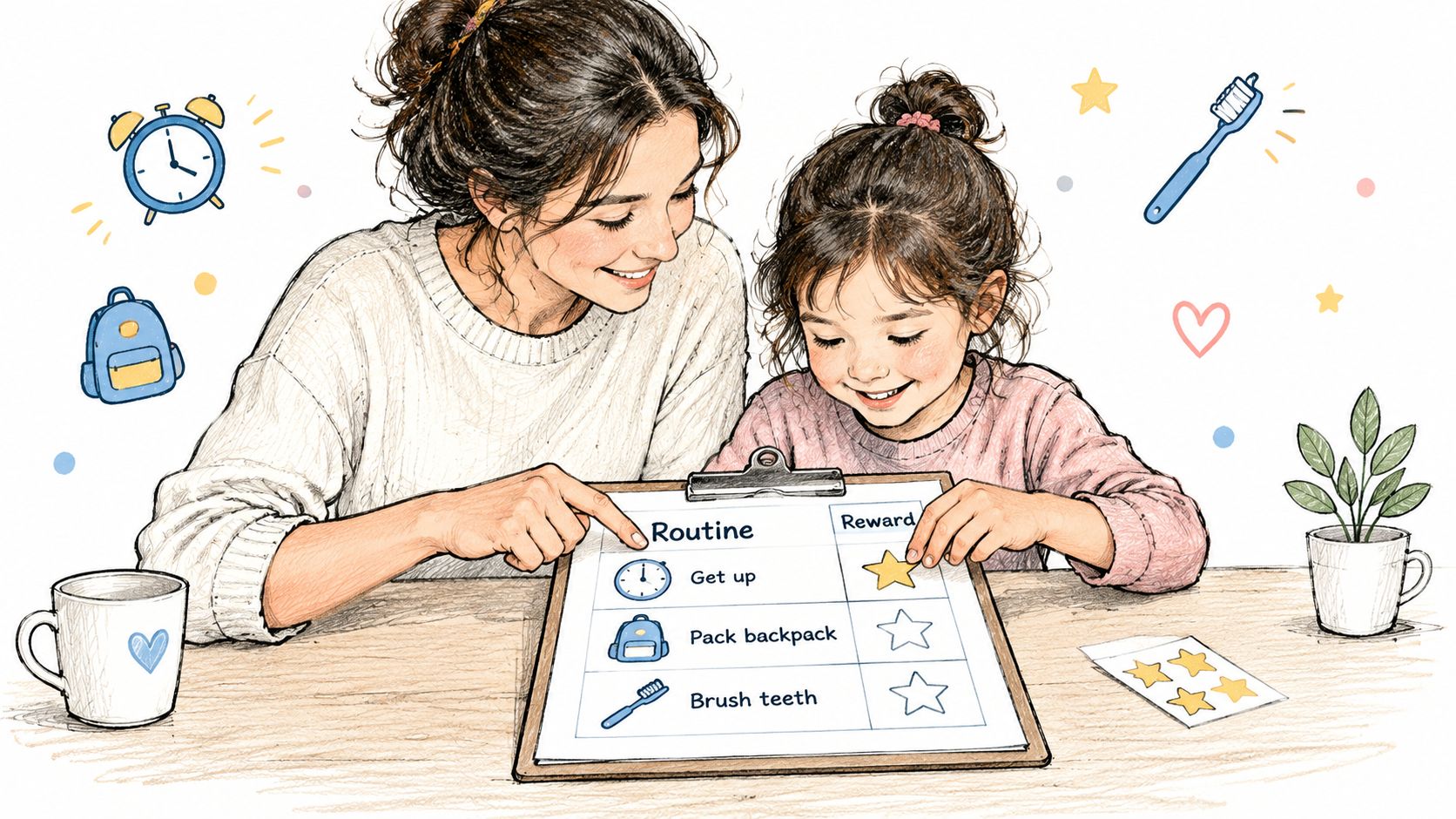
Consider a difficult morning. A visual routine might list getting dressed, eating, brushing teeth, and collecting school materials. The child earns a preferred activity for completing the sequence, while the parent avoids turning every missed step into a lengthy argument. The same approach can be adapted for homework, screen transitions, sibling conflict, and bedtime.
Parent training has effects beyond the child's core symptoms. A large meta-review found improvements in child ADHD symptoms, social skills, and academic performance, along with a strong positive-parenting effect of 0.68. In probably blinded assessments, positive parenting remained moderate at 0.63, and reductions in negative parenting measured 0.43, according to this review of behavioral ADHD interventions.
Make the first target observable
Choose one behavior, such as starting the morning routine by a specific time, rather than attempting to redesign the entire household. Parents can also explore ADHD parent coaching to troubleshoot the plan and reduce exhausting cycles of nagging and refusal.
The plan should account for setbacks. ADHD behavior varies with sleep, stress, task difficulty, and medication changes. A compassionate parent plan reinforces effort and consistency, not perfection, and uses the same key expectations at home and school whenever possible.
3. Executive Function Coaching and Skills Training
Executive function coaching addresses the practical gap between knowing what to do and being able to start, sequence, and finish it. This is often central for adolescents, college students, and young adults who must manage assignments, appointments, materials, and transitions with less adult supervision.
A teen writing a long paper may understand the assignment but still fail to begin because the task feels too large. Coaching turns the project into steps, places interim deadlines on a calendar, estimates the time required, and adds reminders before each transition. A younger child may need a physical “launch pad” near the door, while a college student might use Google Calendar, Todoist, or Notion.
Build external memory
The most effective system usually lives outside the person's head. A simple setup might include:
- One calendar: Put classes, appointments, deadlines, and preparation time in one place.
- Task breakdown: Convert “finish project” into research, outline, draft, revise, and submit.
- Transition alerts: Use phone reminders before leaving, changing tasks, or starting a study block.
- Shutdown routine: Review tomorrow's schedule and place required materials where they'll be found.
The trade-off is that a system can become another unfinished project. Start with one tool, practice it repeatedly, and reward use of the system rather than flawless follow-through. Coaching should also include reverse planning from a due date and realistic time estimation, because a calendar filled with impossible commitments quickly loses credibility.
Match the developmental stage
Children need adults to prompt and reinforce the system. Teens should gradually take ownership while parents still provide accountability. Young adults may benefit from weekly coaching check-ins focused on reviewing what worked, identifying breakdowns, and simplifying the plan.
4. Medication Management Coordination and Psychoeducation
Therapy and medication address different parts of ADHD care. A prescriber evaluates whether medication is appropriate, monitors response and adverse effects, and makes prescribing decisions. A therapist helps the child and family understand the treatment, track functional changes, and build routines that remain important across settings.
A child may understand medication more easily through a concrete explanation: it can help make focus easier, while therapy teaches strategies for using that improved access to attention. A teen who resists medication may need space to discuss stigma, side effects, identity, and fears about dependence rather than being pressured into agreement.
ADHD care often extends beyond childhood. A global analysis reported average DSM-IV adult ADHD prevalence of 2.8%, with estimates of 3.6% in high-income countries, 3.0% in upper-middle-income countries, and 1.4% in low and lower-middle-income countries in the published epidemiologic analysis. The same source describes CBT evidence for adults, including a standardized mean difference of 0.76 against a waitlist and 0.43 against active controls. These findings support age-appropriate care, not a child-only model.
Keep communication concrete
With appropriate consent, the therapist and prescriber can share behavioral observations, sleep concerns, school reports, and changes in daily functioning. A simple log can compare task initiation, appetite, sleep, emotional reactions, and school participation over time.
Therapy shouldn't tell a family to start, stop, or change medication. Those decisions belong with the prescribing clinician. The therapist's role is to help families interpret day-to-day patterns and combine medical care with practical behavioral support.
5. School Consultation and Academic Accommodations Support
A child may manage reasonably well in a quiet therapy office and still struggle in a crowded classroom. School consultation brings the treatment plan into the environment where attention, organization, movement, peer interaction, and academic demands occur.
A therapist can help parents prepare for communication with teachers, school counselors, and administrators. Useful recommendations are specific, such as seating that reduces distractions, shorter instruction segments, assignment chunking, movement opportunities, written directions, or a predictable check-in. Depending on the child's needs and eligibility, families may also discuss formal supports such as a 504 plan or IEP with the school.
Give teachers usable information
Long reports often fail when they don't translate into classroom actions. A one-page summary can identify the student's strengths, the behaviors that interfere with learning, the supports to try, and how adults will know whether the support is helping.
Homework deserves its own plan. “Complete homework independently” is too broad. A useful plan identifies where work happens, how assignments are divided, when breaks occur, what prompts parents provide, and what reinforcement follows completion.
School supports are not a substitute for treatment, and therapy can't guarantee that every accommodation will be approved. The clinician can provide a functional perspective, but the school determines educational services through its own evaluation and processes. Early collaboration usually gives adults more time to adjust strategies before academic frustration and conflict intensify.
6. Mindfulness and Acceptance-Based Interventions
Mindfulness teaches the child to notice attention drifting, body tension, frustration, or an impulsive urge without immediately reacting. Acceptance-based work adds a second skill, responding to the experience without turning it into a judgment such as “I'm bad at everything” or “I'll never get this done.”
For a child who can't sit through a long meditation, the intervention may involve movement, walking, stretching, or sensory grounding. A therapist might ask the child to notice the feeling of their feet on the floor, identify sounds in the room, or describe what they see. A parent can practice taking a few deliberate breaths before responding to refusal, which creates a pause in the escalation cycle.
Keep the practice brief and concrete
The intervention fails when adults present it as a test of willpower. Use a short exercise, then connect it to a specific problem:
- Before homework: Notice the body, name the first task, and begin.
- During frustration: Feel both feet on the floor and slow the exhale.
- During transition: Observe three things in the room before moving on.
- During conflict: Pause long enough to choose a calm instruction.
Mindfulness isn't a replacement for parent training, school support, medication management, or sleep treatment when those are needed. It can be a useful regulation tool, particularly for children and parents who become caught in rapid cycles of criticism and reaction. Treat it as an experiment, celebrate brief moments of awareness, and adapt the practice to the child's developmental level.

7. Social Skills Training and Peer Relationship Support
ADHD can disrupt friendships even when a child wants connection and understands social rules in theory. Interrupting, missing cues, moving too quickly, or reacting strongly to rejection can create repeated peer problems. Social skills training makes the invisible steps explicit and gives the child a safe place to practice them.
For example, joining a playground game can be taught as a sequence. The child approaches, watches briefly, asks what the group is doing, waits for an answer, and then suggests a related idea. Role-play lets the therapist pause, offer feedback, and try the interaction again without the emotional cost of a real rejection.
Practice performance, not just knowledge
A child may correctly explain turn-taking during therapy and still interrupt in a noisy lunchroom. Practice should therefore move from low-pressure role-play toward structured opportunities at school, in clubs, or with a carefully chosen peer. Parents can reinforce attempts to greet, wait, repair a misunderstanding, or try again.
Video feedback can help some children see behaviors they don't notice in the moment. Rejection sensitivity also deserves attention. A therapist may help the child distinguish “that peer was busy” from “nobody likes me,” then plan a next step.
Practical rule: Praise the attempt to use a social skill, not only the outcome. A peer interaction can go poorly even when the child approaches thoughtfully.
Group treatment may be useful when the setting is well structured and the child receives immediate coaching. It won't solve every friendship problem, especially when bullying, anxiety, language differences, or autism-related social needs are also present. School collaboration can create safer, more supported chances to practice.
8. Sleep and Bedtime Behavior Intervention
A child who takes a long time to settle may look more inattentive or irritable the next day. Bedtime resistance can also become a nightly negotiation, with screens, repeated requests, and inconsistent parent responses keeping everyone activated.
Behavioral sleep treatment begins with assessment. Ask about bedtime, wake time, nighttime awakenings, snoring, restless sleep, anxiety, medication timing, and the routines that occur before lights out. A predictable sequence might include washing, pajamas, a quiet activity, and lights out, supported by a visual chart and a consistent morning wake time.
Treat the routine as a behavior plan
If a child refuses bedtime, the answer isn't always to demand an earlier lights-out time. The clinician and parents may adjust the routine gradually, remove stimulating activities from the bedroom, offer a preferred calming activity, and reinforce cooperation. If medication appears connected to sleep-onset difficulty, the family should discuss timing or other options with the prescriber rather than making changes independently.
Sleep intervention works best when parents receive coaching. Adults need a shared response to requests, protests, and delayed settling, because inconsistent consequences can unintentionally extend the negotiation. Families can track sleep patterns in a simple weekly log and use that information to decide whether the plan is helping.
For guidance related to behavioral sleep concerns, families can review Wald Behavioral Health's sleep services. Persistent snoring, unusual movements, severe daytime sleepiness, or other concerning symptoms warrant medical assessment rather than a behavioral plan alone.
9. Emotion Regulation and Distress Tolerance Skills Training
Some children with ADHD move from mild frustration to shouting, throwing, or refusing within moments. Therapy helps identify the early signs, understand common triggers, and practice a response before the escalation becomes too intense for reasoning.
A therapist may use an emotional thermometer or color-coded zones to show the difference between calm, activated, and overwhelmed states. During calm practice, the child can rehearse paced breathing, muscle relaxation, a brief movement break, or squeezing a pillow instead of hitting. DBT-informed distress tolerance skills can be adapted into short, concrete exercises for children and adolescents.
Teach the skill before the crisis
Parents shouldn't introduce a complicated strategy for the first time during a meltdown. Practice through games, stories, and role-play, then choose one cue that adults can use consistently. “Your body is in the red zone. Let's move to the reset space” is more useful than “Calm down.”
Parents also need coaching on how to support regulation without shaming. Matching the child's intensity usually increases the conflict. A calm adult can block unsafe behavior, reduce verbal demands, offer a practiced choice, and return to problem-solving after the nervous system has settled.
Emotion regulation training isn't meant to excuse aggression or unsafe conduct. It adds a plan for preventing escalation and repairing harm. If outbursts are severe, frequent, or associated with depression, anxiety, trauma, or safety concerns, a fuller assessment is important because ADHD may not be the only factor driving the behavior.
10. Integrated Multimodal ADHD Treatment
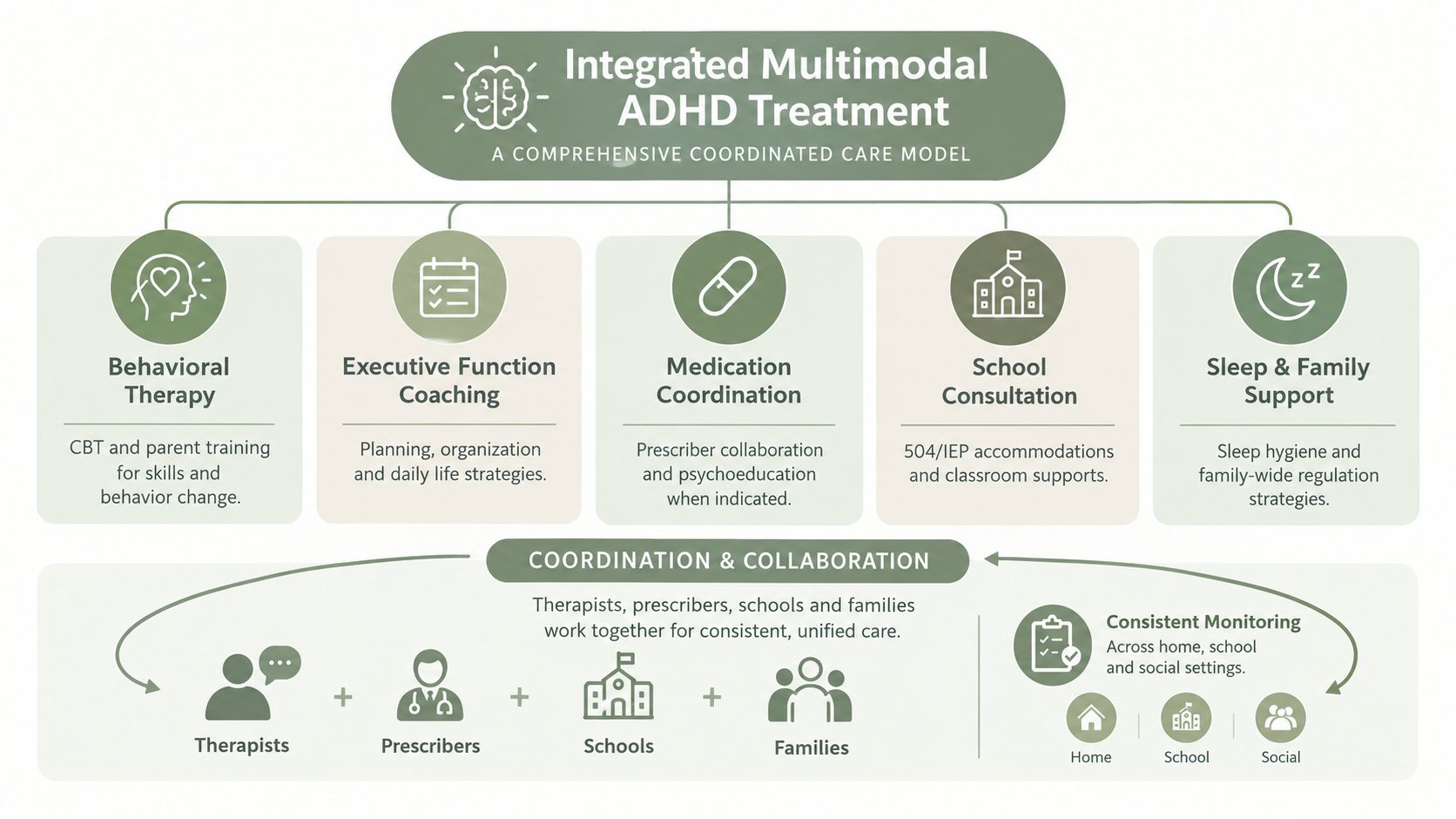
Integrated treatment coordinates interventions instead of asking the child to carry separate, disconnected plans. A younger child might receive parent training, classroom supports, and sleep intervention. An adolescent may add CBT, executive function coaching, emotional regulation work, and medication coordination. A college student may need planning support, prescriber follow-up, and coordination with campus disability services.
The American Academy of Pediatrics' later attention to coexisting and comorbid conditions reflects a central clinical reality. ADHD can overlap with anxiety, depression, learning difficulties, sleep problems, and family stress, so the treatment plan has to identify which problem is impairing daily life most.
Coordinate priorities
A practical plan names one primary coordinator, such as the therapist, and identifies who owns each task. The prescriber manages medication decisions. Parents reinforce routines. Teachers implement classroom strategies. The child or teen practices skills at an age-appropriate level.
Treatment reach remains a real concern. In a 2025 population study, about 40% of children and adolescents with an administrative ADHD diagnosis were currently receiving treatment, while 76% of parents who had accessed care reported satisfaction and 85% judged treatment effective, according to the study published in PubMed. The pattern suggests that access and persistence can be as important as families' perceived value once care begins.
Digital tools deserve careful evaluation. A review of 26 systematic reviews found that digital ADHD interventions showed potential but remained inconclusive overall because evidence quality was low or critically low, as reported in the digital intervention review. An app can support reminders or practice, but engagement isn't the same as durable clinical improvement. Choose tools that support a clinician-approved plan rather than replacing assessment and coordinated care.
Comparison of 10 ADHD Therapy Interventions
| Intervention | Implementation Complexity 🔄 | Resource & Time Requirements ⚡ | Expected Outcomes & Impact ⭐📊 | Ideal Use Cases & Key Advantages 💡 | |---|---:|---:|---|---| | Cognitive Behavioral Therapy (CBT) for ADHD | Moderate, High, structured protocol, requires ADHD-specific therapist training | High, weekly sessions, 12, 20+ sessions, homework and parent involvement | Reduces ADHD symptoms ~30, 40%; improves anxiety/depression; builds transferable executive skills | Best for school‑age and adolescents; complements medication; teaches time‑management and coping skills | | Parent Training & Behavior Management | Moderate, curriculum-based coaching, consistent home implementation needed | Moderate, group or individual sessions; substantial parent time and practice | Effect sizes 0.5, 1.0 on behavior; improves family functioning; can reduce medication need in young children | First‑line for preschool/early elementary ADHD; cost‑effective; strengthens parent consistency | | Executive Function Coaching & Skills Training | Moderate, individualized assessment and system setup; requires skilled coach | Moderate, Ongoing, frequent coaching early, tools (timers, apps, planners) | Improves planning, task initiation, organization; empowers adolescents/young adults | Ideal for teens/college/work transitions; practical, technology‑friendly supports | | Medication Management Coordination & Psychoeducation | Low, Moderate, requires good communication with prescriber, monitoring systems | Low, Moderate, symptom tracking, occasional care coordination | When combined with therapy → superior outcomes (MTA); improves adherence and informed decisions | Useful when medication is considered/used; reduces stigma and supports trials/adjustments | | School Consultation & Academic Accommodations Support | Moderate, liaison work, paperwork for 504/IEP, teacher collaboration | Moderate, meetings, reports, follow‑ups with school staff | Increases generalization of skills to classroom; improves academic performance and consistency | Essential for school‑age children with educational impact; helps secure accommodations and teacher buy‑in | | Mindfulness & Acceptance‑Based Interventions | Low, Moderate, must be adapted for attention limits | Low, short practices (3, 10 min), home practice needed | Small, moderate effects (0.3, 0.6) on stress and emotional regulation; boosts self‑compassion | Adjunctive use for emotion regulation and anxiety; good when families commit to brief daily practice | | Social Skills Training & Peer Support | Moderate, group facilitation, role‑play, feedback cycles | Moderate, repeated sessions, practice opportunities outside therapy | Improves social competence and peer interactions; benefits require deliberate generalization | Children/adolescents with peer difficulties; group formats provide naturalistic practice | | Sleep & Bedtime Behavior Intervention | Moderate, structured assessment and bedtime routine coaching | Low, Moderate, parent‑implemented routines; may need prescriber coordination | Often yields improvements within 1, 2 weeks; effect sizes 0.5, 1.0 on ADHD measures via better sleep | Foundational for children with sleep disturbance; enhances daytime regulation and medication effectiveness | | Emotion Regulation & Distress Tolerance Training | Moderate, High, DBT‑informed skills require repetition and coaching | Moderate, skill practice, parent modeling, homework | Reduces outbursts and impulsive reactions; improves coping and interpersonal outcomes | Priority when emotional dysregulation causes harm; pairs well with behavioral/medication approaches | | Integrated Multimodal ADHD Treatment | High, coordination across providers, individualized multimodal plan | High, multiple providers, regular monitoring, greater time/cost investment | Superior functional outcomes vs single treatments (supported by MTA); broad domain improvements | Best for moderate, severe or complex cases; maximizes generalization across home, school, and medical settings |
Choose the Right Next Step for Your Child
Don't begin by trying every intervention. Begin with the problem that is causing the greatest impairment and can be observed clearly. If mornings are chaotic, parent training and a visual routine may deserve priority. If homework never starts, CBT or executive function coaching may be more relevant. If bedtime resistance affects the entire household, assess sleep and build a consistent behavior plan before adding more academic demands.
Write the target in observable language. “Improve focus” is difficult to track. “Starts the first homework task after one reminder” gives the family and clinician something concrete to review. Record what happens now, choose one support, and check whether the child's behavior, stress, or daily functioning changes. A brief parent log, teacher feedback, assignment record, or sleep diary can reveal patterns that memory misses.
Medication decisions should stay with the prescribing professional, but therapy can make those appointments more useful. Bring observations about sleep, appetite, emotional reactions, task initiation, classroom participation, and medication adherence. With appropriate consent, the therapist, prescriber, school, and family can share relevant information instead of each working from a partial picture.
A pediatric psychologist can help when impairment persists across home and school, family or school conflict is escalating, sleep or emotional concerns are becoming central, or the diagnosis remains uncertain. Referral is also appropriate when anxiety, depression, learning issues, social difficulties, or other comorbidities may be contributing. Parents don't need to wait until the situation becomes unmanageable, especially when implementing routines alone has become exhausting.
Wald Behavioral Health provides individualized therapy for children, adolescents, young adults, and families, with parent training, school-aligned support, and developmentally appropriate care for ADHD and related concerns. The practice offers in-person appointments in Coral Gables and telehealth for clients in Florida, Maryland, and PSYPACT-participating states, subject to applicable requirements. Families can use the practice's free 15-minute consultation to discuss needs, fit, and scheduling through Wald Behavioral Health.
Choose one functional target this week. Write down what currently happens, identify the adult or professional who can support the change, and schedule a consultation if the problem continues across settings or your family needs a coordinated plan.
---
Wald Behavioral Health offers evidence-based ADHD therapy, parent training, family guidance, and school-aligned support for children, adolescents, young adults, and families. Visit Wald Behavioral Health to request a free 15-minute consultation and discuss in-person or telehealth care options.
Questions about your child or teen?
Dr. Wald offers a free 15 minute consultation to talk through what you are seeing and whether the practice is a good fit.
Free 15 Minute Consultation