ADHD and Therapy: A Practical Guide for Every Age

A Tuesday evening can make ADHD treatment feel confusing. Your child took medication in the morning, paid attention in class, and still spends hours starting homework, losing materials, arguing over transitions, or melting down before bedtime. You may be wondering whether the dose is wrong, whether your expectations are too high, or whether therapy could help with the parts of ADHD that medication doesn't reach.
ADHD and therapy work best when they address daily functioning, not only a symptom checklist. Medication can reduce inattention, impulsivity, and hyperactivity during its active window. Therapy teaches the child, caregivers, and sometimes teachers how to build routines, respond to behavior, manage emotions, and make important tasks easier to start and finish.
## Table of Contents - Why ADHD Care Needs More Than a Prescription - What therapy adds - How ADHD Therapy Became Evidence-Based Care - From behavior control to skill building - Why the evidence base matters - The Treatment Gap Most Families Fall Into - Three pathways with different trade-offs - Behavioral Parent Training That Changes the Home Environment - The three mechanics parents practice - Skills-Based CBT for Older Kids, Teens, and Adults - External systems for an unreliable memory - Adult applications and limits - School Supports That Reinforce Therapy at Home - Requests parents can make in meetings - Coordinating Therapy With Medication and Providers - Three workable care arrangements - Matching Therapy to Age and What Realistic Progress Looks Like - What progress should look like
Why ADHD Care Needs More Than a Prescription
A preschooler may take medication and still need an adult beside them for every step of getting dressed. Years later, that same child may sit through class yet miss deadlines, misjudge how long assignments will take, or avoid asking for help. The treatment task changes with age because ADHD shows up differently as expectations, settings, and responsibilities change.
Medication can reduce inattention, impulsivity, and hyperactivity during its active window. It does not teach a child how to begin a routine, repair a conflict, or plan a week. Therapy turns improved attention into usable behavior, while caregivers provide practice and structure at home. The clinician's role is to assess the pattern, teach an intervention, adjust it to the child, and help the family judge whether it is working.
What therapy adds
For preschool and early elementary children, Morning transitions are mainly an adult coaching issue. A therapist can help parents give brief directions, use visual cues, keep the sequence predictable, and reinforce each completed step. Parents can run that routine at home. They should not be expected to design a behavior plan without guidance when safety, severe distress, or persistent conflict is involved.
With school-age children, Homework structure may include a clear start cue, fewer distractions, smaller work periods, planned breaks, and a place for materials. The family implements the routine, while the clinician identifies whether avoidance reflects skill deficits, anxiety, learning problems, medication timing, or a poor task fit.
- Home behavior plans: Parents can use point systems, planned consequences, and specific praise instead of repeating commands until everyone is distressed.
- School communication: A clinician can help convert broad concerns into observable targets, such as recording assignments, beginning independent work, or asking for clarification.
- Executive skills: Older children, teens, and college students can practice calendars, reminders, written checklists, time estimates, and routines that reduce reliance on memory.
- Emotional regulation: Therapy can address frustration, shame, rejection sensitivity, avoidance, and rapid escalation. Parents can reinforce coping attempts, while assessment and treatment of persistent emotional difficulties stay with the clinician.
Practical rule: If medication improves performance in one setting but difficulties continue at home, in relationships, or during transitions, ask which skill or environmental support is missing before assuming the dose should increase.
The American Academy of Pediatrics guidance on ADHD treatment gives behavioral therapy an important role for young children and identifies parent training and classroom management as core behavioral interventions. Medication and therapy address different parts of care. Medication may make skills easier to practice, while therapy helps those skills become part of ordinary life.
How ADHD Therapy Became Evidence-Based Care
A preschooler who cannot wait, follow a routine, or recover from frustration may need a different therapy plan from a college student missing deadlines. ADHD therapy became more useful as clinicians moved beyond stopping disruptive behavior and began teaching skills while changing the environments around the person.
Earlier behavioral approaches often relied on rewards and consequences to reduce difficult behavior. Those tools still have a place. The broader question is now: What does the child need to learn, and what must the adults change around the child so learning can occur?
A foundational shift took shape in the 1980s, as behavioral parent training, cognitive-behavioral therapy, and classroom management gained prominence. A 1982 study by Kendall and Braswell helped show that cognitive-behavioral techniques could teach hyperactive children self-monitoring and problem-solving skills, rather than leaving adults to control behavior. The historical development of these approaches is described in the review of ADHD psychotherapy and behavioral treatment.
From behavior control to skill building
The difference appears in the questions clinicians ask. Instead of focusing only on how to stop a child from interrupting, treatment examines whether the child can recognize the impulse, pause when conversation feels slow, and repair the mistake afterward. It also considers whether the classroom provides a useful cue and whether the caregiver can reinforce a successful attempt promptly.
Parents can change routines, give clear instructions, use planned rewards, and practice skills between sessions. The clinician should assess impairment, set treatment targets, teach the intervention, and adjust it when progress stalls. That division matters. A parent can reinforce a coping strategy at home, but persistent emotional difficulties require clinical assessment rather than home discipline alone.
The treatment shape changes with age. For preschoolers, caregiver responses and home structure often receive the most attention. School-age children may need parent training, classroom coordination, and guided practice with homework or peer problems. For teens and adults, CBT addresses planning, organization, procrastination, emotion regulation, and beliefs formed after repeated criticism or missed deadlines.
Why the evidence base matters
Evidence-based care gives families practical questions. Does the program use written goals, between-session practice, behavior tracking, and strategies designed for ADHD? How will the clinician decide whether a tool is helping? Clear answers make it easier to distinguish active treatment from general reassurance.
The American Academy of Pediatrics recommends behavioral therapy as the initial treatment for children younger than 6 years, while stimulant medication is recommended as a first-line intervention for children 6 years and older. This framework still leaves room to match care to age, impairment, family priorities, and the settings where symptoms interfere.
The Treatment Gap Most Families Fall Into
Diagnosis often leads to medication management because prescribing appointments may be easier to access than specialized behavioral health. The result is a treatment pattern in which many people receive medication without the therapy that helps them apply improved attention to homework, relationships, routines, and work.
The 2023 data show this gap clearly. Among children and adolescents with ADHD, 40.9% received no treatment, 47.8% received drugs alone, 4.2% received psychotherapy alone, and 7.1% received multimodal therapy. Among adults, 44.4% received no treatment, 38.0% received drugs alone, 7.6% received psychotherapy alone, and 10.0% received multimodal therapy. The same dataset reported an administrative ADHD prevalence of 3.6% in children and adolescents and 0.6% in adults. These findings appear in the 2023 ADHD treatment-pattern analysis.
Three pathways with different trade-offs
| Pathway | Children | Adults | |---|---|---| | Medication alone | May reduce core symptoms during the medication window, but leaves routines, parent responses, and school implementation largely unchanged. | May improve attention and impulse control, while organization, procrastination, relationships, and workplace systems still require active practice. | | Therapy alone | Can fit families who decline medication or whose impairment can be addressed through environmental and behavioral changes. | Can fit adults with milder presentations, medication concerns, or a clear preference for weekly skills coaching. | | Multimodal care | Combines medication with parent training, classroom supports, and child-focused skill practice when impairment crosses settings. | Pairs medication with CBT, coaching, or other targeted therapy when symptoms and functional problems reinforce one another. |
Medication-only treatment isn't automatically poor care. Some people function well with medication and a few environmental adjustments. The problem appears when the plan stops at symptom reduction even though the child remains unable to complete homework or the adult remains unable to manage work demands.
Families also face real barriers. Behavioral health clinicians with ADHD expertise may be difficult to find, insurance systems may separate prescribing from therapy, and caregivers may struggle to attend appointments while managing school, work, transportation, and other children. Telehealth parent training and integrated primary care can reduce some access problems, but families should still ask how progress will be measured and how recommendations will reach the home or classroom.
Behavioral Parent Training That Changes the Home Environment
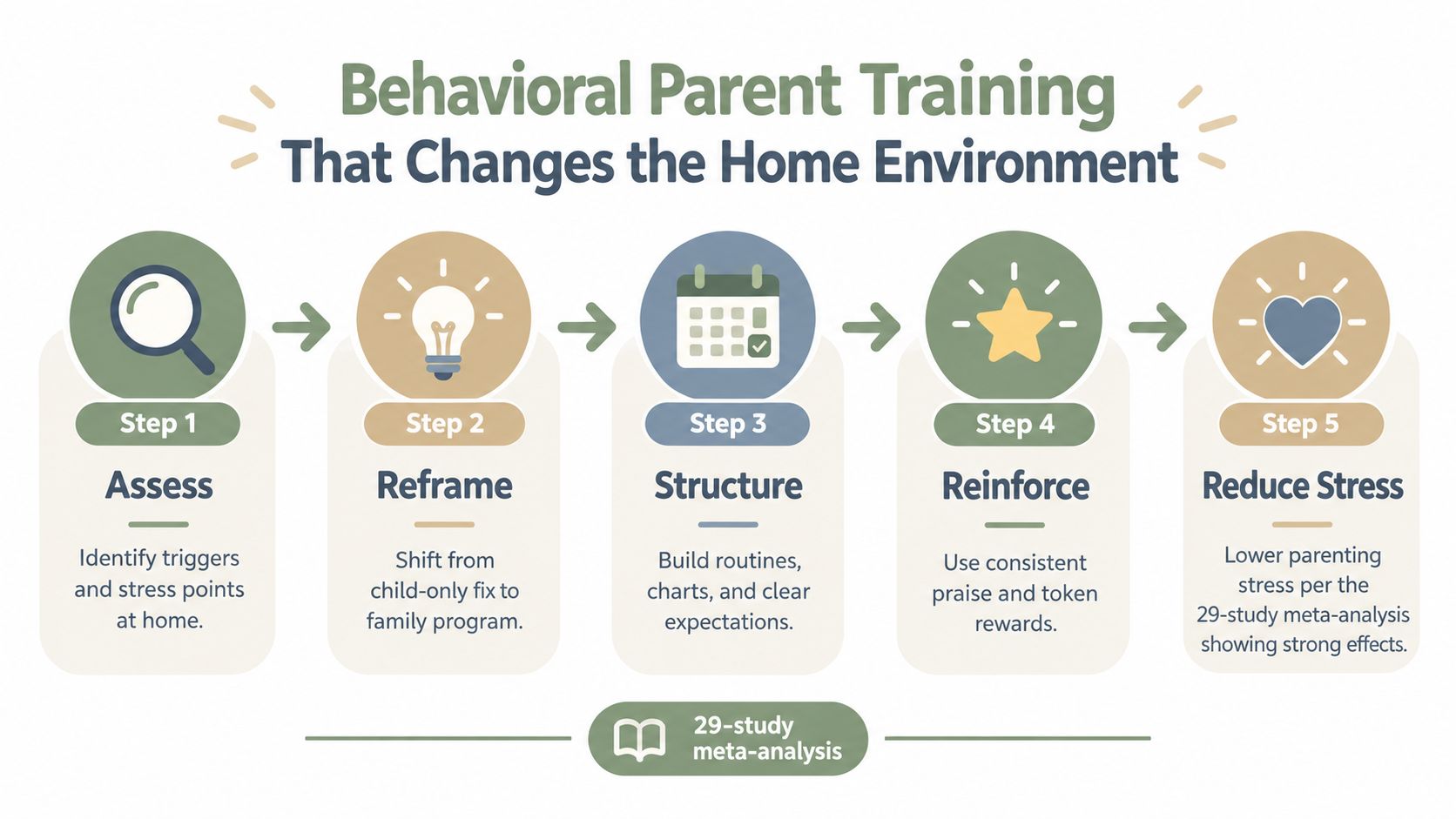
For younger children, therapy often works best when it changes the environment rather than asking the child to exert more self-control. Behavioral parent training teaches caregivers how to make expectations clearer, reinforce useful behavior quickly, and respond to predictable problems without turning every instruction into a negotiation.
A meta-analysis of 29 studies involving 2,345 participants found positive effects on parent outcomes. It also found that antecedent-focused techniques improved parents' sense of competence and mental health, while reinforcement-based techniques produced larger reductions in negative parenting. Long-term follow-up evidence indicated continuing benefits for child symptoms, behavior, positive parenting, and the parent-child relationship, as reported in the meta-analysis of behavioral parent training for ADHD.
The three mechanics parents practice
Antecedent management comes before the behavior. Put shoes beside the door, turn off competing screens, move close to the child, make one clear request, and ask the child to repeat it. These changes reduce the amount of working memory and inhibition required before a task even begins.
Contingency systems connect behavior with an immediate outcome. A point chart might reward getting dressed, placing homework in a folder, or beginning work after one prompt. The reward doesn't have to be large. It needs to be visible, predictable, and close enough in time for the child to connect effort with success.
Consistent consequences prevent adults from changing the rules in response to exhaustion. Planned ignoring may be appropriate for minor attention-seeking behavior, while unsafe behavior, aggression, or serious distress requires an active and proportionate response. A clinician should help the family decide which response fits each behavior.
BPT isn't generic parenting advice. A structured program uses a written behavior plan, tracks patterns, assigns home practice, and adjusts the strategy when the data show that a routine isn't working. Parents should bring a typical weekly schedule, examples of difficult transitions, current reward systems, school communication, sleep concerns, and a short list of behaviors they most want to change.
Structure can feel mechanical at first. For a child with ADHD, predictable cues and immediate feedback often create the safety needed to succeed without repeated criticism.
Parents can also review ADHD parent coaching resources when deciding what questions to bring to a consultation. The clinician's job is to help the family choose a small number of high-impact targets, practice them, and build consistency without demanding perfection from caregivers.
Skills-Based CBT for Older Kids, Teens, and Adults
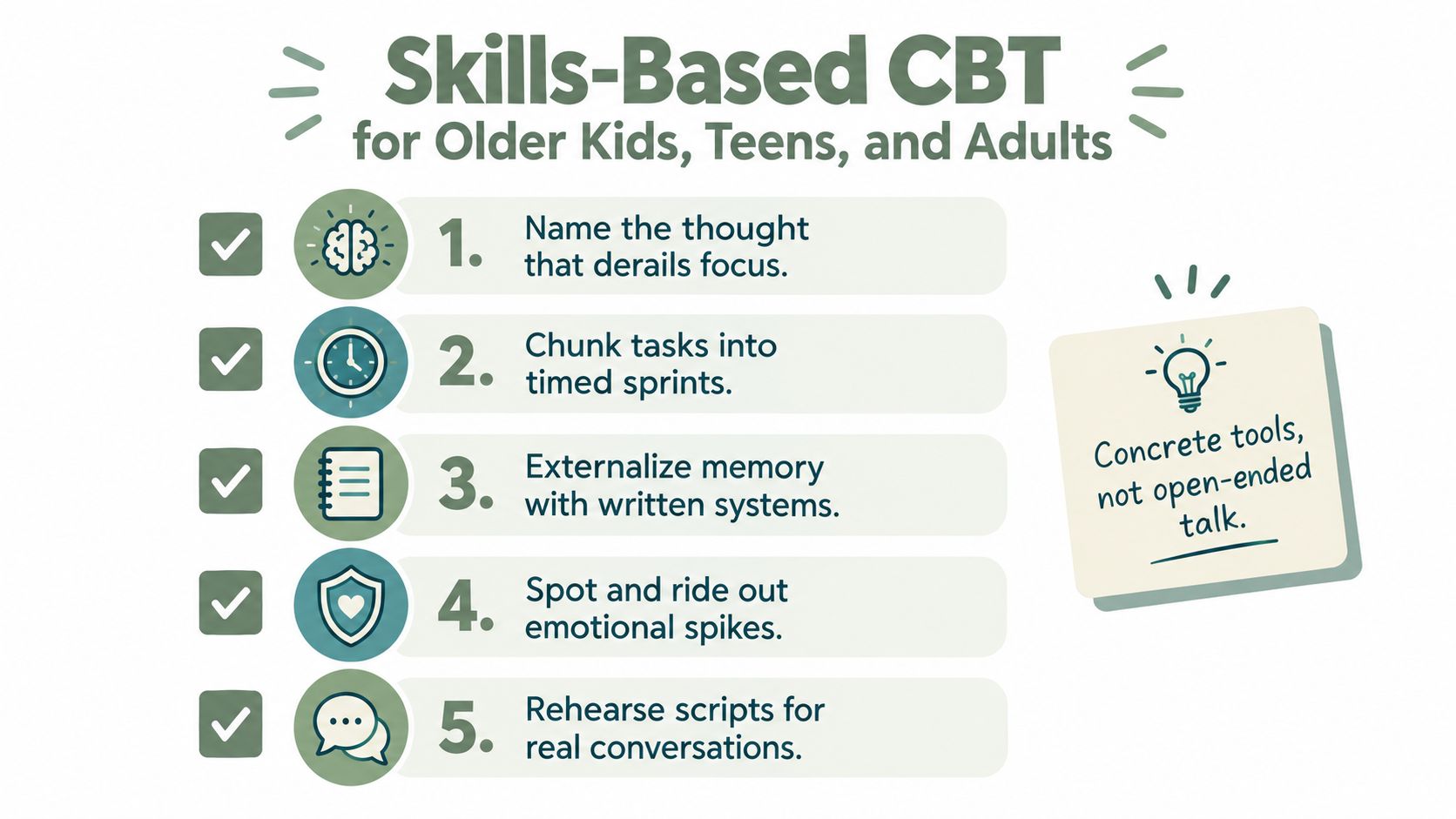
A child who once needed a parent to organize every transition may later need to manage assignments, emotions, and commitments independently. Skills-based CBT changes with that responsibility. The therapist listens to the client's history and feelings, then connects each session to a skill that can be practiced between appointments. The working question becomes: what happens just before avoidance, and what can the client do at that moment?
External systems for an unreliable memory
Older children and teens may build one organization system with a calendar, color-coded folders, phone reminders, and a designated place for unfinished work. The goal is not an attractive planner. It is to move information out of working memory and into a system the client will actually check. Parents can help establish the routine at home, while the clinician tests whether the system fits the client's habits and adjusts it when it fails.
Time management needs the same practical structure. A therapist may help a teen estimate an assignment's duration, schedule transition warnings, divide a project into short work periods, and identify the first physical action. “Work on science” gives the brain no clear entry point. “Open the document and write the heading” does.
Emotion regulation belongs in the plan. Clients can learn to notice early frustration, tolerate boredom long enough to continue, question all-or-nothing thoughts, and rehearse what to say after interrupting or missing a commitment. Teens often need focused work on identity, social feedback, motivation, and the gradual transfer of responsibility from parent to client. Parents can prompt and review agreed systems, but the clinician should teach the underlying skills and address patterns that keep interfering.
Adult applications and limits
Adult CBT often targets workplace organization, relationship communication, avoidance, and anxiety linked to repeated failures. Practice may include preparing for a meeting, recording tasks in one capture system, sending a repair message after forgetting an agreement, or testing a less catastrophic interpretation of a mistake.
A randomized-trial meta-analysis found CBT had a moderate-to-large effect versus waitlist, SMD = 0.76, with a 95% confidence interval from 0.21 to 1.31, and a smaller significant effect versus active controls, SMD = 0.43, with a 95% confidence interval from 0.14 to 0.71. A broader 2025 meta-analysis found improvements in core symptoms, depressive mood, anxiety and stress, and executive function. The findings are summarized in the adult ADHD CBT meta-analysis.
CBT offers structured practice, not effortless focus. It may not be enough when severe hyperactivity, impulsivity, or working-memory difficulties remain prominent. Medication can reduce those barriers for some clients, while CBT teaches how to organize behavior around them. The therapist and prescriber should coordinate rather than treating either approach as a universal replacement for the other.
For families considering treatment during adolescence, ADHD therapy for teens can clarify how much parent involvement remains useful and which responsibilities should shift to the teenager.
School Supports That Reinforce Therapy at Home
A school shouldn't wait for therapy to “fix” a child before changing the classroom environment. Teachers can reduce unnecessary demands on attention by making routines visible, giving concise directions, checking organization, and providing feedback before a small problem becomes a major disruption.
Behavioral classroom management works best when expectations are observable. “Be responsible” is difficult to measure. “Write the assignment in the planner before packing up” gives the teacher and student a behavior they can notice and reinforce. A daily report card can connect school and home through a brief update on selected targets, rather than a long message describing everything that went wrong.
Requests parents can make in meetings
Bring specific observations and ask the team to test a small number of supports:
- Assignment design: Break long work into segments and confirm that the student knows the first step.
- Organization checks: Have the teacher prompt a planner, folder, or digital learning platform check at a predictable point.
- Transition support: Provide a warning before changing activities and allow a movement break before demanding seated work.
- Classroom arrangement: Use preferential seating, reduced visual distractions, and a posted schedule when those changes improve access to instruction.
- Feedback loop: Send home brief information about one or two agreed targets, not a general daily judgment.
An accommodation changes how a student accesses instruction or demonstrates knowledge. A modification changes what the student is expected to learn or complete. The correct plan depends on the student's educational needs and local process, so parents should ask the school team to explain whether a support belongs in a 504 plan, an IEP, or another classroom intervention.
| Support Type | Example | Plan Type | |---|---|---| | Access accommodation | Preferential seating, reduced distractions, or movement breaks | Often considered within a 504 plan or IEP | | Output accommodation | Extended time or assignments divided into sections | May fit a 504 plan or IEP when documented needs support it | | Instructional support | Teacher-prompted organization checks and explicit routines | May be written into an IEP or implemented through a classroom plan | | Modification | A change to the learning expectations or curriculum | Generally requires discussion through the IEP process |
The school psychologist can observe the child, identify setting-specific triggers, and share findings with the outside therapist when families provide appropriate permission. Families who educate at home may also find it useful to review Kuraplan homeschool support for ADHD while building consistent academic routines.
A productive meeting script is simple: “We see that starting independent work is difficult after directions are given. Could we test a written first step, a brief teacher check, and a short feedback form, then review whether those supports improve work initiation?”
Coordinating Therapy With Medication and Providers
A child may take medication and still struggle to start homework. A teenager may understand the plan but miss doses or avoid using it. An adult may need treatment that addresses work demands rather than parent-managed routines. Coordination begins by identifying the remaining functional problem and assigning each part of care to the right professional.
Therapy can be the primary intervention when a family declines medication, impairment is manageable through environmental changes, or the main concerns involve parenting conflict, avoidance, organization, or emotional regulation. It can be added when medication improves attention but homework, relationships, planning, or self-esteem remain difficult. During transitions such as middle school, college, or a new job, therapy may need to focus on the skills that the next setting requires.
Three workable care arrangements
| Pathway | Best Fit For | What It Looks Like | |---|---|---| | Therapy as primary intervention | Families prioritizing behavioral and skills-based care, or clients whose concerns respond to structured practice | Weekly therapy or parent coaching, home practice, relevant school or workplace supports, and regular review of functional goals | | Therapy as an adjunct | People who receive some medication benefit but still struggle in daily settings | The prescriber manages medication while the therapist builds routines, organization, emotional regulation, and communication skills | | Medication first, therapy later | Clients who need initial symptom relief before they can engage with skill practice | Medication is monitored, then therapy is introduced when impairment persists or developmental demands increase |
For younger children, parents usually carry out the home practice while the clinician coaches them on routines, reinforcement, and responses to behavior. Older children and teens can take on more of the practice, but parents may still track implementation and report changes. College students and adults generally need direct skills work, with medication decisions kept with the prescriber.
Combination care is useful when every provider has a defined role and the family can follow the plan. More appointments alone do not guarantee better results. The therapist should not change medication, and the prescriber should not be expected to teach detailed behavioral routines without the relevant training.
Set a shared written goal, obtain permission for communication between providers, and agree on how progress will be reviewed. Track observable outcomes such as homework starts, morning completion, missed assignments, work deadlines, or conflict after transitions. Home assignments should match the family's actual capacity.
Families using remote services can review telehealth benefits for mental health, then ask whether the clinician can involve parents, coordinate with other providers, and protect privacy at home.
Matching Therapy to Age and What Realistic Progress Looks Like
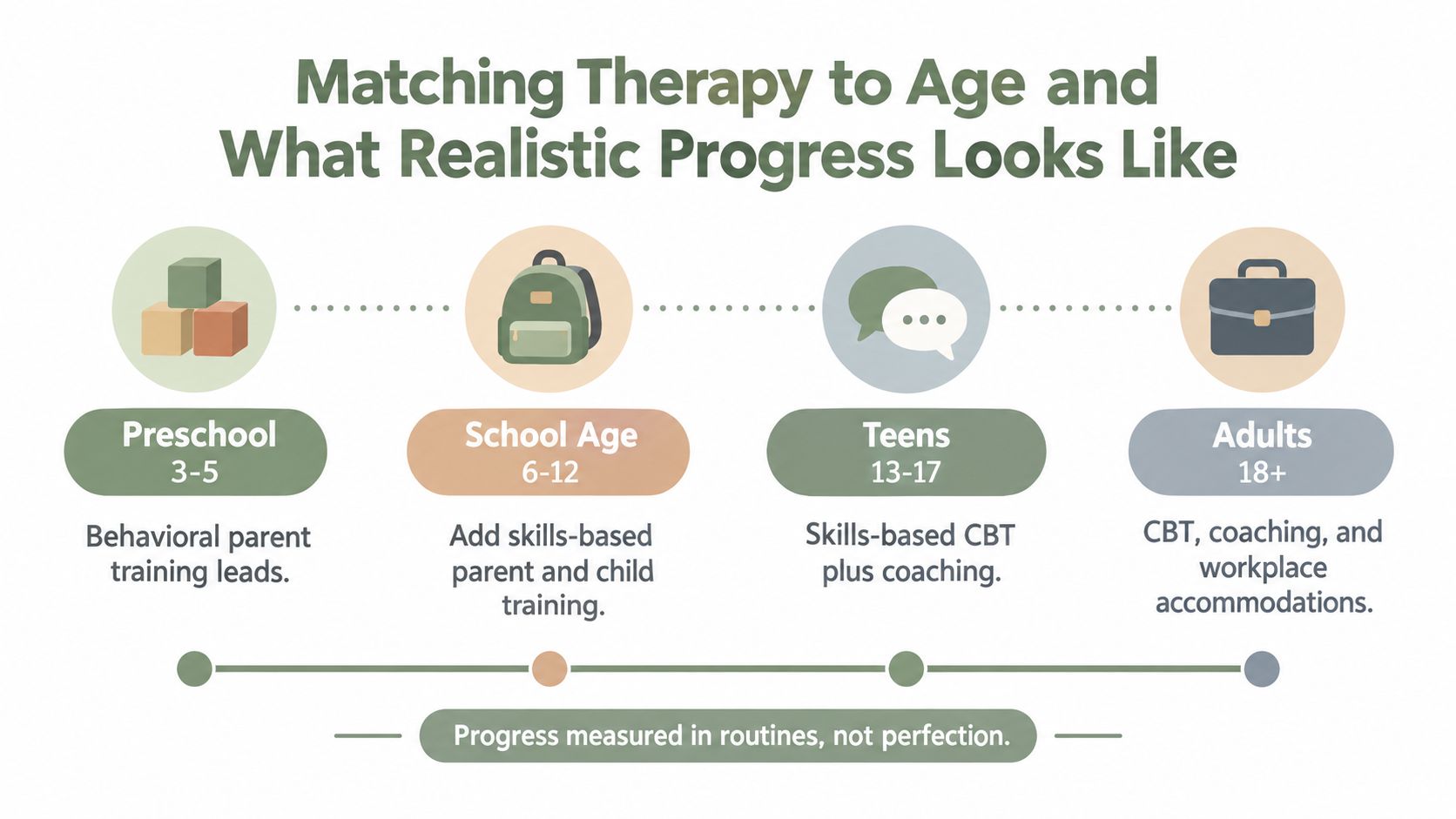
ADHD therapy changes shape as the person's source of structure changes. A preschool child can't be expected to manage a planner, and a college student can't rely on a parent to deliver every reminder. The intervention must follow the developmental task.
Preschoolers usually benefit from caregiver-led behavioral treatment. The clinician helps parents shape routines, give effective directions, reinforce cooperation, and respond consistently to challenging behavior. The child may participate, but the adult environment carries most of the treatment responsibility.
Elementary-age children often need a coordinated plan. Parent training supports mornings, homework, bedtime, and sibling interactions. School strategies address assignments, transitions, and feedback. Child-focused work can introduce simple self-monitoring, friendship skills, and ways to ask for help.
Teenagers need increasing ownership. Therapy may focus on time estimation, studying, digital distractions, emotional spikes, social repair, and the consequences of missed responsibilities. Parents should remain involved when useful, but the clinician should help the teen practice using systems without waiting for an adult to notice a problem.
Young adults and college students face a sharp loss of external structure. Treatment may include academic planning, sleep routines, driving safety, money management, work organization, and communication with roommates or partners. Adults interested in practical support can also explore resources to improve executive functioning as an adult, especially when coaching complements psychotherapy.
What progress should look like
Progress is usually visible in routines before it feels dramatic. A child may start homework with fewer prompts, a parent may stop repeating the same instruction, or a student may recover from a missed assignment without abandoning the entire week. An adult may use one reliable task system, arrive prepared for meetings, or repair a relationship conflict more quickly.
Research supports improvement, but it doesn't promise that every symptom disappears. The adult CBT evidence shows meaningful average effects, while the broader review notes that combined treatment can improve quality of life and anxiety or stress more strongly than CBT alone. A 2025 umbrella review also found at least moderate-certainty evidence for CBT improving adult ADHD symptoms, while noting important limits for some non-drug approaches, as reported in the umbrella review of adult ADHD interventions.
Choose two goals before the first consultation, such as “start homework without a prolonged argument” or “submit assignments through one reliable system.” Bring those goals, a typical week, current medications, school feedback, and the routines that fail most often. A clinician can then match the treatment to the person's age, setting, and actual impairment rather than offering generic advice.
---
Wald Behavioral Health provides evidence-based therapy for children, adolescents, young adults, and families, including ADHD-focused skill building, structured parent guidance, and school-aligned support through in-person care and telehealth. Visit Wald Behavioral Health to schedule a free 15-minute consultation and discuss which goals and treatment format fit your family.
Questions about your child or teen?
Dr. Wald offers a free 15 minute consultation to talk through what you are seeing and whether the practice is a good fit.
Free 15 Minute Consultation