Therapy for Young Adults: A Practical Guide to 2026

You're staring at your laptop after finals, replaying the semester in your head. Your grades are fine, technically, but your mood has been low, your thoughts won't slow down, and even answering a text feels like work. You keep asking yourself whether this is “bad enough” for therapy or whether you should just push through.
That question is common in young adulthood. Therapy isn't reserved for a diagnosis, a breakdown, or a life crisis. It can help when anxiety, low mood, relationship conflict, avoidance, identity questions, or uncertainty start interfering with the life you're trying to build. The useful question is less “Do I qualify?” and more “Would support help me understand what's happening and respond differently?”
## Table of Contents - Why Young Adults Are Reaching Out for Therapy Now - The three decisions you'll make - What Therapy for Young Adults Actually Looks Like - A flexible format for a changing life - Evidence-Based Approaches Worth Knowing - CBT as a structured experiment - ACT for uncertainty and values - DBT for emotional intensity - Exposure for avoidance - Psychodynamic and attachment-oriented work - Common Concerns Brought Into the Room - In-Person and Telehealth Options Compared - How to Judge Fit After the First Few Sessions - Parent involvement and privacy - Practical Next Steps and a Short Decision Checklist
Why Young Adults Are Reaching Out for Therapy Now
You may be choosing a major, applying for jobs, managing rent, and trying to decide which relationships still fit, all at once. Young adulthood often begins around 18 and stretches into the early 30s, though graduate school, financial uncertainty, changing work patterns, and delayed independence can make the transition feel longer. It is a life stage with several decisions running in parallel: identity, values, relationships, and the future you can realistically build.
Stress during this period can be temporary, or it can start narrowing your life. A difficult semester may ease after exams. Persistent dread, loss of motivation, panic, isolation, or disrupted sleep can make classes, work, friendships, and daily routines harder to manage. Therapy offers a place to sort those signals out before you have to solve everything alone.
Recent U.S. data show that young adults are among the most active users of mental health treatment. KFF reported that 26% of adults ages 18 to 26 received counseling and/or prescription medication for mental health concerns in 2022, compared with 18% in 2019, a 45% increase and the largest jump among the age groups examined. The KFF report on young adult mental health treatment provides the underlying comparison.
CDC data for 2024 found that adults ages 18 to 29 received counseling or therapy from a mental health professional at a rate of 20.2%. The comparable figures were 18.7% for ages 30 to 44, 11.7% for ages 45 to 64, 7.5% for ages 65 to 74, and 5.0% for adults 75 and older. Those age-group results come from the CDC National Health Interview Survey early-release report.
The three decisions you'll make
Therapy is a matching process. The therapist, treatment approach, and practical setup all need to work with your current life.
- Approach: Do you want structured skills for anxiety, room to understand long-standing patterns, or a blend of both?
- Setting: Would you attend more consistently in an office, from home, or through a campus service? For telehealth, confirm that the therapist is licensed where you are physically located during sessions.
- Fit: Does this particular therapist listen, explain their reasoning, and work toward goals that matter to you?
Parent involvement may also need clarification. If a parent helps pay for care or handles insurance, ask what information remains private and what, if anything, can be shared. Those boundaries should be explained before treatment begins.
Campus counseling centers and telehealth can make care easier to find, but demand may bring scheduling delays or limited campus appointments. You do not need a perfect plan before sending the first inquiry. Gather enough information to choose a reasonable next step, then assess whether the arrangement fits after you have experienced it.
| Year and indicator | Young-adult figure | Comparable age-group figures | |---|---:|---| | 2024, received counseling or therapy | 20.2% for ages 18 to 29 | 18.7% ages 30 to 44; 11.7% ages 45 to 64; 7.5% ages 65 to 74; 5.0% ages 75 and older | | 2022, received counseling and/or prescription medication | 26% for ages 18 to 26 | 18% for ages 18 to 26 in 2019 | | 2019, received counseling and/or prescription medication | 18% for ages 18 to 26 | 26% for ages 18 to 26 in 2022 |
What Therapy for Young Adults Actually Looks Like
The first month usually feels more ordinary than television suggests. You may begin with an intake lasting roughly 45 to 60 minutes, during which the therapist asks about your current concern, health history, relationships, school or work, sleep, safety, and what you want to change. The conversation should feel structured, but it shouldn't feel like an interrogation.
A therapist might ask, “What happens after you notice an anxious thought?” or “What would be different in your week if therapy helped?” Those questions help turn a broad concern such as “I feel overwhelmed” into workable goals, such as attending class more reliably, reducing reassurance-seeking, handling conflict, or making decisions without endless rumination.
A flexible format for a changing life
Sessions are often weekly or biweekly, depending on need, availability, and the treatment plan. Therapy for young adults has to accommodate changing class schedules, internships, relocations, new jobs, roommates, relationships, and family expectations. A good plan can be consistent without pretending that your life is stable.
The therapist may also consider developmental tasks that don't fit neatly into a symptom checklist. You might be learning how to choose friends without automatically pleasing them, build a career direction before you feel certain, or separate your own values from family expectations. Therapy can address symptoms while also helping you develop a clearer sense of agency.
Practical rule: Bring the problem that keeps repeating, not just the event that happened most recently.
Some therapy is brief and skills-focused. You may practice identifying thinking traps, scheduling activities that support mood, tolerating uncertainty, or approaching situations you've been avoiding. Other work is more exploratory and examines relationship patterns, early experiences, attachment, shame, or the meanings you assign to success and failure.
Therapy isn't the same as academic coaching, although it may help with emotional barriers to studying. It isn't venting to a friend, because the therapist brings clinical training, boundaries, assessment, and a treatment framework. It also isn't a crisis hotline. If you may hurt yourself or someone else, or you can't stay safe, contact emergency services or a local crisis resource immediately rather than waiting for a routine appointment.
Before choosing a clinician, return to the three practical questions: Which approach fits the concern? Which setting can you attend consistently? Which therapist makes the work feel collaborative and understandable?
Evidence-Based Approaches Worth Knowing
Different therapies offer different starting points. The best match depends on the concern, your preferences, the therapist's training, and whether the approach makes sense for your current life.
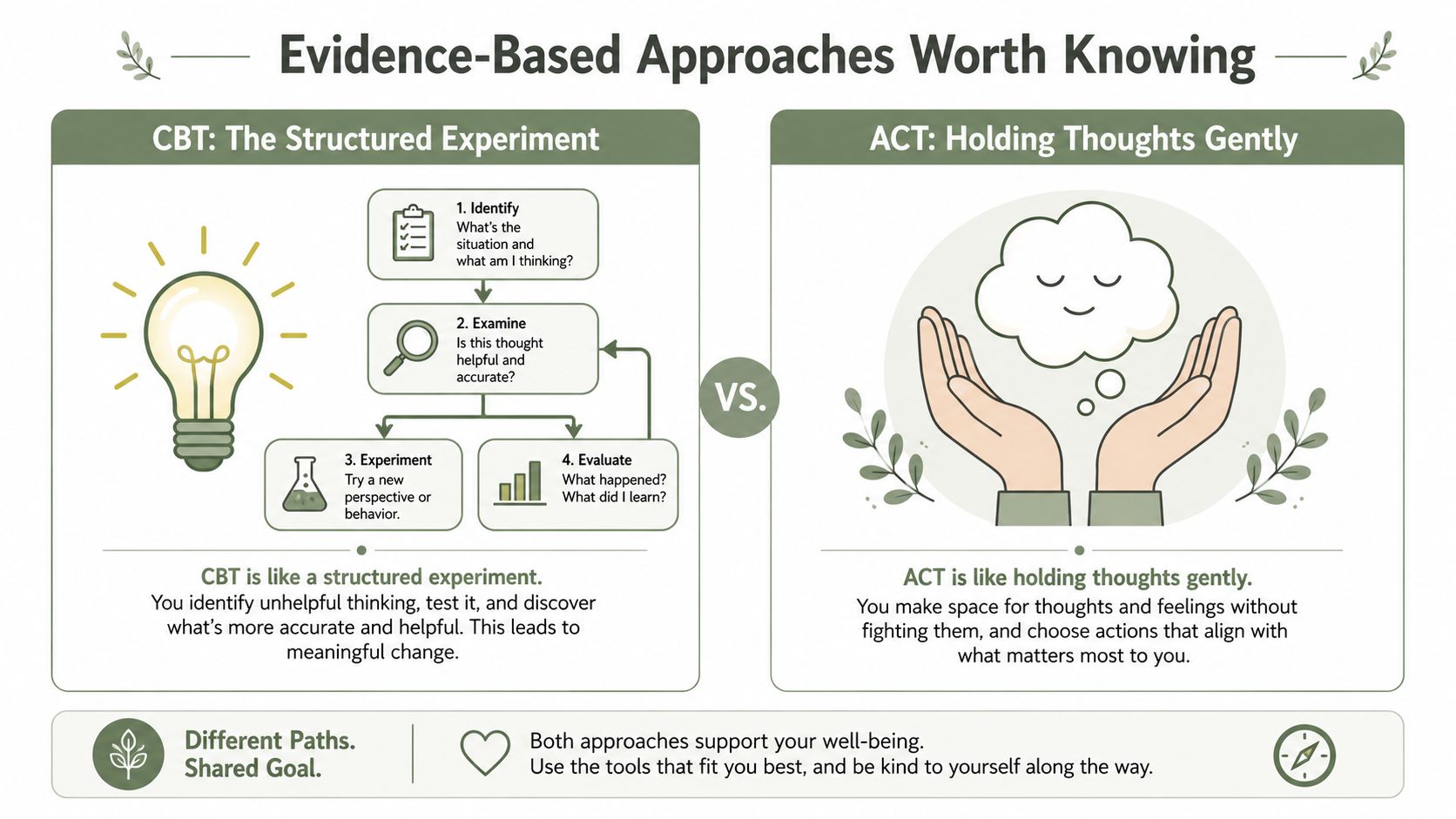
CBT as a structured experiment
Cognitive behavioral therapy, or CBT, treats thoughts, feelings, and actions as connected. It doesn't ask you to replace every negative thought with forced optimism. Instead, you and the therapist test whether a thought is accurate, useful, and supported by evidence.
For example, “If I make one mistake at work, everyone will know I'm incompetent” can become a hypothesis to examine. You might track when the thought appears, identify the prediction, and try a small behavioral experiment, such as asking a reasonable question rather than hiding confusion. CBT often fits anxiety, depression, perfectionism, and avoidance when you want concrete tools.
ACT for uncertainty and values
Acceptance and commitment therapy, or ACT, uses a different metaphor. Rather than wrestling every anxious thought to the ground, you learn to notice it without allowing it to dictate every choice. The therapist may help you identify values, such as creativity, honesty, friendship, or independence, then take a small action in that direction while discomfort is present.
ACT can be useful when attempts to eliminate uncertainty have taken over your life. The aim isn't passive acceptance or liking painful feelings. It's learning that anxiety can be present without becoming the decision-maker. You can learn more about how approaches may be matched to concerns through Wald Behavioral Health's therapy approach information.
DBT for emotional intensity
Dialectical behavior therapy, or DBT, teaches skills for emotions that arrive like emergencies. Distress tolerance can help you get through a sharp wave without making the situation worse. Emotion regulation focuses on understanding vulnerability factors and responding earlier. Interpersonal effectiveness helps with asking for what you need, setting boundaries, and managing conflict.
DBT may be especially relevant when emotional reactions feel rapid, intense, or difficult to recover from. It can be delivered individually, in skills groups, or in a combined format, depending on the provider.
Exposure for avoidance
Exposure-based therapy uses a gradual, planned approach to feared or avoided situations. A person with social anxiety might begin by making brief eye contact or asking a low-stakes question, then work toward more difficult interactions. The therapist helps you remain present long enough to learn that anxiety can rise and fall without requiring escape or a ritual.
Psychodynamic and attachment-oriented work
Psychodynamic and attachment-oriented therapy examines the older scripts that shape current relationships. You might notice that criticism feels dangerous because you learned to equate mistakes with rejection, or that you withdraw whenever someone becomes emotionally close. The first month may involve mapping patterns and building a shared language for them, rather than completing a long list of worksheets.
These approaches aren't mutually exclusive. A therapist may use CBT tools for a current panic cycle while exploring the relationship history that makes criticism especially painful. Therapy for young adults works best as a thoughtful match, not as a loyalty test to one school of therapy.
Common Concerns Brought Into the Room
Maya is 20 and a university junior. She arrives because exam anxiety has started affecting sleep and concentration, but she also feels unsettled about her major. Her family expects a clear career plan, while she isn't sure whether her current path reflects her interests or the safest choice.
A CBT-informed therapist might help Maya identify catastrophic predictions around grades. “If I do poorly on this exam, I'll lose my future” becomes a thought to examine rather than a fact to obey. Together, they might track study behavior, test more balanced predictions, and build a plan for starting work before panic peaks.
That same therapist could draw on ACT when Maya talks about her major. The goal wouldn't be to force certainty. Maya might practice making a values-based decision while accepting that no option comes with a guarantee. The approach changes because the problem changes, even within the same course of therapy.
Jordan is 26 and works in a first marketing job. Nothing feels dramatically wrong, but motivation has thinned out, relationships keep following familiar patterns, and Jordan feels stuck while friends appear to be moving forward. In therapy, Jordan notices a strong need to perform perfectly and a tendency to shut down after even mild criticism.
A psychodynamic conversation might explore family expectations, early experiences of approval, and how perfectionism became a way to stay connected or avoid conflict. When Jordan becomes emotionally flooded during a relationship disagreement, DBT skills could provide an immediate tool for pausing, naming the emotion, and choosing a response rather than sending a string of impulsive messages.
The presenting concern points toward a conversation. It doesn't dictate a single modality.
Maya's structured campus routine gives therapy many natural opportunities for planning and practice. Jordan's early-career life is more diffuse, so sessions may need to address work identity, relationship choices, and the loss of external structure at the same time. Anxiety treatment can include specific support for anxiety concerns, but the same anxiety may require different pacing and examples depending on the person's stage of life.
These are composite examples, not a formula. Two people with depression may need different combinations of behavioral activation, relationship exploration, medication evaluation, sleep support, or skills training. Your therapist should be able to explain why a particular method is being suggested and adjust when it isn't helping.
In-Person and Telehealth Options Compared
The most convenient setting is often the one you can attend consistently, but convenience isn't the only consideration. An office visit removes the challenge of finding privacy at home and may make it easier to notice body language and shifts in energy. That can matter for trauma-focused or emotionally intense work, although many people feel safer and more open from a familiar room.
Telehealth means meeting with a licensed therapist through secure video. It can eliminate commuting, make care easier during a move, and fit around classes or work. A bedroom can also create privacy problems if roommates, family members, or thin walls make it hard to speak freely. Before choosing video, identify a private location and a backup plan for a dropped connection.
Licensure requires special attention when you're studying or working across state lines. A clinician generally needs authority to provide care where you are physically located during the session. The PSYPACT compact can support telepsychology across participating states for eligible psychologists, but a move to a non-participating state may require a new clinician or a different licensing arrangement. Ask directly before beginning, especially if your semester includes travel.
For more detail on remote appointments and practical setup, review telehealth therapy options from Wald Behavioral Health.
| Setting | Best For | Access and Cost | Licensure and Telehealth Notes | |---|---|---|---| | Campus counseling center | Students needing a low-friction entry point | May use student services, with availability shaped by campus capacity | Usually tied to the campus location and student eligibility | | Community clinic | People seeking local care or lower-cost options | May offer insurance, public programs, or sliding-scale arrangements | Confirm the clinician's license and appointment format | | Private practice | A tailored therapist and modality match | Insurance participation and fees vary by clinician | Ask where the therapist is licensed if sessions are remote | | Online platform | People prioritizing scheduling flexibility | Plans, coverage, clinician options, and clinical scope vary | Verify licensing, privacy practices, and whether the service fits your needs | | Primary-care referral | People who want coordinated medical and mental health support | Depends on insurance and local referral networks | Confirm whether the recommended clinician serves your current state |
How to Judge Fit After the First Few Sessions
Therapeutic fit isn't the same as instant comfort. Discussing painful material can feel awkward, and a useful session may leave you thoughtful or tired. After sessions two or three, ask whether the therapist has created enough safety and clarity for you to keep evaluating the relationship.
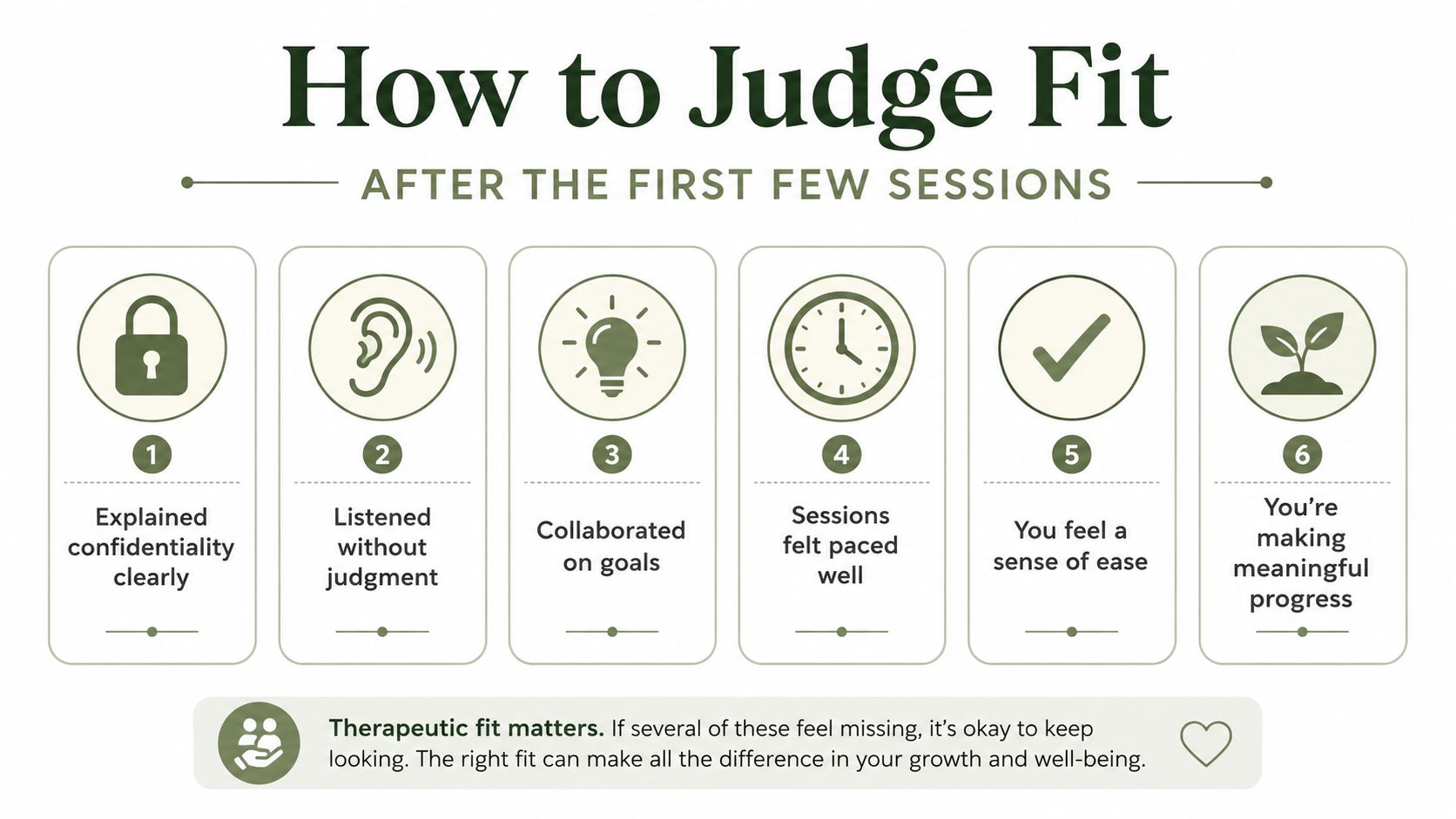
Use this short check:
- Confidentiality: Did the therapist explain what stays private and the limits of confidentiality in language you understand?
- Goals: Did they ask what you want from therapy, rather than deciding what you should want?
- Method: Can they describe what they're doing and why, without becoming defensive?
- Pacing: Does the work move at a challenging but tolerable speed?
- Respect: Do they take your concern seriously, even when they interpret it differently?
- Choice: Do you feel free to disagree, pause, ask questions, or decide not to complete an exercise?
A poor fit may show up as repeated dismissal of the concern you brought in, rigid scripting that ignores your context, or a refusal to discuss the treatment approach. You also shouldn't feel pressured to disclose more quickly than you can manage, pressured to continue indefinitely, or pushed toward a decision that belongs to you.
Parent involvement and privacy
For most college-age and older clients, parents shouldn't attend sessions or receive updates unless you explicitly consent. A therapist may discuss payment, scheduling, safety, or general coordination with a parent under specific circumstances, but the boundaries should be explained clearly and handled according to applicable privacy rules.
If a therapist contacts a parent or shares information without appropriate consent, treat that as a serious concern and ask what happened. Family involvement can be useful when you want it, especially for practical support, but unrequested parental access isn't evidence of better care.
You can switch clinicians without presenting a legal brief for the decision. You might say, “I'm looking for a different approach,” or request a referral that better matches your goals. A professional therapist should be able to discuss the transition without making you responsible for protecting their feelings.
Practical Next Steps and a Short Decision Checklist
Therapy becomes easier to start when you turn a vague intention into a small sequence of decisions. You don't need a perfect diagnosis or a permanent plan before contacting a provider.
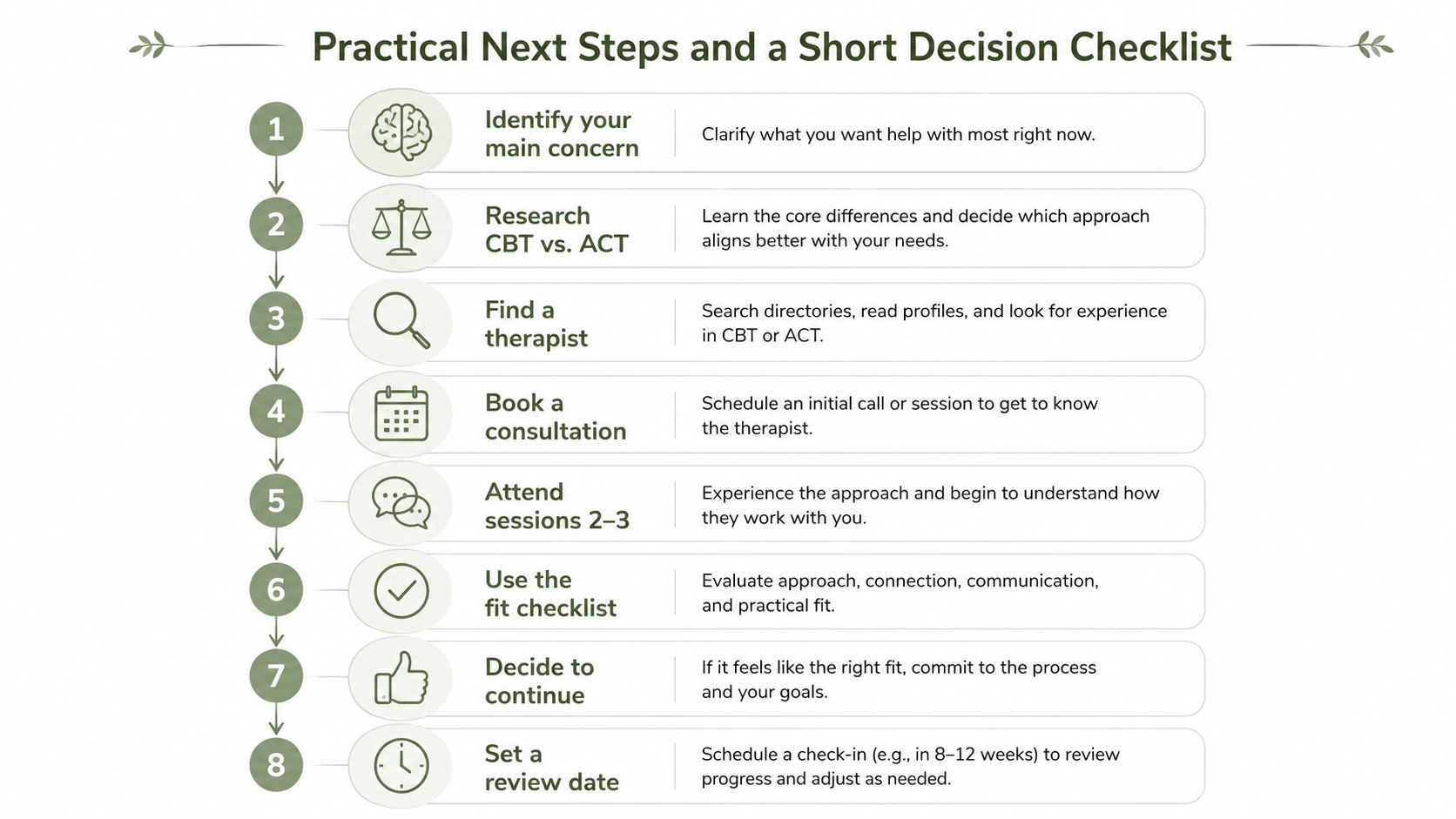
- Name the main concern. Write one sentence about what is interfering with school, work, relationships, sleep, or daily functioning.
- Choose a starting direction. Consider CBT for thought and behavior cycles, ACT for values and uncertainty, DBT for emotional intensity, or psychodynamic work for recurring relationship patterns.
- Pick a workable setting. Compare an office, campus service, community clinic, private practice, and secure video based on privacy, travel, schedule, and cost.
- Check payment before booking. Ask about insurance, self-pay fees, sliding-scale availability, cancellation rules, and whether a consultation is offered.
- Confirm location and licensure. For telehealth, tell the clinician where you'll physically be during sessions, especially if you study, work, or travel across state lines.
- Book an initial appointment. Bring your main concern, relevant history, current medications if applicable, and questions about confidentiality.
- Run the fit check. After sessions two and three, review whether the therapist listens, explains the work, respects your choices, and adjusts the pace.
- Set a review date. Decide when you'll evaluate progress, goals, and whether the current plan still makes sense.
Over several months, therapy may help you clarify a problem, build specific coping skills, practice different responses, and develop a stable working relationship with a clinician. It usually won't repair your mood instantly, eliminate every difficult feeling, or restructure your entire life at once. Budget your time and money for a process that requires participation between sessions, honest feedback, and occasional course corrections.
A therapist is a developmental experiment, not a permanent contract. You can continue when the work fits, revise the plan when it doesn't, or switch providers when the relationship isn't productive. College counseling centers and primary-care clinicians can be low-friction places to ask for referrals, especially if you're unsure where private therapy begins.
If you're looking for developmentally informed therapy for anxiety, depression, stress, relationships, or life transitions, Wald Behavioral Health offers in-person sessions in Coral Gables and secure telehealth for clients in Florida, Maryland, and eligible PSYPACT states. Visit Wald Behavioral Health to review services and request a free 15-minute consultation about fit and scheduling.
Questions about your child or teen?
Dr. Wald offers a free 15 minute consultation to talk through what you are seeing and whether the practice is a good fit.
Free 15 Minute Consultation