OCD Intrusive Thoughts Treatment for Children and Teens
Your child tells you about a frightening thought that keeps coming back, asks again and again whether it means something bad, and seems calm only after you answer. Minutes later, the question returns. You're trying to help, but the reassurance that softens the moment doesn't seem to stop the next one. That pattern is often where OCD intrusive thoughts treatment begins, not with proving a thought false, but with understanding what happens after it appears.
## Table of Contents - Why Intrusive Thought Treatment Starts With Response - Why reassurance can keep the loop going - Understand Intrusive Thoughts and the OCD Cycle - A simple thought to action map - Learn How ERP Treats OCD Symptoms - What ERP is not asking your child to do - Compare ERP and Medication Decisions - When medication enters the conversation - Follow a Pediatric OCD Therapy Course - Practice between sessions - Add Family and School Support Without Reassurance - Coordinating with school - Compare Telehealth and In-Person ERP Care - Factors that matter more than format alone - Choose Care and Know When to Escalate - Urgent warning signs
Why Intrusive Thought Treatment Starts With Response
A 10-year-old gets an unwanted image of hurting a younger sibling while holding scissors for a school project. She doesn't want to hurt anyone. She's horrified that the image appeared, puts the scissors down, and asks her mother, "You know I'd never do that, right?" Her mother answers gently. Relief lasts briefly, then the child asks again, avoids the project, and starts avoiding her sibling too.
That sequence matters more than the image alone. An intrusive thought is an unwanted mental event. It isn't a wish, a plan, or a prediction that something will happen, and feeling distressed by it doesn't make it meaningful. Many children have strange or upsetting thoughts that pass. Clinicians look at the wider pattern, including repeated intrusions, compulsions, avoidance, time lost, distress, and interference with school, family life, sleep, or friendships.
Why reassurance can keep the loop going
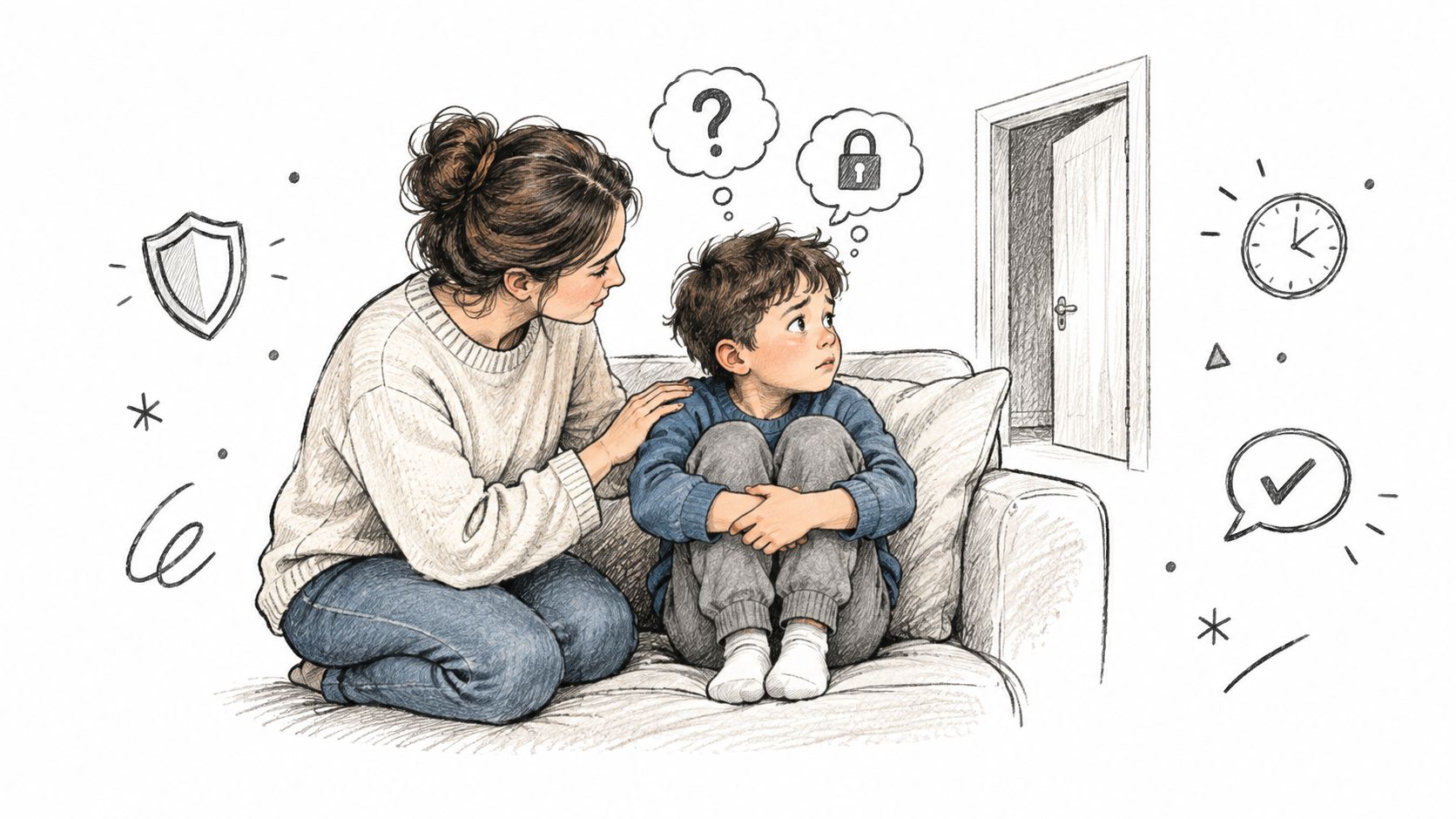
Suppressing a thought, debating it for certainty, or repeatedly reassuring a child can feel kind in the moment. The problem is that each response teaches the brain that the thought needed an urgent answer. Temporary relief makes reassurance, checking, or avoidance more likely next time, so the thought gains importance even though nobody wanted that outcome.
That's why effective care targets the response to the thought rather than trying to eliminate every unwanted thought by force. The National Institutes of Health summary on brain and mental health research notes that exposure and response prevention, or ERP, produces symptom improvement in more than half of treated patients and is now the first treatment many clinicians consider for OCD. The same summary framework reflects a broader point for families. A later summary states that approximately 70% of people with OCD respond to ERP, medication, or a combination.
A thought doesn't need to be disproven perfectly before a child can learn to let it pass without a ritual.
Not every distressing thought means a child has OCD, and not every worry needs ERP. A qualified clinician should assess severity, safety, development, and other concerns such as anxiety or depression before recommending treatment.
Understand Intrusive Thoughts and the OCD Cycle
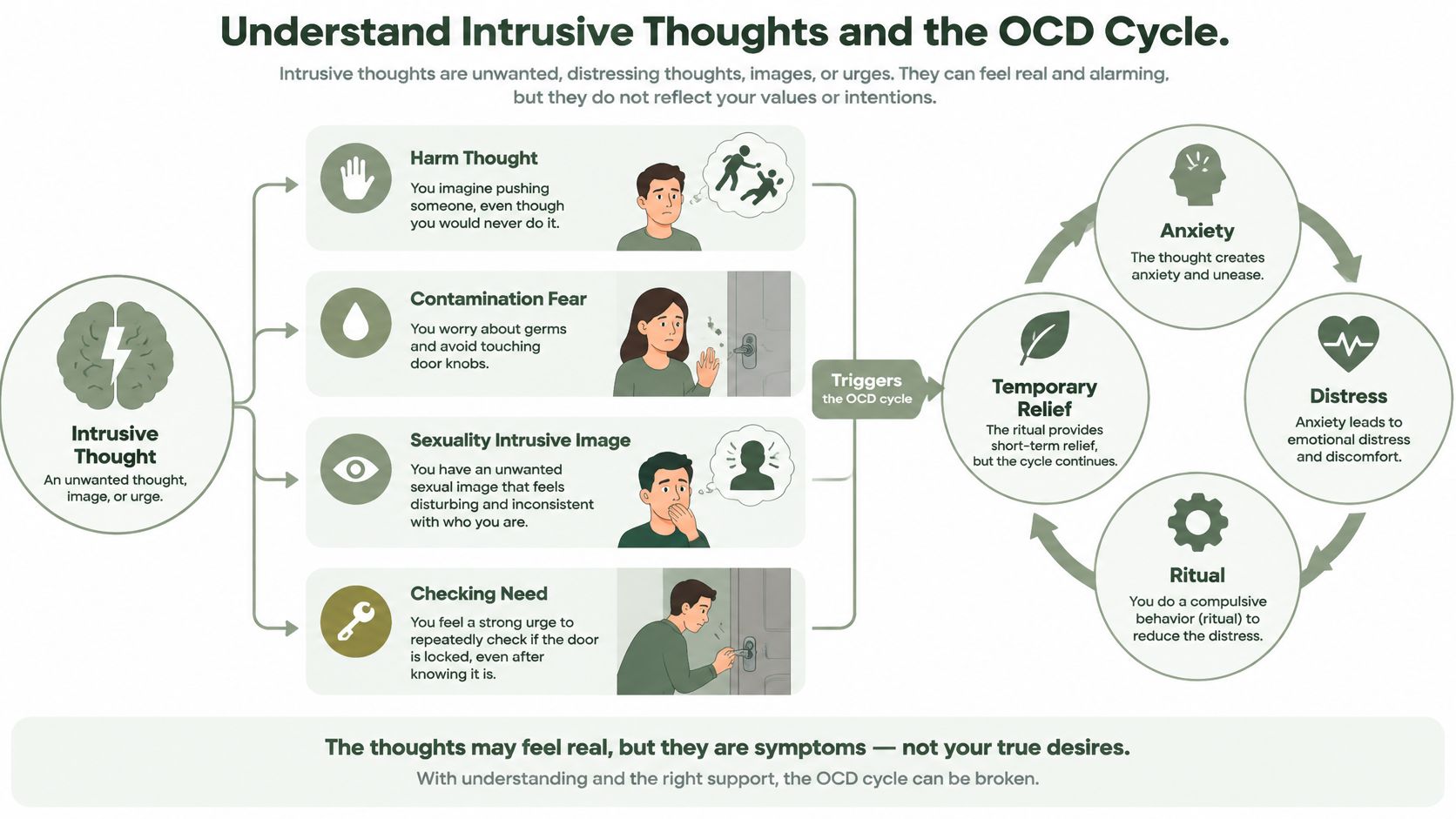
Intrusive thoughts can sound very different from one child to another. The theme often grabs attention, but the cycle underneath is usually more useful for understanding treatment.
- Harm thought: A teen imagines pushing a friend on stairs, feels panicked, then avoids walking near railings with anyone.
- Contamination fear: A child worries a doorknob made her hands dangerous, washes repeatedly, and asks a parent to confirm she's clean.
- Sexuality-related image: An adolescent gets an unwanted sexual image, feels ashamed, then mentally reviews it for hours trying to decide what it means.
- Checking need: A student fears he left something harmful behind, returns to check, photographs the room, and still feels unsure.
These experiences aren't the same as deliberate worry, where someone chooses to think through a real problem. They also aren't firm false beliefs held with conviction, and feeling a sudden mental "urge" in OCD doesn't mean the person wants to act. An intrusive thought isn't a forecast. It arrives uninvited, clashes with the child's values, and triggers an urgent need to make the discomfort stop. Families exploring pediatric OCD care and common symptom patterns often find this distinction is the first thing that lowers shame.
The diagram below maps how different themes can feed the same cycle.
A simple thought to action map
Thought or image leads to anxiety and interpretation, such as "This must mean I'm dangerous." That leads to reassurance, checking, ritualizing, mental reviewing, or avoidance. Relief follows, briefly. Because relief feels rewarding, the brain reaches for the same response faster next time, and the child gets less practice learning that anxiety can rise and fall without a ritual.
Themes can vary with age, development, culture, and what a child cares about most. Diagnosis doesn't rest on one thought's content. A trained professional considers distress, impairment, time consumed, and functional impact, along with other explanations for the symptoms.
The short video below offers another plain language walkthrough of how the cycle repeats.
Learn How ERP Treats OCD Symptoms
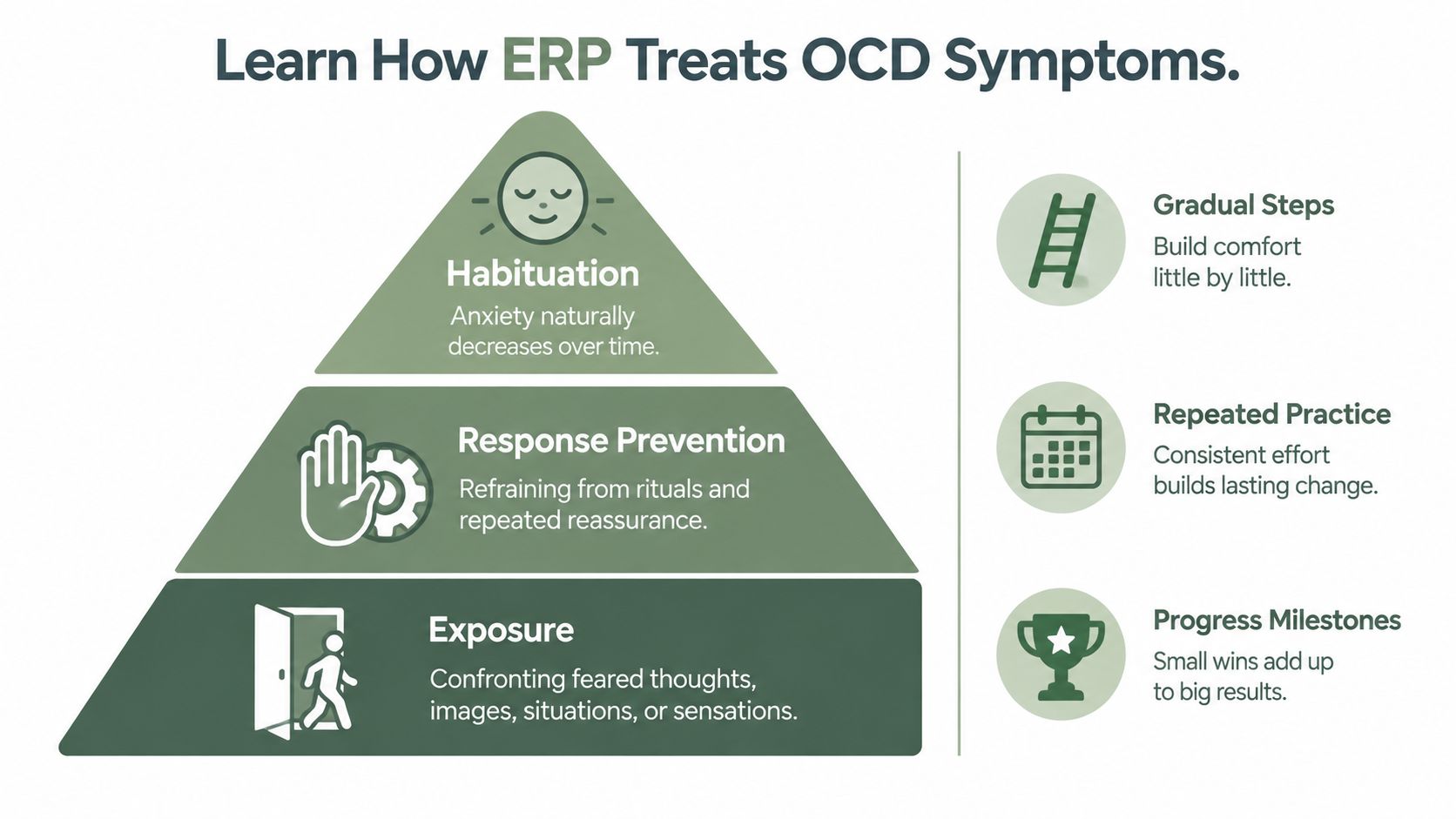
Exposure and response prevention is a structured form of cognitive behavioral therapy built around two linked actions. Exposure means gradually approaching feared thoughts, images, situations, or sensations in a planned way. Response prevention means refraining from the ritual that usually follows, such as checking, washing, mental neutralizing, confessing for relief, or asking for repeated reassurance. Together, they interrupt the cycle where a compulsion briefly lowers distress and then strengthens future compulsive responding.
Take a child who fears contaminating classmates after touching a shared school supply. A clinician wouldn't start with the hardest version of that fear or force distress without a plan. They might build a step that feels challenging but manageable, practice it together, and agree in advance which reassurance questions and washing rituals will be paused. The child learns through experience that uncertainty is uncomfortable, not dangerous, and that anxiety doesn't need a ritual to come down.
The visual below breaks ERP into its three core parts.
What ERP is not asking your child to do
ERP doesn't ask a young person to argue that a feared thought is true. It also doesn't ask them to suppress the thought until it disappears or to earn certainty before moving on. The work is learning to notice the thought, allow uncertainty to be present, and continue with a valued activity without repairing, checking, or avoiding. Over repeated practice, the thought usually carries less urgency because it no longer controls what happens next.
For children and adolescents, treatment is adapted to developmental level. Younger children may use drawings, feeling scales, or playful language for "bossing back" OCD, while teens may track urges and avoidance more directly. Caregivers often help build the exposure hierarchy, support practice between sessions, and step out of rituals they've been pulled into. NICE recommendations for OCD treatment in children and young people support developmentally adapted CBT including ERP with family or caregiver involvement as the treatment of choice for moderate to severe pediatric OCD.
Clinical pace matters: Exposure should be planned, repeated, and adjusted based on severity, safety, and co-occurring anxiety or depression, not turned into a test of toughness.
Adults in the family sometimes recognize their own version of this cycle while supporting a child. If that's familiar, resources on adult OCD therapy and medication management can help you see how similar principles are applied with grown patients, while your child's care stays developmentally matched.
Compare ERP and Medication Decisions
Families often ask whether therapy or medication is the "right" answer. For intrusive thought OCD, CBT with ERP is generally prioritized because it directly targets compulsions, reassurance seeking, and avoidance. Medication can still play an important role, especially when symptoms are moderate to severe, when ERP alone hasn't produced enough improvement, or when co-occurring conditions affect the plan. The better question is usually which combination fits this child's severity, age, access, prior response, and family preference.
Comparing core OCD treatment options
| Treatment option | Primary role | What it targets | Key planning consideration | |---|---|---|---| | CBT with ERP | Core psychological treatment | Compulsions, avoidance, reassurance seeking, response to intrusions | Needs a trained clinician, hierarchy, and between-session practice | | SSRI medication | Evidence-based medication option | Overall OCD symptom intensity | Requires medical supervision and monitoring in youth | | Clomipramine | Established medication option | OCD symptoms when clinically appropriate | Prescribing decisions need specialist medical oversight | | Combined ERP plus medication | Added support for more severe or insufficient response | Both symptom intensity and compulsive behavior patterns | Often considered for moderate to severe presentations |
A peer-reviewed clinical review summarizing comparative OCD treatment evidence reports response rates of approximately 70% for CBT, 49% for SSRIs, 29% for placebo, and 13% for wait-list controls, with remission rates of 53% for CBT versus 24% for SSRI treatment alone. Those numbers explain why ERP is usually central, but they don't predict an individual child's outcome. Definitions of response differ across studies, and results depend on adherence, severity, age, comorbidities, and access to high quality ERP.
When medication enters the conversation
Medication trials for OCD generally require adequate dosing and longer treatment than many families expect, so a prescriber needs time to judge response properly. That same clinical literature estimates roughly 40% to 60% of patients do not satisfactorily respond to an initial SSRI trial. If a prescriber mentions sertraline, a UK guide to sertraline can give general background, but it can't replace pediatric medical advice about whether that medicine fits your child.
Combining approaches can add measurable benefit when ERP alone isn't enough. A systematic review and meta-analysis of ERP combined with pharmacotherapy found ERP plus medication produced greater symptom reduction than medication alone, with a mean between-group difference of -6.60 points. For children, any medication plan should include monitoring for activation, behavioral changes, adverse effects, dose changes, and discontinuation concerns, with CBT and ERP generally continuing alongside it.
Follow a Pediatric OCD Therapy Course
A realistic course of therapy starts before the first exposure. The clinician completes a full assessment of the intrusive thought cycle, rituals, avoidance, time loss, impairment, developmental level, safety, anxiety, depression, medical context, and family accommodation. Parents may describe bedtime reassurance routines or school morning checking that the child is too embarrassed to mention. That full picture prevents treatment from focusing only on the loudest thought while missing the behaviors keeping it powerful.
Next comes shared education. The child and caregivers learn how OCD turns an unwanted thought into an urgent alarm, why rituals bring short relief, and what ERP will practice instead. Then the clinician and young person collaboratively build an exposure hierarchy, a ranked list of situations or thoughts from more manageable to harder. Starting tasks are chosen deliberately. Response prevention is made explicit, so everyone knows which checking, washing, reviewing, or reassurance behaviors the practice is designed to pause.
The timeline below shows how those pieces usually connect.
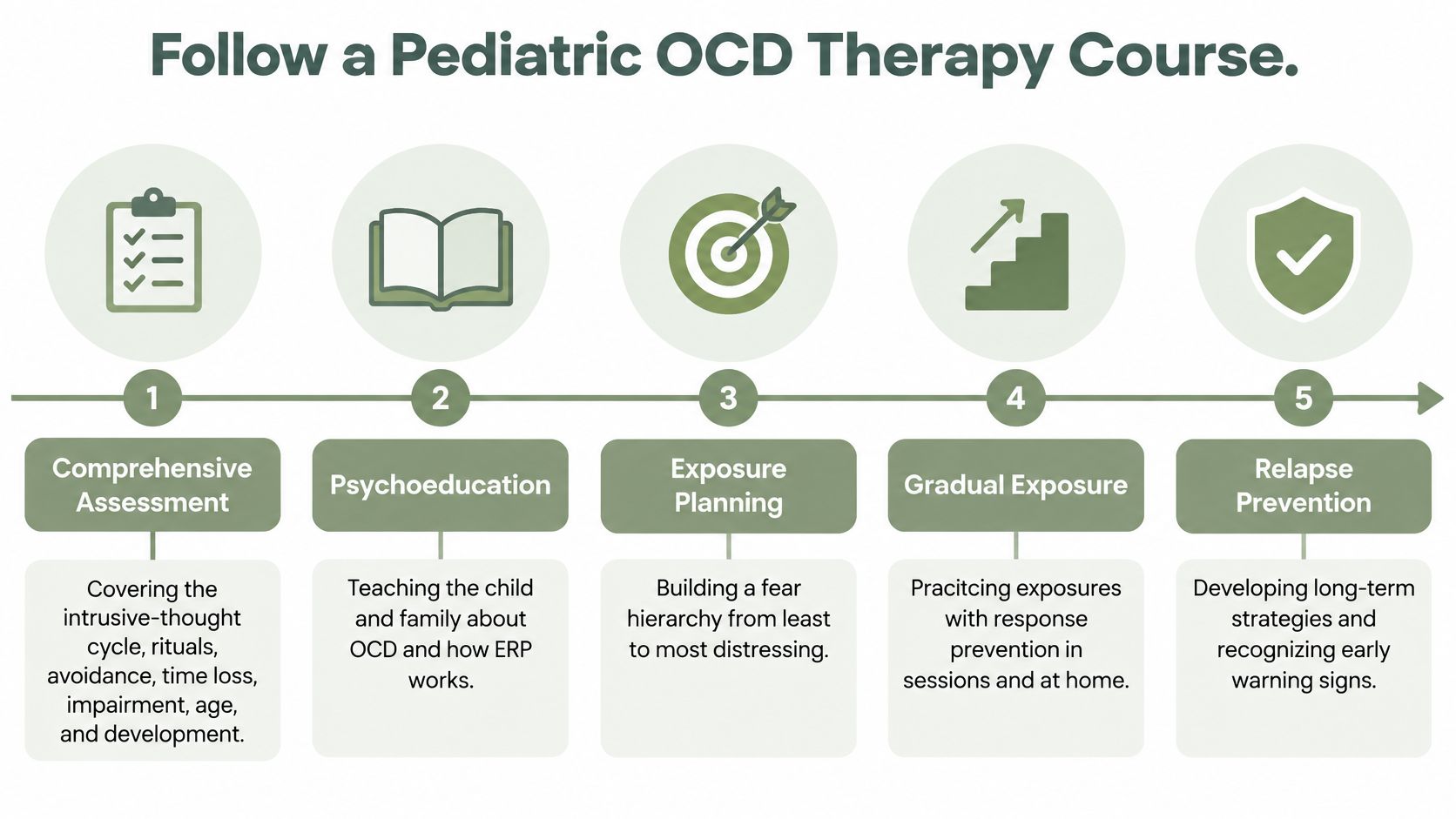
Practice between sessions
Between-session practice is where the learning becomes part of daily life. A child might repeat an agreed exposure at home, record how distress changed, and note any ritual urges that showed up. Parents support the plan by encouraging the practice and staying calm, not by checking on the child's behalf or answering the same fear question in new forms. If distress is higher than expected, the clinician can adjust the step, shorten it, or add support. Adjustment isn't failure. It's how treatment stays effective without becoming a battle of willpower.
- Review the practice: What happened, which rituals were resisted, and where avoidance crept in?
- Check family accommodation: Did reassurance, checking, or ritual participation increase at home?
- Decide the next step: Repeat, adjust, or move up the hierarchy based on progress and readiness.
- Reassess the plan: Discuss barriers, comorbid symptoms, and whether a medication consultation is warranted.
Structured review points matter because families shouldn't change direction before knowing whether ERP was delivered adequately and practiced consistently. There's no single fixed duration that fits every child. Progress is judged by reduced rituals, less avoidance, lower distress, and better functioning at home and school.
Add Family and School Support Without Reassurance
Family support helps most when it strengthens the child's ERP plan instead of becoming part of the ritual. Caregivers can help spot accommodation, keep routines predictable, reduce conflict around symptoms, and notice when avoidance is shrinking a child's life. But repeated reassurance, checking locks for a teen every night, washing items to end an argument, or answering "Am I a bad person?" in detailed debates can function like external compulsions. The child feels better briefly, then needs the same help again.
A steady alternative sounds supportive without feeding OCD. A parent might say, "I can see OCD is asking for certainty again. I love you, and I'm going to follow our plan and not answer that one. You can use your practice steps, and I'll stay nearby while you ride this out." That language separates the child from the symptom and keeps warmth in place. For older children who get overwhelmed during these moments, general ideas about helping teens manage big feelings may support calmer conversations, though emotion skills don't replace ERP itself.
Coordinating with school
School refusal shows why coordination matters. If a child avoids school because intrusive thoughts spike in hallways or bathrooms, excusing every absence can entrench avoidance. A better plan might involve gradual attendance steps, a named school contact, private ways to regroup, and limits on reassurance loops during the day. The core exposure goals still come from the ERP hierarchy, while school staff help the child practice them consistently.
Parents also need support, because watching a child suffer while withholding reassurance can feel unnatural at first. Guidance for caregivers, including resources written for parents supporting a child in therapy, can help families set routines and boundaries without turning every worry into a crisis. Clinicians should tailor caregiver involvement to developmental stage and safety, increasing teen autonomy where appropriate while keeping adults aligned on accommodation.
Compare Telehealth and In-Person ERP Care
Telehealth isn't automatically better or worse than in-person ERP. It's a format, and its value depends on how well it supports the same treatment ingredients, including a trained clinician, caregiver participation, repeated exposure practice, privacy, and a strong therapeutic alliance. For many families, the primary comparison isn't video versus office. It's timely access to a pediatric ERP specialist versus waiting, traveling long distances, or settling for general therapy that doesn't target compulsions.
Access barriers shape that choice in measurable ways. A 2025 study indexed on PubMed of telehealth versus in-person preferences in obsessive-compulsive and related disorders included 216 people, including 168 parents of youth, and found time and distance were the strongest barriers favoring telehealth, while difficulty building rapport and feeling telehealth was impersonal favored in-person care. A separate 2025 real-world observational study of live video ERP for 2,173 children and adolescents reported a median 38.46% symptom reduction at 13 to 17 weeks, with 53.4% meeting full-response criteria.
Factors that matter more than format alone
- Engagement: Can the child focus, speak sincerely, and complete exposure tasks through video, or do they shut down on screen?
- Home practice setting: Is there a private, stable space where exposures can happen without siblings listening or routines being disrupted?
- Caregiver availability: Can a parent join parts of sessions, support homework, and reduce accommodation consistently?
- Technology and privacy: Are connection, audio, and confidentiality reliable enough for sensitive themes?
- Specialist access: Does telehealth connect the family with stronger ERP expertise than what's available locally?
- Therapeutic alliance: Does the child trust the clinician enough to disclose embarrassing thoughts and attempt difficult steps?
Telehealth can also make some exposures more natural. A clinician can guide practice where rituals occur, such as a bedroom door, bathroom sink, backpack, or homework desk. That advantage disappears if the home setting is chaotic, the child can't engage, or caregivers can't be involved as planned. Families considering secure video therapy options for children and teens should ask how exposures, parent check-ins, and privacy will be handled before starting.
Choose the format that protects treatment quality, not just the format that is easiest to schedule.
A different format or closer clinical review may be needed when impairment is severe, safety concerns arise, caregivers can't participate, alliance stays poor, or symptoms don't improve after an appropriately delivered ERP course. In-person assessment can be especially helpful when a clinician needs to observe behavior directly, coordinate closely with caregivers, or rule out concerns that are hard to evaluate remotely. Cost, school schedules, travel across Miami-Dade County, and cross-state rules also belong in the decision, but they shouldn't override safety or fit.
Choose Care and Know When to Escalate
Start by preparing a short summary for an initial consultation. Bring a timeline of when intrusive thoughts, rituals, and avoidance began, plus examples of thought themes without graphic detail. Note how much time symptoms take each day, how school and family life are affected, what caregivers do to help in the moment, prior therapy or medication, relevant medical information, and any privacy or scheduling needs for telehealth. That preparation helps a clinician judge whether the pattern fits OCD, what else should be assessed, and whether ERP should be the first step.
Ask direct questions before committing. Does the clinician have pediatric OCD training? How do they use ERP rather than general talk therapy? How will parents be involved, and how will progress be reviewed? What happens if response is inadequate? Clear answers matter more than a long list of techniques. For families near Coral Gables, Wald Behavioral Health is one local option to consider for developmental assessment, evidence-based child and teen care, family guidance, in-person appointments in Coral Gables, and telehealth across Florida, Maryland, and PSYPACT states, including a free 15-minute consultation.
Urgent warning signs
This article can't diagnose OCD or select a medication for your child. Seek urgent professional or emergency support if thoughts shift toward intent, a plan, access to means, inability to stay safe, dangerous behavior, or severe functional collapse such as not eating, sleeping, attending school, or managing basic care. Escalation is also appropriate when a child becomes highly agitated, expresses wanting to act, or when caregivers no longer feel able to keep the home safe. Intrusive thoughts in OCD are unwanted and distressing, but any concern about real intent should be treated seriously and assessed promptly in person.
The practical path forward is steady rather than dramatic. Get a careful assessment, choose ERP informed care, reduce accommodation at home, review progress, and change format or intensity when the evidence in front of you says the current plan isn't enough.
---
If your child or teen is stuck in a cycle of intrusive thoughts, reassurance seeking, rituals, or avoidance, Wald Behavioral Health offers developmentally informed assessment, ERP based OCD treatment, and parent guidance in Coral Gables and by telehealth where available. Visit Wald Behavioral Health to request a free 15-minute consultation and discuss whether in-person or telehealth care fits your family.
Questions about your child or teen?
Dr. Wald offers a free 15 minute consultation to talk through what you are seeing and whether the practice is a good fit.
Free 15 Minute Consultation