Child Anxiety Therapist Near Me How to Choose the Right Fit
You may be searching for a child anxiety therapist near me after another difficult morning. Your child says their stomach hurts, begs to stay home, needs repeated reassurance about a class or activity, or lies awake worrying about what might happen tomorrow. You search for the closest available name because you want help quickly, but location alone doesn't tell you whether that therapist uses the methods most likely to reduce avoidance and restore daily functioning.
The right decision involves three questions: Does the clinician provide evidence-based anxiety treatment? Will they coach you to support progress at home? Can your family access care consistently, either in person or through properly licensed telehealth? The guidance below will help you answer those questions and avoid spending weeks on a poor fit.
## Table of Contents - When Worry Becomes Something to Get Help For - What Effective Therapy for Child Anxiety Includes - Exposure is the active practice - Look for a structured treatment plan - How Parent Involvement Helps or Hurts Progress - What helpful coaching looks like - Match involvement to age and presentation - Finding a Local or Telehealth Fit Without Wasting Weeks - Verify the real access details - Questions to Ask and Red Flags to Avoid on Your First Call - Questions that deserve specific answers - Red flags that should stop the search - Your Next Steps to Book and Prepare With Confidence
When Worry Becomes Something to Get Help For
A child can feel nervous before a test, a sleepover, a new team, or the first day in a new classroom. Those worries often ease as the child adjusts. Concern rises when fear begins directing the child's routine.
Consider a child who wakes with stomach pain on school mornings, asks the same safety question repeatedly, and gradually stops attending activities they once enjoyed. Their parents may first describe the behavior as shyness, stubbornness, or a phase. The more useful question is whether anxiety is persistent, expanding, and interfering with school, sleep, friendships, family routines, or independence.
Practical rule: Treat avoidance as information, not misbehavior. It tells you what anxiety is controlling.
Look for patterns rather than one isolated episode:
- School disruption: Frequent resistance at drop-off, requests to go home, missed days, difficulty separating, or avoidance of presentations and group work.
- Physical distress: Recurrent headaches, nausea, stomachaches, muscle tension, or difficulty settling before predictable activities.
- Reassurance loops: Repeated questions about safety, illness, mistakes, separation, grades, or what other people might think.
- Sleep problems: Delaying bedtime, needing a caregiver nearby, waking to seek reassurance, or spending a long time worrying.
- Shrinking life: Dropping sports, social events, travel, classroom participation, or ordinary responsibilities because fear feels too strong.
The World Health Organization estimates that 4.1% of children ages 10 to 14 and 5.3% of adolescents ages 15 to 19 experience an anxiety disorder, according to UNICEF's working paper on adolescent mental health. UNICEF also reports that anxiety and depression together account for about 40% of diagnosed mental disorders among adolescents ages 10 to 19, and estimates that more than 13% of adolescents in that age range live with a diagnosed mental disorder, including roughly 86 million ages 15 to 19 and 80 million ages 10 to 14 in its cited estimates.
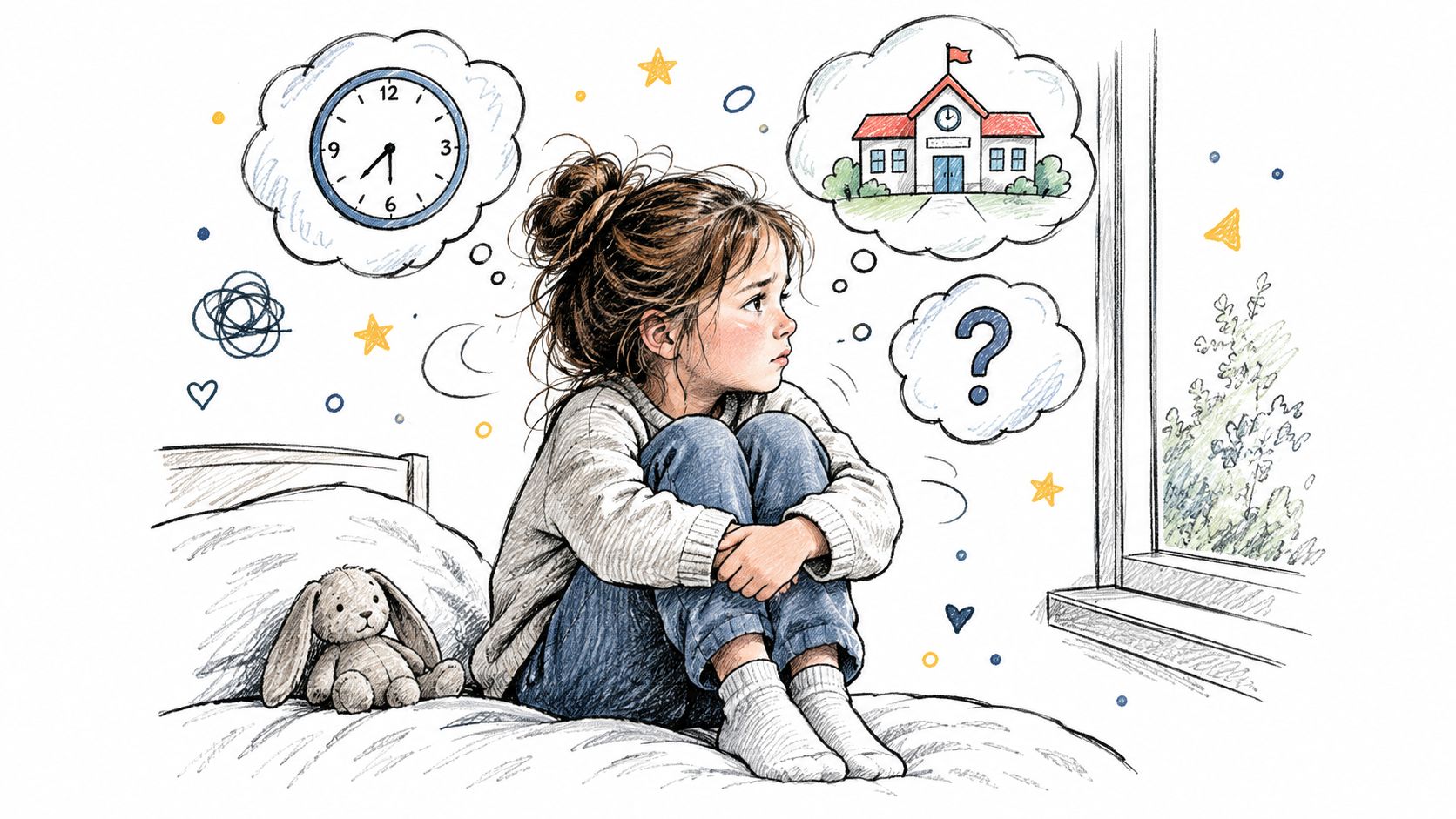
These figures don't diagnose your child, and they shouldn't make you panic. They do show why seeking a child anxiety therapist near me is a reasonable response when worry is impairing everyday life. Anxiety commonly appears during the school-age years, and early support can prevent avoidance from becoming the family's default solution.
Start by writing down what happens, when it happens, what your child avoids, and how the pattern affects school, sleep, activities, and family interactions. A practical overview of child anxiety therapy can help you organize those observations before contacting a clinician.
What Effective Therapy for Child Anxiety Includes
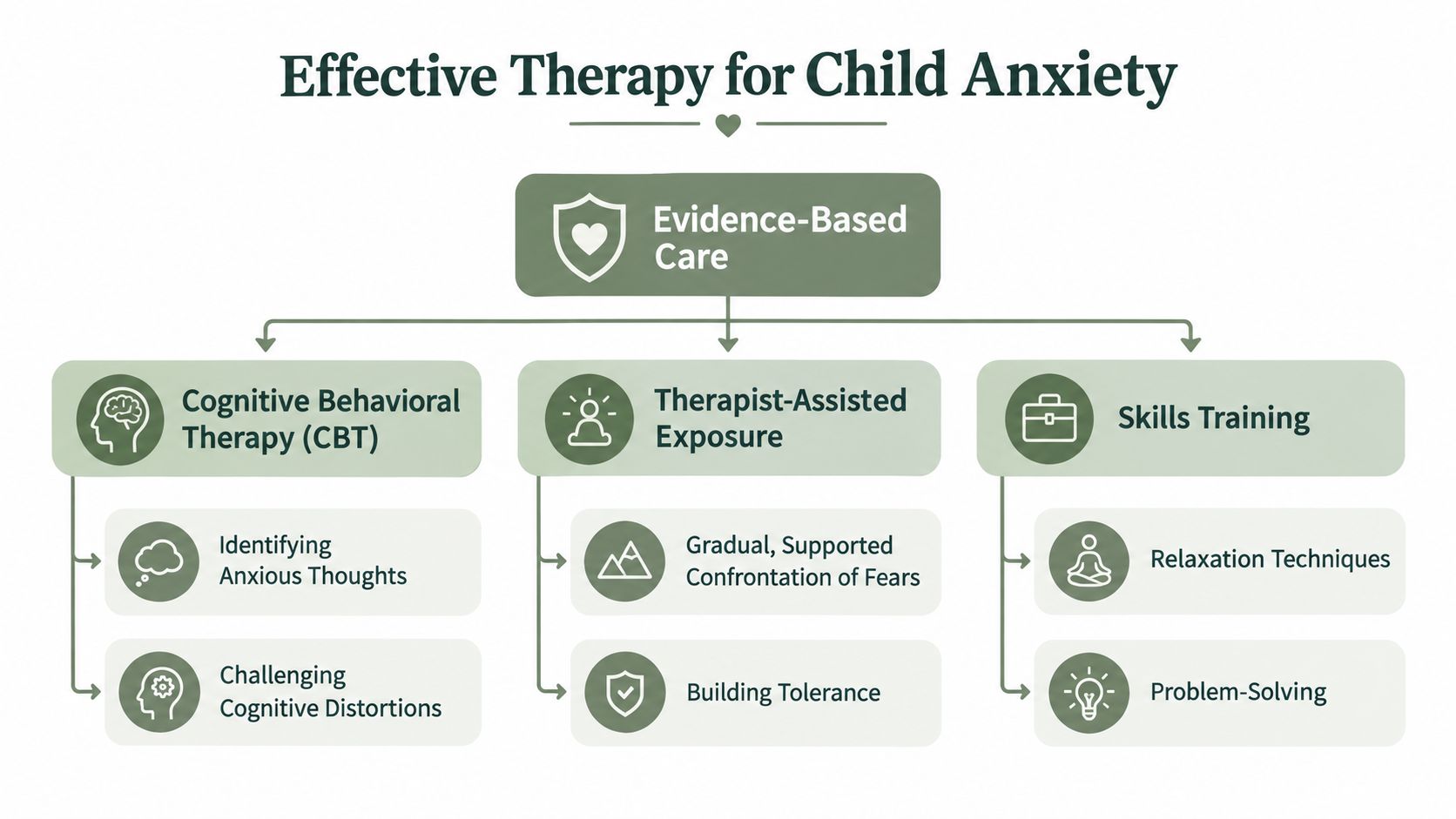
The central question isn't whether a therapist is kind, experienced, or nearby. Those qualities matter, but method matters most. For childhood anxiety, look for cognitive behavioral therapy, or CBT, that includes therapist-assisted exposure.
CBT helps children identify anxious predictions, examine thinking patterns, learn coping skills, and practice new responses. Exposure gives those skills a purpose. The child gradually approaches feared situations instead of escaping, avoiding, or relying on a parent to make the fear disappear. A therapist should design these exercises collaboratively, at a level that challenges the child without overwhelming them.
Exposure is the active practice
Exposure might involve entering school without extended negotiation, speaking briefly in session, sleeping with less parental involvement, touching a feared object, or tolerating an unanswered “what if” question. The therapist and child build a progression, practice it repeatedly, and review what the child learned.
The strongest evidence for child anxiety therapy supports CBT with in-session exposure. A review of exposure-based CBT research reports recovery rates of 47% to 66% and response rates of 57% to 60% across the cited evidence. The same review notes that protocols with more therapist-assisted exposure tend to produce larger treatment effects than protocols without it.
That doesn't promise a particular result for your child. It does give you a practical filter. If sessions focus mainly on talking about worry, relaxation, or reassurance, ask how the therapist will help your child practice approaching feared situations.
Look for a structured treatment plan
Effective care usually includes an assessment, shared goals, planned practice, and a way to measure change. The therapist should ask what anxiety looks like at home and school, identify avoidance and family accommodation, and explain how sessions will connect with between-session work.
Parent-supported formats can be particularly useful for younger children. One modular CBT study cited in the review found that 70.2% of completers were free of the primary anxiety disorder at the 10-week follow-up, while intent-to-treat remission was 58.5%. Those are study benchmarks, not guarantees, but they illustrate why treatment should include more than supportive conversation.
Ask to see a sample home plan. It might include a small exposure, a script for responding to reassurance seeking, or a daily opportunity to practice tolerating uncertainty. If the clinician can't describe what practice looks like between appointments, keep interviewing.
This short video provides a visual introduction to CBT concepts for young people and families:
How Parent Involvement Helps or Hurts Progress
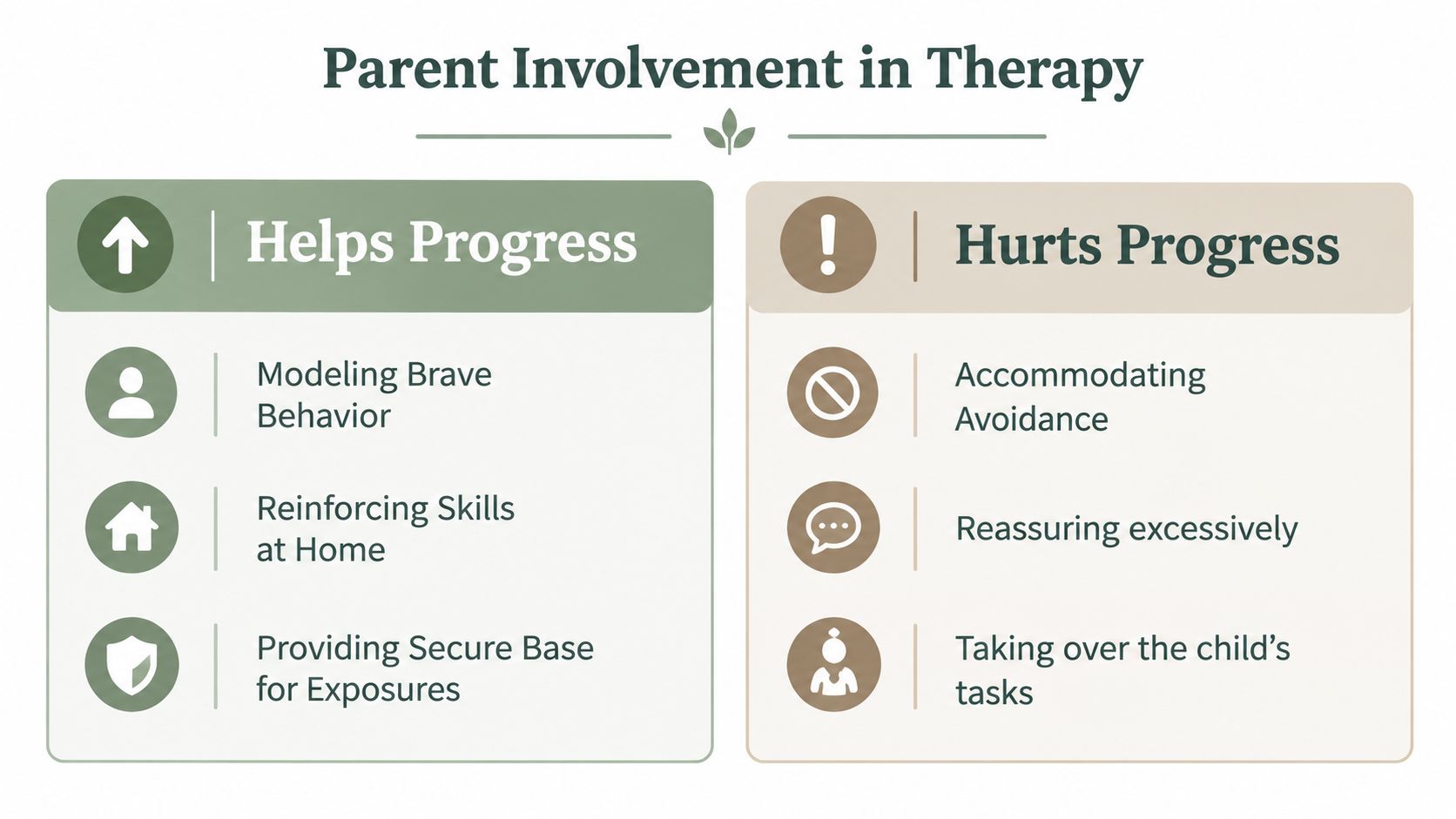
Parent participation isn't automatically helpful. The parent's role should be active, structured, and aligned with exposure, not just sitting in every session or offering comfort whenever anxiety rises.
A systematic review found that parent presence during CBT was associated with greater anxiety reduction after treatment and at follow-up, while broader reviews found that involvement isn't uniformly superior for every adolescent. Parent participation can reduce efficacy when it replaces child-led exposure practice or allows the child to depend on the parent to complete difficult tasks. The review of parent involvement in youth anxiety treatment describes this distinction clearly.
What helpful coaching looks like
A parent coach doesn't force a child into a feared situation. They help the child follow the agreed plan while allowing anxiety to rise and fall without immediate escape.
Helpful responses include:
- Reinforcing approach: “You went into class even though you felt worried. That was brave practice.”
- Reducing accommodation: Letting the child answer an age-appropriate question, sleep in their own room, or complete a routine without repeated parental intervention.
- Supporting repetition: Scheduling home practice and following the therapist's instructions consistently.
- Modeling tolerance: Showing that adults can handle uncertainty without repeatedly checking, avoiding, or seeking reassurance.
- Celebrating effort: Praising willingness and follow-through rather than promising that the child won't feel anxious.
A parent who answers every “Are you sure?” may provide immediate relief while strengthening the reassurance cycle. A parent who speaks for a child at every counter, emails the teacher to remove every challenge, or completes avoided tasks may unintentionally teach the child that anxiety signals incapacity.
Match involvement to age and presentation
Younger children often need substantial caregiver participation because parents control routines, transportation, accommodations, and practice opportunities. Adolescents usually need privacy, ownership, and a clear agreement about what information parents receive. The clinician should explain how involvement will change as the child gains skills.
Benchmark findings show why this question deserves attention. One review reported 84% treatment success when parenting was included versus 57.1% without it, while another source reported 82% of children free of an anxiety diagnosis one year after treatment when parental involvement was strong, compared with 53% to 63% with limited involvement. These figures come from specific studies and don't establish a universal outcome.
Ask, “How will you train me to respond when my child avoids, asks for reassurance, or refuses an exposure?” You want a therapist who offers concrete coaching, not a vague instruction to be supportive. Parent training and information for caregivers can also help families understand how daily responses influence anxiety patterns.
Finding a Local or Telehealth Fit Without Wasting Weeks
A search for a child anxiety therapist near me often assumes that the closest office is the most accessible option. In practice, access depends on the therapist's approach, appointment availability, state licensure, and whether the format works with school and family schedules.
You generally have three paths:
- In-person local care: Useful when your child engages better face to face, the office is manageable, and the clinician has relevant anxiety expertise.
- Telehealth within your state: Helpful when travel disrupts school, work, or routines, or when nearby offices have long waits.
- Interstate telehealth: Possible when the clinician is licensed or authorized to practice where the child is physically located during the session.
Telehealth isn't automatically a lesser option. A comparison study cited in recent research on telehealth access for youth mental health care reported response rates of 71.7% for telehealth and 69.6% for in-person therapy. The same source reported that only 77.5% of U.S. child-treating mental health facilities offered any telehealth, with availability varying by state from 35.5% to 100.0% of reporting facilities. Ask directly rather than assuming a nearby practice offers secure video care.
Verify the real access details
Before booking, confirm the clinician's license and telehealth authority. If your family moves between states, tell the practice where the child will physically be during appointments. PSYPACT authorization may expand options for eligible clinicians and clients, but you still need the practice to confirm that your situation is covered.
For families in Coral Gables and Miami-Dade, compare commute time, school schedules, parking, and the therapist's experience with school refusal or separation anxiety. For families elsewhere in Florida, Maryland, or a PSYPACT-participating state, telehealth may offer continuity with a clinician who fits the child's needs rather than the nearest available address.
| Option | Best when | What to verify | |---|---|---| | Local in-person care | Your child benefits from an office setting and travel is practical | Anxiety specialization, exposure-based CBT, office address, appointment times, parent participation | | Licensed telehealth in your state | Travel or school disruption makes regular office visits difficult | State license, secure platform, privacy at home, emergency procedures, caregiver availability | | Authorized interstate telehealth | A strong clinical fit is outside your state | Clinician authorization, child's physical location, state rules, continuity if you travel |
Don't choose telehealth solely because it offers an earlier appointment. Ask how the therapist conducts exposure practice through video, involves caregivers, protects privacy, and responds if symptoms intensify. The telehealth service information should be paired with a direct licensure and clinical-fit conversation.
Wald Behavioral Health is one example of a practice offering in-person pediatric psychology appointments in Coral Gables and telehealth for eligible clients in Florida, Maryland, and PSYPACT-participating states. Treat that as a starting point for comparison, not a substitute for asking the same method and logistics questions you would ask any provider.
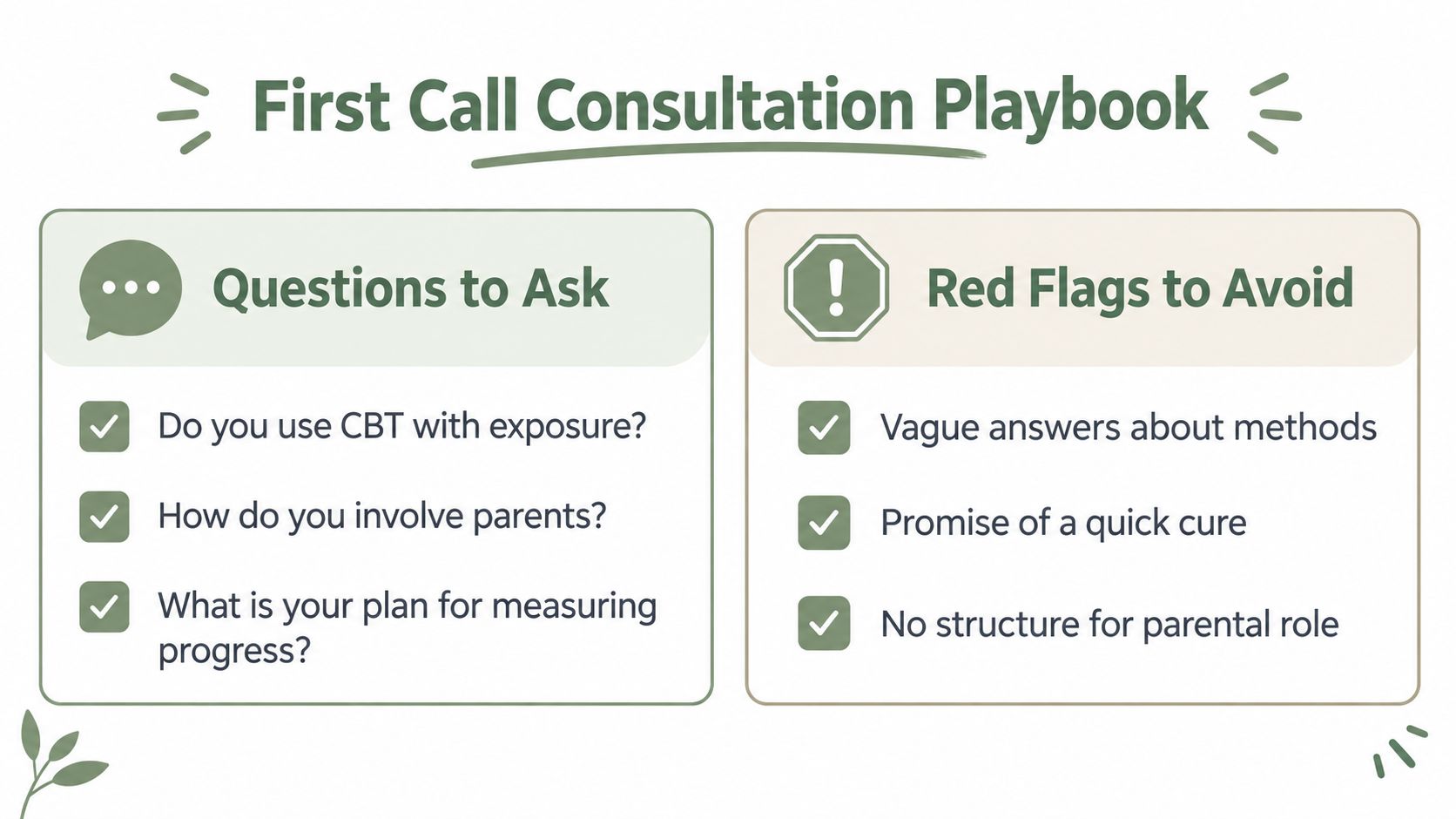
Questions to Ask and Red Flags to Avoid on Your First Call
A short consultation should produce a clear next step. Prepare a concise description of the problem before calling: what your child avoids, how often it happens, what school and sleep look like, and what your family has tried.
Then ask questions that reveal the treatment plan.
Questions that deserve specific answers
- “Do you use CBT with therapist-assisted exposure?” A strong answer explains how the therapist creates a gradual fear hierarchy and practices approach behaviors in session.
- “How do you involve parents?” Look for structured coaching, home assignments, reduced accommodation, and age-appropriate privacy for adolescents.
- “How will you measure progress?” The therapist should discuss changes in avoidance, school attendance, sleep, reassurance seeking, participation, or other agreed targets.
- “What happens between sessions?” Expect manageable practice, not unlimited worksheets or a vague request to use coping skills.
- “How do you handle school refusal, panic, separation anxiety, or OCD-like rituals?” The answer should identify exposure-based planning and explain when additional evaluation or coordination is needed.
- “What would make you change the treatment plan?” A thoughtful clinician can describe how they respond when progress stalls, symptoms broaden, or impairment remains high.
- “What are your practical openings?” Confirm the address, video platform, appointment frequency, evening or weekend availability, fees, cancellation policy, and next available appointment.
A therapist doesn't need to promise quick improvement. They should be able to explain the rationale for treatment in plain language and describe what your family will practice.
Red flags that should stop the search
Be cautious if the clinician can't name a method, treats exposure as optional for an avoidance problem, or focuses only on helping the child feel calm. Relaxation and emotion regulation can support treatment, but coping skills without approach practice may leave the fear cycle intact.
Other warning signs include:
- Vague treatment language: “We use a holistic approach” without explaining what happens in sessions.
- No home plan: The therapist expects weekly conversation to carry all the work.
- Reassurance as the main intervention: The clinician encourages parents to repeatedly prove that nothing bad will happen.
- Parent takeover: The plan relies on caregivers speaking, deciding, or completing tasks for the child.
- Guaranteed outcomes: No ethical clinician can promise a quick cure or a fixed result.
- Unclear escalation: The provider has no process for severe impairment, safety concerns, school coordination, or referral for additional care.
Research supports a nuanced choice between lighter and more intensive options. A school-based screening-to-intervention pathway reduced parent-reported anxiety problems compared with assessment and usual provision alone, suggesting that early, low-friction support can help some families. However, a 2025 randomized trial did not prove a stepped-care internet CBT model noninferior to fully therapist-guided treatment, as reported in the trial record. Ask how the provider will increase support if a lower-intensity approach isn't enough.
Your Next Steps to Book and Prepare With Confidence
Don't keep searching indefinitely. Shortlist two or three clinicians whose methods, parent role, location, and licensure appear to fit. Use the first call to decide whether each provider can explain exposure-based CBT, home practice, progress measurement, and escalation in concrete terms.
Before the first appointment, keep a brief log for several days. Note:
- Triggers: School arrival, bedtime, social situations, health worries, separation, mistakes, or uncertainty.
- Avoidance: What your child refuses, delays, asks you to do, or needs you to change.
- Impact: Missed school, disrupted sleep, reduced activities, family conflict, or lost independence.
- Goals: A specific change your child wants, such as entering school, sleeping independently, joining an activity, or answering for themselves.
Early sessions may include parent interviews, child assessment, goal setting, education about the anxiety cycle, and the first practice plan. Progress often depends on what happens between appointments, so ask the therapist how caregivers and, when appropriate, schools will reinforce the same approach.
If improvement stalls, don't continue an ineffective plan. Tell the clinician what remains difficult, whether exposures are happening, and whether the family is accommodating avoidance. The therapist should adjust the plan, address barriers, or recommend additional evaluation when the presentation requires it.
Wald Behavioral Health offers child and adolescent psychology services at 1390 S Dixie Hwy, Suite 1305, Coral Gables, Florida 33146, along with telehealth for eligible clients in Florida, Maryland, and PSYPACT-participating states. The practice also offers a free 15-minute consultation to discuss fit and scheduling.
---
If you're looking for a child anxiety therapist near me, visit Wald Behavioral Health to review in-person and telehealth options and request a free 15-minute consultation. Bring your child's main triggers, avoidance patterns, and scheduling needs so the practice can help you determine whether its evidence-based, parent-guided care is an appropriate fit.
Questions about your child or teen?
Dr. Wald offers a free 15 minute consultation to talk through what you are seeing and whether the practice is a good fit.
Free 15 Minute Consultation