Applied Psychology Services: A Guide for Your Family

Your child may be waking every night, refusing school, avoiding friends, or becoming so overwhelmed that ordinary advice no longer helps. You've tried reminders, rewards, reassurance, and firmer boundaries, yet the same struggles keep returning. That doesn't mean you're failing as a parent. It may mean your family needs a more structured kind of support.
Applied psychology services turn psychological knowledge into practical tools for daily life. A child might learn how to respond to anxious thoughts, a parent might practice a clearer bedtime plan, or a school might receive guidance for supporting attention and behavior. The work is collaborative, specific, and adapted to the child's age, needs, relationships, and environment.
## Table of Contents - When Your Family Needs More Than Advice - Decoding Applied Psychology Services - What the toolkit may contain - Exploring the Four Main Types for Families - Child psychology - Family psychology - Educational psychology - Neuropsychology - What Applied Psychology Looks Like in Action - An anxious teenager learning through practice - A parent coaching session for bedtime resistance - Where sessions happen - A Practical Guide to Finding and Starting Care - Begin with the problem you can describe - Ask questions before committing - Consider telehealth carefully - How Your Family Can Measure Progress and Success - Look for small changes with real meaning - Treat participation as part of treatment
When Your Family Needs More Than Advice
Many parents seek help after a gradual pattern becomes impossible to ignore. Their child may complain of stomachaches before school, spend hours completing rituals, explode over small changes, or lie awake despite a predictable bedtime. The family has often read parenting books and tried suggestions from friends. What's missing isn't effort. It's a plan that explains what maintains the problem and what each person can do differently.
Applied psychology services provide that plan. A psychologist first works to understand the child's behavior in context. Anxiety, sleep difficulty, refusal, and defiance can look similar from the outside, but they may require very different responses. Assessment and conversation help identify triggers, skills, family patterns, school demands, and strengths.
A useful starting point: The question isn't “How do we make our child stop?” It's “What is this behavior communicating, and what skill or support is missing?”
Access can be difficult even when parents know what kind of help they want. In England, the psychological professions workforce reached 25,406 whole-time equivalent roles in April 2023, including 5,855 clinical psychologist roles, while the vacancy rate for clinical psychologists in child and youth inpatient mental health settings reached 34% (NHS psychological professions workforce census). These shortages can affect how quickly families find care and whether treatment remains consistent.
Parents can begin by reviewing clear information about support for parents and families, then asking prospective providers how they involve caregivers, measure progress, and respond when a treatment plan isn't fitting. The right service should leave you with greater understanding and practical next steps, not more confusion.
Decoding Applied Psychology Services
Think of applied psychology as a practical toolkit for the mind and relationships. The psychologist doesn't hand every family the same tool. They select strategies that match the problem, test whether those strategies help, and adjust them as the child develops.
A research psychologist may study how people learn, regulate emotion, or respond to stress. An applied psychologist uses that knowledge in a real setting. The work might involve observing a child's behavior, teaching coping skills, coaching caregivers, consulting with teachers, or helping a young person practice new responses to feared situations.
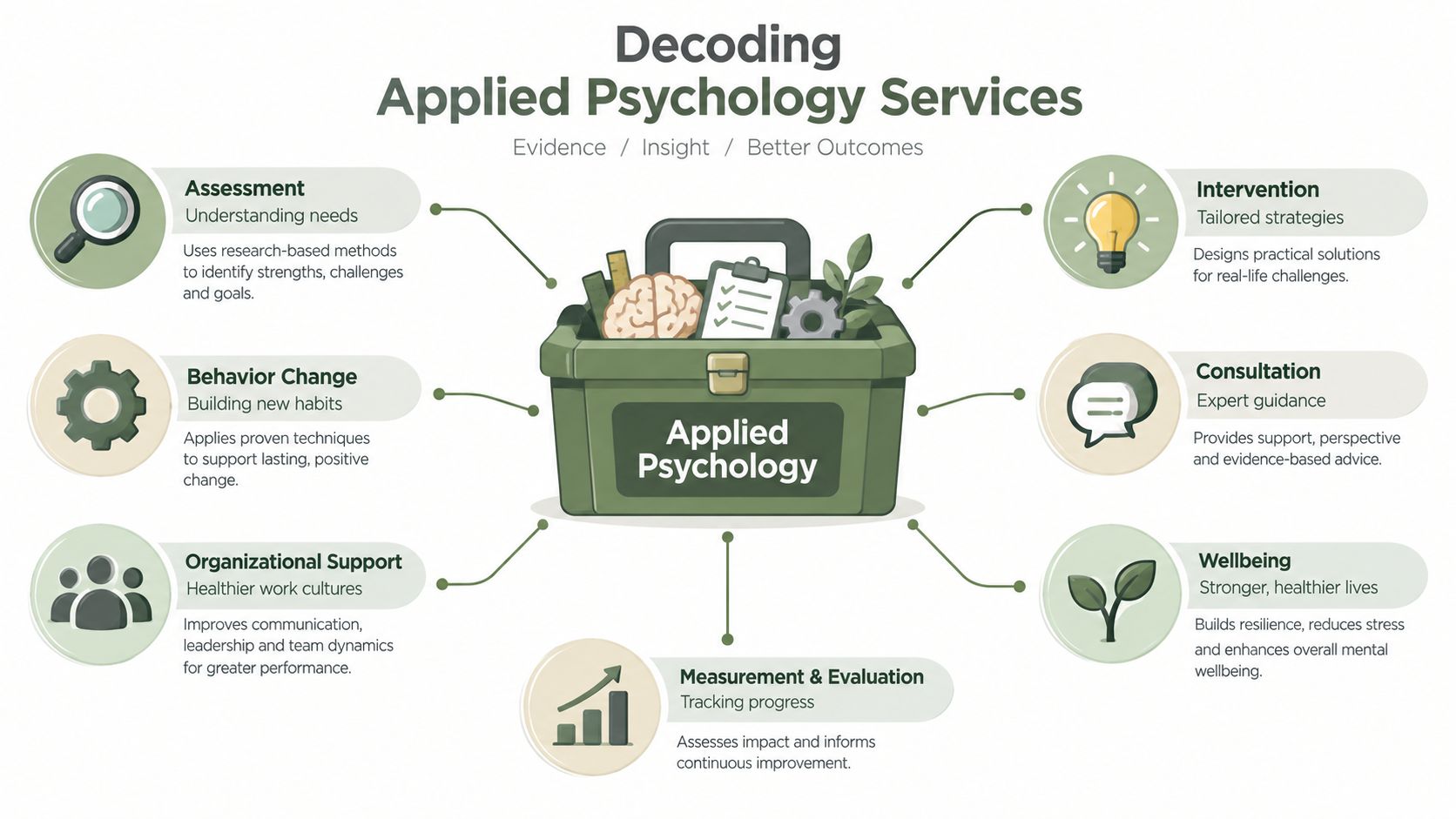
What the toolkit may contain
- Assessment: The psychologist gathers information through interviews, questionnaires, observation, and discussion of developmental history. The purpose isn't to label a child quickly. It's to understand needs well enough to choose appropriate care.
- Skills-based treatment: Cognitive-behavioral therapy may help a child notice anxious predictions, test them, and practice a more flexible response. Behavioral strategies may make routines more predictable and reinforce useful behavior.
- Parent coaching: Caregivers learn how to respond consistently to tantrums, bedtime resistance, noncompliance, or avoidance. The psychologist helps translate treatment ideas into words and actions that work at home.
- Consultation: A provider may coordinate, with appropriate consent, with schools, medical teams, or other professionals. This can reduce the chance that a child receives conflicting expectations in different settings.
- Wellbeing support: Therapy can strengthen emotional regulation, problem-solving, communication, confidence, and coping during medical, academic, or family stress.
The word applied doesn't mean simplistic. It means the work stays connected to the child's actual life. A strategy matters only if a family can understand it, use it, and maintain it between sessions.
Exploring the Four Main Types for Families
Families may hear several psychology terms and assume each one describes a separate service. The boundaries are more practical than absolute. A provider may work across specialties, while each specialty keeps a different question in focus.
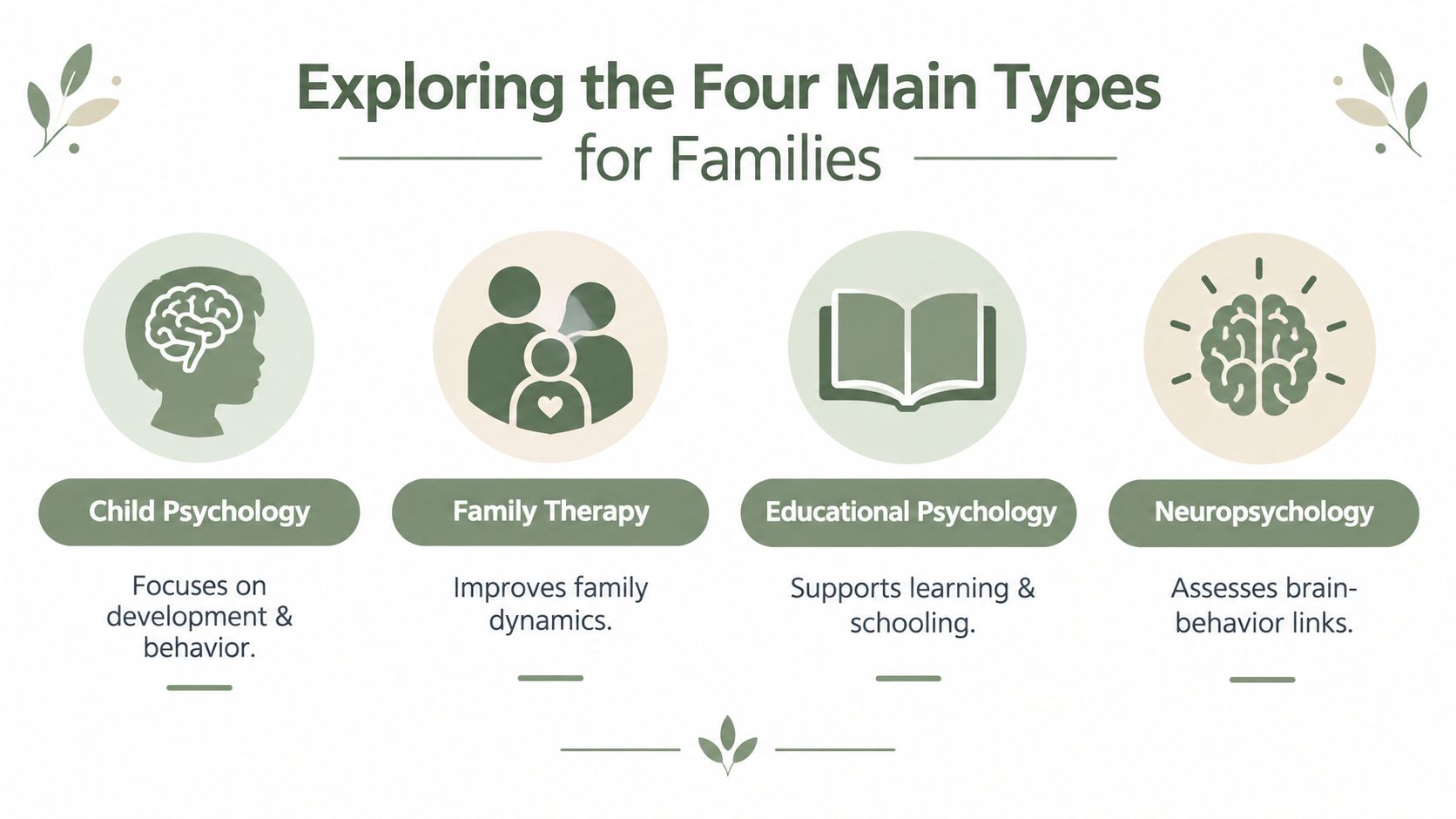
Child psychology
Child psychology addresses emotional, behavioral, and developmental concerns in children and adolescents. A psychologist may help with anxiety, low mood, obsessive-compulsive symptoms, avoidance, emotional outbursts, or persistent distress. For a teenager with social anxiety, care might examine fearful predictions, practice manageable social steps, and support a return to activities that anxiety has restricted.
The aim is not to remove every uncomfortable feeling. It is to help a young person respond to discomfort without letting it direct school, friendships, sleep, or family routines. Progress often depends on what the family can continue between appointments.
Family psychology
Family psychology examines how relationships, communication, expectations, and daily patterns affect a child's wellbeing. The psychologist may meet with a child and caregivers together, separately, or in changing combinations as needs develop.
Parents may practice giving clear directions, responding consistently, repairing conflict, or supporting age-appropriate independence. The service is not about assigning blame. It is about changing interaction patterns so the child receives steady support across ordinary, difficult moments.
Educational psychology
Educational psychology connects learning with attention, motivation, behavior, and emotional development. A psychologist may help clarify why a student avoids work, struggles to organize tasks, becomes overwhelmed in class, or has difficulty participating with peers.
Recommendations might include classroom supports, study routines, communication between home and school, or ways to practice skills in more than one setting. Parents should ask which information will be shared with educators, who will receive it, and what consent arrangements apply.
Neuropsychology
Neuropsychology examines how thinking and brain-based skills relate to everyday functioning. An evaluation may consider attention, memory, language, processing, planning, or emotional regulation when these affect learning, behavior, or independence.
The findings can help a family and school choose supports that match how the child learns. They may also clarify whether a difficulty reflects a skill gap, stress, a developmental difference, or several factors working together. The report becomes useful when its recommendations are realistic enough to apply at home and school.
These four types can overlap. The best fit depends on the child's main needs, the settings involved, and the kind of follow-through a family can sustain. Ask how the provider will involve caregivers and turn recommendations into routines.
What Applied Psychology Looks Like in Action
A child may enter therapy after a difficult morning, a conflict at school, or another night of bedtime resistance. The session then becomes a practice room, more than a conversation while an adult takes notes. Depending on the child's age and goals, the psychologist may teach a skill, observe behavior, rehearse a response, and plan how the family will use it between visits.

An anxious teenager learning through practice
A teenager with social anxiety might describe avoiding presentations, lunchrooms, or group conversations. The psychologist can help identify the thought beneath that avoidance, such as, “Everyone will notice my mistake.” Together, they examine the prediction, choose a manageable practice task, and rehearse a conversation in the session.
The teen may then ask a classmate a question, stay longer in a social setting, or speak briefly during a group activity. At the next visit, the psychologist reviews what occurred, separates predictions from observations, and uses those details to plan the next practice. A parent can support this process by asking what the teen learned rather than demanding immediate confidence.
The task should be challenging enough to build a skill and manageable enough to repeat. Coping strategies, pacing, and encouragement make practice more useful than pressure alone.
A parent coaching session for bedtime resistance
For a younger child who refuses sleep, the psychologist may map the bedtime sequence with the caregiver. Does the child delay through repeated requests? Does crying bring extra attention? Does the routine change from night to night? These details can show how a pattern continues without blaming either the child or the parent.
The provider might help the parent create a short, predictable routine, choose a response to protests, and prepare for testing of the new boundary. The parent practices the wording during the session, tries it at home, and reports what happened. The plan is then adjusted to the family's schedule, space, and capacity to follow it consistently.
Parent-involved interventions can improve parenting skills and caregivers' sense of effectiveness, according to this parent training review. Consistency matters, but families do not need perfect nights for therapy to be useful. They need a plan they can repeat, observe, and revise.
Where sessions happen
Care may take place in a private office, a medical setting, a school-connected context, or through secure telehealth. A provider's approach to evidence-based, developmentally informed care helps explain how treatment is adapted to the child instead of delivered from a fixed script.
Telehealth may let a child practice skills in the setting where difficulties occur. In-person care may fit better when direct observation is needed, privacy at home is limited, or technology distracts the child. The clinician and family should choose the format together, then review whether it remains workable as needs change.
A Practical Guide to Finding and Starting Care
Starting care feels easier when you treat it as a series of decisions rather than one enormous task.

Begin with the problem you can describe
Write down what you're seeing, when it happens, and where it happens. Include strengths, recent changes, school concerns, sleep patterns, medical factors, and strategies you've already tried. A short timeline can help the provider distinguish a long-standing difficulty from a response to a recent transition.
Then identify the kind of help you're seeking. You might need diagnostic clarification, treatment for anxiety or OCD, parent coaching for sleep, support around ADHD-related routines, or guidance for a child coping with a medical condition.
Ask questions before committing
A consultation should give you enough information to judge fit. Consider asking:
- Relevant experience: Does the psychologist regularly work with children of your child's age and presenting concern?
- Family role: How much caregiver participation is expected, and what happens if caregivers have different schedules or approaches?
- Treatment plan: How will goals be chosen, and how will the provider decide whether a strategy is helping?
- Practical details: Are sessions offered in person, by telehealth, or in both formats? How are cancellations, communication, and school coordination handled?
- Safety and privacy: How can your child request private time, and what are the limits of confidentiality?
A provider should explain the intake process in plain language. Intake may include caregiver interviews, child sessions, questionnaires, review of records, and a discussion of goals. You don't need to arrive with a perfect diagnosis. Your observations are useful clinical information.
Consider telehealth carefully
PSYPACT created a structured pathway for psychologists authorized to provide interjurisdictional telepsychology. The compact became operational on April 23, 2019, and PSYPACT materials reported 15,552 APIT authorizations as of February 7, 2025 (PSYPACT background and authorization information). State rules, provider authorization, privacy, emergency procedures, and reimbursement still need to be confirmed before treatment begins.
Evidence also supports thoughtful use of remote care for some child and family concerns. A non-inferiority study found telehealth CBT for youth anxiety similarly efficacious to in-person care across anxiety, caregiver reports, functional impairment, and treatment response, while an early-childhood telehealth parenting trial reported roughly 50% responders after treatment, compared with 6% in a waitlist, increasing to about 60% at follow-up (telehealth family intervention research).
Families can review available therapy and parent-training services while comparing providers, formats, and clinical fit.
This short video can offer another perspective on the process:
Telehealth isn't automatically better or worse. It works best when the child has a private space, reliable access, and a family willing to practice between sessions. In-person care may be the better choice when the child needs direct environmental observation or cannot participate privately.
How Your Family Can Measure Progress and Success
Progress should be defined before treatment becomes a collection of conversations. Ask the psychologist to translate broad hopes, such as “less anxiety” or “better behavior,” into observable goals. A useful goal might involve returning to a school activity, completing a bedtime routine with fewer delays, using a coping skill before avoidance, or reducing the impact of rituals on family life.
The provider may track change through rating scales, behavior records, sleep logs, attendance, caregiver observations, or the child's own account. These tools don't replace clinical judgment. They give the family and psychologist a shared way to notice patterns that are easy to miss from week to week.
Look for small changes with real meaning
A child may not suddenly become comfortable in every feared situation. Progress might first appear as asking for help instead of melting down, recovering more quickly, entering school after a difficult morning, or tolerating a parent's consistent response. Those changes matter because they show the child is using a new skill under pressure.
Caregivers also need a realistic plan for busy weeks. If the home practice is too complicated, say so. The psychologist can shorten it, connect it to an existing routine, or choose a smaller target that the family can repeat consistently.
Treat participation as part of treatment
A review of family and systemic interventions reported that 25% of families considered appropriate for parent training never engaged, while 26% of families who started dropped out (review of family therapy and systemic interventions). These figures highlight why treatment fit, trust, scheduling, and caregiver involvement deserve attention from the beginning.
Progress is a team process: Your child brings effort and courage. You bring observation, practice, and feedback. The psychologist brings structure, expertise, and adjustment when the plan needs changing.
If the relationship doesn't feel collaborative, raise the concern rather than disappearing. A strong provider should welcome questions about pace, goals, family roles, and whether the current approach matches your child.
---
Wald Behavioral Health provides evidence-based therapy and parent training for children, adolescents, young adults, and families, with in-person care in Coral Gables and telehealth options for eligible clients. Visit Wald Behavioral Health to review services and request a free 15-minute consultation about your family's needs, treatment fit, and scheduling.
Questions about your child or teen?
Dr. Wald offers a free 15 minute consultation to talk through what you are seeing and whether the practice is a good fit.
Free 15 Minute Consultation